Fuzzy Logic in Geology 1st Edition Robert V. Demicco
Fuzzy Logic in Geology 1st Edition Robert V. Demicco
Fuzzy Logic in Geology 1st Edition Robert V. Demicco
Fuzzy Logic in Geology 1st Edition Robert V. Demicco
Fuzzy Logic in Geology 1st Edition Robert V. Demicco
1.
Visit https://ebookultra.com todownload the full version and
explore more ebooks
Fuzzy Logic in Geology 1st Edition Robert V.
Demicco
_____ Click the link below to download _____
https://ebookultra.com/download/fuzzy-logic-in-
geology-1st-edition-robert-v-demicco/
Explore and download more ebooks at ebookultra.com
2.
Here are somesuggested products you might be interested in.
Click the link to download
Introduction to Fuzzy Logic 1st Edition James K. Peckol
https://ebookultra.com/download/introduction-to-fuzzy-logic-1st-
edition-james-k-peckol/
Fuzzy Logic with Engineering Applications Third Edition
Ross
https://ebookultra.com/download/fuzzy-logic-with-engineering-
applications-third-edition-ross/
Fuzzy Logic and the Semantic Web 1st Edition Elie Sanchez
(Eds.)
https://ebookultra.com/download/fuzzy-logic-and-the-semantic-web-1st-
edition-elie-sanchez-eds/
Foundations of Fuzzy Logic and Semantic Web Languages 1st
Edition Umberto Straccia
https://ebookultra.com/download/foundations-of-fuzzy-logic-and-
semantic-web-languages-1st-edition-umberto-straccia/
3.
Fuzzy Logic forEmbedded Systems Applications First
Edition Embedded Technology Ahmad Ibrahim
https://ebookultra.com/download/fuzzy-logic-for-embedded-systems-
applications-first-edition-embedded-technology-ahmad-ibrahim/
Fuzzy Logic A Framework for the New Millennium 1st Edition
Lotfi A. Zadeh (Auth.)
https://ebookultra.com/download/fuzzy-logic-a-framework-for-the-new-
millennium-1st-edition-lotfi-a-zadeh-auth/
Introduction To Type 2 Fuzzy Logic Control Theory and
Applications 1st Edition Jerry Mendel
https://ebookultra.com/download/introduction-to-type-2-fuzzy-logic-
control-theory-and-applications-1st-edition-jerry-mendel/
Fuzzy logic a framework for the new millennium in Mackay
Australia in September 2000 23 tables 2002nd Edition
Vladimir Dimitrov
https://ebookultra.com/download/fuzzy-logic-a-framework-for-the-new-
millennium-in-mackay-australia-in-september-2000-23-tables-2002nd-
edition-vladimir-dimitrov/
Second Sight Robert V. Hine
https://ebookultra.com/download/second-sight-robert-v-hine/
5.
Fuzzy Logic inGeology 1st Edition Robert V. Demicco
Digital Instant Download
Author(s): Robert V. Demicco, George J. Klir
ISBN(s): 9780124151468, 0124151469
Edition: 1
File Details: PDF, 7.64 MB
Year: 2003
Language: english
Fuzzy Logic inGeology
Edited by
Robert V. Demicco
and
George J. Klir
CENTER FOR INTELLIGENT SYSTEMS
BINGHAMTON UNIVERSITY (SUNY)
BINGHAMTON, NEW YORK, USA
Amsterdam Boston Heidelberg London New York Oxford
Paris San Diego San Francisco Singapore Sydney Tokyo
Contents
Contributors vii
Foreword byLotfi A. Zadeh ix
Preface xiii
Glossary of Symbols xv
Chapter 1 Introduction 1
Chapter 2 Fuzzy Logic: A Specialized Tutorial 11
Chapter 3 Fuzzy Logic and Earth Science: An Overview 63
Chapter 4 Fuzzy Logic in Geological Sciences: A Literature Review 103
Chapter 5 Applications of Fuzzy Logic to Stratigraphic Modeling 121
Chapter 6 Fuzzy Logic in Hydrology and Water Resources 153
Chapter 7 Formal Concept Analysis in Geology 191
Chapter 8 Fuzzy Logic and Earthquake Research 239
Chapter 9 Fuzzy Transform: Application to the Reef Growth Problem 275
Chapter 10 Ancient Sea Level Estimation 301
Acknowledgments 337
Index 339
v
Contributors
● Andras Bardossy(Chapter 6): Institute of Hydraulic Engineering, Uni-
versity of Stuttgart, Pfaffenwaldring 61, D-70550 Stuttgart, Germany
[bardossy@europe.com].
● Radim Bělohlávek (Chapter 7): Department of Computer Science, Palacký
University of Olomouc, Tomkova 40, CZ-77900 Olomouc, Czech Republic
[belohlavek@inf.upol.cz].
● Istvan Bogardi (Chapter 6): Department of Civil Engineering, University of
Nebraska at Lincoln, Lincoln, Nebraska 68588, USA [ibogardi@unl.edu].
● Robert V. Demicco (Chapters 1, 3, 4, and 5): Department of Geological & Envi-
ronmental Studies and Center for Intelligent Systems, Binghamton University
(SUNY), Binghamton, New York 13902, USA [demicco@binghamton.edu].
● Lucien Duckstein (Chapter 6): Ecole Nationale du Génie Rural des Eaux et des
Forêts, 19 avenue du Maine, 75732 CEDEX 15, France [duckstein@engref.fr].
● Chongfu Huang (Chapter 8): Institute of Resources Science, Beijing Normal Uni-
versity, 19 Xinjiekouwai Street, Beijing 100875, China [hchongfu@bnu.edu.cn].
● George J. Klir (Chapters 1 and 2): Department of Systems Science & Industrial
Engineering and Center for Intelligent Systems, Binghamton University (SUNY),
Binghamton, New York 13902, USA [gklir@binghamton.edu].
● Vilem Novák (Chapter 10): Institute for Research and Applications of Fuzzy
Modeling, University of Ostrava, 30. dubna 22, 70103 Ostrava, Czech Republic
[Vilem.Novak@osu.cz].
● Irina Perfilieva (Chapter 9): Institute for Research and Applications of Fuzzy
Modeling, University of Ostrava, 30. dubna 22, 70103 Ostrava, Czech Republic
[Perfili@dynami.osu.cz].
● Rita Pongracz (Chapter 6): Department of Meteorology, Eotvos Lorand Univer-
sity, Pazmany P. setany1/A, H-1117 Budapest, Hungary [prita@caesar.elte.hu].
vii
Foreword
In October 1999,at the invitation of my eminent friend, Professor George Klir, I
visited the Binghamton campus of the State University of New York. In the course
of my visit, I became aware of the fact that Professor Klir, a leading contributor
to fuzzy logic and theories of uncertainty, was collaborating with Professor Robert
Demicco, a leading contributor to geology and an expert on sedimentology, on an
NSF-supported research project involving an exploration of possible applications of
fuzzy logic to geology. What could be more obvious than suggesting to Professors
Klir and Demicco to edit a book entitled “Fuzzy Logic in Geology.” No such book
was in existence at the time.
I was delighted when Professors Klir and Demicco accepted my suggestion. And,
needless to say, I am gratified that the book has become a reality. But, what is really
important is that Professors Klir and Demicco, the contributors and the publisher,
Academic Press, have produced a book that is superlative in all respects.
As the editors state in the preface, Fuzzy Logic in Geology is intended to serve three
principal purposes: (1) to examine what has been done in this field; (2) to explore
new directions; and (3) to expand the use of fuzzy logic in geology and related fields
through exposition of new tools.
To say that Fuzzy Logic in Geology achieves its aims with distinction is an under-
statement. The excellence of organization, the wealth of new material, the profusion
of applications, and the high expository skill of contributors, including Professors Klir
and Demicco, combine to make the book an invaluable reference and an important
source of new ideas. There is no doubt that Fuzzy Logic in Geology will be viewed
as a landmark in its field.
In the preface, Professors Klir and Demicco note that applications of fuzzy logic
in science are far less visible than in engineering and, especially, in the realm of
consumer products. Is there an explanation?
In science, there is a deep-seated tradition of striving for the ultimate in rigor and
precision.Although fuzzy logic is a mathematically based theory, as is seen in Chapter
2, there is a misperception, reflecting the connotation of its label, that fuzzy logic is
imprecise and not well-founded. In fact, fuzzy logic may be viewed as an attempt
to deal precisely with imprecision, just as probability theory may be viewed as an
attempt to deal precisely with uncertainty.
ix
16.
x Foreword
A relatedpoint is that in many of its applications, a concept which plays a key
role is that of a linguistic variable, that is, a variable where values are words rather
than numbers. Words are less precise than numbers. That is why the use of linguistic
variables in fuzzy logic drew critical comments from some of the leading members
of the scientific establishment. As an illustration, when I gave my first lecture on
linguistic variables in 1972, Professor Rudolf Kalman, a brilliant scientist/engineer,
had this to say:
I would like to comment briefly on Professor Zadeh’s presentation. His proposals could be
severely, ferociously, even brutally criticized from a technical point of view. This would be
out of place here. But a blunt question remains: Is Professor Zadeh presenting important
ideas or is he indulging in wishful thinking? No doubt Professor Zadeh’s enthusiasm for
fuzziness has been reinforced by the prevailing climate in the US—one of unprecedented
permissiveness. ‘Fuzzification’ is a kind of scientific permissiveness; it tends to result in
socially appealing slogans unaccompanied by the discipline of hard scientific work and patient
observation.
In a similar vein, a colleague of mine at UCB and a friend, Professor William
Kahan, wrote:
Fuzzy theory is wrong, wrong, and pernicious. I cannot think of any problem that could not
be solved better by ordinary logic. . . . What Zadeh is saying is the same sort of things as,
‘Technology got us into this mess and now it can’t get us out’. Well, technology did not get us
into this mess. Greed and weakness and ambivalence got us into this mess. What we need is
more logical thinking, not less. The danger of fuzzy theory is that it will encourage the sort of
imprecise thinking that has brought us so much trouble.
What Professors Kalman, Kahan, and other prominent members of the scientific
establishment did not realize is that mathematically based use of words enhances the
ability of scientific theories to deal with real-world problems. In particular, in both
science and engineering, the use of words makes it possible to exploit the tolerance
for imprecision to achieve tractability, robustness, simplicity and low cost of solution.
The use of linguistic variable is the basis for the calculus of fuzzy if-then rules—a
calculus which plays a key role in many of the applications of fuzzy logic—including
its applications in geology.
During the past few years, the use of words in fuzzy logic has evolved into method-
ology labeled computing with words and perceptions (CWP)—a methodology which
casts a new light on fuzzy logic and may lead to a radical enlargement of the role of
natural languages in science and engineering.
Computing with words and perceptions is inspired by the remarkable human capa-
bility to perform a wide variety of physical and mental tasks, e.g., driving a car in
city traffic or playing tennis, without any measurements and any computations. In
performing such tasks, humans employ perceptions—perceptions of distance, speed,
direction, intent, likelihood, and other attributes of physical and mental objects.
17.
Foreword xi
There isan enormous literature on perceptions, spanning psychology, philosophy,
linguistics, and other fields. But what has not been in existence is a theory in which
perceptions can be operated on as objects of computation. Fuzzy logic provides a
basis for such a theory—a theory which is referred to as the computational theory of
perceptions (CTP).
Inthecomputationaltheoryofperceptions, perceptionsaredealtwithnotaspatterns
of brain activity, but through their descriptions in a natural language. In this sense,
a natural language may be viewed as a system for describing perceptions. Thus, if
classical, bivalent logic is viewed as the logic of measurements, then fuzzy logic may
be viewed as the logic of perceptions.
Although the methodology of computing with words and perceptions is not treated
explicitly in the book, the basic ideas which underlie it are in evidence throughout.
Furthermore, Fuzzy Logic in Geology ventures beyond well-established techniques
and presents authoritative expositions of methods which lie on the frontiers of
fuzzy logic. In this respect, particularly worthy of note are the chapters on for-
mal concept analysis (R. Bělohlávek), F-transformation (I. Perfilieva), and linguistic
theory (V. Novák).
In sum, Fuzzy Logic in Geology is a true role model. It is a high quality work
which opens the door to application of new methods and new viewpoints to a variety
of basic problems in geology, geophysics, and related fields. It is well-organized and
reader-friendly. The editors, the contributors, and the publisher deserve our thanks
and accolades.
Lotfi A. Zadeh
May 13, 2003
Berkeley, CA
Preface
This book hasthree purposes. Its first purpose is to demonstrate that fuzzy logic opens
a radically new way to represent geological knowledge and to deal with geological
problems, and that this new approach has been surprisingly successful in many areas
of geology. This book’s second purpose is to help geologists understand the main
facets of fuzzy logic and the role of these facets in geology. The final purpose of this
book is to make researchers in fuzzy logic aware of the emerging opportunities for
the application of their expertise in geology.
This book is a chimera in that it is oriented not only at theoreticians, practitioners,
and teachers of geology, but also at members of the fuzzy-set community. For geol-
ogists, thebookcontainsaspecializedtutorialonfuzzylogic(Chapter2), abasicintro-
duction to the application of fuzzy logic to model geological situations (Chapter 3), an
overview of currently known applications of fuzzy logic in geology (Chapter 4), and
six additional chapters with more extensive examples of applications of fuzzy logic
to problems in a broad range of geological disciplines. For fuzzy logicians, the book
is an overview of areas of geology in which fuzzy logic is already well established or
is promising. Thus, our overall aim in preparing this book is to provide a useful link
between the two communities and further stimulate interdisciplinary research.
The book is a product of a close cooperation between the editors and the several
contributing authors. The authors were commissioned to write chapters on specific
topics. Great care has been taken to assure that the mathematical terminology and
notation are uniform throughout the book. Moreover, care was also taken to assure
that the structure of individual chapters and the style of referencing were consistent
throughout. Furthermore, authors were requested to focus on clarity of presentation,
adding summaries of technical content where appropriate. All these features make
the book attractive and appropriate as a text for graduate courses and seminars.
The book is written, by and large, in a narrative style, with the exception of a
few sections in Chapters 7 and 9. These chapters are dependent on fairly complex
mathematical preliminaries. It is far more efficient to introduce these preliminaries in
a more formal style, typical of mathematical literature, using numbered definitions,
lemmas, theorems, and examples. Although this formal presentation in Chapters 7
and 9 is essential for understanding operational details of the described methods, it
is not necessary for a conceptual understanding of the methods and their geological
applications. In fact, these chapters are structured conceptually. With this structure,
xiii
20.
xiv Preface
the readermay still get the gist of the chapter without studying the details of the
formal presentation.
The idea of preparing a book on fuzzy logic in geology was suggested to the
editors by Lotfi Zadeh, the founder of fuzzy logic, during his visit to Binghamton
University in October 1999. Our opinion then, and now, is that it was a good idea.
While fuzzy logic is now well established as an important tool in engineering, its
applications in science are far less developed. Nevertheless, the utility of fuzzy logic
in various areas of science has been increasingly recognized since at least the mid
1990s. A good example is in chemistry, where the role of fuzzy logic is examined
in the excellent book Fuzzy Logic in Chemistry, edited by Dennis H. Rouvray and
published by Academic Press in 1997. It thus seemed natural to propose this book,
which examines the role of fuzzy logic in geology, to Academic Press, with an eye
toward obtaining a synergistic effect. We hope that this book will not only serve its
purpose well, but that it will stimulate publication of other books exploring the role
of fuzzy logic in other areas of natural sciences such as biology and physics as well
as in the social sciences such as geography and economics.
Robert V. Demicco and George J. Klir
Binghamton, New York
December 2002
21.
Glossary of Symbols
GeneralSymbols
{x, y, . . .} Set of elements x, y, . . .
{x | p{x}} Set determined by property p
x1, x2, . . . , xn n-tuple
[xij ] Matrix
[x1, x2, . . . , xn] Vector
[a, b] Closed interval of real numbers between a and b
[a, b), (b, a] Interval of real numbers closed in a and open in b
(a, b) Open interval of real numbers
A, B, C . . . . Arbitrary sets (crisp or fuzzy)
x ∈ A Element x belongs to crisp set A
A(x) or μA(X) Membership grade of x in fuzzy set A
αA α-cut of fuzzy set A
α+A Strong α-cut of fuzzy set A
A = B Set equality
A = B Set inequality
A − B Set difference
A ⊆ B Set inclusion
A ⊂ B Proper set inclusion (A ⊆ B and A = B)
SUB(A, B) Degree of subsethood of A in B
P(X) Set of all crisp subsets of X (power set)
F(X) Set of all standard fuzzy subsets of X (fuzzy power set)
|A| Cardinality of crisp or fuzzy set A (sigma count)
hA Height of fuzzy set A
A Complement of set A
A ∩ B Set intersection
A ∪ B Set union
A × B Cartesian product of sets A and B
A2 Cartesian product A × A
f : X → Y Function from X to Y
f −1 Inverse of function f
R ◦ Q Standard composition of fuzzy relations R and Q
xv
22.
xvi Glossary ofSymbols
R ∗ Q Join of fuzzy relations R and Q
R−1 Inverse of a binary fuzzy relation
Less than
≤ Less than or equal to (also used for a partial ordering)
x | y x given y
x ⇒ y x implies y
x ⇔ y x if and only if y
Summation
Product
max(a1, a2, . . . , an) Maximum of (a1, a2, . . . , an)
min(a1, a2, . . . , an) Minimum of (a1, a2, . . . , an)
N Set of positive integers (natural numbers)
Nn Set {1, 2, . . . , n}
R Set of all real numbers
Special Symbols
B(X, Y, I) The set of all fuzzy concepts in a given context X, Y, I
c Fuzzy complement
d(A) Defuzzified value of fuzzy set A
E Similarity relation (fuzzy equivalence)
h Averaging operation
hp Generalized means
i Fuzzy intersection or t-norm
imin Drastic fuzzy intersection
iw Fuzzy intersection of Yager class
J Fuzzy implication operator
L Set of truth degrees
L Complete residuated lattice
LX The set of all fuzzy sets in X with truth values in L
m Fuzzy modifier
NecE Necessity measure corresponding to PosE
pA Fuzzy propositional form and truth assignment
p Fuzzy probability qualifier
PosE Possibility measure associated with a proposition “ν is E”
S(Q, R) Solution set of fuzzy relation equation R ◦ Q = R
T Fuzzy truth qualifier
X, Y Variables
X, Z, I Fuzzy context
u Fuzzy union or t-conorm
umax Drastic fuzzy union
23.
Glossary of Symbolsxvii
uw Fuzzy union of Yager class
W Set of possible worlds
X Universal set (universe of discourse)
Ø Empty set
⊗ Operation on L corresponding to conjunction (t-norm)
→ Operation on L corresponding to implication
∧ Classical operation of conjunction or minimum operation
∨ Classical operation of disjunction or maximum operation
Chapter 1 Introduction
RobertV. Demicco and George J. Klir
Traditionally, science, engineering, and mathematics showed virtually no interest in
studying uncertainty. It was considered undesirable and the ideal was to eliminate
it. In fact, eliminating uncertainty from science was viewed as one manifestation
of progress. This attitude towards uncertainty, prevalent prior to the 20th century,
was seriously challenged by some developments in the first half of that century.
Among them were the emergence of statistical mechanics, Heisenberg’s uncertainty
principle in quantum mechanics, and Gödel’s theorems that established an inher-
ent uncertainty in formal mathematical systems. In spite of these developments, the
traditional attitude towards uncertainty changed too little and too slowly during the
first half of the century. While uncertainty became recognized as useful, or even
essential, in statistical mechanics and in some other areas (such as the actuarial pro-
fession or the design of large-scale telephone exchanges), it was for a long time
tacitly assumed that probability theory was capable of capturing the full scope of
uncertainty.
The presumed equality between uncertainty and probability was challenged only
in the second half of the 20th century. The challenge came from two important gen-
eralizations in mathematics. The first one was the generalization of classical measure
theory [Halmos, 1950] to the theory of monotone measures, which was first suggested
by Choquet [1953] in his theory of capacities. The second one was the generalization
of classical set theory to fuzzy set theory, which was introduced by Zadeh [1965]. In
the theory of monotone measures, the additivity requirement of classical measures is
replaced with a weaker requirement of monotonicity with respect to set inclusion. In
fuzzy set theory, the requirement of sharp boundaries of classical sets is abandoned.
That is, the membership of an object in a fuzzy set is not a matter of either affirma-
tion or denial, as it is in the case of any classical set, but it is in general a matter of
degree.
For historical reasons of little significance, monotone measures are often referred
to in the literature as fuzzy measures [Wang Klir, 1992]. This name is somewhat
confusing since no fuzzy sets are involved in the definition of monotone measures.
However, monotone measures can be fuzzified (i.e., defined on fuzzy sets), which
results in a more general class of monotone measures—fuzzy monotone measures
[Wang Klir, 1992, Appendix E].
1
FUZZY LOGIC IN GEOLOGY Copyright 2004, Elsevier Science (USA)
All rights of reproduction in any form reserved.
ISBN: 0-12-415146-9
26.
2 1 Introduction
Asis well known, probability theory is based on classical measure theory which,
in turn, is based on classical set theory [Halmos, 1950]. When classical measures are
replaced with monotone measures of some type and classical sets are replaced with
fuzzy sets of some type, a framework is obtained for formalizing some new types
of uncertainty, distinct from probability. This indicates that the two generalizations
have opened a vast territory for formalizing uncertainty. At this time, only a rather
small part of this territory has been adequately explored [Klir Wierman, 1999;
Klir, 2002].
Liberating uncertainty from its narrow confines of probability theory opens new,
more expressive ways of representing scientific knowledge. As is increasingly rec-
ognized, scientific knowledge is organized, by and large, in terms of systems of
various types (or categories in the sense of mathematical theory of categories)
[Klir Rozehnal, 1996; Klir Elias, 2003]. In general, systems are viewed as
relations between states of some variables. They are constructed for various purposes
(prediction, retrodiction, prescription, diagnosis, control, etc.). In each system, its
relations are utilized, in a given purposeful way, for determining unknown states
of some variables on the basis of known states of some other variables. Systems in
which the unknown states are determined uniquely are called deterministic; all other
systems are called nondeterministic.
By definition, each nondeterministic system involves uncertainty of some type.
This uncertainty pertains to the purpose for which the system was constructed. It is
thus natural to distinguish between predictive uncertainty, retrodictive uncertainty,
diagnostic uncertainty, etc. In each nondeterministic system, the relevant uncertainty
must be properly incorporated into the description of the system in some formalized
language. To understand the full scope of uncertainty is thus essential for dealing with
nondeterministic systems.
When constructing a system for some given purpose, our ultimate goal is to obtain a
system that is as useful as possible for this purpose. This means, in turn, to construct a
system with a proper blend of the three most fundamental characteristics of systems:
credibility, complexity, and uncertainty. Ideally, we would like to obtain a system
with high credibility, low complexity, and low uncertainty. Unfortunately, these three
criteria conflict with one another. To achieve high usefulness of the system, we need
to find the right trade-off among them.
The relationship between credibility, complexity and uncertainty is quite intri-
cate and is not fully understood yet. However, it is already well established that
uncertainty has a pivotal role in any efforts to maximize the usefulness of constructed
systems.Although usually undesirable in systems when considered alone, uncertainty
becomes very valuable when considered in connection with credibility and complex-
ity of systems. Aslight increase in relevant uncertainty may often significantly reduce
complexity and, at the same time, increase credibility of the system. Uncertainty is
thus an important commodity in the knowledge business, a commodity that can be
traded for gains in the other essential characteristics of systems by which we represent
27.
1 Introduction 3
knowledge.Because of this important role, uncertainty is no longer viewed in science
and engineering as an unavoidable plague, but rather as an important resource that
allow us to deal effectively with problems involving very complex systems.
It is our contention that monotone measures and fuzzy sets (as well as the various
uncertainty theories opened by these two profound generalizations in mathematics)
are highly relevant to geology, and that their utility in geology should be seriously
studiedintheyearsahead. Theaimofthisbookistodemonstratethispointbyfocusing
on the role of fuzzy set theory, and especially the associated fuzzy logic, in geology.
The term “fuzzy logic” has in fact two distinct meanings. In a narrow sense, it is
viewed as a generalization of classical multivalued logics. It is concerned with the
development of syntactic aspects (based on the notion of proof ) and semantic aspects
(based on the notion of truth) of a relevant logic calculus. In order to be acceptable,
the calculus must be sound (provability implies truth) and complete (truth implies
provability). These issues have successfully been addressed for fuzzy logic in the
narrow sense by Hájek [1998].
In a broad sense, fuzzy logic is viewed as a system of concepts, principles, and
methods for dealing with modes of reasoning that are approximate rather than exact.
The two meanings are connected since the very purpose of research on fuzzy logic in
the narrow sense is to provide fuzzy logic in the broad sense with sound foundations.
In this book, we are concerned only with fuzzy logic in the broad sense, which is
surveyed in Chapter 2, and its role in geology, which is the subject of Chapters 3–10.
From the standpoint of science, as it is still predominantly understood, the ideas
of a fuzzy set and a fuzzy proposition are extremely radical. When accepted, one
has to give up classical bivalent logic, generally presumed to be the principal pillar
of science. Instead, we obtain a logic in which propositions are not required to be
either true or false, but may be true or false to different degrees. As a consequence,
some laws of bivalent logic no longer hold, such as the law of excluded middle or the
law of contradiction. At first sight, this seems to be at odds with the very purpose of
science. However, this is not the case. There are at least the following four reasons
why allowing membership degrees in sets and degrees of truth in propositions in fact
enhances scientific methodology quite considerably:
1. Fuzzy sets and fuzzy propositions possess far greater capabilities than their classi-
cal counterparts to capture irreducible measurement uncertainties in their various
manifestations. As a consequence, their use improves the bridge between mathe-
matical models and the associated physical reality considerably. It is paradoxical
that, in the face of the inevitable measurement errors, fuzzy data are always more
accurate than their crisp (i.e., nonfuzzy) counterparts. Crisp data of each vari-
able are based on a partition of the state set of the variable. The coarseness of
this partition is determined by the resolution power of the measuring instrument
employed. Measurements falling into the same block of the partition are not dis-
tinguished in crisp data, regardless of their position within the block. Thus, for
28.
4 1 Introduction
example,a measurement that is at the mid-point of the block is not distinguished
from those at the borders with adjacent blocks. While the former is uncertainty
free, provided that the block is sufficiently large relative to the resolution power of
the measuring instrument employed, the latter involves considerable uncertainty
due to the inevitability of measurement errors. This fundamental distinction is
not captured at all in crisp data. On the contrary, fuzzy data can capture this
and other measurement distinctions of this kind in terms of distinct member-
ship degrees. Fuzzy data are thus more accurate than crisp data in this sense.
Membership degrees that accompany fuzzy data express indirectly pertinent mea-
surement uncertainties. When fuzzy data are processed, the membership degrees
are processed as well. This implies that any results obtained by this processing
are again more accurate (in the empirical sense) than their counterparts obtained
by processing the less accurate crisp data.
2. An important feature of fuzzy logic in the broad sense is its capability to capture
the vagueness of linguistic terms in statements that are expressed in natural lan-
guages. Vagueness of a symbol (a linguistic term) in a given language results from
the existence of objects for which it is intrinsically impossible to decide whether
the symbol does or does not apply to them according to linguistic habits of some
speech community using the language. That is, vagueness is a kind of uncertainty
that does not result from information deficiency, but rather from imprecise mean-
ings of linguistic terms, which are particularly abundant in natural languages.
Classical set theory and classical bivalent logic are not capable of expressing the
imprecision in meanings of vague terms. Hence, propositions in natural language
that contain vague terms were traditionally viewed as unscientific. However, this
view is extremely restrictive. As has increasingly been recognized in many areas
of science, including especially geology, natural language is often the only way
in which meaningful knowledge can be expressed.
3. Fuzzy sets and fuzzy propositions are powerful tools for managing complexity and
controlling computational cost. This is primarily due to granulation of systems
variables, which is a fuzzy counterpart of the classical quantization of variables.
In quantization, states of a given variable are grouped into subsets (quanta) that
are pairwise disjoint. In granulation, they are grouped into suitable fuzzy subsets
(granules). The aim of both quantization and granulation is to make precision
compatible with a given task. The advantage of granulation is that, contrary
to quantization, it allows us to express gradual transitions from each granule
to its neighbors. In quantization, the transition from one quantum to another is
always abrupt and, hence, rather superficial. Granulation is thus a better way than
quantization to adjust precision of systems as needed.
4. The apparatus of fuzzy set theory and fuzzy logic enhances our capabilities of
modeling human common-sense reasoning, decision-making, and other aspects
of human cognition. These capabilities are essential for acquiring knowledge
from human experts, for representating and manipulating knowledge in expert
29.
1 Introduction 5
systemsin a human-like manner, and, generally, for designing and building
human-friendly machines with high intelligence. Fuzzy sets and fuzzy propo-
sitions are also essential for studying human reasoning, decision making, and
acting that are based on perceptions rather than measurements.
It is the synergy of all these capabilities that has made fuzzy set theory and fuzzy
logic highly successful in many engineering applications over the last two decades
or so. The most visible of these applications have been in the area of control, ranging
from simple control systems in consumer products (intelligent washing machines,
vacuum cleaners, camcorders, etc.) to highly challenging control systems, such as
the one for controlling a pilotless helicopter via wireless communication of commands
expressed in natural language. Less visible but equally successful applications have
been demonstrated in the areas of database and information retrieval systems, expert
systems, decision making, pattern recognition and clustering, image processing and
computervision, manufacturing, robotics, transportation, riskandreliabilityanalyses,
and many other engineering areas. In fact, every field of engineering has already been
positively affected, in one way or another, by fuzzy set theory and fuzzy logic [Ruspini
et al., 1998].
In science, applications of fuzzy set theory and fuzzy logic have developed at
a considerably slower pace than in engineering and only in some areas of science
thus far. This is understandable if we realize how extremely radical the ideas of
fuzzy sets and fuzzy propositions actually are. Nevertheless, successful applications
have already been demonstrated in many areas of science. Examples are applications
in quantum physics [Pykacz, 1993; Cattaneo, 1993], chemistry [Rouvray, 1997],
biology [Von Sternberg Klir, 1998], geography [Gale, 1972], ecology [Libelli
Cianchi, 1996], linguistics [Rieger, 2001], economics [Billot, 1992], psychology
[Zétényi, 1988], and social sciences [Smithson, 1987]. In geology, the utility of fuzzy
set theory and fuzzy logic was recognized, by and large, only in the late 1990s, but the
number of publications dealing with applications of fuzzy logic in geology is already
substantial and is growing fast (Chapter 4). This is a clear indicator that the use of
fuzzy logic in geology has a great potential. Our motivation for publishing this book
is to help to develop this potential.
It is important to realize that fuzzy set theory and fuzzy logic are not only tools
that help us to deal with some difficult problems in science, engineering, and other
professional areas, but they also provide us with a conceptual framework for a rad-
ically new way of thinking. Sharp boundaries of classical sets and absolute truths
or falsities of classical propositions are still possible under the new thinking, when
justifiable, but they are viewed as limiting cases rather than the only possibilities.
Thinking in absolute terms is replaced with thinking in relative terms. Everything
becomes a matter of degree. This change in our thinking will undoubtedly open new,
more refined ways of looking at old issues of epistemology, ethics, law, social policy,
and other areas that affect our lives.
30.
6 1 Introduction
Theemergence of fuzzy set theory and fuzzy logic and their impact on mathematics
and logic as well as on science and science-dependent areas of human affairs possess
all distinctive features that are characteristic of a paradigm shift, as introduced in
the highly influential book by Thomas Kuhn [1962]. Since logic is fundamental to
virtually all branches of mathematics as well as science, this paradigm shift has much
broader implications than those generally recognized in the history of science and
mathematics, each of which affects only a particular area of science or mathemat-
ics. It is thus appropriate to refer to it as a “grand paradigm shift.” Various special
characteristics of this paradigm shift, which is still ongoing, are discussed by Klir
[1995, 1997, 2000]. It is generally agreed that this paradigm shift was initiated by the
publication of the seminal paper by Zadeh [1965]. However, many ideas pertaining
to fuzzy logic had appeared in the literature prior to the publication of that paper.
Unfortunately, these ideas were by and large ignored at that time [Klir, 2001].
The purpose of this book is threefold: (i) to examine how fuzzy logic has already
been applied in some areas of geology; (ii) to stimulate the development of applica-
tions of fuzzy logic in other areas of geology; and (iii) to stimulate the use of additional
tools of fuzzy logic in geology. Material covered in Chapters 2–10 was carefully
selected to accomplish this purpose. The following is a brief preview of this material.
Chapter 2 is an overview of fuzzy logic in the broad sense. It is written as a tutorial
for those readers who are not familiar with fuzzy logic. This chapter covers not only
those components of fuzzy logic that are employed in subsequent chapters, but also
some additional ones which offer new application possibilities for geology. More-
over, this chapter introduces terminology and notation that are followed consistently
throughout the whole book.
The aim of Chapter 3 is twofold: (i) to discuss reasons for using fuzzy logic in
geology; and (ii) to illustrate the use of fuzzy logic in geology by simple examples.
For geologists, some of the notions of fuzzy logic introduced in Chapter 2 are further
discussed in terms of simple geological interpretations. For researchers in fuzzy logic,
the chapter is a sort of tutorial which introduces them to some issues that are of concern
to geology.
Chapter 4 is a comprehensive overview of currently known applications of fuzzy
logic in geology. It is primarily an annotated bibliography that is grouped into the
following nine categories: (1) surface hydrology; (2) subsurface hydrology; (3)
groundwater risk assessment; (4) geotechnical engineering; (5) hydrocarbon explo-
ration; (6) seismology; (7) soil science and landscape development; (8) deposition
of sediments; and (9) miscellaneous applications. In addition, the role of fuzzy logic
within the broader area of soft computing is briefly characterized. The aim of this
chapter is to provide readers with a useful resource for further study of established
applications of fuzzy logic in geology, sometimes in the broader context of soft
computing.
Each of the remaining six chapters of this book covers in greater depth applica-
tions of fuzzy logic in some specific area of geology. The utility of fuzzy logic to
31.
1 Introduction 7
stratigraphicmodeling is demonstrated in Chapter 5 via several case studies. The
chapter describes two-dimensional and three-dimensional stratigraphic simulations
that use fuzzy logic to model sediment production, sediment erosion, sediment trans-
port, and sediment deposition. It is shown that fuzzy logic offers a robust, easily
adaptable, and computationally efficient alternative to the traditional numerical solu-
tion of complex, coupled differential equations commonly used to model sediment
dispersal in stratigraphic models.
Chapter 6 examines the utility of fuzzy logic in hydrology and water resources.
These are areas of geology where applications of fuzzy logic are well established.
After the various applications of fuzzy logic in these areas are surveyed, one major
area of hydrology is chosen to describe the use of fuzzy logic in detail: the area
of hydro-climatic modeling of hydrological extremes (i.e., droughts and intensive
precipitation). Results over four regions (Arizona, Nebraska, Germany, and Hungary)
and under three different climates (semiarid, dry, and wet continental) suggest that
the use of fuzzy logic is successful in predicting statistical properties of monthly
precipitation and drought index from the joint forcing of macrocirculation patterns
and ENSO information.
The purpose of Chapter 7 is to present formal concept analysis of fuzzy data and
to explore its prospective applications in geology and paleontology. Formal concept
analysis is concerned with analyzing data in terms of objects and their attributes. It
is capable of answering questions such as: (i) What are the natural concepts that are
hidden in the object-attribute data (e.g., important classes of organisms, minerals, or
fossils)?; or(ii)Whatarethedependenciesthatareimplicitintheobject-attributedata?
Fuzzified formal concept analysis, which is a relatively new methodological tool, is
described in detail in the chapter and is illustrated by an example from paleontology.
Chapter 8 is a comprehensive overview of the role of fuzzy logic in seismology
and some closely related areas. Basic terminology of seismology is introduced to help
readers who are not familiar with this area of geology. The focus in the chapter is
on applications of fuzzy logic and other areas of fuzzy mathematics to earthquake
prediction, assessment of earthquake intensity, assessment of earthquake damage,
and study of the relationship between isoseismal area and earthquake magnitude.
Thelasttwochaptersofthebookexploresomenewideasemergingfromfuzzylogic
that can be applied to a broad range of geological problems. These chapters require
some mathematical sophistication, but they are self-contained in the sense that the
reader is provided with the relevant preliminaries and specific examples of applica-
tions. Chapter 9 describes a new numerical technique—fuzzy transformation—that
allowscomplexfunctionstobeapproximatedtoahighorder. Moreover, usefulmanip-
ulations (such as numerical integration) are, in a number of cases, easier for the
transformed expressions than for the originals. This technique is then applied to a
solution of an ordinary differential equation used to model long-term reef growth
under a variable sea level regime. Chapter 10 provides an example of how fuzzy
logic can mathematically formalize what heretofore were primarily only linguistic
32.
8 1 Introduction
descriptionsand interpretations of geologic phenomena. In this case, a computer pro-
gram using specialized fuzzy-set based “evaluating expressions” is taught to mimic
the linguistic geologic “rules” for both the division of Paleozoic measured sections of
limestone into a hierarchy of different cycles, and the interpretation of those cycles
in terms of ancient sea level.
References
Billot, A. [1992], Economic Theory of Fuzzy Equilibria. Springer-Verlag, New York.
Cattaneo, G. [1993], “Fuzzy quantum logic II: The logics of unsharp quantum mechanics.”
International Journal of Theoretical Physics, 32(10), 1709–1734.
Choquet, G. [1953–54], “Theory of capacities.” Annales de L’Institut Fourier, 5, 131–295.
Gale, S. [1972], “Inexactness, fuzzy sets and the foundations of behavioral geography.”
Geographical Analysis, 4, 337–349.
Hájek, P. [1998], Metamathematics of Fuzzy Logic. Kluwer, Boston, MA.
Halmos, P. R. [1950], Measure Theory. Van Nostrand, Princeton, NJ.
Klir, G. J. [1995], “From classical sets to fuzzy sets: a grand paradigm shift.” In: Wang,
P. P. (ed.), Advances in Fuzzy Theory and Technology, Vol. III, pp. 3–30. Duke University,
Durham, NC.
Klir, G. J. [1997], “From classical mathematics to fuzzy mathematics: emergence of a new
paradigm for theoretical science.” In: Rouvray, D. H. (ed.), Fuzzy Logic in Chemistry,
pp. 31–63. Academic Press, San Diego, CA.
Klir, G. J. [2000], Fuzzy Sets: An Overview of Fundamentals, Applications, and Personal
Views. Beijing Normal University Press, Beijing, China.
Klir, G. J. [2001], “Foundations of fuzzy set theory and fuzzy logic: A historical overview.”
International Journal of General Systems, 30(2), 91–132.
Klir, G. J. [2002], “Uncertainty-based information.” In: Melo-Pinto and H.-N. Teodorescu
(eds.), Systemic Organisation of Information in Fuzzy Systems, pp. 21–52. IOS Press,
Amsterdam.
Klir, G. J., Elias, D. [2003], Architecture of Systems Problem Solving (2nd edition).
Kluwer/Plenum, New York.
Klir, G. J., Rozehnal, I. [1996], “Epistemological categories of systems: an overview.”
International Journal of General Systems, 24(1–2), 207–224.
Klir, G. J., Wierman, M. J. [1999], Uncertainty-Based Information: Elements of Gener-
alized Information Theory (2nd edition). Physica-Verlag/Springer-Verlag, Heidelberg and
New York.
Kuhn, T. S. [1962], The Structure of Scientific Revolutions. University of Chicago Press,
Chicago, IL.
Libelli, S. M., Cianchi, P. [1996], “Fuzzy ecological models.” In: Pedrycz, W. (ed.), Fuzzy
Modelling Paradigms and Practice, pp.141–164. Kluwer, Boston, MA.
Pykacz, J. [1993], “Fuzzy quantum logic I.” International Journal of Theoretical Physics,
32(10), 1691–1707.
Rieger, B. B. [2001], “Computing granular word meanings: A fuzzy linguistic approach in
computational semiotics.” In: Wang, P. P. (ed.), Computing with Words, pp. 147–208.
John Wiley, New York.
33.
References 9
Rouvray, D.H. (ed.) [1997], Fuzzy Logic in Chemistry. Academic Press, San Diego, CA.
Ruspini, E. H., Bonissone, P. P., Pedrycz, W. (eds.) [1988], Handbook of Fuzzy Computation.
Institute of Physics Publishing, Bristol (UK) and Philadelphia, PA.
Smithson, M. [1987], Fuzzy Set Analysis for Behavioral and Social Sciences. Springer-Verlag,
New York.
Von Sternberg, R., Klir, G. J. [1998], “Generative archetypes and taxa: A fuzzy set
formalization.” Biology Forum, 91, 403–424.
Wang, Z., Klir, G. J. [1992], Fuzzy Measure Theory. Plenum Press, New York.
Zadeh, L. A. [1965], “Fuzzy sets.” Information and Control, 8(3), 338–353.
Zétényi, T. (ed.) [1988], Fuzzy Sets in Psychology. North-Holland, Amsterdam and New York.
Chapter 2 FuzzyLogic: A Specialized Tutorial
George J. Klir
2.1 Introduction 11
2.2 Basic Concepts of Fuzzy Sets 14
2.3 Operations on Fuzzy Sets 19
2.3.1 Modifiers 19
2.3.2 Complements 21
2.3.3 Intersections and unions 22
2.3.4 Averaging operations 25
2.3.5 Arithmetic operations 28
2.4 Fuzzy Relations 31
2.4.1 Projections, cylindric extensions, and cylindric closures 32
2.4.2 Inverses, compositions, and joins 33
2.4.3 Fuzzy relation equations 34
2.4.4 Fuzzy relations on a single set 36
2.5 Fuzzy Logic 38
2.5.1 Basic types of propositional forms 41
2.5.2 Approximate reasoning 44
2.6 Possibility Theory 46
2.7 Fuzzy Systems 49
2.8 Constructing Fuzzy Sets and Operations 53
2.9 Nonstandard Fuzzy Sets 55
2.10 Principal Sources for Further Study 57
References 59
2.1 Introduction
The term “fuzzy logic,” as currently used in the literature, has two distinct meanings.
In the narrow sense, it is viewed as a generalization of the various many-valued log-
ics that have been investigated in the area of mathematical logic since the beginning
of the 20th century. An excellent historical overview of the emergence and devel-
opment of many-valued logics was prepared by Rescher [1969]; the various issues
11
FUZZY LOGIC IN GEOLOGY Copyright 2004, Elsevier Science (USA)
All rights of reproduction in any form reserved.
ISBN: 0-12-415146-9
36.
12 2 FuzzyLogic: A Specialized Tutorial
involved in generalizing many-valued logics into fuzzy logic are thoroughly covered
in monographs by Hájek [1998] and Novák et al. [1999].
In the alternative, broad sense, fuzzy logic is viewed as a system of concepts,
principles, and methods for dealing with modes of reasoning that are approximate
rather than exact [Novák Perfilieva, 2000]. In this book, we are interested in fuzzy
logic only in this broad sense. In this sense, fuzzy logic is based upon fuzzy set theory.
It utilizes the apparatus of fuzzy set theory for formulating various forms of sound
approximate reasoning in natural language. It is thus essential to begin our tutorial
with an overview of basic concepts of fuzzy set theory.
Fuzzy set theory, introduced by Zadeh [1965], is an outgrowth of classical set
theory. Contrary to the classical concept of a set, or crisp set, the boundary of a
fuzzy set is not precise. That is, the change from nonmembership to membership
in a fuzzy set may be gradual rather than abrupt. This gradual change is expressed
by a membership function, which completely and uniquely characterizes a particular
fuzzy set.
Every geologist is familiar with the terms clay, silt, and gravel, terms used to
describe the “size” of sedimentary particles (Figure 2.1a). These terms stand for crisp
sets as they are most commonly used, insofar as a grain can only belong to one size
grade at a time. Thus, in the traditional “pigeon hole” view of grain sizes, a spherical
grain with a diameter of 1.999 mm would be sand whereas a grain 2.001 mm in diam-
eter would be gravel. An alternative representation of the crisp set “sand” would be to
assign a value of 1 to grain diameters that are members of the set “sand” (the domain
interval (0.0625–2] mm) and a 0 to grain diameters that are not sand. In contrast,
Figure 2.1 Comparison of crisp-set (a) versus fuzzy-set (b) representation of the geologic
variable “grain size.”
37.
2.1 Introduction 13
onepossible representation of the sedimentary size terms clay, silt, sand, and gravel
with fuzzy sets is shown in Figure 2.1b. In a fuzzy set representation the range of
membership in a given set (e.g., “sand”) is not limited to 0 or 1 but can take on any
value between and including [0, 1]. Our hypothetical 1.999 and 2.001 mm diame-
ter grains are simultaneously members of both sets, sand and gravel, to a degree of
about 0.5. The simple trapezoids represent the membership functions.
Two distinct notations are most commonly employed in the literature to denote
membership functions. In one of them, the membership function of a fuzzy set A is
denoted by μA(x) and usually has the form
μA: X → [0, 1], (2.1)
where X denotes the universal set under consideration and A is a label of the fuzzy
set defined by this function. The universal set is always assumed to be a crisp set.
For each x ∈ X, the value μA(x) expresses the degree (or grade) of membership of
element x of X in fuzzy set A.
In the second notation, the symbol A of a fuzzy set is also used to denote the
membership function of A. However, no ambiguity results from this double use of
the same symbol since each fuzzy set is completely and uniquely defined by one
particular membership function. That is, A(x) in the second notation has the same
meaning as μA in the first notation; (2.1) is thus written in the second notation as
A: X → [0, 1]. (2.2)
In this book, the second notation is adopted. It is simpler and, by and large,
more popular in current literature on fuzzy set theory. Classical (crisp) sets may
be viewed from the standpoint of fuzzy set theory as special fuzzy sets, in which
A(x) is either 0 or 1 for each x ∈ X. Hence, we use the same notation for fuzzy sets
and crisp sets.
Fuzzy sets whose membership functions have the form (2.2), which are called
standard fuzzy sets, do not capture the full variety of fuzzy sets. Since standard fuzzy
sets are currently predominant in the literature, this tutorial is largely devoted to
them. However, basic properties of several nonstandard types of fuzzy sets, whose
importance in some applications has lately been recognized, are introduced in
Section 2.9.
Additional examples of membership functions are shown in Figure 2.2. These func-
tions may be considered as candidates for representing the meaning of the linguistic
expression “around 3” in the context of a given application. The width of each of these
functions is, of course, strongly dependent on the application context. In general, a
membership function that is supposed to capture the intended meaning of a linguistic
expression in the context of a particular application must be somehow constructed.
This issue is discussed in Section 2.8.
38.
14 2 FuzzyLogic: A Specialized Tutorial
Figure 2.2 Possible shapes of membership functions whose purpose is to capture the meaning
of the linguistic expression “around 3” in the context of a given application.
2.2 Basic Concepts of Fuzzy Sets
Given two fuzzy sets A, B defined on the same universal set X, A is said to be a
subset of B if and only if
A(x) ≤ B(x)
for all x ∈ X. The usual notation, A ⊆ B, is used to signify the subsethood relation.
The set of all fuzzy subsets of X is called the fuzzy power set of X and is denoted
by F(X). Observe that this set is crisp, even though its members are fuzzy sets.
Moreover, this set is always infinite, even if X is finite. It is also useful to define a
degree of subsethood, SUB(A, B), of A in B. When the sets are defined on a finite
39.
2.2 Basic Conceptsof Fuzzy Sets 15
universal set X, we have
SUB(A, B) =
x∈X
A(x) −
x∈X
max[0, A(x) − B(x)]
x∈X
A(x)
. (2.3)
The negative term in the numerator describes the sum of the degrees to which the
subset inequality A(x) ≤ B(x) is violated, the positive term describes the largest
possible violation of the inequality, the difference in the numerator describes the sum
of the degrees to which the inequality is not violated, and the term in the denominator
is a normalizing factor to obtain the range
0 ≤ SUB(A, B) ≤ 1.
When sets A and B are defined on a bounded subset of real numbers (i.e., X is a
closed interval of real numbers), the three terms in (2.3) are replaced with integrals
over X.
For any fuzzy set A defined on a finite universal set X, its scalar cardinality, |A|,
is defined by the formula
|A| =
x∈X
A(x).
Scalar cardinality is sometimes referred to in the literature as a sigma count.
Among the most important concepts of standard fuzzy sets are the concepts of an
α-cut and a strong α-cut. Given a fuzzy set A defined on X and a particular number
α in the unit interval [0, 1], the α-cut of A, denoted by αA, is a crisp set that consists
of all elements of X whose membership degrees in A are greater than or equal to α.
This can formally be written as
α
A = {x|A(x) ≥ α}.
The strong α-cut, α+A, has a similar meaning, but the condition “greater than or equal
to” is replaced with the stronger condition “greater than.” Formally,
α+
A = {x|A(x) α}.
The set 0+A is called the support of A and the set 1A is called the core of A. When
the core A is not empty, A is called normal; otherwise, it is called subnormal. The
largest value of A is called the height of A and it is denoted by hA. The set of distinct
values A(x) for all x ∈ X is called the level set of A and is denoted by ΛA.
40.
16 2 FuzzyLogic: A Specialized Tutorial
Figure 2.3 Illustration of some basic characteristics of fuzzy sets.
All the introduced concepts are illustrated in Figure 2.3. We can see that
α1A ⊆ α2A and α1+
A ⊆ α2+
A2
when α1 ≥ α2. This implies that the set of all distinct α-cuts (as well as strong α-cuts)
is always a nested family of crisp sets. When α is increased, the new α-cut (strong
α-cut) is always a subset of the previous one. Clearly, 0A = X and 1+A = ∅.
It is well established [Klir Yuan, 1995] that each fuzzy set is uniquely represented
by the associated family of its α-cuts via the formula
A(x) = sup {α · α
A(x)|α ∈ [0, 1]}, (2.4)
or by the associated family of its strong α-cuts via the formula
A(x) = sup {α · α+
A(x)|α ∈ [0, 1]}, (2.5)
where sup denotes the supremum of the respective set and αA (or α+A) denotes for
each α ∈ [0, 1] the special membership function (characteristic function) of the α-cut
(or strong α-cut, respectively).
The significance of the α-cut (or strong α-cut) representation of fuzzy sets is that
it connects fuzzy sets with crisp sets. While each crisp set is a collection of objects
that are conceived as a whole, each fuzzy set is a collection of nested crisp sets that
are also conceived as a whole. Fuzzy sets are thus wholes of a higher category.
The α-cut representation of fuzzy sets allows us to extend the various properties
of crisp sets, established in classical set theory, into their fuzzy counterparts. This
is accomplished by requiring that the classical property be satisfied by all α-cuts of
the fuzzy set concerned. Any property that is extended in this way from classical
41.
2.2 Basic Conceptsof Fuzzy Sets 17
set theory into the domain of fuzzy set theory is called a cutworthy property. For
example, when convexity of fuzzy sets is defined by the requirement that all α-cuts
of a fuzzy convex set be convex in the classical sense, this conception of fuzzy
convexityiscutworthy. Otherimportantexamplesaretheconceptsofafuzzypartition,
fuzzy equivalence, fuzzy compatibility, and various kinds of fuzzy orderings that are
cutworthy (Section 2.4).
It is important to realize that many (perhaps most) properties of fuzzy sets, perfectly
meaningful and useful, are not cutworthy. These properties cannot be derived from
classical set theory.
Another way of connecting classical set theory and fuzzy set theory is to fuzzify
functions. Given a function
f : X → Y,
where X and Y are crisp sets, we say that the function is fuzzified when it is extended
to act on fuzzy sets defined on X and Y. That is, the fuzzified function maps, in
general, fuzzy sets defined on X to fuzzy sets defined on Y. Formally, the fuzzified
function, F, has the form
F: F(X) → F(Y),
where F(X) and F(Y) denote the fuzzy power set (the set of all fuzzy subsets) of X
and Y, respectively. To qualify as a fuzzified version of f , function F must conform
to f within the extended domain F(X) and F(Y). This is guaranteed when a principle
is employed that is called an extension principle. According to this principle,
B = F(A)
is determined for any given fuzzy set A ∈ F(X) via the formula
B(y) = max
x|y=f (x)
A(x) (2.6)
for all y ∈ Y. Clearly, when the maximum in (2.6) does not exist, it is replaced with
the supremum.
The inverse function
F−1
: F(Y) → F(X),
of F is defined, according to the extension principle, for any given B ∈ F(Y), by the
formula
[F−1
(B)](x) = B(y), (2.7)
for all x ∈ X, where y = f (x). Clearly,
F−1
[F(A)] ⊇ A
42.
18 2 FuzzyLogic: A Specialized Tutorial
Figure 2.4 Illustration of the extension principle.
for all A ∈ F(X), where the equality is obtained when f is a one-to-one function.
The use of the extension principle is illustrated in Figure 2.4, where it is shown
how fuzzy set A is mapped to fuzzy set B via function F that is consistent with the
given function f . That is, B = F(A). For example, since
b = f (a1) = f (a2) = f (a3),
we have
B(b) = max[A(a1), A(a2), A(a3)]
by Equation (2.6). Conversely,
F−1
(B)(a1) = F−1
(B)(a2) = F−1
(B)(a3) = B(b)
by (2.7).
The introduced extension principle, by which functions are fuzzified, is basically
described by Equations (2.6) and (2.7). These equations are direct generalizations
of similar equations describing the extension principle of classical set theory. In the
latter, symbols A and B denote characteristic functions of crisp sets.
43.
2.3 Operations onFuzzy Sets 19
2.3 Operations on Fuzzy Sets
Operations on fuzzy sets possess a considerably greater variety than those on classical
sets. In fact, most operations on fuzzy sets do not have any counterparts in classical set
theory. The following five types of operations on fuzzy sets are currently recognized:
(a) modifiers;
(b) complements;
(c) intersections;
(d) unions;
(e) averaging operations.
Modifiers and complements operate on one fuzzy set. Intersections and unions oper-
ate on two fuzzy sets, but their application can be extended to any number of fuzzy
sets via their property of associativity. The averaging operations, which are not asso-
ciative, operate, in general, on n fuzzy sets (n ≥ 2). In addition to these five types
of operations, special fuzzy sets referred to as fuzzy intervals are also subject to
arithmetic operations.
As can be seen from this overall characterization of operations on fuzzy sets, this
subject is very extensive. It is also a subject that has been investigated by many
researchers, and that is now quite well developed. Due to the enormous scope of
the subject, we are able to present in this section only a very brief characterization
of each of the introduced types of operations, but we provide the reader with ample
references for further study.
2.3.1 Modifiers
Modifiers are unary operations whose primary purpose is to modify fuzzy sets to
account for linguistic hedges, such as very, fairly, extremely, moderately, etc., in
representing expressions of natural language. Each modifier, m, is an increasing
(and usually continuous) one-to-one function of the form
m: [0, 1] → [0, 1],
which assigns to each membership grade A(x) of a given fuzzy set A a modified
grade m(A(x)). The modified grades for all x ∈ X define a new, modified fuzzy set.
Denoting conveniently this modified set by MA, we have
m(A(x)) = MA(x)
Observe that function m is totally independent of elements x to which values A(x)
are assigned; it depends only on the values themselves. In describing its formal
properties, we may thus ignore x and assume that the argument of m is an arbitrary
number a in the unit interval [0, 1].
44.
20 2 FuzzyLogic: A Specialized Tutorial
In general, a modifier increases or decreases values of the membership functions to
which it is applied, but preserves the order. That is, if a ≤ b then m(a) ≤ m(b) for all
a, b ∈ [0, 1]or, recognizingthemeaningofa andb, ifA(x) ≤ A(y)forsomex, y ∈ X,
then MA(x) ≤ MA(y). Sometimes, it is also required that m(0) = 0 and m(1) = 1.
Modifiers are basically of three types, depending on which values of the
membership functions they increase or decrease:
(i) modifiers that increase all values;
(ii) modifiers that decrease all values;
(iii) modifiers that increase some values and decrease other values.
To illustrate these types of modifiers, let us consider the fuzzy set A in Figure 2.2.
For each x ∈ R, A is clearly defined by the formula
A(x) =
⎧
⎪
⎪
⎨
⎪
⎪
⎩
(x − 1)/2 when x ∈ [1,3]
(5 − x)/2 when x ∈ [3,5]
0 otherwise
Assume that this fuzzy set represents, in a given application context, the linguistic
concept “close to 3.” To modify A for representing the concept “very close to 3,”
we need to reduce in some way the values of A. This can be done by choosing an
appropriate modifier from the class of functions
mλ(a) = aλ
, (2.8)
where a is the value of A to which mλ is applied and λ is a parameter whose value
determines how strongly mλ modifies A. For each value of λ, which must be in this
case greater than 1, we obtain a particular modifier. When applying the modifier to
A, we obtain a new membership function, mλ[A(x)], a composite of functions A and
m, which for each x ∈ R is defined by the formula
mλ[A(x)] =
⎧
⎪
⎪
⎨
⎪
⎪
⎩
[(x − 1)/2]λ when x ∈ [1,3]
[(5 − x)/2]λ when x ∈ [3,5]
0 otherwise
This modified membership function has a shape exemplified by the function labeled
as C in Figure 2.2. Its width is determined by the value λ of the chosen modifier: the
larger the value, the narrower the function. The proper value of λ must be determined
in the context of each particular application.
Assume now that we want to modify the same set A for representing the concept
“fairly close to 3.” In this case, we need to increase the values of A. This can be done
with modifiers of the form (2.8), provided that λ ∈ (0, 1). Applying these modifiers to
45.
2.3 Operations onFuzzy Sets 21
A results in a new membership function whose shape is exemplified by the function
labeled as F in Figure 2.2. The smaller the value of λ, the wider is the modified
membership function.
It should be mentioned at this point that (2.8) is given here solely as an example of
a possible class of modifiers of fuzzy sets. As is well known, these modifiers do not
always properly capture the meaning of linguistic hedges in natural language. Amore
comprehensive treatment of linguistic hedges is presented in Chapter 10; see also
Novák [1989].
2.3.2 Complements
Similarly to modifiers, complements of fuzzy sets may be defined via appropri-
ate unary operations on [0, 1]. While modifiers preserve the order of membership
degrees, complements reverse the order. In particular, each fuzzy complement, c,
must satisfy at least the following two requirements:
(c1) c(0) = 1 and c(1) = 0;
(c2) for all a, b ∈ [0, 1], if a ≤ b, then c(a) ≥ c(b).
Requirement (c1) guarantees that all fuzzy complements collapse to the unique clas-
sical complement for crisp sets. Requirement (c2) guarantees that increases in the
degree of membership in A do not result in increases in the degree of membership
in the complement of A. This is essential since any increase in the degree of mem-
bership of an object in a fuzzy set cannot simultaneously increase the degree of
nonmembership of the same object in the same fuzzy set.
When used as a fuzzy complement, function c is always applied to membership
degrees A(x) of some fuzzy set A. It depends only on the values A(x) and not on the
objects x to which the values are assigned. For the purpose of characterizing fuzzy
complements, we may thus ignore these objects and observe only how function c
depends on numbers in [0, 1]. This is the reason why no reference is made to specific
degrees A(x) in the requirements (c1) and (c2). However, when function c defines a
complement of a particular fuzzy set A, we must keep track of the relevant objects x
to make the connection between A(x) and c[A(x)].
Although requirements (c1) and (c2) are sufficient to characterize the largest class
of acceptable fuzzy complements, two additional requirements are imposed on fuzzy
complements by most applications of fuzzy set theory:
(c3) c is a continuous function;
(c4) c(c(a)) = a for all a ∈ [0, 1].
Requirement (c3) guarantees that infinitesimal changes in the argument do not result
in discontinuous changes in the function. Requirement (c4) guarantees that fuzzy sets
46.
22 2 FuzzyLogic: A Specialized Tutorial
are not changed by double complementation. Fuzzy complements that satisfy (c4)
are called involutive.
A practical class of fuzzy complements that satisfy requirements (c1)–(c4) is
defined for each a ∈ [0, 1] by the formula
cλ(a) = (1 − aλ
)1/λ
, (2.9)
where λ ∈ (0, ∞); it is called the Yager class of fuzzy complements. One particular
fuzzy complement is obtained for each value of the parameter λ. The complement
obtained for λ = 1, which is called a standard fuzzy complement, is the most com-
mon complement in applications of fuzzy set theory. Clearly, the standard fuzzy
complement of a fuzzy set A, usually denoted by
A, is defined for each x ∈ X by the
equation
A(x) = 1 − A(x).
Other parameter-based formulas for describing classes of fuzzy complements have
been proposed in the literature. In fact, some procedures have been developed by
which new classes of fuzzy complements can be generated [Klir Yuan, 1995].
However, this theoretical topic is beyond the scope of this tutorial.
To determine the most fitting complement in the context of each particular appli-
cation is a problem of knowledge acquisition, somewhat similar to the problem of
constructing membership functions. Given a class of fuzzy complements, such as the
Yager class, the constructing problem reduces to the problem of determining the right
value of the relevant parameter.
2.3.3 Intersections and unions
Intersections and unions of fuzzy sets, denoted by i and u respectively, are general-
izations of the classical operations of intersections and unions of crisp sets. They may
be defined via appropriate functions that map each pair of real numbers from [0, 1]
(representing degrees A(x) and B(x) of given fuzzy sets A and B for some x ∈ X)
into a single number in [0, 1] (representing membership degree (A ∩ B)(x) of the
intersection of A and B or membership degree of the union of A and B for the given
x). Hence,
(A ∩ B)(x) = i[A(x), B(x)]
and
(A ∪ B)(x) = u[A(x), B(x)]
for all x ∈ X. To discuss properties of functions i and u, which do not depend on x,
we may view i and u as functions from [0, 1] × [0, 1] to [0, 1].
47.
2.3 Operations onFuzzy Sets 23
Contrary to their classical counterparts, fuzzy intersections and unions are not
unique. This is a natural consequence of the well-established fact that the linguistic
expressions “x is a member of A and B” and “x is a member of A or B” have different
meanings when applied by human beings to different vague concepts in different
contexts. To be able to capture the different meanings, we need to characterize the
classes of fuzzy intersections and fuzzy unions as broadly as possible.
It has been established that operations known in the literature as triangular
norms or t-norms and triangular conorms or t-conorms, which have been exten-
sively studied in mathematics, possess exactly those properties that are requisite, on
intuitive grounds, for fuzzy intersections and fuzzy unions, respectively. The class
of t-norms/fuzzy intersections is characterized by four requirements; the class of
t-conorms/fuzzy unions is also characterized by four requirements, three of which are
identical with the requirements for t-norms. In the following list, the requirements for
t-norms/fuzzy intersections i are paired with their counterparts for t-conorms/fuzzy
unions u, and must be satisfied for all a, b, d ∈ [0, 1]:
(i1) i(a, 1) = a (boundary requirement for i);
(u1) u(a, 0) = a (boundary requirement for u);
(i2) b ≤ d implies i(a, b) ≤ i(a, d)
(monotonicity);
(u2) b ≤ d implies u(a, b) ≤ u(a, d)
(i3) i(a, b) = i(b, a)
(commutativity);
(u3) u(a, b) = u(b, a)
(i4) i(a, i(b, d)) = i(i(a, b), d)
(associativity).
(u4) u(a, u(b, d)) = u(u(a, b), d)
It is easy to see that the first three requirements for i ensure that fuzzy intersections
collapse to the classical set intersection when applied to crisp sets: i(0, 1) = 0 and
i(1, 1) = 1 follow directly from the boundary requirement; i(1, 0) = 0 and i(0, 0) =
0 follow then from commutativity and monotonicity, respectively. Similarly, the
first three requirements for u ensure that fuzzy unions collapse to the classical set
union when applied to crisp sets. Commutativity requirements ensure that fuzzy
intersections and unions are symmetric operations, indifferent to the order in which
sets to be combined are considered; together with monotonicity requirements, they
guarantee that fuzzy intersections and unions do not decrease when any of their
arguments are increased, and do not increase when any arguments are decreased.
Associativity requirements allow us to extend fuzzy intersections and unions to more
than two sets, in perfect analogy with their classical counterparts.
The following are examples of some common fuzzy intersections and fuzzy unions
with their usual names (each defined for all a, b ∈ [0, 1]).
Standard fuzzy intersection: i(a, b) = min(a, b)
Algebraic product: i(a, b) = ab
48.
24 2 FuzzyLogic: A Specialized Tutorial
Bounded difference: i(a, b) = max(0, a + b − 1)
Drastic intersection: imin(a, b) =
⎧
⎨
⎩
a when b = 1
b when a = 1
0 otherwise
Standard fuzzy union: u(a, b) = max(a, b)
Algebraic sum: u(a, b) = a + b − ab
Bounded sum: u(a, b) = min(1, a + b)
Drastic union: umax(a, b) =
⎧
⎨
⎩
a when b = 0
b when a = 0
1 otherwise
It is easy to verify that the inequalities
imin(a, b) ≤ i(a, b) ≤ min(a, b)
max(a, b) ≤ u(a, b) ≤ umax(a, b)
are satisfied for all a, b ∈ [0, 1] by any fuzzy intersection i and any fuzzy union u,
respectively. These inequalities specify, in effect, the full ranges of fuzzy intersections
and fuzzy unions.
Examples of classes of fuzzy intersections, iw, and fuzzy union, uw, that cover the
full ranges of these operations are defined for all a, b ∈ [0, 1] by the formulas
iw(a, b) = 1 − min{1, [(1 − a)w + (1 − b)w]1/w}
uw(a, b) = min[1, (aw + bw)1/w]
, (2.10)
where w is a parameter whose range is (0, ∞). One particular fuzzy intersection
and one particular fuzzy union are obtained for each value of the parameter. These
operations are often referred to in the literature as the Yager classes of intersections
and unions. Although it is not obvious from the formulas, it is relatively easy to prove
that the standard fuzzy operations are obtained in the limit for w → ∞.
Since Yager intersections increase as the value of w increases, they become less
restrictive or weaker with increasing w. The drastic intersection is the strongest and
the standard intersection is the weakest. For Yager unions, this pattern is inverted;
they become more restrictive or stronger with increasing w. The standard union is
the strongest, the drastic union the weakest.
It should be mentioned that various other classes of fuzzy intersections and
unions have been examined in the literature. Moreover, special procedures are now
available by which new classes of fuzzy intersection and unions can be generated
[Klir Yuan, 1995].
Among the great variety of fuzzy intersections and unions, the standard operations
possess certain properties that give them special significance. First, we recognize
that they are located at opposite ends of the respected ranges of these operations.
49.
2.3 Operations onFuzzy Sets 25
While the standard intersection is the weakest one among all fuzzy intersections,
the standard union is the strongest one among all fuzzy unions. Second, the standard
operationsaretheonlycutworthyoperationsamongallfuzzyintersectionsandunions.
Third, they are also the only operations among fuzzy intersections and unions that
are idempotent. This means that is(a, a) = us(a, a) = a for all a ∈ [0, 1]. Non-
standard fuzzy intersections are only subidempotent, while nonstandard fuzzy unions
are superidempotent; this means that
i(a, a) a and u(a, a) a
for all a ∈ (0, 1). In addition, when using the standard fuzzy operations, errors of the
operands do not compound. This is a desirable property from the computational point
of view, which other fuzzy operations do not possess.
Whatever combination of fuzzy counterparts of the three classical set-theoretic
operations (complement, intersection, union) we choose, some properties of the clas-
sical operations (properties of the underlying Boolean algebra) are inevitably violated.
This is a consequence of imprecise boundaries of fuzzy sets. The standard fuzzy oper-
ations violate only the law of excluded middle and the law of contradiction. Some
other combinations preserve these laws, but violate distributivity and idempotence
[Klir Yuan, 1995].
2.3.4 Averaging operations
Fuzzy intersections (t-norms) and fuzzy unions (t-conorms) are special types of oper-
ations for aggregating fuzzy sets: given two or more fuzzy sets, they produce a single
fuzzy set, an aggregate of the given sets. While they do not cover all aggregating oper-
ations, they cover all aggregating operations that are associative. Because of the lack
of associativity, the remaining aggregating operations must be defined as functions
of n arguments for each n ≥ 2. These remaining aggregation operations are called
averaging operations. As the name suggests, they average in various ways member-
ship functions of two or more fuzzy sets defined on the same universal set. They
do not have any counterparts in classical set theory. Indeed, an average of several
characteristic functions of classical sets is not, in general, a characteristic function!
However, classical sets can be averaged if they are viewed as special fuzzy sets.
For each n ≥ 2, an averaging operation, h, aggregates n fuzzy sets defined on the
same universal set X, say sets A1, A2, . . . , An. Denoting conveniently the aggregate
fuzzy set by H(A1, A2, . . . , An), we have
H(A1, A2, . . . , An)(x) = h[A1(x), A2(x), . . . , An(x)]
for all x ∈ X. Since properties of various averaging operations h do not depend on
x, but only on the membership degrees A1(x), A2(x), . . . , An(x) ∈ [0, 1], we may
view these operations as functions from [0, 1]n to [0, 1].
50.
26 2 FuzzyLogic: A Specialized Tutorial
The following two requirements are requisite for any averaging operation h with
n arguments (n ≥ 2):
(h1) for all a ∈ [0, 1], h(a, a, . . . , a) = a (idempotency);
(h2) for any pair of n-tuples of real numbers in [0,1], a1, a2, . . . , an and
b1, b2, . . . , bn, if ai ≤ bi for all i ∈ Nn, then
h(a1, a2, . . . , an) ≤ h(b1, b2, . . . , bn) (monotonicity).
Requirement (h1) expresses our intuition that an average of equal numbers must result
in the same number. Requirement (h2) guarantees that the average does not decrease
when any of the arguments increase.
In addition to these essential and easily understood requirements, averaging
operations on fuzzy sets are usually expected to satisfy two additional requirements:
(h3) h is a continuous function;
(h4) h is a symmetric function in all its arguments, which means that
h(a1, a2, . . . , an) = h(ap(1), ap(2), . . . , ap(n))
for any permutation p on Nn. Requirement (h3) guarantees that small changes in any
of the arguments do not result in discontinuous changes in the average. Requirement
(h4) captures the usual assumption that the aggregated fuzzy sets are equally impor-
tant. If this assumption is not warranted in some application contexts, the symmetry
requirement must be dropped.
It is significant that any averaging operation h that satisfies the two basic require-
ments (h1) and (h2) produces numbers that for each n-tuple a1, a2, . . . , an ∈ [0, 1]n
lie within the interval defined by the inequalities
min(a1, a2, . . . , an) ≤ h(a1, a2, . . . , an) ≤ max(a1, a2, . . . , an).
To see this, let
a∗ = min(a1, a2, . . . , an) and a∗
= max(a1, a2, . . . , an).
If h satisfies requirements (h1) and (h2), then a∗ = h(a∗, a∗, . . . , a∗) ≤ h(a1,
a2, . . . , an) ≤ h(a∗
1, a∗
2, . . . , a∗
n) = a∗. Conversely, if h produces numbers within the
interval bounded by the min and max operations, then it must also satisfy requirement
(h1) of idempotency; indeed,
a = min(a, a, . . . , a) ≤ h(a, a, . . . , a) ≤ max(a, a, . . . , a) = a
for all a ∈ [0, 1]. That is, averaging operations cover the whole range between the
standard fuzzy intersection and the standard fuzzy union. The standard operations
Maraschino—till at lastthe clock striking two, reminded her it was
time to go to bed.
'Ah,' said I, 'that is extremely just and proper. But, alas! I am like
my melancholy little friend who was very gentil, but whose hair
came a leetle through the top of his hat,—I have no bed to go to.'
'It's very provoking,' said the landlady, 'so tired as you are, too.'
'It is, indeed,' replied I—seeing a proposition of some sort or
other on the tip of her tongue.
'Now,' said she, looking remarkably serious, 'can I trust you—will
you promise me, if I give you a bed, to do as I bid you, Mr. Daly?'
'Your commands,' said I, 'shall be obeyed to the letter—only let
me rest myself quietly and comfortably—it is all I ask—for never was
poor devil so tired in his life as I.'
'Take a drop more punch, Mr. Daly,' said my landlady, 'it will make
you sleep the sounder.'
'No fear of that,' said I; 'but what do you propose?'
'Why,' said mine hostess, 'I have one bed unoccupied.'
'Why didn't you say so before?' cried I.
'I'll tell you why,' said my fair friend; 'it's a double-bedded room,
and the other bed is occupied by a——'
'——snoring farmer, from Farnham,' said I; 'or perhaps a tight-
skinned sailor, walking his way to town from Portsmouth.'
'No,' said she, looking very pathetic—and very pretty by the way
—'by a lady.'
'A lady,' said I, 'oh, charming thought!——'
'There it is,' interrupted the lady, 'that's just what I expected, you
are all fire and tow—alight in a moment—now I shall not say another
word, and you must sleep, if you will sleep here, in the arm-chair by
the fire.'
53.
'No,' said I,'no—don't be angry—I didn't know—I thought——'
'Yes, Mr. Daly, that's what you are always thinking, I believe,' said
mine hostess, 'but that won't do—the lady who occupies the other
bed in the double-bedded room is a sad invalid; she has been
stopping here for some time, and the only rest she gets is by dint of
laudanum, which the doctor gives her in large doses, and she sleeps
soundly during the night, which makes up for the sufferings she
endures by day. If you choose to behave well—and, tired as you are,
I don't like to turn you out or leave you here—you shall have the
other bed. You must go gently into the room, and when you are in
bed I will come and take away your candle; and as I sleep in the
next room, if you don't remain perfectly quiet I shall insist upon your
getting up and coming down again here into the bar.'
'Agreed,' said I, 'I only ask for a bed—all I want is rest—I am
scarcely able to walk or stand, therefore I agree to your condition;
let me finish my punch, and marshal me the way I should go.'
After looking at me suspiciously and hesitatingly for a minute or
two, my dear landlady agreed to trust me; and accordingly having
seen that my bed was properly prepared she returned, and, lighting
a candle, preceded me upstairs, and opening the door of the room
put her finger to her lips to enforce silence, whispering me, that
when I was in bed I should knock against the wainscot which
separated her room from that in which I was to repose, and that she
would come and fetch my candle.
I promised to obey all her injunctions. The curtains of the other
bed were closely drawn—I never felt so awkward in my life—but I
had promised; yet one peep before the light vanished—no—perhaps
the lady would wake and scream, and I should be forthwith ejected.
I resolved to keep my faith, at all events till mine hostess was herself
asleep, and then see—as far as utter darkness would permit—how
the affair would terminate.
Accordingly, I hurried off my clothes—washed my face, hands,
and mouth as gently and quietly as possible, and having concluded
54.
my brief preparationsfor depositing myself on my much longed-for
couch, gave the concerted signal, and scarcely was well in my place
before my dear landlady entered the room on tip-toe, and, coming
up close to the bedside and having whispered 'Now, remember your
promise,' took the glimmering light away, and left me in the dark
with my fair and slumbering companion.
There was something very strange in my position; I was tired to
death, but somehow I could not sleep. I lay and listened to hear
whether my fair incognita would sneeze—or cough—or cry 'hem'—or
play off any little coquettish trick which, under the circumstances, I
thought probable enough. I durst not move, for I knew I was
watched; however, I sat up in the bed and began to wonder. Is it,
thought I, an old woman or a young woman?—an invalid is
interesting, and, bless her, she must be uncommonly genteel, for
she does not snore in the least—a few minutes served to convince
me that my landlady did—and I rather rejoiced in the sound of her
slumbers, since I thought I might perhaps succeed in attracting the
attention of my sleeping partner; and the fact that a gentleman of
my very respectable pretensions was so whimsically associated with
her—knowing mine hostess's archness—induced me to attribute her
readiness to quarter me upon the slumbering beauty, to a
foreknowledge on her part that my introduction would not be
considered altogether an intrusion.
After I had satisfied myself that my landlady was really safe, I
had recourse to some slight coughs, which do occasionally infest
one; but no, my signals were not answered: the dose of laudanum
had been particularly strong that night. At last I thought I heard a
slight movement. I began to listen till I heard the beating of my own
heart, and felt a sort of drumming palpitation in my ears. I held my
breath: pshaw, thought I, this woman has been cheating me, the
other bed is tenantless,—a trick to try me,—and for what a stupid
dolt she will set me down if I don't convince her that I had at least
curiosity enough in my composition to ascertain what was in it.
55.
My feelings firedat the thought. Up I got,—groped my way
across the room,—the white dimity drapery being just visible amidst
the 'palpable obscure.' I reached the bed,—I paused,—I heard
nothing;—I partly opened the curtains at the side, and said in a soft,
very soft voice, 'Hem!' No answer. 'Ma'am,—ma'am,' still silent;—'are
you there?' said I;—and, placing my hand on the pillow, found she
was. Dear, unconscious creature, there she lay, comfortably cuddled
up in the clothes, and sleeping, or seeming to sleep, soundly. I was,
I admit, on the point of proceeding to awaken her, in order to
announce my presence, when, in stepping towards the head of the
bed, my foot came in contact with a chair which stood on its right-
hand side, which was overthrown with a crash that, in an instant,
roused—not my dear opium-drinker—but my lynx-like landlady. I
heard her jump out of bed. I jumped into mine, but, in less than two
minutes, there she was, like Margaret's 'grimly ghost,' standing
before me, loading me with reproaches, and ordering me, in the
most peremptory terms, to take the candle, descend the stairs, and
dress myself in the parlour behind the bar, and wait until she came
down to eject me from the house; seeing that she could have no
kind of confidence in a gentleman who had so much confidence in
himself.
Vain were my pantomimic supplications: she would listen to
nothing but immediate abdication; and I could not well be angry
with her, for she had put faith in me, and perhaps run the risk of
losing a valuable customer by indulging me with the luxuries of ease
and rest which, under no other circumstances, she could have
afforded me. I implicitly obeyed her commands; and, as soon as she
had retired to dress herself, collected my wearing apparel, and slunk
downstairs to prepare for my departure, which seemed inevitable. As
I passed along the passages, I heard multifarious snorings in all
directions, which convinced me of the truth of my landlady's
assertions as to the influx of company, and made me repent more
sorely than before, that I could not for once in my life act with
discretion and decorum.
56.
I had scarcelyfinished dressing myself when my landlady made
her appearance in the parlour.
'I really am surprised, sir,' said she, 'at your conduct. I thought,
as a gentleman, you might have been trusted, considering the
circumstances under which I ventured to put you into that room.'
'Really,' said I, 'I thought you were playing me a trick, and I could
not bear your having the laugh against me, and so I certainly did
venture just to ascertain——'
'Ascertain!' cried the landlady; 'that's just the very thing you
ought upon no consideration whatever to have done. Did I not tell
you the lady was an invalid? Oh! Mr. Daly, Mr. Daly! I believe you are
the d——'
'——evil be, ma'am,' said I, interrupting her, 'to him who evil
thinks. I meant no harm, and——'
'You might have ruined me, sir,' said mine hostess.
'Might I?' said I; 'when?'
'This very night, sir,' said she; 'this very hour. Why, what would
have been thought of me and my house, if it had been known that I
had allowed you to sleep in that room? Nobody would have believed
that I did it out of pure regard for your comfort, tired and knocked
up as you were, and because I had not a hole or corner besides into
which you could have poked yourself: however, it will be a lesson for
me another time; and now, Mr. Daly, if you will take my advice,—the
lads are getting up in the yard,—you will let me order out a chaise
and pair, and go on to Guildford, where, I have no doubt, they have
plenty of beds, and where you may get some comfortable rest; and
as the brother of the lady in No. 3 is sleeping here to-night,
something unpleasant to all parties might happen in the morning,
and you would do me a very great favour if you would go.'
I felt considerably inclined, for many reasons, to accede to what
appeared the very reasonable desire of mine hostess: first of all, I
might do her a mischief by staying; in the second place, the lady
57.
might complain toher brother; in the third place, the White Hart at
Guildford was a remarkably good inn; and a well-made bed, and a
well-warmed bed-room, would be extremely comfortable by
comparison with the chilly atmosphere and the chair-slumber of the
parlour behind the bar at Ripley. To Guildford I must eventually
proceed,—and why not now? So, with the best possible grace, I told
mine hostess that I was at her command, and begged of her to
dispose of me as she thought fit.
I paid her liberally for the horses, the repast, and the portion of
my night's rest which I ought to have had; and when I stepped into
the 'yellow and two,' I shook hands with her, and she gave me a
look as much as to say, again and again, 'Daly, Daly! you are not to
be trusted.'
Well, sir, away I went, glasses rattling, and wind whistling (a
short stage, you know); and, before four, we reached the White
Hart. I had forestalled my Guildford sleep in the chaise; however, we
soon made them hear at the inn, and in less than three quarters of
an hour I was again rolled up in the sheets, having before I went to
bed written a note to my servant at Wrigglesworth, which I desired
might be sent off early in the morning, directing him, after leaving
word with Sir Marmaduke's man that I was alive, if not merry, to
come to me with my clothes and other requisites for dressing by ten
o'clock; and certainly, I must say, I never did enjoy my rest and
quietness so entirely and completely as upon that particular
occasion. Instead of ten o'clock—having desired that I might not be
disturbed—I did not awake until past noon, and then regretted that
my balmy comfort had been broken in upon.
From my servant, when I saw him, I learned that my friends at
Wrigglesworth had really expressed great anxiety on my account,
which did not displease me,—I rather like to create an effect,—but I
did not hear that my dear Lady Wrigglesworth had either absented
herself from dinner or disappeared for the evening in consequence
of my absence, which I confess mortified my vanity a little. I
dressed, and having ensconced myself in the drawing-room of the
58.
White Hart, thewalls of which apartment were most constitutionally
decorated with loyal and orthodox prints, and which immediately
faces the Gothic House, I delighted myself by watching the
movements of two uncommonly pretty girls in the said antiquated
edifice, who appeared to be in full possession, in the absence, as I
surmised, of some greater, and probably graver, personages.
After breakfast I strolled out. I like Guildford: it is a nice, clean,
handsome, healthy town; the hill in the street I admit to be a
nuisance; the alternation between climbing up and sliding down is
tiresome, and even dangerous. These little objections did not affect
me—nothing affects me when I am on the hunt for subjects—so
away I went—smack bang into a Quaker's shop to buy myself a pair
of gloves—and there—there I saw what I had never before seen—
two Quaker children playing about the place, thee'ing and thou'ing
each other with perfect French familiarity. Now, do you know,
continued Daly, it is quite worthy of remark,—that nobody—always,
I presume, excepting Quakers themselves—has ever seen a Quaker
baby in arms, a Quaker lady enceinte, or a Quaker gentleman with a
wooden leg—eh? I like these statistical speculations. So, having
bought my gloves, I returned to 'mine inn,' about one, intending
forthwith to proceed to Wrigglesworth.
Just as I reached the door of the White Hart, and just as my man
was bringing out my horses, my eye was attracted by a funeral
procession, consisting merely of a hearse, one mourning coach, and
a private carriage, which had halted before the door; two persons
who had occupied the coach having entered the house while fresh
horses were put to the three vehicles. A natural and not very
blameable curiosity prompted me to ask a jolly, merry-looking
undertaker, whose funeral it was, whither they were going, and
whence they had come?
'Why, sir,' said the man, 'what you see here isn't the regular job
as I hopes to turn it out at Chichester next Tuesday, which is the day
fixed for the interment of the corpse. Short notice, you see, sir;
could not do everything in a minute, sir.'
59.
'What is thename of the——?' I hesitatingly asked.
'Miss Barmingfield, sir,' said the man, 'is the name of the corpse.
Poor young lady, it was as well as you and me three days ago, and
was a coming down to Chichester to spend a month with its mother;
when, just in a minute, it was taken ill at Ripley, and out it went for
all the world like the snuff of a candle.'
'At Ripley!' said I; 'did she live at Ripley?'
'No, sir, she didn't,' said the undertaker; 'you'll excuse me—she
died there.'
'But she must have lived there first, I presume,' said I, rather
angrily; for a joker hates to be joked upon.
'A very short time indeed,' said the jolly undertaker. 'She arrived
at the Talbot the day before yesterday, about twelve o'clock, in high
health, and by six at night, as I said afore, she was a corpse.'
'At the Talbot!' said I. 'And are you bringing the body from the
Talbot now?'
'Yes, sir,' said the man; 'on our way to Chichester. We could not
move her, poor dear young lady, afore, because I couldn't get things
ready till this morning.'
'Pray,' said I, with a degree of agitation which evidently
astonished my companion in the crape, 'where—in what part of the
Talbot at Ripley did the young lady die?'
'In Number 3; that 'ere double-bedded room right over the
gateway,' said the man. 'We only packed her up this morning.'
My dear Gurney, you may easily imagine what my feelings were.
Only conceive the idea of having been turned into a double-bedded
room in the dark with a dead woman! It was lucky that the horses
were pronounced ready, and that Major Barmingfield, whose
residence at Ripley mine hostess had so truly announced, made his
appearance just at the moment that the undertaker had enlightened
me on the subject. I felt a mingled sensation of horror at the event,
60.
of joy atmy escape from the place where it occurred, and of
repentance for my misconduct towards my landlady, who had so
good-naturedly strained a point for my accommodation, which nearly
overset me; and I have not a notion what I should have done, had it
not been that the coldness of the weather afforded me an excuse for
drinking off a glass of brandy, and the lateness of the hour forced
me to mount my nag and begin my canter to Wrigglesworth
forthwith.
A VISIT TO THE OLD BAILEY.
As I entered the Court, a case of some importance had
terminated, and the judge just concluded his summing up, when the
clerk of the arraigns put the customary question to the jury, How
say ye, gentlemen—is the prisoner at the bar guilty or not guilty?
Upon which the jurymen laid their heads together, and I heard
something in a whisper from their foreman, who immediately
pronounced the agreeable verdict, Not guilty. The prisoner bowed
gracefully—he was a pickpocket—and retired.
The prompt decision of the jury convinced me that it must have
been a clear case; and I rejoiced at the departure of the now
exonerated sufferer.
That's a reg'lar rascal, said the sheriff to me in a whisper; never
was such a case heard on, to be sure—seventeen watches, thirty-
two pocket handkerchiefs, four pair of spectacles, and five snuff-
boxes, all found upon his person!
Yet, said I, the evidence could not have been very strong
against him—the jury acquitted him after a minute's consultation.
Evidence, Mr. Gurney! said the sheriff, how little do you know of
the Old Bailey!—why, if these London juries were to wait to consider
evidence, we never should get through the business—the way we do
here is to make a zig-zag of it.
61.
I did notexactly comprehend the term as it was now applied,
although Daly had often used it in my society with reference to a pin
and a card universally employed at the interesting game of rouge et
noir; and I therefore made no scruple of expressing my ignorance.
Don't you understand, sir? said the sheriff—why, the next
prisoner will be found guilty—the last was acquitted—the one after
the next will be acquitted too—it comes alternate like—save half,
convict half—that's what we call a zig-zag; and taking the
haggregate, it comes to the same pint, and I think justice is done as
fair here as in any court in Christendom.
This explanation rendered the next prisoner who made his
appearance an object of considerable interest to me. He was a little
dirty boy, who stood charged with having stolen a pound of bacon
and a peg-top from a boy somewhat his junior. The young
prosecutor produced a witness, who, as far as appearances went,
might, without any great injustice, have taken the place of the
prisoner, and who gave his evidence with considerable fluency and
flippancy. His manner attracted the notice of one of the leading
barristers of the court, Mr. Flappertrap, who, in cross-examining him,
inquired whether he knew the nature of an oath.
Yes, I does, said the boy.
Explain it, said Flappertrap.
You may be d——d, replied the lad; that's a hoath, arn't it?
What does he say? said the judge—who, as I about this period
discovered, was as deaf as a post.
He says, 'You may be d——d,' my lord, said Flappertrap, who
appeared particularly glad of an opportunity to borrow a phrase,
which he might use for the occasion.
What does he mean by that? said the judge. That is the way, my
lord, he exhibits his knowledge of the nature of an oath.
Pah! pah! said the judge—Boy, d'ye hear me?
62.
Yes, said theboy, I hears.
Have you ever been to school?
Yes, said the boy, in St. Giles's parish for three years.
Do you know your catechism?
The boy muttered something which was not audible to the court
generally, and was utterly lost upon the judge personally.
What does he say? said his lordship.
Speak up, sir, said Mr. Flappertrap.
The boy muttered again, looking down and seeming embarrassed.
Speak louder, sir, said another barrister, whose name I did not
know, but who was remarkable for a most unequivocal obliquity of
vision—speak to his lordship—look at him—look as I do, sir.
I can't, said the boy, you squints!
A laugh followed this bit of naïvete, which greatly abashed the
counsellor, and somewhat puzzled the judge.
What does he say? said his lordship.
He says he knows his catechism, my lord.
Oh—does not know his catechism—why then, what—
Does know, my lord, whispered the lord mayor, who was in the
chair.
Oh—ah—does know—I know—here, boy, said his lordship, you
know your catechism, do you?
Yes, replied he, sullenly.
We'll see, then—what is your name? said his lordship.
My name, said the intelligent lad—what, in the catechism?
Yes, what is your name?
M. or N. as the case may be, said the boy.
63.
Go down, godown, said the judge, angrily, and down he went.
Gentlemen of the jury, said his lordship, this case will require
very little of your attention—the only evidence against the prisoner
at the bar which goes to fasten the crime upon him, is that which
has been offered by the last witness, who evidently is ignorant of
the nature and obligation of an oath. With respect to the pig's toes
which the prisoner stands charged with stealing——
A peg-top, my lord! said Flappertrap, standing up, turning round,
and speaking over the bench into the judge's ears.
Peg-top, said his lordship—oh—ah—I see—very bad pen—it
looks in my notes like pig's toes. Well—peg-top—of the peg-top
which it is alleged he took from the prosecutor, there has not been
one syllable mentioned by the prosecutor himself; nor do I see that
the charge of taking the bacon is by any means proved. There is no
point for me to direct your attention to, and you will say whether the
prisoner at the bar is guilty or not; and a very trumpery case it is
altogether, that I must admit.
His lordship ceased, and the jury again laid their heads together;
again the foreman gave the little hem of conscious readiness for
decision; again did the clerk of the arraigns ask the important
question, How say ye, gentlemen, is the prisoner at the bar guilty
or not guilty? Guilty, said the foreman to the clerk of the arraigns;
and I told you so, said the sheriff to me.
The next case was a short one. The prisoner a woman, the
evidence clear and straightforward; but no great interest was
excited, because it was known that the case, for the trial of which in
point of fact the learned judge had, for particular reasons, given his
attendance, and which accounted for his lordship's presence at the
close of the session, was very speedily to come on. This
extraordinary combination of circumstances afforded me the most
favourable opportunity of seeing all the sights of this half awful, half
amusing scene, even to the discharge of the grand jury, who had
been specially kept together for the purpose of finding or ignoring
64.
the bill preferredagainst the eminent culprit, who was evidently the
great attraction of the day—having found which, they had but three
more to decide upon.
It was in the middle of the defence of the female prisoner, now
coram nobis, and just as she was making a beautiful but useless
appeal to the gentlemen of the jury, that a bustle in the court
announced some coming event.
I am, said the weeping prisoner, an orphan—I lost my mother
while I was yet a child—my father married again, and I was driven
from what had been before a happy home—I have only to pray——
Bang went a door—the scuffle of feet were heard—down went
some benches—Make way—make way! cried some of the officers.
Stand back, sir, stand back—the gentlemen of the grand jury are
coming into court. To what the moaning prisoner at the bar might
have limited her supplications, I never had an opportunity of
ascertaining, for the noise I have mentioned was succeeded by the
appearance of eighteen or nineteen men, dressed up in something
like the shabbiest dominoes I had seen at Lady Wolverhampton's
masquerade, trimmed with very dirty fur—the leader, or foreman,
carrying in his hand three bits of parchment. As these gentlemen
advanced to a space reserved for them in the centre of the court,
the judge kept exchanging bows with them until they had all
reached their destination—the foreman then delivered to the clerk of
arraigns the three bits of parchment, who, putting his glasses on his
nose, read—James Hickson, larceny—not found.—John Hogg, felony
—true bill.—Mary Ann Hodges, felony—not found. The clerk then
informed his lordship, partly by words, and partly by signs, the result
of the deliberations of the grand jury, and the fact that there were
no more bills to set before them. Having thus far proceeded, that
officer inquired if the gentlemen of the grand jury had any
presentment to make; whereupon the foreman, one of the largest
and dirtiest-looking persons imaginable, but whose countenance was
indicative of love of power and command, and who appeared, at the
moment he prepared himself to unburthen his great soul of a
65.
grievance, to feelas if the whole world were a football, made for
him to play with,—
My lord, said he, drawing himself up into an attitude, I am sure
I need not, at this time of day, enter into any discussion with your
lordship on the vast importance of the rights and privileges of
Englishmen—of the original establishment of the trial by jury in this
country. It would be worse than idle to occupy your valuable time
and that of this court, by dilating upon the merits of our constitution
—the chiefest of which has, I may say—been always—and I will say
—wisely, considerately, and prudently held to be that peculiar mode
of administering justice between man and man. But, my lord, if in
civil cases the deliberation and decision of a jury are considered
adequate safeguards to the rights and property of the people, the
law, still more careful of their lives and liberties, has interposed in
criminal cases another and a higher tribunal, in the nature of a
grand jury. [Hereabouts the judge, having bowed his head
graciously, omitted to raise it again, having dropped into a sound
slumber.]
That tribunal of mediation in the first instance, is full of
importance; and whatever subsequent proceedings may be taken in
a case, I do say, for myself and my fellows, that the decision upon
ex-parte evidence requires more circumspection, more care, and
more consideration than a verdict delivered after a case had been
argued, and after witnesses have been heard on both sides.
If, my lord, your lordship concedes this point, I will merely say,
generally, that when the mind is occupied by any important object,
more especially in matters of jurisprudence, it is absolutely
necessary that nothing, if possible, should occur to irritate or
exacerbate the feelings—all should be calm, and at rest.
Several people turned their eyes towards his lordship, and some
smiled.
No incidental annoyance should be permitted to interpose itself;
nothing which could divert the judge from the point to which his
66.
intellectual faculties oughtto be directed, and to which, my lord,
under suitable circumstances, they would as they should naturally
converge. But, my lord, we are finite beings—creatures of habit—
subject to all the weaknesses of our nature, and liable to be acted
upon by impulses almost unaccountable to ourselves. For myself and
my fellows, I may, perhaps, hope for a favourable interpretation of
our intentions, and a lenient judgment of our conduct. We have, my
lord, struggled hard to do our duty, and I hope we have done it
serviceably and effectually—conscientiously and faithfully, I am sure
we have. But, my lord, we do think it necessary to call your
lordship's most serious attention to a fact which is embodied in the
presentment I hold in my hand. It is one which occurs to us to be of
paramount importance, as far as the tempering of justice with mercy
is involved: we have suffered grievously from the existence of the
evil to which we point; and although at this time of the year its
effects are of course not so heavily felt as in the winter season, we
have considered it a duty we owe to this court, to our fellow-
countrymen, and, we may say, to every man intimately or remotely
connected with the administration of criminal justice, spread as they
may be over the whole surface of the globe, to state that the
chimney in the grand jury-room smokes so much and so continually,
that it is impossible to endure its effects calmly or patiently; and we
therefore think it right to bring the matter thus formally before your
lordship, and to desire that measures may be taken to abate a
nuisance which, by its effects, is calculated to thwart, impede, and
even distort the course of justice, and produce evils, the magnitude
of which it is scarcely possible to imagine, and certainly not to
express.
A buzz of approbation from the gentlemen of the grand jury, who
had been undergoing the process of smoke-drying for several days,
created a stir in the court, in the midst of which the learned judge
awoke; and the lord mayor having whispered into his lordship's wig,
his lordship bowed, and the clerk took the parchment.
Mr. Foreman, and gentlemen of the grand jury, said his lordship,
I am happy to say that your labours for the present are concluded;
67.
there are nomore bills for your consideration. Your presentment
shall be attended to, and I have to acknowledge your great zeal and
attention, and to give you thanks for your services:—gentlemen, you
are now discharged.
The bows, and scufflings, and cries of Make way there for the
gentlemen of the grand jury, who are coming out of court, were
resumed, and the orator and his peers retired, leaving the poor girl
at the bar, wondering what had happened, and what could be the
reason that the worshipful community with the cat-skin tippets
should have interposed themselves in the middle of her pathetic
defence, in order to discuss the irritating characteristic of a smoky
chimney.
I admit that the pompous oratory of the foreman, the mons
parturiens—a splendid exhibition, and the ridiculus mus, which
eventually presented itself, were to me treats of no common order,
and I regretted that Daly was not with me to participate with me in
devouring the grave absurdities which we should have had before
us.
The trial of the girl was concluded, and I had no doubt as to her
fate, now that I became acquainted with the principle,—she was
acquitted, and never shall I forget the effect which this result of her
trial produced upon her manners and features. The moment my
friend Zig-zag had pronounced the words, Not guilty, the pathetic
expression which had characterised her countenance turned into the
most humorous, and having winked her eye at the learned judge,
who, poor man, had summed up decidedly against her, she
proceeded to place her two hands extended in a right line from the
tip of her nose, in the direction of his lordship's seat, after the
fashion of what is called taking a double sight, and then, making a
noise which, if not indescribable by imitation, is certainly irreducible
to writing, something between that which a hackney-coachman
utters to encourage his tired horses, and that which a duck makes
when it sees either a ditch or a drake in dry weather, she turned
herself suddenly round with the least graceful pirouette I ever saw,
68.
leaving one ofthe hands which she had previously elevated for
observation the last part of her person visible.
A short case of pot-stealing followed—the prisoner was found
guilty in ten minutes; and then came the case. It was a curious and
intricate one, and I felt quite assured, when I saw the prisoner, a
genteel-looking young man, take his place under the inverted mirror,
contrived with an almost diabolical ingenuity, so as to refract and
reflect the light upon his face from the huge window at his back; I
said to myself, having got both hardened and hungry during my
short probation in court, We shall not dine at six to-day.
It might, perhaps, injure the feelings of the individual himself, or, if
he is dead, those of his friends and relations, to detail the particular
case, the more especially as nothing could be clearer than that the
crime laid to his charge was amply and satisfactorily—to everybody
except himself—proved and substantiated.
Just as the last witness for the defence was under cross-
examination, I saw one of the lord mayor's servants put his
powdered head in a little hole, and whisper something to the
ordinary of Newgate, a remarkably pious-looking man, in full
canonicals, with a bag-wig, which, to use Foote's phraseology,
speaking of Dr. Simony (by whom, as of course everybody knows, he
meant the unfortunate Dr. Dodd), looked as white as a curd, and as
close as a cauliflower. It struck me that either the pretty wanton
who had just been acquitted desired some serious conversation with
the clergyman, or that the last convicted pot-stealer felt some
qualms of conscience, and had sent for spiritual assistance; but no,
—my friend Mr. Sheriff Bucklesbury relieved my mind from any such
apprehensions, by inviting me to a whisper, with an expression of
countenance which convinced me that it was nothing of so serious a
character which had suddenly summoned the reverend divine from
the court.
Good news! said the sheriff; land is in sight.
What? said I, not exactly catching the idea.
69.
Dinner is notfar distant, said the sheriff, the ordinary has been
sent for to dress the salad.
Well, thought I, that ever a man so dressed, and so addressed, as
the reverend divine opposite, should quit the seat of justice
tempered with mercy, to mix oil and vinegar in a salad-bowl, does
seem strange. It was evident to me, from the manner in which my
friend spoke of the chaplain's secular vocations, that his respect for
the table was infinitely greater than that which he entertained for
the cloth, and never from that day have I seen painted over
suburban inns, an ordinary on Sundays at two o'clock, without
thinking of the reverend functionary so styled in the Old Bailey, and
the probable duties he would be called upon to perform.
The evidence having terminated, and the clock pointing to fifteen
minutes after six, his lordship began summing up. I have already
mentioned that his lordship was deaf, and the strange blunders
which I noticed in his early charges will perhaps serve to inform the
reader of these papers, whoever he may be, that his lordship's
handwriting was utterly unintelligible, even to himself; indeed, so
completely illegible were his notes, that the only resource his
lordship had, if ever they were called for upon motions for new trials
(which perhaps I need not here add, was in his lordship's case by no
means an unfrequent occurrence), was to send them to be printed—
printers being proverbially the best decypherers in the world.
His lordship's charge—barring the inevitable blunders and
hesitations, rendered absolutely necessary by this almost hopeless
illegibility—was exceedingly minute and elaborated. He recapitulated
the evidence of the three first witnesses verbatim, and continued
thus of the fourth:—
Now, gentlemen of the jury, here is Amos Hardy—Handy—no, not
Handy—Harding—Amos Harding tells you, that on Tuesday—no, not
Tuesday—I see—Friday the 14th—that is, the 24th—he was going
along Liverpool—no—Liquorpond Street—near Gug's Island—Guy's—
no—Gray's Inn Lane—yes—going along Liquorpond Street, Gray's
Inn Lane—at about eight o'clock in the morning—and saw the fire
70.
break out ofMr. Stephenson's windows. This, gentlemen of the jury,
is a very remarkable fact—and in connection with some other
circumstances to which we shall presently come, is quite worthy of
your particular attention—you perceive that he swears to eight
o'clock in the morning.
Evening, my lord, said Mr. Flappertrap, standing up and
whispering his lordship audibly.
Evening is it? said his lordship—ay, so it is—evening—no matter
—he swears to the time at which he saw the fire break out—and
hence will naturally arise in your minds a chain of circumstances
which it will be my duty to endeavour to unravel. In the first place
——
Hereabouts one of the servants of the court put his head in at one
of the doors at the back of the bench, and whispered the lord mayor
much after the same manner in which Mr. Flappertrap had just
before whispered the judge. His lordship immediately pulled out his
watch—then looked at the clock—and then wrote a few words upon
a slip of paper, and laid that slip of paper upon his lordship's notes.
The judge took up the memorandum, and tore it in pieces—as I
thought indignantly.
You know what that means? said my friend, the sheriff.
No, said I.
Dinner's waiting, replied my friend—an announcement which
startled me, as it seemed impossible but that it would be kept
waiting for some time. This little scene, however, was followed by
the arrival of the recorder, who, after bowing to the lord mayor, took
his seat on the bench.
I told you so, said the sheriff; Mr. Recorder is come to try the
remaining cases—— A cry of Silence—pray, silence, indicated that
Mr. Sheriff Bucklesbury and I were speaking somewhat too loudly.
The circumstances to which I allude, continued his lordship,
after he had torn up the note, are in fact so clearly detailed in the
71.
evidence you haveheard, that to men of intelligence and
experience, like those I am now addressing, any attempt at
explanation on my part would be superfluous. The case appears a
very clear one—you have to decide upon the value of the evidence,
and return your verdict accordingly, giving the prisoner the benefit of
any doubts you may entertain on the question.
Never was I more surprised than at finding the promised
explanations and comparisons of fact and testimony so suddenly cut
short, after the manner of the story of the Bear and Fiddle, and I
could not help, while the clerk of the arraigns was putting his
accustomed question to the jury, noticing the circumstance to my
worshipful friend.
To be sure, said the sheriff, don't you see—the time is up—he
smells the marrow puddings.
The jury, emulating the expedition of the judge, in one minute,
according to the zig-zag system, acquitted the prisoner; whereupon,
his lordship rising to depart, addressed that individual in words to
this effect:—
Prisoner at the bar, you have been tried by an able, patient, and
conscientious jury of your countrymen, who, convinced like myself of
the enormity of your crime, and of the wicked intentions by which
you were actuated in its commission, have returned the only verdict
which they could justly and honestly return—they have well
discharged their duty. And although it is not my province in this
place to pronounce the awful sentence of the law upon you, I shall
take care——
Here Mr. Flappertrap whispered his lordship that the jury had
acquitted the prisoner.
By-and-by, sir, said his lordship, angry at being interrupted—I
shall take care, young man, that an example shall be made in your
person of the——
The lord mayor here ventured to suggest that the young man
was found not guilty.
72.
Very well, mylord—presently, presently, said his lordship
—even-handedness of justice; and that an enormous offender of
your class may not be suffered to escape the just vengeance of the
laws which he has outraged.
Here Mr. Flappertrap whipped a bit of paper over the desk of the
bench into the very place which the announcement of dinner had so
recently occupied. His lordship looked at it, and exclaimed,
unconsciously—Oh! ah!—umph! and then continued—It is true
that upon the present occasion the mercy and forbearance of the
jury have been exercised in a signal manner; and I trust their
benevolence and indulgence will not be thrown away upon you. I
maintain my own opinion still—yet they have decided, and I have
only to receive that decision—you are discharged, sir, and may go
about your business; but I can tell you this, young man, you have
had a very narrow escape indeed.
There was not a man in court who did not tacitly admit the truth
and justice of at least the concluding passage of his lordship's
address to the acquitted prisoner; nor was that individual himself the
least astonished of his lordship's auditors. The incident, however,
was worthy of its place in the day's proceedings, as producing a
climax to the judicial operations of the learned lord, and leaving
upon the minds of all his majesty's liege subjects then and there
present, a conviction, that however classical it maybe to picture
Justice blind, it is not, as a matter of convenience and utility, at all
desirable that she should also be deaf.
THE TOOTHPICK-MAKERS' COMPANY.
The day was extremely fine; the windows of the rooms opening to
the water, the house smelling of fried fish and mud, and the little
boys with naked legs screaming, please to make a scramble, we
having attained this enviable position in the building which looked
like a race-stand, by treading a labyrinth of the dirtiest alleys and
73.
stable-yards that everpauper or pony inhabited. It was, however, a
joyous scene; and Hull, who was good enough to be my Mentor on
the occasion, pooh-poohed the waiters into allowing us to look at
the dinner-room, all laid out for the company; more than a hundred
were expected, partitions had been pulled down, holes cut out here,
and props poked in there, to afford the required accommodation; in
short, everything gave token of a goodly day.
Hull, who was at home everywhere, and everywhere popular,
appeared, as soon as he arrived, to supersede everybody else.
My dear friend, said he, I happen to know these people—the
Toothpick Makers are one of the most ancient corporations of the
city. My dear sir, the Mercers were incorporated in the 17th of
Richard the Second—I have a tract that will prove it—1393 they
were embodied—I know the clerk of the company at this day—so do
you.
No, I do not, said I.
Pooh, pooh, said Hull, don't tell me—Jemmy Hobbs—everybody
knows Jemmy Hobbs—married Miss Ball of Blackheath—'Splendid
fellow, Jemmy. Well! these Mercers are a fine company, so are the
Grocers,—St. Anthony is their patron. My dear sir, I am forced to
know all these things. Then there are the Drapers, and the
Fishmongers—pooh, pooh—Doctors, and Proctors, and Princes of the
Blood, are all fishmongers—Walworth was a fishmonger—eh—my
dear friend, you should see their paintings—splendid things—
Spiridiona Roma—fish in all seasons. Then there are the Goldsmiths
and the Skinners, and the Merchant Tailors—Linen Armourers—eh—
queer fellows, some of them; but I do assure you— (this was said
in a whisper,) you will see some men here to-day worth seeing.
I suppose, said I, the Toothpick Makers' Company was founded
by Curius Dentatus—whence comes the French cure-dent.
Pooh, pooh, said Hull, no such thing—much older than Curius
Dentatus—I happen to know—founded in the reign of Edward the
Fifth, my dear friend.
74.
About this periodthe company began to arrive thicker and
faster, and certainly I had never seen any one of them before,
which gave, at least, an air of novelty to the scene. Generally
speaking, they ran fat, and wore white waistcoats, such as that to
which I had likened the bow window of 77, St. James's Street: they
looked all very hot, and puffed a good deal;—however, they kept
coming and coming, until the drawing-room, as a sort of thing like a
bad conservatory, well placed to the south-west, was called, was so
full that I began to be as hot as my companions. Six o'clock arrived,
but no dinner; the master of the house (who, from wearing a similar
sort of uniform waistcoat, I took to be a Toothpick Maker,) came in
and spoke to some of the fattest persons of the community,
evidently intimating that the banquet was ready—nevertheless no
move was made, because it appeared that Mr. Hicks had not arrived.
You had better, said one of the more important persons in the
room, let men be placed ready to see when Mr. Hicks arrives at the
end of the lane by the stables.
Yes, sir, was the answer; and from that time I heard nothing but
Hicks and Mr. Hicks talked of, until I was driven by extreme curiosity
to inquire of my omniscient friend Hull, who Mr. Hicks was.
Hicks! exclaimed Hull—why, my dear friend, you know Mr. Hicks
—the great Mr. Hicks—everybody knows Hicks.
I for one, said I, do not— and it turned out that at the
moment I was not likely to be enlightened, for, just as Hull was
about to give me an account of this important personage, a hubbub
and bustle near the door, which speedily pervaded the whole
assembly, proclaimed his arrival. In a moment the buzz of
conversation ceased, a sort of circle was made round Mr. Hicks, and
several of the most distinguished members of the community hurried
up to take their places near him. Hull dragged me towards this
sanctum, this magic ring, and, with a look of the greatest
importance, assured me, that it was right that I should immediately
be presented to Mr. Hicks. The presentation accordingly took place,
and no sooner was it over, than one of the grandees came up to me,
75.
and, in aconfidential whisper, informed me that my place at dinner
was on the left of Mr. Hicks, as being a friend of the master. I
concluded that the arrangement was attributable to Hull, who, I
found, was to be my neighbour on the left, and, although I could
have dispensed with the honour of so close an approximation to the
hero of the day, I rejoiced mightily that I was placed so near my
friend Hull, who would be as useful to me upon such an occasion as
is a catalogue of the pictures at an exhibition anywhere else.
In a very short time dinner was announced, and Mr. Hicks, having
the master on his right hand, led the way to the large room upstairs,
round the whole of which the table ran, exhibiting, as I entered the
apartment, a lengthened line of tin covers, looking like a collection of
cuirasses, glittering on the board;—the heat was tremendous, and
the air redolent with fried flounders. A few minutes sufficed to
arrange us, grace was said by the chaplain, and we fell to. As in all
similar cases, the exercise of eating and drinking superseded
conversation or remark, and I, who did but little in that way myself,
and having therefore an opportunity of seeing the modus operandi
at my leisure, became suddenly enlightened as to the extent to
which such pleasures may be carried. Of each and every dish did
each and every man partake, from turtle to white-bait, both
inclusive; by comparison with the individuals now before and around
me, my friend Bucklesbury, whom I had a week before considered a
prodigy in the way of feeding, sank into insignificance; to the
elaborated course of fish succeeded a host of fowls, cutlets, hashes,
stews, and other things of that nature, accompanied by sundry
haunches of venison, and succeeded again by ducks innumerable,
and peas immeasurable. The destruction of all these articles was,
however, effected with ease in less than an hour and a half, during
which the attentions paid to Mr. Hicks were most marked and
gratifying: if the sun shone in upon the tip of his nose, the waiters
were ordered to pull down the blinds before him; if the gentlest
breeze wantoned about the back of his neck, the master of the
house was called to shut the window behind him; for him the
chairman culled the choicest bits; to him the landlord tendered his
76.
most particular wines:every eye was fixed on his actions, every ear
seemed open to his words; he had, however, as yet spoken little, but
had eaten the more.
All sublunary pleasures must have an end, so had this dinner; and
a call of silence, and the thumping of the president's hammer upon
the table, announced that some professional gentlemen were about
to sing Non nobis, Domine. They began—we all standing up—I with
the sun full in my eyes, setting over London in all its glory. The
voices harmonised beautifully; but fine and melodious as they were,
I felt that the canon, or whatever it is called, very much resembled a
fire which, smouldering and smouldering in the low notes, kept
perpetually bursting out in a fresh place, when one fancied it out. As
far as the religious feeling of the thing goes, it was misplaced; and
as for its duration, it seemed to be more like three graces than one.
This over, the wine began to pass, and beards to wag; Hicks
grew condescending, and the day began to mend; the King's health
was given—song, God save the King—chorus by the company, all
standing—The Queen—The Prince of Wales—then the Duke of York
and the Army—the Duke of Clarence and the Navy—the Memory of
St. Ursula, the mother of all Toothpick Makers, with an appropriate
glee, received with loud cheers.
The Master then rose and begged to propose a toast. No sooner
had he uttered these words, than the whole room rang with
applause, the wine-glasses danced hornpipes upon the table to the
music of the forks and spoons, and the noise was tremendous. I
see, continued the worthy president, that you anticipate my
intentions; gentlemen, there could be no doubt upon your minds
what the toast would be (more cheering). I will not occupy your
time, nor hinder you from the gratification of your feelings upon this
topic by dilating upon the merits of the illustrious individual whose
health I am about to propose; whether we regard him in public life,
guiding by his zeal and energy the community which he fosters and
protects by his influence, or view him in private society, the
ornament of the circle of which he is the centre, our gratitude and
77.
Welcome to ourwebsite – the ideal destination for book lovers and
knowledge seekers. With a mission to inspire endlessly, we offer a
vast collection of books, ranging from classic literary works to
specialized publications, self-development books, and children's
literature. Each book is a new journey of discovery, expanding
knowledge and enriching the soul of the reade
Our website is not just a platform for buying books, but a bridge
connecting readers to the timeless values of culture and wisdom. With
an elegant, user-friendly interface and an intelligent search system,
we are committed to providing a quick and convenient shopping
experience. Additionally, our special promotions and home delivery
services ensure that you save time and fully enjoy the joy of reading.
Let us accompany you on the journey of exploring knowledge and
personal growth!
ebookultra.com









![Contributors
● Andras Bardossy (Chapter 6): Institute of Hydraulic Engineering, Uni-
versity of Stuttgart, Pfaffenwaldring 61, D-70550 Stuttgart, Germany
[bardossy@europe.com].
● Radim Bělohlávek (Chapter 7): Department of Computer Science, Palacký
University of Olomouc, Tomkova 40, CZ-77900 Olomouc, Czech Republic
[belohlavek@inf.upol.cz].
● Istvan Bogardi (Chapter 6): Department of Civil Engineering, University of
Nebraska at Lincoln, Lincoln, Nebraska 68588, USA [ibogardi@unl.edu].
● Robert V. Demicco (Chapters 1, 3, 4, and 5): Department of Geological & Envi-
ronmental Studies and Center for Intelligent Systems, Binghamton University
(SUNY), Binghamton, New York 13902, USA [demicco@binghamton.edu].
● Lucien Duckstein (Chapter 6): Ecole Nationale du Génie Rural des Eaux et des
Forêts, 19 avenue du Maine, 75732 CEDEX 15, France [duckstein@engref.fr].
● Chongfu Huang (Chapter 8): Institute of Resources Science, Beijing Normal Uni-
versity, 19 Xinjiekouwai Street, Beijing 100875, China [hchongfu@bnu.edu.cn].
● George J. Klir (Chapters 1 and 2): Department of Systems Science & Industrial
Engineering and Center for Intelligent Systems, Binghamton University (SUNY),
Binghamton, New York 13902, USA [gklir@binghamton.edu].
● Vilem Novák (Chapter 10): Institute for Research and Applications of Fuzzy
Modeling, University of Ostrava, 30. dubna 22, 70103 Ostrava, Czech Republic
[Vilem.Novak@osu.cz].
● Irina Perfilieva (Chapter 9): Institute for Research and Applications of Fuzzy
Modeling, University of Ostrava, 30. dubna 22, 70103 Ostrava, Czech Republic
[Perfili@dynami.osu.cz].
● Rita Pongracz (Chapter 6): Department of Meteorology, Eotvos Lorand Univer-
sity, Pazmany P. setany1/A, H-1117 Budapest, Hungary [prita@caesar.elte.hu].
vii](https://image.slidesharecdn.com/71683-250226063937-6b294fc7/75/Fuzzy-Logic-in-Geology-1st-Edition-Robert-V-Demicco-13-2048.jpg)


![Glossary of Symbols
General Symbols
{x, y, . . .} Set of elements x, y, . . .
{x | p{x}} Set determined by property p
x1, x2, . . . , xn n-tuple
[xij ] Matrix
[x1, x2, . . . , xn] Vector
[a, b] Closed interval of real numbers between a and b
[a, b), (b, a] Interval of real numbers closed in a and open in b
(a, b) Open interval of real numbers
A, B, C . . . . Arbitrary sets (crisp or fuzzy)
x ∈ A Element x belongs to crisp set A
A(x) or μA(X) Membership grade of x in fuzzy set A
αA α-cut of fuzzy set A
α+A Strong α-cut of fuzzy set A
A = B Set equality
A = B Set inequality
A − B Set difference
A ⊆ B Set inclusion
A ⊂ B Proper set inclusion (A ⊆ B and A = B)
SUB(A, B) Degree of subsethood of A in B
P(X) Set of all crisp subsets of X (power set)
F(X) Set of all standard fuzzy subsets of X (fuzzy power set)
|A| Cardinality of crisp or fuzzy set A (sigma count)
hA Height of fuzzy set A
A Complement of set A
A ∩ B Set intersection
A ∪ B Set union
A × B Cartesian product of sets A and B
A2 Cartesian product A × A
f : X → Y Function from X to Y
f −1 Inverse of function f
R ◦ Q Standard composition of fuzzy relations R and Q
xv](https://image.slidesharecdn.com/71683-250226063937-6b294fc7/75/Fuzzy-Logic-in-Geology-1st-Edition-Robert-V-Demicco-21-2048.jpg)


![Chapter 1 Introduction
Robert V. Demicco and George J. Klir
Traditionally, science, engineering, and mathematics showed virtually no interest in
studying uncertainty. It was considered undesirable and the ideal was to eliminate
it. In fact, eliminating uncertainty from science was viewed as one manifestation
of progress. This attitude towards uncertainty, prevalent prior to the 20th century,
was seriously challenged by some developments in the first half of that century.
Among them were the emergence of statistical mechanics, Heisenberg’s uncertainty
principle in quantum mechanics, and Gödel’s theorems that established an inher-
ent uncertainty in formal mathematical systems. In spite of these developments, the
traditional attitude towards uncertainty changed too little and too slowly during the
first half of the century. While uncertainty became recognized as useful, or even
essential, in statistical mechanics and in some other areas (such as the actuarial pro-
fession or the design of large-scale telephone exchanges), it was for a long time
tacitly assumed that probability theory was capable of capturing the full scope of
uncertainty.
The presumed equality between uncertainty and probability was challenged only
in the second half of the 20th century. The challenge came from two important gen-
eralizations in mathematics. The first one was the generalization of classical measure
theory [Halmos, 1950] to the theory of monotone measures, which was first suggested
by Choquet [1953] in his theory of capacities. The second one was the generalization
of classical set theory to fuzzy set theory, which was introduced by Zadeh [1965]. In
the theory of monotone measures, the additivity requirement of classical measures is
replaced with a weaker requirement of monotonicity with respect to set inclusion. In
fuzzy set theory, the requirement of sharp boundaries of classical sets is abandoned.
That is, the membership of an object in a fuzzy set is not a matter of either affirma-
tion or denial, as it is in the case of any classical set, but it is in general a matter of
degree.
For historical reasons of little significance, monotone measures are often referred
to in the literature as fuzzy measures [Wang Klir, 1992]. This name is somewhat
confusing since no fuzzy sets are involved in the definition of monotone measures.
However, monotone measures can be fuzzified (i.e., defined on fuzzy sets), which
results in a more general class of monotone measures—fuzzy monotone measures
[Wang Klir, 1992, Appendix E].
1
FUZZY LOGIC IN GEOLOGY Copyright 2004, Elsevier Science (USA)
All rights of reproduction in any form reserved.
ISBN: 0-12-415146-9](https://image.slidesharecdn.com/71683-250226063937-6b294fc7/75/Fuzzy-Logic-in-Geology-1st-Edition-Robert-V-Demicco-25-2048.jpg)
![2 1 Introduction
As is well known, probability theory is based on classical measure theory which,
in turn, is based on classical set theory [Halmos, 1950]. When classical measures are
replaced with monotone measures of some type and classical sets are replaced with
fuzzy sets of some type, a framework is obtained for formalizing some new types
of uncertainty, distinct from probability. This indicates that the two generalizations
have opened a vast territory for formalizing uncertainty. At this time, only a rather
small part of this territory has been adequately explored [Klir Wierman, 1999;
Klir, 2002].
Liberating uncertainty from its narrow confines of probability theory opens new,
more expressive ways of representing scientific knowledge. As is increasingly rec-
ognized, scientific knowledge is organized, by and large, in terms of systems of
various types (or categories in the sense of mathematical theory of categories)
[Klir Rozehnal, 1996; Klir Elias, 2003]. In general, systems are viewed as
relations between states of some variables. They are constructed for various purposes
(prediction, retrodiction, prescription, diagnosis, control, etc.). In each system, its
relations are utilized, in a given purposeful way, for determining unknown states
of some variables on the basis of known states of some other variables. Systems in
which the unknown states are determined uniquely are called deterministic; all other
systems are called nondeterministic.
By definition, each nondeterministic system involves uncertainty of some type.
This uncertainty pertains to the purpose for which the system was constructed. It is
thus natural to distinguish between predictive uncertainty, retrodictive uncertainty,
diagnostic uncertainty, etc. In each nondeterministic system, the relevant uncertainty
must be properly incorporated into the description of the system in some formalized
language. To understand the full scope of uncertainty is thus essential for dealing with
nondeterministic systems.
When constructing a system for some given purpose, our ultimate goal is to obtain a
system that is as useful as possible for this purpose. This means, in turn, to construct a
system with a proper blend of the three most fundamental characteristics of systems:
credibility, complexity, and uncertainty. Ideally, we would like to obtain a system
with high credibility, low complexity, and low uncertainty. Unfortunately, these three
criteria conflict with one another. To achieve high usefulness of the system, we need
to find the right trade-off among them.
The relationship between credibility, complexity and uncertainty is quite intri-
cate and is not fully understood yet. However, it is already well established that
uncertainty has a pivotal role in any efforts to maximize the usefulness of constructed
systems.Although usually undesirable in systems when considered alone, uncertainty
becomes very valuable when considered in connection with credibility and complex-
ity of systems. Aslight increase in relevant uncertainty may often significantly reduce
complexity and, at the same time, increase credibility of the system. Uncertainty is
thus an important commodity in the knowledge business, a commodity that can be
traded for gains in the other essential characteristics of systems by which we represent](https://image.slidesharecdn.com/71683-250226063937-6b294fc7/75/Fuzzy-Logic-in-Geology-1st-Edition-Robert-V-Demicco-26-2048.jpg)
![1 Introduction 3
knowledge. Because of this important role, uncertainty is no longer viewed in science
and engineering as an unavoidable plague, but rather as an important resource that
allow us to deal effectively with problems involving very complex systems.
It is our contention that monotone measures and fuzzy sets (as well as the various
uncertainty theories opened by these two profound generalizations in mathematics)
are highly relevant to geology, and that their utility in geology should be seriously
studiedintheyearsahead. Theaimofthisbookistodemonstratethispointbyfocusing
on the role of fuzzy set theory, and especially the associated fuzzy logic, in geology.
The term “fuzzy logic” has in fact two distinct meanings. In a narrow sense, it is
viewed as a generalization of classical multivalued logics. It is concerned with the
development of syntactic aspects (based on the notion of proof ) and semantic aspects
(based on the notion of truth) of a relevant logic calculus. In order to be acceptable,
the calculus must be sound (provability implies truth) and complete (truth implies
provability). These issues have successfully been addressed for fuzzy logic in the
narrow sense by Hájek [1998].
In a broad sense, fuzzy logic is viewed as a system of concepts, principles, and
methods for dealing with modes of reasoning that are approximate rather than exact.
The two meanings are connected since the very purpose of research on fuzzy logic in
the narrow sense is to provide fuzzy logic in the broad sense with sound foundations.
In this book, we are concerned only with fuzzy logic in the broad sense, which is
surveyed in Chapter 2, and its role in geology, which is the subject of Chapters 3–10.
From the standpoint of science, as it is still predominantly understood, the ideas
of a fuzzy set and a fuzzy proposition are extremely radical. When accepted, one
has to give up classical bivalent logic, generally presumed to be the principal pillar
of science. Instead, we obtain a logic in which propositions are not required to be
either true or false, but may be true or false to different degrees. As a consequence,
some laws of bivalent logic no longer hold, such as the law of excluded middle or the
law of contradiction. At first sight, this seems to be at odds with the very purpose of
science. However, this is not the case. There are at least the following four reasons
why allowing membership degrees in sets and degrees of truth in propositions in fact
enhances scientific methodology quite considerably:
1. Fuzzy sets and fuzzy propositions possess far greater capabilities than their classi-
cal counterparts to capture irreducible measurement uncertainties in their various
manifestations. As a consequence, their use improves the bridge between mathe-
matical models and the associated physical reality considerably. It is paradoxical
that, in the face of the inevitable measurement errors, fuzzy data are always more
accurate than their crisp (i.e., nonfuzzy) counterparts. Crisp data of each vari-
able are based on a partition of the state set of the variable. The coarseness of
this partition is determined by the resolution power of the measuring instrument
employed. Measurements falling into the same block of the partition are not dis-
tinguished in crisp data, regardless of their position within the block. Thus, for](https://image.slidesharecdn.com/71683-250226063937-6b294fc7/75/Fuzzy-Logic-in-Geology-1st-Edition-Robert-V-Demicco-27-2048.jpg)
![1 Introduction 5
systems in a human-like manner, and, generally, for designing and building
human-friendly machines with high intelligence. Fuzzy sets and fuzzy propo-
sitions are also essential for studying human reasoning, decision making, and
acting that are based on perceptions rather than measurements.
It is the synergy of all these capabilities that has made fuzzy set theory and fuzzy
logic highly successful in many engineering applications over the last two decades
or so. The most visible of these applications have been in the area of control, ranging
from simple control systems in consumer products (intelligent washing machines,
vacuum cleaners, camcorders, etc.) to highly challenging control systems, such as
the one for controlling a pilotless helicopter via wireless communication of commands
expressed in natural language. Less visible but equally successful applications have
been demonstrated in the areas of database and information retrieval systems, expert
systems, decision making, pattern recognition and clustering, image processing and
computervision, manufacturing, robotics, transportation, riskandreliabilityanalyses,
and many other engineering areas. In fact, every field of engineering has already been
positively affected, in one way or another, by fuzzy set theory and fuzzy logic [Ruspini
et al., 1998].
In science, applications of fuzzy set theory and fuzzy logic have developed at
a considerably slower pace than in engineering and only in some areas of science
thus far. This is understandable if we realize how extremely radical the ideas of
fuzzy sets and fuzzy propositions actually are. Nevertheless, successful applications
have already been demonstrated in many areas of science. Examples are applications
in quantum physics [Pykacz, 1993; Cattaneo, 1993], chemistry [Rouvray, 1997],
biology [Von Sternberg Klir, 1998], geography [Gale, 1972], ecology [Libelli
Cianchi, 1996], linguistics [Rieger, 2001], economics [Billot, 1992], psychology
[Zétényi, 1988], and social sciences [Smithson, 1987]. In geology, the utility of fuzzy
set theory and fuzzy logic was recognized, by and large, only in the late 1990s, but the
number of publications dealing with applications of fuzzy logic in geology is already
substantial and is growing fast (Chapter 4). This is a clear indicator that the use of
fuzzy logic in geology has a great potential. Our motivation for publishing this book
is to help to develop this potential.
It is important to realize that fuzzy set theory and fuzzy logic are not only tools
that help us to deal with some difficult problems in science, engineering, and other
professional areas, but they also provide us with a conceptual framework for a rad-
ically new way of thinking. Sharp boundaries of classical sets and absolute truths
or falsities of classical propositions are still possible under the new thinking, when
justifiable, but they are viewed as limiting cases rather than the only possibilities.
Thinking in absolute terms is replaced with thinking in relative terms. Everything
becomes a matter of degree. This change in our thinking will undoubtedly open new,
more refined ways of looking at old issues of epistemology, ethics, law, social policy,
and other areas that affect our lives.](https://image.slidesharecdn.com/71683-250226063937-6b294fc7/75/Fuzzy-Logic-in-Geology-1st-Edition-Robert-V-Demicco-29-2048.jpg)
![6 1 Introduction
The emergence of fuzzy set theory and fuzzy logic and their impact on mathematics
and logic as well as on science and science-dependent areas of human affairs possess
all distinctive features that are characteristic of a paradigm shift, as introduced in
the highly influential book by Thomas Kuhn [1962]. Since logic is fundamental to
virtually all branches of mathematics as well as science, this paradigm shift has much
broader implications than those generally recognized in the history of science and
mathematics, each of which affects only a particular area of science or mathemat-
ics. It is thus appropriate to refer to it as a “grand paradigm shift.” Various special
characteristics of this paradigm shift, which is still ongoing, are discussed by Klir
[1995, 1997, 2000]. It is generally agreed that this paradigm shift was initiated by the
publication of the seminal paper by Zadeh [1965]. However, many ideas pertaining
to fuzzy logic had appeared in the literature prior to the publication of that paper.
Unfortunately, these ideas were by and large ignored at that time [Klir, 2001].
The purpose of this book is threefold: (i) to examine how fuzzy logic has already
been applied in some areas of geology; (ii) to stimulate the development of applica-
tions of fuzzy logic in other areas of geology; and (iii) to stimulate the use of additional
tools of fuzzy logic in geology. Material covered in Chapters 2–10 was carefully
selected to accomplish this purpose. The following is a brief preview of this material.
Chapter 2 is an overview of fuzzy logic in the broad sense. It is written as a tutorial
for those readers who are not familiar with fuzzy logic. This chapter covers not only
those components of fuzzy logic that are employed in subsequent chapters, but also
some additional ones which offer new application possibilities for geology. More-
over, this chapter introduces terminology and notation that are followed consistently
throughout the whole book.
The aim of Chapter 3 is twofold: (i) to discuss reasons for using fuzzy logic in
geology; and (ii) to illustrate the use of fuzzy logic in geology by simple examples.
For geologists, some of the notions of fuzzy logic introduced in Chapter 2 are further
discussed in terms of simple geological interpretations. For researchers in fuzzy logic,
the chapter is a sort of tutorial which introduces them to some issues that are of concern
to geology.
Chapter 4 is a comprehensive overview of currently known applications of fuzzy
logic in geology. It is primarily an annotated bibliography that is grouped into the
following nine categories: (1) surface hydrology; (2) subsurface hydrology; (3)
groundwater risk assessment; (4) geotechnical engineering; (5) hydrocarbon explo-
ration; (6) seismology; (7) soil science and landscape development; (8) deposition
of sediments; and (9) miscellaneous applications. In addition, the role of fuzzy logic
within the broader area of soft computing is briefly characterized. The aim of this
chapter is to provide readers with a useful resource for further study of established
applications of fuzzy logic in geology, sometimes in the broader context of soft
computing.
Each of the remaining six chapters of this book covers in greater depth applica-
tions of fuzzy logic in some specific area of geology. The utility of fuzzy logic to](https://image.slidesharecdn.com/71683-250226063937-6b294fc7/75/Fuzzy-Logic-in-Geology-1st-Edition-Robert-V-Demicco-30-2048.jpg)
![8 1 Introduction
descriptions and interpretations of geologic phenomena. In this case, a computer pro-
gram using specialized fuzzy-set based “evaluating expressions” is taught to mimic
the linguistic geologic “rules” for both the division of Paleozoic measured sections of
limestone into a hierarchy of different cycles, and the interpretation of those cycles
in terms of ancient sea level.
References
Billot, A. [1992], Economic Theory of Fuzzy Equilibria. Springer-Verlag, New York.
Cattaneo, G. [1993], “Fuzzy quantum logic II: The logics of unsharp quantum mechanics.”
International Journal of Theoretical Physics, 32(10), 1709–1734.
Choquet, G. [1953–54], “Theory of capacities.” Annales de L’Institut Fourier, 5, 131–295.
Gale, S. [1972], “Inexactness, fuzzy sets and the foundations of behavioral geography.”
Geographical Analysis, 4, 337–349.
Hájek, P. [1998], Metamathematics of Fuzzy Logic. Kluwer, Boston, MA.
Halmos, P. R. [1950], Measure Theory. Van Nostrand, Princeton, NJ.
Klir, G. J. [1995], “From classical sets to fuzzy sets: a grand paradigm shift.” In: Wang,
P. P. (ed.), Advances in Fuzzy Theory and Technology, Vol. III, pp. 3–30. Duke University,
Durham, NC.
Klir, G. J. [1997], “From classical mathematics to fuzzy mathematics: emergence of a new
paradigm for theoretical science.” In: Rouvray, D. H. (ed.), Fuzzy Logic in Chemistry,
pp. 31–63. Academic Press, San Diego, CA.
Klir, G. J. [2000], Fuzzy Sets: An Overview of Fundamentals, Applications, and Personal
Views. Beijing Normal University Press, Beijing, China.
Klir, G. J. [2001], “Foundations of fuzzy set theory and fuzzy logic: A historical overview.”
International Journal of General Systems, 30(2), 91–132.
Klir, G. J. [2002], “Uncertainty-based information.” In: Melo-Pinto and H.-N. Teodorescu
(eds.), Systemic Organisation of Information in Fuzzy Systems, pp. 21–52. IOS Press,
Amsterdam.
Klir, G. J., Elias, D. [2003], Architecture of Systems Problem Solving (2nd edition).
Kluwer/Plenum, New York.
Klir, G. J., Rozehnal, I. [1996], “Epistemological categories of systems: an overview.”
International Journal of General Systems, 24(1–2), 207–224.
Klir, G. J., Wierman, M. J. [1999], Uncertainty-Based Information: Elements of Gener-
alized Information Theory (2nd edition). Physica-Verlag/Springer-Verlag, Heidelberg and
New York.
Kuhn, T. S. [1962], The Structure of Scientific Revolutions. University of Chicago Press,
Chicago, IL.
Libelli, S. M., Cianchi, P. [1996], “Fuzzy ecological models.” In: Pedrycz, W. (ed.), Fuzzy
Modelling Paradigms and Practice, pp.141–164. Kluwer, Boston, MA.
Pykacz, J. [1993], “Fuzzy quantum logic I.” International Journal of Theoretical Physics,
32(10), 1691–1707.
Rieger, B. B. [2001], “Computing granular word meanings: A fuzzy linguistic approach in
computational semiotics.” In: Wang, P. P. (ed.), Computing with Words, pp. 147–208.
John Wiley, New York.](https://image.slidesharecdn.com/71683-250226063937-6b294fc7/75/Fuzzy-Logic-in-Geology-1st-Edition-Robert-V-Demicco-32-2048.jpg)
![References 9
Rouvray, D. H. (ed.) [1997], Fuzzy Logic in Chemistry. Academic Press, San Diego, CA.
Ruspini, E. H., Bonissone, P. P., Pedrycz, W. (eds.) [1988], Handbook of Fuzzy Computation.
Institute of Physics Publishing, Bristol (UK) and Philadelphia, PA.
Smithson, M. [1987], Fuzzy Set Analysis for Behavioral and Social Sciences. Springer-Verlag,
New York.
Von Sternberg, R., Klir, G. J. [1998], “Generative archetypes and taxa: A fuzzy set
formalization.” Biology Forum, 91, 403–424.
Wang, Z., Klir, G. J. [1992], Fuzzy Measure Theory. Plenum Press, New York.
Zadeh, L. A. [1965], “Fuzzy sets.” Information and Control, 8(3), 338–353.
Zétényi, T. (ed.) [1988], Fuzzy Sets in Psychology. North-Holland, Amsterdam and New York.](https://image.slidesharecdn.com/71683-250226063937-6b294fc7/75/Fuzzy-Logic-in-Geology-1st-Edition-Robert-V-Demicco-33-2048.jpg)

![Chapter 2 Fuzzy Logic: A Specialized Tutorial
George J. Klir
2.1 Introduction 11
2.2 Basic Concepts of Fuzzy Sets 14
2.3 Operations on Fuzzy Sets 19
2.3.1 Modifiers 19
2.3.2 Complements 21
2.3.3 Intersections and unions 22
2.3.4 Averaging operations 25
2.3.5 Arithmetic operations 28
2.4 Fuzzy Relations 31
2.4.1 Projections, cylindric extensions, and cylindric closures 32
2.4.2 Inverses, compositions, and joins 33
2.4.3 Fuzzy relation equations 34
2.4.4 Fuzzy relations on a single set 36
2.5 Fuzzy Logic 38
2.5.1 Basic types of propositional forms 41
2.5.2 Approximate reasoning 44
2.6 Possibility Theory 46
2.7 Fuzzy Systems 49
2.8 Constructing Fuzzy Sets and Operations 53
2.9 Nonstandard Fuzzy Sets 55
2.10 Principal Sources for Further Study 57
References 59
2.1 Introduction
The term “fuzzy logic,” as currently used in the literature, has two distinct meanings.
In the narrow sense, it is viewed as a generalization of the various many-valued log-
ics that have been investigated in the area of mathematical logic since the beginning
of the 20th century. An excellent historical overview of the emergence and devel-
opment of many-valued logics was prepared by Rescher [1969]; the various issues
11
FUZZY LOGIC IN GEOLOGY Copyright 2004, Elsevier Science (USA)
All rights of reproduction in any form reserved.
ISBN: 0-12-415146-9](https://image.slidesharecdn.com/71683-250226063937-6b294fc7/75/Fuzzy-Logic-in-Geology-1st-Edition-Robert-V-Demicco-35-2048.jpg)
![12 2 Fuzzy Logic: A Specialized Tutorial
involved in generalizing many-valued logics into fuzzy logic are thoroughly covered
in monographs by Hájek [1998] and Novák et al. [1999].
In the alternative, broad sense, fuzzy logic is viewed as a system of concepts,
principles, and methods for dealing with modes of reasoning that are approximate
rather than exact [Novák Perfilieva, 2000]. In this book, we are interested in fuzzy
logic only in this broad sense. In this sense, fuzzy logic is based upon fuzzy set theory.
It utilizes the apparatus of fuzzy set theory for formulating various forms of sound
approximate reasoning in natural language. It is thus essential to begin our tutorial
with an overview of basic concepts of fuzzy set theory.
Fuzzy set theory, introduced by Zadeh [1965], is an outgrowth of classical set
theory. Contrary to the classical concept of a set, or crisp set, the boundary of a
fuzzy set is not precise. That is, the change from nonmembership to membership
in a fuzzy set may be gradual rather than abrupt. This gradual change is expressed
by a membership function, which completely and uniquely characterizes a particular
fuzzy set.
Every geologist is familiar with the terms clay, silt, and gravel, terms used to
describe the “size” of sedimentary particles (Figure 2.1a). These terms stand for crisp
sets as they are most commonly used, insofar as a grain can only belong to one size
grade at a time. Thus, in the traditional “pigeon hole” view of grain sizes, a spherical
grain with a diameter of 1.999 mm would be sand whereas a grain 2.001 mm in diam-
eter would be gravel. An alternative representation of the crisp set “sand” would be to
assign a value of 1 to grain diameters that are members of the set “sand” (the domain
interval (0.0625–2] mm) and a 0 to grain diameters that are not sand. In contrast,
Figure 2.1 Comparison of crisp-set (a) versus fuzzy-set (b) representation of the geologic
variable “grain size.”](https://image.slidesharecdn.com/71683-250226063937-6b294fc7/75/Fuzzy-Logic-in-Geology-1st-Edition-Robert-V-Demicco-36-2048.jpg)
![2.1 Introduction 13
one possible representation of the sedimentary size terms clay, silt, sand, and gravel
with fuzzy sets is shown in Figure 2.1b. In a fuzzy set representation the range of
membership in a given set (e.g., “sand”) is not limited to 0 or 1 but can take on any
value between and including [0, 1]. Our hypothetical 1.999 and 2.001 mm diame-
ter grains are simultaneously members of both sets, sand and gravel, to a degree of
about 0.5. The simple trapezoids represent the membership functions.
Two distinct notations are most commonly employed in the literature to denote
membership functions. In one of them, the membership function of a fuzzy set A is
denoted by μA(x) and usually has the form
μA: X → [0, 1], (2.1)
where X denotes the universal set under consideration and A is a label of the fuzzy
set defined by this function. The universal set is always assumed to be a crisp set.
For each x ∈ X, the value μA(x) expresses the degree (or grade) of membership of
element x of X in fuzzy set A.
In the second notation, the symbol A of a fuzzy set is also used to denote the
membership function of A. However, no ambiguity results from this double use of
the same symbol since each fuzzy set is completely and uniquely defined by one
particular membership function. That is, A(x) in the second notation has the same
meaning as μA in the first notation; (2.1) is thus written in the second notation as
A: X → [0, 1]. (2.2)
In this book, the second notation is adopted. It is simpler and, by and large,
more popular in current literature on fuzzy set theory. Classical (crisp) sets may
be viewed from the standpoint of fuzzy set theory as special fuzzy sets, in which
A(x) is either 0 or 1 for each x ∈ X. Hence, we use the same notation for fuzzy sets
and crisp sets.
Fuzzy sets whose membership functions have the form (2.2), which are called
standard fuzzy sets, do not capture the full variety of fuzzy sets. Since standard fuzzy
sets are currently predominant in the literature, this tutorial is largely devoted to
them. However, basic properties of several nonstandard types of fuzzy sets, whose
importance in some applications has lately been recognized, are introduced in
Section 2.9.
Additional examples of membership functions are shown in Figure 2.2. These func-
tions may be considered as candidates for representing the meaning of the linguistic
expression “around 3” in the context of a given application. The width of each of these
functions is, of course, strongly dependent on the application context. In general, a
membership function that is supposed to capture the intended meaning of a linguistic
expression in the context of a particular application must be somehow constructed.
This issue is discussed in Section 2.8.](https://image.slidesharecdn.com/71683-250226063937-6b294fc7/75/Fuzzy-Logic-in-Geology-1st-Edition-Robert-V-Demicco-37-2048.jpg)
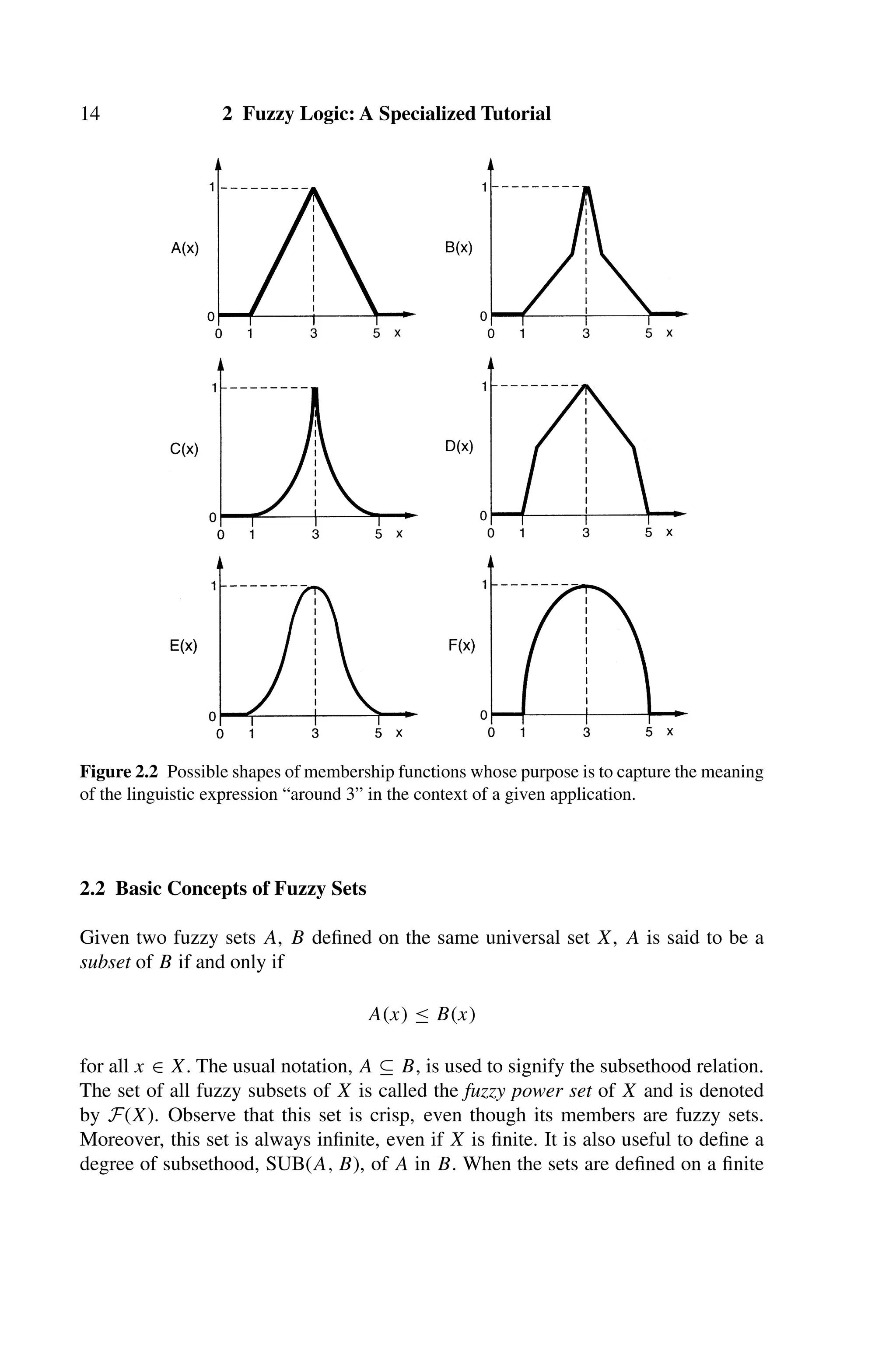
![2.2 Basic Concepts of Fuzzy Sets 15
universal set X, we have
SUB(A, B) =
x∈X
A(x) −
x∈X
max[0, A(x) − B(x)]
x∈X
A(x)
. (2.3)
The negative term in the numerator describes the sum of the degrees to which the
subset inequality A(x) ≤ B(x) is violated, the positive term describes the largest
possible violation of the inequality, the difference in the numerator describes the sum
of the degrees to which the inequality is not violated, and the term in the denominator
is a normalizing factor to obtain the range
0 ≤ SUB(A, B) ≤ 1.
When sets A and B are defined on a bounded subset of real numbers (i.e., X is a
closed interval of real numbers), the three terms in (2.3) are replaced with integrals
over X.
For any fuzzy set A defined on a finite universal set X, its scalar cardinality, |A|,
is defined by the formula
|A| =
x∈X
A(x).
Scalar cardinality is sometimes referred to in the literature as a sigma count.
Among the most important concepts of standard fuzzy sets are the concepts of an
α-cut and a strong α-cut. Given a fuzzy set A defined on X and a particular number
α in the unit interval [0, 1], the α-cut of A, denoted by αA, is a crisp set that consists
of all elements of X whose membership degrees in A are greater than or equal to α.
This can formally be written as
α
A = {x|A(x) ≥ α}.
The strong α-cut, α+A, has a similar meaning, but the condition “greater than or equal
to” is replaced with the stronger condition “greater than.” Formally,
α+
A = {x|A(x) α}.
The set 0+A is called the support of A and the set 1A is called the core of A. When
the core A is not empty, A is called normal; otherwise, it is called subnormal. The
largest value of A is called the height of A and it is denoted by hA. The set of distinct
values A(x) for all x ∈ X is called the level set of A and is denoted by ΛA.](https://image.slidesharecdn.com/71683-250226063937-6b294fc7/75/Fuzzy-Logic-in-Geology-1st-Edition-Robert-V-Demicco-39-2048.jpg)
![16 2 Fuzzy Logic: A Specialized Tutorial
Figure 2.3 Illustration of some basic characteristics of fuzzy sets.
All the introduced concepts are illustrated in Figure 2.3. We can see that
α1A ⊆ α2A and α1+
A ⊆ α2+
A2
when α1 ≥ α2. This implies that the set of all distinct α-cuts (as well as strong α-cuts)
is always a nested family of crisp sets. When α is increased, the new α-cut (strong
α-cut) is always a subset of the previous one. Clearly, 0A = X and 1+A = ∅.
It is well established [Klir Yuan, 1995] that each fuzzy set is uniquely represented
by the associated family of its α-cuts via the formula
A(x) = sup {α · α
A(x)|α ∈ [0, 1]}, (2.4)
or by the associated family of its strong α-cuts via the formula
A(x) = sup {α · α+
A(x)|α ∈ [0, 1]}, (2.5)
where sup denotes the supremum of the respective set and αA (or α+A) denotes for
each α ∈ [0, 1] the special membership function (characteristic function) of the α-cut
(or strong α-cut, respectively).
The significance of the α-cut (or strong α-cut) representation of fuzzy sets is that
it connects fuzzy sets with crisp sets. While each crisp set is a collection of objects
that are conceived as a whole, each fuzzy set is a collection of nested crisp sets that
are also conceived as a whole. Fuzzy sets are thus wholes of a higher category.
The α-cut representation of fuzzy sets allows us to extend the various properties
of crisp sets, established in classical set theory, into their fuzzy counterparts. This
is accomplished by requiring that the classical property be satisfied by all α-cuts of
the fuzzy set concerned. Any property that is extended in this way from classical](https://image.slidesharecdn.com/71683-250226063937-6b294fc7/75/Fuzzy-Logic-in-Geology-1st-Edition-Robert-V-Demicco-40-2048.jpg)
 = B(y), (2.7)
for all x ∈ X, where y = f (x). Clearly,
F−1
[F(A)] ⊇ A](https://image.slidesharecdn.com/71683-250226063937-6b294fc7/75/Fuzzy-Logic-in-Geology-1st-Edition-Robert-V-Demicco-41-2048.jpg)
![18 2 Fuzzy Logic: A Specialized Tutorial
Figure 2.4 Illustration of the extension principle.
for all A ∈ F(X), where the equality is obtained when f is a one-to-one function.
The use of the extension principle is illustrated in Figure 2.4, where it is shown
how fuzzy set A is mapped to fuzzy set B via function F that is consistent with the
given function f . That is, B = F(A). For example, since
b = f (a1) = f (a2) = f (a3),
we have
B(b) = max[A(a1), A(a2), A(a3)]
by Equation (2.6). Conversely,
F−1
(B)(a1) = F−1
(B)(a2) = F−1
(B)(a3) = B(b)
by (2.7).
The introduced extension principle, by which functions are fuzzified, is basically
described by Equations (2.6) and (2.7). These equations are direct generalizations
of similar equations describing the extension principle of classical set theory. In the
latter, symbols A and B denote characteristic functions of crisp sets.](https://image.slidesharecdn.com/71683-250226063937-6b294fc7/75/Fuzzy-Logic-in-Geology-1st-Edition-Robert-V-Demicco-42-2048.jpg)
![2.3 Operations on Fuzzy Sets 19
2.3 Operations on Fuzzy Sets
Operations on fuzzy sets possess a considerably greater variety than those on classical
sets. In fact, most operations on fuzzy sets do not have any counterparts in classical set
theory. The following five types of operations on fuzzy sets are currently recognized:
(a) modifiers;
(b) complements;
(c) intersections;
(d) unions;
(e) averaging operations.
Modifiers and complements operate on one fuzzy set. Intersections and unions oper-
ate on two fuzzy sets, but their application can be extended to any number of fuzzy
sets via their property of associativity. The averaging operations, which are not asso-
ciative, operate, in general, on n fuzzy sets (n ≥ 2). In addition to these five types
of operations, special fuzzy sets referred to as fuzzy intervals are also subject to
arithmetic operations.
As can be seen from this overall characterization of operations on fuzzy sets, this
subject is very extensive. It is also a subject that has been investigated by many
researchers, and that is now quite well developed. Due to the enormous scope of
the subject, we are able to present in this section only a very brief characterization
of each of the introduced types of operations, but we provide the reader with ample
references for further study.
2.3.1 Modifiers
Modifiers are unary operations whose primary purpose is to modify fuzzy sets to
account for linguistic hedges, such as very, fairly, extremely, moderately, etc., in
representing expressions of natural language. Each modifier, m, is an increasing
(and usually continuous) one-to-one function of the form
m: [0, 1] → [0, 1],
which assigns to each membership grade A(x) of a given fuzzy set A a modified
grade m(A(x)). The modified grades for all x ∈ X define a new, modified fuzzy set.
Denoting conveniently this modified set by MA, we have
m(A(x)) = MA(x)
Observe that function m is totally independent of elements x to which values A(x)
are assigned; it depends only on the values themselves. In describing its formal
properties, we may thus ignore x and assume that the argument of m is an arbitrary
number a in the unit interval [0, 1].](https://image.slidesharecdn.com/71683-250226063937-6b294fc7/75/Fuzzy-Logic-in-Geology-1st-Edition-Robert-V-Demicco-43-2048.jpg)
![20 2 Fuzzy Logic: A Specialized Tutorial
In general, a modifier increases or decreases values of the membership functions to
which it is applied, but preserves the order. That is, if a ≤ b then m(a) ≤ m(b) for all
a, b ∈ [0, 1]or, recognizingthemeaningofa andb, ifA(x) ≤ A(y)forsomex, y ∈ X,
then MA(x) ≤ MA(y). Sometimes, it is also required that m(0) = 0 and m(1) = 1.
Modifiers are basically of three types, depending on which values of the
membership functions they increase or decrease:
(i) modifiers that increase all values;
(ii) modifiers that decrease all values;
(iii) modifiers that increase some values and decrease other values.
To illustrate these types of modifiers, let us consider the fuzzy set A in Figure 2.2.
For each x ∈ R, A is clearly defined by the formula
A(x) =
⎧
⎪
⎪
⎨
⎪
⎪
⎩
(x − 1)/2 when x ∈ [1,3]
(5 − x)/2 when x ∈ [3,5]
0 otherwise
Assume that this fuzzy set represents, in a given application context, the linguistic
concept “close to 3.” To modify A for representing the concept “very close to 3,”
we need to reduce in some way the values of A. This can be done by choosing an
appropriate modifier from the class of functions
mλ(a) = aλ
, (2.8)
where a is the value of A to which mλ is applied and λ is a parameter whose value
determines how strongly mλ modifies A. For each value of λ, which must be in this
case greater than 1, we obtain a particular modifier. When applying the modifier to
A, we obtain a new membership function, mλ[A(x)], a composite of functions A and
m, which for each x ∈ R is defined by the formula
mλ[A(x)] =
⎧
⎪
⎪
⎨
⎪
⎪
⎩
[(x − 1)/2]λ when x ∈ [1,3]
[(5 − x)/2]λ when x ∈ [3,5]
0 otherwise
This modified membership function has a shape exemplified by the function labeled
as C in Figure 2.2. Its width is determined by the value λ of the chosen modifier: the
larger the value, the narrower the function. The proper value of λ must be determined
in the context of each particular application.
Assume now that we want to modify the same set A for representing the concept
“fairly close to 3.” In this case, we need to increase the values of A. This can be done
with modifiers of the form (2.8), provided that λ ∈ (0, 1). Applying these modifiers to](https://image.slidesharecdn.com/71683-250226063937-6b294fc7/75/Fuzzy-Logic-in-Geology-1st-Edition-Robert-V-Demicco-44-2048.jpg)
![2.3 Operations on Fuzzy Sets 21
A results in a new membership function whose shape is exemplified by the function
labeled as F in Figure 2.2. The smaller the value of λ, the wider is the modified
membership function.
It should be mentioned at this point that (2.8) is given here solely as an example of
a possible class of modifiers of fuzzy sets. As is well known, these modifiers do not
always properly capture the meaning of linguistic hedges in natural language. Amore
comprehensive treatment of linguistic hedges is presented in Chapter 10; see also
Novák [1989].
2.3.2 Complements
Similarly to modifiers, complements of fuzzy sets may be defined via appropri-
ate unary operations on [0, 1]. While modifiers preserve the order of membership
degrees, complements reverse the order. In particular, each fuzzy complement, c,
must satisfy at least the following two requirements:
(c1) c(0) = 1 and c(1) = 0;
(c2) for all a, b ∈ [0, 1], if a ≤ b, then c(a) ≥ c(b).
Requirement (c1) guarantees that all fuzzy complements collapse to the unique clas-
sical complement for crisp sets. Requirement (c2) guarantees that increases in the
degree of membership in A do not result in increases in the degree of membership
in the complement of A. This is essential since any increase in the degree of mem-
bership of an object in a fuzzy set cannot simultaneously increase the degree of
nonmembership of the same object in the same fuzzy set.
When used as a fuzzy complement, function c is always applied to membership
degrees A(x) of some fuzzy set A. It depends only on the values A(x) and not on the
objects x to which the values are assigned. For the purpose of characterizing fuzzy
complements, we may thus ignore these objects and observe only how function c
depends on numbers in [0, 1]. This is the reason why no reference is made to specific
degrees A(x) in the requirements (c1) and (c2). However, when function c defines a
complement of a particular fuzzy set A, we must keep track of the relevant objects x
to make the connection between A(x) and c[A(x)].
Although requirements (c1) and (c2) are sufficient to characterize the largest class
of acceptable fuzzy complements, two additional requirements are imposed on fuzzy
complements by most applications of fuzzy set theory:
(c3) c is a continuous function;
(c4) c(c(a)) = a for all a ∈ [0, 1].
Requirement (c3) guarantees that infinitesimal changes in the argument do not result
in discontinuous changes in the function. Requirement (c4) guarantees that fuzzy sets](https://image.slidesharecdn.com/71683-250226063937-6b294fc7/75/Fuzzy-Logic-in-Geology-1st-Edition-Robert-V-Demicco-45-2048.jpg)
![22 2 Fuzzy Logic: A Specialized Tutorial
are not changed by double complementation. Fuzzy complements that satisfy (c4)
are called involutive.
A practical class of fuzzy complements that satisfy requirements (c1)–(c4) is
defined for each a ∈ [0, 1] by the formula
cλ(a) = (1 − aλ
)1/λ
, (2.9)
where λ ∈ (0, ∞); it is called the Yager class of fuzzy complements. One particular
fuzzy complement is obtained for each value of the parameter λ. The complement
obtained for λ = 1, which is called a standard fuzzy complement, is the most com-
mon complement in applications of fuzzy set theory. Clearly, the standard fuzzy
complement of a fuzzy set A, usually denoted by
A, is defined for each x ∈ X by the
equation
A(x) = 1 − A(x).
Other parameter-based formulas for describing classes of fuzzy complements have
been proposed in the literature. In fact, some procedures have been developed by
which new classes of fuzzy complements can be generated [Klir Yuan, 1995].
However, this theoretical topic is beyond the scope of this tutorial.
To determine the most fitting complement in the context of each particular appli-
cation is a problem of knowledge acquisition, somewhat similar to the problem of
constructing membership functions. Given a class of fuzzy complements, such as the
Yager class, the constructing problem reduces to the problem of determining the right
value of the relevant parameter.
2.3.3 Intersections and unions
Intersections and unions of fuzzy sets, denoted by i and u respectively, are general-
izations of the classical operations of intersections and unions of crisp sets. They may
be defined via appropriate functions that map each pair of real numbers from [0, 1]
(representing degrees A(x) and B(x) of given fuzzy sets A and B for some x ∈ X)
into a single number in [0, 1] (representing membership degree (A ∩ B)(x) of the
intersection of A and B or membership degree of the union of A and B for the given
x). Hence,
(A ∩ B)(x) = i[A(x), B(x)]
and
(A ∪ B)(x) = u[A(x), B(x)]
for all x ∈ X. To discuss properties of functions i and u, which do not depend on x,
we may view i and u as functions from [0, 1] × [0, 1] to [0, 1].](https://image.slidesharecdn.com/71683-250226063937-6b294fc7/75/Fuzzy-Logic-in-Geology-1st-Edition-Robert-V-Demicco-46-2048.jpg)
![2.3 Operations on Fuzzy Sets 23
Contrary to their classical counterparts, fuzzy intersections and unions are not
unique. This is a natural consequence of the well-established fact that the linguistic
expressions “x is a member of A and B” and “x is a member of A or B” have different
meanings when applied by human beings to different vague concepts in different
contexts. To be able to capture the different meanings, we need to characterize the
classes of fuzzy intersections and fuzzy unions as broadly as possible.
It has been established that operations known in the literature as triangular
norms or t-norms and triangular conorms or t-conorms, which have been exten-
sively studied in mathematics, possess exactly those properties that are requisite, on
intuitive grounds, for fuzzy intersections and fuzzy unions, respectively. The class
of t-norms/fuzzy intersections is characterized by four requirements; the class of
t-conorms/fuzzy unions is also characterized by four requirements, three of which are
identical with the requirements for t-norms. In the following list, the requirements for
t-norms/fuzzy intersections i are paired with their counterparts for t-conorms/fuzzy
unions u, and must be satisfied for all a, b, d ∈ [0, 1]:
(i1) i(a, 1) = a (boundary requirement for i);
(u1) u(a, 0) = a (boundary requirement for u);
(i2) b ≤ d implies i(a, b) ≤ i(a, d)
(monotonicity);
(u2) b ≤ d implies u(a, b) ≤ u(a, d)
(i3) i(a, b) = i(b, a)
(commutativity);
(u3) u(a, b) = u(b, a)
(i4) i(a, i(b, d)) = i(i(a, b), d)
(associativity).
(u4) u(a, u(b, d)) = u(u(a, b), d)
It is easy to see that the first three requirements for i ensure that fuzzy intersections
collapse to the classical set intersection when applied to crisp sets: i(0, 1) = 0 and
i(1, 1) = 1 follow directly from the boundary requirement; i(1, 0) = 0 and i(0, 0) =
0 follow then from commutativity and monotonicity, respectively. Similarly, the
first three requirements for u ensure that fuzzy unions collapse to the classical set
union when applied to crisp sets. Commutativity requirements ensure that fuzzy
intersections and unions are symmetric operations, indifferent to the order in which
sets to be combined are considered; together with monotonicity requirements, they
guarantee that fuzzy intersections and unions do not decrease when any of their
arguments are increased, and do not increase when any arguments are decreased.
Associativity requirements allow us to extend fuzzy intersections and unions to more
than two sets, in perfect analogy with their classical counterparts.
The following are examples of some common fuzzy intersections and fuzzy unions
with their usual names (each defined for all a, b ∈ [0, 1]).
Standard fuzzy intersection: i(a, b) = min(a, b)
Algebraic product: i(a, b) = ab](https://image.slidesharecdn.com/71683-250226063937-6b294fc7/75/Fuzzy-Logic-in-Geology-1st-Edition-Robert-V-Demicco-47-2048.jpg)
![24 2 Fuzzy Logic: A Specialized Tutorial
Bounded difference: i(a, b) = max(0, a + b − 1)
Drastic intersection: imin(a, b) =
⎧
⎨
⎩
a when b = 1
b when a = 1
0 otherwise
Standard fuzzy union: u(a, b) = max(a, b)
Algebraic sum: u(a, b) = a + b − ab
Bounded sum: u(a, b) = min(1, a + b)
Drastic union: umax(a, b) =
⎧
⎨
⎩
a when b = 0
b when a = 0
1 otherwise
It is easy to verify that the inequalities
imin(a, b) ≤ i(a, b) ≤ min(a, b)
max(a, b) ≤ u(a, b) ≤ umax(a, b)
are satisfied for all a, b ∈ [0, 1] by any fuzzy intersection i and any fuzzy union u,
respectively. These inequalities specify, in effect, the full ranges of fuzzy intersections
and fuzzy unions.
Examples of classes of fuzzy intersections, iw, and fuzzy union, uw, that cover the
full ranges of these operations are defined for all a, b ∈ [0, 1] by the formulas
iw(a, b) = 1 − min{1, [(1 − a)w + (1 − b)w]1/w}
uw(a, b) = min[1, (aw + bw)1/w]
, (2.10)
where w is a parameter whose range is (0, ∞). One particular fuzzy intersection
and one particular fuzzy union are obtained for each value of the parameter. These
operations are often referred to in the literature as the Yager classes of intersections
and unions. Although it is not obvious from the formulas, it is relatively easy to prove
that the standard fuzzy operations are obtained in the limit for w → ∞.
Since Yager intersections increase as the value of w increases, they become less
restrictive or weaker with increasing w. The drastic intersection is the strongest and
the standard intersection is the weakest. For Yager unions, this pattern is inverted;
they become more restrictive or stronger with increasing w. The standard union is
the strongest, the drastic union the weakest.
It should be mentioned that various other classes of fuzzy intersections and
unions have been examined in the literature. Moreover, special procedures are now
available by which new classes of fuzzy intersection and unions can be generated
[Klir Yuan, 1995].
Among the great variety of fuzzy intersections and unions, the standard operations
possess certain properties that give them special significance. First, we recognize
that they are located at opposite ends of the respected ranges of these operations.](https://image.slidesharecdn.com/71683-250226063937-6b294fc7/75/Fuzzy-Logic-in-Geology-1st-Edition-Robert-V-Demicco-48-2048.jpg)
![2.3 Operations on Fuzzy Sets 25
While the standard intersection is the weakest one among all fuzzy intersections,
the standard union is the strongest one among all fuzzy unions. Second, the standard
operationsaretheonlycutworthyoperationsamongallfuzzyintersectionsandunions.
Third, they are also the only operations among fuzzy intersections and unions that
are idempotent. This means that is(a, a) = us(a, a) = a for all a ∈ [0, 1]. Non-
standard fuzzy intersections are only subidempotent, while nonstandard fuzzy unions
are superidempotent; this means that
i(a, a) a and u(a, a) a
for all a ∈ (0, 1). In addition, when using the standard fuzzy operations, errors of the
operands do not compound. This is a desirable property from the computational point
of view, which other fuzzy operations do not possess.
Whatever combination of fuzzy counterparts of the three classical set-theoretic
operations (complement, intersection, union) we choose, some properties of the clas-
sical operations (properties of the underlying Boolean algebra) are inevitably violated.
This is a consequence of imprecise boundaries of fuzzy sets. The standard fuzzy oper-
ations violate only the law of excluded middle and the law of contradiction. Some
other combinations preserve these laws, but violate distributivity and idempotence
[Klir Yuan, 1995].
2.3.4 Averaging operations
Fuzzy intersections (t-norms) and fuzzy unions (t-conorms) are special types of oper-
ations for aggregating fuzzy sets: given two or more fuzzy sets, they produce a single
fuzzy set, an aggregate of the given sets. While they do not cover all aggregating oper-
ations, they cover all aggregating operations that are associative. Because of the lack
of associativity, the remaining aggregating operations must be defined as functions
of n arguments for each n ≥ 2. These remaining aggregation operations are called
averaging operations. As the name suggests, they average in various ways member-
ship functions of two or more fuzzy sets defined on the same universal set. They
do not have any counterparts in classical set theory. Indeed, an average of several
characteristic functions of classical sets is not, in general, a characteristic function!
However, classical sets can be averaged if they are viewed as special fuzzy sets.
For each n ≥ 2, an averaging operation, h, aggregates n fuzzy sets defined on the
same universal set X, say sets A1, A2, . . . , An. Denoting conveniently the aggregate
fuzzy set by H(A1, A2, . . . , An), we have
H(A1, A2, . . . , An)(x) = h[A1(x), A2(x), . . . , An(x)]
for all x ∈ X. Since properties of various averaging operations h do not depend on
x, but only on the membership degrees A1(x), A2(x), . . . , An(x) ∈ [0, 1], we may
view these operations as functions from [0, 1]n to [0, 1].](https://image.slidesharecdn.com/71683-250226063937-6b294fc7/75/Fuzzy-Logic-in-Geology-1st-Edition-Robert-V-Demicco-49-2048.jpg)
![26 2 Fuzzy Logic: A Specialized Tutorial
The following two requirements are requisite for any averaging operation h with
n arguments (n ≥ 2):
(h1) for all a ∈ [0, 1], h(a, a, . . . , a) = a (idempotency);
(h2) for any pair of n-tuples of real numbers in [0,1], a1, a2, . . . , an and
b1, b2, . . . , bn, if ai ≤ bi for all i ∈ Nn, then
h(a1, a2, . . . , an) ≤ h(b1, b2, . . . , bn) (monotonicity).
Requirement (h1) expresses our intuition that an average of equal numbers must result
in the same number. Requirement (h2) guarantees that the average does not decrease
when any of the arguments increase.
In addition to these essential and easily understood requirements, averaging
operations on fuzzy sets are usually expected to satisfy two additional requirements:
(h3) h is a continuous function;
(h4) h is a symmetric function in all its arguments, which means that
h(a1, a2, . . . , an) = h(ap(1), ap(2), . . . , ap(n))
for any permutation p on Nn. Requirement (h3) guarantees that small changes in any
of the arguments do not result in discontinuous changes in the average. Requirement
(h4) captures the usual assumption that the aggregated fuzzy sets are equally impor-
tant. If this assumption is not warranted in some application contexts, the symmetry
requirement must be dropped.
It is significant that any averaging operation h that satisfies the two basic require-
ments (h1) and (h2) produces numbers that for each n-tuple a1, a2, . . . , an ∈ [0, 1]n
lie within the interval defined by the inequalities
min(a1, a2, . . . , an) ≤ h(a1, a2, . . . , an) ≤ max(a1, a2, . . . , an).
To see this, let
a∗ = min(a1, a2, . . . , an) and a∗
= max(a1, a2, . . . , an).
If h satisfies requirements (h1) and (h2), then a∗ = h(a∗, a∗, . . . , a∗) ≤ h(a1,
a2, . . . , an) ≤ h(a∗
1, a∗
2, . . . , a∗
n) = a∗. Conversely, if h produces numbers within the
interval bounded by the min and max operations, then it must also satisfy requirement
(h1) of idempotency; indeed,
a = min(a, a, . . . , a) ≤ h(a, a, . . . , a) ≤ max(a, a, . . . , a) = a
for all a ∈ [0, 1]. That is, averaging operations cover the whole range between the
standard fuzzy intersection and the standard fuzzy union. The standard operations](https://image.slidesharecdn.com/71683-250226063937-6b294fc7/75/Fuzzy-Logic-in-Geology-1st-Edition-Robert-V-Demicco-50-2048.jpg)

![grievance, to feel as if the whole world were a football, made for
him to play with,—
My lord, said he, drawing himself up into an attitude, I am sure
I need not, at this time of day, enter into any discussion with your
lordship on the vast importance of the rights and privileges of
Englishmen—of the original establishment of the trial by jury in this
country. It would be worse than idle to occupy your valuable time
and that of this court, by dilating upon the merits of our constitution
—the chiefest of which has, I may say—been always—and I will say
—wisely, considerately, and prudently held to be that peculiar mode
of administering justice between man and man. But, my lord, if in
civil cases the deliberation and decision of a jury are considered
adequate safeguards to the rights and property of the people, the
law, still more careful of their lives and liberties, has interposed in
criminal cases another and a higher tribunal, in the nature of a
grand jury. [Hereabouts the judge, having bowed his head
graciously, omitted to raise it again, having dropped into a sound
slumber.]
That tribunal of mediation in the first instance, is full of
importance; and whatever subsequent proceedings may be taken in
a case, I do say, for myself and my fellows, that the decision upon
ex-parte evidence requires more circumspection, more care, and
more consideration than a verdict delivered after a case had been
argued, and after witnesses have been heard on both sides.
If, my lord, your lordship concedes this point, I will merely say,
generally, that when the mind is occupied by any important object,
more especially in matters of jurisprudence, it is absolutely
necessary that nothing, if possible, should occur to irritate or
exacerbate the feelings—all should be calm, and at rest.
Several people turned their eyes towards his lordship, and some
smiled.
No incidental annoyance should be permitted to interpose itself;
nothing which could divert the judge from the point to which his](https://image.slidesharecdn.com/71683-250226063937-6b294fc7/75/Fuzzy-Logic-in-Geology-1st-Edition-Robert-V-Demicco-65-2048.jpg)