Team	Finland	Future	Watch	Report	– Digitalization	Examples	for	the	
Manufacturing	Industry	– www.insyke.fi
1
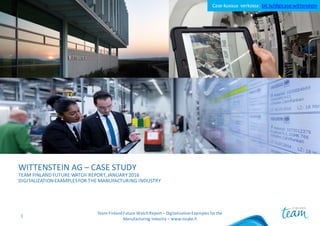
WITTENSTEIN	AG	– CASE	STUDY
TEAM	FINLAND	FUTURE	WATCH	REPORT,	JANUARY	2016	
DIGITALIZATION	EXAMPLES	FOR	THE	MANUFACTURING	INDUSTRY
Case-kuvaus	 verkossa:	bit.ly/digicase-wittenstein
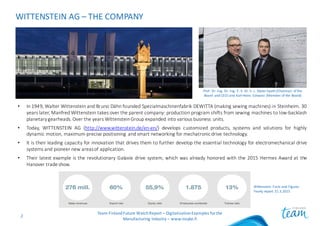
WITTENSTEIN	AG	– THE	COMPANY
• In 1949, Walter Wittenstein and Bruno Dähn founded Spezialmaschinenfabrik DEWITTA (making sewing machines) in Steinheim. 30
years later, Manfred Wittenstein takes over the parent company: production program shifts from sewing machines to low-backlash
planetarygearheads. Over the years WittensteinGroup expanded into various business units.
• Today, WITTENSTEIN AG (http://www.wittenstein.de/en-en/) develops customized products, systems and solutions for highly
dynamic motion, maximum-precise positioning and smart networking for mechatronicdrive technology.
• It is their leading capacity for innovation that drives them to further develop the essential technology for electromechanical drive
systems and pioneer new areasof application.
• Their latest example is the revolutionary Galaxie drive system, which was already honored with the 2015 Hermes Award at the
Hanover tradeshow.
Team	Finland	Future	Watch	Report	– Digitalization	Examples	for	the	
Manufacturing	Industry	– www.insyke.fi
2
Prof.	Dr.-Ing.	Dr.-Ing.	E.	h.	Dr.	h.	c.	Dieter	Spath (Chairman	 of	the	
Board	 and	CEO)	and	Karl-Heinz	Schwarz	(Member	of	the	Board)
Wittenstein Facts	and	Figures
Yearly	report	 31.3.2015
WITTENSTEIN	AG	– PRODUCTION	OF	THE	FUTURE
• Industrial	production	is	increasing	in	complexity:	Products	are	
becoming	more	customized,	innovation	cycles	shorter.	Furthermore,	
networking	with	customers	and	suppliers	is	entering	new	dimensions.	
Mastering	complexity	and	complex	technologies	is	therefore	the	
main	challenge	in	remaining	competitive.	Decentralized	self-
organization	instead	of	central	control	is	the	solution.	For	this,	
Wittenstein	AG	uses	"Industry	4.0"	technology	to	turn	the	factories	of	
tomorrow	into	smart	factories.
• As	a	driver	of	innovation	in	mechatronic	drive	technology,	
Wittenstein	sees	themselves	as	a	pioneer	for	Industry	4.0.	Their	
commitment	centers	on	production	optimization	as	well	as	the	
development	of	products	for	Industry	4.0.
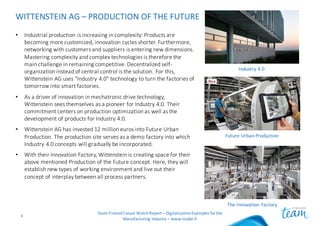
• Wittenstein	AG	has	invested	12	million	euros	into	Future	Urban	
Production.	The	production	site	serves	as	a	demo	factory	into	which	
Industry	4.0	concepts	will	gradually	be	incorporated.
• With	their	Innovation	Factory,	Wittenstein	is	creating	space	for	their	
above	mentioned	Production	of	the	Future	concept.	Here,	they	will	
establish	new	types	of	working	environment	and	live	out	their	
concept	of	interplay	between	all	process	partners.
Team	Finland	Future	Watch	Report	– Digitalization	Examples	for	the	
Manufacturing	Industry	– www.insyke.fi
3
Industry	4.0
Future	Urban	Production
The	Innovation	Factory
WITTENSTEIN	AG	– THE	CHANGE	TOWARDS	INDUSTRY	4.0
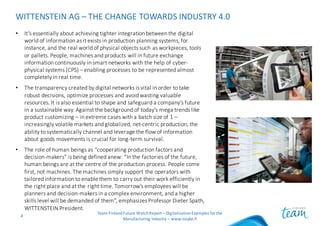
• It’s	essentially	about	achieving	tighter	integration	between	the	digital	
world	of	information	as	it	exists	in	production	planning	systems,	for	
instance,	and	the	real	world	of	physical	objects	such	as	workpieces,	tools	
or	pallets.	People,	machines	and	products	will	in	future	exchange	
information	continuously	in	smart	networks	with	the	help	of	cyber-
physical	systems	(CPS)	– enabling	processes	to	be	represented	almost	
completely	in	real	time.
• The	transparency	created	by	digital	networks	is	vital	in	order	to	take	
robust	decisions,	optimize	processes	and	avoid	wasting	valuable	
resources.	It	is	also	essential	to	shape	and	safeguard	a	company’s	future	
in	a	sustainable	way.	Against	the	background	of	today’s	mega	trends	like	
product	customizing	– in	extreme	cases	with	a	batch	size	of	1	–
increasingly	volatile	markets	and	globalized,	net-centric	production,	the	
ability	to	systematically	channel	and	leverage	the	flow	of	information	
about	goods	movements	is	crucial	for	long-term	survival.
• The	role	of	human	beings	as	“cooperating	production	factors	and	
decision-makers”	is	being	defined	anew:	“In	the	factories	of	the	future,	
human	beings	are	at	the	centre of	the	production	process.	People	come	
first,	not	machines.	The	machines	simply	support	the	operators	with	
tailored	information	to	enable	them	to	carry	out	their	work	efficiently	in	
the	right	place	and	at	the	right	time.	Tomorrow’s	employees	will	be	
planners	and	decision-makers	in	a	complex	environment,	and	a	higher	
skills	level	will	be	demanded	of	them”,	emphasizes	Professor	Dieter	Spath,	
WITTENSTEIN	President.
Team	Finland	Future	Watch	Report	– Digitalization	Examples	for	the	
Manufacturing	Industry	– www.insyke.fi
4
Production planning and control in the age of Industry 4.0
which
forma
digital
specifi
can b
proce
situati
organ
stanc
a mac
produ
We w
The ro
ductio
define
future
produ
»Even in Industry 4.0 problems with
tools and processes cannot always be
ruled out. In this case, prompt and robust
decisions are called for. And that’s some-
thing human beings can still do best.«
DR. MARIA HERGESELL, HEAD OF TECHNOLOGY MANAGEMENT,
WITTENSTEIN BASTIAN GMBH
WITTENSTEIN	AG	– THE	CHANGE	TOWARDS	INDUSTRY	4.0	– MILK	RUN	4.0
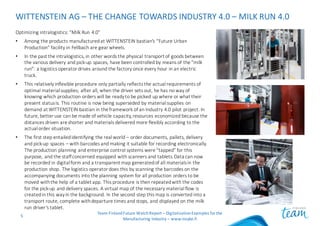
Optimizing	intralogistics:	“Milk	Run	4.0”
• Among	the	products	manufactured	at	WITTENSTEIN	bastian’s “Future	Urban	
Production”	facility	in	Fellbach are	gear	wheels.	
• In	the	past	the	intralogistics,	in	other	words	the	physical	transport	of	goods	between	
the	various	delivery	and	pick-up	spaces,	have	been	controlled	by	means	of	the	“milk	
run”:	a	logistics	operator	drives	around	the	factory	once	every	hour	in	an	electric	
truck.	
• This	relatively	inflexible	procedure	only	partially	reflects	the	actual	requirements	of	
optimal	material	supplies;	after	all,	when	the	driver	sets	out,	he	has	no	way	of	
knowing	which	production	orders	will	be	ready	to	be	picked	up	where	or	what	their	
present	status	is.	This	routine	is	now	being	superseded	by	material	supplies	on	
demand	at	WITTENSTEIN	bastian in	the	framework	of	an	Industry	4.0	pilot	project.	In	
future,	better	use	can	be	made	of	vehicle	capacity,	resources	economized	because	the	
distances	driven	are	shorter	and	materials	delivered	more	flexibly	according	to	the	
actual	order	situation.
• The	first	step	entailed	identifying	the	real	world	– order	documents,	pallets,	delivery	
and	pick-up	spaces	– with	barcodes	and	making	it	suitable	for	recording	electronically.	
The	production	planning	and	enterprise	control	systems	were	“tapped”	for	this	
purpose,	and	the	staff	concerned	equipped	with	scanners	and	tablets.	Data	can	now	
be	recorded	in	digital	form	and	a	transparent	map	generated	of	all	materials	in	the	
production	shop.	The	logistics	operator	does	this	by	scanning	the	barcodes	on	the	
accompanying	documents	into	the	planning	system	for	all	production	orders	to	be	
moved	with	the	help	of	a	tablet	app.	This	procedure	is	then	repeated	with	the	codes	
for	the	pick-up	and	delivery	spaces.	A	virtual	map	of	the	necessary	material	flow	is	
created	in	this	way	in	the	background.	In	the	second	step	this	map	is	converted	into	a	
transport	route,	complete	with	departure	times	and	stops,	and	displayed	on	the	milk	
run	driver’s	tablet.
Team	Finland	Future	Watch	Report	– Digitalization	Examples	for	the	
Manufacturing	Industry	– www.insyke.fi
5
15move
open up brand new opportunities for interac-
tion – people are obviously very curious and
excited about what the future has in store”,
explains Dr. Peter Stephan, Project Manag-
er, Future Field Cyber-Physical Systems at
WITTENSTEIN.
Progress not opposition, acceptance not re-
jection: in this way, staff themselves help drive
the implementation of Industry 4.0. By defini-
tion, these dynamics are conducive to the on-
going optimization of processes.
al requirements of optimal material supplies;
Up to 50% more efficient
in tests:
Material supplies in Fell-
bach are now organized on
demand.
16 move
The first step entailed identifying the real world –
order documents, pallets, delivery and pick-up
spaces – with barcodes and making it suitable
for recording electronically. The production
planning and enterprise control systems were
“tapped” for this purpose, and the staff con-
cerned equipped with scanners and tablets.
Data can now be recorded in digital form and
a transparent map generated of all materials
in the production shop. The logistics opera-
tor does this by scanning the barcodes on the
accompanying documents into the planning
system for all production orders to be moved
with the help of a tablet app. This procedure is
then repeated with the codes for the pick-up
and delivery spaces. A virtual map of the nec-
essary material flow is created in this way in
the background. In the second step this map
is converted into a transport route, complete
with departure times and stops, and displayed
on the milk run driver’s tablet.
A smart planning algorithm, which calculates
the optimal travel times based on the virtual
map of the required material flow and the num-
ber of transport orders per day, is currently be-
ing tested. The preliminary results confirm the
enormous potential for optimization that was
previously predicted with a simulation: by in-
terconnecting smart components, the number
of transport cycles actually completed and the
distances travelled in order to supply parts for
gear wheel production can ideally be halved!
Join us on a trip around WITTENSTEIN
bastian‘s »Future Urban Production«
facility with the Milk Run 4.0
»New technologies open up brand
new opportunities for interaction«
DR. PETER STEPHAN, PROJECT MANAGER, FUTURE FIELD CYBER-PHYSICAL-SYSTEMS
Digital networks create the
necessary transparency to take
robust decisions and optimize
processes.
“Optimizing Intralogistics” and “Representing
Production Planning with Mobile Information
Access” – WITTENSTEIN bastian is putting
its trust in the very latest generation of infor-
mation technology: tablet PCs with dedicated
apps, organized in a WLAN. This hardware is
not simply necessary from a technical point
of view; it also provides added motivation to
get involved. “Compared to traditional media
like planning boards and T-cards, new tech-
nologies such as tablet PCs and smartphones
open up brand new opportunities for interac-
tion – people are obviously very curious and
excited about what the future has in store”,
explains Dr. Peter Stephan, Project Manag-
er, Future Field Cyber-Physical Systems at
WITTENSTEIN.
Progress not opposition, acceptance not re-
jection: in this way, staff themselves help drive
the implementation of Industry 4.0. By defini-
tion, these dynamics are conducive to the on-
going optimization of processes.
Optimizing intralogistics: “Milk Run 4.0”
Among the products manufactured at WIT-
TENSTEIN bastian’s “Future Urban Production”
facility in Fellbach are gear wheels. In the past
the intralogistics, in other words the physical
transport of goods between the various de-
livery and pick-up spaces, have been con-
trolled by means of the “milk run”: a logistics
operator drives around the factory once every
hour in an electric truck. This relatively inflex-
ible procedure only partially reflects the actu-
al requirements of optimal material supplies;
after all, when the driver sets out, he has no
way of knowing which production orders will
be ready to be picked up where or what their
present status is. This routine is now being su-
perseded by material supplies on demand at
WITTENSTEIN bastian in the framework of an
Industry 4.0 pilot project. In future, better use
can be made of vehicle capacity, resources
economized because the distances driven are
shorter and materials delivered more flexibly
according to the actual order situation.
Up to 50% more efficient
in tests:
Material supplies in Fell-
bach are now organized on
demand.
WITTENSTEIN	AG	– INDUSTRY	4.0	– MILK	RUN	4.0		– BENEFITS
• Better	customer	experience – By	incorporating	Industry	
4.0,	the	precision	and	accuracy	improved	which	resulted	
in	better	customer	experience.			
• Less	non-productive	work – Milk	Run	4.0	is	a	good	
example	for	this	particular	benefit.	By	incorporating	
Industry	4.0	principles	in	the	traditional	milk	run	setup,	
the	efficiency	in	terms	of	saving	time	improved	by	50%	
and	that	allowed	the	milk	run	operator	to	engage	in	
other	productive	tasks.	
• Environmental	Sustainability	– Under	its	SIR	(Security,	
Intelligence	&	Resource	efficiency)	market	strategy,	
WITTENSTEIN	has	already	been	monitoring	resource	
efficiency	for	a	long	time.	Their	components	and	systems	
in	the	area	of	mechatronic	drive	technology	themselves	
are	resource-efficient	and/or	contribute	to	boosting	the	
resource-efficiency	of	the	overall	system	(such	as	the	
machine	into	which	they	are	installed).	WITTENSTEIN's	
production	processes	are	also	energy-efficient	and	
environmentally	friendly.
• Differentiation/Pioneers	in	Industry	4.0 – As	a	driver	of	
innovation	in	mechatronic	drive	technology,	Wittenstein	
is	also	a	pioneer	for	Industry	4.0.	Their	commitment	
centers	on	production	optimization	as	well	as	the	
development	of	products	for	Industry	4.0.
Team	Finland	Future	Watch	Report	– Digitalization	Examples	for	the	
Manufacturing	Industry	– www.insyke.fi
6
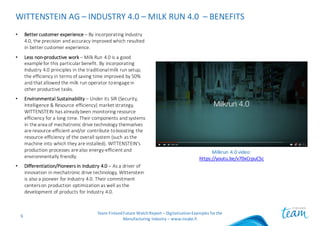
Milkrun 4.0	video:	
https://youtu.be/v70xCrpuC5c
WITTENSTEIN	AG	– LESSONS	LEARNED
Team	Finland	Future	Watch	Report	– Digitalization	Examples	for	the	
Manufacturing	Industry	– www.insyke.fi
7
• Production	of	the	future – By	incorporating	this	particular	strategy	of	production	of	future	(factories	of	the	future),	
WITTENSTEIN	is	a	good	and	successful	example	of	business	value	creation	by	incorporating	Industry	4.0	protocols	
and	implementing	techniques	like	Milk	Run	4.0	for	intralogistics.
• Industry	4.0	is	powered	by	people	– The	experts	are	in	no	doubt:	the	core	ideas	of	industry	4.0	provide	a	unique	
chance	to	respond	even	more	flexibly	to	customer	needs	– not	only	with	dedicated	products	but	also	with	
innovative,	dedicated	production	processes.	
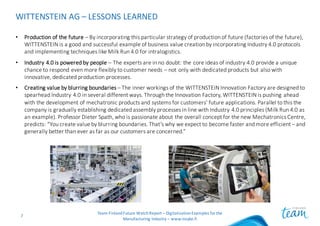
• Creating	value	by	blurring	boundaries	– The	inner	workings	of	the	WITTENSTEIN	Innovation	Factory	are	designed	to	
spearhead	Industry	4.0	in	several	different	ways.	Through	the	Innovation	Factory,	WITTENSTEIN	is	pushing	ahead	
with	the	development	of	mechatronic	products	and	systems	for	customers’	future	applications.	Parallel	to	this	the	
company	is	gradually	establishing	dedicated	assembly	processes	in	line	with	Industry	4.0	principles	(Milk	Run	4.0	as	
an	example).	Professor	Dieter	Spath,	who	is	passionate	about	the	overall	concept	for	the	new	Mechatronics	Centre,	
predicts:	“You	create	value	by	blurring	boundaries.	That’s	why	we	expect	to	become	faster	and	more	efficient	– and	
generally	better	than	ever	as	far	as	our	customers	are	concerned.”
Laura	Nurmi,	Tekes
laura.nurmi@tekes.fi
+358	29	505	5623
Karan	Menon,	Tampere	
University of	Technology
karan.menon@tut.fi
+358	40	130	5046
Digitalisaatioesimerkkejä teollisuudelle	
-raportti	verkossa:	
http://bit.ly/digiesimerkkeja-teollisuudelle

Wittenstein - Future Watch Case Study

  • 1.
    Team Finland Future Watch Report – Digitalization Examples for the Manufacturing Industry – www.insyke.fi 1 WITTENSTEIN AG –CASE STUDY TEAM FINLAND FUTURE WATCH REPORT, JANUARY 2016 DIGITALIZATION EXAMPLES FOR THE MANUFACTURING INDUSTRY Case-kuvaus verkossa: bit.ly/digicase-wittenstein
  • 2.
    WITTENSTEIN AG – THE COMPANY • In1949, Walter Wittenstein and Bruno Dähn founded Spezialmaschinenfabrik DEWITTA (making sewing machines) in Steinheim. 30 years later, Manfred Wittenstein takes over the parent company: production program shifts from sewing machines to low-backlash planetarygearheads. Over the years WittensteinGroup expanded into various business units. • Today, WITTENSTEIN AG (http://www.wittenstein.de/en-en/) develops customized products, systems and solutions for highly dynamic motion, maximum-precise positioning and smart networking for mechatronicdrive technology. • It is their leading capacity for innovation that drives them to further develop the essential technology for electromechanical drive systems and pioneer new areasof application. • Their latest example is the revolutionary Galaxie drive system, which was already honored with the 2015 Hermes Award at the Hanover tradeshow. Team Finland Future Watch Report – Digitalization Examples for the Manufacturing Industry – www.insyke.fi 2 Prof. Dr.-Ing. Dr.-Ing. E. h. Dr. h. c. Dieter Spath (Chairman of the Board and CEO) and Karl-Heinz Schwarz (Member of the Board) Wittenstein Facts and Figures Yearly report 31.3.2015
  • 3.
    WITTENSTEIN AG – PRODUCTION OF THE FUTURE • Industrial production is increasing in complexity: Products are becoming more customized, innovation cycles shorter. Furthermore, networking with customers and suppliers is entering new dimensions. Mastering complexity and complex technologies is therefore the main challenge in remaining competitive. Decentralized self- organization instead of central control is the solution. For this, Wittenstein AG uses "Industry 4.0" technology to turn the factories of tomorrow into smart factories. •As a driver of innovation in mechatronic drive technology, Wittenstein sees themselves as a pioneer for Industry 4.0. Their commitment centers on production optimization as well as the development of products for Industry 4.0. • Wittenstein AG has invested 12 million euros into Future Urban Production. The production site serves as a demo factory into which Industry 4.0 concepts will gradually be incorporated. • With their Innovation Factory, Wittenstein is creating space for their above mentioned Production of the Future concept. Here, they will establish new types of working environment and live out their concept of interplay between all process partners. Team Finland Future Watch Report – Digitalization Examples for the Manufacturing Industry – www.insyke.fi 3 Industry 4.0 Future Urban Production The Innovation Factory
  • 4.
    WITTENSTEIN AG – THE CHANGE TOWARDS INDUSTRY 4.0 • It’s essentially about achieving tighter integration between the digital world of information as it exists in production planning systems, for instance, and the real world of physical objects such as workpieces, tools or pallets. People, machines and products will in future exchange information continuously in smart networks with the help of cyber- physical systems (CPS) –enabling processes to be represented almost completely in real time. • The transparency created by digital networks is vital in order to take robust decisions, optimize processes and avoid wasting valuable resources. It is also essential to shape and safeguard a company’s future in a sustainable way. Against the background of today’s mega trends like product customizing – in extreme cases with a batch size of 1 – increasingly volatile markets and globalized, net-centric production, the ability to systematically channel and leverage the flow of information about goods movements is crucial for long-term survival. • The role of human beings as “cooperating production factors and decision-makers” is being defined anew: “In the factories of the future, human beings are at the centre of the production process. People come first, not machines. The machines simply support the operators with tailored information to enable them to carry out their work efficiently in the right place and at the right time. Tomorrow’s employees will be planners and decision-makers in a complex environment, and a higher skills level will be demanded of them”, emphasizes Professor Dieter Spath, WITTENSTEIN President. Team Finland Future Watch Report – Digitalization Examples for the Manufacturing Industry – www.insyke.fi 4 Production planning and control in the age of Industry 4.0 which forma digital specifi can b proce situati organ stanc a mac produ We w The ro ductio define future produ »Even in Industry 4.0 problems with tools and processes cannot always be ruled out. In this case, prompt and robust decisions are called for. And that’s some- thing human beings can still do best.« DR. MARIA HERGESELL, HEAD OF TECHNOLOGY MANAGEMENT, WITTENSTEIN BASTIAN GMBH
  • 5.
    WITTENSTEIN AG – THE CHANGE TOWARDS INDUSTRY 4.0 – MILK RUN 4.0 Optimizing intralogistics: “Milk Run 4.0” •Among the products manufactured at WITTENSTEIN bastian’s “Future Urban Production” facility in Fellbach are gear wheels. • In the past the intralogistics, in other words the physical transport of goods between the various delivery and pick-up spaces, have been controlled by means of the “milk run”: a logistics operator drives around the factory once every hour in an electric truck. • This relatively inflexible procedure only partially reflects the actual requirements of optimal material supplies; after all, when the driver sets out, he has no way of knowing which production orders will be ready to be picked up where or what their present status is. This routine is now being superseded by material supplies on demand at WITTENSTEIN bastian in the framework of an Industry 4.0 pilot project. In future, better use can be made of vehicle capacity, resources economized because the distances driven are shorter and materials delivered more flexibly according to the actual order situation. • The first step entailed identifying the real world – order documents, pallets, delivery and pick-up spaces – with barcodes and making it suitable for recording electronically. The production planning and enterprise control systems were “tapped” for this purpose, and the staff concerned equipped with scanners and tablets. Data can now be recorded in digital form and a transparent map generated of all materials in the production shop. The logistics operator does this by scanning the barcodes on the accompanying documents into the planning system for all production orders to be moved with the help of a tablet app. This procedure is then repeated with the codes for the pick-up and delivery spaces. A virtual map of the necessary material flow is created in this way in the background. In the second step this map is converted into a transport route, complete with departure times and stops, and displayed on the milk run driver’s tablet. Team Finland Future Watch Report – Digitalization Examples for the Manufacturing Industry – www.insyke.fi 5 15move open up brand new opportunities for interac- tion – people are obviously very curious and excited about what the future has in store”, explains Dr. Peter Stephan, Project Manag- er, Future Field Cyber-Physical Systems at WITTENSTEIN. Progress not opposition, acceptance not re- jection: in this way, staff themselves help drive the implementation of Industry 4.0. By defini- tion, these dynamics are conducive to the on- going optimization of processes. al requirements of optimal material supplies; Up to 50% more efficient in tests: Material supplies in Fell- bach are now organized on demand. 16 move The first step entailed identifying the real world – order documents, pallets, delivery and pick-up spaces – with barcodes and making it suitable for recording electronically. The production planning and enterprise control systems were “tapped” for this purpose, and the staff con- cerned equipped with scanners and tablets. Data can now be recorded in digital form and a transparent map generated of all materials in the production shop. The logistics opera- tor does this by scanning the barcodes on the accompanying documents into the planning system for all production orders to be moved with the help of a tablet app. This procedure is then repeated with the codes for the pick-up and delivery spaces. A virtual map of the nec- essary material flow is created in this way in the background. In the second step this map is converted into a transport route, complete with departure times and stops, and displayed on the milk run driver’s tablet. A smart planning algorithm, which calculates the optimal travel times based on the virtual map of the required material flow and the num- ber of transport orders per day, is currently be- ing tested. The preliminary results confirm the enormous potential for optimization that was previously predicted with a simulation: by in- terconnecting smart components, the number of transport cycles actually completed and the distances travelled in order to supply parts for gear wheel production can ideally be halved! Join us on a trip around WITTENSTEIN bastian‘s »Future Urban Production« facility with the Milk Run 4.0 »New technologies open up brand new opportunities for interaction« DR. PETER STEPHAN, PROJECT MANAGER, FUTURE FIELD CYBER-PHYSICAL-SYSTEMS Digital networks create the necessary transparency to take robust decisions and optimize processes. “Optimizing Intralogistics” and “Representing Production Planning with Mobile Information Access” – WITTENSTEIN bastian is putting its trust in the very latest generation of infor- mation technology: tablet PCs with dedicated apps, organized in a WLAN. This hardware is not simply necessary from a technical point of view; it also provides added motivation to get involved. “Compared to traditional media like planning boards and T-cards, new tech- nologies such as tablet PCs and smartphones open up brand new opportunities for interac- tion – people are obviously very curious and excited about what the future has in store”, explains Dr. Peter Stephan, Project Manag- er, Future Field Cyber-Physical Systems at WITTENSTEIN. Progress not opposition, acceptance not re- jection: in this way, staff themselves help drive the implementation of Industry 4.0. By defini- tion, these dynamics are conducive to the on- going optimization of processes. Optimizing intralogistics: “Milk Run 4.0” Among the products manufactured at WIT- TENSTEIN bastian’s “Future Urban Production” facility in Fellbach are gear wheels. In the past the intralogistics, in other words the physical transport of goods between the various de- livery and pick-up spaces, have been con- trolled by means of the “milk run”: a logistics operator drives around the factory once every hour in an electric truck. This relatively inflex- ible procedure only partially reflects the actu- al requirements of optimal material supplies; after all, when the driver sets out, he has no way of knowing which production orders will be ready to be picked up where or what their present status is. This routine is now being su- perseded by material supplies on demand at WITTENSTEIN bastian in the framework of an Industry 4.0 pilot project. In future, better use can be made of vehicle capacity, resources economized because the distances driven are shorter and materials delivered more flexibly according to the actual order situation. Up to 50% more efficient in tests: Material supplies in Fell- bach are now organized on demand.
  • 6.
    WITTENSTEIN AG – INDUSTRY 4.0 – MILK RUN 4.0 –BENEFITS • Better customer experience – By incorporating Industry 4.0, the precision and accuracy improved which resulted in better customer experience. • Less non-productive work – Milk Run 4.0 is a good example for this particular benefit. By incorporating Industry 4.0 principles in the traditional milk run setup, the efficiency in terms of saving time improved by 50% and that allowed the milk run operator to engage in other productive tasks. • Environmental Sustainability – Under its SIR (Security, Intelligence & Resource efficiency) market strategy, WITTENSTEIN has already been monitoring resource efficiency for a long time. Their components and systems in the area of mechatronic drive technology themselves are resource-efficient and/or contribute to boosting the resource-efficiency of the overall system (such as the machine into which they are installed). WITTENSTEIN's production processes are also energy-efficient and environmentally friendly. • Differentiation/Pioneers in Industry 4.0 – As a driver of innovation in mechatronic drive technology, Wittenstein is also a pioneer for Industry 4.0. Their commitment centers on production optimization as well as the development of products for Industry 4.0. Team Finland Future Watch Report – Digitalization Examples for the Manufacturing Industry – www.insyke.fi 6 Milkrun 4.0 video: https://youtu.be/v70xCrpuC5c
  • 7.
    WITTENSTEIN AG – LESSONS LEARNED Team Finland Future Watch Report – Digitalization Examples for the Manufacturing Industry –www.insyke.fi 7 • Production of the future – By incorporating this particular strategy of production of future (factories of the future), WITTENSTEIN is a good and successful example of business value creation by incorporating Industry 4.0 protocols and implementing techniques like Milk Run 4.0 for intralogistics. • Industry 4.0 is powered by people – The experts are in no doubt: the core ideas of industry 4.0 provide a unique chance to respond even more flexibly to customer needs – not only with dedicated products but also with innovative, dedicated production processes. • Creating value by blurring boundaries – The inner workings of the WITTENSTEIN Innovation Factory are designed to spearhead Industry 4.0 in several different ways. Through the Innovation Factory, WITTENSTEIN is pushing ahead with the development of mechatronic products and systems for customers’ future applications. Parallel to this the company is gradually establishing dedicated assembly processes in line with Industry 4.0 principles (Milk Run 4.0 as an example). Professor Dieter Spath, who is passionate about the overall concept for the new Mechatronics Centre, predicts: “You create value by blurring boundaries. That’s why we expect to become faster and more efficient – and generally better than ever as far as our customers are concerned.”
  • 8.