1
*
2
CONTENTS
* Introduction
* WI-FI
* WIMAX
* GI-FI
* LI-FI
* Conclusion
Live Wireless Demonstration
3
*
*Short for wireless fidelity.
*It is a wireless technology that uses radio frequency to
transmit data through the air.
* Wi-Fi is based on the 802.11 standard
*802.11a
*802.11b
*802.11g
4
*
*IEEE (Institute of Electrical and Electronics
Engineers) established the 802.11 Group in 1990.
Specifications for standard ratified in 1997.
*Initial speeds were 1 and 2 Mbps.
*IEEE modified the standard in 1999 to include:
*802.11b
*802.11a
*802.11g was added in 2003.
*IEEE Created standard, but Wi-Fi Alliance certifies
products
5
*
*The Wi-Fi CERTIFIED logo from the Wi-Fi Alliance.
*Rigorous interoperability testing requirements.
*Certifies the interoperability of 802.11 products from the
many different vendors.
6
*
*Freedom – You can work from any location that you can
get a signal.
*Setup Cost – No cabling required.
*Flexibility – Quick and easy to setup in temp or permanent
space.
*Scaleable – Can be expanded with growth.
*Mobile Access – Can access the network on the move.
7
*
*Speed – Slower than cable.
*Range – Affected by various medium.
*Travels best through open space.
*Reduced by walls, glass, water, etc
*Security – Greater exposure to risks.
*Unauthorized access.
*Compromising data.
*Denial of service.
8
*
Standard Speed Freq band Notes
*802.11 2 Mbps 2.4 GHz (1997)
*802.11a 54 Mbps 5 GHz (1999)
*802.11g 54 Mbps 2.4 GHz
*802.11n 600 Mbps 2.4/5 GHz
*
*Wired Equivalency Protocol (WEP)
*Wi-Fi Protected Access (WPA)
*Wi-Fi Protected Access 2 (WPA2)
*Extended EAP(Extensible Authentication Protocol)
9
*
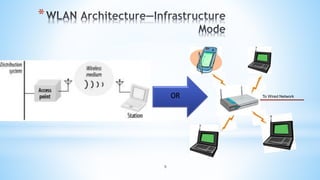
To Wired NetworkOR
10
*
*WiMax is a radio technology that promises to deliver
two-way Internet access at speeds of up to 75 Mbps
at long range.
*Its backers claim that WiMax can transmit data up
to 30 miles between broadcast towers and can
blanket areas more than a mile in radius with
bandwidth that exceeds current DSL and cable
broadband capabilities.
*So, some believe that it could slash the cost of
bringing broadband to remote areas.
11
*
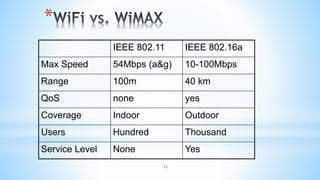
IEEE 802.11 IEEE 802.16a
Max Speed 54Mbps (a&g) 10-100Mbps
Range 100m 40 km
QoS none yes
Coverage Indoor Outdoor
Users Hundred Thousand
Service Level None Yes
12
*
*Short For or Gigabit Wireless.
*Gi-fi is the world's first transceiver integrated on a single
chip that operates at 60GHz on the CMOS process.
* Gi-Fi allows wireless transfer of audio and video data
up to 5 gigabits per second
*Gi-Fi is ten times the current maximum wireless transfer
rate usually within a range of 10 meters.
13
*
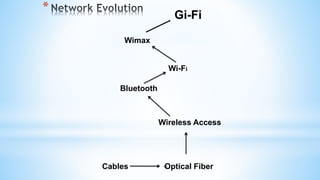
Cables Optical Fiber
Wireless Access
Bluetooth
Wi-Fi
Wimax
Gi-Fi
14
*
*High speed of data transfer.
*Low power consumption
*High Security
*Cost Effective
*Small size
*Quick Deployment
*Highly portable,High Mobility
15
*
*
*Short for Light fidelity.
*At the heart of this technology is a new generation of
high brightness light emitting diodes.
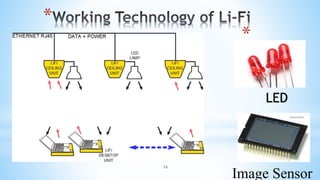
*It is possible to encode data in the light by varying the
rate at which the LED’s flicker on and off to give
different strings 1s and 0s.
*Li-Fi is a term, one used to describe visible light
communication technology applied to high speed
wireless communication.
16
*
*
LED
Image Sensor
17
*
**Green information technology
*Lighting points Used as Hotspots
*Can be used in hospitals and even underwater
*
*
*Li-Fi doesn’t work in the dark or outdoors.
*Li-Fi has a big drawback compared to Wi-Fi, unlike wi-
Fi we cannot move to other rooms unless there are wired
bulbs too.
18
*
*Wi-Fi gives us the point-to-multiple point internet
facility, by which we can create the Wi-Fi hotspot zone
anywhere.
*Wi-Max completely revaluated the business world for
the faster internet facility.
*Gi-Fi follows the tradition of Li-Fi. More and more
research should be done in the field of these new
wireless technology and its applications.
*Now according to the demand of consumers we
introduced the Li-Fi technology for more than 1 Gbps
speed.
19
*
*ISTP Journal of Research in Electrical and Electronics
Engineering (ISTP-JREEE)
*Wikipedia -> http://en.m.wikipedia.org?wiki?wireless
*www.cisco.com/wireless_networking
*http://www.slideshare.net/accessallow/lifi technology
*http://www.slideshare.net/tapeshchalisgaonkar1/gi-fi-
technology-finl-ppt
20
*Now,
Wireless Live
Demonstration
21
*THANK
YOU
YR

Future of Telecommunication Technologies

  • 1.
  • 2.
    2 CONTENTS * Introduction * WI-FI *WIMAX * GI-FI * LI-FI * Conclusion Live Wireless Demonstration
  • 3.
    3 * *Short for wirelessfidelity. *It is a wireless technology that uses radio frequency to transmit data through the air. * Wi-Fi is based on the 802.11 standard *802.11a *802.11b *802.11g
  • 4.
    4 * *IEEE (Institute ofElectrical and Electronics Engineers) established the 802.11 Group in 1990. Specifications for standard ratified in 1997. *Initial speeds were 1 and 2 Mbps. *IEEE modified the standard in 1999 to include: *802.11b *802.11a *802.11g was added in 2003. *IEEE Created standard, but Wi-Fi Alliance certifies products
  • 5.
    5 * *The Wi-Fi CERTIFIEDlogo from the Wi-Fi Alliance. *Rigorous interoperability testing requirements. *Certifies the interoperability of 802.11 products from the many different vendors.
  • 6.
    6 * *Freedom – Youcan work from any location that you can get a signal. *Setup Cost – No cabling required. *Flexibility – Quick and easy to setup in temp or permanent space. *Scaleable – Can be expanded with growth. *Mobile Access – Can access the network on the move.
  • 7.
    7 * *Speed – Slowerthan cable. *Range – Affected by various medium. *Travels best through open space. *Reduced by walls, glass, water, etc *Security – Greater exposure to risks. *Unauthorized access. *Compromising data. *Denial of service.
  • 8.
    8 * Standard Speed Freqband Notes *802.11 2 Mbps 2.4 GHz (1997) *802.11a 54 Mbps 5 GHz (1999) *802.11g 54 Mbps 2.4 GHz *802.11n 600 Mbps 2.4/5 GHz * *Wired Equivalency Protocol (WEP) *Wi-Fi Protected Access (WPA) *Wi-Fi Protected Access 2 (WPA2) *Extended EAP(Extensible Authentication Protocol)
  • 9.
  • 10.
    10 * *WiMax is aradio technology that promises to deliver two-way Internet access at speeds of up to 75 Mbps at long range. *Its backers claim that WiMax can transmit data up to 30 miles between broadcast towers and can blanket areas more than a mile in radius with bandwidth that exceeds current DSL and cable broadband capabilities. *So, some believe that it could slash the cost of bringing broadband to remote areas.
  • 11.
    11 * IEEE 802.11 IEEE802.16a Max Speed 54Mbps (a&g) 10-100Mbps Range 100m 40 km QoS none yes Coverage Indoor Outdoor Users Hundred Thousand Service Level None Yes
  • 12.
    12 * *Short For orGigabit Wireless. *Gi-fi is the world's first transceiver integrated on a single chip that operates at 60GHz on the CMOS process. * Gi-Fi allows wireless transfer of audio and video data up to 5 gigabits per second *Gi-Fi is ten times the current maximum wireless transfer rate usually within a range of 10 meters.
  • 13.
    13 * Cables Optical Fiber WirelessAccess Bluetooth Wi-Fi Wimax Gi-Fi
  • 14.
    14 * *High speed ofdata transfer. *Low power consumption *High Security *Cost Effective *Small size *Quick Deployment *Highly portable,High Mobility
  • 15.
    15 * * *Short for Lightfidelity. *At the heart of this technology is a new generation of high brightness light emitting diodes. *It is possible to encode data in the light by varying the rate at which the LED’s flicker on and off to give different strings 1s and 0s. *Li-Fi is a term, one used to describe visible light communication technology applied to high speed wireless communication.
  • 16.
  • 17.
    17 * **Green information technology *Lightingpoints Used as Hotspots *Can be used in hospitals and even underwater * * *Li-Fi doesn’t work in the dark or outdoors. *Li-Fi has a big drawback compared to Wi-Fi, unlike wi- Fi we cannot move to other rooms unless there are wired bulbs too.
  • 18.
    18 * *Wi-Fi gives usthe point-to-multiple point internet facility, by which we can create the Wi-Fi hotspot zone anywhere. *Wi-Max completely revaluated the business world for the faster internet facility. *Gi-Fi follows the tradition of Li-Fi. More and more research should be done in the field of these new wireless technology and its applications. *Now according to the demand of consumers we introduced the Li-Fi technology for more than 1 Gbps speed.
  • 19.
    19 * *ISTP Journal ofResearch in Electrical and Electronics Engineering (ISTP-JREEE) *Wikipedia -> http://en.m.wikipedia.org?wiki?wireless *www.cisco.com/wireless_networking *http://www.slideshare.net/accessallow/lifi technology *http://www.slideshare.net/tapeshchalisgaonkar1/gi-fi- technology-finl-ppt
  • 20.
  • 21.