JISC Research Conference 19 th  October 2010 Plenary Address Professor Paul Curran  Vice-Chancellor City University London
Traditional academic paradox Academic culture is collegial and inherently  collaborative  Academics  compete  for resources, prestige and position
A collaborative culture was formalised in University funding arrangements University Grants Committee Proposition 7 (1948): ‘ Public money should not be used to compete against itself’
From 1980s an increasinly competitive culture was formalised in university funding arrangements 1985:  University Grants Committee concluded that research quality is a basis for differential funding and competition 1992:  Research funding linked to Research Assessment Exercise outcomes and research competition increased 1990s:  Increased competition for postgraduates, international students and enterprise activity 2006:  Fees, but not high enough to create teaching competition  2012:  High fees and teaching competition to increase
Universities are increasingly competitive  However, academics ignore institutional boundaries and continue to:   Appoint external advisors on senior appointment committees  and Departmental Reviews Share sensitive data (e.g., salaries)  Research and teach together & Interaction between senior staff (e.g., VCs) is routine
The most competitive universities are often the most collaborative  Universities must collaborate in some areas to compete:   International student exchange Joint Masters and Doctoral programmes Joint publication and bids for funding by academic staff Networks of like-minded institutions   Illustrate using networks in general and WC2 network in particular
National and international networks Informal networks National networks (Russell Group, University Alliance, 94 Group, Million+) Large international networks (Universitas 21, WUN, Pacific Rim) Small international networks (mainly technology-based)
International collaboration Research and mainly graduate education ( Erasmus Mundus  etc.) UK: 1% of the world’s population; 5% of the world’s scientific research; 14% of the world’s most highly cited papers UK’s major partners in papers are the US (30%), Germany (14%), France (11%) and Japan, Australia, Canada, China, India (less than 7% each) About half of the postgraduate students in the UK come from abroad Inward  Erasmus  student flow to the UK is 2.3 times greater than outward student flow
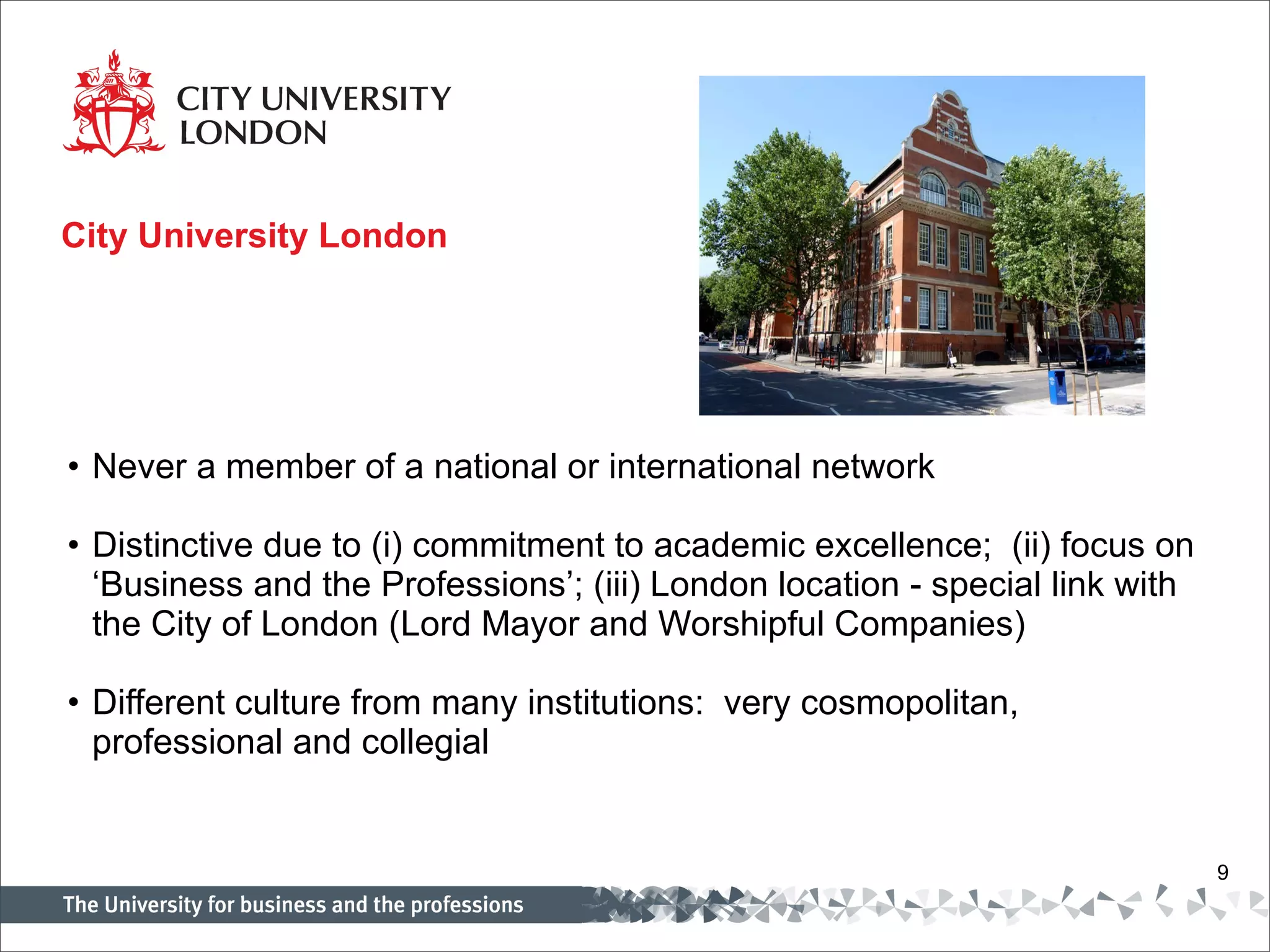
City University London Never a member of a national or international network Distinctive due to (i) commitment to academic excellence;  (ii) focus on ‘Business and the Professions’; (iii) London location - special link with the City of London (Lord Mayor and Worshipful Companies) Different culture from many institutions:  very cosmopolitan, professional and collegial
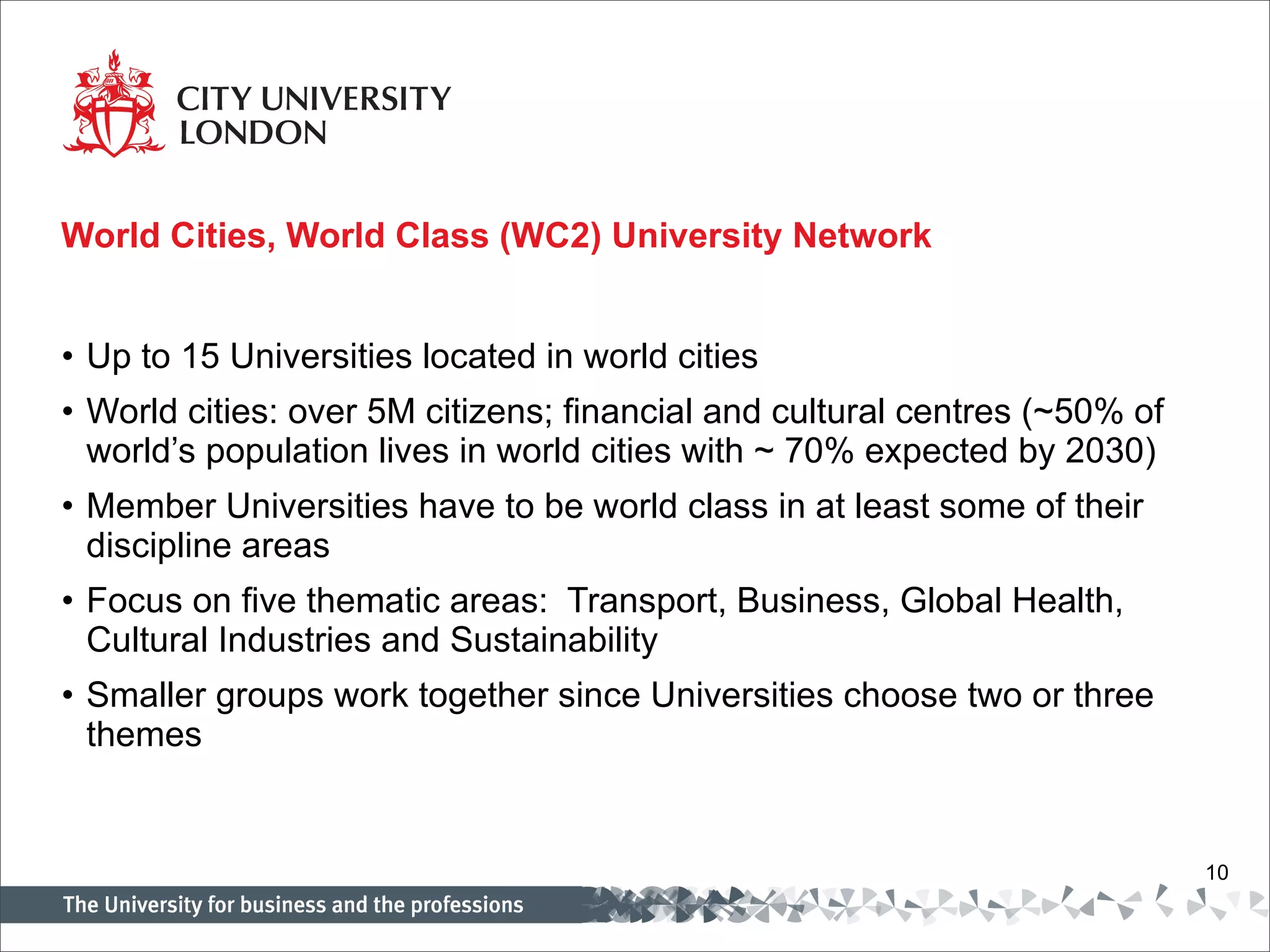
World Cities, World Class (WC2) University Network Up to 15 Universities located in world cities World cities: over 5M citizens; financial and cultural centres (~50% of world’s population lives in world cities with ~ 70% expected by 2030) Member Universities have to be world class in at least some of their discipline areas Focus on five thematic areas:  Transport, Business, Global Health, Cultural Industries and Sustainability Smaller groups work together since Universities choose two or three themes
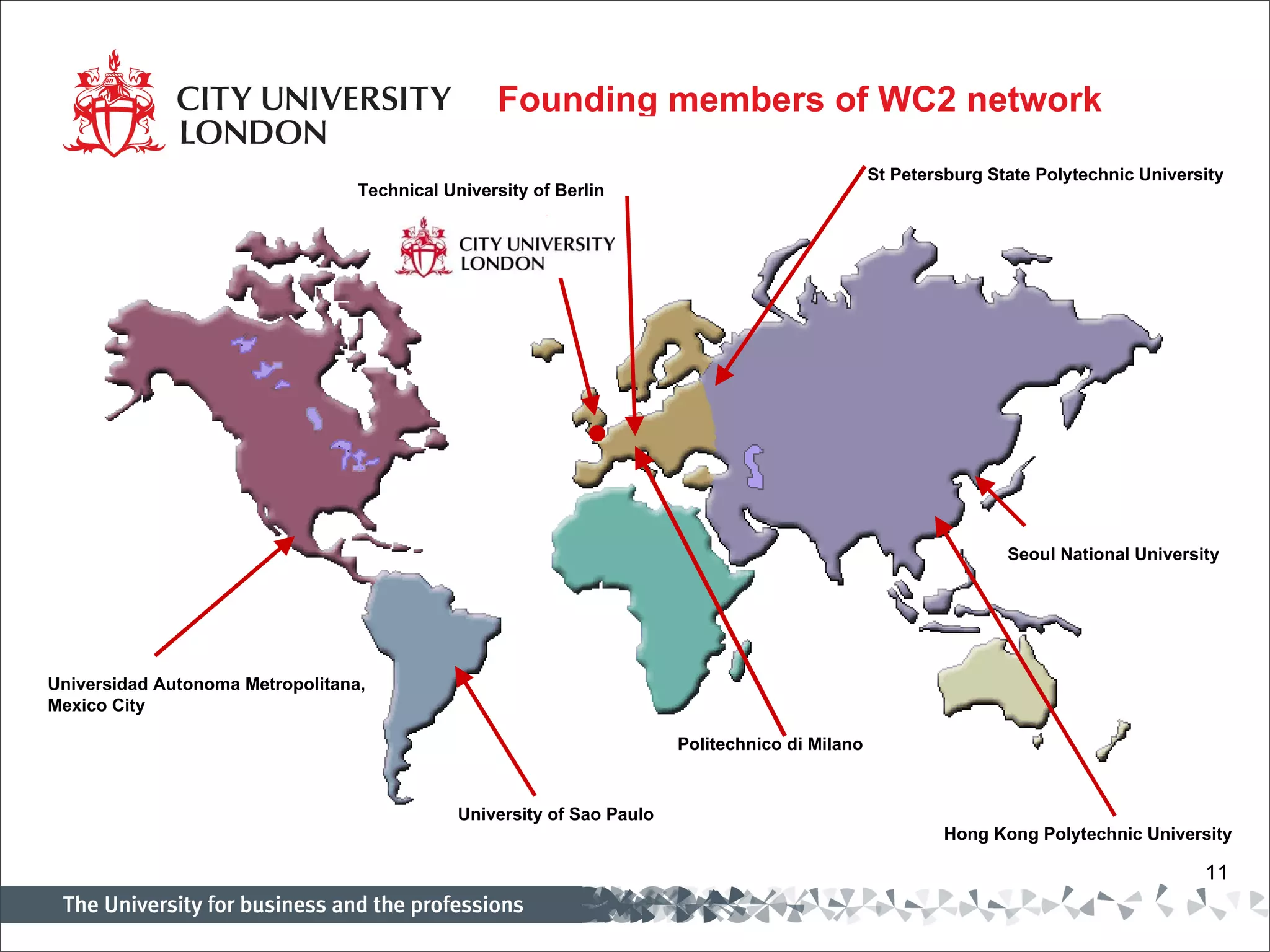
Politechnico di Milano Hong Kong Polytechnic University St Petersburg State Polytechnic University Seoul National University Technical University of Berlin Universidad Autonoma Metropolitana,  Mexico City University of Sao Paulo Founding members of WC2 network
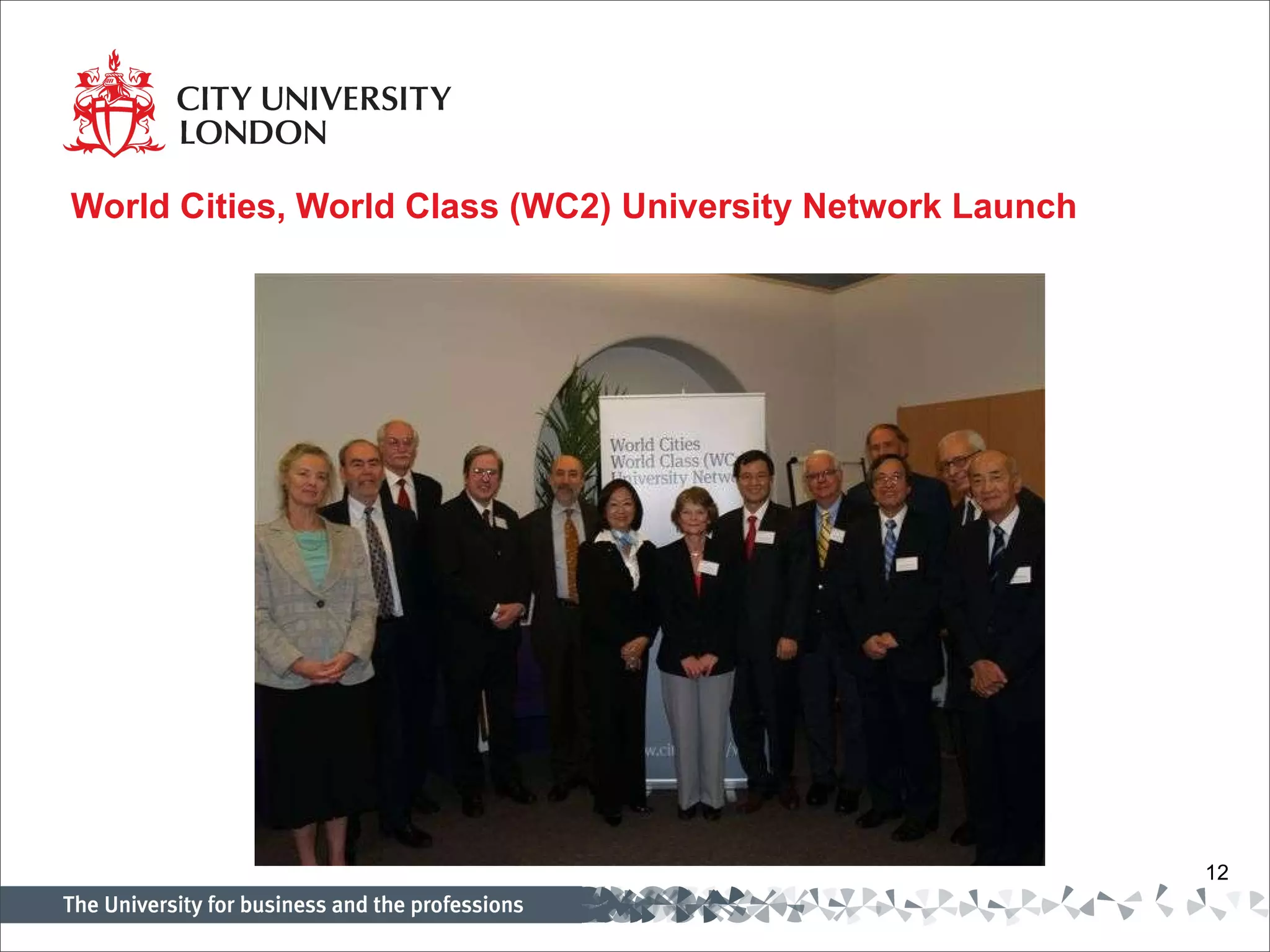
World Cities, World Class (WC2) University Network Launch
World Cities, World Class (WC2) University Network No fees (universities select level of investment) Meetings every six months in rotating venues Doctoral students as WC2 scholars (exchange scholars) Top down approach with Presidents/Vice-Presidents driving the network React quickly to international (e.g.,  EU) and national government proposals Improve global rankings through increased grant winning and publications
Three parallel sessions to explore ‘collaboration in a competitive environment’   Session 1:   Research beyond institutional boundaries ,  Chair: Professor Rob Macredie, Brunel University   Session 2:   The ‘open road to competitiveness ’,  Chair: Matthew Dovey, JISC   Session 3:   Collaboration: growing benefit or necessary evil?,  Chair:  Jonathan Adams, Research Evaluation  

Future of Research Plenary Presentation

  • 1.
    JISC Research Conference19 th October 2010 Plenary Address Professor Paul Curran Vice-Chancellor City University London
  • 2.
    Traditional academic paradoxAcademic culture is collegial and inherently collaborative Academics compete for resources, prestige and position
  • 3.
    A collaborative culturewas formalised in University funding arrangements University Grants Committee Proposition 7 (1948): ‘ Public money should not be used to compete against itself’
  • 4.
    From 1980s anincreasinly competitive culture was formalised in university funding arrangements 1985: University Grants Committee concluded that research quality is a basis for differential funding and competition 1992: Research funding linked to Research Assessment Exercise outcomes and research competition increased 1990s: Increased competition for postgraduates, international students and enterprise activity 2006: Fees, but not high enough to create teaching competition 2012: High fees and teaching competition to increase
  • 5.
    Universities are increasinglycompetitive However, academics ignore institutional boundaries and continue to:   Appoint external advisors on senior appointment committees and Departmental Reviews Share sensitive data (e.g., salaries) Research and teach together & Interaction between senior staff (e.g., VCs) is routine
  • 6.
    The most competitiveuniversities are often the most collaborative Universities must collaborate in some areas to compete:   International student exchange Joint Masters and Doctoral programmes Joint publication and bids for funding by academic staff Networks of like-minded institutions   Illustrate using networks in general and WC2 network in particular
  • 7.
    National and internationalnetworks Informal networks National networks (Russell Group, University Alliance, 94 Group, Million+) Large international networks (Universitas 21, WUN, Pacific Rim) Small international networks (mainly technology-based)
  • 8.
    International collaboration Researchand mainly graduate education ( Erasmus Mundus etc.) UK: 1% of the world’s population; 5% of the world’s scientific research; 14% of the world’s most highly cited papers UK’s major partners in papers are the US (30%), Germany (14%), France (11%) and Japan, Australia, Canada, China, India (less than 7% each) About half of the postgraduate students in the UK come from abroad Inward Erasmus student flow to the UK is 2.3 times greater than outward student flow
  • 9.
    City University LondonNever a member of a national or international network Distinctive due to (i) commitment to academic excellence; (ii) focus on ‘Business and the Professions’; (iii) London location - special link with the City of London (Lord Mayor and Worshipful Companies) Different culture from many institutions: very cosmopolitan, professional and collegial
  • 10.
    World Cities, WorldClass (WC2) University Network Up to 15 Universities located in world cities World cities: over 5M citizens; financial and cultural centres (~50% of world’s population lives in world cities with ~ 70% expected by 2030) Member Universities have to be world class in at least some of their discipline areas Focus on five thematic areas: Transport, Business, Global Health, Cultural Industries and Sustainability Smaller groups work together since Universities choose two or three themes
  • 11.
    Politechnico di MilanoHong Kong Polytechnic University St Petersburg State Polytechnic University Seoul National University Technical University of Berlin Universidad Autonoma Metropolitana, Mexico City University of Sao Paulo Founding members of WC2 network
  • 12.
    World Cities, WorldClass (WC2) University Network Launch
  • 13.
    World Cities, WorldClass (WC2) University Network No fees (universities select level of investment) Meetings every six months in rotating venues Doctoral students as WC2 scholars (exchange scholars) Top down approach with Presidents/Vice-Presidents driving the network React quickly to international (e.g., EU) and national government proposals Improve global rankings through increased grant winning and publications
  • 14.
    Three parallel sessionsto explore ‘collaboration in a competitive environment’   Session 1: Research beyond institutional boundaries , Chair: Professor Rob Macredie, Brunel University   Session 2: The ‘open road to competitiveness ’, Chair: Matthew Dovey, JISC   Session 3: Collaboration: growing benefit or necessary evil?, Chair: Jonathan Adams, Research Evaluation