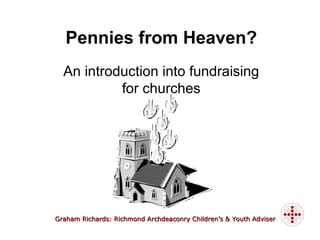
Pennies from Heaven? An introduction into fundraising for churches
Most important lesson of the session: Why do people support charitable causes? Because someone asked them! Most important lesson of the session: Why do people support charitable causes? Because someone asked them! Most important lesson of the session: Why do people support charitable causes? Because someone asked them!
The second lesson is similar: People are more likely to give, and give more, when asked by someone they know… … so ask others to ask others to ask others…
The third point to learn is that: Fundraising is all about Passion Passion is what sells the need to the potential donor If those asking are passionate about their cause, they will express it Help people to feel that they “own” the project too They need to feel that it represents their values & beliefs
So what have we learnt so far? The most important thing is to  ask People like  familiarity , that is, to be asked by people they know We need to be  passionate  about our cause We need to help people  identify  with our cause
A few glossary terms I might slip in without thinking: Warm contacts  = people with some connection to us Cold contacts  = people we have no previous links with ROI  = return on investment (You can only raise £ by spending £) Any others – stop me and ask!
Let’s look at the very basics, where you have to start from before raising funds: What are you fundraising for? Equipment? Activities? Staff? Facilities (capital projects)?
How much do you need to raise? How much have you already raised from within the church community? The total needed will determine what type(s) of fundraising you need to undertake Is it all needed at the same time? Can it be phased in stages?
What is the project’s timescale? When is it needed by? What progress has already taken place? What are the stages the project needs to go through? Is there a deadline for  making decisions?
What is your evidence base? What  quantitative  evidence do you have for your project? Numbers/statistics/costs/future forecasts/etc What  qualitative  evidence do you have for your project? People’s views, opinions and beliefs Gathered through interviews, focus groups, questionnaires, etc You need to show clearly your sources for the above (how you gathered the evidence) Have you carried out a STEP analysis? (These are external factors beyond your control) S ocial T echnological E conomic P olitical
What are the projected outcomes for your project? Quantitative & Qualitative Need to show clear outcomes Need to show how this evidence will be collected & measured Need to present this evidence after it has been gathered (i.e. Annual Report, newsletters, updates, etc)
What is Plan B?
Basics two: Who are your target audiences? You need to identify who the people are you are going to approach for funding. This may vary according to the type of funding you are after. For example: Large capital projects : Trusts, wealthy individuals, corporate businesses, landfill tax credit companies Medium-sized projects : Trusts, wealthy individuals, regional businesses, landfill tax credit, other significant individuals Small-sized projects : local trusts, local businesses, your own church membership, the local community (neighbours, schools, organisations
A useful tool to help identify who all your stakeholders and potential donor targets are is this:
 
Types of Fundraising Three of the most common types of fundraising: 1. Trusts These specific types of charity give grants to other charities They each have a Trust Deed Determines their criteria for making grants Says what they can and can’t fund Look for those who state: “General charitable purposes” A few will give to religious purposes, most specifically say they don’t Use the services of your local Council for Voluntary Services (CVS) to find trusts Most offer a “FunderFinder” service (for free or a small charge) It matches your need criteria to trusts’ grant-making criteria There is a right way and a wrong way to write Trust applications National average rejection rate is 90% One third of applicants are ineligible! If in doubt, seek professional advice and support
Types of Fundraising 2. Major Donors This refers to wealthy individuals who can be approached to make a significant donation It is a highly specialised area of fundraising Unless you have someone managing your campaign who either has warm “rich” contacts or knows people who know them, seek professional help These people, along with trusts can make or break an appeal An appeal only  goes “public” once a significant proportion of the funding has been raised
Types of Fundraising 3. Events What most people associate with fundraising They take a lot of time and money to put on and the ROI (return on investment) isn’t usually that good compared to trusts, major donors, etc They are needed in the public phase of an appeal as part of the getting people onboard However, they are great for smaller fundraising projects & can be very creative!
4. Don’t forget to Worth an extra 28p per £1 (will go down to 25p per £1 in April 2011) You can only ask for it if you are a registered charity or church with charitable status
Fundraising books and online services Fundraising for Churches  by Jane Grieve (now Revd Jane Grieve) Pub: SPCK From:  www.amazon.co.uk  used from as little as 1p + p&p! Successful Fundraising  by John Baguley Pub: Bibliotech Books From: £13.50 on  www.amazon.co.uk Capital Campaigns  by Trudy Hayden Pub: DSC From: £17.59 on  www.amazon.co.uk Major Donor Fundraising  by Margaret M Holman & Lucy Sargent Pub: DSC From: £21.80 on  www.amazon.co.uk Find the Funds – a new approach to fundraising research  by Christopher Carnie Pub: DSC From: £4.50 used on  www.amazon.co.uk The Porcupine Principle & other fundraising secrets  by Jonathan Farnhill  Pub: DSC From £4.50 used on  www.amazon.co.uk The directory of Grant-making Trusts 2010 -2011 Pub: DSC Cost: £125 Check out the  Directory of Social Change’s  online bookshop at:  http:// www.dsc.org.uk /Publications A great source of books on all aspects of fundraising,  project development & management for charities and voluntary groups
Online Trust Databases DSC’s  www.trusfunding.org.uk  is an online database with annual subs starting at £287.88 for one user FunderFinder’s similar service is at:  http:// www.funderfinder.org.uk/gin.php  You need to subscribe to Groups in Need (GIN) and not their PIN service. Costs £185 + VAT for up to 500 browser sessions. They also offer a handy 24 hour unlimited search option for £10 inc VAT (Don’t forget your local CVS may have FunderFinder and offer a service to local voluntary organisations)
Fundraising – the Christian approach There are strong biblical precedents to follow: Tithing First Fruits Regular Giving Sacrifice If the fundraising you need to do is to repair the church building, then that is a public matter. The community “own” the local church, not the Christians* who use it. *They themselves are The Church.  So go public, ask the community to support your appeal. If the fundraising is for something that The Church wants to do, it is a spiritual, Christian concern. We should not expect Joe Public to foot the bill. It is up to The Church members to raise the funds, mostly from within The Church (locally or nationally). If the project has community implications too, that is, the local community will share the benefits of the project, then it is fair to ask them to support those aspects that they will benefit from.
The first example of regular committed fundraising? Paul motivates his church donors   As he travelled round the eastern Mediterranean on his missionary journeys during the 50s AD, Paul heard about the severe famine that was affecting Jerusalem.  So he appealed to the different churches to collect money to send off.  In his first letter to the church in Corinth (1 Cor 16, 1-4) he asked them to set aside a proportion of their income each week, so he would get a better result than a single one-off appeal.  He explained that this is what the church in Galatia (central Turkey) was already doing  - and that was a much poorer and war-torn region than the prosperous Corinth seaport.    In his second letter (2 Cor 8-9) Paul provides a much lengthier theological rationale about Christian generosity and the grace of God.  This time he compares the Corinthian’s initial efforts to those of the churches in Macedonia (northern Greece), even though the latter were also suffering ‘extreme poverty’.
Learning points A clear fundraising objective – the relief of the famine in Jerusalem. Using comparisons with other fundraising groups (churches) – peer pressure. The sacrificial giving of churches despite being in hardship and poverty. Using regular (weekly) giving to build up a bigger final total.  Putting fundraising first in people’s spending priorities  (‘On the first day of every week, each one of you should set aside a sum of money…’  And,  ‘Give first to the Lord.’ )  Developing the ancient Jewish tradition of giving a proportion of income  (‘a sum of money   in keeping with your income …’  .  Jews were taught to give a variety of donations to God’s work, including the regular tithe (10 per cent of income) and other one-off or annual gifts.   Thanking the Corinthians for their past generosity – and encouraging them to do even better in future. Providing someone reliable (Titus) to oversee & take the collection to Jerusalem. Encouraging the Corinthians to send their own people to Jerusalem to monitor that the money was spent effectively (accountability). Teaching that donor’s gifts should be motivated by God’s generosity in providing their physical wealth and well-being, and spiritual salvation through Jesus’ death and resurrection.
Giving Volunteer Fundraisers Ideas There are lots of other causes with some amazing pages on their website giving ideas for their fundraising volunteers.  Why not have a glance through a few before coming up with your own ideas... here are some of the best I have found: Blue Cross An A-Z of fundraising ideas for their event fundraisers http://www.bluecross.org.uk/web/site/Fundraising/AZFundraising.asp Youthnet 20 general fundraising ideas (including Social networking) http://www.youthnet.org/getinvolved/challengeevents/fundraisingideas Macmillan Have a little green book of fundraising ideas... downloadable from.. http://www.macmillan.org.uk/Fundraising/FundraisingIdeas/FundraisingIdeas.aspx Red Nose Day Ideas in a nicely presented way for their 2009 event http:// www.rednoseday.com/do_something/fundraising_ideas World Lane Trust Another list of 20 ideas http://www.worldlandtrust.org/education/top20.htm Princes Trust Another handy list http://www.princes-trust.org.uk/support_us/fundraise/fundraising_ideas.aspx Charity Challenge One of the most comprehensive lists comes from Charity Challenge, the active event company http://www.charitychallenge.com/pdf/A-Z_of_Fundraising_Ideas.pdf
Thank you for coming I’m happy to answer questions afterwards if there is time

Fundraising for churches

  • 1.
    Pennies from Heaven?An introduction into fundraising for churches
  • 2.
    Most important lessonof the session: Why do people support charitable causes? Because someone asked them! Most important lesson of the session: Why do people support charitable causes? Because someone asked them! Most important lesson of the session: Why do people support charitable causes? Because someone asked them!
  • 3.
    The second lessonis similar: People are more likely to give, and give more, when asked by someone they know… … so ask others to ask others to ask others…
  • 4.
    The third pointto learn is that: Fundraising is all about Passion Passion is what sells the need to the potential donor If those asking are passionate about their cause, they will express it Help people to feel that they “own” the project too They need to feel that it represents their values & beliefs
  • 5.
    So what havewe learnt so far? The most important thing is to ask People like familiarity , that is, to be asked by people they know We need to be passionate about our cause We need to help people identify with our cause
  • 6.
    A few glossaryterms I might slip in without thinking: Warm contacts = people with some connection to us Cold contacts = people we have no previous links with ROI = return on investment (You can only raise £ by spending £) Any others – stop me and ask!
  • 7.
    Let’s look atthe very basics, where you have to start from before raising funds: What are you fundraising for? Equipment? Activities? Staff? Facilities (capital projects)?
  • 8.
    How much doyou need to raise? How much have you already raised from within the church community? The total needed will determine what type(s) of fundraising you need to undertake Is it all needed at the same time? Can it be phased in stages?
  • 9.
    What is theproject’s timescale? When is it needed by? What progress has already taken place? What are the stages the project needs to go through? Is there a deadline for making decisions?
  • 10.
    What is yourevidence base? What quantitative evidence do you have for your project? Numbers/statistics/costs/future forecasts/etc What qualitative evidence do you have for your project? People’s views, opinions and beliefs Gathered through interviews, focus groups, questionnaires, etc You need to show clearly your sources for the above (how you gathered the evidence) Have you carried out a STEP analysis? (These are external factors beyond your control) S ocial T echnological E conomic P olitical
  • 11.
    What are theprojected outcomes for your project? Quantitative & Qualitative Need to show clear outcomes Need to show how this evidence will be collected & measured Need to present this evidence after it has been gathered (i.e. Annual Report, newsletters, updates, etc)
  • 12.
  • 13.
    Basics two: Whoare your target audiences? You need to identify who the people are you are going to approach for funding. This may vary according to the type of funding you are after. For example: Large capital projects : Trusts, wealthy individuals, corporate businesses, landfill tax credit companies Medium-sized projects : Trusts, wealthy individuals, regional businesses, landfill tax credit, other significant individuals Small-sized projects : local trusts, local businesses, your own church membership, the local community (neighbours, schools, organisations
  • 14.
    A useful toolto help identify who all your stakeholders and potential donor targets are is this:
  • 15.
  • 16.
    Types of FundraisingThree of the most common types of fundraising: 1. Trusts These specific types of charity give grants to other charities They each have a Trust Deed Determines their criteria for making grants Says what they can and can’t fund Look for those who state: “General charitable purposes” A few will give to religious purposes, most specifically say they don’t Use the services of your local Council for Voluntary Services (CVS) to find trusts Most offer a “FunderFinder” service (for free or a small charge) It matches your need criteria to trusts’ grant-making criteria There is a right way and a wrong way to write Trust applications National average rejection rate is 90% One third of applicants are ineligible! If in doubt, seek professional advice and support
  • 17.
    Types of Fundraising2. Major Donors This refers to wealthy individuals who can be approached to make a significant donation It is a highly specialised area of fundraising Unless you have someone managing your campaign who either has warm “rich” contacts or knows people who know them, seek professional help These people, along with trusts can make or break an appeal An appeal only goes “public” once a significant proportion of the funding has been raised
  • 18.
    Types of Fundraising3. Events What most people associate with fundraising They take a lot of time and money to put on and the ROI (return on investment) isn’t usually that good compared to trusts, major donors, etc They are needed in the public phase of an appeal as part of the getting people onboard However, they are great for smaller fundraising projects & can be very creative!
  • 19.
    4. Don’t forgetto Worth an extra 28p per £1 (will go down to 25p per £1 in April 2011) You can only ask for it if you are a registered charity or church with charitable status
  • 20.
    Fundraising books andonline services Fundraising for Churches by Jane Grieve (now Revd Jane Grieve) Pub: SPCK From: www.amazon.co.uk used from as little as 1p + p&p! Successful Fundraising by John Baguley Pub: Bibliotech Books From: £13.50 on www.amazon.co.uk Capital Campaigns by Trudy Hayden Pub: DSC From: £17.59 on www.amazon.co.uk Major Donor Fundraising by Margaret M Holman & Lucy Sargent Pub: DSC From: £21.80 on www.amazon.co.uk Find the Funds – a new approach to fundraising research by Christopher Carnie Pub: DSC From: £4.50 used on www.amazon.co.uk The Porcupine Principle & other fundraising secrets by Jonathan Farnhill Pub: DSC From £4.50 used on www.amazon.co.uk The directory of Grant-making Trusts 2010 -2011 Pub: DSC Cost: £125 Check out the Directory of Social Change’s online bookshop at: http:// www.dsc.org.uk /Publications A great source of books on all aspects of fundraising, project development & management for charities and voluntary groups
  • 21.
    Online Trust DatabasesDSC’s www.trusfunding.org.uk is an online database with annual subs starting at £287.88 for one user FunderFinder’s similar service is at: http:// www.funderfinder.org.uk/gin.php You need to subscribe to Groups in Need (GIN) and not their PIN service. Costs £185 + VAT for up to 500 browser sessions. They also offer a handy 24 hour unlimited search option for £10 inc VAT (Don’t forget your local CVS may have FunderFinder and offer a service to local voluntary organisations)
  • 22.
    Fundraising – theChristian approach There are strong biblical precedents to follow: Tithing First Fruits Regular Giving Sacrifice If the fundraising you need to do is to repair the church building, then that is a public matter. The community “own” the local church, not the Christians* who use it. *They themselves are The Church. So go public, ask the community to support your appeal. If the fundraising is for something that The Church wants to do, it is a spiritual, Christian concern. We should not expect Joe Public to foot the bill. It is up to The Church members to raise the funds, mostly from within The Church (locally or nationally). If the project has community implications too, that is, the local community will share the benefits of the project, then it is fair to ask them to support those aspects that they will benefit from.
  • 23.
    The first exampleof regular committed fundraising? Paul motivates his church donors As he travelled round the eastern Mediterranean on his missionary journeys during the 50s AD, Paul heard about the severe famine that was affecting Jerusalem.  So he appealed to the different churches to collect money to send off.  In his first letter to the church in Corinth (1 Cor 16, 1-4) he asked them to set aside a proportion of their income each week, so he would get a better result than a single one-off appeal.  He explained that this is what the church in Galatia (central Turkey) was already doing  - and that was a much poorer and war-torn region than the prosperous Corinth seaport.   In his second letter (2 Cor 8-9) Paul provides a much lengthier theological rationale about Christian generosity and the grace of God.  This time he compares the Corinthian’s initial efforts to those of the churches in Macedonia (northern Greece), even though the latter were also suffering ‘extreme poverty’.
  • 24.
    Learning points Aclear fundraising objective – the relief of the famine in Jerusalem. Using comparisons with other fundraising groups (churches) – peer pressure. The sacrificial giving of churches despite being in hardship and poverty. Using regular (weekly) giving to build up a bigger final total. Putting fundraising first in people’s spending priorities (‘On the first day of every week, each one of you should set aside a sum of money…’ And, ‘Give first to the Lord.’ ) Developing the ancient Jewish tradition of giving a proportion of income (‘a sum of money in keeping with your income …’ .  Jews were taught to give a variety of donations to God’s work, including the regular tithe (10 per cent of income) and other one-off or annual gifts.  Thanking the Corinthians for their past generosity – and encouraging them to do even better in future. Providing someone reliable (Titus) to oversee & take the collection to Jerusalem. Encouraging the Corinthians to send their own people to Jerusalem to monitor that the money was spent effectively (accountability). Teaching that donor’s gifts should be motivated by God’s generosity in providing their physical wealth and well-being, and spiritual salvation through Jesus’ death and resurrection.
  • 25.
    Giving Volunteer FundraisersIdeas There are lots of other causes with some amazing pages on their website giving ideas for their fundraising volunteers.  Why not have a glance through a few before coming up with your own ideas... here are some of the best I have found: Blue Cross An A-Z of fundraising ideas for their event fundraisers http://www.bluecross.org.uk/web/site/Fundraising/AZFundraising.asp Youthnet 20 general fundraising ideas (including Social networking) http://www.youthnet.org/getinvolved/challengeevents/fundraisingideas Macmillan Have a little green book of fundraising ideas... downloadable from.. http://www.macmillan.org.uk/Fundraising/FundraisingIdeas/FundraisingIdeas.aspx Red Nose Day Ideas in a nicely presented way for their 2009 event http:// www.rednoseday.com/do_something/fundraising_ideas World Lane Trust Another list of 20 ideas http://www.worldlandtrust.org/education/top20.htm Princes Trust Another handy list http://www.princes-trust.org.uk/support_us/fundraise/fundraising_ideas.aspx Charity Challenge One of the most comprehensive lists comes from Charity Challenge, the active event company http://www.charitychallenge.com/pdf/A-Z_of_Fundraising_Ideas.pdf
  • 26.
    Thank you forcoming I’m happy to answer questions afterwards if there is time