Interagency Session
   NSPD-59 and Identity Management


Duane Blackburn
Office of Science and Technology Policy
Executive Office of the President

September 22, 2009


                                          Biometrics.gov
Interagency Session
                          NSPD-59

Duane Blackburn
Office of Science and Technology Policy
Executive Office of the President


                                          Biometrics.gov
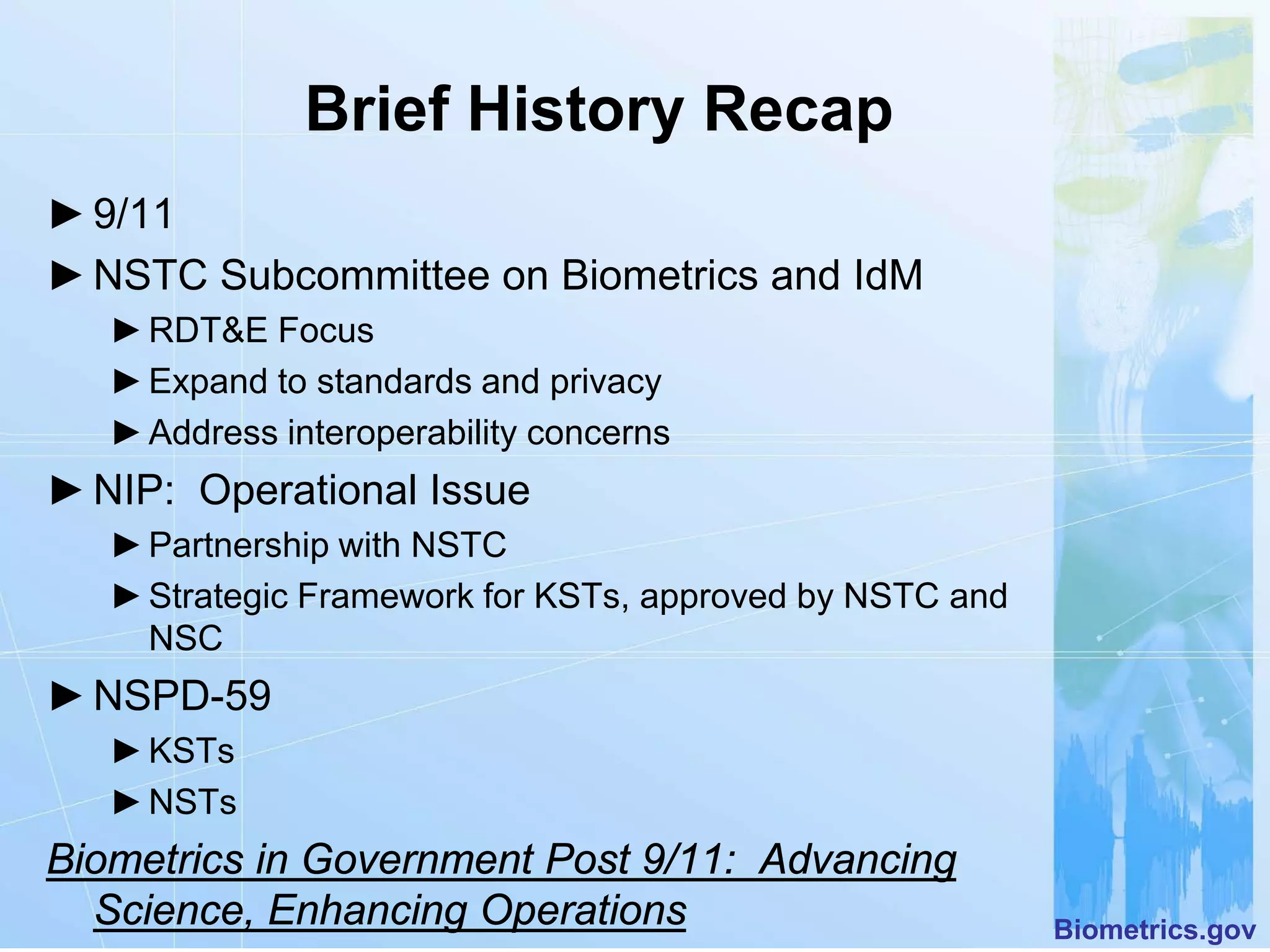
Brief History Recap
► 9/11
► NSTC Subcommittee on Biometrics and IdM
   ► RDT&E Focus
   ► Expand to standards and privacy
   ► Address interoperability concerns
► NIP: Operational Issue
   ► Partnership with NSTC
   ► Strategic Framework for KSTs, approved by NSTC and
     NSC
► NSPD-59
   ► KSTs
   ► NSTs
Biometrics in Government Post 9/11: Advancing
  Science, Enhancing Operations                           Biometrics.gov
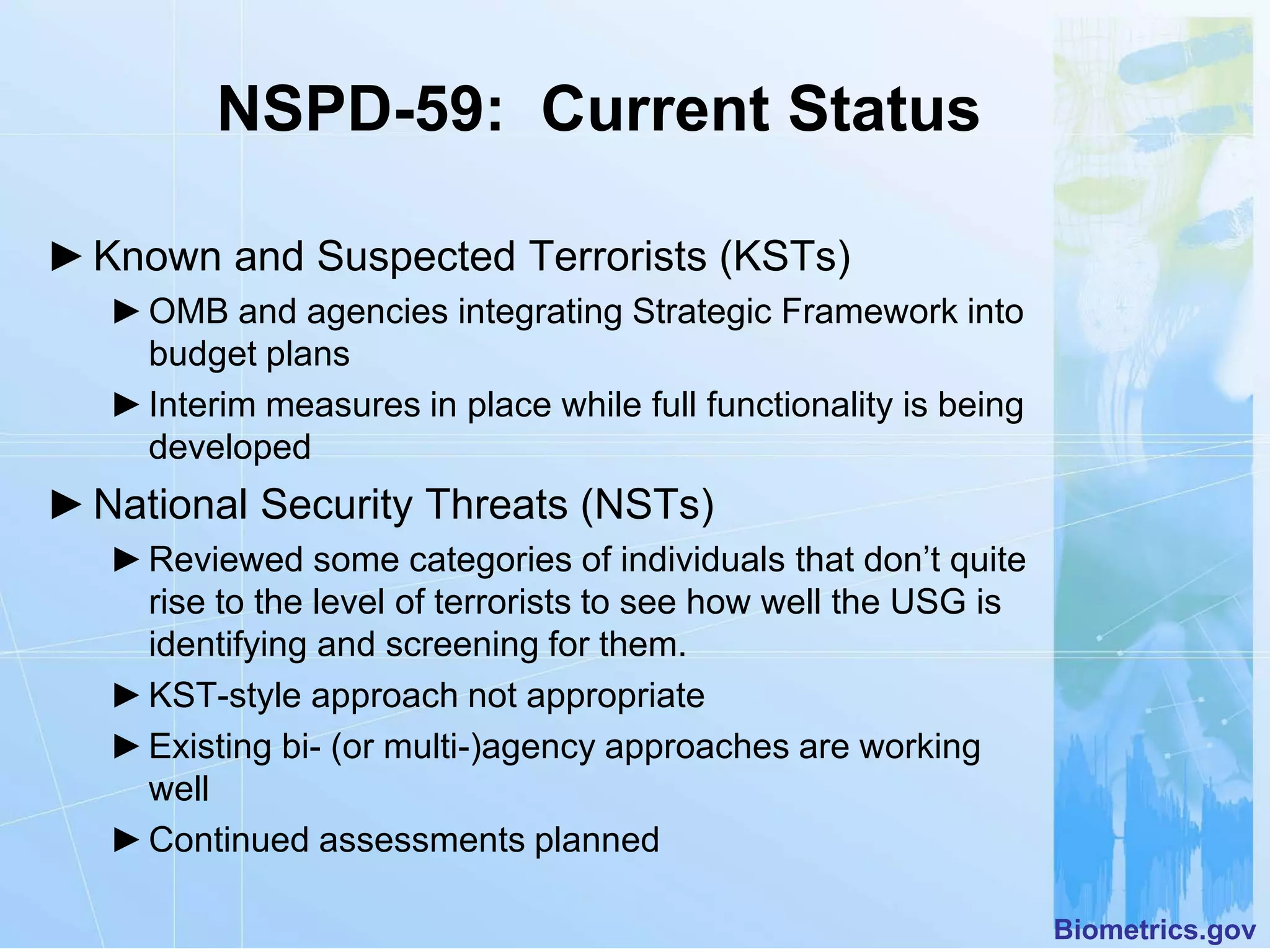
NSPD-59: Current Status

► Known and Suspected Terrorists (KSTs)
   ► OMB and agencies integrating Strategic Framework into
     budget plans
   ► Interim measures in place while full functionality is being
     developed
► National Security Threats (NSTs)
   ► Reviewed some categories of individuals that don’t quite
     rise to the level of terrorists to see how well the USG is
     identifying and screening for them.
   ► KST-style approach not appropriate
   ► Existing bi- (or multi-)agency approaches are working
     well
   ► Continued assessments planned

                                                                   Biometrics.gov
NSPD-59: FAQs

► How can biometrics community help?
   ► Standards; RDT&E
   ► “Biometrics PD” is a misnomer
► How has the administration change impacted PD
  activities?
   ► Key thrusts and personnel remain unchanged
   ► Consolidation of HSC and NSC has been beneficial
► Can the PD be considered a success?
   ► Pros: Raised stature of efforts with incoming
     appointees
   ► Cons: Development of PD took lots of time and effort
     that we are still trying to recover from; addition of
     concurrent NST thrust sapped resources
   ► Summation: Ask me in five years!                        Biometrics.gov
Interagency Session
               Identity Management

Duane Blackburn
Office of Science and Technology Policy
Executive Office of the President


                                          Biometrics.gov
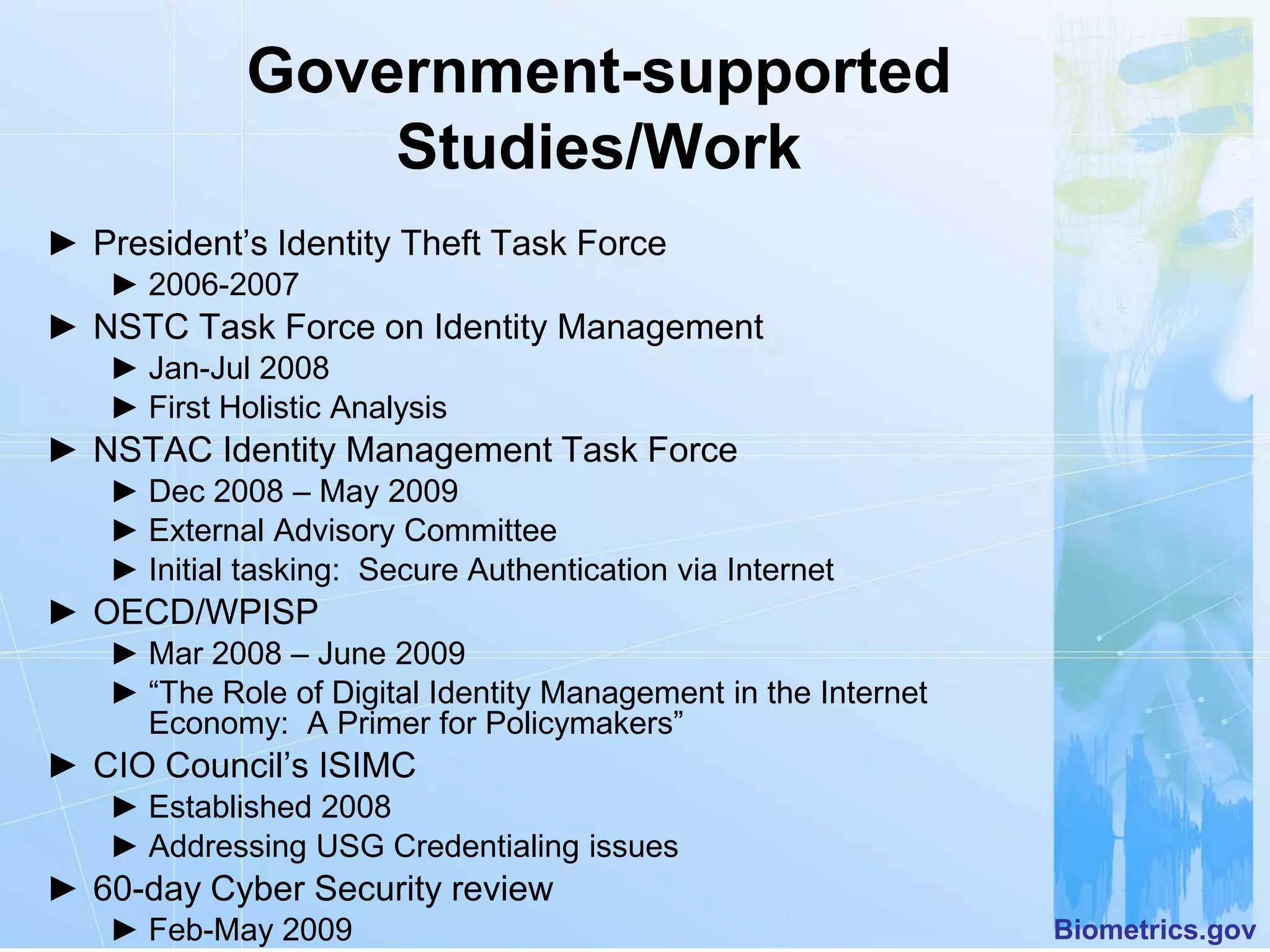
Government-supported
                 Studies/Work
► President’s Identity Theft Task Force
   ► 2006-2007
► NSTC Task Force on Identity Management
   ► Jan-Jul 2008
   ► First Holistic Analysis
► NSTAC Identity Management Task Force
   ► Dec 2008 – May 2009
   ► External Advisory Committee
   ► Initial tasking: Secure Authentication via Internet
► OECD/WPISP
   ► Mar 2008 – June 2009
   ► “The Role of Digital Identity Management in the Internet
     Economy: A Primer for Policymakers”
► CIO Council’s ISIMC
   ► Established 2008
   ► Addressing USG Credentialing issues
► 60-day Cyber Security review
   ► Feb-May 2009                                               Biometrics.gov
Common Themes - Importance

► Identity Management is a critical, though often
  underappreciated, component of successful
  applications in a variety of sectors
► IdM can help remove barriers to collaboration and
  innovation by ensuring trust
► People/things have only one “true” identity, but
  several aliases with varying degrees of
  confidence in the linkages to the “true” identity.
   ► How to enable and manage these identities properly in
     a single application is difficult, but is even more difficult
     across interconnected systems
► IdM activities in one application impacts and
  relies upon others, though these impacts aren’t
  normally understood or accounted for                               Biometrics.gov
Common Themes – R&D

► Technology available now is good, but
  improvements are needed to improve
  capabilities, resiliency, privacy protection,
  convenience and security
► Research is needed on how to best combine
  different technologies
► Researcher access to useful data is an inhibitor
► Side to side comparisons of technology options is
  difficult/confusing and isn’t keeping pace with
  new products


                                                      Biometrics.gov
Common Themes - Standards

► Interoperability is difficult if the systems do not
  share definitions and data structures
   ► Increases the chance of errors, which would be
     propagated throughout the interconnected systems
► Market-based and consensus-supported
  standards most likely to be universally accepted
► The existence and use of universal standards (or
  lack thereof) is often viewed as an indicator of a
  market/technology’s maturity


                                                        Biometrics.gov
Common Themes - Privacy

► Improving IdM can actually enhance privacy
  protection over the status quo – if done properly
► Outreach is an important aspect of privacy policy
   ► Even if the privacy policy is correct, negative public
     perception will scuttle a program quickly
► Privacy isn’t just for lawyers
   ► Building protections directly into the technology will
     provide greater assurance that the protections are
     implemented thoroughly and consistently.
► A single IdM privacy breach creates enduring
  problems in multiple systems
► Privacy and security aren’t mutually exclusive

                                                              Biometrics.gov
Common Themes – Need for Governance

► Identity-based systems are inherently connected
  to one another. Overall governance is required to
  manage this properly rather than ad-hoc or not at
  all
► All levels of government have the responsibility to
  ensure the safety and wellbeing of its citizenry –
  and IdM has clear impacts on national security,
  the economy, cyberspace, and individual
  healthcare
► Government must provide leadership and work
  with all stakeholders to create favorable
  conditions for the development of IdM that
  benefits users
                                                        Biometrics.gov
Looking to the Future

► National dialogue
► Standards development
► Policy coordination
► Public/Private partnership


                                   Biometrics.gov
Duane Blackburn
dblackburn@ostp.eop.gov
      202-456-6068


                          Biometrics.gov

BCC 2009 - NSTC

  • 1.
    Interagency Session NSPD-59 and Identity Management Duane Blackburn Office of Science and Technology Policy Executive Office of the President September 22, 2009 Biometrics.gov
  • 2.
    Interagency Session NSPD-59 Duane Blackburn Office of Science and Technology Policy Executive Office of the President Biometrics.gov
  • 3.
    Brief History Recap ►9/11 ► NSTC Subcommittee on Biometrics and IdM ► RDT&E Focus ► Expand to standards and privacy ► Address interoperability concerns ► NIP: Operational Issue ► Partnership with NSTC ► Strategic Framework for KSTs, approved by NSTC and NSC ► NSPD-59 ► KSTs ► NSTs Biometrics in Government Post 9/11: Advancing Science, Enhancing Operations Biometrics.gov
  • 4.
    NSPD-59: Current Status ►Known and Suspected Terrorists (KSTs) ► OMB and agencies integrating Strategic Framework into budget plans ► Interim measures in place while full functionality is being developed ► National Security Threats (NSTs) ► Reviewed some categories of individuals that don’t quite rise to the level of terrorists to see how well the USG is identifying and screening for them. ► KST-style approach not appropriate ► Existing bi- (or multi-)agency approaches are working well ► Continued assessments planned Biometrics.gov
  • 5.
    NSPD-59: FAQs ► Howcan biometrics community help? ► Standards; RDT&E ► “Biometrics PD” is a misnomer ► How has the administration change impacted PD activities? ► Key thrusts and personnel remain unchanged ► Consolidation of HSC and NSC has been beneficial ► Can the PD be considered a success? ► Pros: Raised stature of efforts with incoming appointees ► Cons: Development of PD took lots of time and effort that we are still trying to recover from; addition of concurrent NST thrust sapped resources ► Summation: Ask me in five years! Biometrics.gov
  • 6.
    Interagency Session Identity Management Duane Blackburn Office of Science and Technology Policy Executive Office of the President Biometrics.gov
  • 7.
    Government-supported Studies/Work ► President’s Identity Theft Task Force ► 2006-2007 ► NSTC Task Force on Identity Management ► Jan-Jul 2008 ► First Holistic Analysis ► NSTAC Identity Management Task Force ► Dec 2008 – May 2009 ► External Advisory Committee ► Initial tasking: Secure Authentication via Internet ► OECD/WPISP ► Mar 2008 – June 2009 ► “The Role of Digital Identity Management in the Internet Economy: A Primer for Policymakers” ► CIO Council’s ISIMC ► Established 2008 ► Addressing USG Credentialing issues ► 60-day Cyber Security review ► Feb-May 2009 Biometrics.gov
  • 8.
    Common Themes -Importance ► Identity Management is a critical, though often underappreciated, component of successful applications in a variety of sectors ► IdM can help remove barriers to collaboration and innovation by ensuring trust ► People/things have only one “true” identity, but several aliases with varying degrees of confidence in the linkages to the “true” identity. ► How to enable and manage these identities properly in a single application is difficult, but is even more difficult across interconnected systems ► IdM activities in one application impacts and relies upon others, though these impacts aren’t normally understood or accounted for Biometrics.gov
  • 9.
    Common Themes –R&D ► Technology available now is good, but improvements are needed to improve capabilities, resiliency, privacy protection, convenience and security ► Research is needed on how to best combine different technologies ► Researcher access to useful data is an inhibitor ► Side to side comparisons of technology options is difficult/confusing and isn’t keeping pace with new products Biometrics.gov
  • 10.
    Common Themes -Standards ► Interoperability is difficult if the systems do not share definitions and data structures ► Increases the chance of errors, which would be propagated throughout the interconnected systems ► Market-based and consensus-supported standards most likely to be universally accepted ► The existence and use of universal standards (or lack thereof) is often viewed as an indicator of a market/technology’s maturity Biometrics.gov
  • 11.
    Common Themes -Privacy ► Improving IdM can actually enhance privacy protection over the status quo – if done properly ► Outreach is an important aspect of privacy policy ► Even if the privacy policy is correct, negative public perception will scuttle a program quickly ► Privacy isn’t just for lawyers ► Building protections directly into the technology will provide greater assurance that the protections are implemented thoroughly and consistently. ► A single IdM privacy breach creates enduring problems in multiple systems ► Privacy and security aren’t mutually exclusive Biometrics.gov
  • 12.
    Common Themes –Need for Governance ► Identity-based systems are inherently connected to one another. Overall governance is required to manage this properly rather than ad-hoc or not at all ► All levels of government have the responsibility to ensure the safety and wellbeing of its citizenry – and IdM has clear impacts on national security, the economy, cyberspace, and individual healthcare ► Government must provide leadership and work with all stakeholders to create favorable conditions for the development of IdM that benefits users Biometrics.gov
  • 13.
    Looking to theFuture ► National dialogue ► Standards development ► Policy coordination ► Public/Private partnership Biometrics.gov
  • 14.
    Duane Blackburn dblackburn@ostp.eop.gov 202-456-6068 Biometrics.gov