Functors,
Applicatives,
Monads
Motivation
Functors, Applicatives, Monads
● Why Oh Why?
● I am going back to PHP
● Gimme my imperative code back
● Let me get my PhD first
Why should I bother?
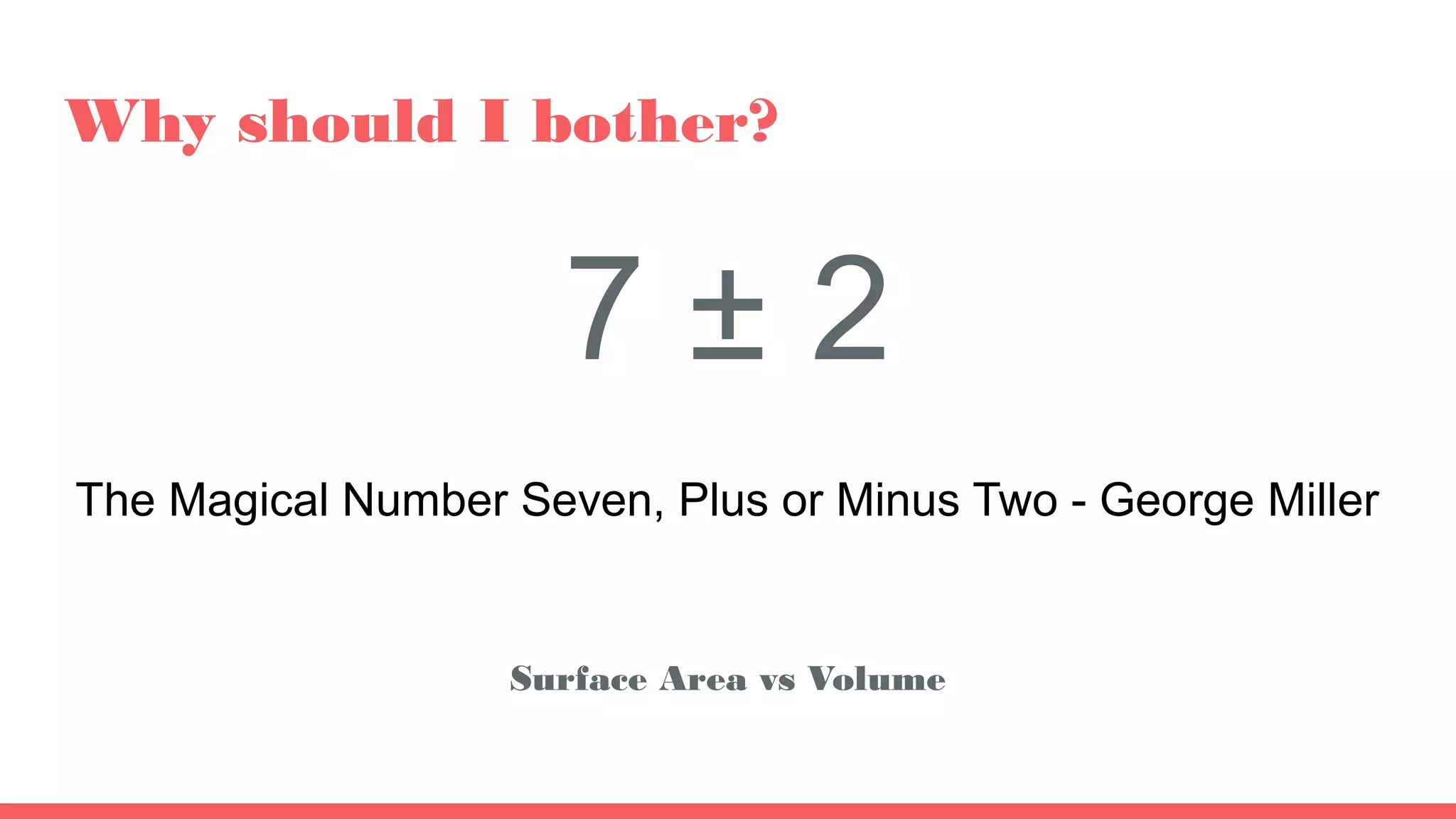
7 ± 2
The Magical Number Seven, Plus or Minus Two - George Miller
Surface Area vs Volume
Functions vs Subroutines
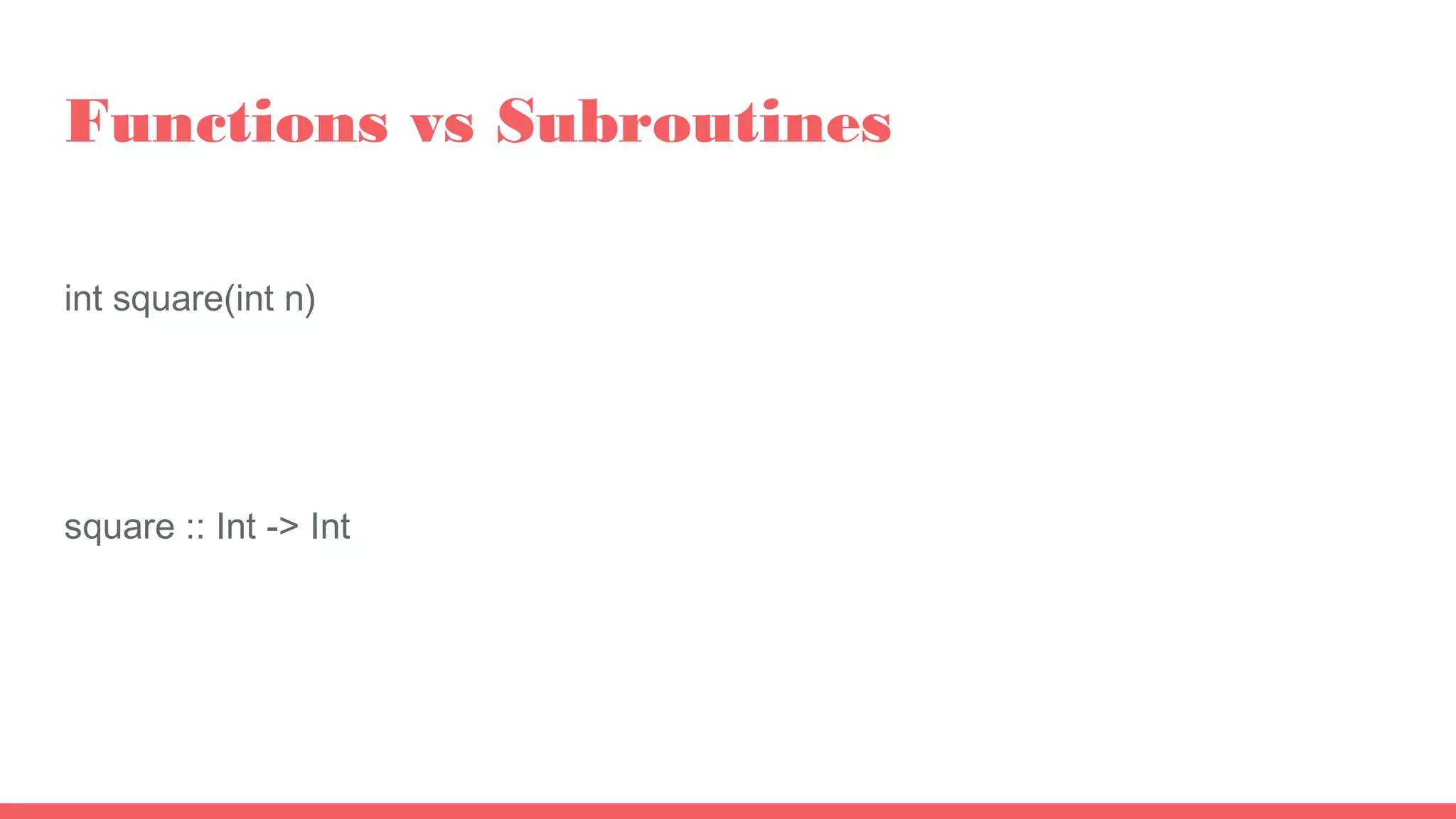
int square(int n)
square :: Int -> Int
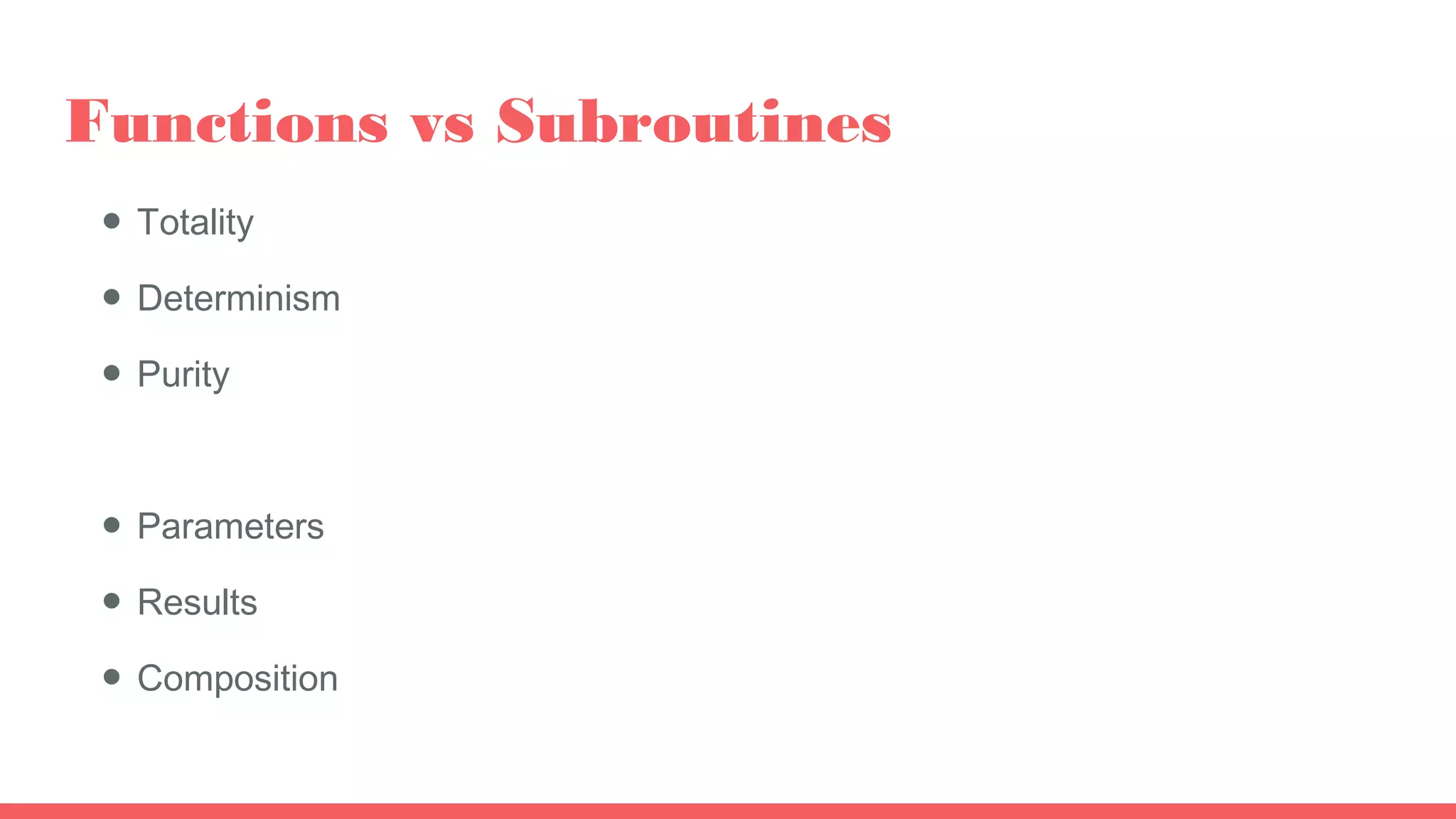
Functions vs Subroutines
● Totality
● Determinism
● Purity
● Parameters
● Results
● Composition
Function Composition
● Build larger programs by composing smaller functions together
xs = [1, 2, 3, 4, 5]
stddev xs = sqrt . average . map (square . (mu -)) xs
pyth x y = sqrt (square x + square y)
● How does values flow from function to function?
Functions vs Subroutines
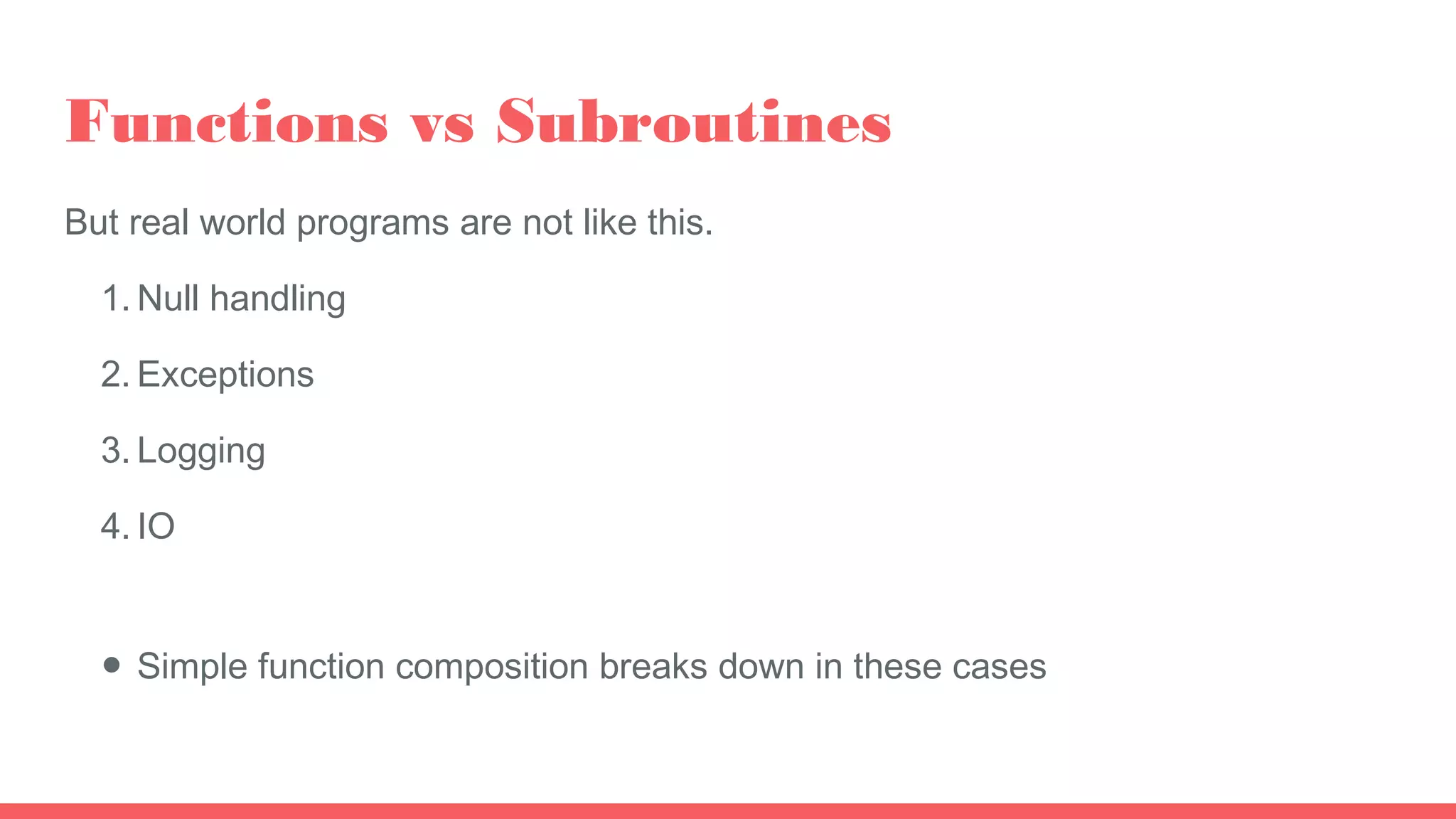
But real world programs are not like this.
1. Null handling
2. Exceptions
3. Logging
4. IO
● Simple function composition breaks down in these cases
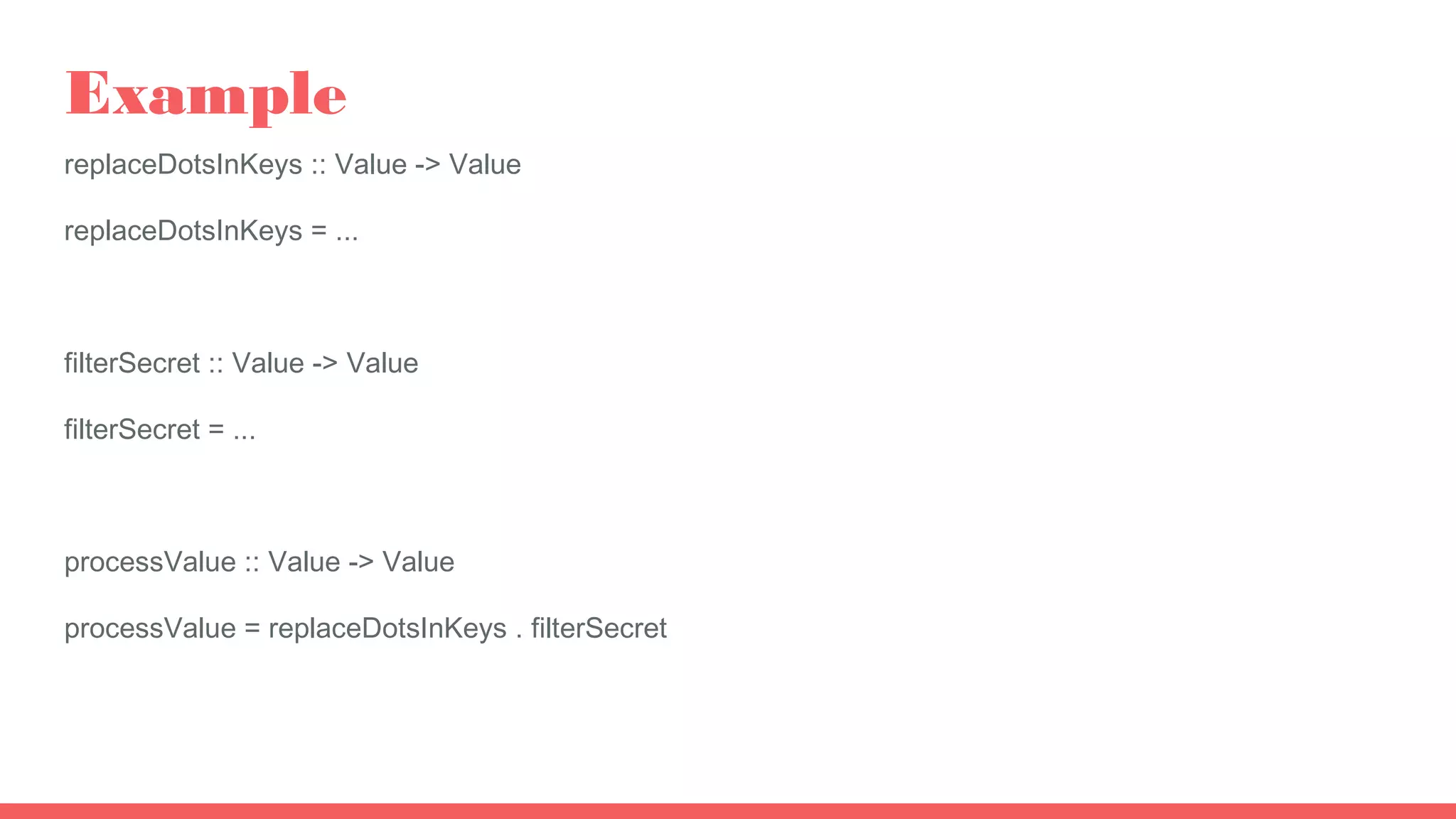
Example
replaceDotsInKeys :: Value -> Value
replaceDotsInKeys = ...
filterSecret :: Value -> Value
filterSecret = ...
processValue :: Value -> Value
processValue = replaceDotsInKeys . filterSecret
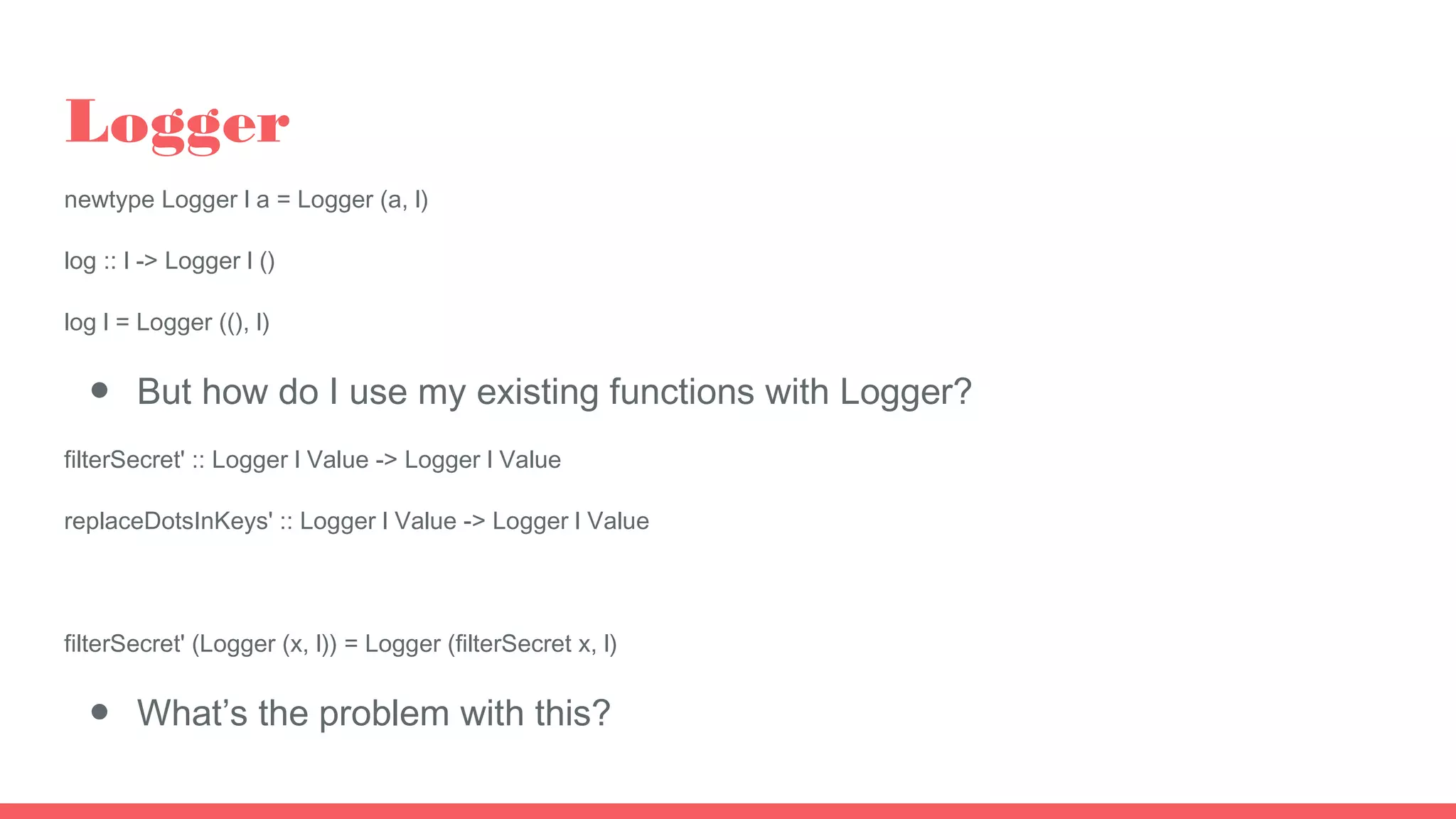
Logger
newtype Logger l a = Logger (a, l)
log :: l -> Logger l ()
log l = Logger ((), l)
● But how do I use my existing functions with Logger?
filterSecret' :: Logger l Value -> Logger l Value
replaceDotsInKeys' :: Logger l Value -> Logger l Value
filterSecret' (Logger (x, l)) = Logger (filterSecret x, l)
● What’s the problem with this?
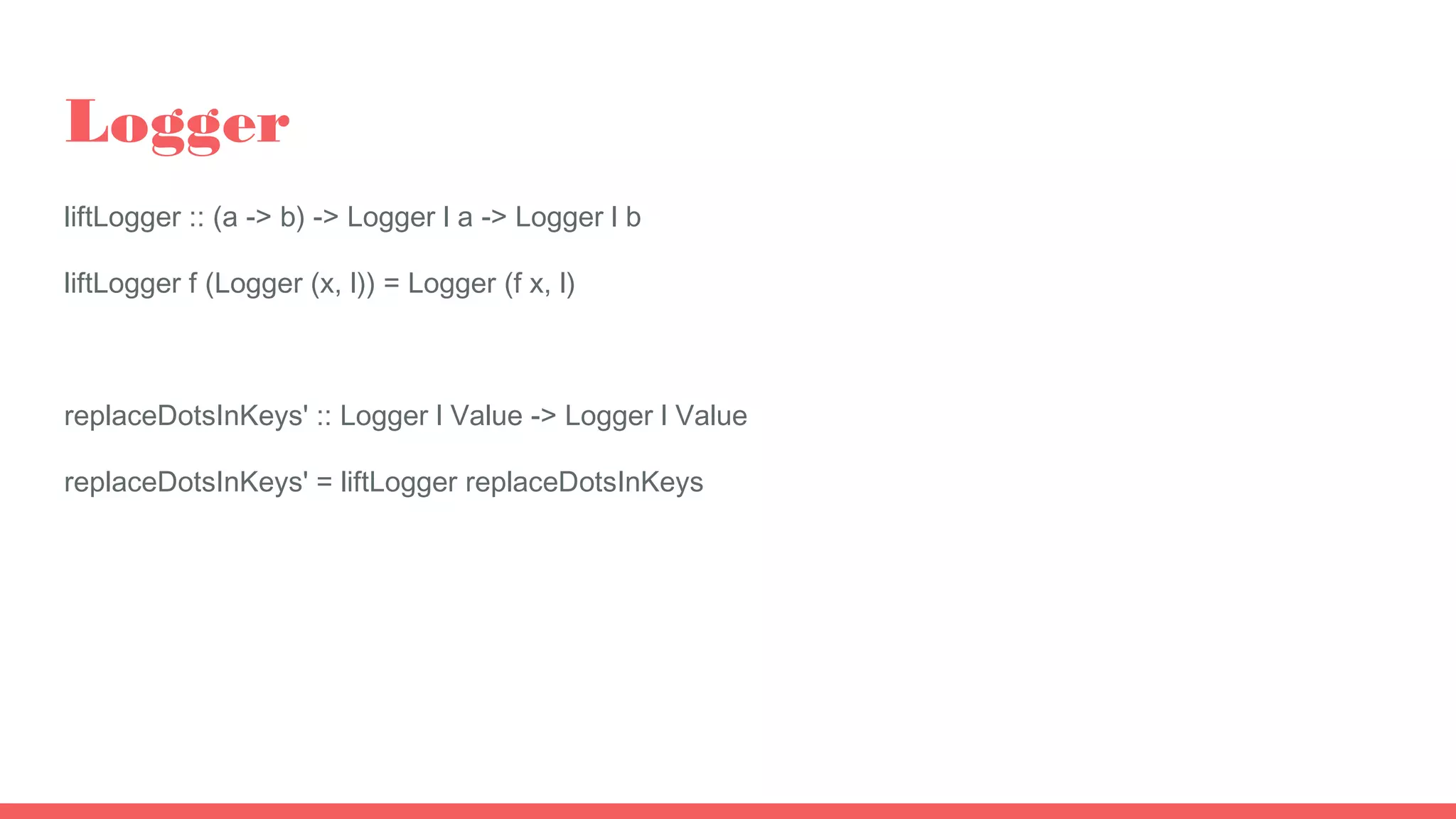
Logger
liftLogger :: (a -> b) -> Logger l a -> Logger l b
liftLogger f (Logger (x, l)) = Logger (f x, l)
replaceDotsInKeys' :: Logger l Value -> Logger l Value
replaceDotsInKeys' = liftLogger replaceDotsInKeys
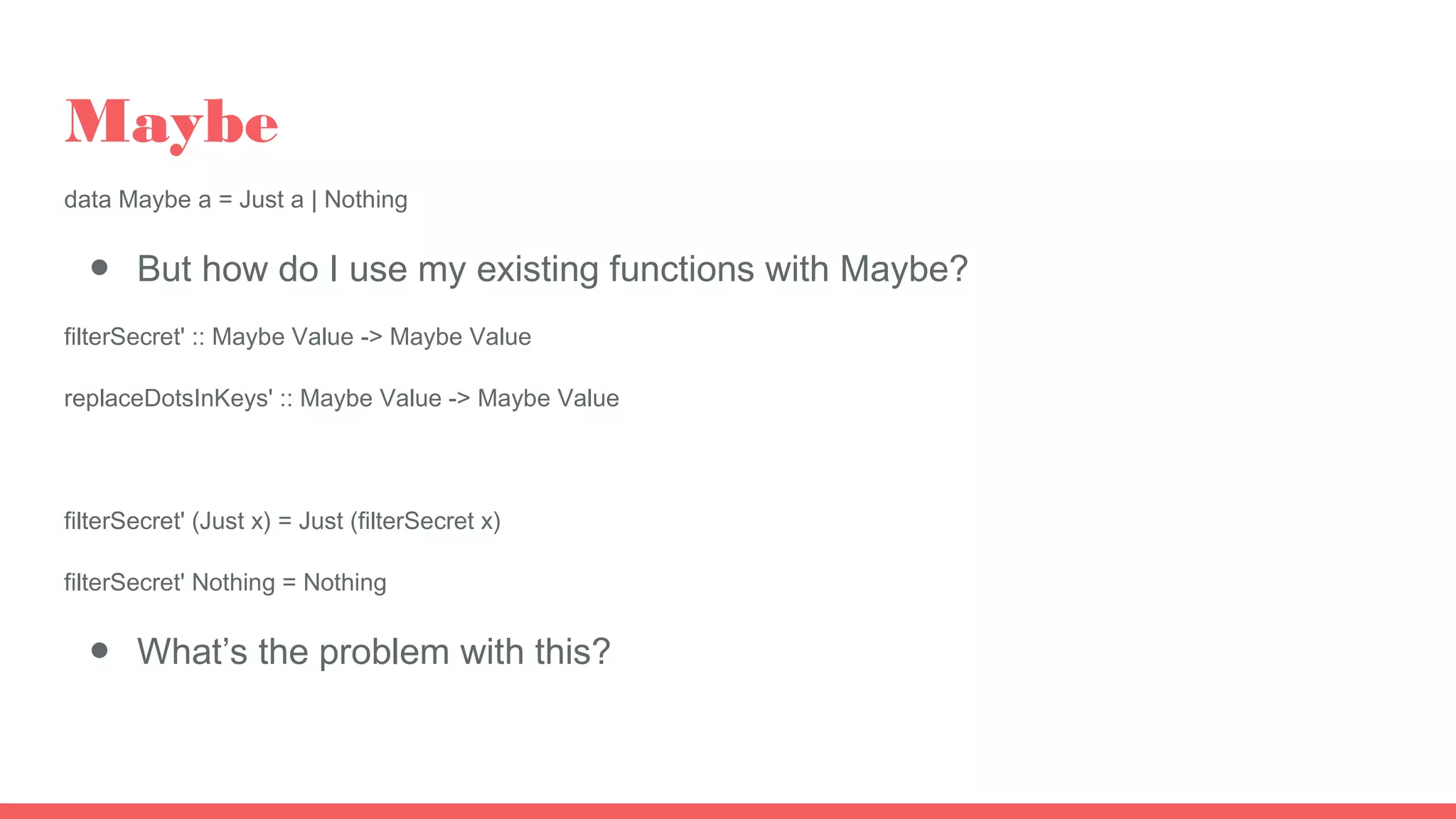
Maybe
data Maybe a = Just a | Nothing
● But how do I use my existing functions with Maybe?
filterSecret' :: Maybe Value -> Maybe Value
replaceDotsInKeys' :: Maybe Value -> Maybe Value
filterSecret' (Just x) = Just (filterSecret x)
filterSecret' Nothing = Nothing
● What’s the problem with this?
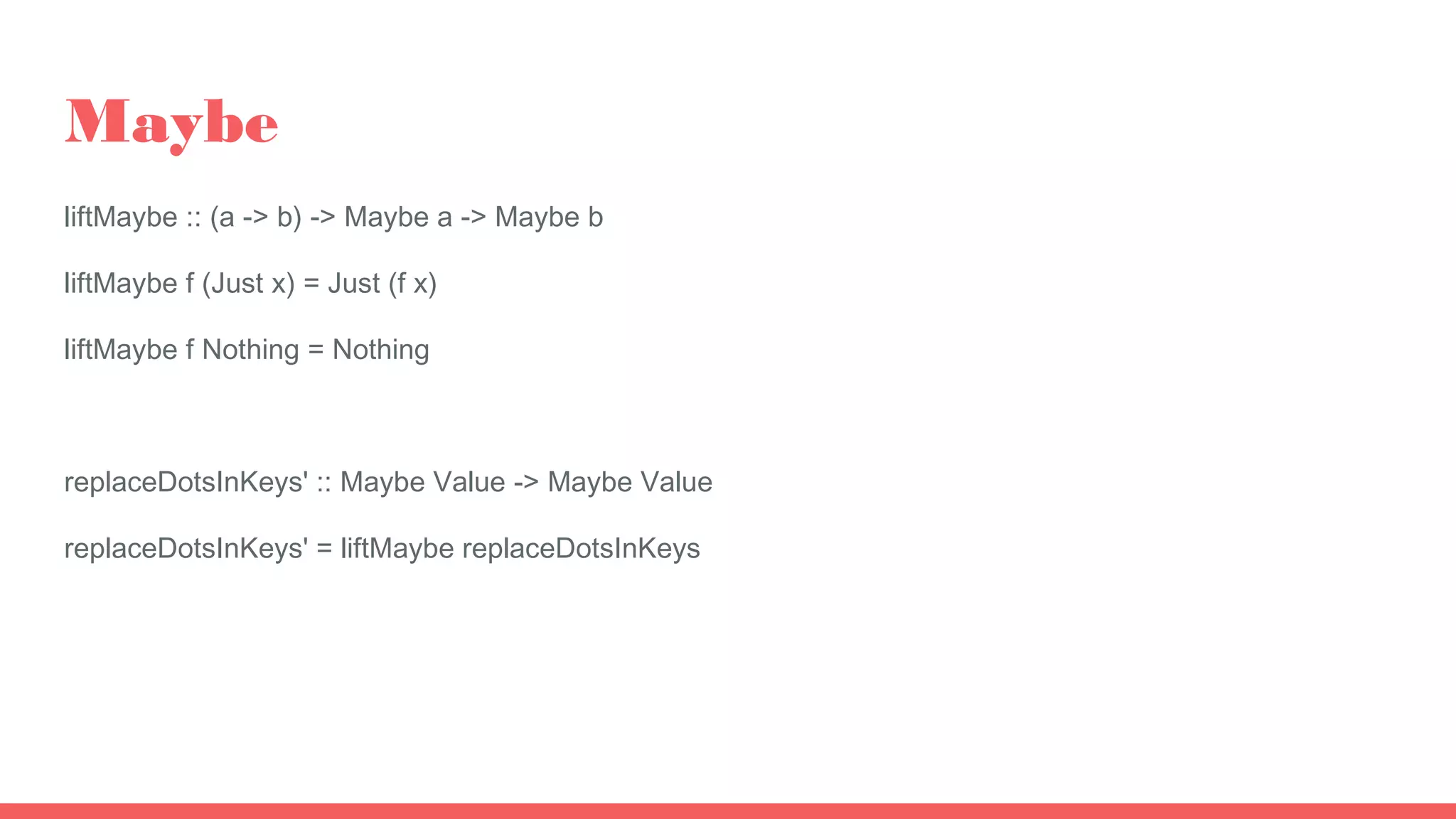
Maybe
liftMaybe :: (a -> b) -> Maybe a -> Maybe b
liftMaybe f (Just x) = Just (f x)
liftMaybe f Nothing = Nothing
replaceDotsInKeys' :: Maybe Value -> Maybe Value
replaceDotsInKeys' = liftMaybe replaceDotsInKeys
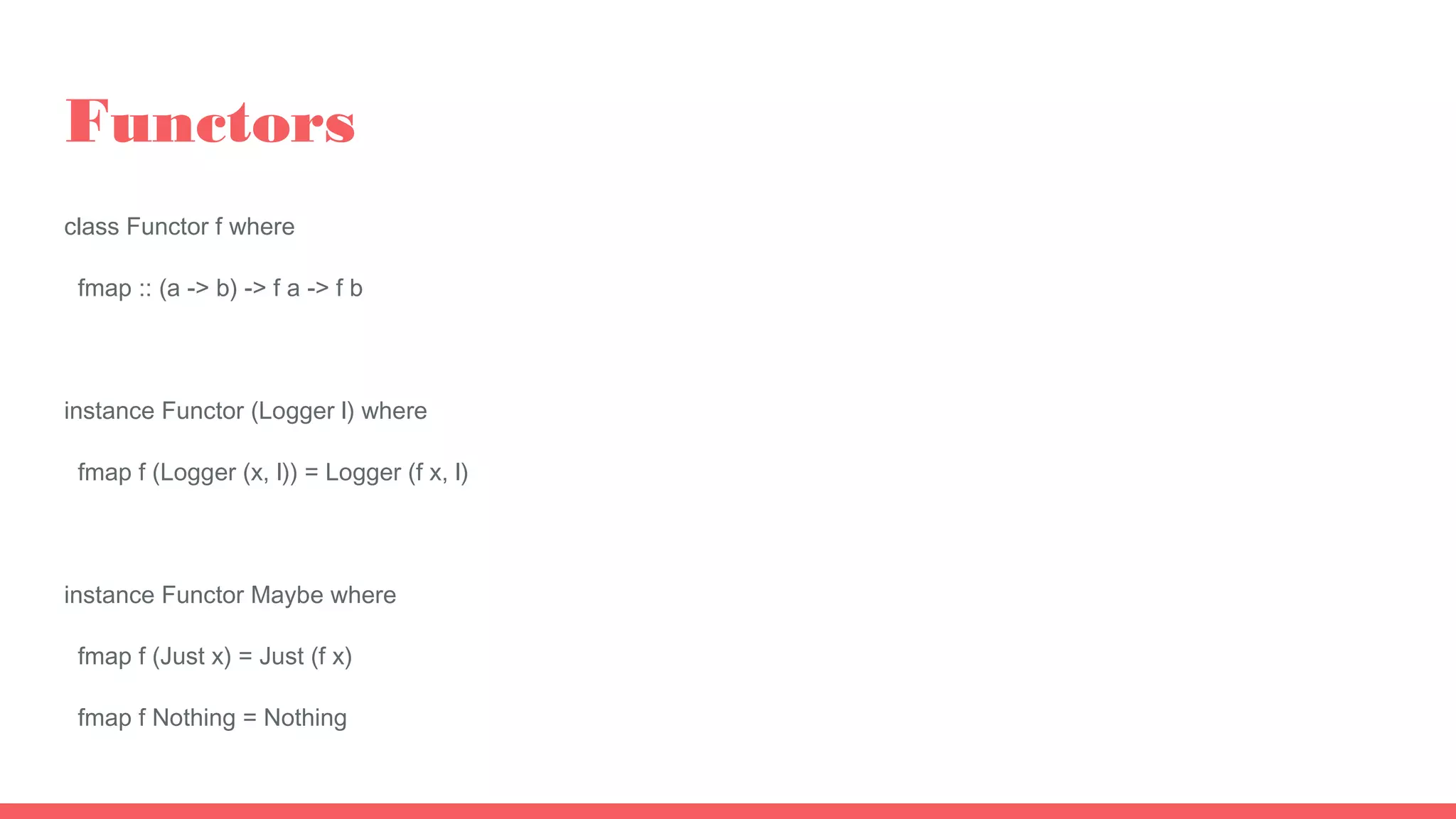
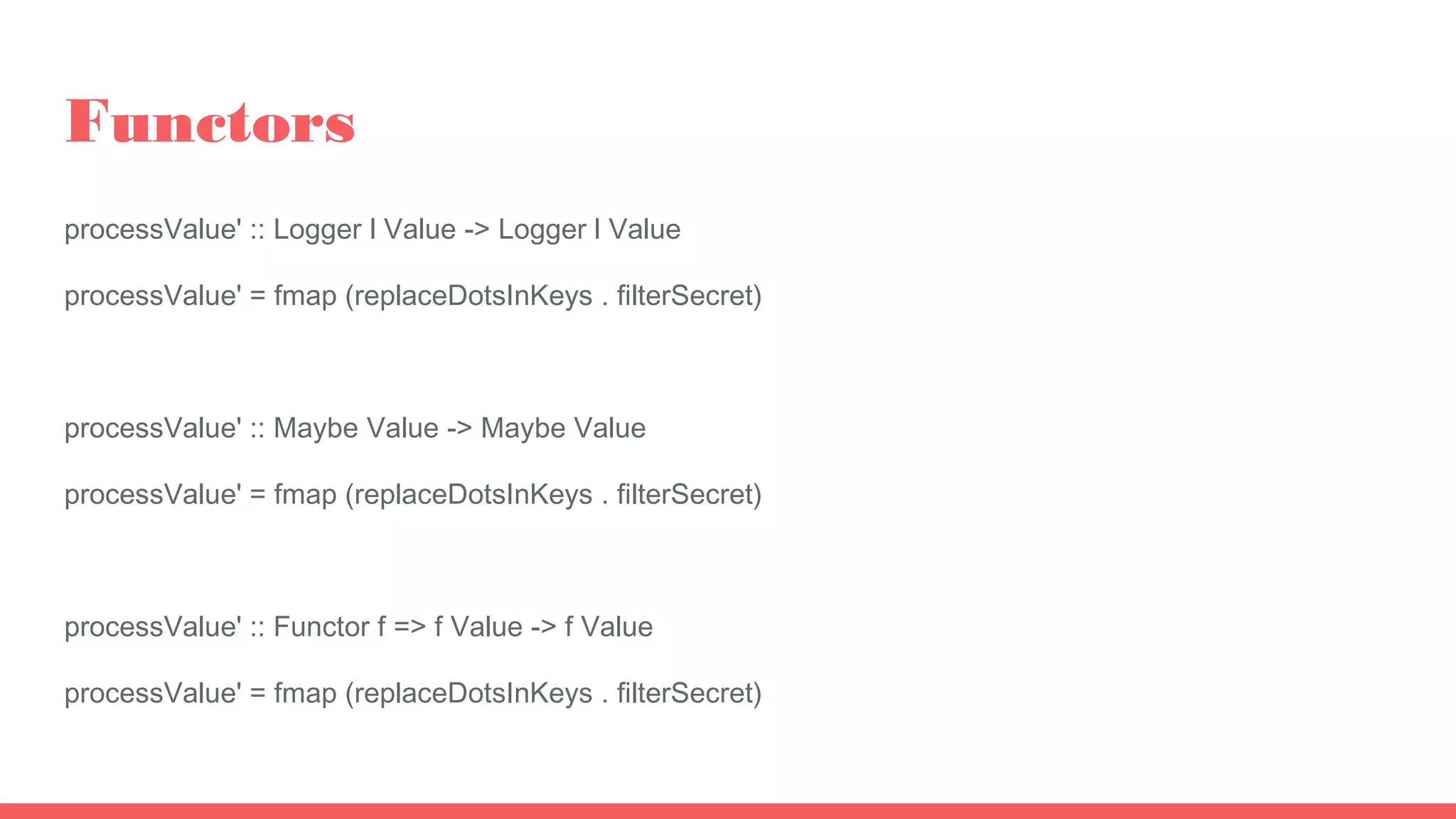
Functors
class Functor f where
fmap :: (a -> b) -> f a -> f b
instance Functor (Logger l) where
fmap f (Logger (x, l)) = Logger (f x, l)
instance Functor Maybe where
fmap f (Just x) = Just (f x)
fmap f Nothing = Nothing
Functors
processValue' :: Logger l Value -> Logger l Value
processValue' = fmap (replaceDotsInKeys . filterSecret)
processValue' :: Maybe Value -> Maybe Value
processValue' = fmap (replaceDotsInKeys . filterSecret)
processValue' :: Functor f => f Value -> f Value
processValue' = fmap (replaceDotsInKeys . filterSecret)
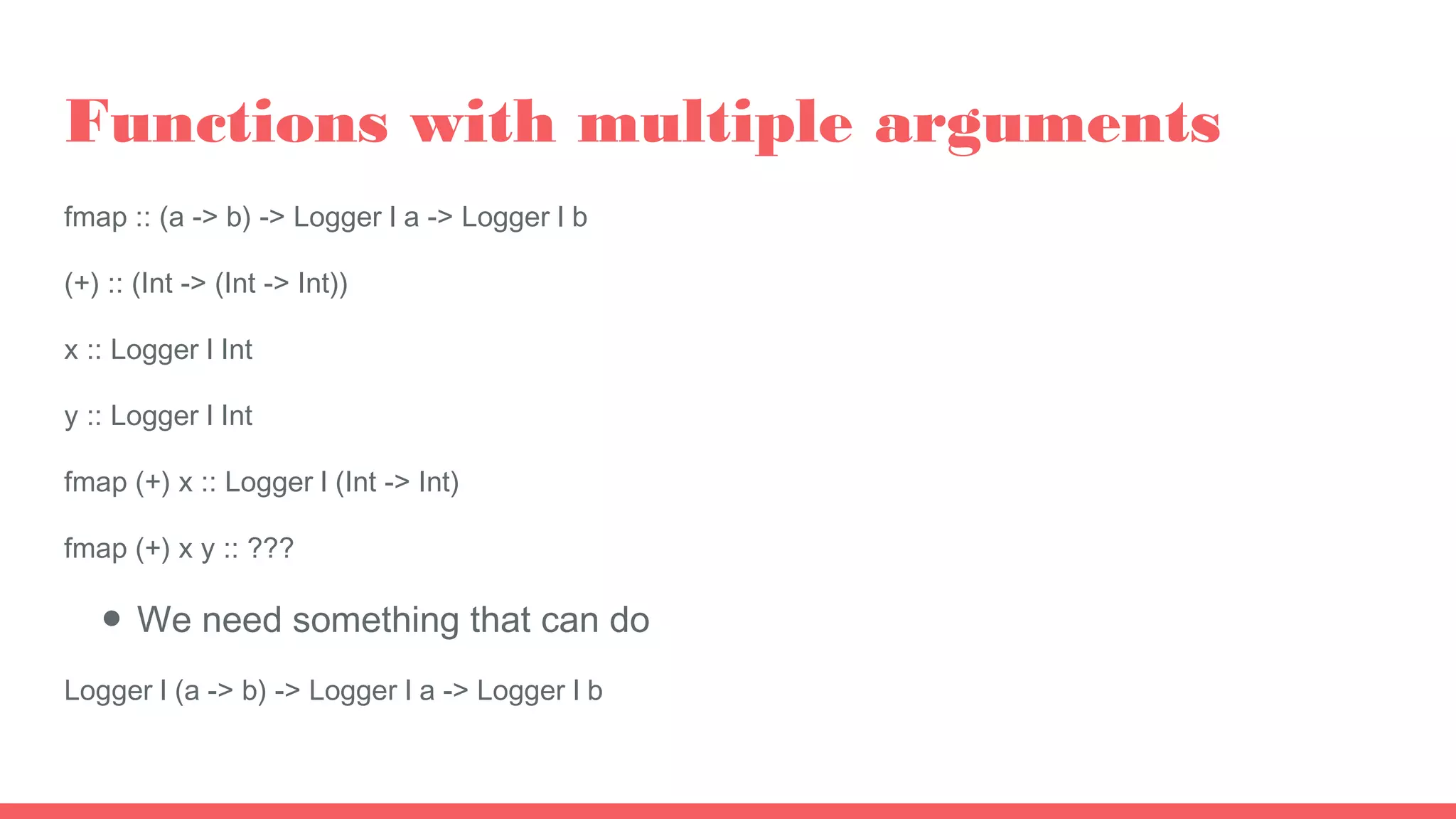
Functions with multiple arguments
fmap :: (a -> b) -> Logger l a -> Logger l b
(+) :: (Int -> (Int -> Int))
x :: Logger l Int
y :: Logger l Int
fmap (+) x :: Logger l (Int -> Int)
fmap (+) x y :: ???
● We need something that can do
Logger l (a -> b) -> Logger l a -> Logger l b
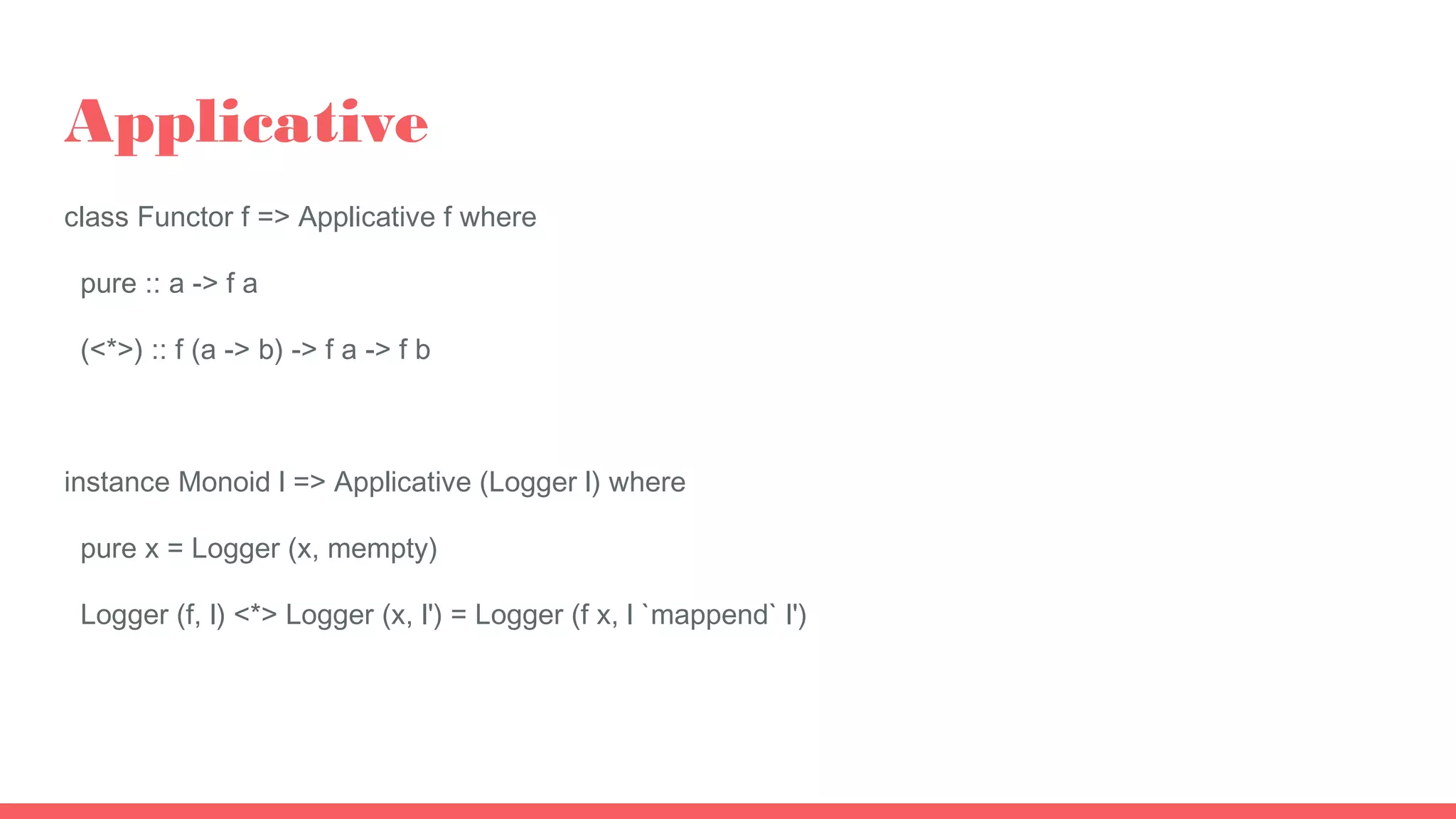
Applicative
class Functor f => Applicative f where
pure :: a -> f a
(<*>) :: f (a -> b) -> f a -> f b
instance Monoid l => Applicative (Logger l) where
pure x = Logger (x, mempty)
Logger (f, l) <*> Logger (x, l') = Logger (f x, l `mappend` l')
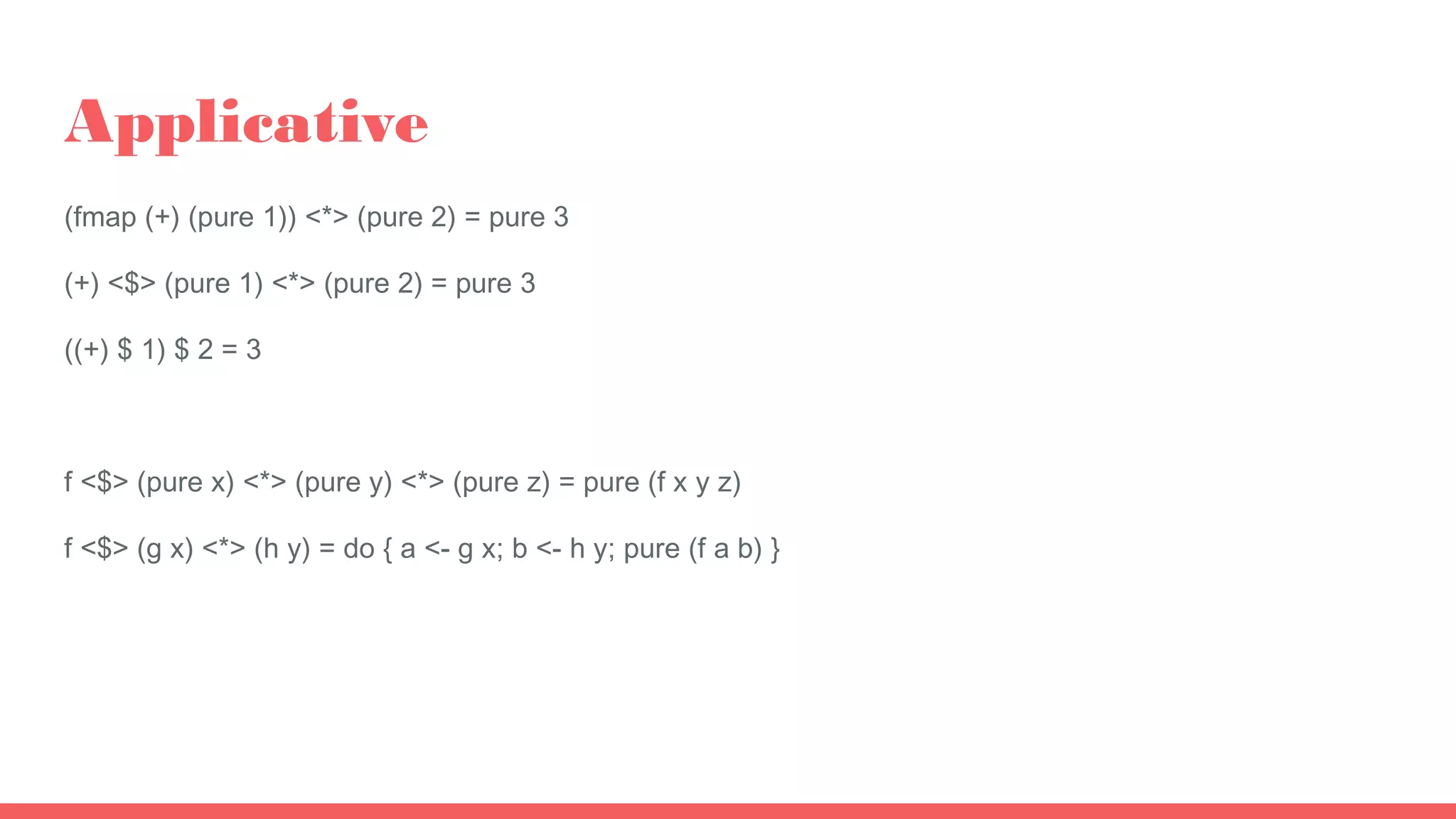
Applicative
(fmap (+) (pure 1)) <*> (pure 2) = pure 3
(+) <$> (pure 1) <*> (pure 2) = pure 3
((+) $ 1) $ 2 = 3
f <$> (pure x) <*> (pure y) <*> (pure z) = pure (f x y z)
f <$> (g x) <*> (h y) = do { a <- g x; b <- h y; pure (f a b) }
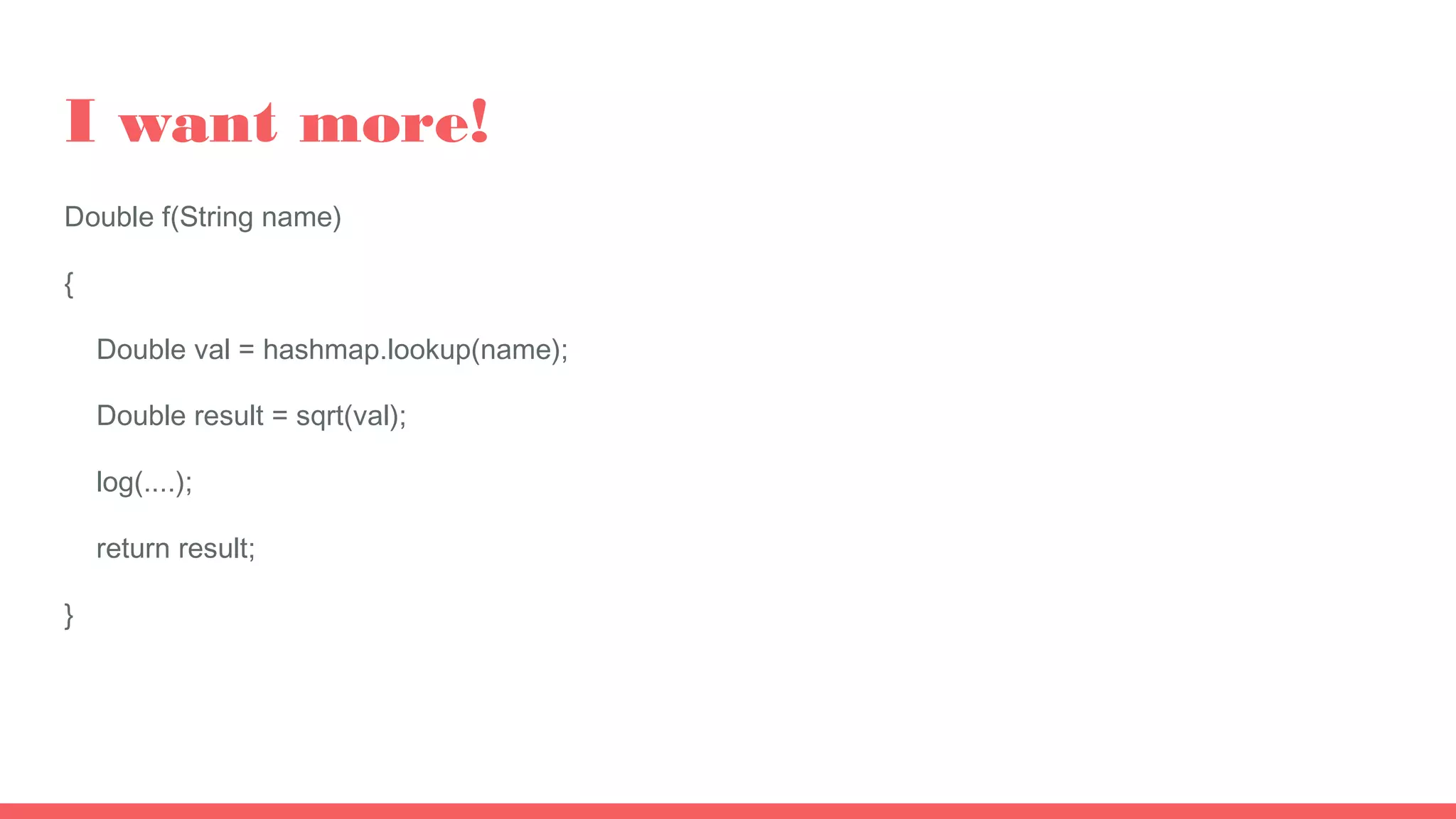
I want more!
Double f(String name)
{
Double val = hashmap.lookup(name);
Double result = sqrt(val);
log(....);
return result;
}
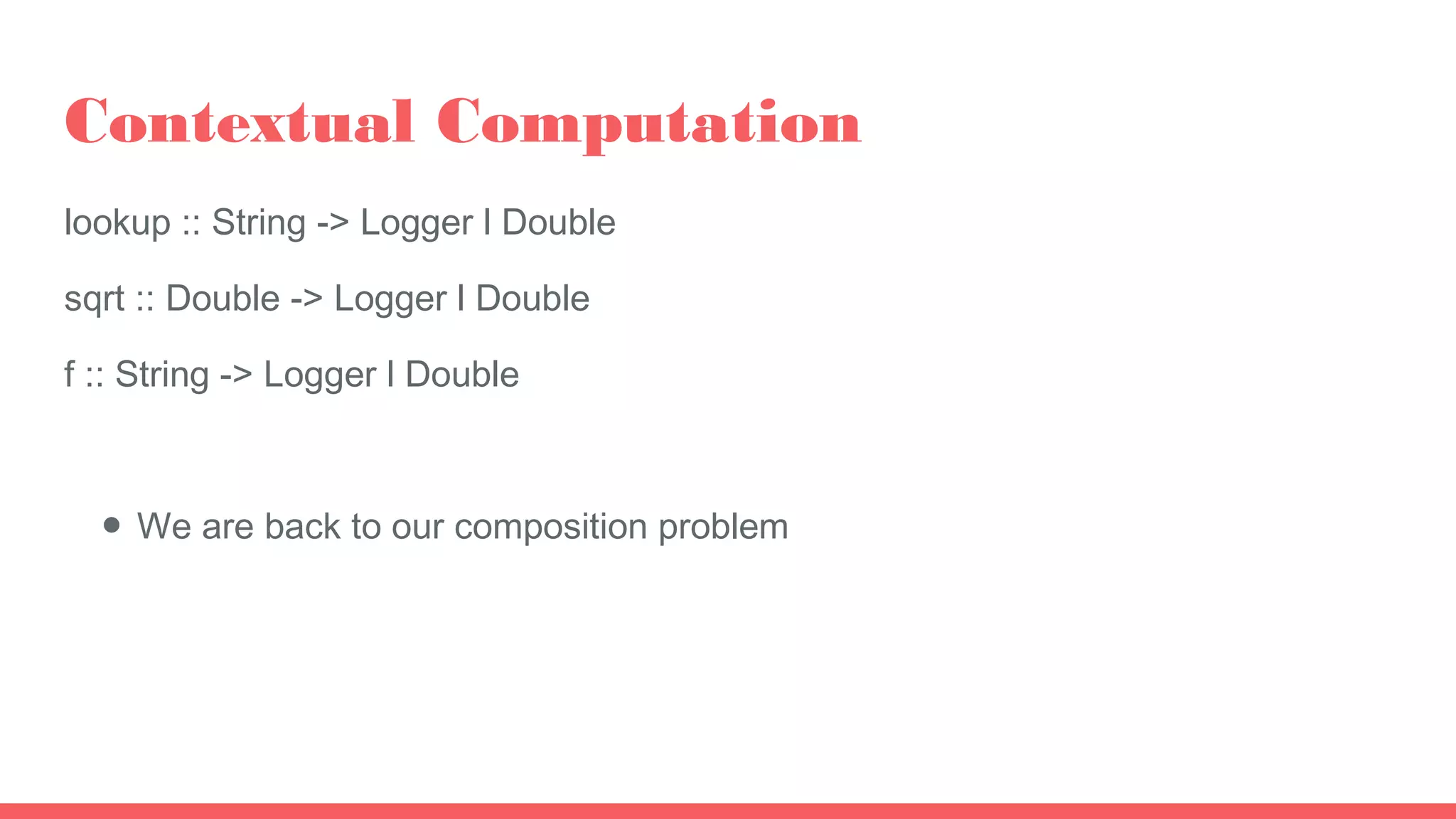
Contextual Computation
lookup :: String -> Logger l Double
sqrt :: Double -> Logger l Double
f :: String -> Logger l Double
● We are back to our composition problem
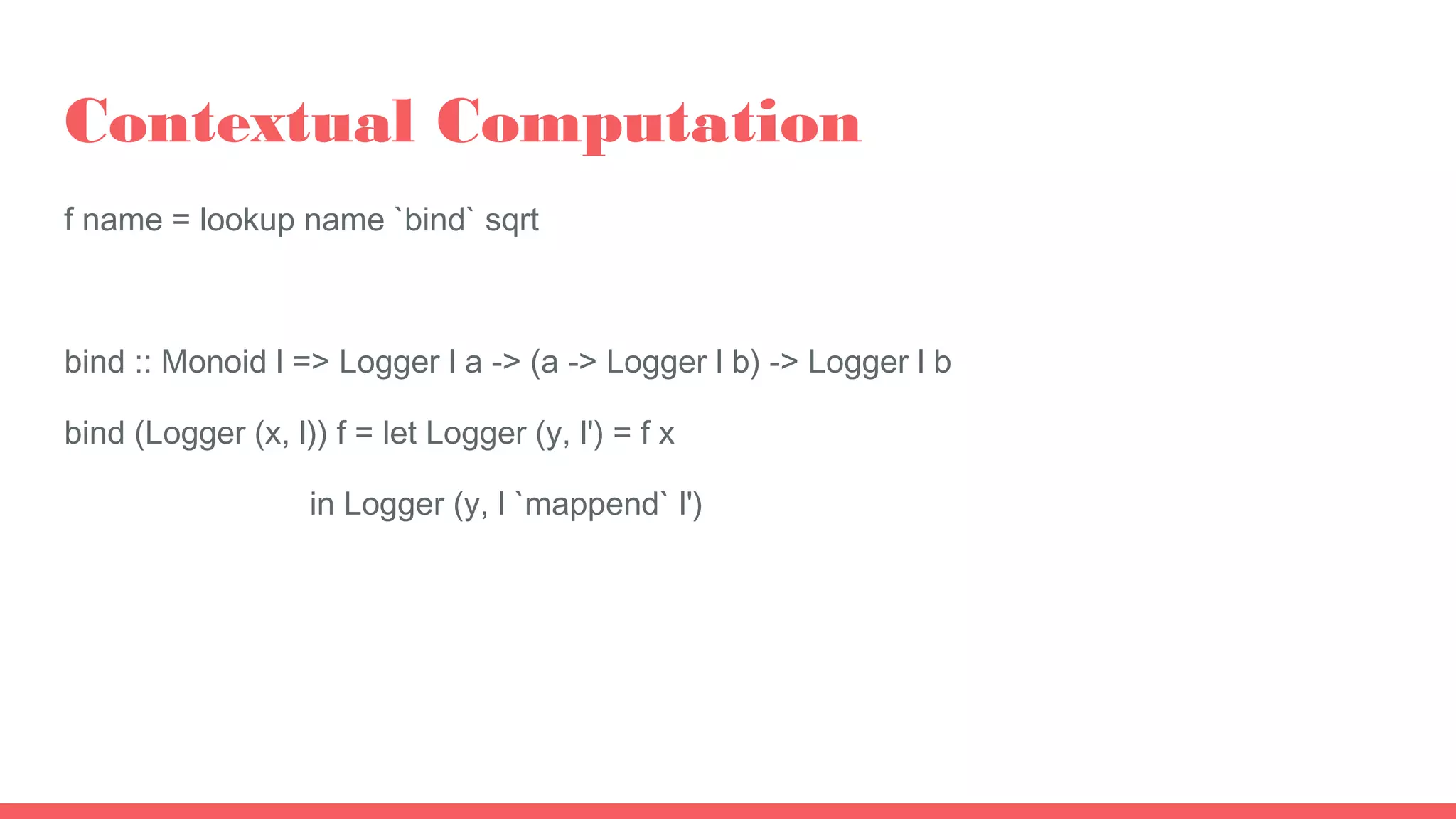
Contextual Computation
f name = lookup name `bind` sqrt
bind :: Monoid l => Logger l a -> (a -> Logger l b) -> Logger l b
bind (Logger (x, l)) f = let Logger (y, l') = f x
in Logger (y, l `mappend` l')
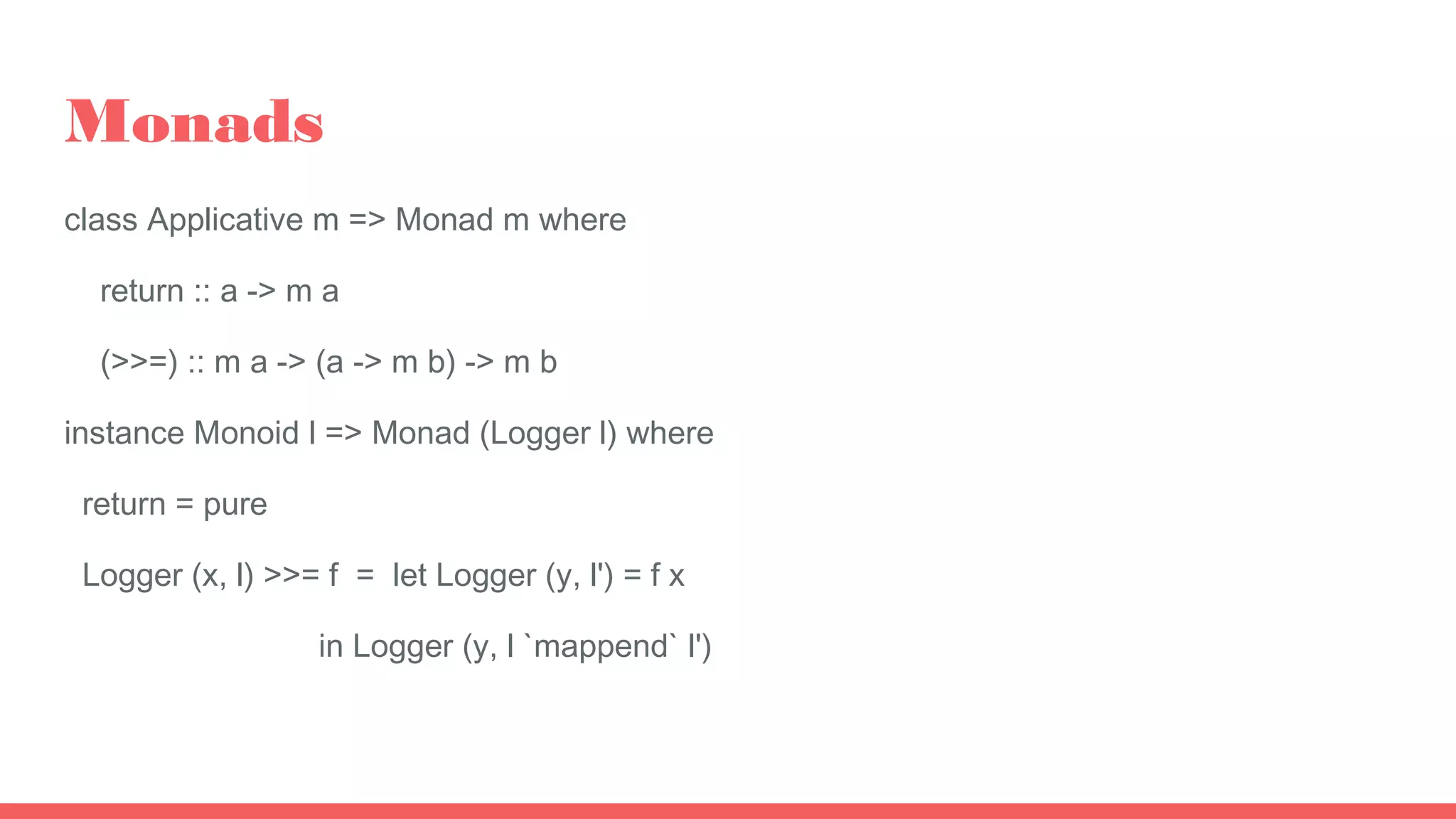
Monads
class Applicative m => Monad m where
return :: a -> m a
(>>=) :: m a -> (a -> m b) -> m b
instance Monoid l => Monad (Logger l) where
return = pure
Logger (x, l) >>= f = let Logger (y, l') = f x
in Logger (y, l `mappend` l')
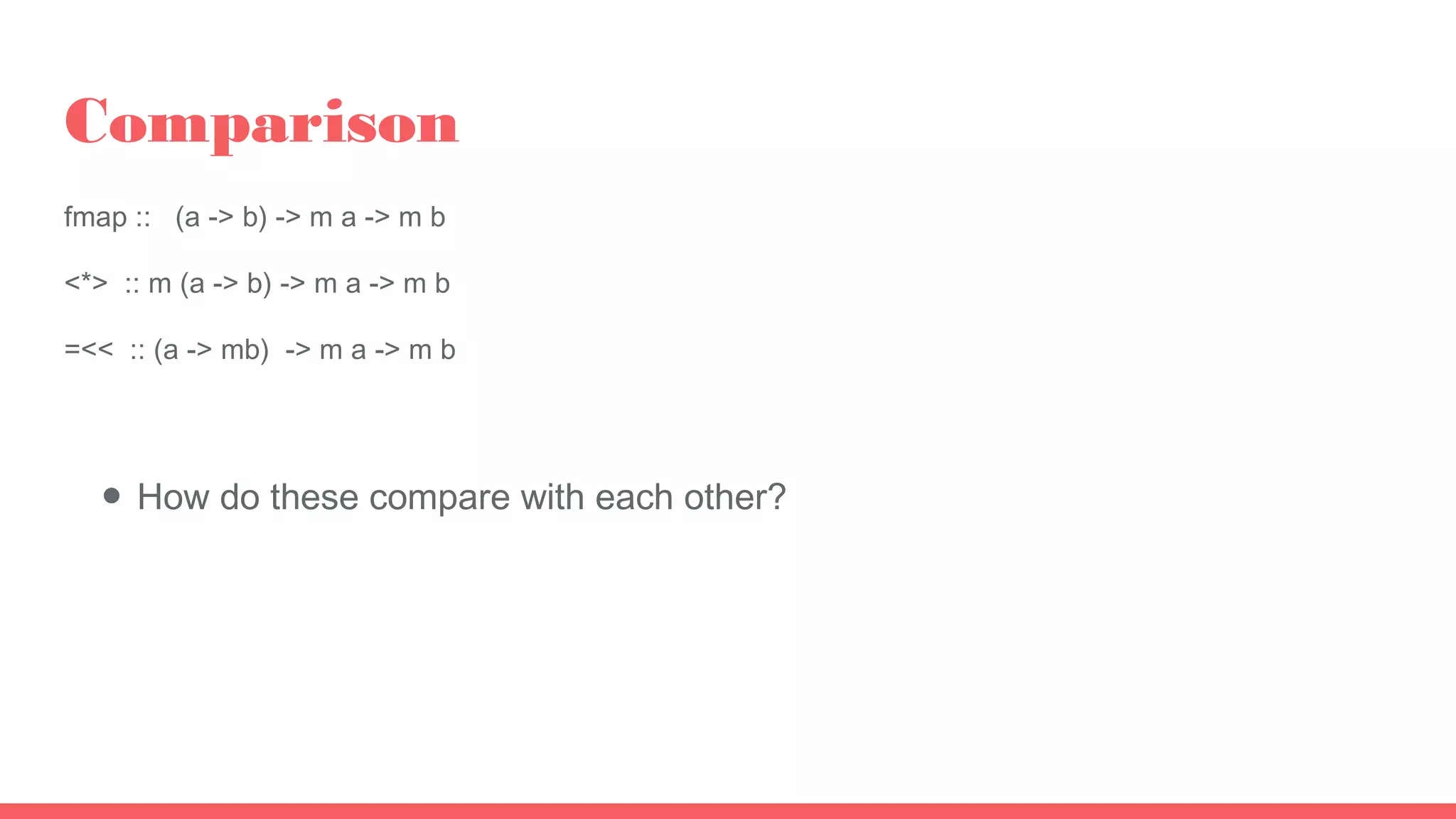
Comparison
fmap :: (a -> b) -> m a -> m b
<*> :: m (a -> b) -> m a -> m b
=<< :: (a -> mb) -> m a -> m b
● How do these compare with each other?

Functors, applicatives, monads

  • 1.
  • 2.
    Functors, Applicatives, Monads ●Why Oh Why? ● I am going back to PHP ● Gimme my imperative code back ● Let me get my PhD first
  • 3.
    Why should Ibother? 7 ± 2 The Magical Number Seven, Plus or Minus Two - George Miller Surface Area vs Volume
  • 4.
    Functions vs Subroutines intsquare(int n) square :: Int -> Int
  • 5.
    Functions vs Subroutines ●Totality ● Determinism ● Purity ● Parameters ● Results ● Composition
  • 6.
    Function Composition ● Buildlarger programs by composing smaller functions together xs = [1, 2, 3, 4, 5] stddev xs = sqrt . average . map (square . (mu -)) xs pyth x y = sqrt (square x + square y) ● How does values flow from function to function?
  • 7.
    Functions vs Subroutines Butreal world programs are not like this. 1. Null handling 2. Exceptions 3. Logging 4. IO ● Simple function composition breaks down in these cases
  • 8.
    Example replaceDotsInKeys :: Value-> Value replaceDotsInKeys = ... filterSecret :: Value -> Value filterSecret = ... processValue :: Value -> Value processValue = replaceDotsInKeys . filterSecret
  • 9.
    Logger newtype Logger la = Logger (a, l) log :: l -> Logger l () log l = Logger ((), l) ● But how do I use my existing functions with Logger? filterSecret' :: Logger l Value -> Logger l Value replaceDotsInKeys' :: Logger l Value -> Logger l Value filterSecret' (Logger (x, l)) = Logger (filterSecret x, l) ● What’s the problem with this?
  • 10.
    Logger liftLogger :: (a-> b) -> Logger l a -> Logger l b liftLogger f (Logger (x, l)) = Logger (f x, l) replaceDotsInKeys' :: Logger l Value -> Logger l Value replaceDotsInKeys' = liftLogger replaceDotsInKeys
  • 11.
    Maybe data Maybe a= Just a | Nothing ● But how do I use my existing functions with Maybe? filterSecret' :: Maybe Value -> Maybe Value replaceDotsInKeys' :: Maybe Value -> Maybe Value filterSecret' (Just x) = Just (filterSecret x) filterSecret' Nothing = Nothing ● What’s the problem with this?
  • 12.
    Maybe liftMaybe :: (a-> b) -> Maybe a -> Maybe b liftMaybe f (Just x) = Just (f x) liftMaybe f Nothing = Nothing replaceDotsInKeys' :: Maybe Value -> Maybe Value replaceDotsInKeys' = liftMaybe replaceDotsInKeys
  • 13.
    Functors class Functor fwhere fmap :: (a -> b) -> f a -> f b instance Functor (Logger l) where fmap f (Logger (x, l)) = Logger (f x, l) instance Functor Maybe where fmap f (Just x) = Just (f x) fmap f Nothing = Nothing
  • 14.
    Functors processValue' :: Loggerl Value -> Logger l Value processValue' = fmap (replaceDotsInKeys . filterSecret) processValue' :: Maybe Value -> Maybe Value processValue' = fmap (replaceDotsInKeys . filterSecret) processValue' :: Functor f => f Value -> f Value processValue' = fmap (replaceDotsInKeys . filterSecret)
  • 15.
    Functions with multiplearguments fmap :: (a -> b) -> Logger l a -> Logger l b (+) :: (Int -> (Int -> Int)) x :: Logger l Int y :: Logger l Int fmap (+) x :: Logger l (Int -> Int) fmap (+) x y :: ??? ● We need something that can do Logger l (a -> b) -> Logger l a -> Logger l b
  • 16.
    Applicative class Functor f=> Applicative f where pure :: a -> f a (<*>) :: f (a -> b) -> f a -> f b instance Monoid l => Applicative (Logger l) where pure x = Logger (x, mempty) Logger (f, l) <*> Logger (x, l') = Logger (f x, l `mappend` l')
  • 17.
    Applicative (fmap (+) (pure1)) <*> (pure 2) = pure 3 (+) <$> (pure 1) <*> (pure 2) = pure 3 ((+) $ 1) $ 2 = 3 f <$> (pure x) <*> (pure y) <*> (pure z) = pure (f x y z) f <$> (g x) <*> (h y) = do { a <- g x; b <- h y; pure (f a b) }
  • 18.
    I want more! Doublef(String name) { Double val = hashmap.lookup(name); Double result = sqrt(val); log(....); return result; }
  • 19.
    Contextual Computation lookup ::String -> Logger l Double sqrt :: Double -> Logger l Double f :: String -> Logger l Double ● We are back to our composition problem
  • 20.
    Contextual Computation f name= lookup name `bind` sqrt bind :: Monoid l => Logger l a -> (a -> Logger l b) -> Logger l b bind (Logger (x, l)) f = let Logger (y, l') = f x in Logger (y, l `mappend` l')
  • 21.
    Monads class Applicative m=> Monad m where return :: a -> m a (>>=) :: m a -> (a -> m b) -> m b instance Monoid l => Monad (Logger l) where return = pure Logger (x, l) >>= f = let Logger (y, l') = f x in Logger (y, l `mappend` l')
  • 22.
    Comparison fmap :: (a-> b) -> m a -> m b <*> :: m (a -> b) -> m a -> m b =<< :: (a -> mb) -> m a -> m b ● How do these compare with each other?

Editor's Notes

  • #6 Totality. A function must yield a value for every possible input. Determinism. A function must yield the same value for the same input. Purity. A function’s only effect must be the computation of its return value. Composition is the key to deal with 7+-2 problem.