ď‚§The print() function allows a program to display text onto the
console.
ď‚§The print function will print everything as strings and anything
that is not already a string is automatically converted to its string
representation.
ď‚§>>> print("Hello World!!")
Hello World!!
ď‚§They are
1. str.format()
2. f-strings
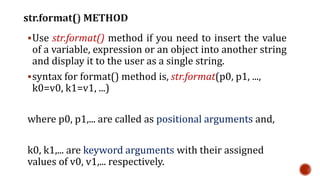
ď‚§Use str.format() method if you need to insert the value
of a variable, expression or an object into another string
and display it to the user as a single string.
ď‚§syntax for format() method is, str.format(p0, p1, ...,
k0=v0, k1=v1, ...)
where p0, p1,... are called as positional arguments and,
k0, k1,... are keyword arguments with their assigned
values of v0, v1,... respectively.
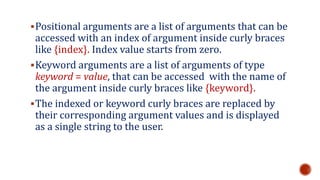
ď‚§Positional arguments are a list of arguments that can be
accessed with an index of argument inside curly braces
like {index}. Index value starts from zero.
ď‚§Keyword arguments are a list of arguments of type
keyword = value, that can be accessed with the name of
the argument inside curly braces like {keyword}.
ď‚§The indexed or keyword curly braces are replaced by
their corresponding argument values and is displayed
as a single string to the user.
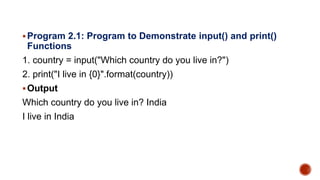
ď‚§Program 2.1: Program to Demonstrate input() and print()
Functions
1. country = input("Which country do you live in?")
2. print("I live in {0}".format(country))
ď‚§Output
Which country do you live in? India
I live in India
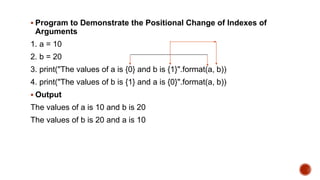
ď‚§ Program to Demonstrate the Positional Change of Indexes of
Arguments
1. a = 10
2. b = 20
3. print("The values of a is {0} and b is {1}".format(a, b))
4. print("The values of b is {1} and a is {0}".format(a, b))
ď‚§ Output
The values of a is 10 and b is 20
The values of b is 20 and a is 10
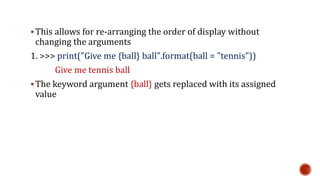
ď‚§This allows for re-arranging the order of display without
changing the arguments
1. >>> print("Give me {ball} ball".format(ball = "tennis"))
Give me tennis ball
ď‚§The keyword argument {ball} gets replaced with its assigned
value
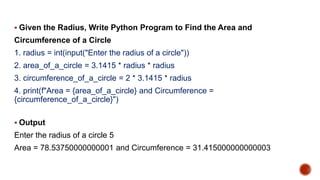
ď‚§ Given the Radius, Write Python Program to Find the Area and
Circumference of a Circle
1. radius = int(input("Enter the radius of a circle"))
2. area_of_a_circle = 3.1415 * radius * radius
3. circumference_of_a_circle = 2 * 3.1415 * radius
4. print(f"Area = {area_of_a_circle} and Circumference =
{circumference_of_a_circle}")
ď‚§ Output
Enter the radius of a circle 5
Area = 78.53750000000001 and Circumference = 31.415000000000003
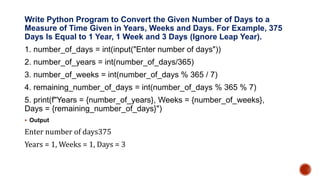
Write Python Program to Convert the Given Number of Days to a
Measure of Time Given in Years, Weeks and Days. For Example, 375
Days Is Equal to 1 Year, 1 Week and 3 Days (Ignore Leap Year).
1. number_of_days = int(input("Enter number of days"))
2. number_of_years = int(number_of_days/365)
3. number_of_weeks = int(number_of_days % 365 / 7)
4. remaining_number_of_days = int(number_of_days % 365 % 7)
5. print(f"Years = {number_of_years}, Weeks = {number_of_weeks},
Days = {remaining_number_of_days}")
ď‚§ Output
Enter number of days375
Years = 1, Weeks = 1, Days = 3

Function for python for the embedded system

  • 2.
    ď‚§The print() functionallows a program to display text onto the console. ď‚§The print function will print everything as strings and anything that is not already a string is automatically converted to its string representation. ď‚§>>> print("Hello World!!") Hello World!! ď‚§They are 1. str.format() 2. f-strings
  • 3.
    ď‚§Use str.format() methodif you need to insert the value of a variable, expression or an object into another string and display it to the user as a single string. ď‚§syntax for format() method is, str.format(p0, p1, ..., k0=v0, k1=v1, ...) where p0, p1,... are called as positional arguments and, k0, k1,... are keyword arguments with their assigned values of v0, v1,... respectively.
  • 4.
    ď‚§Positional arguments area list of arguments that can be accessed with an index of argument inside curly braces like {index}. Index value starts from zero. ď‚§Keyword arguments are a list of arguments of type keyword = value, that can be accessed with the name of the argument inside curly braces like {keyword}. ď‚§The indexed or keyword curly braces are replaced by their corresponding argument values and is displayed as a single string to the user.
  • 5.
    ď‚§Program 2.1: Programto Demonstrate input() and print() Functions 1. country = input("Which country do you live in?") 2. print("I live in {0}".format(country)) ď‚§Output Which country do you live in? India I live in India
  • 6.
    ď‚§ Program toDemonstrate the Positional Change of Indexes of Arguments 1. a = 10 2. b = 20 3. print("The values of a is {0} and b is {1}".format(a, b)) 4. print("The values of b is {1} and a is {0}".format(a, b)) ď‚§ Output The values of a is 10 and b is 20 The values of b is 20 and a is 10
  • 7.
    ď‚§This allows forre-arranging the order of display without changing the arguments 1. >>> print("Give me {ball} ball".format(ball = "tennis")) Give me tennis ball ď‚§The keyword argument {ball} gets replaced with its assigned value
  • 8.
    ď‚§ Given theRadius, Write Python Program to Find the Area and Circumference of a Circle 1. radius = int(input("Enter the radius of a circle")) 2. area_of_a_circle = 3.1415 * radius * radius 3. circumference_of_a_circle = 2 * 3.1415 * radius 4. print(f"Area = {area_of_a_circle} and Circumference = {circumference_of_a_circle}") ď‚§ Output Enter the radius of a circle 5 Area = 78.53750000000001 and Circumference = 31.415000000000003
  • 9.
    Write Python Programto Convert the Given Number of Days to a Measure of Time Given in Years, Weeks and Days. For Example, 375 Days Is Equal to 1 Year, 1 Week and 3 Days (Ignore Leap Year). 1. number_of_days = int(input("Enter number of days")) 2. number_of_years = int(number_of_days/365) 3. number_of_weeks = int(number_of_days % 365 / 7) 4. remaining_number_of_days = int(number_of_days % 365 % 7) 5. print(f"Years = {number_of_years}, Weeks = {number_of_weeks}, Days = {remaining_number_of_days}") ď‚§ Output Enter number of days375 Years = 1, Weeks = 1, Days = 3