












SELF-EFFICACY AND CLASSROOM MANAGEMENT: A CORRELATION STUDY

REGARDING THE FACTORS THAT INFLUENCE CLASSROOM MANAGEMENT

                                    by

                        Stephanie Diamond Hicks


              A Dissertation Presented in Partial Fulfillment

                   Of the Requirements for the Degree

                           Doctor of Education


                            Liberty University

                              May 31, 2012
SELF-EFFICACY AND CLASSROOM MANAGEMENT: A CORRELATION STUDY

REGARDING THE FACTORS THAT INFLUENCE CLASSROOM MANAGEMENT

                      by Stephanie Diamond Hicks

              A Dissertation Presented in Partial Fulfillment
                  Of the Requirements for the Degree
                           Doctor of Education


                   Liberty University, Lynchburg, VA
                             May 31, 2012


                                                                APPROVED BY:


                          Margaret Elizabeth Ackerman, Ed.D., Committee Chair


                                         Sally Childs, Ed.D., Committee Member


                                  Amanda Dunnagan, Ed.D., Committee Member


                            Scott B. Watson, Associate Dean Advanced Programs
SELF-EFFICACY AND CLASSROOM MANAGEMENT: A CORRELATION STUDY

REGARDING THE FACTORS THAT INFLUENCE CLASSROOM MANAGEMENT

                                        ABSTRACT
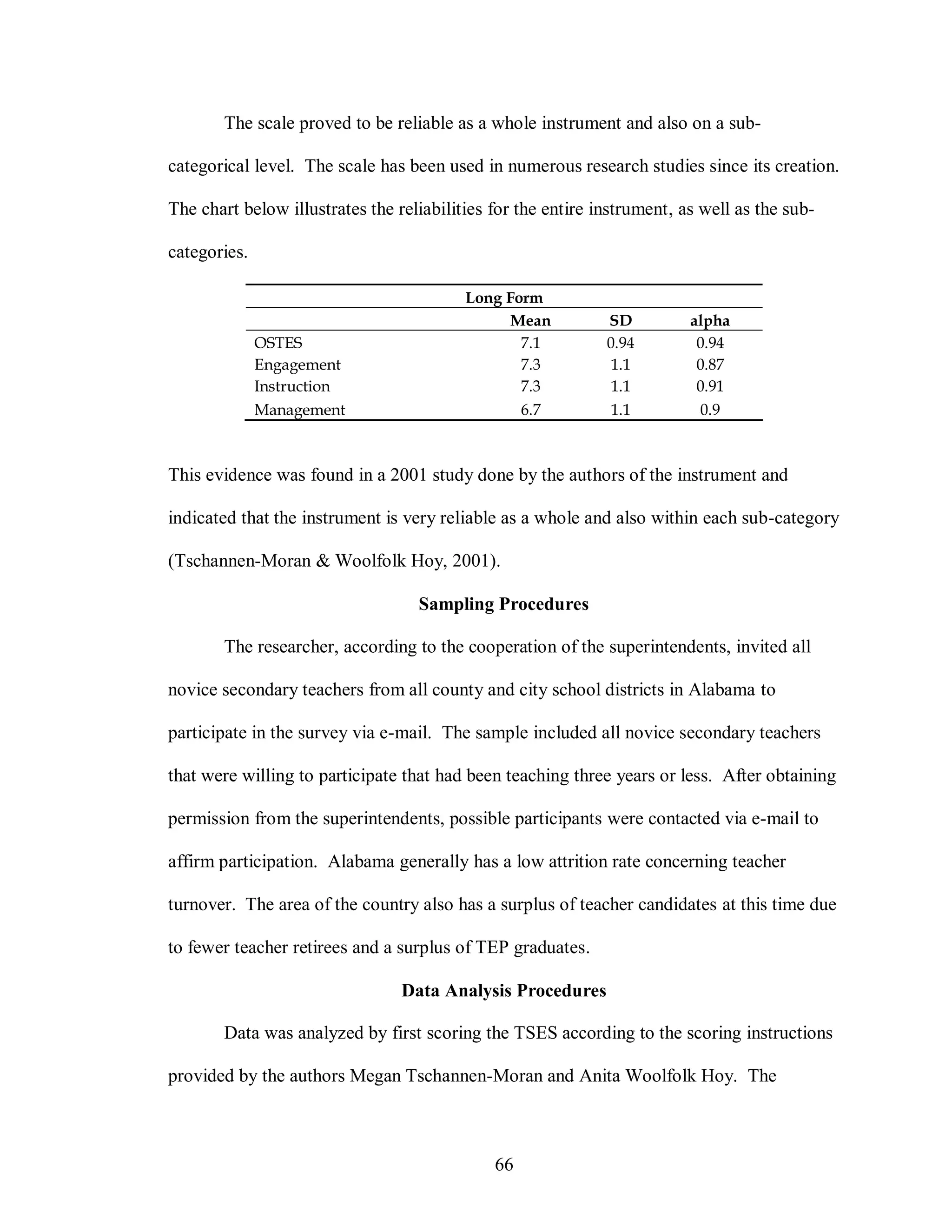
Classroom management has proved to be a plaguing aspect of the teaching and learning

process over the past century. This single skill has heavily contributed to teacher stress

and burnout (Gordon, 2002;Jepson & Forrest, 2006), teacher turnover (Ritter & Hancock,

2007; Rosas & West, 2009), overall teacher self-efficacy (Caprara, Barbaranelli,

Borgogni, & Steca, 2003; Edwards, Green, & Lyons, 2002), student achievement and

teacher performance in the classroom (Edwards et al., 2002; Milner, 2002; Poulou, 2007),

and is commonly a major concern of principals regarding new teachers (Principal

Perspectives, 2004; Williams, 1976). The purpose of the study was to determine if

novice secondary teachers feel confident in their ability to effectively manage a

classroom and, if so, what variables were related to this confidence (self-efficacy). The

study examined the relationship regarding novice secondary teacher self-efficacy

regarding classroom management and the age of the teacher, teacher gender, teacher

certification method, the presence or absence of a mentoring program during the first year

of teaching, and the number of classroom management classes taken in the teacher

education program. This study determined the relationship between a teacher’s sense of

self-efficacy as determined by the Teachers Sense of Efficacy Scale (TSES) and the

noted factors, and examined the depth of and each factoral relation as well as group factor

relation.
Dedication


       I would like to dedicate this work to my loving family, without which I could not

have succeeded. To my loving husband, thank you for always being there for me and

supporting me through this long road. To my four precious children, who have endured

through many years of a mom in school, may you follow my example. To my parents,

who have loved and encouraged me throughout my journey, thank you. Last, but not

least, to my in-laws, who have afforded me many of the wonderful opportunities that I

have experienced, and who are always praying for me, thank you.


                                           ii
Table of Contents
Dedication ...................................................................................................................... ii
Table of Contents .......................................................................................................... iii
CHAPTER ONE: INTRODUCTION ..............................................................................1
Purpose of the Study ........................................................................................................2
Problem ...........................................................................................................................4
Justification of the Study .................................................................................................5
Research Questions .........................................................................................................6
Definition of Terms .........................................................................................................9
Limitation of the Study .................................................................................................. 10
Significance of the Study ............................................................................................... 11
CHAPTER TWO: REVIEW OF THE LITERATURE ................................................... 13
Theoretical Underpinnings ............................................................................................. 13
Historical Background ................................................................................................... 21
Teacher Self-Efficacy .................................................................................................... 25
Classroom Management ................................................................................................ 30
The Importance of Classroom Management ................................................................... 32
Factors that Effect Classroom Management ................................................................... 41
Research on Self-Efficacy and Classroom Management ................................................. 47
Efforts to Correct the Problem of Poor Classroom Management .................................... 51
Conclusion .................................................................................................................... 55
CHAPTER THREE: METHODOLOGY ....................................................................... 57
Overview of the Study ................................................................................................... 58
Design of the Study ....................................................................................................... 59
Data Gathering Methods ................................................................................................ 63
Instrumentation.............................................................................................................. 64
Sampling Procedures ..................................................................................................... 66


                                                                iii
Data Analysis Procedures .............................................................................................. 66
CHAPTER FOUR: FINDINGS ..................................................................................... 69
Population & Demographics of Study Participants ......................................................... 73
Inferential Analysis ....................................................................................................... 74
CHAPTER FIVE: CONCLUSION ................................................................................ 88
Research Objective ........................................................................................................ 89
Contribution to Knowledge ............................................................................................ 90
Recommendations for Future Research .......................................................................... 92
Limitations .................................................................................................................... 93
Self-Reflection .............................................................................................................. 93
References ..................................................................................................................... 95
Appendix ..................................................................................................................... 117


                                                                iv
CHAPTER ONE: INTRODUCTION

       Classroom management has proved to be a plaguing aspect of the teaching and

learning process over the past century. This single skill has heavily contributed to

teacher stress and burnout (Gordon, 2002; Jepson & Forrest, 2006), teacher turnover

(Ritter & Hancock, 2007; Rosas & West, 2009), overall teacher self-efficacy (Capraraet

al., 2003; Edwards et al., 2002), student achievement and teacher performance in the

classroom (Edwards et al., 2002; Milner, 2002; Poulou, 2007), and has commonly been a

major concern of principals regarding new teachers (Principal Perspectives, 2004;

Williams, 1976). Classroom management problems are the leading concern of novice

teachers, and are the most common cause of teacher attrition within the first five years

(Evertson, 2001; Latz, 1992; Merrett & Wheldall, 2003; Ritter & Hancock, 2007; Rosas

& West, 2009; Silvestri, 2001; Stoughton, 2007).

       Despite research over the last century that shows classroom management as being

a monumental problem for novice teachers, historically teacher education programs have

failed to provide a well-conceptualized practical approach to classroom management

(Burden, 1983; Jones, 1982). Although there have been competencies in place regarding

classroom management (Gilbert & Lignugaris-Kraft, 1997), it has not been until recently

that classroom management has become a major concern of teacher education programs.

Although most teacher education programs now require some form of training in

classroom management, there are some states that do not require any instruction in

classroom management (Clement, 2010; Windshcitl, 2005). School districts across the

country have also noticed the problem and have implemented mentoring programs for


                                             1
new teachers (Barrera, Braley & Slate, 2010; Beutel & Spooner-Lane, 2009; Riggs &

Sandlin, 2002). Although many beneficial changes have been made regarding classroom

management, the aforementioned struggles faced by teachers are still present according to

current research (Ritter & Hancock, 2007; Rosas & West, 2009; Stoughton, 2007).

       Recent research has confirmed that self-efficacy is a determining factor in teacher

performance and, thus, affects a teacher’s ability to achieve desired outcomes in the

classroom, including classroom management ability (Poulou, 2007). Because self-

efficacy is a relatively new construct (Bandura, 1977), research is limited, and at times

contradictory regarding the variables that affect teacher self-efficacy regarding classroom

management (Gordon & Debus, 2002; Henson, 2001; Tschannen-Moran, et. al., 1998).

Despite this fact, it is known that self-efficacy plays a major part in novice teachers’

beliefs and actions toward classroom management (Emmer & Hickman, 1991; McNeely

& Mertz, 1990).

                                   Purpose of the Study

       The purpose of the study was to determine if novice secondary teachers exhibit

self-efficacy regarding classroom management and, if so, which variables are related to

self-efficacy. The study examined the relationship regarding novice secondary teacher

self-efficacy regarding classroom management and the age of the teacher, teacher gender,

teacher certification method, the presence or absence of a mentoring program during the

first year of teaching, and the number of classroom management classes taken in the

teacher education program. This study determined the relationship between a teacher’s

sense of self-efficacy as determined by the Teachers Sense of Efficacy Scale (TSES) and


                                              2
the noted factors, and examined the depth of and each factorial relation as well as group

factor relation.

        The writer determined whether or not novice secondary teachers are satisfied with

the training that they received concerning classroom management. Research indicates

that most novice teachers are usually shocked by the realities of the classroom, often

despite initial training and support given throughout program (Sadler, 2006; Veenman,

1984). The writer established through this study whether or not teachers feel that their

teacher education programs adequately prepared them for what they experienced during

the first three years of teaching. Previous research states that novice teachers do not feel

that they were well prepared by their teacher education programs (Merrett & Wheldall,

1993; Silvestri, 2001). This information benefits educational research by providing

current research and gives direction to teacher education programs in regards to

revamping the program. The answers to this question were correlated with the TSES

scores for each teacher, thus determining the existence of a relationship between

teachers’ sense of self-efficacy and teacher satisfaction with the teacher education

program.

        The study also discovered if novice secondary teachers feel that the students in

their classroom are well behaved. Research has indicated that teacher self-efficacy does,

in fact, change teacher behavior (Guskey 1988; Milner, 2002), but it is unclear whether or

not the change in teacher behavior alters student behavior. It is obviously hypothesized

that better management will result in better student behavior, but does a trilogy exist

between self-efficacy, better management, and better student behavior? The writer also


                                              3
clarified through this study whether or not teachers with a higher sense of self-efficacy

perceive fewer behavior problems in class.

       The information gathered in this study also exposed whether novice secondary

teachers feel they learn their classroom management skills ‘on the job’. This objective is

a development of corollary question one, and delves further into the initial experiences of

new teachers. This ultimately indicated whether or not teachers feel that they were given

proper experiences by their teacher education programs concerning classroom

management. This information is beneficial to educational research in the advancement

of classroom management preparation for new teachers.

       Although many studies have been done regarding self-efficacy, classroom

management, and the individual factors that affect self-efficacy regarding classroom

management, few have considered more than one or two variables at a time. This study

explored several of these factors in conjunction with each other, along with several

corollary questions that gave the educational community a clearer understanding of the

complex relationship between self-efficacy, classroom management, and multiple

variables that have been previously linked to self-efficacy research.

                                         Problem

       Research has shown that classroom management has been a historical problem for

new teachers (Evertson, 2001; Latz, 1992; Merrett & Wheldall, 2003; Ritter & Hancock,

2007; Rosas & West, 2009; Silvestri, 2001; Stoughton, 2007; Veenman, 1984). Despite

the recent trends of teacher education programs to increase training in the area of

classroom management and of school districts to correct new teachers’ deficiencies in

classroom management skills, new teachers continue to struggle with the reality of


                                             4
classroom management issues. Recent research has linked teachers’ self-efficacy with

classroom management success (Gordon, 2001; Henson, 2003), however, little

information is known regarding the variables that affect teacher self-efficacy regarding

classroom management such as teacher age, teacher gender, certification method, the

presence or absence of a mentoring program during the first year of teaching, and the

number of classroom management classes the teacher had during the teacher education

program (Laczko & Berliner, 2001; Laczko-Kerr, 2002; Qu & Becker, 2003; Ritter &

Hancock, 2007). Although colleges and school districts have increased efforts to remedy

the problems that new teachers face, the exact causes of the problem area of classroom

management seems to evade researchers.

                                Justification of the Study

       Because no one can pin point the exact reasons that teachers struggle in the area

of classroom management, more research is needed. While research does link teacher

self-efficacy with classroom management success (Poulou, 2007), little information is

known regarding the effects that variables such as teacher age, teacher gender,

certification method, the presence or absence of a mentoring program during the first few

years of teaching, and the number of classroom management classes the teacher had

during the teacher education program has on a teacher’s sense of self-efficacy regarding

classroom management. When available, research regarding these variables is often

limited or contradictory (Laczko & Berliner, 2001; Laczko-Kerr, 2002; Qu & Becker,

2003; Ritter & Hancock, 2007). Through this study, the writer sought to shed light upon

some relationships of variables that make a large impact on the link between self-efficacy

and classroom management.


                                            5
This study attempted to uncover some relationships that have not previously been

discovered regarding variables that effect self-efficacy, and also give an up-to-date

perspective on teacher attitudes toward classroom management, student behavior, and

how well teachers feel that their teacher education programs prepare them for life in a

real classroom. This study provided teacher education programs with an in-depth look at

the feelings of new teachers and their experiences in the first few years of teaching. This

research proved to be applicable for the restructuring and revamping of teacher education

programs to better equip new teachers for handling real-life classroom management

issues, reinforced the educational trend of self-efficacy and promoted the cultivation of

this entity by teacher education programs in new teachers.

                                   Research Questions

       The study made an effort to understand the relationship between numerous

variables by determining the answers to the following research questions and associated

statistical hypotheses:

Research Question 1

       Is there a relationship between a teacher’s level of self-efficacy and the age of the

teacher?

       Null hypothesis 1. There is no significant relationship between novice secondary

teachers’ level of self-efficacy concerning the area of classroom management and the age

of the teacher.

       Alternative hypothesis 1. There is a significant relationship between novice

secondary teachers’ level of self-efficacy concerning the area of classroom management

and the age of the teacher.


                                             6
Research Question 2

       Is there a relationship between a teacher’s level of self-efficacy and the gender of

the teacher?

       Null hypothesis 2. There is no significant relationship between novice secondary

teachers’ level of self-efficacy concerning the area of classroom management and the

gender of the teacher.

       Alternative hypothesis 2. There is a significant relationship between novice

secondary teachers’ level of self-efficacy concerning the area of classroom management

and the gender of the teacher.

Research Question 3

       Is there a relationship between a teacher’s level of self-efficacy and the presence

or absence of a mentoring program during the first year of teaching?

       Null hypothesis 3. There is no significant relationship between novice secondary

teachers’ level of self-efficacy concerning the area of classroom management and the

presence or absence of a mentoring program during the first year of teaching.

       Alternative hypothesis 3. There is a significant relationship between novice

secondary teachers’ level of self-efficacy concerning the area of classroom management

and the presence or absence of a mentoring program during the first year of teaching.

Research Question 4

       Is there a relationship between a teacher’s level of self-efficacy and the method of

teacher certification?


                                             7
Null hypothesis 4. There is no significant relationship between novice secondary

teachers’ level of self-efficacy concerning the area of classroom management and the

certification method by which the teacher received his or her licensure.

       Alternative hypothesis 4. There is a significant relationship between novice

secondary teachers’ level of self-efficacy concerning the area of classroom management

and the certification method by which the teacher received his or her licensure.

Research Question 5

       Is there a relationship between a teacher’s level of self-efficacy and the number of

classroom management classes completed by the teacher in the teacher preparatory

program?

       Null hypothesis 5. There is no significant relationship between novice secondary

teachers’ level of self-efficacy concerning the area of classroom management and the

number of classroom management classes completed in the teacher preparatory program.

       Alternative hypothesis 5. There is a significant relationship between novice

secondary teachers’ level of self-efficacy concerning the area of classroom management

and the number of classroom management classes completed in the teacher preparatory

program.

Corollary Research Question 1

       Do novice secondary teachers feel that their teacher education program

adequately prepared them to deal with classroom management issues that they have faced

in their own classroom?


                                             8
Null hypothesis corollary research question 1. Novice secondary teachers do

not feel that their teacher education program adequately prepared them to deal with

classroom management issues that they have faced in their own classroom.

       Alternative hypothesis corollary research question 1. Novice secondary

teachers feel that their teacher education program adequately prepared them to deal with

classroom management issues that they have faced in their own classroom.

Corollary Research Question 2

       On a scale from one to five, one being poorly behaved and five being extremely

behaved, how well behaved are the students in your classroom?

       Null hypothesis corollary research question 2. No relationship will be

noticeable regarding teacher self-efficacy levels and student behavior.

       Alternative hypothesis corollary research question 2. Student behavior will be

directly linked with teacher self-efficacy levels.

Corollary Research Question 3

       Do you feel that you learned your classroom management skills ‘on the job’?

       Null hypothesis corollary research question 3. Novice secondary teachers will

not feel that their classroom management skills are learned ‘on the job’.

       Alternative hypothesis corollary research question 3. Novice secondary

teachers will feel that their classroom management skills are learned ‘on the job’.

                                    Definition of Terms

       Self-Efficacy: Self-efficacy refers to the level of confidence that one has about

one’s own ability to perform a certain task. Self-efficacy is task specific (i.e., a person’s

self-efficacy may be high regarding their ability to play baseball, but low regarding their


                                              9
ability to play football). Self-efficacy is an ‘I can’ belief. Self-efficacy is described by

Bandura as “beliefs in one’s capabilities to organize and execute the courses of action

required to produce given attainments” (1997, p. 2).

       Classroom Management: Classroom management refers to a teacher’s “efforts

to oversee the activities of a classroom, including learning, social interaction, and student

behavior” (Martin, Yin, & Baldwin, 1998).

       Teacher Stress: Stress is defined as “the physical, mental, or emotional reaction

resulting from an individual’s response to environmental tensions, conflicts, pressures,

and other stimuli” (Greenberg, 1984).

       Novice: This refers to any newly hired teacher with zero to three full years of

experience. If the teacher has begun their fourth year, they do not qualify for the study.

       Secondary: This refers to grades nine through twelve.

       Mentoring Program: A mentoring program is a program offered by the school or

district in which the novice teacher is employed that intends to aid the novice teacher in

transitioning from student to teacher. In most cases, older, more experienced teachers are

paired with novice teachers to give feedback, guidance, and encouragement during the

novice teacher’s first year. In this study, a mentoring program does not include the

student teaching internship, which usually occurs the last semester of the teacher

education program.

                                  Limitation of the Study

       The economic condition of the educational system could serve as a limitation.

Schools across the country are failing to renew new teacher contracts because of lack of

funds. This decreased the sample size of the study and possibly affected teacher response


                                              10
on the Teacher’s Sense of Efficacy Scale due to the overall attitudes involving economic

stress and job placement. Teachers’ responses to the survey could possibly be lower due

to the poor economic condition of the country, higher levels of organizational stress, and

the lack of needed funds and materials in schools.

       Another possible limitation was participation in the study. Many times people are

unwilling to take a few minutes to fill out a survey. Time is valuable and some people

are not willing to share it, even for the purpose of research. Overall the study had a

narrow participation rate (N=141) which was less than 10% of the population.

                                 Significance of the Study

       This study sought to detect possible correlations between certain variables

regarding teacher self-efficacy and classroom management, which could be beneficial in

many ways. Correlations in this study possibly suggested, but do not determine, a

cause/effect relationship between variables, which justifies further research on the topic

of self-efficacy and classroom management. Policy and curriculum are often research-

based (Honig & Coburn, 2008), therefore, the findings of this study may spur changes in

district policy-making and teacher education programs’ courses of study. This

information presented an in-depth look at new secondary teachers’ levels of self-efficacy

and determined if certain factors are related to higher levels of self-efficacy.

       The study exposed how teachers in the state of Alabama feel about their training

in the area of classroom management. This was beneficial to the teacher education

programs in this geographic area and supplied helpful information needed to make

necessary changes in order to meet the growing needs of teachers in the area of classroom

management. Teacher education programs need to adequately prepare new teachers for


                                              11
the experiences that they will face in the classroom, and this information allows teacher

education programs to have immediate feedback on their achievement in the area of

classroom management.

        This study also linked a teacher’s level of self-efficacy with student behavior.

Although there are studies that link teacher self-efficacy with student achievement, there

are relatively few studies that link teacher’s self-efficacy levels with perceived student

behavior (Newman-Carlson & Horne, 2004). This proved to be beneficial in reinforcing

the importance of the concept of self-efficacy for new teachers, which in turn, calls for a

change in teacher education curriculum. If teachers with higher levels of self-efficacy

perceive lower levels of student misbehavior, it reinforces the importance of the

cultivation of new teacher self-efficacy, and proves beneficial for the overhaul of teacher

education programs.

        The summation of the information provided in this study was beneficial to the

teacher education programs in this geographic area (possibly generalizable), as well as

educational research as a whole and supplied helpful information to make necessary

changes to meet the growing needs of teachers in the area of classroom management. It

associated student behavior with teacher self-efficacy, which is a relatively new and

under-researched concept (Newman-Carlson & Horne, 2004). Overall, this study was the

first of its kind and is significant in the area of educational research because it

consolidated current research and established relationships among multiple factors

regarding teacher self-efficacy concerning classroom management and certain variables.


                                              12
CHAPTER TWO: REVIEW OF THE LITERATURE

       Classroom management has been a topic of high interest over the past few

decades. Numerous studies have shown that classroom management is the main problem

that novice teachers face (Evertson, 2001; Latz, 1992; Merrett & Wheldall, 2003; Ritter

& Hancock, 2007; Rosas & West, 2009; Silvestri, 2001; Stoughton, 2007). New teachers

often complain that they have received little or no instruction regarding classroom

management and that, when incorporated, it has little value due to disconnection from

‘real world’ classrooms (Siebert, 2005). Further, research has revealed that new teachers

feel that the training that they received was inadequate and that they did most of their

learning ‘on the job’ (Baker, 2005; Merrett & Wheldall, 1993; Siebert, 2005). School

districts have also recognized the problem and many have instituted a mandated

mentoring program in which all new teachers must participate (Beutel & Spooner-Lane,

2009; Barrera et al., 2010).

       One of the new focal points of modern research regarding teacher success in

classroom management regards the influence of teacher self-efficacy. The marriage of

these two entities, classroom management and teacher self-efficacy, is a relatively new

concept in the education field. The following review of literature will give a theoretical

background for the topics covered and provide historical and current research regard the

effect of self-efficacy on classroom management.

                               Theoretical Underpinnings

Rotter & RAND Research


                                             13
Julian Rotter developed basis of the idea of self-efficacy in 1966 when he

introduced his social learning theory. The basic premise of theory is that one’s

personality represents an interaction of the individual with the environment. In other

words, if one changes how one thinks, or if one changes the environment one is

responding to, behavior will undoubtedly change. The ideal of changing the way one

thinks is the basic foundation of the theory of self-efficacy.

       In 1966, Rotter wrote an article entitled “Generalized Expectancies for Internal

Versus External Control of Reinforcement.” In this article, Rotter divided teacher

attitudes into two categories regarding teacher locus of control: nature and nurture.

Tschannen-Moran, et al. accurately describes these two categories as follows:

       Teachers who concur that the influence of the environment overwhelms a

       teacher’s ability to have an impact on a student’s learning exhibits a belief

       that reinforcement of their teaching efforts lies outside their control, or is

       external to them. Teachers who express confidence in their ability to

       teach difficult or unmotivated students evidence a belief that

       reinforcement of teaching activities lies within the teacher’s control, or is

       internal (1998).

Because of the ideals set forth in this article, in 1976, the RAND organization added two

items to a pre-existing survey regarding teacher beliefs about one’s ability to teach based

on Rotter’s pre-existing theory. The items were as follows:

       RAND item # 1: “When it comes right down to it, a teacher really can’t

       do much because most of a student’s motivation and performance depends

       on his or her home environment” (Tschannen-Moran, et. al, 1998).


                                             14
RAND item # 2: “If I really try hard, I can get through to even the most

       difficult or unmotivated students” (Tschannen-Moran, et. al, 1998).

Teachers were to rate their level of agreement with each of these statements. The results

to these two items produced extraordinary findings, and proved to be the birth of the idea

of self-efficacy. Because of the brevity and triviality of the two items listed on the

RAND questionnaire, more research was conduct to produce better instruments that

measured the existence and importance of self-efficacy.

Bandura & Self-Efficacy

       Despite the pre-existence of Rotter’s 1966 social learning theory and the research

of the RAND Corporation, the birth of self-efficacy is most often credited to Albert

Bandura. Educational researchers have long based their ideals of teacher efficacy on the

theoretical framework of Bandura (1977). Bandura developed a model of self-efficacy

that entailed two types of expectations: outcome expectancy and efficacy expectancy

(1977). Outcome expectancy refers to a person’s assumption that a certain behavior will

lead to a certain consequence. Efficacy expectancy refers to the belief that a person can

successfully accomplish the behavior that leads to the desired consequence. Bandura

described self-efficacy as “beliefs in one’s capabilities to organize and execute the

courses of action required to produce given attainments” (1977).

       Bandura recognizes four entities that play a role in developing and maintaining

self-efficacy. These include mastery experiences, vicarious experiences, psychological

and emotional states, and social persuasion. Self-efficacy relies most heavily on the

influences of mastery experiences. Mastery experiences refer to successful performances

in a specified task (i.e., finishing a marathon or decorating a birthday cake). Vicarious


                                             15
experiences also play a role in the development of an individual’s self-efficacy.

Vicarious experiences refer to the witnessing of a skill being modeled by another

individual. An individual’s psychological and emotional state can also carry a heavy

influence on an individual’s level of self-efficacy. Finally, social persuasion also plays

an important role. Social persuasion refers to formal or informal performance feedback

(i.e., an encouraging pre-game speech given by a coach, or a player overhearing

someone’s lack of confidence in their ability to hit the ball).

       Initially, this theory was applied only to students in traditional K-12 classrooms.

Researchers began to look into the effect self-efficacy had on success of students.

Through numerous studies, student self-efficacy proved to be a deciding factor in student

success (Moore & Esselman, 1992; Poulou, 2007; Ross, 1992; Tschannen-Moran et. al,

1998; Watson, 1991). Later, Bandura’s theory of self-efficacy was extended to include

the realm of teacher beliefs and behaviors, where research concludes its significance.

Research has shown that a teacher’s confidence in their ability to perform the actions that

lead to student learning is one of the few individual attitudinal characteristics that predict

teacher practice and student outcomes (Kagan, 1992; Poulou, 2007; Tschannen-Moran &

Woolfolk-Hoy, 1998).

       In a later work, Bandura differentiates his ideals regarding self-efficacy with

Rotter’s 1966 work regarding internal-external locus of control (1997). Bandura argues

that a person’s belief about whether one can perform certain actions (self-efficacy) is not

the same phenomenon as the belief about whether or not those actions affect outcomes

(locus of control) (Tschannen-Moran, et. al, 1998). Later research has shown that

“perceived self-efficacy and locus of control bear little or no empirical relationship to one


                                              16
another, and …perceived self-efficacy is a strong predictor of behavior” (Tschannen-

Moran, et. al, 1998). In addition to education, self-efficacy has proved to be a

substantiating factor in many areas of life including career choice, heart attack

rehabilitation, drug addiction relapse, smoking cessation behavior, and even phobia-

related anxiety (Bandura, 1982).

Behaviorism & Classroom Management

       “Behavioral psychology, also known as behaviorism, is a theory of learning based

on the idea that all behaviors are acquired through conditioning” (Cherry, 2009).

Behaviorism is based upon the practice of conditioning. There are two types of

conditioning used in behaviorism: classical conditioning, and operant conditioning.

According to Cherry (2009),

       Classical conditioning is a technique used in behavioral training in which

       a naturally occurring stimulus is paired with a response. Next, a

       previously neutral stimulus is paired with the naturally occurring stimulus.

       Eventually, the previously neutral stimulus comes to evoke the response

       without the presence of the naturally occurring stimulus. The two

       elements are then known as the conditioned stimulus and the conditioned

       response.

       This type of conditioning is most often associated with Pavlov and the drooling

dog experiment. Although this theory can be applied to the educational setting, operant

conditioning is more widely used by educational professionals (Williams, 2008). Cherry

(2009) describes operant conditioning as “a method of learning that occurs through

rewards and punishments for behavior. Through operant conditioning, an association is


                                             17
made between a behavior and a consequence for that behavior.” The theory of

behaviorism is based upon the works of a myriad of scientists including Ivan Pavlov, B.

F. Skinner, Edward Thorndike, and John Watson (Cherry, 2009).

       Behaviorism has, until the last few decades, been the cornerstone of classroom

management, and for many years teachers and principals have relied on behaviorism to

govern traditional schools and classrooms (Boghossian, 2006). “The primary emphasis

for classroom management in a behavioral model is the use of techniques that bring

students’ behavior under stimulus control” (Garrett, 2008). Students are conditioned to

conform to the rules using both rewards and punishments. From a behavioral

perspective, the management procedures needed to reduce student misbehavior fall into

two broad categories: proactive strategies and reactive strategies—prevention techniques

(rewards) and consequences (punishment) (Wilks, 1996).

       Despite futile attempts to control behavior, one of the top public concerns for

education is lack of discipline (Gallup & Newport, 2008). After decades of use,

behaviorist classroom management strategies have not significantly changed student

behavior, and the area of classroom management for teachers is becoming exceedingly

difficult (Freidberg & Lamb, 2009). Over the last two decades, society and the field of

education have made a dramatic change in thinking concerning children and education.

The focus has shifted to a more student-centered, hands-on approach to educating

children, resulting in behaviorist ideas being abandoned for newer, more enthusiastic

ideals based on current research in the educational field (Boghossian, 2006). A key

theoretical rival to behaviorism is constructivism.


                                             18
Piaget & Constructivism

       Constructivism is a theory of learning that originated from the French

developmental psychologist Jean Piaget (Wadsworth, 1989). Piaget proposed that

knowledge is constructed; that is, knowledge is either accommodated or assimilated into

schemata (Wadsworth, 1989). Piaget suggested that people’s minds are similar to a filing

cabinet. When new information enters, the brain either files the information into an

existing schema (accommodation), or makes a new folder for new information

(assimilation). Piaget also proposed that children execute this activity according to their

mental stage. Piaget observed four developmental stages that all children pass through on

their journey to adulthood, and their approximate age in which these stages take place

(note: all stages are approximate because students pass through stages at their own pace):


      The stage of sensori-motor intelligence (0-2 years)

      The stage of preoperational thought (2-7)

      The stage of concrete operations (7-11)

      The stage of formal operations (11-15)

Each stage is characterized by specific mental and physical behavior patterns. This

research has been very beneficial to understanding the mental capacity of students in the

learning environment, as well as the preparation of grade level curriculum. These stages

also have a large impact on student behavior and, thus, should be considered when

investigating the area of classroom management.

       A constructivist approach to classroom management allows children to be a part

of the decision making process and implementing self-governance ideals. Education in

general has taken a more constructive approach to educating children (Boghossian,


                                             19
2006). Although thought patterns and pedagogy are shifting to a more student-centered

environment, which is said to be more educationally beneficial for students, teachers

continue to struggle with the area of classroom management. Research shows that

“teachers find accommodating behavioral difficulties more challenging and less feasible

than making instructional modifications for academic problems” (Crothers & Kolbert,

2008).

Kounin

         Jacob Kounin was an educational psychologist and classroom management

theorist, and was most popular for his work on classroom management in the 1970’s.

Kounin based his work on the theory of Glasser (Kounin, 1977). Prior to Kounin’s work,

most educators viewed discipline and instruction as non-related entities in the classroom

(Evertson, 2001). Kounin’s work integrated the concepts of discipline and instruction

and postulated that the two entities were not separate, but in fact very much interrelated

and dependent upon one another (1997).

         Kounin noted several important teacher behaviors that dramatically impact the

occurrence of misbehavior in students. One of the most important was the evidence of

teacher planning and organization (Kounin, 1997). Kounin was also one of the first

theorists to research and approve of preventative discipline—the use of techniques and

strategies designed to prevent discipline problems (1997). After years of research,

Kounin used five terms to denote actions of teachers that made a vast difference in

preventing student behavior. These included: withitness—a teacher’s ability to know

what is going on in the classroom at all times; overlapping—a teacher’s ability to multi-

task; momentum—a teacher’s ability to keep the lesson going smoothly; group alerting—


                                             20
a teacher’s ability to keep all students engaged and actively involved; and smoothness—a

teacher’s ability to transition smoothly from one activity to another (Kounin, 1977). In

preventing student misbehavior, Kounin also discovered the “Ripple Effect” (1977). The

“Ripple Effect” states that how a teacher handles one student’s misbehavior influences

the present and future behavior of other students. The “Ripple Effect” can be positive or

negative in terms of student behavior.

       Kounin’s contributions to the field of education have had a tremendous impact on

the field of education, especially in the area of classroom management. His work is very

important to the educational field because it notes that instruction and discipline are

interrelated and cannot be separated from one another. Kounin fortified previous

ideology regarding the importance of planning and organization in the classroom, and his

work on preventative discipline is widely accepted and applied in classrooms across the

country (Evertson, 2001).

                                  Historical Background

       Classroom management has been an inundating topic in the field of education for

the past century. Classroom management has been one of the most studied disciplines in

educational research, and produces the most inconsistent findings, leaving researchers

searching for possible answers to longstanding questions (Veenman, 1984; Williams,

1976). Research on classroom management began around the turn of the century, yet

more than one hundred years later, beginning teachers still struggle with the same

problems they did a century ago (Evertson, 2001; Latz, 1992; Merrett & Wheldall, 2003;

Ritter & Hancock, 2007; Rosas & West, 2009; Silvestri, 2001; Stoughton, 2007;

Veenman, 1984; Williams, 1976).


                                             21
Williams

       In 1976, Williams conducted a review of literature for his doctoral dissertation

that consisted of 37 studies ranging in date from 1930 to 1975. Williams found that in

both the elementary and secondary setting, discipline and pupil control was the most

frequent and challenging problem experienced by new teachers (1976). Of the 37

studies, 17 cited pupil control, discipline, or classroom management as the number one

problem area that they experienced. In the additional 20 studies, discipline, pupil control,

and classroom management were cited as one of the most severe problems faced by new

teachers (Williams, 1976). Williams also researched principals’ perceptions of beginning

teachers and found that administrators viewed discipline as the number one problem for

beginning teachers (1976).

       Williams’ analysis of literature also recognized several factors that affected the

success of beginning teachers, including gender of the teacher, age of the teacher, and

teacher certification method. A study done by Stone (1964) noted that male novice

teachers perceived fewer problems than did their female counterparts. Stone (1964) and

Briscoe (1972) also found that beginning teachers in the 24 to 35 age range perceived

fewer problems than teachers older than 35 or younger than 24. In contrast to those

findings, Ayers (1972) found that age was not an important factor in perceived problems

of beginning teachers. Formica (1962) found that beginning teachers with alternative or

emergency certificates (shorter preparation time) reported more problems than those with

traditional four-year degrees. Also, teachers that experienced traditional certification

were, at that time, more likely to remain in the teaching profession (Bledsoe, Cox &

Burnham, 1967).


                                             22
Williams’ study reinforced the previous literature regarding problems faced by

beginning teachers. Williams found that discipline and pupil control, which combine to

make up a significant component in classroom management, were among the most

common problems faced by new teachers (1976). Williams also concluded that

principals viewed discipline as one of the most notable areas of failure for beginning

teachers (1976). Although self-efficacy is not mentioned, Williams did note that

beginning teachers who “were rated excellent by themselves or their principals” seemed

to experience fewer problems than did those who were rated as “average” (Williams,

1976). Williams’ study was inconclusive concerning variables such as teacher gender

and certification method, however, he did note that beginning secondary teachers

experienced more problems than beginning elementary teachers (1976).

Veenman

       Transitioning from student to teacher is often a traumatic change for newcomers

in the educational profession. New teachers often experience a “reality shock,” which

marks the collapse of missionary ideals formed during teacher education programs by the

harsh and rude reality of classroom life (Sadler, 2006; Veenman, 1984). This transition

period can be a very trying time in the lives of new teachers. According to research,

there are five indications of the existence of reality shock: perceptions of problems

(teacher becomes aware of problems related to stress, workload, and other variables),

changes in behavior (changes in teaching behavior because of external pressures and

challenges), changes of attitudes (a shift in attitudes about teaching regarding teaching

methods), changes of personality (a change in self-efficacy and/or self-concept), and

leaving the teaching profession (teachers are so discouraged that they leave the


                                             23
profession) (Muller-Fohrbrodt, Cloetta, & Dann, 1978). The causes of the reality shock

experienced by teachers could be attributed to several causes including a teacher’s

personality, beliefs, and attitudes, but most often the reality shock is caused by situational

problems (Veenman, 1984). These could include, but are not limited to, leadership style

of the school administration, inadequate teacher preparation, shortage of materials and

supplies, absence of clearly stated goals, and lack of support (Veenman, 1984).

       The results of Veenman’s 1984 meta-analysis echoed the findings of Williams’

1976 study. Veenman’s analysis consisted of 83 individual studies regarding problems of

beginning teachers. The results of this analysis showed that classroom discipline was the

most serious problem that new teachers faced (Veenman 1984). This is evidenced in a

study done by Lagana in 1970, which noted that 83% of elementary and secondary

beginning teachers experienced discipline problems in their classroom. A research study

constituting a national sample also indicated that the more problems teachers encounter

the first year of teaching, the more likely they are to leave the teaching profession (Taylor

& Dale, 1971).

       Veenman’s analysis also included studies that tried to relate the problems of

beginning teachers to personal and situational variables such as gender, age, job

satisfaction, attitude, teacher behavior, experience, personality traits, and teacher training

(1984). The authors of one study found that in a secondary education classroom, male

teachers experienced fewer behavior problems than their female counterparts (Stone,

1964). Stone’s study also reported that teachers under the age of 24 experienced more

behavior problems than teachers ages 24 to 35 (1964). However, historical findings on

this topic have been inconsistent. Grantham (1961) and Williams (1976) reported no


                                              24
observable differences between teacher gender or teacher age. Veenman’s study also

reported that teachers that exhibited higher concern levels about self (self-efficacy)

reported more severe problems in teaching (1984). Veenman’s study also concluded that

the aspects of teaching that involved behavior control was perceived as the most

challenging problems for teachers despite experience levels (1984). Veenman did a

follow-up study in 1987 that added seventeen studies to his 1984 base of knowledge.

This study found similar results to the 1984 work, and brought the total number of studies

to one hundred (Veenman, 1984; Veenman 1987).

       In summary, Veenman’s analyses found eight frequently perceived problems

among beginning teachers in literature written from 1960 to 1984 (1984). Classroom

management was by far the most serious and frequent problem faced by beginning

teachers (Veenman, 1984, Veenman 1987). These findings directly emulate research

collected since the early 1930’s, which also asserts that new teachers during this time

period experienced problems with classroom management (Williams, 1976). These

historical literature reviews combine to provide substantial evidence that classroom

management has been a recurring problem for novice teachers. Williams’ study also

exposes a prequel to the idea of self-efficacy and the impact this has on teacher

performance and job satisfaction.

                                    Teacher Self-Efficacy

                    “As a man thinketh, so is he” Proverbs 23:7 (KJV).

       Self-efficacy refers to the level of confidence that one has about one’s own ability

to perform a certain task. The idea of self-efficacy is relatively new in the field of

education, but has gained great popularity over the past few decades. Bullough proposes


                                             25
that novice teachers need to possess a clear and positive image of themselves as teachers

(self-efficacy) before growth can occur; without a clear self-image (high self-efficacy)

novices are certain to fail miserably in the classroom (1991). Beginning teachers need

strong self-efficacy beliefs in order to continue in the field of education (Mulholland &

Wallace, 2001). Teachers who exhibit high levels of self-efficacy are also more satisfied

with their job and more empowered (Edwards et al., 2002). Thus, self-efficacy is directly

related to teacher success in the classroom.

       Self-efficacy is often divided into two categories: general teaching efficacy and

personal teaching efficacy. General teaching efficacy refers to the beliefs held by a

teacher concerning the power that external factors, such as home environment, violence,

or abuse, have in comparison to the influences that teachers and schools have on student

learning (Tschannen-Moran et al., 1998). Personal teaching efficacy refers to the degree

to which teachers believe that they have adequate training or experience to develop

strategies to overcome obstacles to student learning (Tschannen-Moran et al., 1998).

These two constructs work together to comprise the subject of self-efficacy.

       According to numerous studies, teacher self-efficacy is one of the few attitudinal

factors that research has proven to affect student achievement (Ashton & Webb, 1986;

Moore & Esselman, 1992; Poulou, 2007; Ross, 1992; Tschannen-Moran et al., 1998;

Watson, 1991). High teaching efficacy has been correlated to student achievement in

both reading and math (Watson, 1991). Teacher self-efficacy ultimately plays an

important role in shaping students’ attitudes toward school, the subject matter, and even

the teacher. In a study done by Woolfolk, Rosoff, & Hoy, the authors found a direct

correlation between the teacher’s level of self-efficacy and the students’ interest in school


                                               26
(1990). The study also showed that the higher the teacher’s sense of self-efficacy, the

more likely students were to give a positive evaluation of the teacher (Woolfolk, Rosoff,

& Hoy, 1990). The following quote summarizes the cycle of teacher self-efficacy:

       Greater efficacy leads to greater effort and persistence, which leads to

       better performance, which in turn leads to greater efficacy. The reverse is

       also true. Lower efficacy leads to less effort and giving up easily, which

       leads to poor teaching outcomes, which then produce decreased efficacy

       (Tschannen-Moran, et. al., 1998).

Bandura (1997) also notes that teachers that are devoid of efficacy adopt a custodial view

of education and are often angered by student misbehavior, utilize coercive disciplinary

practices, and are often cynical about student motivation and ability. Teachers that have

a high sense of self-efficacy believe that teaching makes a difference and that they

personally can affect student learning; teachers that have low self-efficacy believe that

the action of teaching has little influence and they cannot overcome environmental and

situational obstacles to learning (Gordon, 2001). This ideology is rooted in the age-old

nature/nurture dilemma that has plagued education since its foundation.

       In addition to benefits for the student, high levels of teacher self-efficacy have

multiple advantages for the teacher as well. Teacher self-efficacy is very important

because it has been linked to positive teacher behavior in the classroom (Guskey 1988;

Milner, 2002), increased enthusiasm for teaching (Allinder, 1994; Ashton, 1984; Fuchs,

Fuchs, & Bishop, 1992), lower levels of teacher stress and an increased resistance to

teacher burnout (Brouwers & Tomic, 2000; Freidman & Farber, 1992; Greenglass and

Burke, 1988; Smylie, 1998), and an increased level of professional commitment


                                             27
(Coladarci, 1992; Evans & Tribbel, 1986; Glickman & Tamashiro, 1982). High levels of

self-efficacy are also positively correlated with a teacher organization and planning

tendencies and a teacher’s willingness to work with students experiencing difficulties

(Fuchs et al., 1992). Teacher efficacy ultimately proposes that a teacher’s level of self-

efficacy directly influences the persistence a teacher will show in an obstructing situation,

and also the amount of effort a teacher will put forth in a teaching situation (Tschannen-

Moran et al., 1998).

       Little is known about exactly what causes the phenomenon of self-efficacy. A

plethora of ideals are present regarding the formation of self-efficacy among teachers.

Research has suggested that student teachers’ beliefs about control and motivation were

directly related to teacher efficacy (Woolfolk & Hoy, 1990). Also, teachers’ individual

capability and confidence with the day-to-day routines in the classroom has been linked

to an increase in self-efficacy level (Yeung & Watkins, 2000). A teacher’s experience

during student teaching practice has also been correlated with higher self-efficacy levels

(Bandura, 1997; Mulholland & Wallace, 2001; Pajares, 1997).

       The question of whether or not self-efficacy changes over time brings mixed

conclusions regarding research. Some studies argue that self-efficacy can be improved

through training and support programs for new teachers (Tschannen-Moran et al., 1998).

Other studies argue that self-efficacy may be more easily influenced in the formative

years of the teacher education program (Henson, 2001; Gordon & Debus, 2002). Even

other studies still insist that teacher efficacy declines after a new teacher experiences the

‘reality shock’ of teaching, and although it may increase later in one’s career, most times

it does not achieve initial levels of self-efficacy (Housego, 1992; Spector, 1990;


                                              28
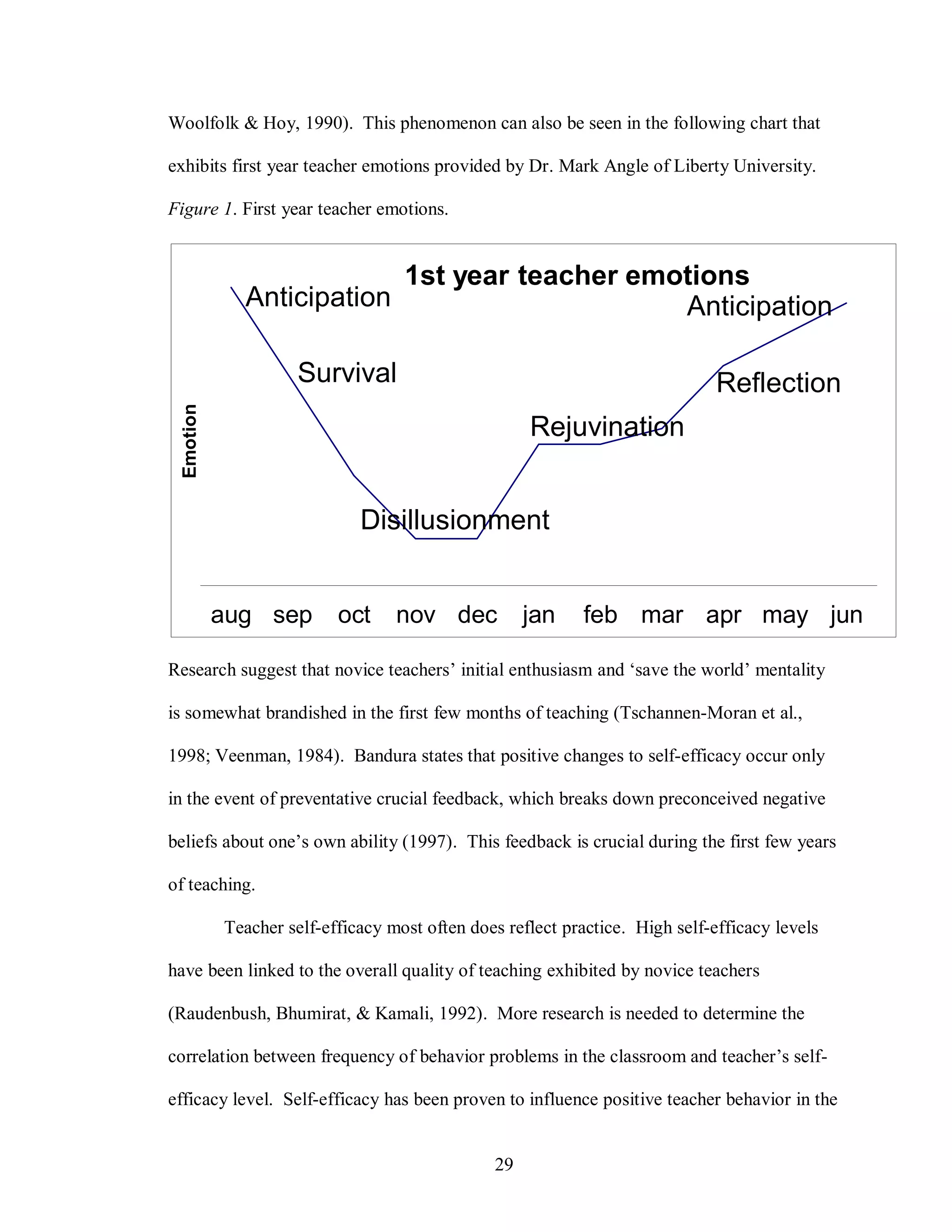
Woolfolk & Hoy, 1990). This phenomenon can also be seen in the following chart that

exhibits first year teacher emotions provided by Dr. Mark Angle of Liberty University.

Figure 1. First year teacher emotions.


                          1st year teacher emotions
             Anticipation                     Anticipation

                     Survival                                                 Reflection
 Emotion


                                                    Rejuvination


                             Disillusionment


           aug sep        oct     nov dec           jan    feb mar apr may jun

Research suggest that novice teachers’ initial enthusiasm and ‘save the world’ mentality

is somewhat brandished in the first few months of teaching (Tschannen-Moran et al.,

1998; Veenman, 1984). Bandura states that positive changes to self-efficacy occur only

in the event of preventative crucial feedback, which breaks down preconceived negative

beliefs about one’s own ability (1997). This feedback is crucial during the first few years

of teaching.

           Teacher self-efficacy most often does reflect practice. High self-efficacy levels

have been linked to the overall quality of teaching exhibited by novice teachers

(Raudenbush, Bhumirat, & Kamali, 1992). More research is needed to determine the

correlation between frequency of behavior problems in the classroom and teacher’s self-

efficacy level. Self-efficacy has been proven to influence positive teacher behavior in the


                                               29
classroom (Guskey 1988; Milner, 2002), and also student academic success (Ashton &

Webb, 1986; Moore & Esselman, 1992; Poulou, 2007; Ross, 1992; Tschannen-Moran et

al., 1998; Watson, 1991), but has not been directly linked to student behavior.

                                 Classroom Management

       Classroom management has been a historical problem for teachers. Since the

early 1930’s, teachers have reported that classroom management and student misbehavior

were the two most trying issues for new and, sometimes, even experienced teachers

(Johnston, 1978; Williams, 1976). Although society and the educational system have

undergone monumental transformations since that time, classroom management still

remains as the most trying issue for new teachers (Evertson, 2001; Latz, 1992; Merrett &

Wheldall, 2003; Ritter & Hancock, 2007; Rosas & West, 2009; Silvestri, 2001;

Stoughton, 2007). Classroom management refers to a teacher’s ability to keep order in

the classroom, engage students in learning, and elicit student cooperation, all while

balancing the menial tasks of the classroom (Wong & Wong, 2009). Research shows that

“students spend up to one-half of instructional time engaged in tasks not related to

learning, such as classroom procedural matters, transitions between activities, discipline

situations, and off task activities (Codding & Smyth, 2008).

        Classroom management is a dichotomous element in the classroom, and can be

broken down into two parts: behavioral management and instructional management

(Magableh, & Hawamdeh, 2007). These two entities intertwine to form a healthy

classroom atmosphere for students and teachers. Behaviors related to management of

learning situations, or instructional management, include: interruption of teacher, non

interest of teaching material, collective answers, not participating, cheating, slowness in


                                             30
completing work, reading another subject during the lesson, preparing the assignments

during the lesson, and not completing the assignments (Codding & Smyth, 2008).

Behaviors related to behavior management include: side talks, joking during the lesson,

changing sitting locations, issuing annoying voices, too many requests, using a cell

phone, occupation in side matters, eating in the classroom, stubbornness, lying, theft,

laughing without reason, assaulting others, pretending of sickness, non interest of

classroom cleanliness, damaging individual or classroom property, or bullying other

students (Codding & Smyth, 2008). Behaviors that are disruptive to the classroom such

as inattention, over activity, and noncompliance are the most common complaint of

teachers (Goldstein, 1995). The following research will investigate the importance of

good classroom management in the classroom, some factors that influence classroom

management, and what is being done in the educational world to correct the problem.

       The ultimate goals of classroom management are to provide a healthy, safe

environment for learning, and to equip students with the necessary skills to be successful

in life, both academically and socially (Wong & Wong, 2009). Classroom management

is often reduced to a set of techniques for disciplining individual children’s misbehavior

(Choi & Lee, 2009). Although every classroom management plan must have a form of

discipline that enforces consequences for undesirable behaviors, the overall goal for

classroom management is not disciplining individual students (Wong & Wong, 2009).

Management, whether of a classroom, a family, or an entire business, involves many key

aspects—discipline is only a very small part of the picture. As a manager of a classroom,

the teacher is to direct children in learning and behavior—controlling the learning


                                            31
environment and coaching the children—training students to be successful both

academically and behaviorally, individually and as a team.

                      The Importance of Classroom Management

       Classroom management has become increasingly important over the past few

decades. The main reason is that with good classroom management, effective teaching

and learning cannot and will not take place (Marzano, Marzano & Pickering, 2003).

Teachers have recently been put under extreme pressure for their students to perform.

Increased accountability and high stakes testing require students to meet a desired level

of academic success, and without a properly managed classroom, this task is near

impossible. If one cannot manage a classroom, one cannot be sure that the students are

learning the material. Poor classroom management may also lead to increased levels of

school violence and bullying (Allen, 2010), as well as increased teacher stress levels,

increased probability of burnout, and higher levels of teacher attrition (Jepson & Forrest,

2006; Hamann, 1985; Mercer & Mercer, 1986; O’Hair, 1995, Clunies-Ross, Little, &

Keinhuis, 2008; Lewis, Romi, Qui, & Katz, 2005).

Increased Accountability & High Stakes Testing

       Teachers are responsible for student learning, and although this is a heavy burden

to bear, it is ultimately the truth. Today’s teachers are bombarded with accountability

issues regarding testing and laws that govern education. Teachers are often pressed for

time to cover all of the material that students ultimately need to reach the stated goals of

the classroom. A teacher with a poorly managed classroom will use valuable

instructional time for discipline and maintaining order, rather than teaching. This misuse

of time is a very critical issue in the educational arena. Therefore, initiating and


                                             32
maintaining an efficient classroom management plan is crucial in the establishment of

safe learning environments that ultimately promotes academic achievement and success

for all students. New laws governing student achievement such as the No Child Left

Behind Act of 2001 (NCLB) have had an enormous impact on schools across the country.

This law has raised the standards for educators everywhere and promotes academic gains

for all students. NCLB mandates that a certain percent of students meet benchmark

requirements each year in certain academic areas (e.g. graduation rate, SAT, etc.), with

percentages expected to improve yearly (Floch, Carlson, Martinez, & O'Day, 2007).

This ‘improvement’ is known as Annual Yearly Progress (AYP). If schools fail to meet

AYP, they are in danger of the state taking over and revamping the school, which often

results in a large amount of undesired teacher turnover (Floch, et. al., 2007). It is also a

very costly procedure, for which the district foots the bill.

       The Individuals with Disabilities Education Act (IDEA) also proposes a need for

teachers to possess better classroom management skills. The law, passed in 2004, states

that students with disabilities are to be educated in the ‘least restrictive environment’,

which often means the traditional classroom setting. Students with emotional or

behavioral disorders (EBD) are classified under IDEA. “It is estimated that 10 to 25% of

preschool or early school age children meet the minimum criteria for operational defiant

disorder (ODD), meaning they display high rates of aggressive, disruptive, oppositional,

hyperactive behavior problems and peer relationship difficulties (Campbell, 1990, 1991;

Webster-Stratton & Woolley, 1999)” (Webster-Stratton & Reid). These students are

usually mainstreamed into the traditional classroom (especially those undiagnosed), and

are under the instruction of traditional classroom teachers. These students are often


                                              33
unpredictable in their behavior and can become disruptive and even violent. Research

has shown that student aggression is more prevalent in poorly managed classrooms, thus

indicating that poor classroom management could escalate the poor behavior of students

with ODD or other behavior disorders (Kellam, Ling, Merisca, Brown, & Ialongon,

1988). It is immensely important that educators be able to maintain a controlled

environment so that all students, including those with disabilities, are able to have a

proper learning experience. It is eminent to the safety of both the teacher and the student

to maintain a safe learning environment and, to do this; teachers must know how to

properly manage a classroom.

Bullying & School Violence

        Bullying and school violence have recently become a major concern in the

educational field. In the last couple of decades, the effect of bullying has been seen in the

dramatic increase in juvenile violence and childhood and adolescent psychiatric disorders

(depression, anorexia, etc.) (Crothers & Kolbert, 2008). Poor classroom management is

detrimental to the health and safety of students within a classroom. Laziness in the area

of classroom management will be rewarded with chaos and, as the Bible says in Proverbs

21:5, “Good planning and hard work lead to prosperity,” (NLT, 2004).

       Bullying is the deliberate act of a more powerful person to hurt, frighten, or

intimidate a weaker person on a continual and deliberate basis (Scarpaci, 2006).

“Bullying can be physical (hitting, shoving, poking, tripping, and slapping), verbal

(name-calling, insults, derision, racist remarks, and teasing), and social (persuading other

to exclude or reject someone)” (Scarpaci, 2006). Almost 30% of youth in the United

States (or over 5.7 million children) are estimated to be involved in bullying as either a


                                             34
bully, a target of bullying, or both (Bullying Facts and Statistics, 2007). In a recent

national survey of students in grades 6 through 10, 13% reported bullying others, 11%

reported being the target of bullies, and another 6% said that they bullied others and were

bullied themselves (National Youth Violence Prevention Center, 2007). Research also

links bullying to school shootings, suicide, depression, alcoholism, and poor academic

performance (Scarpaci, 2006). Research also indicates that bullying is as detrimental to a

child’s overall health as child abuse (Scarpaci, 2006). Children that exhibit aggressive

behaviors are more likely to perform poorly academically, socially, and emotionally

(Alvarez, 2007).

       One possible reason that bullying continues to be a problem in schools across the

country is due to teacher beliefs and actions regarding bullying. The strategies used by

teachers, whether positive or negative, have a lifelong influence on children. Teachers

are responsible for their attitudes regarding bullying—whether they see bullying as a

normal part of life (normative), an injustice that needs to be stopped (assertive), or a

situation that will dissolve on its own (avoidant)—directly influences the amount and

severity of bullying in a classroom (Kochenderfer-Ladd & Pelletier, 2008). These

attitudes affect the actions that a teacher takes to provide a safe learning environment for

all students, which is ultimately the goal of classroom management. Another reason that

bullying continues to be a problem is that teachers are inconsistent in their actions

regarding timing and consequences for undesirable student behavior (Kochenderfer-Ladd

& Pelletier, 2008). The organizational culture of the school can also have a dramatic

impact on the classroom management procedures of teachers. General classroom


                                             35
management has been directly linked to the frequency of classroom bullying

(Kochenderfer-Ladd, & Pelletier, 2008).

       Teachers that struggle with classroom management are a liability to schools in

this era of education. Court systems are beginning to recognize the availability of a safe

learning environment as a right of the student. This can be seen in the recent court

rulings of Theno vs. Tonganoxie School District (Teen Bullied, 2005). In this case, Dylan

Theno was awarded $440,000 for harassment that took place on school grounds because

he proved that the school acted in deliberate indifference in regards to his protection from

bullies (Teen Bullied, 2005). Acting with deliberate indifference can make a school

liable for both mental and physical damage that occurs from bully victimization (Kern &

Alexander, 2009).

       Bullying is also very closely linked with school violence. “Research by the Secret

Service and the U. S. Department of Education involving 37 school shootings, including

Columbine, finds that about two-thirds of student shooters felt bullied, harassed,

threatened or injured by others” (School Bullying, 2009). There also appears to be a

strong relationship between bullying other students and experiencing later legal and

criminal problems as an adult.

       In one study, 60% of those characterized as bullies in grades 6 through 9 had at

least one criminal conviction by age 24 (National Youth Violence Prevention Center,

2009). Also, several authors conducted a longitudinal study to examine a possible

relationship between implementation of a classroom management technique called the

Good Behavior Game and the effects it has on students later in life. The trial of the GBG

took place over the course of a two-year period. Students were then contacted between


                                            36
the ages of 19 to 21 and were interviewed via a 90-minute telephone interview. Results

showed that young adults who were in GBG first grade classrooms had lower levels of

lifetime drug abuse/dependence disorders compared with the control group, and the GBG

also decreased antisocial behavioral outcomes, lowered the smoking probability for

males, and dropped the prevalence for ASPD (antisocial personality disorder). This

suggests that teachers’ classroom management skills play a role in the development of

moral character over the course of a lifetime (Kellam, Hendricks Brown, Poduska,

Ialongo, Toyibno, Ford, Windham, & Wilcox, 2007). Several other researchers have

found similar results regarding the correlation of childhood behavior and problems later

in life.

           ‘Early onset’ aggressive behavior problems in preschool children are

           astable over time and appear to be the most important behavioral risk

           factor for antisocial behavior in adolescence. Such behavior in children

           under 12 years of age has repeatedly been found to predict the

           development of drug abuse in adolescence (Dishion & Andrews, 1995) as

           well as other problems such as juvenile delinquency, depression violent

           behavior, and school dropout (Snyder, 2001). Since conduct disorder

           becomes increasingly resistant to change over time, intervention that

           begins in the early school years is clearly a strategic way to prevent or

           reduce aggressive behavior problems before they “ripple” to result in well-

           established negative reputations, academic failure, and escalating violence

           in adolescence (Webster-Stratton & Reid).


                                                37
Recent years have witnessed an increased focus on children’s behavior in

schools as a result of tragic events in locations such as Red Lake, Minnesota, and

Littleton, Colorado (Little & Akin-Little, 2008). Although more research needs to

be done in order to directly link the events of school violence with classroom

management, the events do raise awareness of the possible correlation of the

variables. Also, aggressive, disruptive behavior, especially when exhibited at an

early age, has been shown to be an important maladaptive classroom behavioral

antecedent of adolescent and adult illicit drug use, conduct disorders, antisocial

personality disorder, criminal behavior, and school failure and dropout (Dishion

& Andrews, 1995; Kellam et al., 2008; Snyder, 2001). Misbehavior in the

classroom, even in the early primary grades, can be an indicator of misbehavior

later in life (Goldstein, 1995).

Teacher Stress, Teacher Burnout, & Teacher Attrition

        Teaching today is a very stressful profession. The levels of stress experienced by

teachers undoubtedly have a strong effect on teacher performance, career decisions,

physical and mental health, and overall job satisfaction (Jepson & Forrest, 2006). Stress

is defined as “the physical, mental, or emotional reaction resulting from an individual’s

response to environmental tensions, conflicts, pressures, and other stimuli” (Greenberg,

1984). There are many influential factors regarding teacher stress. Some studies suggest

that teacher gender is a contributing factor of stress (Farber, 1991; Gupta & Jenkins,

1981). Female teachers, in particular, are more likely to experience stress, especially

when dealing with discipline issues (Gupta & Jenkins, 1981; Okebuloka & Jegede, 1989).

Certification method is also noted to play a role in the amount of stress experienced by


                                             38
teachers (Ritter & Hancock, 2007). Despite the many things that can cause stress for

teachers, the most prevalent is classroom misbehavior and discipline (Clunies-Ross,

Little, & Keinhuis, 2008; Hamann, 1985; Lewis, Romi, Qui, & Katz, 2005; Mercer &

Mercer, 1986; O’Hair, 1995). Student attitudes and behavior, such as lack of interest

(Hamann, 1985; Geving, 2007), violence and disruptive behavior (O’Hair, 1995),

disrespect (Geving, 2007), high levels of classroom noisiness (Geving, 2007), and

negative attitudes toward curriculum and learning (Brown, 1987) directly affect teacher

stress levels. Research also indicates that teachers’ feeling that they were inadequately

prepared in handling classroom management issues serves as a prevalent stress factor

(Merrett & Wheldall, 1993; Silvestri, 2001; Youseff, 2003).

       If stress levels get exceedingly high, teachers can go into distress, which is

synonymous with burnout (Punch & Tuettman, 1990). Punch & Tuettman found that

more women experienced psychological distress due to work related stress factors than

did men (1990). Teachers that experience burnout are likely to experience consequences

such as “detachment, depersonalization, avoidance, apathy, cynicism, and physical and

emotional fatigue” (Gordon, 2002). Research has suggested that female teachers

experience greater levels of emotional exhaustion (which is a precursor of burnout) than

their male counterparts (Greenglass & Burke, 2003). Teacher stress and burnout can also

be infectious to students. Teachers that exhibit the above behaviors are more likely to

have decreased student productivity and performance in their classroom (Payne, 1994).

       A teacher’s sense of job satisfaction is very important because it influences

teacher behavior in the classroom (Caprara et al., 2003; Judge, Thoresen, Bono, & Patton,

2001). Job satisfaction denotes the perceived fulfillment that a teacher receives from


                                            39
daily occupational activities. Research indicates that both self-efficacy and collective

efficacy contribute to the level of job satisfaction experienced by teachers (Caprara et al.,

2003). As a general rule of thumb, the higher a teacher’s level of job satisfaction, the

lower the teacher’s stress level will be, and the less likely a teacher will be to leave the

teaching profession all together.

       Teacher stress and burnout, in severe cases, can lead to teacher attrition (Duck,

2007). The American education system as a whole is experiencing a large teacher

shortage (Maryland State Department of Education, 2006; Quigney, 2010; Committee for

Economic, 2007). Some scholars argue that it is not a shortage of teachers, per say, but

rather an alarming attrition rate among qualified teachers (Duck, 2007). Student

misbehavior is said to be the most prominent reason for teachers to leave the teaching

profession (Gordon, 2002). Research notes that almost 50% of teachers leave the

profession within the first five years (Henke, Chen, & Geis, 2000). Teacher attrition is a

very costly process for the educational system, and detrimental to student achievement.

The National Commission on Teaching and America’s Future estimates that American

schools spend an average of $7.43 billion yearly to recruit, hire, and train replacement

teachers (Alliance for Educational Excellence, 2008). The fate of American education

rests on the shoulders of educators. The general consensus of modern research suggests

that the most important factor in determining student success is the quality of the teacher

(Heilig & Jez, 2010). Research conducted by the Alliance for Educational Excellence

suggests that teachers that are dissatisfied with their relationships with parents,

administrators, and students were more likely to leave the teaching profession (2008).


                                              40
Therefore, it is extremely important that the problems, such as classroom management

issues that lead to teacher attrition, are solved.

                       Factors that Effect Classroom Management

        There is no cookie-cutter formula that equates good classroom management.

Classroom management requires the development and honing of skills and strategies to

produce a safe and orderly learning environment. Classroom management is different for

every teacher, every classroom, and every situation, and could possibly be the most

complex aspect of teaching (Wong & Wong, 2009). Classroom management relies

heavily on planning, establishing, and maintaining routines and procedures, and

enforcing rules with consequences (Wong & Wong, 2009). One of the most influential

factors affecting classroom management practice appears to be experience. Although

surveys generally indicate that teachers with more years of experience perceive fewer

problems regarding classroom management, instead of implying that teachers learn to

manage classroom over time, these surveys could be evidence that teachers that did not

learn to properly manage classrooms have left the profession (Baker, 2005). Besides

experience, there are also several other factors that heavily influence the classroom

management abilities of new teachers including teacher preparation programs,

certification methods, school policies, and organizational culture.

Teacher Education Programs

        Teachers are most often judged for effectiveness based on their ability to manage

a classroom rather than on their academic knowledge and ability (Principal Perspectives,

2004; Taylor & Dale, 1971; Veenman, 1984). According to research, classroom

management and discipline are very important to principals. In a survey of 600


                                               41
principals, 85% agree that classroom management is the most severe and threatening

problem that new teachers face, and the primary adversary to a becoming a successful

teacher (Principal Perspectives, 2004). Of the principals that were interviewed, 63%

believe that teacher education programs should “put a greater emphasis on teaching

practical knowledge of classroom conditions, including classroom management skills and

discipline strategies” (Principal Perspectives, 2004). This number is an increase from a

study by Taylor and Dale (1971) that noted that 73% of principals in secondary schools

reported that classroom management was a major problem of new teachers.

       There have been numerous studies that assess new teachers’ satisfaction with

teacher preparation, especially in the area of classroom management. In 1993, authors

Merrett and Wheldall discovered that 72% of secondary teachers were dissatisfied with

their initial professional training and teaching experience concerning classroom

management. Of these respondents, 86% felt that they had to learn classroom

management skills ‘on the job’ (Merrett & Wheldall, 1993). A survey of Colorado

teachers also noted that new teachers were unsatisfied with their classroom management

preparation and felt inadequate in the area of classroom management (Silvestri, 2001).

The supervisors of these new teachers verified that over 90% of the teachers met all

district standards other than in the area of classroom management (Silvestri, 2001).

Research also shows that the majority of students feel that their college courses are not

applicable in the real classroom (Kagan, 1992; Merrett & Wheldall, 1993).

       Due to the unpredictability of classroom life, beginners’ experiences in the

classroom are often not clearly depicted by university coursework, nor by the classroom

practicum experiences provided in teacher education programs. In fact, most new


                                            42
teachers felt unprepared for their first teaching experience and felt that their university

coursework was somewhat disconnected from the classroom management issues that they

faced during their first teaching experiences (Kagan, 1992; Merrett & Wheldall, 1993).

Behavior, especially in older children, is unpredictable and despite the amount of

emphasis put on classroom management during the teacher education program,

circumstances in the actual classroom will vary. Classroom management is an ever-

changing discipline that is to be practiced, and is not necessarily a single fact or set of

facts that can be acquired through book knowledge. For example, someone can

extensively explain to how to ride a bike, but one will not learn how to ride until getting

on the bike for his or herself. In other words, there is a difference in ‘knowing’ and

‘doing’. Unfortunately, many of the teacher education programs allow their teachers to

‘get on the bike’ of classroom management ‘without a helmet and knee and elbow pads’

(experience and strategies) to protect the teacher from injury. They also often do not

have their ‘dad’ (support personnel, teacher education program, cooperating teacher,

mentor teacher, or principal) running along beside them assuring their success. These

teachers often ‘crash their bike,’ wearing no protection and having no one to bandage

their wounds. Some never get on the bike again.

       There is general consensus among new teachers that there is a great division

between theory and practice in the area of classroom management, as evidenced by

teacher education programs (Melnick & Meister, 2008; Stoughton, 2007). One of the

most common complaints of novices regarding classroom management is the lack of

practical, useful knowledge available to them (Merrett & Wheldall, 1993; Sadler, 2006;

Veenman, 1984). Before teachers begin the teaching profession, they often have a false


                                              43
sense of security regarding their ability to perform and preconceived beliefs regarding

classroom life and student behavior (Emmer & Hickman, 1991; Veenman, 1984;

Veenman, 1987). During the first few months of teaching, this ‘save the world’ mentality

is often replaced with survival skills. During this time, theory, or what was taught in the

teacher education programs, is often replaced with ‘old-hat’ remedies and techniques to

control behavior (Emmer & Hickman, 1991; Veenman, 1984; Veenman, 1987). Because

the theory has not been practiced and engrained into beginning teachers through

experience, progressive methods often taught by teacher education programs are easily

replaced with more traditional, authoritarian methods of classroom management (Emmer

& Hickman, 1991; Veenman, 1984; Veenman, 1987). Thus, the failure to practice theory

leads to a practice devoid of theory.

       Colleges and universities around the world are attempting to oust traditional

methods of classroom management, such as interventionists and controlling methods of

instruction, and replace these with constructivist and proactive approaches (Freiberg &

Lamb, 2009). Teachers cannot survive in a constructivist and proactive world without

self-efficacy. “Teacher education programs should be designed to foster reasonable

internal attributions for student success and failure and facilitate development of self-

efficacy” (Henson, 2003). Because research shows that teacher self-efficacy can be more

easily influenced during the beginning years of teacher education, it is the job of teacher

education programs to instill this trait into prospective teachers (Hummel & Strom,

1987). Ultimately, without self-efficacy, teachers will revert back to traditional methods

of teaching.


                                             44
It is important to note that regardless of how good of an education a teacher has, if

classroom management is not taught and practiced along with the other strategies and

procedures, teachers may question good teaching methods because of student behavior

and regress to more traditional methods. Therefore, it is imperative that teacher

education programs tightly interweave classroom management into all coursework.

Because of the effects it has on the classroom environment and the mental and physical

well-being of the teacher and students, classroom management is the cornerstone of a

high-quality education.

Certification Method

       The task of improving teacher quality has led to a heated debate regarding

certification methods over the past few years. Because states are responsible for their

own educational systems, there is no single prescribed manner for attaining certification.

Certification methods could be another factor influencing classroom management

abilities (Laczko-Kerr, 2002; Laczko & Berliner, 2001). There are many different routes

to teacher certification including traditional, alternative, emergency, and out of field.

Because of teacher shortages, many teachers are hired on an emergency certificate, which

allows them to teach while they are going back to school to get certified. This puts

teachers in the classroom without formal classroom management (or academic) training,

which can lead to further stress for the teacher. Teachers that go through alternative

certification usually have a Bachelor’s degree in a subject area, and are usually given a

less dense version of the traditional certification classes. These certifications usually take

about one year to complete. Sometimes, because of budgeting issues, teachers are forced

to teach out of field. This can also influence classroom management practices. If


                                              45
teachers feel that they are academically and pedagogically ill prepared, it can also lead to

student behavior problems in the classroom.

       Research on the ‘best’ certification method (as in the most beneficial to teachers)

has shown mixed results. Some studies argue that traditional certification produces more

high-quality teachers than emergency certified teachers (Laczko-Kerr, 2002; Laczko &

Berliner, 2001) and alternatively certified teachers (Laczko-Kerr, 2002). Results from a

meta-analysis of 24 studies that examined the issue of teacher certification and teacher

quality concluded that traditional certification was at least as effective as alternate-route

training, and generally more effective than emergency certification (Qu & Becker, 2003).

       Research also implies that certification methods may influence the way teachers

conduct and manage their classroom. A study was conducted to determine if teacher

certification methods or years of experience (or the combination of these) influenced

teacher ideals and practices regarding classroom management. Results showed that

neither years of experience or certification method alone influenced classroom

management beliefs, but the combination of these factors did produce change in ideals

and practice (Ritter & Hancock, 2007). Teachers that were traditionally certified and had

several years of experience were more likely to have progressive views regarding

classroom management and allow children to be part of the decision processes in the

classroom (Ritter & Hancock, 2007).

       Because of the inconsistency in teacher education program curriculum and routes

to certification, it is difficult to get an accurate picture of what works and what does not

work. Universities and education policy makers need to collaborate and focus on the

needs of new teachers across the country.


                                              46
Teacher preparation programs need to give preservice teacher more

       opportunities for actual experiences with increasing levels of complexity

       and challenge to provide mastery experiences and specific feedback. An

       apprenticeship approach—whereby the complex task of teaching is broken

       down into its elements and an apprentice teacher is allowed to work on

       developing one set of skills at a time—should encourage a compounding

       sense of efficacy over various context and skills (Tschannen-Moran et al.,

       1998).

Theoretical knowledge is good, but it will not help a new teacher that is struggling

with practical issues like classroom management. By solidifying a teacher

education curriculum that can be generalized throughout all states, new teachers

would be benefitting, there would be a better understanding of what really works,

and it would be easier to see and correct problems.

                Research on Self-Efficacy and Classroom Management

       The marriage of the theories of self-efficacy and classroom management is

relatively new in educational research. Although researchers have stumbled around this

idea since the beginning of Bandura’s work on self-efficacy, only recent research has co-

mingled the idea that a teacher’s self-efficacy does influence teacher behavior regarding

classroom management and possibly even student behavior (Narvaez, Vaydich, Turner,

& Khmelkov, 2008; Newman-Carlson & Horne, 2004). The following research discusses

the results of a few studies that dealt directly with the areas of classroom management

and self-efficacy.


                                            47
A study by Emmer and Hickman found that classroom management/discipline

efficacy is separate from other types of teacher efficacy (1991). Thus, a teacher’s level of

total self-efficacy may not be a clear reflection of self-efficacy in regards to classroom

management and discipline. This study also found that efficacy beliefs predict

preferences for certain strategies to deal with hypothetical problems presented in the

study (Emmer & Hickman, 1991).

       A study by Mcneely and Mertz tracked the behaviors of 11 secondary student

teachers in numerous content fields (1990). At the beginning of the semester, student

teachers experienced a high sense of self-efficacy, were detailed planners, and used a

variety of activities in each lesson. By the end of the student teaching experience, these

teachers saw their students as their opponents, were focused on controlling student

behavior, and taught lessons that allowed the teacher to be in total control (Mcneely &

Mertz, 1990). High self-efficacy encourages productive habits and activities in teachers,

but if teachers lack management abilities, an efficacious classroom can be replaced by a

dictatorship, as demonstrated the in Mcneely and Mertz study.

       A study done by Baker indicated that there is a relationship between self-efficacy

and teachers’ willingness and ability to manage challenging students (2005). According

to research, teachers’ self-efficacy when dealing with behavior problems presented by

students that have an emotional or behavioral disorder (EBD) is generally lower than

dealing with non-disabled students (Baker, 2005). This information is important because

self-efficacy is directly related to teacher behavior in the classroom (Guskey 1988;

Milner, 2002), and the number of students with EBD in the mainstream classroom is on

the rise (Albrecht, Johns, Mounsteven, & Olorunda, 2009).


                                             48
The number of students ages 6–21 in the United States identified with

       serious emotional disabilities has increased 10.3% from 439,164 to

       484,488 during the most recently reported comparison period, 1995–2004,

       according to the U.S. Department of Education, Office of Special

       Education and Rehabilitative Services, Office of Special Education

       Programs (OSEP) (2006). Students with emotional disabilities currently

       comprise 7.4% of the total school-age population of students with

       disabilities (OSEP Data Accountability Center, 2007) (Albrecht et al.,

       2009).

This indicates that teachers need to be prepared to manage unwanted student behavior in

the classroom, thus proposing a need for increased attention on teacher self-efficacy in

the area of classroom management.

       Gordon conducted a study that compared the cognitive, affective, and behavioral

factors associated with classroom management of 96 highly efficacious teachers and 93

low efficacy teachers. The study found that teacher self-efficacy is a good predictor of

general effectiveness in the area of classroom management. Gordon’s accusation that

high teacher efficacy is directly related to managerial excellence is noted through the

following findings of her study:

       High efficacy teachers are less likely to perceive their difficult students as

       having chronic behavior problems, are more likely to expect behavior

       improvement, are less likely to feel angry, embarrassed or guilty about

       student misbehavior, are more likely to like problem students, and are

       more likely to feel confident about being able to manage student


                                             49
misbehavior. In addition, high efficacy teachers tend to possess stronger

       humanistic pupil control ideology and tend to utilize fewer negative

       consequences and severe punishments. High efficacy teachers also have

       fewer problem students in their classes, are more likely to have been

       mentor or supervising teachers, are less stressed, have better relationships

       with their principals, experience greater job satisfaction, and are more

       likely to report that the students in their classes are above average

       academically.

               In stark contrast, low efficacy teachers are more likely to perceive

       their difficult students as having chronic behavior problems, are less likely

       to expect student misbehavior improvement, are more likely to feel angry,

       embarrassed, and guilty about student misbehavior, are less likely to like

       problem students, and are less likely to feel confident about being able to

       manage student misbehavior. Furthermore, low efficacy teachers tend to

       possess less humanistic (more custodial) pupil control ideologies and tend

       to utilize more negative consequences and severe punishments. Low

       efficacy teachers also have more problem students in their classes, are less

       likely to have been mentor or supervising teachers, are more stressed, have

       worse relationships with their principals, experience less ob satisfaction

       and are more likely to report that the students in their classes are below

       average academically (2001).

As shown above, self-efficacy is directly linked to teacher behavior and attitude toward

students that are prone to misbehave. Self-efficacy is also directly linked to overall


                                             50
teacher effectiveness (Allinder, 1994; Ashton, 1984; Fuchs et al., 1992; Guskey 1988;

Milner, 2002; Tschannen-Moran et al., 1998).

       Although self-perception of teaching confidence has been found to be a

contributing factor to the efficacy of instruction, classroom management, and students’

engagement in learning (Poulou, 2007), very little significance is given to the theory of

self-efficacy and its possible ramifications. A study done by Henson noted that self-

efficacy is crucial to accomplishing the goals of the teacher education programs and in

creating a shift in educational practice regarding classroom management throughout the

country (2003). This could mean that the induction and development of self-efficacy in

teacher education programs along with more practical classroom management courses

may lead to better classroom managers. This could have a dramatic effect on new

teachers and their struggles with classroom management.

           Efforts to Correct the Problem of Poor Classroom Management

       The problems that classroom management issues bring about in school systems

are no secret. Despite the efforts of teacher education programs, school districts across

the country have implemented mentoring and induction programs for new teachers in an

attempt to bridge the gap from theory to practice (Barrera et al., 2010; Beutel & Spooner-

Lane, 2009). Many such programs require beginning teachers to work with a mentor

teacher, or in a group of content teachers, who are responsible for helping the novices

grow and learn their first year on the job. Some districts also require that new teachers go

through professional development, which is a commonly proposed remedy for classroom

management issues. Some areas of the country are also supporting research to join the

forces of teacher education programs and school districts so that the novice teacher gets


                                            51
the support and feedback that he or she needs. This method is known as collaborative

action research.

Collaborative Action Research

       Collaborative action research (CAR) is the partnership between K-12 schools and

post-secondary schools to support new teachers after they have finished the teacher

education program and have been placed in a classroom. Collaborative action research is

carried out by involving a network of people at the teacher education program and at the

school where the novice teacher is employed. Collaborative action research is a

relatively new idea that is aimed at correcting some of the issues that new teacher often

faces, such as classroom management. This type of research gives teacher education

programs the information that they need to make necessary program changes, while

providing support to new teachers. The goal of collaborative action research is to

improve the product of the schools of education, which is the teacher. Research has

noted that collaborative action research is effective in increasing teachers’ levels of self-

efficacy (Farrell, 2003); preventing teacher burnout (Allen & Miller, 1990); and helping

beginning teachers cope with the everyday demands of life (Burn, Childs, & McNicholl,

2007). CAR has also been helpful in combating unwanted student behavior problems

(Mitchell, Reilly, & Logue, 2009).

Mentoring & Induction Programs

       Because school districts realized that new teachers are often overwhelmed with

the complex aspects of the managing a classroom, many school districts implemented a

mentoring system for new teachers. In a mentoring system, new teachers are assigned a

mentor from a similar discipline in order to meet the needs of the new teacher. The


                                              52
mentor serves several purposes for the new teacher, including a confidant to talk to about

classroom issues, a friend, an advisor, and a guide. Mentoring programs usually focus on

respect and professionalism; overcoming the isolation that new teachers often feel;

ensuring that new teachers comprehend the curriculum; ensuring that new teachers have a

classroom management plan with myriad of strategies available to them; covering means

of assessment; ensuring teacher retention and how to work with students that are

physically, emotionally, or academically challenged (Kent, Feldman, & Hayes, 2009;

Fletcher & Strong, 2009).

       Mentor programs are increasing in popularity across the United States and

research has shown that quality-mentoring programs are often successful in alleviating

stress for new teachers and for retaining teachers (Barrera, 2010; Beutel & Spooner-Lane,

2009). Mentoring allows beginning teachers to harness the wisdom of more experienced

teachers in dealing with classroom management issues, rather than suffering and second-

guessing oneself in isolation. Success of mentoring programs always depends on the

dedication and time sacrifice provided by the mentor teacher and the system-wide

commitment to excellence (Moir, 2009).

       Induction programs are often another form of mentoring services that are required

by school districts. Induction programs often use mentoring as a tool along with other

resources to help new teachers during their first few years of teaching. These programs

are very effective because they take some of the most common problems for new teachers

and reduce or eliminate them (Moir, 2009). Some of these problems include workload

(teachers will often have a reduced workload during the first two years, which will

gradually increase over a five year period), accountability for extracurricular activities


                                             53
(teachers will not be responsible for coaching or sponsoring school related activities for

the first year or two), and feeling ostracized (new teachers will be given help in the form

of mentoring and group collaboration to defeat the ‘alone’ feeling that new teachers often

face) (Moir, 2009). Mentoring and induction programs have been linked to an increase in

self-efficacy among both mentor teachers and new teachers (Riggs & Sandlin, 2002).

Professional Development

       Professional development, although not as in-depth as a mentoring program, is

often sought out by educational systems to improve beginning teachers’ skills.

Classroom management is a topic that is frequently addressed in professional

development seminars. Pre-service teachers often have a limited opportunity to gain and

implement appropriate classroom management strategies. Because new teachers are

‘new’ to the area of classroom management, a void in the area of classroom management

skills is often noticeable to the teacher and to others around them. Because of the limited

time new teachers have in field experience and in the college classroom during their

college training, new avenues such as professional development are being heavily relied

upon to culminate the development of teaching skills such as classroom management.

Professional development can take on many forms, including a lecture, video, webcast, or

even a project, and can be helpful if implemented correctly.

       The main goal of professional development is to strengthen teachers’ instructional

and/or managerial skills, ultimately resulting in more effective teaching. An increase in

effectiveness often raises the likelihood of obtaining mastery experiences, which is the

strongest predictor of self-efficacy (Ross & Bruce, 2007). According to research, self-

efficacy is often improved through the use of professional development (Martin,


                                             54
McCaughtry, Hodges-Kulinna, & Cothran, 2008; Ross & Bruce, 2007). One study

indicated that the professional development program utilized had positive effects on

teacher self-efficacy in regards to student behavior management issues (Ross & Bruce,

2007).

                                         Conclusion

         In conclusion, classroom management is a very serious problem that new teachers

face in the classroom today. Since the early 1900’s, new teachers have struggled with

classroom management issues and today, over a century later; today, the same issues in

education are still being combatted. Historically, teachers have been expected to know

how to manage a classroom, despite the fact that their course of study rarely addressed

the issue. Today, more teacher education programs have realized this error and are

beginning to include classroom management courses into teacher education curriculum.

However, pre-service teachers often complain that classroom management instruction is

often too theoretical and does not emulate what happens in the real classroom.

         Classroom management is the foundation for learning. Without proper classroom

management, students cannot and will not learn. Classroom management plays a very

important role in the classroom, despite the fact that it is often not given the respectful

consideration that it is due. Classroom management is an important indicator to

administration of the successfulness of a teacher. Regardless of how knowledgeable and

skilled a teacher is at his or her career, a lack of classroom management will often

counteract the prevalence of such skills. Many times, classroom management can be the

deciding factor of renewed contracts or pink slips.


                                              55
Research over the past few decades has concluded that classroom management is

a skill that can be taught and perfected over the lifetime of the teacher. Generally

speaking, classroom management abilities usually improve over time. However, many

teachers do not get that time because of the great amount of distress that new teachers

experience on the job during the first few years of teaching. The fact that over half of

new teachers leave the profession during the first five years is a testimony that new

teachers are ill prepared for life in the real classroom.

        Recent research has linked the attitudinal factor of self-efficacy with success in

the classroom. As evidenced, several studies have linked self-efficacy with student

achievement, teacher behavior, teacher stress and burnout, classroom management, and

much more. Self-efficacy is one of the few attitudinal characteristics of teachers that

make a significant difference in teacher attitude, teacher behavior, and student

achievement. There are very few studies that seek to determine relationships between

self-efficacy regarding classroom management and factors that could possibly contribute

to this self-efficacy such as teacher age, teacher gender, certification method, the

presence or absence of a mentoring program during the first year of teaching, and the

number of classroom management classes taken by the teacher during their course of

study. The results from these studies are often conflicting. There are also very few

studies that relate self-efficacy regarding classroom management with teacher satisfaction

regarding initial teacher training and with student behavior. Although some studies

covered some of the above-mentioned aspects, few were related to self-efficacy. The fact

that research is devoid of this topic shows a need for this study.


                                              56
CHAPTER THREE: METHODOLOGY

       Classroom management has become an increasing problem over the past few

decades. Although teachers attend rigorous college classes, and complete a student

teaching practicum, many teachers still feel inadequate in the area of classroom

management (Merrett & Wheldall, 2003). Evidence from the news and increasing

discipline problems in the classroom also confirms that classroom management is indeed

a problem. Recent research has presented several possible solutions to the issue;

however, little progress has been made in correcting the problem. There is a large gap

between knowledge of and actual implementation of classroom management strategies.

This gap concerning the process of the implementation of classroom management

strategies into the classroom requires further research in education. This issue poses real

problems in the classroom for teachers and students. Classroom management is the basis

for all learning and, without it, effective teaching and learning cannot take place

(Marzano, Marzano, & Pickering, 2003).

       Classroom management is by far one of the most important aspects of education

and has been proven to be one of the most trying issues for new teachers (Evertson, 2001;

Latz, 1992; Merrett & Wheldall, 2003; Ritter & Hancock, 2007; Rosas & West, 2009;

Silvestri, 2001; Stoughton, 2007). If one cannot manage a classroom, students will not

learn. Numerous studies point out the hardships that the inability to manage a classroom

can produce. Issues regarding classroom management have been linked to various

problems such as teacher turnover, teacher stress and burnout, and job dissatisfaction

(Duck, 2007; Gordon, 2002; Stoughton, 2007). Thus, research shows that classroom


                                             57
management is the number one concern of novice teachers, and that novice teachers are

unprepared to face the realities of a classroom. Studies have also indicated that teachers

feel that they must learn classroom management ‘on the job’ (Melnick & Meister, 2008;

Merrett & Wheldall, 2003).

       Previous research has indicated that teacher self-efficacy is one of the few attitude

factors that have been proven to affect teacher behavior and student achievement in the

classroom (Edmund & Hickman, 1991). New teachers often struggle with the area of

self-efficacy, especially when dealing with classroom management (Edmund & Hickman,

Tschannen-Moran & Woolfolk Hoy, 2001). Teachers’ feelings of being ill prepared

many times overcome the confidence that they have in their ability to manage a

classroom. Because self-efficacy is one of the few attitude factors that affect teacher

behavior and student achievement, it is important that self-efficacy is taken into

consideration when dealing with the topic of classroom management.

                                  Overview of the Study

       As stated earlier, the purpose of this study was to evaluate the relationship

between secondary novice teachers’ sense of self-efficacy concerning classroom

management and factors that may contribute to self-efficacy. The study sought to

measure teachers’ self-efficacy, along with several miscellaneous factors that could

possibly influence teacher self-efficacy, such as the age of the teacher, teacher gender,

level of education, certification method, and the number of preparatory classes that the

teacher completed regarding classroom management in their teacher preparatory

program. The study sought to establish whether or not novice teachers felt that their

teacher education programs adequately prepared them for the realities of the classroom


                                             58
regarding the area of classroom management, and provided some in-depth information

regarding classroom behavior management. The findings of this study could lead to a

better understanding of what promotes self-efficacy regarding classroom management

and can aid college teacher preparatory programs in re-conceptualizing teacher education

programs to meet the growing needs in the area of classroom management.

                                   Design of the Study

       The study was a simple quantitative correlation study, which measured the

relationship between the dependent variable (self-efficacy) and the independent variables

(teacher age, teacher gender, teacher certification method, the presence or absence of a

mentoring program during the first three years of teaching, and number of classroom

management classes taken by the teacher in the teacher preparatory program). The study

also consisted of three corollary research questions that gave further insight into the area

of classroom management and teacher efficacy. The study did not determine a causal-

comparative relationship, but rather will showed a relationship between different

individual variables and the combinations of different variables.

Research Questions & Associated Statistical Hypotheses

       Research question 1. Is there a relationship between a teacher’s level of self-

efficacy and the age of the teacher?

       Null hypothesis 1. There is no significant relationship between novice secondary

teachers’ level of self-efficacy concerning the area of classroom management and the age

of the teacher.


                                             59
Alternative hypothesis 1. There is a significant relationship between novice

secondary teachers’ level of self-efficacy concerning the area of classroom management

and the age of the teacher.

       Research question 2. Is there a relationship between a teacher’s level of self-

efficacy and the gender of the teacher?

       Null hypothesis 2. There is no significant relationship between novice secondary

teachers’ level of self-efficacy concerning the area of classroom management and the

gender of the teacher.

       Alternative hypothesis 2. There is a significant relationship between novice

secondary teachers’ level of self-efficacy concerning the area of classroom management

and the gender of the teacher.

       Research question 3. Is there a relationship between a teacher’s level of self-

efficacy and the presence or absence of a mentoring program during the first year of

teaching?

       Null hypothesis 3. There is no significant relationship between novice secondary

teachers’ level of self-efficacy concerning the area of classroom management and the

presence or absence of a mentoring program during the first year of teaching.

       Alternative hypothesis 3. There is a significant relationship between novice

secondary teachers’ level of self-efficacy concerning the area of classroom management

and the presence or absence of a mentoring program during the first year of teaching.

       Research question 4. Is there a relationship between a teacher’s level of self-

efficacy and the method of teacher certification?


                                            60
Null hypothesis 4. There is no significant relationship between novice secondary

teachers’ level of self-efficacy concerning the area of classroom management and the

certification method by which the teacher received his or her licensure.

       Alternative hypothesis 4. There is a significant relationship between novice

secondary teachers’ level of self-efficacy concerning the area of classroom management

and the certification method by which the teacher received his or her licensure.

       Research question 5. Is there a relationship between a teacher’s level of self-

efficacy and the number of classroom management classes completed by the teacher in

the teacher preparatory program?

       Null hypothesis 5. There is no significant relationship between novice secondary

teachers’ level of self-efficacy concerning the area of classroom management and the

number of classroom management classes completed in the teacher preparatory program.

       Alternative hypothesis 5. There is a significant relationship between novice

secondary teachers’ level of self-efficacy concerning the area of classroom management

and the number of classroom management classes completed in the teacher preparatory

program.

       Corollary research question 1. Do novice secondary teachers feel that their

teacher education program adequately prepared them to deal with classroom management

issues that they have faced in their own classroom?

       Null hypothesis corollary research question 1. Novice secondary teachers do not

feel that their teacher education program adequately prepared them to deal with

classroom management issues that they have faced in their own classroom.


                                            61
Alternative hypothesis corollary research question 1. Novice secondary teachers

feel that their teacher education program adequately prepared them to deal with

classroom management issues that they have faced in their own classroom.

       Corollary research question 2. On a scale from one to five, one being poorly

behaved and five being extremely behaved, how well behaved are the students in your

classroom?

       Null hypothesis corollary research question 2. No relationship will be noticeable

regarding teacher self-efficacy levels and student behavior.

       Alternative hypothesis corollary research question 2. Student behavior will be

directly linked with teacher self-efficacy levels.

       Corollary research question 3. Do you feel that you learned your classroom

management skills ‘on the job’?

       Null hypothesis corollary research question 3. Novice secondary teachers will

not feel that their classroom management skills are learned ‘on the job’.

       Alternative hypothesis corollary research question 3. Novice secondary teachers

will feel that their classroom management skills are learned ‘on the job’.

Procedures for Answering the Primary Research Questions

       Efficacy scores for the entire instrument was gathered and correlations were

shown from the entire scale and also from the sub-category of questions involving

classroom management. Each of the independent variables, which include (1) age of

teacher, (2) teacher gender, (3) teacher’s level of education, and (4) number of classroom

management classes completed in the teacher preparatory program, were measured

individually and scored with the TSES scale. The researcher identified existing


                                              62
relationships between the TSES and individual independent variables as well as various

grouped variables and reported the findings in the results portion of the study.

Procedures for Answering the Corollary Research Question 1

       This question was answered by respondents marking a “yes” or “no” to the

question on the demographics portion of the survey. The answers to this question were

checked for correlation with individual teacher self-efficacy scores, as well as a whole

group score. The answer to this question was tested to see if a correlation existed with

the information in the primary research question.

Procedures for Answering the Corollary Research Question 2

       This question was answered by a Likert-type scale, where the teacher chose the

answer that best described the behavior most often exhibited by their class. The scale

ranged from 1 (poorly behaved) to 5 (extremely behaved).

Procedures for Answering the Corollary Research Question 3

       This question was answered by a yes or no question on the demographics portion

of the survey. The answers to this question were checked for correlation with individual

teacher self-efficacy scores as well as a whole group score. The answer to this question

was also tested to see if a correlation existed with the information in the primary research

question.

                                Data Gathering Methods

       First, the researcher obtained permission from the IRB, as well as the school

districts to conduct the study. Permission was also obtained from the superintendents of

any or all county and city school systems in Alabama through a direct correspondence

with the superintendents of each school district. The researcher followed up with an e-


                                             63
mail that was forwarded to possible participants encouraging participation. The

superintendents were required to respond to an e-mailed consent form in order to allow

the researcher to conduct the study. Principals were then contacted by the school districts

individually through e-mail in order to obtain the contact information of possible

participants. E-mails were then sent to possible participants within the school districts

chosen. If these teachers chose to participate, they opened the link in the e-mail and

follow the directions to complete the survey, giving the demographic data that was

needed. Data was collected on the website for the researcher to review. The researcher

then organized and analyzed the data with the statistical program SPSS.

                                      Instrumentation

       The instrument utilized to measure teacher self-efficacy was the Teacher Sense of

Efficacy Scale (TSES), which was developed by Anita Woolfolk Hoy and Megan

Tschannen-Moran in 2001. The scale was previously referred to as the Ohio State

Teacher Efficacy Scale (OSTES) because it originated at Ohio State University. The

instrument has two forms—a long form that consists of twenty-four questions and a short

form that consists of twelve questions. For the purpose of this study the long form was

used in order to get a better picture of teacher self-efficacy through factor analysis of the

instrument. The instrument was divided into three basic sub-categories in which teachers

generally experience self-efficacy. These sub-categories included student engagement,

instructional strategies, and classroom management. Each sub-category included eight

questions pertaining to the topic, although some questions did overlap in subject matter.

The questions were scored on a Likert-type nine-point scale. Participants recorded their

answers to the twenty-four questions by choosing the number that best fit their answer


                                              64
level. These levels ranged from lowest to highest and included the titles: nothing, very

little, some influence, quite a bit, and a great deal. Special attention was given to the

subset of questions that concerned classroom management, although the whole scale was

analyzed.

       The participants entered their demographic data before completing the assessment

(TSES). This provided the researcher with all of the independent variables needed to

conduct the study. This information will be referred to as demographic data for the

remainder of the study. The corollary research question ‘Do you feel that your teacher

education has prepared you for the classroom management issues that you have faced in

your own classroom?’ was also answered in the area for the demographic data in a ‘yes’

or ‘no’ option.

Validity

       The instrument has proven to be valid, and has been one of the main instruments

for teacher efficacy measurement since its creation in 2001. The research used to verify

the instrument’s validity and reliability refers to the instrument as the OSTES. In an

article by the authors of the instrument, Tschannen-Moran and Woolfolk Hoy examined

the construct validity of the TSES (then called the OSTES). The study included three

separate studies in which validity and reliability were tested. The results of the analyses

indicated that the short and long forms of the TSES proved to be considerably valid and

reliable for exploring the construct of teacher efficacy (Tschannen-Moran & Woolfolk

Hoy, 2001).

Reliability


                                             65
The scale proved to be reliable as a whole instrument and also on a sub-

categorical level. The scale has been used in numerous research studies since its creation.

The chart below illustrates the reliabilities for the entire instrument, as well as the sub-

categories.

                                          Long Form
                                               Mean           SD          alpha
              OSTES                              7.1          0.94         0.94
              Engagement                         7.3           1.1         0.87
              Instruction                        7.3           1.1         0.91
              Management                         6.7           1.1         0.9


This evidence was found in a 2001 study done by the authors of the instrument and

indicated that the instrument is very reliable as a whole and also within each sub-category

(Tschannen-Moran & Woolfolk Hoy, 2001).

                                   Sampling Procedures

       The researcher, according to the cooperation of the superintendents, invited all

novice secondary teachers from all county and city school districts in Alabama to

participate in the survey via e-mail. The sample included all novice secondary teachers

that were willing to participate that had been teaching three years or less. After obtaining

permission from the superintendents, possible participants were contacted via e-mail to

affirm participation. Alabama generally has a low attrition rate concerning teacher

turnover. The area of the country also has a surplus of teacher candidates at this time due

to fewer teacher retirees and a surplus of TEP graduates.

                                 Data Analysis Procedures

       Data was analyzed by first scoring the TSES according to the scoring instructions

provided by the authors Megan Tschannen-Moran and Anita Woolfolk Hoy. The


                                              66
instrument comes with exact directions on scoring the items. The answers were first

considered as a whole-instrument answer to determine the overall self-efficacy of novice

secondary teachers. Then, the researcher completed a factorial analysis to determine the

influence of the sub-set of questions that deal with the impact that classroom

management has on teacher self-efficacy and to see if that produced a considerably

different efficacy level from the efficacy-level that was produced by the entire scale.

Differences are noted in the results portion of the study.

       When analyzing the independent variables for correlation with the dependent

variable, the researcher used the Pearson product-moment correlation coefficient (r). The

study showed the correlations between (1) teacher age and total self-efficacy level, (2)

teacher age and classroom management sub-scale self-efficacy level, (3) teacher gender

and total self-efficacy level, (4) teacher gender and classroom management sub-scale

self-efficacy level, (5) the presence or absence of a mentoring program during the first

year of teaching and total self-efficacy level, (6) the presence or absence of a mentoring

program during the first year of teaching and the classroom management sub-scale self-

efficacy level, (7) teacher certification method and total self-efficacy level, (8) teacher’s

certification method and classroom management sub-scale self-efficacy level, (9) the

number of classroom management classes completed in the teacher preparatory program

and total self-efficacy level, and (10) the number of classroom management classes

completed in the teacher preparatory program and classroom management sub-scale self-

efficacy level. In addition to this, the study identified relationships (if applicable)

between combinations of these independent variables and the dependent variable as the

researcher noticed patterns in the data.


                                              67
Next, the study statistically examined the ‘yes’ and ‘no’ answers of the corollary

research questions: ‘Do you feel that your teacher preparation program adequately

prepared you to deal with the classroom management issues that you have faced in your

own classroom?’ and ‘Do you feel that you had to learn classroom management “on the

job”’? The study also correlated the teacher’s perceived level of student behavior with

his or her self-efficacy level. The study sought to recognize if there was a relationship

between the answers given by the participants and the total level of self-efficacy as well

as the level of self-efficacy claimed by the classroom management sub-scale. All

information is reported in the results portion of the study.


                                             68
CHAPTER FOUR: FINDINGS

       In Chapter 4, the results of the research are presented in a descriptive format as

well as with tables. The results of Chapter 4 are divided into three sections (a)

demographic findings, (b) investigation of assumptions as relates to inferential analysis,

and (c) tests of hypotheses. The chapter concludes with a summary of the results. SPSS

v20.0 was used for all descriptive and inferential analyses. All inferential analyses were

set at a 95% level of significance.

       The purpose of this study was to evaluate the relationship between secondary

novice teachers’ sense of self-efficacy concerning classroom management and factors

that may contribute to self-efficacy. The study measured teachers’ self-efficacy along

with several miscellaneous factors that could possibly influence teacher self-efficacy,

such as the age of the teacher, teacher gender, level of education, certification method,

and the number of preparatory classes that the teacher had regarding classroom

management in their teacher preparatory program. The study also sought to establish

whether or not novice teachers feel that their teacher education programs adequately

prepared them for the realities of the classroom regarding the area of classroom

management, and provided some in-depth information regarding classroom behavior

management.

       The study was a simple quantitative correlation study, which will measure the

relationship between the dependent variable (self-efficacy) and the independent variables

(teacher age, teacher gender, education, level of the teacher, teacher certification method,


                                             69
and number of classroom management classes taken by the teacher in the teacher

preparatory program). The study also consists of three corollary research questions that

gave further insight into the area of classroom management and teacher efficacy. The

study does not determine a causal-comparative relationship, but rather showed a

relationship between different individual variables and the combinations of different

variables. This study investigated five research questions and three corollary research

questions. The five research questions, three corollary questions and their associated

statistical hypotheses are as follows:

       Research question 1. Is there a relationship between a teacher’s level of self-

efficacy and the age of the teacher?

       Null hypothesis 1. There is no significant relationship between novice secondary

teachers’ level of self-efficacy concerning the area of classroom management and the age

of the teacher.

       Alternative hypothesis 1. There is a significant relationship between novice

secondary teachers’ level of self-efficacy concerning the area of classroom management

and the age of the teacher.

       Research question 2. Is there a relationship between a teacher’s level of self-

efficacy and the gender of the teacher?

       Null hypothesis 2. There is no significant relationship between novice secondary

teachers’ level of self-efficacy concerning the area of classroom management and the

gender of the teacher.


                                            70
Alternative hypothesis 2. There is a significant relationship between novice

secondary teachers’ level of self-efficacy concerning the area of classroom management

and the gender of the teacher.

       Research question 3. Is there a relationship between a teacher’s level of self-

efficacy and the presence or absence of a mentoring program during the first year of

teaching?

       Null hypothesis 3. There is no significant relationship between novice secondary

teachers’ level of self-efficacy concerning the area of classroom management and the

presence or absence of a mentoring program during the first year of teaching.

       Alternative hypothesis 3. There is a significant relationship between novice

secondary teachers’ level of self-efficacy concerning the area of classroom management

and the presence or absence of a mentoring program during the first year of teaching.

       Research question 4. Is there a relationship between a teacher’s level of self-

efficacy and the method of teacher certification?

       Null hypothesis 4. There is no significant relationship between novice secondary

teachers’ level of self-efficacy concerning the area of classroom management and the

certification method by which the teacher received his or her licensure.

       Alternative hypothesis 4. There is a significant relationship between novice

secondary teachers’ level of self-efficacy concerning the area of classroom management

and the certification method by which the teacher received his or her licensure.

       Research question 5. Is there a relationship between a teacher’s level of self-

efficacy and the number of classroom management classes completed by the teacher in

the teacher preparatory program?


                                            71
Null hypothesis 5. There is no significant relationship between novice secondary

teachers’ level of self-efficacy concerning the area of classroom management and the

number of classroom management classes completed in the teacher preparatory program.

       Alternative hypothesis 5. There is a significant relationship between novice

secondary teachers’ level of self-efficacy concerning the area of classroom management

and the number of classroom management classes completed in the teacher preparatory

program.

       Corollary research question 1. Do novice secondary teachers feel that their

teacher education program adequately prepared them to deal with classroom management

issues that they have faced in their own classroom?

       Null hypothesis corollary research question 1. Novice secondary teachers do not

feel that their teacher education program adequately prepared them to deal with

classroom management issues that they have faced in their own classroom.

       Alternative hypothesis corollary research question 1. Novice secondary teachers

feel that their teacher education program adequately prepared them to deal with

classroom management issues that they have faced in their own classroom.

       Corollary research question 2. On a scale from one to five, one being poorly

behaved and five being extremely behaved, how well behaved are the students in your

classroom?

       Null hypothesis corollary research question 2. No relationship will be noticeable

regarding teacher self-efficacy levels and student behavior.

       Alternative hypothesis corollary research question 2. Student behavior will be

directly linked with teacher self-efficacy levels.


                                              72
Corollary research question 3. Do you feel that you learned your classroom

management skills ‘on the job’?

       Null hypothesis corollary research question 3. Novice secondary teachers will

not feel that their classroom management skills are learned ‘on the job’.

       Alternative hypothesis corollary research question 3. Novice secondary teachers

will feel that their classroom management skills are learned ‘on the job’.

                  Population & Demographics of Study Participants

       The population of study included all novice secondary teachers from all county

and city school districts in Alabama who had been teaching for three years or less. A

total of N = 141 novice teachers participated in the study. Table 1 presents frequency

counts and percentages for the nominal demographic variables of the study. Table 2

presents measures of central tendency for the ordinal and continuous demographic

variables of the study.

       The majority of participants were female (95 participants, 67.4%). The age of

participants ranged from 20 to 64 years (M = 39.24 years, SD = 12.22 years). More than

half of the teachers (55.3%) participated in a mentoring program during their first year of

employment, and the majority of teachers (63.1%) had obtained a traditional certification.

       The teachers were enrolled in a mean of less than two classes during their teacher

education program (M = 1.47, SD = 1.55). Most of the teachers (65.2%) felt that their

teacher education program had not adequately prepared them to deal with the classroom

management issues they faced, and the majority of teachers (96.5%) felt that they learned

their classroom management skills on the job. The teachers rated their students on a scale


                                            73
of 1 to 5, with 1 being very poorly behaved and 5 being extremely behaved. The mean

rating of the students’ behavior was 3.61 (SD = 0.84).

                                   Inferential Analysis

Instrumentation

       The instrument utilized to measure teacher self-efficacy was the Teacher Sense of

Efficacy Scale (TSES), which was developed by Anita Woolfolk Hoy and Megan

Tschannen-Moran in 2001. The scale was previously referred to as the Ohio State

Teacher Efficacy Scale (OSTES) because it was developed at Ohio State University. The

long form instrument, consisting of 24 Likert-scaled items, was used for this study. The

instrument can be divided into basic sub-categories in which teachers generally

experience self-efficacy. These sub-categories include student engagement, instructional

strategies, and classroom management. Although teachers answered all 24 questions,

only the overall TSES score and the classroom management sub-category were utilized in

this study. The questions relating to the classroom management sub-category were

questions 3, 5, 8, 13, 15, 16, 19, and 21. The questions were scored on a Likert-type

nine-point scale. Participants scored their answers to the 24 questions by choosing the

number that best defined their thought on a particular item. The levels of response

ranged from lowest to highest and included the titles: nothing, very little, some influence,

quite a bit, and a great deal. Higher scores on the overall TSES and classroom

management sub-scales indicate a higher level of teacher self-efficacy. The average of

the scores for each teacher were used in analysis, thus the range of scores for both the

overall TSES and classroom management sub-scale were 1 to 9

Reliability


                                             74
Cronbach’s Coefficient Alpha was used to check the internal consistency

reliability of the two TSES variable constructs with the data obtained in this study.

Cronbach’s alpha for each variable construct were as follows: (a) overall TSES, α = .945

and (b) classroom management sub-scale, α = .916. A Cronbach’s alpha value of .70 or

above is considered acceptable. Therefore, all constructs were reliable for the dataset

used in this study.

        A factor analysis was also performed per the methods of Chapter 3 to determine if

factor loadings were consistent with those defined in the TSES instrumentation

documentation. A Varimax rotation indicated a 3 factor solution. Although the items of

the factor loadings of this study were not exactly the same as for the documentation, the

loadings were fairly consistent. A sample of 300 or more records is considered

acceptable for a proper factor analysis (Tabachnick & Fidell, 2007). Therefore, the factor

loadings may have been more consistent with the documentation if a larger sample were

used. Appendix A presents a table of factor loadings from the factor analysis performed

in this study.

Assumptions for Data Analysis

        Data was missing for some records across many of the variables used in

inferential analysis. However, the frequency of data for any given variable was small,

with no variables exceeding 5%. SPSS offers an option for handling missing data called

pairwise deletion. Pairwise deletion excludes cases only from any calculations involving

variables for which they have missing data, but includes cases on all calculations for

which the case’s data are available. Pairwise deletion is considered viable if the missing

data is missing completely at random (MCAR). A statistical rule of thumb suggests that


                                             75
missing data can be considered MCAR if the missing observations for a given variable

are less than or equal to five percent (McKnight, McKnight, Souraya, & Fiueredo, 2007).

Since the total percentage of data missing on any one variable was less than 5%, it was

determined that pairwise deletion would be utilized.

       The dataset was investigated for the inferential analysis assumptions of absence of

outliers, normality, linearity, homoscedasticity of residuals, and absence of

multicollinearity as relates to the two variable constructs of (a) overall TSES, and (b)

classroom management sub-scale.

       Outliers in a dataset have the potential to distort results of an inferential analysis.

A check of boxplots for the two variable constructs used during inferential analysis was

performed to visually inspect for outliers. The boxplots for the construct of classroom

management sub-scale indicated 3 outliers in the lower range (2.1% of the data). An

acceptable standard for the presence of outliers is that a variable not contain more than

5% outliers (Tabachnick & Fidell, 2007). The data values on the classroom management

sub-scale were standardized to check for the presence of extreme outliers (z-score of +/-

3.3). The outliers were not extreme. A data check of the outliers indicated that they were

within the acceptable range of values for the construct. A check of the mean values and

5% trimmed mean values for the construct did not indicate a large difference in values. It

was therefore determined that all records would be retained for analysis and that the

outlier assumption was not violated.

       Normality for the scores of the two variable constructs was investigated with

SPSS Explore. The Kolmogorov-Smirnov test for normality indicated normal

distributions on both of the variables. A visual check of histograms and Normal Q-Q


                                              76
plots indicated that the data approached a normal distribution for both of the constructs.

Therefore the assumption of normality was met.

        Assumptions of linearity between study variables and homoscedasticity of

residuals, requirements for correlational and multiple regression analysis, were checked

with scatterplots of the data. The assumptions of linearity and homoscedasticity were not

violated.

        Multicollinearity diagnostics for multiple regression were performed using

Pearson’s Product Moment correlation analysis and computation of variance inflation

factors (VIF) during multiple regression analysis. Multicollinearity may be assumed with

a correlation coefficient between two variables of .90 or greater, and/or a VIF of greater

than 10 (Pallant, 2005). Multicollinearity was not detected for any variables used during

inferential analysis and the assumption of absence of multicollinearity to be met. Table 3

presents the measures of central tendency for the two TSES variable constructs used for

inferential analysis.

Hypothesis Testing

        A series correlation via Pearson’s product moment correlations (r, for continuous

and dichotomous variable associations), Spearman’s rank order correlations (ρ, for bi-

variate associations involving at least one ordinal variable), and one multiple regression

analysis were performed to address the five statistical hypotheses and three corollary

analyses of the study. This section will begin with the presentation of results for the

correlations and the multiple regression. Following the presentation of the analysis

results, each of the hypotheses and corollaries will be addressed in turn using the results

derived from the inferential analyses.


                                             77
Correlational Analysis

       Bi-variate correlations were performed via Pearson’s product moment correlations

(for continuous and dichotomous variable associations) or Spearman’s rank order

correlations (for bi-variate associations involving at least one ordinal variable). The

variables and their codings for correlational analysis are as follows:

      Age. A continuous variable, coded as a teacher’s age in years.

      Overall TSES. A continuous variable, coded as the mean score TSES for each

       teacher on the 24-item scale.

      Classroom management subscale. A continuous variable coded as the mean

       score for TSES items 3, 5, 8, 13, 15, 16, 19, and 21.

      Gender. A dichotomous variable, coded as 1 = female, 0 = male.

      Mentoring Program. A dichotomous variable, coded as 1 = teacher participated

       in a mentoring program, 0 = teacher did not participate in a mentoring program.

      Teacher Certification. A dichotomous variable, coded as 1 = traditional

       certification, 0 = other certification.

      Adequate Preparation. A dichotomous variable, coded as 1 = teacher felt

       adequately prepared to deal with classroom management issues, 0 = teacher did

       not feel adequately prepared to deal with classroom management issues.

      On the Job Management Skills. A dichotomous variables, coded as 1 = teacher

       felt they learned their classroom management skills on the job, 0 = teacher felt

       they did not learn their classroom management skills on the job.


                                                 78
   Number of Classroom Management Classes. An ordinal variable, which is the

       count of the number of classroom management classes a teacher had while in the

       teacher education program.

      Student Behavior. An ordinal variable with a scale of 1 to 5, 1 referring to a

       teacher’s assessment that his or her students are poorly behaved, to 5 referring to

       a teacher’s assessment that his or her students are extremely well behaved.

Table 4 presents the results of the correlational analyses. Cohen (1983) suggests that

correlation coefficients between .10 to .29 are weak, between .30 to .49 are moderate, and

between .50 to 1.0 are strong.

       Statistically significant weak direct correlations were found between age and

number of classroom management classes (ρ = .231, p = .010), and age and student

behavior (ρ = .271, p = .001). The direction of the correlations indicate that as a teacher’s

age increases or decreases, the number of classroom management classes and the student

behavior scores move in a similar manner. Age was significantly moderately indirectly

correlated with the variable of mentoring program (r = -.374, p < .0005). The direction

of the correlation suggests that a teacher’s participation in a mentoring program is more

likely for younger teachers.

       Overall TSES score was significantly strongly directly correlated with the

classroom management subscale (r = .883, p < .0005), indicating that the scores on the

two scales move in a like manner. Overall TSES score was moderately directly

correlated with the student behavior score (ρ = .449, p < .0005) indicating that teacher

self-efficacy increases with higher scores on student behavior, and decreases with lower

student behavior scores. A significant weak indirect relationship was found between


                                             79
overall TSES score and the variable of on the job management skills (r = -.200, p = .034)

indicating that teachers who felt they learned their classroom management skills on the

job had lower self-efficacy.

       The classroom management subscale score of the TSES had a significant weak

direct correlation with the adequate preparation variable (r = .229, p = .009), indicating

that teachers self-efficacy score on the classroom management sub-scale increased when

they felt adequately prepared to deal with classroom management issues. A significant

moderate direct correlation was present for the classroom management subscale score

and the student behavior score (ρ = .483, p < .0005), which indicated that teachers with

higher classroom management self-efficacy reported their students were better behaved.

       The variable of adequate preparation was significantly moderately directly

correlated with the variables of number of classroom management classes (ρ = .470, p <

.0005), and significantly weakly directly correlated with student behavior (ρ = .169, p =

.047). The direct relationship between the variables indicated that teachers who felt

adequately prepared to deal with classroom management issues had more classroom

management classes and reported better student behavior.

       Finally, a significant indirect weak correlation was found between the variables of

teacher certification and mentoring programs (r = -.263, p = .002), indicating that

teachers who received traditional teacher certification were less likely to have

participated in a mentoring program.

Multiple Regression Analysis

       A simultaneous multiple regression was performed with the dependent variable of

overall TSES score and seven independent variable predictors of (a) Age, (b) Gender, (c)


                                             80
Teacher Certification, (d) Adequate Preparation, (e) On the Job Management Skills, (f)

Number of Classroom Management Classes, and (g) Student Behavior. All variables

were coded the same for the correlation analyses. Results of the regression are presented

in Table 5 and include the unstandardized model coefficients (B) and associated standard

errors (SE B), standardized regression coefficients (β), and t-statistics and significance

values for the predictor variables.

       R value for regression was significantly different from zero F (8, 94) = 3.74, p =

.001, with R2 of .242 (.177 adjusted). The adjusted R-square value of .177 indicates that

approximately 18% of the variability in the dependent variable of overall TSES score was

predicted by the 7 independent variables in the model. One predictor, student behavior,

was significant [t (7) = 4.42, p < .0005]. The 95% confidence interval for the predictor of

student behavior was (0.277, 0.727). The squared semi-partial correlation for the

predictor of student behavior was .158, indicating that this variable contributed 15.8% of

unique variance to the model outcome of overall TSES score.

       The size and direction of the relationship between student behavior and overall

TSES score suggests that teacher self-efficacy increases as student behavior improves.

Conclusions of Hypotheses & Corollaries as it Relates to Inferential Analysis

       Research question 1. Is there a relationship between a teacher’s level of self-

efficacy and the age of the teacher?

       Null hypothesis 1. There is no significant relationship between novice secondary

teachers’ level of self-efficacy concerning the area of classroom management and the age

of the teacher.


                                             81
Alternative hypothesis 1. There is a significant relationship between novice

secondary teachers’ level of self-efficacy concerning the area of classroom management

and the age of the teacher.

       Conclusion as relates to hypothesis 1. The variable of age was not significantly

correlated with the variables of overall TSES score (r = .034, p = .721) or classroom

management sub-scale score (r = .151, p = .092). Also, the variable of age was not a

significant predictor of the multiple regression outcome of overall TSES score [t(7) = -

0.896, p = .373]. Therefore, fail to reject Null Hypothesis 1. There is not sufficient

evidence to indicate a significant relationship between novice secondary teachers’ level

of self-efficacy concerning the area of classroom management and the age of the teacher.

       Research question 2. Is there a relationship between a teacher’s level of self-

efficacy and the gender of the teacher?

       Null hypothesis 2. There is no significant relationship between novice secondary

teachers’ level of self-efficacy concerning the area of classroom management and the

gender of the teacher.

       Alternative hypothesis 2. There is a significant relationship between novice

secondary teachers’ level of self-efficacy concerning the area of classroom management

and the gender of the teacher.

       Conclusion as relates to hypothesis 2. The variable of gender was not

significantly correlated with the variables of overall TSES score (r = -.036, p = .706) or

classroom management sub-scale score (r = -.100, p = .258). Also, the variable of gender

was not a significant predictor of the multiple regression outcome of overall TSES score

t(7) = 0.006, p = .995]. Therefore, fail to reject Null Hypothesis 2. There is not


                                            82
sufficient evidence to indicate a significant relationship between novice secondary

teachers’ level of self-efficacy concerning the area of classroom management and the

gender of the teacher.

       Research question 3. Is there a relationship between a teacher’s level of self-

efficacy and the presence or absence of a mentoring program during the first year of

teaching?

       Null hypothesis 3. There is no significant relationship between novice secondary

teachers’ level of self-efficacy concerning the area of classroom management and the

presence or absence of a mentoring program during the first year of teaching.

       Alternative hypothesis 3. There is a significant relationship between novice

secondary teachers’ level of self-efficacy concerning the area of classroom management

and the presence or absence of a mentoring program during the first year of teaching.

       Conclusion as relates to hypothesis 3. The variable of mentoring program was

not significantly correlated with the variables of overall TSES score (r = -.025, p = .791)

or classroom management sub-scale score (r = -.095, p = .284). Also, the variable of

mentoring programs was not a significant predictor of the multiple regression outcome of

overall TSES score t(7) = -0.458, p = .648]. Therefore, fail to reject Null Hypothesis 3.

There is not sufficient evidence to indicate a significant relationship between novice

secondary teachers’ level of self-efficacy concerning the area of classroom management

and the presence or absence of a mentoring program during the first year of teaching.

       Research question 4. Is there a relationship between a teacher’s level of self-

efficacy and the method of teacher certification?


                                            83
Null hypothesis 4. There is no significant relationship between novice secondary

teachers’ level of self-efficacy concerning the area of classroom management and the

certification method by which the teacher received his or her licensure.

       Alternative hypothesis 4. There is a significant relationship between novice

secondary teachers’ level of self-efficacy concerning the area of classroom management

and the certification method by which the teacher received his or her licensure.

       Conclusion as relates to hypothesis 4. The variable of teacher certification was

not significantly correlated with the variables of overall TSES score (r = .041, p = .669)

or classroom management sub-scale score (r = .045, p = .612). Also, the variable of

teacher certification was not a significant predictor of the multiple regression outcome of

overall TSES score t(7) = 0.117, p = .907]. Therefore, fail to reject Null Hypothesis 4.

There is not sufficient evidence to indicate a significant relationship between novice

secondary teachers’ level of self-efficacy concerning the area of classroom management

and the certification method by which the teacher received his or her licensure.

       Research question 5. Is there a relationship between a teacher’s level of self-

efficacy and the number of classroom management classes completed by the teacher in

the teacher preparatory program?

       Null hypothesis 5. There is no significant relationship between novice secondary

teachers’ level of self-efficacy concerning the area of classroom management and the

number of classroom management classes completed in the teacher preparatory program.

       Alternative hypothesis 5. There is a significant relationship between novice

secondary teachers’ level of self-efficacy concerning the area of classroom management


                                            84
and the number of classroom management classes completed in the teacher preparatory

program.

       Conclusion as relates to hypothesis 5. The variable of number of classroom

management classes was not significantly correlated with the variables of overall TSES

score (ρ = .020, p = .841) or classroom management sub-scale score (ρ = .017, p = .854).

Also, the variable of number of classroom management classes was not a significant

predictor of the multiple regression outcome of overall TSES score t(7) = -0.564, p =

.574]. Therefore, fail to reject Null Hypothesis 5. There is not sufficient evidence to

indicate a significant relationship between novice secondary teachers’ level of self-

efficacy concerning the area of classroom management and the number of classroom

management classes completed in the teacher preparatory program.

       Corollary research question 1. Do novice secondary teachers feel that their

teacher education program adequately prepared them to deal with classroom management

issues that they have faced in their own classroom?

       Null hypothesis corollary research question 1. Novice secondary teachers do not

feel that their teacher education program adequately prepared them to deal with

classroom management issues that they have faced in their own classroom.

       Alternative hypothesis corollary research question 1. Novice secondary teachers

feel that their teacher education program adequately prepared them to deal with

classroom management issues that they have faced in their own classroom.

       Conclusion as relates to corollary research question 1. The variable of adequate

preparation was significantly directly correlated with the classroom management subscale

(r = .229, p = .009). Therefore, reject the Null Hypothesis to corollary research question


                                            85
1. There is sufficient evidence to indicate that novice secondary teachers feel that their

teacher education program adequately prepared them to deal with classroom management

issues that they have faced in their own classroom.

       Corollary research question 2. On a scale from one to five, one being poorly

behaved and five being extremely behaved, how well behaved are the students in your

classroom?

       Null hypothesis corollary research question 2. No relationship will be noticeable

regarding teacher self-efficacy levels and student behavior.

       Alternative hypothesis corollary research question 2. Student behavior will be

directly linked with teacher self-efficacy levels.

       Conclusion as relates to corollary research question 2. Overall TSES score was

moderately directly correlated with the student behavior score (ρ = .449, p < .0005)

indicating that teacher self-efficacy increases with higher scores on student behavior, and

decreases with lower student behavior scores. A significant moderate direct correlation

was also present for the classroom management subscale score and the student behavior

score (ρ = .483, p < .0005), which indicated that teachers with higher classroom

management self-efficacy reported their students were better behaved. Finally, the

predictor of student behavior was significant for the dependent variable of overall TSES

in the multiple regression analysis [t (7) = 4.42, p < .0005], and the size and direction of

the relationship between student behavior and overall TSES score suggests that teacher

self-efficacy increases as student behavior improves. Therefore, reject the Null

Hypothesis to corollary research question 2. There is sufficient evidence to indicate that

student behavior is directly linked with teacher self-efficacy levels.


                                              86
Corollary research question 3. Do you feel that you learned your classroom

management skills ‘on the job’?

       Null hypothesis corollary research question 3. Novice secondary teachers will

not feel that their classroom management skills are learned ‘on the job’.

       Alternative hypothesis corollary research question 3. Novice secondary teachers

will feel that their classroom management skills are learned ‘on the job’.

       Conclusion as relates to corollary research question 3. A vast majority of

teachers (96.5%) felt they learned their classroom management skills on the job. The

variable of on the job management skills was significantly indirectly correlated with the

overall TSES score (r = -.200, p = .034), indicating that those who felt they learned their

classroom management skills on the job had lower self-efficacy. Therefore, reject the

Null Hypothesis to corollary research question 3. There is sufficient evidence to indicate

that novice secondary teachers feel that their classroom management skills are learned

‘on the job’.


                                             87
CHAPTER FIVE: CONCLUSION

       Classroom management has proven to be a critical concern and nagging problem

for novice teachers. This single skill has heavily contributed to teacher stress and

burnout (Jepson & Forrest, 2006; Gordon, 2002), teacher turnover (Ritter & Hancock,

2007; Rosas & West, 2009), overall teacher self-efficacy (Caprara et al., 2003; Edwards

et al., 2002), student achievement and teacher performance in the classroom (Edwards et

al., 2002; Milner, 2002; Poulou, 2007), has commonly been a major concern of principals

regarding new teachers (Principal Perspectives, 2004; Williams, 1976), and has been the

leading cause of teacher attrition within the first five years (Evertson, 2001; Latz, 1992;

Merrett & Wheldall, 2003; Ritter & Hancock, 2007; Rosas & West, 2009; Silvestri, 2001;

Stoughton, 2007).

       Recent research has confirmed that self-efficacy is a determining factor in teacher

performance, and thus affects a teacher’s ability to achieve desired outcomes in the

classroom, including those related to classroom I (Poulou, 2007). Because self-efficacy

is a relatively new construct (Bandura, 1977), research is limited, and at times

contradictory regarding the variables that affect teacher self-efficacy regarding classroom

management (Gordon & Debus, 2002; Henson, 2001; Tschannen-Moran et al., 1998).

Despite this fact, it is known that self-efficacy plays a major part in novice teachers’

beliefs and actions toward classroom management (Emmer & Hickman, 1991; McNeely

& Mertz, 1990).


                                             88
Research Objective

       The purpose of this study was to evaluate the relationship between secondary

novice teachers’ sense of self-efficacy concerning classroom management and factors

that may contribute to self-efficacy. The study measured teachers’ self-efficacy along

with several miscellaneous factors that could possibly influence teacher self-efficacy,

such as the age of the teacher, teacher gender, the presence or absence of a teacher-

mentoring program, certification method, and the number of preparatory classes that the

teacher had regarding classroom management in their teacher preparatory program. The

study also established whether or not novice teachers feel that their teacher education

programs adequately prepared them for the realities of the classroom regarding the area

of classroom management, and provided some in-depth information regarding classroom

behavior management.

       Although previous studies have linked variables such as teacher age, teacher

gender, and certification method to teacher self-efficacy (Gordon & Debus, 2002;

Henson, 2001; Tschannen-Moran et al., 1998), this study did not find any correlation

between the dependent and independent variables that were tested. There were no

significant correlations between the teacher’s scores on the TSES (or the classroom

management sub-scale) and teacher age, teacher gender, the presence or absence of a

teacher-mentoring program, teacher certification type, or the number of classroom

management courses taken by the teacher during the teacher preparatory program. The

most conclusive findings came from the corollary research questions. Question three was

particularly the most interesting. Of all 141 teachers that completed the survey, 96.5%

believed that they learned their classroom management skills ‘on the job’. The other


                                            89
questions revealed that there is a significant correlation between student behavior and

teacher self-efficacy levels.

                                Contribution to Knowledge

       Although this study did not confirm any significant relationships between the

dependent and independent variables, it substantiated the seriousness of teachers’

classroom management abilities and solidify that classroom management is a vast

problem for novice teachers. Corollary question one reveals that in the teachers’

opinions, teacher education programs are not doing enough to prepare novice teachers for

classroom management challenges faced in the classroom. The current findings

substantially added to the understanding of teacher expectations in regards to teacher

preparatory programs. The significance of the relationships between the two variables

suggested that the vast majority of teachers feel unprepared when faced with the real-life

scenarios of a classroom. Classroom management is a crucial part of overall teacher

success, and it is imperative that educational systems and teacher preparatory programs

address this concern with future TEP students.

       The results of this study also resounded the fact that student behavior and teacher

self-efficacy are directly linked. Corollary question two significantly correlated teachers’

scores on the TSES classroom management subscale to their rating of student behavior in

their classroom. Teachers with higher self-efficacy scores and particularly those that had

higher classroom management subscale scores perceived better student behavior. Thus,

this study suggested that there is a direct relationship between perceived student behavior

and teacher self-efficacy. This research added to the knowledge base regarding self-


                                            90
efficacy and student behavior and will also serve as a building block for future research

regarding the link in teacher self-efficacy and student behavior.

       One of the more significant findings to emerge from this study came from teacher

responses to corollary research question three. According to the present research, 96.5%

of teachers surveyed believed that their classroom management skills were learned ‘on

the job’. In 1993, Merrett and Wheldall found that 86% of teachers believed that they

learned their classroom management skills ‘on the job’. According to this research, that

number increased over 10% in the less than two decades. This is a significant increase to

a number that should have been steadily decreasing over time. Research has strongly

suggested over the last three decades that the issue of classroom management needs to be

addressed in teacher education programs, and possibly even by accrediting institutions.

The fact that 96.5% of a large sample of teachers feel that they learned their classroom

management skills ‘on the job’ rather than through quality exercises and meaningful

practicum speaks poorly of teacher education programs and their commitment to produce

well qualified, self-confident teachers. Hopefully this research will spur the educational

community toward further investigation of how to effectively teach classroom

management to prospective novice teachers.

       Taken together, the findings from the corollary research questions suggest that

there is a large gap in educational theory and practice concerning classroom management.

This study showed that novice teachers felt unprepared for the classroom management

challenges they experience during the first three years of teaching, while feeling low self-

efficacy concerning classroom management. Self-efficacy concerning classroom

management is a necessary component of successful teaching. Although this study does


                                             91
not make any variable correlations, it echoed the findings of several previous studies

regarding teacher self-efficacy and classroom management (Merrett & Wheldall, 1993).

                        Recommendations for Future Research

       This study raised many questions that are in need of further investigation.

According to this research, teacher self-efficacy is directly linked to perceived student

behavior. The aspect of self-efficacy regarding classroom management is a relatively

new construct in the field of education. More research regarding teacher self-efficacy

and student behavior would be beneficial to establish a more formal relationship between

the two variables.

       Second, and most importantly, this research resonated the previous findings that

classroom management is a large problem for novice teachers. This research concluded

that novice teachers do not feel prepared for their experiences in the classroom. Further

investigation into the factors that affect teacher self-efficacy and classroom management

is necessary to determine what makes a good classroom manager. After characteristics

are positively determined, teacher education programs can make adjustments in teacher

education courses regarding self-efficacy and classroom management. The researcher

would recommend a qualitative study to attempt to understand exactly what traits are

possessed by teachers that score highly on the TSES, giving special consideration to the

classroom management subscale. Because the variables in this study did not show any

correlation, this author would recommend further literary analysis and research regarding

the topic of classroom management and self-efficacy to determine new possible factors

that influence classroom management skills and abilities.


                                             92
Limitations

       This study had several limitations. First and foremost, the Alabama State

Department of Education (ALSDE) was very uncooperative in aiding the researcher to

attain the e-mail addresses of teachers needed for the study. The ALSDE would not

release any e-mails to the researcher due to privacy policies. Therefore, the researcher

had to obtain permission from individual superintendents to conduct research in all 132

county and city school districts in Alabama. After permission was obtained, the surveys

were sent to the superintendents (and also to their secretaries), who then forwarded it to

the possible participants. This is a limitation because the researcher had no control over

who received the survey instrument. Although most superintendents were very

supporting of the research, it is unknown exactly how many people received the survey.

       Another limitation was the participation rate of the survey. Of 2,036 qualifying

participants in the state of Alabama, only 154 teachers attempted the survey. Of those

154 teachers, 13 teachers did not complete the TSES portion of the survey, thus making

their surveys invalid. The survey had around a 6.9% return rate, and although this is not

a failure, generally a 10%-15% return rate is wanted. There were three districts that

chose not to let the surveys be distributed, and several other districts that did not have any

qualifying teachers.

                                      Self-Reflection

       This study solidified the fact that novice teachers struggle with the issue of

practical classroom management upon graduating from teacher education programs. It

also showed that despite knowledge of this problem, effective classroom management of

novice teachers has continued to worsen over the past two decades. New teachers feel


                                             93
less prepared than ever to effectively manage a classroom. This is a widespread and

critical problem for education systems across the nation. Issues such as school violence

and bullying are becoming increasingly common across the country, which makes

classroom management skills a necessity for all teachers (Kochenderfer-Ladd & Pelletier,

2008; National Youth Violence Prevention Center, 2007; Scarpaci, 2006). It is

imperative that teachers receive proper training in practical classroom management to

deter bullying and bouts of school violence in their own classroom. Being able to

effectively manage a classroom is also a critical part of teacher retention and long-term

teacher success (Evertson, 2001; Latz, 1992; Merrett & Wheldall, 2003; Ritter &

Hancock, 2007; Rosas & West, 2009; Silvestri, 2001; Stoughton, 2007).

        It is extremely important for educational researchers to further investigate the

characteristics, personality traits, and training of novice teachers that exhibit exceptional

classroom management skills. If researchers can determine the variables that are

correlated with successful classroom managers, teacher education programs can make

effective changes in curriculum and teaching strategies to better equip novice teachers for

the challenges of today’s classroom. Being able to effectively manage student behavior

in a classroom is a necessity for all teachers, and it is the responsibility of teacher

education programs to provide adequate and practical training to ensure teacher success

in this area.


                                              94
References

Albrecht, S. F., Johns, B. H., Mounsteven, J., & Olorunda, O. (2009). Working

       conditions as risk or resiliency factors for teachers of students with emotional and

       behavioral disabilities. Psychology in the Schools, 46(10), 1006-1022.

Allen, K. K. & Miller, M.S. (1990). Teacher-research collaboratives: cooperative

       professional development. Theory into Practice, 29, 196-202.

Allen, K. P. (2010). Classroom management, bullying, and teacher practices.

       Professional Educator, 34(1), 1-15.

Allinder, R. (1994). The relationship between efficacy and the instructional practices of

       special education teachers and consultants. Teacher Education and Special

       Education,17, 86-95.

Alvarez, H. K. (2007). The impact of teacher preparation on responses to student

       aggression in the classroom. Teaching and Teacher Education, 23, 1113-1126.

Angle, M. (2006). Chart: emotions of first year teachers.

Ashton, P. (1984). Teacher efficacy: a motivational paradigm for effective teacher

       education. Journal of Teacher Education.

Ashton, P. & Webb, R. (1986). Making a difference: teachers’ sense of efficacy and

       student achievement. New York: Longman.

Ayers, J. B. (1972). Elementary school teachers’ attitudes toward instructional television.

       The Journal of Experimental Education, 41(1), 1-4.

Baker , P.H. (2005). Managing student behavior: how ready are teachers to meet the

       challenge? American Secondary Education, 33(3), 51-64.


                                             95
Bandura, A. (1977). Self-efficacy: toward unifying theory of behavioral change.

       Psychological Review, 84, 191-215.

Bandura, A. (1982). Self-efficacy mechanisms in human agency. American Psychologist,

       37, 122-147.

Bandura, A. (1997). Self-efficacy: The exercise of control. New York: W. H. Freeman.

Barrera, A., Braley, R. T., & Slate, J. R. (2010). Beginning teacher success: An

       investigation into the feedback from mentors of formal mentoring programs.

       Mentoring & Tutoring: Partnership in Learning, 18(1), 61-74.

Bartlett, M.S. (1954). A note on the multiplying factors for various chi square

       approximations. Journal of the Royal Statistical Society, 16 (Series B), 296-298.

Beutel, D. & Spooner-Lane, R. (2009). Building mentoring capacities in experienced

       teachers. International Journal of Learning, 16(4), 351-360.

Bledsoe, J. C., Cox, J. V., & Burnham, R. United States Office of Education, Bureau of

       Research. (1967). Comparison between selected characteristics and performance

       of provisionally and professionally certified beginning teachers in Georgia. (5-

       1029-2-12-1)

Bogdan, R.C. & Biklen, S.K. (1998). Qualitative Research for Education: An

       Introduction to Theory and Methods. Boston: Allyn and Bacon.

Boghossian, P. (2006). Behaviorism, constructivism, and soctratic pedagogy.

       Educational Philosophy and Theory, 38(6), 713-722.

Briscoe, F. G. (1972). The professional concerns of first-year secondary teacher in

       selected Michigan public schools: A pilot study. (Doctoral Dissertation).

       Retreived from ProQuest database.


                                            96
Brouwers, A. & Tomic, W. (2000). A longitudinal study of teacher burnout and

       perceived self-efficacy in classroom management. Teaching and Teacher

       Education, 16, 239-253.

Brown, P. A. (1987). An investigation if problems which cause stress among music

       teachers in Tennessee. Dissertation Abstracts International, 48, 261-273.

Bullough, R. V., Jr. (1991). Exploring personal teaching metaphors in preservice teacher

       education. Journal of Teacher Education, 42(1), 43-51.

Bullying facts and statistics. (2007). Retrieved July 14, 2009, from

       http://www.safeyouth.org/scripts/faq/bullying.asp#16

Burden, P. R. (1983). Classroom management guidelines for teacher education. Paper

       presented at the Mid-American Mini-Clinic of the Association of Teacher

       Educators, Wichita, KS.

Burn, K., Childs, A., & McNicholl, J. (2007). The potential and challenges for student

       teachers’ learning of subject specific pedagogical knowledge within secondary

       school subject departments. Curriculum Journal, 18(4), 429-445.

Caprara, G. V., Barbaranelli, C., Borgogni, L., & Steca, P. (2003). Efficacy beliefs as

       determinants of teachers’ job satisfaction. Journal of Educational Psychology,

       95, 821–832.

Catell, R.B. (1966). The screen test for number of factors. Multivariate Behavioral

       Research, 1, 245-276.

Cherry, K. (2009). What is behaviorism? Retrieved April 30, 2009, from

       http://psychology.about.com/od/behavioralpsychology/f/behaviorism.htm


                                            97
Chin, J. P., Diehl, V. A, & Norman, K. (1987). Development of an instrument measuring

       user satisfaction of the human-computer interface, Proc. ACM CHI ‘88

       (Washington, DC) 213-218. CS-TR-1926, CAR-TR-328.

Choi, I. & Lee, K. (2009). Designing and implementing a case-based learning

       environment for enhancing ill-structured problem solving: Classroom

       management problems for prospective teachers. Education Tech Research Dev,

       57, 99-129.

Clement, M. C. (2010). Preparing teachers for classroom management: The teacher

       educator’s role. Delta Kappa Gamma Bulletin, 77(1), 41-44.

Clunies-Ross, P., Little, E., & Keinhuis, M. (2008). Self-reported and actual use of

       proactive and reactive classroom management strategies and their relationship

       with teacher stress and student behavior. Educational Psychology, 28(6), 693-

       710.

Codding, R., & Smyth, C. (2008). Using performance feedback to decrease classroom

       transition time and examine collateral effects on academic engagement. Journal

       of Educational and Psychological Consultation,18, 325-345.

Cohen, J. & Cohen, E. (1983). Applied Multiple Regression/Correlational Analysis for

       the Behavioral Sciences. Hillsdale, Erlbaum, NJ.

Cohen, Jacob. (1992). A Power Primer, Psychological Bulletin: 112, 155-159.

Coladarci, T. (1992). Teachers’ sense of efficacy and commitment to teaching. Journal

       of Experimental Education, 60, 323-337.

Colandarci, T. (1992). Teachers’ sense of efficacy and commitment to teaching. Journal

       of Experimental Education, 60, 323-337.


                                            98
Comfrey, A. L. & Lee, H. B. (1992). A First Course in Factor Analysis. Hillsdale, NJ:

       Lawrence Erlbaum Associates.

Committee for Economic Development, MetLife Foundation. (2007). Policy brief:

       teacher shortage. Washington, DC: Committee for Economic Development.

       Retrieved from http://www.eric.ed.gov/PDFS/ED502298.pdf.

Cooper, R. & Schindler, S. (2005). Business Research Methods. McGraw-Hill, Boston,

       MA.

Costello, A. B. & Osborne, J. (2005). Best practices in exploratory factor analysis: Four

       recommendations for getting the most from your analysis. Practical Assessment

       Research & Evaluation, 10(7).

Creswell, J.W. (2005). Educational Research: Planning, Conducting, and Evaluating

       Quantitative and Qualitative Research. Upper Saddle River, NJ: Prentice Hall.

Crothers, L. & Kolbert, J. (2008). Tackling a problematic behavior management issue:

       Teachers’ intervention in childhood bullying problems. Intervention in School &

       Clinic, 43(3), 132-139.

Dishon, T. J. & Andrews, D. W. (1995). Preventing escalation in problem behaviors with

       high-risk young adolescents: immediate and 1-year outcomes. Journal of

       Consulting and Clinical Psychology, 63, 538-548.

Duck, L. (2007). Using sounder foundations to help avoid the “why new teachers cry”

       phenomenon. The Clearing House, 81(1), 29-36.

Edwards, J., Green, K., & Lyons, C. (2002). Personal empowerment, efficacy and

       environmental characteristics. Journal of Educational Administration, 40(1), 67-

       86.


                                            99
Emmer, E. T. & Hickman, J. (1991). Teacher efficacy in classroom management and

       discipline. Educational and Psychological Measurement, 51, 755-765.

Evans, E. D. & Tribbel, M. (1986). Perceived teaching problems, self-efficacy and

       commitment to teaching among preservice teachers. Journal of Educational

       Research, 80(2), 81-85.

Everitt, B. S. & Pickles, A. (2007). Statistical Aspects of the Design and Analysis of

       Clinical Trials. London, UK: Imperial College Press.

Evertson, C. M. (n.d.). Classroom management—creating a learning environment,

       setting expectations, motivational climate, maintaining a learning environment,

       when problems occur. Retrieved from

       http://education.stateuniversity.com/pages/1834/Classroom-Management.html

Ewing M.T., Salzberger T., & Sinkovics R.R. (2009). Confirmatory factor analysis vs.

       Rasch approaches: Differences and measurement implications. Rasch

       Measurement Transactions, 23:1, 1194-5.

Farber, B. A. (1991). Crisis in education: stress and burnout in the American teacher.

       San Francisco, CA: Jossey-Bass.

Farrell, J. B. (2003). Empowering beginning teachers through action research. A paper

       presented at the annual meeting of the American Educational Research

       Association, Chicago, IL.

Faul, F., Erdfelder, E., Lang, A.G., & Buchner, A. (2007). G*Power 3: A flexible

       statistical power analysis program for the social, behavioral, and biomedical

       sciences. Behavior Research Methods, 39, 175-191.


                                           100
Fink, A. (2006). How to conduct surveys: A step-by-step guide. Thousand Oaks, CA:

       Sage Publications.

Fink, A. (2003). How to ask survey questions (Vol.2). Thousand Oaks, CA: Sage

       Publications.

Fletcher, S. H. & Strong, M. A. (2009). Full-release and site-based mentoring of new

       elementary grade teachers: an analysis of changes in student achievement. New

       Educator, 5(4), 329-341.

Floch, L., Carlson, K., Martinez, P., O’Day, J., & U.S. Department of Education. (2007).

       State and local implementation of the “no child left behind act.” Volume iii—

       accountability under “nclb” interim report (ED499023). Jessup, MD: Education

       Publications Center.

Formica, F. A. (1962). Teaching difficulties encountered by beginning elementary

       teachers. (Doctoral Dissertation) Retreived from ProQuest database.

Freiberg, J.H. & Lamb, S. M. (2009). Dimensions of person-centered classroom

       management. Theory Into Practice, 48, 99-105.

Friedman, I. A. & Farber, B. A. (1992). Professional self-concept as a predictor of

       teacher burnout. Journal of Educational Research, 86(1), 28-35.

Fuchs, L. S., Fuchs, D., & Bishop, N. (1992). Instructional adaptation for students at

       risk. Journal of Educational Research, 86, 70-84.

Gallup, A. M. & Newport, F. (2008). The Gallup pole: Cumulative index 1997-2007.

       Lanham, MD: Rowman & Littlefield Publishers, Inc.


                                           101
Garrett, T. (2008). Student-centered and teacher-centered classroom management: A

       case study of three elementary teachers. Journal of Classroom Interaction, 43(1),

       34-47.

Geving, A. M. (2007). Identifying the types of student and teacher behaviors associated

       with teacher stress. Teaching and Teacher Education, 23, 624-640.

Gilbert, G. H. & Lignugaris-Kraft, B. (1997) Classroom management and instruction

       competencies for preparing elementary and special education teachers. Teaching

       and Teacher Education, 13, 597-610.

Glickman, C. & Tamashiro, R. (1982). A comparison of first-year, fifth-year, and former

       teachers on efficacy, ego development, and problem solving. Psychology in

       Schools, 19, 558-562.

Goldstein, S. (1995). Understanding and managing children’s classroom behavior. New

       York: Wiley.

Gordon, C. & Debus, R. (2002). Developing deep learning approaches and personal

       teaching efficacy within a pre-service teacher education context. British Journal

       of Educational Psychology, 72, 483-511.

Gordon, D. (2002). Discipline in the music classroom: one component contributing to

       teacher stress. Music Education Research. 4(1), 157-165.

Gordon, L.M. (2001). High teacher efficacy as a marker of teacher effectiveness in the

       domain of classroom management. Paper presented at the Annual Meeting of the

       California Council on Teacher Education, San Diego, CA.

Gorusch, R. L. (1983). Factor Analysis. Hillsdale, NJ: Lawrence Erlbaum Associates.


                                          102
Grantham, J. W. (1961). A study of the problems of beginning teachers in selected

       secondary schools in Mississippi. (Doctoral dissertation.). Retrieved from ERIC

       database.

Greenberg, S. (1984). Stress and the teaching profession. Baltimore, MD: Paul H.

       Brooks Publishing.

Greenglass, E. & Burke, R. J. (2003). Teacher Stress. In M. Dollard, A. Winefield, & H.

       Winefield (Eds.) Occupational Stress for the Service Professions, (213-236).

       London: Taylor & Francis.

Greenglass, E. R. & Burke, R. J. (1988). Work and family precursors of burnout in

       teachers: sex differences. Sex Roles, 18(3/4), 215-229.

Guadagnoli, E. & Velicer, W. F. (1988). Relation of sample size to the stability of

       component patterns. Psychological Bulletin, 103, 265-275.

Gujarati, D. (2003). Basic Econometrics. Boston, MA: McGraw Hill.

Gupta, N. & Jenkins, G. D. (1981). Work role stress among female and male public

       school teachers. Paper presented at the meeting of the American Psychological

       Association, Los Angeles, CA.

Guskey, T. (1988). Teacher efficacy, self-concept, and attitudes toward the

       implementation of instructional innovation. Teaching and Teacher Education, 4,

       63-69.

Hamann, D. L. (1985). Teacher burnout. Dialogue in Instrumental Music Education, 9,

       53-61.

Heilig, J.V. & Jez, S.J. (2010). Teach For America: A Review of the Evidence. Boulder

       and Tempe: Education and the Public Interest Center & Education Policy


                                           103
Research Unit. Retrieved from http://epicpolicy.org/publication/teach-for-

       america.

Henke, R.R., Chen, X., & Geis, S. (2000). Progress through the teacher pipeline: 1992–

       93 college graduate and elementary/secondary school teaching as of 1997.

       Statistical Analysis Report. National Center for Education Statistics, Washington,

       DC.

Henson, R. K. (2003). Relationships among preservice teachers’ self-efficacy, task

       analysis, and classroom management beliefs. Research in the Schools, 10(1), 53-

       62.

Henson, R. K. (2001). The effects of participation in teacher research on teacher

       efficacy. Teaching and Teacher Education, 17(7), 819-836.

Holy Bible, New Living Translation. (2004). Wheaton, IL; Tyndale.

Honig, M. I. & Coburn, C. (2008). Evidence-based decision making in school district

       central offices: toward a policy and research agenda. Educational Policy, 22(4),

       578-608.

Hosmer, D. W. & Lemeshow, S. (2000). Applied Logistic Regression. New York;

       Chichester, Wiley.

Housego, B. (1992). Monitoring student teachers’ feelings of preparedness to teach,

       personal teaching efficacy, and teaching efficacy in a new secondary teacher

       education program. Alberta Journal of Educational Research, 38(1), 49-64.

Hummel, T. J. & Strom, S. M. (1987). The relationship between teaching Thomas J.

       Hummel experience and satisfaction with Sharon M. Strom teacher preparation: A

       summary of three surveys. Journal of Teacher Education, 35(5), 28-36.


                                           104
Jepson, E. & Forrest, S. (2006). Individual contributory factors in teacher stress: The role

       of achievement striving and occupational commitment. British Journal of

       Educational Psychology, 76(1), 183-197.

Johnson R.B. & Christensen L.B. (2007). Educational Research: Quantitative,

       Qualitative, and Mixed Approaches. Thousand Oaks, CA: Sage Publications.

Johnston, J. M. (1978). Conceptions of the first year of teaching: An analysis of

       periodical professional literature (Doctoral Disseration). Retrieved from

       University Microfilms International. (UMI No. 7902151)

Jones, V. F. (1982). Training teachers to be effective classroom managers. In D. Duke

       (Ed.), Helping teachers manage classrooms (pp. 52-69). Alexandria, VA:

       Publications, Association for Supervision and Curriculum Development.

Judge, T. A., Thoresen, C. J., Bono, J. E., & Patton, G. K. (2001). The job satisfaction-

       job performance relationship: A qualitative and quantitative review.

       Psychological Bulletin, 127, 376–407.

Kaiser, H. (1970). A second generation Little Jiffy. Psychometrika, 35, 401-415

Kaiser, H. (1974). An index of factorial simplicity. Psychometrika, 39, 31-36.

Kagan, D. (1992). Professional growth among preservice and beginning teachers.

       Review of Educational Research, 62(2), 129-169.

Kellam, S., Hendricks Brown, C., Poduska, J., Ialongo, W., Toyinbo, P., Ford, C.,

       Windham, A., & Wilcox, H. (2007). Effects of a universal classroom behavior

       management program in first and second grades on young adult behavioral,

       psychiatric, and social outcomes. Drug and Alcohol Prevention, 95, 5-28.


                                            105
Kellam, S. G., Ling, X., Merisca, R., Brown, C. H., & Ialongon, N. (1988). The effect of

       the level of aggression in the first grade classroom on the course and malleability

       of aggressive behavior in middle school. Development and Psychopathology, 10,

       165-185.

Kent, A. M., Feldman, P., & Hayes, R. L. (2010). Mentoring and inducting new teachers

       into the profession, an innovative approach. International Journal of Applied

       Educational Research, 5(1) 73-95.

Kern, A. & Alexander, D. M. (2009). American Public School Law. Belmont:

       Wadsworth Publishing.

Kirk, Roger E. (1995). Experimental design: procedures for the behavioral sciences.

       Pacific Grove, CA: Brooks/Cole.

Kochenderfer-Ladd, B. & Pelletier, M. E. (2008). Teachers’ views and beliefs about

       bullying: Influences on classroom management strategies and students’ coping

       with peer victimization. Journal of School Psychology: 46(4), 431-453.

Kounin, J. S. (1977). Discipline and group management in classrooms. Huntington,

       NY: Krieger.

Laczko-Kerr, I. (2002). The effects of teacher certification on student achievement: an

       analysis of Stanford Nine achievement for students with emergency and standard

       certified teachers. A paper presented at the annual meeting of the American

       Educational Research Association, New Orleans, LA.

Laczko, I. I. & Berliner, D. C. (2001). Does certification matter? An analysis of teacher

       certification on student achievement. A paper presented at the annual meeting of

       the American Educational Research Association, Seattle, WA.


                                           106
Lagana, J. F. (1970). What happens to the attitudes of beginning teachers? Danville, IL:

       Interstate Printers.

Latz, M. (1992). Preservice teachers’ perceptions and concerns about classroom

       management and discipline: A qualitative investigation. Journal of Science

       Teacher Education, 3(1), 1–4.

Leedy, P. D. & Ormrod, J. E. (2005). Practical research: Planning and design. Upper

       Saddle River, NJ: Prentice Hall.

Lewis, R., Romi, S., Qui, X., & Katz, Y. J. (2005). Teachers’ classroom discipline and

       student misbehavior in Australia, China, and Israel. Teaching and Teacher

       Education, 21, 729-741.

Litmin, M.S. (1995). How to measure survey reliability and validity. Thousand Oaks,

       CA: Sage Publications.

Little, S. & Akin-Little, A. (2008). Psychology’s contributions to classroom

       management. Psychology in the Schools. 45(3), 227-234.

MacCallum, R. C., Widaman, Keith F., Zhang, S.; Hong, S. (1999). Sample size in factor

       analysis. Psychological Methods, 4(1), 84-99.

Magableh, A. & Hawamdeh, B. (2007). Accountability and discipline in classroom

       management: Case study: Jarash-Jordan. College Student Journal, 41(4), 901-

       908.

Magidson, J. & Vermunt, J.K. (2001). Latent Class Factor and Cluster Models, bi-plots

       and Related Graphical Displays. Sociological Methodology, 31, 223-264.


                                          107
Martin, J. J., McCaughtry, N., Hodges-Kulinna, P., & Cothran, D. (2008). The influences

       of professional development on teachers’ self-efficacy toward educational change.

       Physical Education and Sport Pedagogy, 13(2), 171-190.

Martin, N. K., Yin, Z., & Baldwin, B. (1998). Classroom management training, class

       size and graduate study: do these variables impact teachers’ beliefs regarding

       classroom management style? Paper presented at the annual meeting of the

       American Educational Research Association, San Diego, CA.

Maryland State Department of Education. (2006). Maryland teacher staffing report

       (ED497758). Baltimore, MD: Maryland State Board of Education. Retrieved

       from http://www.eric.ed.gov/PDFS/ED497758.pdf

Marzano, R., Marzano, J., & Pickering, D. (2003). Classroom management that works:

       Research-based strategies for every teacher. Moorabbin: Hawker-Brownlow

       Education.

Mcneely, S. R. & Mertz, N. T. (1990). Cognitive constructs of preservice teachers:

       research on how student teachers think about teaching. A paper presented at the

       Annual Meeting of the American Educational Research Association, Boston, MA.

McKnight, P.R., McKnight, K., Souraya, S., & Figueredo, A.J. (2007). Missing Data: A

       Gentle Introduction. NewYork, NY: The Guilford Press.

Meinert, Curtis L. (1986). Clinical Trials: Design, Conduct, and Analysis. New York,

       NY: The Oxford Press.

Mercer, R. J. & Mercer, J. R. (1986). Band director burn-out: strategies for survival. The

       Instrumentalist, 41, 44-52.


                                           108
Merrett, F. & Wheldall, K. (1993). How do teachers learn to manage classroom

       behavior? A study of teachers’ opinions about their initial training with special

       reference to classroom behavior management. Educational Studies, 19(1), 91-

       107.

Milner, H. (2002). A case study of an experienced teacher’s self-efficacy and persistence

       through crisis situations: theoretical and practical considerations. High School

       Journal, 86, 28-35.

Mitchell, S. N., Reilly, R. C., & Logue, M. E. (2009). Benefits of collaborative action

       research for the beginning teacher. Teaching and Teacher Education, 25(2), 344-

       349.

Moir, E. (2009). Accellerating teacher effectiveness: Lessons learned from two decades

       of teacher induction. The Phi Delta Kappan, 91(2), 14-21.

Moore, W. & Esselman, M. (1992). Teacher efficacy, power, school climate and

       achievement: a desegregating district’s experience. Paper presented at the

       Annual Meeting of the American Educational Research Association, San

       Francisco.

Mulholland, J. & Wallace, J. (2001). Teacher induction and elementary science teaching;

       enhancing self-efficacy. Teaching and Teacher Education, 17, 243-261.

Muller-Fohrbrodt, G., Cloetta, B., & Dann, H. D. (1978). Der praxis schock bei junger

       lehrern. Stuttgart: Klett.

Narvaez, D., Vaydich, J., Turner, J.C, & Khmelkov, V. (2008). Teacher self-efficacy for

       moral education. Journal of Research in Character Education, 6(2), 3-15.


                                           109
Newman-Carlson, D. & Horne, A. M. (2004). Bully busters: a psychoeducational

       intervention for reducing bullying behavior in middle school students. Journal of

       Counseling and Development, 82, 259-267.

Nunnally, J.O. (1978). Psychometric Theory. New York, NY: McGraw-Hill.

Nvivo qualitative data analysis software; QSR International Pty Ltd. Version 9, 2010.

O’Hair, M. J. (1995). Educating teachers for leadership and change. Teachers

       Educational Yearbook III. Thousand Oaks, CA: Corwin.

Okebuloka, P. A. & Jegede, O. J. (1989). Determinants of occupational stress among

       teachers in Nigeria. Educational Studies,15, 23-26.

Osborne, J.W. & Costello, A.B. (2004). Sample size and subject to item ratio in principal

       components analysis. Practical Assessment, Research & Evaluation, 9(11).

Pajares, F. (1997). Current directions in self-efficacy. In M. Maehr & P. Pintrich (Eds.),

       Advances in motivation and achievement (pp. 1-49). Greenwich, CT: JAI Press.

Pallant, J. (2005). SPSS Survival Manual. New York, NY: Open University Press.

Payne, R. S. (1994). The relationship between teachers’ beliefs and sense of efficacy and

       their significance to urban LSES minority students. Journal of Negro Education,

       63, 181-196.

Pedhazur, E. J. (1997). Multiple Regression in Behavioral Research: Explanation and

       Prediction. Fort Worth, TX: Harcourt Brace College Publishers.

Poulou, M. (2007). Personal teaching efficacy and its sources: student teachers’

       perceptions. Educational Psychology, 27(2), 191-218.

Principal perspectives. (2004). Education Week, 24(6), 43-43.


                                           110
Punch, K.F. & Tuettmann, E. (1990). Correlates of psychological distress among

       secondary teachers. British Educational Research Journal, 16,369–382.

Qu, Y. & Becker, B. J. (2003). Does traditional teacher certification imply quality: a

       meta analysis. A paper presented at the annual meeting of the American

       Educational Research Association, Chicago, IL.

Quigney, T. A. (2010). Alternative teaching certification in special education: rationale,

       concerns and recommendations. Issues in Teacher Education, 19, 41-58.

Rabe-Hesketh, S. & Everitt, B.S. (2007). A Handbook of Statistical Analyses Using

       Stata. Boca Raton, FL: Chapman & Hall.

Raudenbush, S., Bhumirat, C. & Kamali, M. (1992). Predictors and consequences of

       primary teachers’ sense of efficacy and students’ perceptions of teaching quality

       in Thailand. International Journal of Educational Research, 17(2), 165-177.

Riggs, I. M. & Sandlin, R. A. (2002). Professional development of mentors with a

       beginning teacher induction program: how does the garden (mentors) grow?

       Paper presented at the annual meeting of the American Educational Research

       Association, New Orleans, LA.

Ritter, J. T. & Hancock, D. R. (2007). Exploring the relationship between certification

       sources, experience levels, and classroom management orientations of classroom

       teachers. Teaching and Teacher Education, 23(6), 145-159.

Rosas, C. & West, M. (2009). Teacher beliefs about classroom management: Pre-service

       and inservice teachers’ beliefs about classroom management. International

       Journal of Applied Educational Studies, 5(1), 54-61.


                                           111
Ross, J. & Bruce, C. (2007). Professional development effects on teacher efficacy: results

       of randomized field trial. Journal of Educational Research, 101(1), 50-60.

Ross, J. A. (1992). Teacher efficacy and the effect of coaching on student achievement.

       Canadian Journal of Education, 17(1), 51-65.

Rotter, J. B. (1966). Generalized expectancies for internal versus external control of

       reinforcement. Psychological Monographs, 80, 1-28.

Sadler, T. (2006). “I won’t last three weeks”: Preservice science teachers reflect on their

       student teaching experiences. Journal of Science Teacher Education, 17, 217-

       241.

Scarpaci, R. T. (2006). Bullying: Effective strategies for its prevention. Kappa Delta Pi:

       Summer, 171-174.

School bullying is nothing new, but psychologists identify new ways to prevent it.

       (2009). Retrieved July 14, 2009, from Psychology Matters Web site:

       http://www.psychologymatters.org/bullying.html.

Siebert, C. J. (2005). Promoting preservice teacher’s success in classroom management

       by leveraging a local union’s resources: a professional development school

       initiative. Education, 125, 385-392.

Silvestri, L. (2001). Pre-service teachers’ self-reported knowledge of classroom

       management. Education, 121(3), 575-580.

Slaughter, L., Norman, K.L., & Shneiderman, B. (1995). Assessing users’ subjective

       satisfaction with the Information System for Youth Services (ISYS),

       VA Tech Proc. Of Third Annual Mid-Atlantic Human Factors Conference

       (Blacksburg, VA, March 26-28, 1995) 164-170. CS-TR-3463, CAR-TR-768


                                            112
Smylie, M. (1998). The enhancement function of staff development: organizational and

       psychological antecedents to individual teacher change. American Education

       Research Journal, 25(1), 1-30.

Snyder, H. (2001). Child delinquents. Thousand Oaks, CA: Sage.

Spector, J. E. (1990). Efficacy for teaching in preservice teachers. Paper presented at the

       Annual Meeting of the American Educational Research Association, Boston.

SPSS for Windows v.15.0 (2006). Chicago, IL, USA.

Stangor, Charles. (2004). Research Methods for the Behavioral Sciences. Boston, MA:

       Houghton Mifflin.

Stevens, J. (1996). Applied multivariate statistics for the social sciences. Mahway, NJ:

       Lawrence Erlbaum.

Stone, E. H. (1964). Personal and professional problems recognized by beginning, junior

       and senior high school teachers and the relation to the number of their problems to

       personal characteristics, professional preparation, teacher assignment and career

       paths. (Doctoral Dissertation). Retrieved from ProQuest database.

Stoughton, E. H. (2007). “How will I get them to behave?”: Pre service teachers reflect

       on classroom management. Teaching and Teacher Education, 23(7), 1024-1037.

Tabachnick, B.G. & Fidell, L.S. (2007). Using Multivariate Statistics. Boston, MA:

       Pearson Education, Inc.

Taylor, J. K. & Dale, I. R. (1971). A survey of teachers in their first year of service.

       Briston: University of Bristol, Institute of Education.


                                             113
Teen bullied by students as gay awarded $440,000. (2005). The San Diego Union

       Tribune. Retrieved on July 21, 2009 from

       http://www.signsonsandiego.com/uniontrib/20051224/news_1n24bully.html

Tschannen-Moran, M. & Woolfolk Hoy, A. (2001). Teacher efficacy: capturing and

       elusive construct. Teaching and Teacher Education, 17, 783-805.

Tschannen-Moran, M., Woolfolk Hoy, A., & Hoy, W. K. (1998). Teacher efficacy: Its

       meaning and measure. Review of Educational Research, 68, 202-248.

Tsikriktsis, N. (2005). A review of techniques for treating missing data in OM survey

       research. Journal of Operations Management, 24, 53-62.

Veenman, S. (1984). Perceived problems of beginning teachers. Review of Educational

       Research, 54(2), 143-178.

Veenman, S. (October, 1987). On becoming a teacher: An analysis of initial training.

       Paper presented at the Conference on Education of the World Rasque Congress,

       Bilbao, Spain.

Vermunt, J.K. & Magidson, J. (2005). Latent GOLD 4.0 User’s Guide. Belmont, MA;

       Statistical Innovations Inc.

Wadsworth, B. (1989). Piaget’s theory of cognitive and affective development. White

       Plains: Longman.

Walker, J. (2008). Looking at teacher practice through the lens of parenting style. The

       Journal of Experimental Education, 76(2), 218-240.

Watson, S. (1991). A study of the effects of teacher efficacy on the academic achievement

       of third-grade students in selected elementary schools in South Carolina.

       (Doctoral Dissertation). Retrieved from ProQuest Database.


                                           114
Webster-Stratton, C. & Reid, M. J. (n.d.). The incredible years classroom management

       teacher training program: content, methods, and process. Unpublished

       manuscript, Department of Education, University of Washington, Seattle,

       Washington. Retrieved from http://www.son.washington.edu/centers/parenting-

       clinic/opendocs/teachertrainingprogram.pdf.

What keeps good teachers in the classroom? Understanding and reducing teacher

       turnover. (2008). Alliance for Excellent Education. Issue Brief.

Wilks, R. (1996). Classroom management in primary schools: A review of the literature.

       Behaviour Change, 13, 20-32.

Williams, J. (2008). Behaviorist approaches. Times Educational Supplement, 48, 12-15.

Williams, L. E. (1976). Perceptions of the problems of beginning teachers and the

       relationship of the problems to selected variables. (Doctoral dissertation).

       Retrieved from ProQuest Database.

Windschitl, M. (2005). Guest editorial: the future of science teacher preparation in

       America: where is the evidence to inform program design and guide responsible

       policy decisions? Science Education, 89(4), 525-534.

Wong, H. & Wong, R., (2009). The first days of school: how to be an effective classroom

       manager. Mountain View, CA: Harry K. Wong Publications.

Woolfolk, A. E. & Hoy, W. K. (1990). Prospective teachers’ sense of efficacy and

       beliefs about control. Journal of Educational Psychology, 82, 81-91.

Woolfolk, A. E., Rosoff, B., & Hoy, W. K. (1990). Teachers’ sense of efficacy and their

       beliefs about managing students. Teaching and Teacher Education, 6, 137-148.


                                           115
Yeung, K. & Watkins, D. (2000). Hong Kong student teachers’ personal construction of

       teaching efficacy. Educational Psychology, 20(2), 213-235.

Youseff, G. (2003). An investigation into the influences of teachers’ classroom

       management beliefs and practices on classroom procedures. Paper presented at

       the Association for Research in Education.


                                          116
Appendix

Table 1
Frequency Counts and Percentages of the Nominal Demographic Variables of Study (N
= 141)


Variable                                                            Frequency   Percent

Gender
  Male                                                                     46       32.6
  Female                                                                   95       67.4

Did you participate in a mentoring program during your first
year of employment in your school district?
   Yes                                                                     78       55.3
   No                                                                      62       44.0
   Missing                                                                  1        0.7

Which of the following best describes your teacher certification?
  Traditional                                                              89       63.1
  5th year or Alternative Certification                                    47       33.3
  Emergency Certification                                                   4        2.8
  Missing                                                                   1        0.7

Do you feel that your teacher education program adequately
prepared you to deal with the classroom management issues you
have faced in your own classroom?
   Yes                                                                     47       33.3
   No                                                                      92       65.2
   Missing                                                                  2        1.4

Do you feel that you learned your classroom management skills
‘on the job’?
   Yes                                                                   136        96.5
   No                                                                      4         2.8
   Missing                                                                 1         0.7


                                           117
Table 2
Measures of Central Tendency for the Continuous Demographic Variables of Study (N =
141)


Variable                                         M        SD      Mdn       Range

Age                                              39.24   12.22    37.00     20 – 64

How many classroom management classes did
you have during your teacher education            1.47    1.55      1.00      0 – 10
program?

On a scale from one to five, one being very
poorly behaved and five being extremely
behaved, how well behaved are the students in     3.61    0.84      4.00       1-5
your classroom?


Note. M = Mean; SD= Standard Deviation; Mdn = Median.


                                         118
Table 3
Measures of Central Tendency for the TSES Variable Constructs Scores Used for
Inferential Analysis


Variable                                          M       SD      Mdn       Range

Overall TSES                                       6.89   0.99     6.96   4.29 – 9.00

Classroom management sub-scale                     7.14   1.21     7.31   2.88 – 9.00


Note. M = Mean; SD= Standard Deviation; Mdn = Median.
Possible range of scores: 1 – 9.


                                        119
120
Table 5
Multiple Regression Results for Overall TSES Score Regressed on the Predictors of Study


Variable                              B             SE B      β         t       p-value


Age                                 -0.008          0.009   -0.094   -0.896       .373


Gender                               0.001          0.192   0.001    0.006        .995


Teacher certification                0.022          0.193   0.011    0.117        .907


Adequate preparation                 0.318          0.217   0.153    1.466        .146


On the job management skills        -0.853          0.554   -0.144   -1.539       .127


Number of classroom
management classes
                                    -0.039          0.070   -0.061   -0.564       .574


Student behavior                     0.502          0.113   0.425    4.422      <.0005


Constant                             6.195          0.797    ---       ---         ---


Model Summary                  F = 3.74, p = .001
                               N = 103
                               R2 = .242
                               Adjusted R2 = .177


                                             121

Fulltext

  • 1.
    SELF-EFFICACY AND CLASSROOMMANAGEMENT: A CORRELATION STUDY REGARDING THE FACTORS THAT INFLUENCE CLASSROOM MANAGEMENT by Stephanie Diamond Hicks A Dissertation Presented in Partial Fulfillment Of the Requirements for the Degree Doctor of Education Liberty University May 31, 2012
  • 2.
    SELF-EFFICACY AND CLASSROOMMANAGEMENT: A CORRELATION STUDY REGARDING THE FACTORS THAT INFLUENCE CLASSROOM MANAGEMENT by Stephanie Diamond Hicks A Dissertation Presented in Partial Fulfillment Of the Requirements for the Degree Doctor of Education Liberty University, Lynchburg, VA May 31, 2012 APPROVED BY: Margaret Elizabeth Ackerman, Ed.D., Committee Chair Sally Childs, Ed.D., Committee Member Amanda Dunnagan, Ed.D., Committee Member Scott B. Watson, Associate Dean Advanced Programs
  • 3.
    SELF-EFFICACY AND CLASSROOMMANAGEMENT: A CORRELATION STUDY REGARDING THE FACTORS THAT INFLUENCE CLASSROOM MANAGEMENT ABSTRACT Classroom management has proved to be a plaguing aspect of the teaching and learning process over the past century. This single skill has heavily contributed to teacher stress and burnout (Gordon, 2002;Jepson & Forrest, 2006), teacher turnover (Ritter & Hancock, 2007; Rosas & West, 2009), overall teacher self-efficacy (Caprara, Barbaranelli, Borgogni, & Steca, 2003; Edwards, Green, & Lyons, 2002), student achievement and teacher performance in the classroom (Edwards et al., 2002; Milner, 2002; Poulou, 2007), and is commonly a major concern of principals regarding new teachers (Principal Perspectives, 2004; Williams, 1976). The purpose of the study was to determine if novice secondary teachers feel confident in their ability to effectively manage a classroom and, if so, what variables were related to this confidence (self-efficacy). The study examined the relationship regarding novice secondary teacher self-efficacy regarding classroom management and the age of the teacher, teacher gender, teacher certification method, the presence or absence of a mentoring program during the first year of teaching, and the number of classroom management classes taken in the teacher education program. This study determined the relationship between a teacher’s sense of self-efficacy as determined by the Teachers Sense of Efficacy Scale (TSES) and the noted factors, and examined the depth of and each factoral relation as well as group factor relation.
  • 4.
    Dedication I would like to dedicate this work to my loving family, without which I could not have succeeded. To my loving husband, thank you for always being there for me and supporting me through this long road. To my four precious children, who have endured through many years of a mom in school, may you follow my example. To my parents, who have loved and encouraged me throughout my journey, thank you. Last, but not least, to my in-laws, who have afforded me many of the wonderful opportunities that I have experienced, and who are always praying for me, thank you. ii
  • 5.
    Table of Contents Dedication...................................................................................................................... ii Table of Contents .......................................................................................................... iii CHAPTER ONE: INTRODUCTION ..............................................................................1 Purpose of the Study ........................................................................................................2 Problem ...........................................................................................................................4 Justification of the Study .................................................................................................5 Research Questions .........................................................................................................6 Definition of Terms .........................................................................................................9 Limitation of the Study .................................................................................................. 10 Significance of the Study ............................................................................................... 11 CHAPTER TWO: REVIEW OF THE LITERATURE ................................................... 13 Theoretical Underpinnings ............................................................................................. 13 Historical Background ................................................................................................... 21 Teacher Self-Efficacy .................................................................................................... 25 Classroom Management ................................................................................................ 30 The Importance of Classroom Management ................................................................... 32 Factors that Effect Classroom Management ................................................................... 41 Research on Self-Efficacy and Classroom Management ................................................. 47 Efforts to Correct the Problem of Poor Classroom Management .................................... 51 Conclusion .................................................................................................................... 55 CHAPTER THREE: METHODOLOGY ....................................................................... 57 Overview of the Study ................................................................................................... 58 Design of the Study ....................................................................................................... 59 Data Gathering Methods ................................................................................................ 63 Instrumentation.............................................................................................................. 64 Sampling Procedures ..................................................................................................... 66 iii
  • 6.
    Data Analysis Procedures.............................................................................................. 66 CHAPTER FOUR: FINDINGS ..................................................................................... 69 Population & Demographics of Study Participants ......................................................... 73 Inferential Analysis ....................................................................................................... 74 CHAPTER FIVE: CONCLUSION ................................................................................ 88 Research Objective ........................................................................................................ 89 Contribution to Knowledge ............................................................................................ 90 Recommendations for Future Research .......................................................................... 92 Limitations .................................................................................................................... 93 Self-Reflection .............................................................................................................. 93 References ..................................................................................................................... 95 Appendix ..................................................................................................................... 117 iv
  • 7.
    CHAPTER ONE: INTRODUCTION Classroom management has proved to be a plaguing aspect of the teaching and learning process over the past century. This single skill has heavily contributed to teacher stress and burnout (Gordon, 2002; Jepson & Forrest, 2006), teacher turnover (Ritter & Hancock, 2007; Rosas & West, 2009), overall teacher self-efficacy (Capraraet al., 2003; Edwards et al., 2002), student achievement and teacher performance in the classroom (Edwards et al., 2002; Milner, 2002; Poulou, 2007), and has commonly been a major concern of principals regarding new teachers (Principal Perspectives, 2004; Williams, 1976). Classroom management problems are the leading concern of novice teachers, and are the most common cause of teacher attrition within the first five years (Evertson, 2001; Latz, 1992; Merrett & Wheldall, 2003; Ritter & Hancock, 2007; Rosas & West, 2009; Silvestri, 2001; Stoughton, 2007). Despite research over the last century that shows classroom management as being a monumental problem for novice teachers, historically teacher education programs have failed to provide a well-conceptualized practical approach to classroom management (Burden, 1983; Jones, 1982). Although there have been competencies in place regarding classroom management (Gilbert & Lignugaris-Kraft, 1997), it has not been until recently that classroom management has become a major concern of teacher education programs. Although most teacher education programs now require some form of training in classroom management, there are some states that do not require any instruction in classroom management (Clement, 2010; Windshcitl, 2005). School districts across the country have also noticed the problem and have implemented mentoring programs for 1
  • 8.
    new teachers (Barrera,Braley & Slate, 2010; Beutel & Spooner-Lane, 2009; Riggs & Sandlin, 2002). Although many beneficial changes have been made regarding classroom management, the aforementioned struggles faced by teachers are still present according to current research (Ritter & Hancock, 2007; Rosas & West, 2009; Stoughton, 2007). Recent research has confirmed that self-efficacy is a determining factor in teacher performance and, thus, affects a teacher’s ability to achieve desired outcomes in the classroom, including classroom management ability (Poulou, 2007). Because self- efficacy is a relatively new construct (Bandura, 1977), research is limited, and at times contradictory regarding the variables that affect teacher self-efficacy regarding classroom management (Gordon & Debus, 2002; Henson, 2001; Tschannen-Moran, et. al., 1998). Despite this fact, it is known that self-efficacy plays a major part in novice teachers’ beliefs and actions toward classroom management (Emmer & Hickman, 1991; McNeely & Mertz, 1990). Purpose of the Study The purpose of the study was to determine if novice secondary teachers exhibit self-efficacy regarding classroom management and, if so, which variables are related to self-efficacy. The study examined the relationship regarding novice secondary teacher self-efficacy regarding classroom management and the age of the teacher, teacher gender, teacher certification method, the presence or absence of a mentoring program during the first year of teaching, and the number of classroom management classes taken in the teacher education program. This study determined the relationship between a teacher’s sense of self-efficacy as determined by the Teachers Sense of Efficacy Scale (TSES) and 2
  • 9.
    the noted factors,and examined the depth of and each factorial relation as well as group factor relation. The writer determined whether or not novice secondary teachers are satisfied with the training that they received concerning classroom management. Research indicates that most novice teachers are usually shocked by the realities of the classroom, often despite initial training and support given throughout program (Sadler, 2006; Veenman, 1984). The writer established through this study whether or not teachers feel that their teacher education programs adequately prepared them for what they experienced during the first three years of teaching. Previous research states that novice teachers do not feel that they were well prepared by their teacher education programs (Merrett & Wheldall, 1993; Silvestri, 2001). This information benefits educational research by providing current research and gives direction to teacher education programs in regards to revamping the program. The answers to this question were correlated with the TSES scores for each teacher, thus determining the existence of a relationship between teachers’ sense of self-efficacy and teacher satisfaction with the teacher education program. The study also discovered if novice secondary teachers feel that the students in their classroom are well behaved. Research has indicated that teacher self-efficacy does, in fact, change teacher behavior (Guskey 1988; Milner, 2002), but it is unclear whether or not the change in teacher behavior alters student behavior. It is obviously hypothesized that better management will result in better student behavior, but does a trilogy exist between self-efficacy, better management, and better student behavior? The writer also 3
  • 10.
    clarified through thisstudy whether or not teachers with a higher sense of self-efficacy perceive fewer behavior problems in class. The information gathered in this study also exposed whether novice secondary teachers feel they learn their classroom management skills ‘on the job’. This objective is a development of corollary question one, and delves further into the initial experiences of new teachers. This ultimately indicated whether or not teachers feel that they were given proper experiences by their teacher education programs concerning classroom management. This information is beneficial to educational research in the advancement of classroom management preparation for new teachers. Although many studies have been done regarding self-efficacy, classroom management, and the individual factors that affect self-efficacy regarding classroom management, few have considered more than one or two variables at a time. This study explored several of these factors in conjunction with each other, along with several corollary questions that gave the educational community a clearer understanding of the complex relationship between self-efficacy, classroom management, and multiple variables that have been previously linked to self-efficacy research. Problem Research has shown that classroom management has been a historical problem for new teachers (Evertson, 2001; Latz, 1992; Merrett & Wheldall, 2003; Ritter & Hancock, 2007; Rosas & West, 2009; Silvestri, 2001; Stoughton, 2007; Veenman, 1984). Despite the recent trends of teacher education programs to increase training in the area of classroom management and of school districts to correct new teachers’ deficiencies in classroom management skills, new teachers continue to struggle with the reality of 4
  • 11.
    classroom management issues.Recent research has linked teachers’ self-efficacy with classroom management success (Gordon, 2001; Henson, 2003), however, little information is known regarding the variables that affect teacher self-efficacy regarding classroom management such as teacher age, teacher gender, certification method, the presence or absence of a mentoring program during the first year of teaching, and the number of classroom management classes the teacher had during the teacher education program (Laczko & Berliner, 2001; Laczko-Kerr, 2002; Qu & Becker, 2003; Ritter & Hancock, 2007). Although colleges and school districts have increased efforts to remedy the problems that new teachers face, the exact causes of the problem area of classroom management seems to evade researchers. Justification of the Study Because no one can pin point the exact reasons that teachers struggle in the area of classroom management, more research is needed. While research does link teacher self-efficacy with classroom management success (Poulou, 2007), little information is known regarding the effects that variables such as teacher age, teacher gender, certification method, the presence or absence of a mentoring program during the first few years of teaching, and the number of classroom management classes the teacher had during the teacher education program has on a teacher’s sense of self-efficacy regarding classroom management. When available, research regarding these variables is often limited or contradictory (Laczko & Berliner, 2001; Laczko-Kerr, 2002; Qu & Becker, 2003; Ritter & Hancock, 2007). Through this study, the writer sought to shed light upon some relationships of variables that make a large impact on the link between self-efficacy and classroom management. 5
  • 12.
    This study attemptedto uncover some relationships that have not previously been discovered regarding variables that effect self-efficacy, and also give an up-to-date perspective on teacher attitudes toward classroom management, student behavior, and how well teachers feel that their teacher education programs prepare them for life in a real classroom. This study provided teacher education programs with an in-depth look at the feelings of new teachers and their experiences in the first few years of teaching. This research proved to be applicable for the restructuring and revamping of teacher education programs to better equip new teachers for handling real-life classroom management issues, reinforced the educational trend of self-efficacy and promoted the cultivation of this entity by teacher education programs in new teachers. Research Questions The study made an effort to understand the relationship between numerous variables by determining the answers to the following research questions and associated statistical hypotheses: Research Question 1 Is there a relationship between a teacher’s level of self-efficacy and the age of the teacher? Null hypothesis 1. There is no significant relationship between novice secondary teachers’ level of self-efficacy concerning the area of classroom management and the age of the teacher. Alternative hypothesis 1. There is a significant relationship between novice secondary teachers’ level of self-efficacy concerning the area of classroom management and the age of the teacher. 6
  • 13.
    Research Question 2 Is there a relationship between a teacher’s level of self-efficacy and the gender of the teacher? Null hypothesis 2. There is no significant relationship between novice secondary teachers’ level of self-efficacy concerning the area of classroom management and the gender of the teacher. Alternative hypothesis 2. There is a significant relationship between novice secondary teachers’ level of self-efficacy concerning the area of classroom management and the gender of the teacher. Research Question 3 Is there a relationship between a teacher’s level of self-efficacy and the presence or absence of a mentoring program during the first year of teaching? Null hypothesis 3. There is no significant relationship between novice secondary teachers’ level of self-efficacy concerning the area of classroom management and the presence or absence of a mentoring program during the first year of teaching. Alternative hypothesis 3. There is a significant relationship between novice secondary teachers’ level of self-efficacy concerning the area of classroom management and the presence or absence of a mentoring program during the first year of teaching. Research Question 4 Is there a relationship between a teacher’s level of self-efficacy and the method of teacher certification? 7
  • 14.
    Null hypothesis 4.There is no significant relationship between novice secondary teachers’ level of self-efficacy concerning the area of classroom management and the certification method by which the teacher received his or her licensure. Alternative hypothesis 4. There is a significant relationship between novice secondary teachers’ level of self-efficacy concerning the area of classroom management and the certification method by which the teacher received his or her licensure. Research Question 5 Is there a relationship between a teacher’s level of self-efficacy and the number of classroom management classes completed by the teacher in the teacher preparatory program? Null hypothesis 5. There is no significant relationship between novice secondary teachers’ level of self-efficacy concerning the area of classroom management and the number of classroom management classes completed in the teacher preparatory program. Alternative hypothesis 5. There is a significant relationship between novice secondary teachers’ level of self-efficacy concerning the area of classroom management and the number of classroom management classes completed in the teacher preparatory program. Corollary Research Question 1 Do novice secondary teachers feel that their teacher education program adequately prepared them to deal with classroom management issues that they have faced in their own classroom? 8
  • 15.
    Null hypothesis corollaryresearch question 1. Novice secondary teachers do not feel that their teacher education program adequately prepared them to deal with classroom management issues that they have faced in their own classroom. Alternative hypothesis corollary research question 1. Novice secondary teachers feel that their teacher education program adequately prepared them to deal with classroom management issues that they have faced in their own classroom. Corollary Research Question 2 On a scale from one to five, one being poorly behaved and five being extremely behaved, how well behaved are the students in your classroom? Null hypothesis corollary research question 2. No relationship will be noticeable regarding teacher self-efficacy levels and student behavior. Alternative hypothesis corollary research question 2. Student behavior will be directly linked with teacher self-efficacy levels. Corollary Research Question 3 Do you feel that you learned your classroom management skills ‘on the job’? Null hypothesis corollary research question 3. Novice secondary teachers will not feel that their classroom management skills are learned ‘on the job’. Alternative hypothesis corollary research question 3. Novice secondary teachers will feel that their classroom management skills are learned ‘on the job’. Definition of Terms Self-Efficacy: Self-efficacy refers to the level of confidence that one has about one’s own ability to perform a certain task. Self-efficacy is task specific (i.e., a person’s self-efficacy may be high regarding their ability to play baseball, but low regarding their 9
  • 16.
    ability to playfootball). Self-efficacy is an ‘I can’ belief. Self-efficacy is described by Bandura as “beliefs in one’s capabilities to organize and execute the courses of action required to produce given attainments” (1997, p. 2). Classroom Management: Classroom management refers to a teacher’s “efforts to oversee the activities of a classroom, including learning, social interaction, and student behavior” (Martin, Yin, & Baldwin, 1998). Teacher Stress: Stress is defined as “the physical, mental, or emotional reaction resulting from an individual’s response to environmental tensions, conflicts, pressures, and other stimuli” (Greenberg, 1984). Novice: This refers to any newly hired teacher with zero to three full years of experience. If the teacher has begun their fourth year, they do not qualify for the study. Secondary: This refers to grades nine through twelve. Mentoring Program: A mentoring program is a program offered by the school or district in which the novice teacher is employed that intends to aid the novice teacher in transitioning from student to teacher. In most cases, older, more experienced teachers are paired with novice teachers to give feedback, guidance, and encouragement during the novice teacher’s first year. In this study, a mentoring program does not include the student teaching internship, which usually occurs the last semester of the teacher education program. Limitation of the Study The economic condition of the educational system could serve as a limitation. Schools across the country are failing to renew new teacher contracts because of lack of funds. This decreased the sample size of the study and possibly affected teacher response 10
  • 17.
    on the Teacher’sSense of Efficacy Scale due to the overall attitudes involving economic stress and job placement. Teachers’ responses to the survey could possibly be lower due to the poor economic condition of the country, higher levels of organizational stress, and the lack of needed funds and materials in schools. Another possible limitation was participation in the study. Many times people are unwilling to take a few minutes to fill out a survey. Time is valuable and some people are not willing to share it, even for the purpose of research. Overall the study had a narrow participation rate (N=141) which was less than 10% of the population. Significance of the Study This study sought to detect possible correlations between certain variables regarding teacher self-efficacy and classroom management, which could be beneficial in many ways. Correlations in this study possibly suggested, but do not determine, a cause/effect relationship between variables, which justifies further research on the topic of self-efficacy and classroom management. Policy and curriculum are often research- based (Honig & Coburn, 2008), therefore, the findings of this study may spur changes in district policy-making and teacher education programs’ courses of study. This information presented an in-depth look at new secondary teachers’ levels of self-efficacy and determined if certain factors are related to higher levels of self-efficacy. The study exposed how teachers in the state of Alabama feel about their training in the area of classroom management. This was beneficial to the teacher education programs in this geographic area and supplied helpful information needed to make necessary changes in order to meet the growing needs of teachers in the area of classroom management. Teacher education programs need to adequately prepare new teachers for 11
  • 18.
    the experiences thatthey will face in the classroom, and this information allows teacher education programs to have immediate feedback on their achievement in the area of classroom management. This study also linked a teacher’s level of self-efficacy with student behavior. Although there are studies that link teacher self-efficacy with student achievement, there are relatively few studies that link teacher’s self-efficacy levels with perceived student behavior (Newman-Carlson & Horne, 2004). This proved to be beneficial in reinforcing the importance of the concept of self-efficacy for new teachers, which in turn, calls for a change in teacher education curriculum. If teachers with higher levels of self-efficacy perceive lower levels of student misbehavior, it reinforces the importance of the cultivation of new teacher self-efficacy, and proves beneficial for the overhaul of teacher education programs. The summation of the information provided in this study was beneficial to the teacher education programs in this geographic area (possibly generalizable), as well as educational research as a whole and supplied helpful information to make necessary changes to meet the growing needs of teachers in the area of classroom management. It associated student behavior with teacher self-efficacy, which is a relatively new and under-researched concept (Newman-Carlson & Horne, 2004). Overall, this study was the first of its kind and is significant in the area of educational research because it consolidated current research and established relationships among multiple factors regarding teacher self-efficacy concerning classroom management and certain variables. 12
  • 19.
    CHAPTER TWO: REVIEWOF THE LITERATURE Classroom management has been a topic of high interest over the past few decades. Numerous studies have shown that classroom management is the main problem that novice teachers face (Evertson, 2001; Latz, 1992; Merrett & Wheldall, 2003; Ritter & Hancock, 2007; Rosas & West, 2009; Silvestri, 2001; Stoughton, 2007). New teachers often complain that they have received little or no instruction regarding classroom management and that, when incorporated, it has little value due to disconnection from ‘real world’ classrooms (Siebert, 2005). Further, research has revealed that new teachers feel that the training that they received was inadequate and that they did most of their learning ‘on the job’ (Baker, 2005; Merrett & Wheldall, 1993; Siebert, 2005). School districts have also recognized the problem and many have instituted a mandated mentoring program in which all new teachers must participate (Beutel & Spooner-Lane, 2009; Barrera et al., 2010). One of the new focal points of modern research regarding teacher success in classroom management regards the influence of teacher self-efficacy. The marriage of these two entities, classroom management and teacher self-efficacy, is a relatively new concept in the education field. The following review of literature will give a theoretical background for the topics covered and provide historical and current research regard the effect of self-efficacy on classroom management. Theoretical Underpinnings Rotter & RAND Research 13
  • 20.
    Julian Rotter developedbasis of the idea of self-efficacy in 1966 when he introduced his social learning theory. The basic premise of theory is that one’s personality represents an interaction of the individual with the environment. In other words, if one changes how one thinks, or if one changes the environment one is responding to, behavior will undoubtedly change. The ideal of changing the way one thinks is the basic foundation of the theory of self-efficacy. In 1966, Rotter wrote an article entitled “Generalized Expectancies for Internal Versus External Control of Reinforcement.” In this article, Rotter divided teacher attitudes into two categories regarding teacher locus of control: nature and nurture. Tschannen-Moran, et al. accurately describes these two categories as follows: Teachers who concur that the influence of the environment overwhelms a teacher’s ability to have an impact on a student’s learning exhibits a belief that reinforcement of their teaching efforts lies outside their control, or is external to them. Teachers who express confidence in their ability to teach difficult or unmotivated students evidence a belief that reinforcement of teaching activities lies within the teacher’s control, or is internal (1998). Because of the ideals set forth in this article, in 1976, the RAND organization added two items to a pre-existing survey regarding teacher beliefs about one’s ability to teach based on Rotter’s pre-existing theory. The items were as follows: RAND item # 1: “When it comes right down to it, a teacher really can’t do much because most of a student’s motivation and performance depends on his or her home environment” (Tschannen-Moran, et. al, 1998). 14
  • 21.
    RAND item #2: “If I really try hard, I can get through to even the most difficult or unmotivated students” (Tschannen-Moran, et. al, 1998). Teachers were to rate their level of agreement with each of these statements. The results to these two items produced extraordinary findings, and proved to be the birth of the idea of self-efficacy. Because of the brevity and triviality of the two items listed on the RAND questionnaire, more research was conduct to produce better instruments that measured the existence and importance of self-efficacy. Bandura & Self-Efficacy Despite the pre-existence of Rotter’s 1966 social learning theory and the research of the RAND Corporation, the birth of self-efficacy is most often credited to Albert Bandura. Educational researchers have long based their ideals of teacher efficacy on the theoretical framework of Bandura (1977). Bandura developed a model of self-efficacy that entailed two types of expectations: outcome expectancy and efficacy expectancy (1977). Outcome expectancy refers to a person’s assumption that a certain behavior will lead to a certain consequence. Efficacy expectancy refers to the belief that a person can successfully accomplish the behavior that leads to the desired consequence. Bandura described self-efficacy as “beliefs in one’s capabilities to organize and execute the courses of action required to produce given attainments” (1977). Bandura recognizes four entities that play a role in developing and maintaining self-efficacy. These include mastery experiences, vicarious experiences, psychological and emotional states, and social persuasion. Self-efficacy relies most heavily on the influences of mastery experiences. Mastery experiences refer to successful performances in a specified task (i.e., finishing a marathon or decorating a birthday cake). Vicarious 15
  • 22.
    experiences also playa role in the development of an individual’s self-efficacy. Vicarious experiences refer to the witnessing of a skill being modeled by another individual. An individual’s psychological and emotional state can also carry a heavy influence on an individual’s level of self-efficacy. Finally, social persuasion also plays an important role. Social persuasion refers to formal or informal performance feedback (i.e., an encouraging pre-game speech given by a coach, or a player overhearing someone’s lack of confidence in their ability to hit the ball). Initially, this theory was applied only to students in traditional K-12 classrooms. Researchers began to look into the effect self-efficacy had on success of students. Through numerous studies, student self-efficacy proved to be a deciding factor in student success (Moore & Esselman, 1992; Poulou, 2007; Ross, 1992; Tschannen-Moran et. al, 1998; Watson, 1991). Later, Bandura’s theory of self-efficacy was extended to include the realm of teacher beliefs and behaviors, where research concludes its significance. Research has shown that a teacher’s confidence in their ability to perform the actions that lead to student learning is one of the few individual attitudinal characteristics that predict teacher practice and student outcomes (Kagan, 1992; Poulou, 2007; Tschannen-Moran & Woolfolk-Hoy, 1998). In a later work, Bandura differentiates his ideals regarding self-efficacy with Rotter’s 1966 work regarding internal-external locus of control (1997). Bandura argues that a person’s belief about whether one can perform certain actions (self-efficacy) is not the same phenomenon as the belief about whether or not those actions affect outcomes (locus of control) (Tschannen-Moran, et. al, 1998). Later research has shown that “perceived self-efficacy and locus of control bear little or no empirical relationship to one 16
  • 23.
    another, and …perceivedself-efficacy is a strong predictor of behavior” (Tschannen- Moran, et. al, 1998). In addition to education, self-efficacy has proved to be a substantiating factor in many areas of life including career choice, heart attack rehabilitation, drug addiction relapse, smoking cessation behavior, and even phobia- related anxiety (Bandura, 1982). Behaviorism & Classroom Management “Behavioral psychology, also known as behaviorism, is a theory of learning based on the idea that all behaviors are acquired through conditioning” (Cherry, 2009). Behaviorism is based upon the practice of conditioning. There are two types of conditioning used in behaviorism: classical conditioning, and operant conditioning. According to Cherry (2009), Classical conditioning is a technique used in behavioral training in which a naturally occurring stimulus is paired with a response. Next, a previously neutral stimulus is paired with the naturally occurring stimulus. Eventually, the previously neutral stimulus comes to evoke the response without the presence of the naturally occurring stimulus. The two elements are then known as the conditioned stimulus and the conditioned response. This type of conditioning is most often associated with Pavlov and the drooling dog experiment. Although this theory can be applied to the educational setting, operant conditioning is more widely used by educational professionals (Williams, 2008). Cherry (2009) describes operant conditioning as “a method of learning that occurs through rewards and punishments for behavior. Through operant conditioning, an association is 17
  • 24.
    made between abehavior and a consequence for that behavior.” The theory of behaviorism is based upon the works of a myriad of scientists including Ivan Pavlov, B. F. Skinner, Edward Thorndike, and John Watson (Cherry, 2009). Behaviorism has, until the last few decades, been the cornerstone of classroom management, and for many years teachers and principals have relied on behaviorism to govern traditional schools and classrooms (Boghossian, 2006). “The primary emphasis for classroom management in a behavioral model is the use of techniques that bring students’ behavior under stimulus control” (Garrett, 2008). Students are conditioned to conform to the rules using both rewards and punishments. From a behavioral perspective, the management procedures needed to reduce student misbehavior fall into two broad categories: proactive strategies and reactive strategies—prevention techniques (rewards) and consequences (punishment) (Wilks, 1996). Despite futile attempts to control behavior, one of the top public concerns for education is lack of discipline (Gallup & Newport, 2008). After decades of use, behaviorist classroom management strategies have not significantly changed student behavior, and the area of classroom management for teachers is becoming exceedingly difficult (Freidberg & Lamb, 2009). Over the last two decades, society and the field of education have made a dramatic change in thinking concerning children and education. The focus has shifted to a more student-centered, hands-on approach to educating children, resulting in behaviorist ideas being abandoned for newer, more enthusiastic ideals based on current research in the educational field (Boghossian, 2006). A key theoretical rival to behaviorism is constructivism. 18
  • 25.
    Piaget & Constructivism Constructivism is a theory of learning that originated from the French developmental psychologist Jean Piaget (Wadsworth, 1989). Piaget proposed that knowledge is constructed; that is, knowledge is either accommodated or assimilated into schemata (Wadsworth, 1989). Piaget suggested that people’s minds are similar to a filing cabinet. When new information enters, the brain either files the information into an existing schema (accommodation), or makes a new folder for new information (assimilation). Piaget also proposed that children execute this activity according to their mental stage. Piaget observed four developmental stages that all children pass through on their journey to adulthood, and their approximate age in which these stages take place (note: all stages are approximate because students pass through stages at their own pace):  The stage of sensori-motor intelligence (0-2 years)  The stage of preoperational thought (2-7)  The stage of concrete operations (7-11)  The stage of formal operations (11-15) Each stage is characterized by specific mental and physical behavior patterns. This research has been very beneficial to understanding the mental capacity of students in the learning environment, as well as the preparation of grade level curriculum. These stages also have a large impact on student behavior and, thus, should be considered when investigating the area of classroom management. A constructivist approach to classroom management allows children to be a part of the decision making process and implementing self-governance ideals. Education in general has taken a more constructive approach to educating children (Boghossian, 19
  • 26.
    2006). Although thoughtpatterns and pedagogy are shifting to a more student-centered environment, which is said to be more educationally beneficial for students, teachers continue to struggle with the area of classroom management. Research shows that “teachers find accommodating behavioral difficulties more challenging and less feasible than making instructional modifications for academic problems” (Crothers & Kolbert, 2008). Kounin Jacob Kounin was an educational psychologist and classroom management theorist, and was most popular for his work on classroom management in the 1970’s. Kounin based his work on the theory of Glasser (Kounin, 1977). Prior to Kounin’s work, most educators viewed discipline and instruction as non-related entities in the classroom (Evertson, 2001). Kounin’s work integrated the concepts of discipline and instruction and postulated that the two entities were not separate, but in fact very much interrelated and dependent upon one another (1997). Kounin noted several important teacher behaviors that dramatically impact the occurrence of misbehavior in students. One of the most important was the evidence of teacher planning and organization (Kounin, 1997). Kounin was also one of the first theorists to research and approve of preventative discipline—the use of techniques and strategies designed to prevent discipline problems (1997). After years of research, Kounin used five terms to denote actions of teachers that made a vast difference in preventing student behavior. These included: withitness—a teacher’s ability to know what is going on in the classroom at all times; overlapping—a teacher’s ability to multi- task; momentum—a teacher’s ability to keep the lesson going smoothly; group alerting— 20
  • 27.
    a teacher’s abilityto keep all students engaged and actively involved; and smoothness—a teacher’s ability to transition smoothly from one activity to another (Kounin, 1977). In preventing student misbehavior, Kounin also discovered the “Ripple Effect” (1977). The “Ripple Effect” states that how a teacher handles one student’s misbehavior influences the present and future behavior of other students. The “Ripple Effect” can be positive or negative in terms of student behavior. Kounin’s contributions to the field of education have had a tremendous impact on the field of education, especially in the area of classroom management. His work is very important to the educational field because it notes that instruction and discipline are interrelated and cannot be separated from one another. Kounin fortified previous ideology regarding the importance of planning and organization in the classroom, and his work on preventative discipline is widely accepted and applied in classrooms across the country (Evertson, 2001). Historical Background Classroom management has been an inundating topic in the field of education for the past century. Classroom management has been one of the most studied disciplines in educational research, and produces the most inconsistent findings, leaving researchers searching for possible answers to longstanding questions (Veenman, 1984; Williams, 1976). Research on classroom management began around the turn of the century, yet more than one hundred years later, beginning teachers still struggle with the same problems they did a century ago (Evertson, 2001; Latz, 1992; Merrett & Wheldall, 2003; Ritter & Hancock, 2007; Rosas & West, 2009; Silvestri, 2001; Stoughton, 2007; Veenman, 1984; Williams, 1976). 21
  • 28.
    Williams In 1976, Williams conducted a review of literature for his doctoral dissertation that consisted of 37 studies ranging in date from 1930 to 1975. Williams found that in both the elementary and secondary setting, discipline and pupil control was the most frequent and challenging problem experienced by new teachers (1976). Of the 37 studies, 17 cited pupil control, discipline, or classroom management as the number one problem area that they experienced. In the additional 20 studies, discipline, pupil control, and classroom management were cited as one of the most severe problems faced by new teachers (Williams, 1976). Williams also researched principals’ perceptions of beginning teachers and found that administrators viewed discipline as the number one problem for beginning teachers (1976). Williams’ analysis of literature also recognized several factors that affected the success of beginning teachers, including gender of the teacher, age of the teacher, and teacher certification method. A study done by Stone (1964) noted that male novice teachers perceived fewer problems than did their female counterparts. Stone (1964) and Briscoe (1972) also found that beginning teachers in the 24 to 35 age range perceived fewer problems than teachers older than 35 or younger than 24. In contrast to those findings, Ayers (1972) found that age was not an important factor in perceived problems of beginning teachers. Formica (1962) found that beginning teachers with alternative or emergency certificates (shorter preparation time) reported more problems than those with traditional four-year degrees. Also, teachers that experienced traditional certification were, at that time, more likely to remain in the teaching profession (Bledsoe, Cox & Burnham, 1967). 22
  • 29.
    Williams’ study reinforcedthe previous literature regarding problems faced by beginning teachers. Williams found that discipline and pupil control, which combine to make up a significant component in classroom management, were among the most common problems faced by new teachers (1976). Williams also concluded that principals viewed discipline as one of the most notable areas of failure for beginning teachers (1976). Although self-efficacy is not mentioned, Williams did note that beginning teachers who “were rated excellent by themselves or their principals” seemed to experience fewer problems than did those who were rated as “average” (Williams, 1976). Williams’ study was inconclusive concerning variables such as teacher gender and certification method, however, he did note that beginning secondary teachers experienced more problems than beginning elementary teachers (1976). Veenman Transitioning from student to teacher is often a traumatic change for newcomers in the educational profession. New teachers often experience a “reality shock,” which marks the collapse of missionary ideals formed during teacher education programs by the harsh and rude reality of classroom life (Sadler, 2006; Veenman, 1984). This transition period can be a very trying time in the lives of new teachers. According to research, there are five indications of the existence of reality shock: perceptions of problems (teacher becomes aware of problems related to stress, workload, and other variables), changes in behavior (changes in teaching behavior because of external pressures and challenges), changes of attitudes (a shift in attitudes about teaching regarding teaching methods), changes of personality (a change in self-efficacy and/or self-concept), and leaving the teaching profession (teachers are so discouraged that they leave the 23
  • 30.
    profession) (Muller-Fohrbrodt, Cloetta,& Dann, 1978). The causes of the reality shock experienced by teachers could be attributed to several causes including a teacher’s personality, beliefs, and attitudes, but most often the reality shock is caused by situational problems (Veenman, 1984). These could include, but are not limited to, leadership style of the school administration, inadequate teacher preparation, shortage of materials and supplies, absence of clearly stated goals, and lack of support (Veenman, 1984). The results of Veenman’s 1984 meta-analysis echoed the findings of Williams’ 1976 study. Veenman’s analysis consisted of 83 individual studies regarding problems of beginning teachers. The results of this analysis showed that classroom discipline was the most serious problem that new teachers faced (Veenman 1984). This is evidenced in a study done by Lagana in 1970, which noted that 83% of elementary and secondary beginning teachers experienced discipline problems in their classroom. A research study constituting a national sample also indicated that the more problems teachers encounter the first year of teaching, the more likely they are to leave the teaching profession (Taylor & Dale, 1971). Veenman’s analysis also included studies that tried to relate the problems of beginning teachers to personal and situational variables such as gender, age, job satisfaction, attitude, teacher behavior, experience, personality traits, and teacher training (1984). The authors of one study found that in a secondary education classroom, male teachers experienced fewer behavior problems than their female counterparts (Stone, 1964). Stone’s study also reported that teachers under the age of 24 experienced more behavior problems than teachers ages 24 to 35 (1964). However, historical findings on this topic have been inconsistent. Grantham (1961) and Williams (1976) reported no 24
  • 31.
    observable differences betweenteacher gender or teacher age. Veenman’s study also reported that teachers that exhibited higher concern levels about self (self-efficacy) reported more severe problems in teaching (1984). Veenman’s study also concluded that the aspects of teaching that involved behavior control was perceived as the most challenging problems for teachers despite experience levels (1984). Veenman did a follow-up study in 1987 that added seventeen studies to his 1984 base of knowledge. This study found similar results to the 1984 work, and brought the total number of studies to one hundred (Veenman, 1984; Veenman 1987). In summary, Veenman’s analyses found eight frequently perceived problems among beginning teachers in literature written from 1960 to 1984 (1984). Classroom management was by far the most serious and frequent problem faced by beginning teachers (Veenman, 1984, Veenman 1987). These findings directly emulate research collected since the early 1930’s, which also asserts that new teachers during this time period experienced problems with classroom management (Williams, 1976). These historical literature reviews combine to provide substantial evidence that classroom management has been a recurring problem for novice teachers. Williams’ study also exposes a prequel to the idea of self-efficacy and the impact this has on teacher performance and job satisfaction. Teacher Self-Efficacy “As a man thinketh, so is he” Proverbs 23:7 (KJV). Self-efficacy refers to the level of confidence that one has about one’s own ability to perform a certain task. The idea of self-efficacy is relatively new in the field of education, but has gained great popularity over the past few decades. Bullough proposes 25
  • 32.
    that novice teachersneed to possess a clear and positive image of themselves as teachers (self-efficacy) before growth can occur; without a clear self-image (high self-efficacy) novices are certain to fail miserably in the classroom (1991). Beginning teachers need strong self-efficacy beliefs in order to continue in the field of education (Mulholland & Wallace, 2001). Teachers who exhibit high levels of self-efficacy are also more satisfied with their job and more empowered (Edwards et al., 2002). Thus, self-efficacy is directly related to teacher success in the classroom. Self-efficacy is often divided into two categories: general teaching efficacy and personal teaching efficacy. General teaching efficacy refers to the beliefs held by a teacher concerning the power that external factors, such as home environment, violence, or abuse, have in comparison to the influences that teachers and schools have on student learning (Tschannen-Moran et al., 1998). Personal teaching efficacy refers to the degree to which teachers believe that they have adequate training or experience to develop strategies to overcome obstacles to student learning (Tschannen-Moran et al., 1998). These two constructs work together to comprise the subject of self-efficacy. According to numerous studies, teacher self-efficacy is one of the few attitudinal factors that research has proven to affect student achievement (Ashton & Webb, 1986; Moore & Esselman, 1992; Poulou, 2007; Ross, 1992; Tschannen-Moran et al., 1998; Watson, 1991). High teaching efficacy has been correlated to student achievement in both reading and math (Watson, 1991). Teacher self-efficacy ultimately plays an important role in shaping students’ attitudes toward school, the subject matter, and even the teacher. In a study done by Woolfolk, Rosoff, & Hoy, the authors found a direct correlation between the teacher’s level of self-efficacy and the students’ interest in school 26
  • 33.
    (1990). The studyalso showed that the higher the teacher’s sense of self-efficacy, the more likely students were to give a positive evaluation of the teacher (Woolfolk, Rosoff, & Hoy, 1990). The following quote summarizes the cycle of teacher self-efficacy: Greater efficacy leads to greater effort and persistence, which leads to better performance, which in turn leads to greater efficacy. The reverse is also true. Lower efficacy leads to less effort and giving up easily, which leads to poor teaching outcomes, which then produce decreased efficacy (Tschannen-Moran, et. al., 1998). Bandura (1997) also notes that teachers that are devoid of efficacy adopt a custodial view of education and are often angered by student misbehavior, utilize coercive disciplinary practices, and are often cynical about student motivation and ability. Teachers that have a high sense of self-efficacy believe that teaching makes a difference and that they personally can affect student learning; teachers that have low self-efficacy believe that the action of teaching has little influence and they cannot overcome environmental and situational obstacles to learning (Gordon, 2001). This ideology is rooted in the age-old nature/nurture dilemma that has plagued education since its foundation. In addition to benefits for the student, high levels of teacher self-efficacy have multiple advantages for the teacher as well. Teacher self-efficacy is very important because it has been linked to positive teacher behavior in the classroom (Guskey 1988; Milner, 2002), increased enthusiasm for teaching (Allinder, 1994; Ashton, 1984; Fuchs, Fuchs, & Bishop, 1992), lower levels of teacher stress and an increased resistance to teacher burnout (Brouwers & Tomic, 2000; Freidman & Farber, 1992; Greenglass and Burke, 1988; Smylie, 1998), and an increased level of professional commitment 27
  • 34.
    (Coladarci, 1992; Evans& Tribbel, 1986; Glickman & Tamashiro, 1982). High levels of self-efficacy are also positively correlated with a teacher organization and planning tendencies and a teacher’s willingness to work with students experiencing difficulties (Fuchs et al., 1992). Teacher efficacy ultimately proposes that a teacher’s level of self- efficacy directly influences the persistence a teacher will show in an obstructing situation, and also the amount of effort a teacher will put forth in a teaching situation (Tschannen- Moran et al., 1998). Little is known about exactly what causes the phenomenon of self-efficacy. A plethora of ideals are present regarding the formation of self-efficacy among teachers. Research has suggested that student teachers’ beliefs about control and motivation were directly related to teacher efficacy (Woolfolk & Hoy, 1990). Also, teachers’ individual capability and confidence with the day-to-day routines in the classroom has been linked to an increase in self-efficacy level (Yeung & Watkins, 2000). A teacher’s experience during student teaching practice has also been correlated with higher self-efficacy levels (Bandura, 1997; Mulholland & Wallace, 2001; Pajares, 1997). The question of whether or not self-efficacy changes over time brings mixed conclusions regarding research. Some studies argue that self-efficacy can be improved through training and support programs for new teachers (Tschannen-Moran et al., 1998). Other studies argue that self-efficacy may be more easily influenced in the formative years of the teacher education program (Henson, 2001; Gordon & Debus, 2002). Even other studies still insist that teacher efficacy declines after a new teacher experiences the ‘reality shock’ of teaching, and although it may increase later in one’s career, most times it does not achieve initial levels of self-efficacy (Housego, 1992; Spector, 1990; 28
  • 35.
    Woolfolk & Hoy,1990). This phenomenon can also be seen in the following chart that exhibits first year teacher emotions provided by Dr. Mark Angle of Liberty University. Figure 1. First year teacher emotions. 1st year teacher emotions Anticipation Anticipation Survival Reflection Emotion Rejuvination Disillusionment aug sep oct nov dec jan feb mar apr may jun Research suggest that novice teachers’ initial enthusiasm and ‘save the world’ mentality is somewhat brandished in the first few months of teaching (Tschannen-Moran et al., 1998; Veenman, 1984). Bandura states that positive changes to self-efficacy occur only in the event of preventative crucial feedback, which breaks down preconceived negative beliefs about one’s own ability (1997). This feedback is crucial during the first few years of teaching. Teacher self-efficacy most often does reflect practice. High self-efficacy levels have been linked to the overall quality of teaching exhibited by novice teachers (Raudenbush, Bhumirat, & Kamali, 1992). More research is needed to determine the correlation between frequency of behavior problems in the classroom and teacher’s self- efficacy level. Self-efficacy has been proven to influence positive teacher behavior in the 29
  • 36.
    classroom (Guskey 1988;Milner, 2002), and also student academic success (Ashton & Webb, 1986; Moore & Esselman, 1992; Poulou, 2007; Ross, 1992; Tschannen-Moran et al., 1998; Watson, 1991), but has not been directly linked to student behavior. Classroom Management Classroom management has been a historical problem for teachers. Since the early 1930’s, teachers have reported that classroom management and student misbehavior were the two most trying issues for new and, sometimes, even experienced teachers (Johnston, 1978; Williams, 1976). Although society and the educational system have undergone monumental transformations since that time, classroom management still remains as the most trying issue for new teachers (Evertson, 2001; Latz, 1992; Merrett & Wheldall, 2003; Ritter & Hancock, 2007; Rosas & West, 2009; Silvestri, 2001; Stoughton, 2007). Classroom management refers to a teacher’s ability to keep order in the classroom, engage students in learning, and elicit student cooperation, all while balancing the menial tasks of the classroom (Wong & Wong, 2009). Research shows that “students spend up to one-half of instructional time engaged in tasks not related to learning, such as classroom procedural matters, transitions between activities, discipline situations, and off task activities (Codding & Smyth, 2008). Classroom management is a dichotomous element in the classroom, and can be broken down into two parts: behavioral management and instructional management (Magableh, & Hawamdeh, 2007). These two entities intertwine to form a healthy classroom atmosphere for students and teachers. Behaviors related to management of learning situations, or instructional management, include: interruption of teacher, non interest of teaching material, collective answers, not participating, cheating, slowness in 30
  • 37.
    completing work, readinganother subject during the lesson, preparing the assignments during the lesson, and not completing the assignments (Codding & Smyth, 2008). Behaviors related to behavior management include: side talks, joking during the lesson, changing sitting locations, issuing annoying voices, too many requests, using a cell phone, occupation in side matters, eating in the classroom, stubbornness, lying, theft, laughing without reason, assaulting others, pretending of sickness, non interest of classroom cleanliness, damaging individual or classroom property, or bullying other students (Codding & Smyth, 2008). Behaviors that are disruptive to the classroom such as inattention, over activity, and noncompliance are the most common complaint of teachers (Goldstein, 1995). The following research will investigate the importance of good classroom management in the classroom, some factors that influence classroom management, and what is being done in the educational world to correct the problem. The ultimate goals of classroom management are to provide a healthy, safe environment for learning, and to equip students with the necessary skills to be successful in life, both academically and socially (Wong & Wong, 2009). Classroom management is often reduced to a set of techniques for disciplining individual children’s misbehavior (Choi & Lee, 2009). Although every classroom management plan must have a form of discipline that enforces consequences for undesirable behaviors, the overall goal for classroom management is not disciplining individual students (Wong & Wong, 2009). Management, whether of a classroom, a family, or an entire business, involves many key aspects—discipline is only a very small part of the picture. As a manager of a classroom, the teacher is to direct children in learning and behavior—controlling the learning 31
  • 38.
    environment and coachingthe children—training students to be successful both academically and behaviorally, individually and as a team. The Importance of Classroom Management Classroom management has become increasingly important over the past few decades. The main reason is that with good classroom management, effective teaching and learning cannot and will not take place (Marzano, Marzano & Pickering, 2003). Teachers have recently been put under extreme pressure for their students to perform. Increased accountability and high stakes testing require students to meet a desired level of academic success, and without a properly managed classroom, this task is near impossible. If one cannot manage a classroom, one cannot be sure that the students are learning the material. Poor classroom management may also lead to increased levels of school violence and bullying (Allen, 2010), as well as increased teacher stress levels, increased probability of burnout, and higher levels of teacher attrition (Jepson & Forrest, 2006; Hamann, 1985; Mercer & Mercer, 1986; O’Hair, 1995, Clunies-Ross, Little, & Keinhuis, 2008; Lewis, Romi, Qui, & Katz, 2005). Increased Accountability & High Stakes Testing Teachers are responsible for student learning, and although this is a heavy burden to bear, it is ultimately the truth. Today’s teachers are bombarded with accountability issues regarding testing and laws that govern education. Teachers are often pressed for time to cover all of the material that students ultimately need to reach the stated goals of the classroom. A teacher with a poorly managed classroom will use valuable instructional time for discipline and maintaining order, rather than teaching. This misuse of time is a very critical issue in the educational arena. Therefore, initiating and 32
  • 39.
    maintaining an efficientclassroom management plan is crucial in the establishment of safe learning environments that ultimately promotes academic achievement and success for all students. New laws governing student achievement such as the No Child Left Behind Act of 2001 (NCLB) have had an enormous impact on schools across the country. This law has raised the standards for educators everywhere and promotes academic gains for all students. NCLB mandates that a certain percent of students meet benchmark requirements each year in certain academic areas (e.g. graduation rate, SAT, etc.), with percentages expected to improve yearly (Floch, Carlson, Martinez, & O'Day, 2007). This ‘improvement’ is known as Annual Yearly Progress (AYP). If schools fail to meet AYP, they are in danger of the state taking over and revamping the school, which often results in a large amount of undesired teacher turnover (Floch, et. al., 2007). It is also a very costly procedure, for which the district foots the bill. The Individuals with Disabilities Education Act (IDEA) also proposes a need for teachers to possess better classroom management skills. The law, passed in 2004, states that students with disabilities are to be educated in the ‘least restrictive environment’, which often means the traditional classroom setting. Students with emotional or behavioral disorders (EBD) are classified under IDEA. “It is estimated that 10 to 25% of preschool or early school age children meet the minimum criteria for operational defiant disorder (ODD), meaning they display high rates of aggressive, disruptive, oppositional, hyperactive behavior problems and peer relationship difficulties (Campbell, 1990, 1991; Webster-Stratton & Woolley, 1999)” (Webster-Stratton & Reid). These students are usually mainstreamed into the traditional classroom (especially those undiagnosed), and are under the instruction of traditional classroom teachers. These students are often 33
  • 40.
    unpredictable in theirbehavior and can become disruptive and even violent. Research has shown that student aggression is more prevalent in poorly managed classrooms, thus indicating that poor classroom management could escalate the poor behavior of students with ODD or other behavior disorders (Kellam, Ling, Merisca, Brown, & Ialongon, 1988). It is immensely important that educators be able to maintain a controlled environment so that all students, including those with disabilities, are able to have a proper learning experience. It is eminent to the safety of both the teacher and the student to maintain a safe learning environment and, to do this; teachers must know how to properly manage a classroom. Bullying & School Violence Bullying and school violence have recently become a major concern in the educational field. In the last couple of decades, the effect of bullying has been seen in the dramatic increase in juvenile violence and childhood and adolescent psychiatric disorders (depression, anorexia, etc.) (Crothers & Kolbert, 2008). Poor classroom management is detrimental to the health and safety of students within a classroom. Laziness in the area of classroom management will be rewarded with chaos and, as the Bible says in Proverbs 21:5, “Good planning and hard work lead to prosperity,” (NLT, 2004). Bullying is the deliberate act of a more powerful person to hurt, frighten, or intimidate a weaker person on a continual and deliberate basis (Scarpaci, 2006). “Bullying can be physical (hitting, shoving, poking, tripping, and slapping), verbal (name-calling, insults, derision, racist remarks, and teasing), and social (persuading other to exclude or reject someone)” (Scarpaci, 2006). Almost 30% of youth in the United States (or over 5.7 million children) are estimated to be involved in bullying as either a 34
  • 41.
    bully, a targetof bullying, or both (Bullying Facts and Statistics, 2007). In a recent national survey of students in grades 6 through 10, 13% reported bullying others, 11% reported being the target of bullies, and another 6% said that they bullied others and were bullied themselves (National Youth Violence Prevention Center, 2007). Research also links bullying to school shootings, suicide, depression, alcoholism, and poor academic performance (Scarpaci, 2006). Research also indicates that bullying is as detrimental to a child’s overall health as child abuse (Scarpaci, 2006). Children that exhibit aggressive behaviors are more likely to perform poorly academically, socially, and emotionally (Alvarez, 2007). One possible reason that bullying continues to be a problem in schools across the country is due to teacher beliefs and actions regarding bullying. The strategies used by teachers, whether positive or negative, have a lifelong influence on children. Teachers are responsible for their attitudes regarding bullying—whether they see bullying as a normal part of life (normative), an injustice that needs to be stopped (assertive), or a situation that will dissolve on its own (avoidant)—directly influences the amount and severity of bullying in a classroom (Kochenderfer-Ladd & Pelletier, 2008). These attitudes affect the actions that a teacher takes to provide a safe learning environment for all students, which is ultimately the goal of classroom management. Another reason that bullying continues to be a problem is that teachers are inconsistent in their actions regarding timing and consequences for undesirable student behavior (Kochenderfer-Ladd & Pelletier, 2008). The organizational culture of the school can also have a dramatic impact on the classroom management procedures of teachers. General classroom 35
  • 42.
    management has beendirectly linked to the frequency of classroom bullying (Kochenderfer-Ladd, & Pelletier, 2008). Teachers that struggle with classroom management are a liability to schools in this era of education. Court systems are beginning to recognize the availability of a safe learning environment as a right of the student. This can be seen in the recent court rulings of Theno vs. Tonganoxie School District (Teen Bullied, 2005). In this case, Dylan Theno was awarded $440,000 for harassment that took place on school grounds because he proved that the school acted in deliberate indifference in regards to his protection from bullies (Teen Bullied, 2005). Acting with deliberate indifference can make a school liable for both mental and physical damage that occurs from bully victimization (Kern & Alexander, 2009). Bullying is also very closely linked with school violence. “Research by the Secret Service and the U. S. Department of Education involving 37 school shootings, including Columbine, finds that about two-thirds of student shooters felt bullied, harassed, threatened or injured by others” (School Bullying, 2009). There also appears to be a strong relationship between bullying other students and experiencing later legal and criminal problems as an adult. In one study, 60% of those characterized as bullies in grades 6 through 9 had at least one criminal conviction by age 24 (National Youth Violence Prevention Center, 2009). Also, several authors conducted a longitudinal study to examine a possible relationship between implementation of a classroom management technique called the Good Behavior Game and the effects it has on students later in life. The trial of the GBG took place over the course of a two-year period. Students were then contacted between 36
  • 43.
    the ages of19 to 21 and were interviewed via a 90-minute telephone interview. Results showed that young adults who were in GBG first grade classrooms had lower levels of lifetime drug abuse/dependence disorders compared with the control group, and the GBG also decreased antisocial behavioral outcomes, lowered the smoking probability for males, and dropped the prevalence for ASPD (antisocial personality disorder). This suggests that teachers’ classroom management skills play a role in the development of moral character over the course of a lifetime (Kellam, Hendricks Brown, Poduska, Ialongo, Toyibno, Ford, Windham, & Wilcox, 2007). Several other researchers have found similar results regarding the correlation of childhood behavior and problems later in life. ‘Early onset’ aggressive behavior problems in preschool children are astable over time and appear to be the most important behavioral risk factor for antisocial behavior in adolescence. Such behavior in children under 12 years of age has repeatedly been found to predict the development of drug abuse in adolescence (Dishion & Andrews, 1995) as well as other problems such as juvenile delinquency, depression violent behavior, and school dropout (Snyder, 2001). Since conduct disorder becomes increasingly resistant to change over time, intervention that begins in the early school years is clearly a strategic way to prevent or reduce aggressive behavior problems before they “ripple” to result in well- established negative reputations, academic failure, and escalating violence in adolescence (Webster-Stratton & Reid). 37
  • 44.
    Recent years havewitnessed an increased focus on children’s behavior in schools as a result of tragic events in locations such as Red Lake, Minnesota, and Littleton, Colorado (Little & Akin-Little, 2008). Although more research needs to be done in order to directly link the events of school violence with classroom management, the events do raise awareness of the possible correlation of the variables. Also, aggressive, disruptive behavior, especially when exhibited at an early age, has been shown to be an important maladaptive classroom behavioral antecedent of adolescent and adult illicit drug use, conduct disorders, antisocial personality disorder, criminal behavior, and school failure and dropout (Dishion & Andrews, 1995; Kellam et al., 2008; Snyder, 2001). Misbehavior in the classroom, even in the early primary grades, can be an indicator of misbehavior later in life (Goldstein, 1995). Teacher Stress, Teacher Burnout, & Teacher Attrition Teaching today is a very stressful profession. The levels of stress experienced by teachers undoubtedly have a strong effect on teacher performance, career decisions, physical and mental health, and overall job satisfaction (Jepson & Forrest, 2006). Stress is defined as “the physical, mental, or emotional reaction resulting from an individual’s response to environmental tensions, conflicts, pressures, and other stimuli” (Greenberg, 1984). There are many influential factors regarding teacher stress. Some studies suggest that teacher gender is a contributing factor of stress (Farber, 1991; Gupta & Jenkins, 1981). Female teachers, in particular, are more likely to experience stress, especially when dealing with discipline issues (Gupta & Jenkins, 1981; Okebuloka & Jegede, 1989). Certification method is also noted to play a role in the amount of stress experienced by 38
  • 45.
    teachers (Ritter &Hancock, 2007). Despite the many things that can cause stress for teachers, the most prevalent is classroom misbehavior and discipline (Clunies-Ross, Little, & Keinhuis, 2008; Hamann, 1985; Lewis, Romi, Qui, & Katz, 2005; Mercer & Mercer, 1986; O’Hair, 1995). Student attitudes and behavior, such as lack of interest (Hamann, 1985; Geving, 2007), violence and disruptive behavior (O’Hair, 1995), disrespect (Geving, 2007), high levels of classroom noisiness (Geving, 2007), and negative attitudes toward curriculum and learning (Brown, 1987) directly affect teacher stress levels. Research also indicates that teachers’ feeling that they were inadequately prepared in handling classroom management issues serves as a prevalent stress factor (Merrett & Wheldall, 1993; Silvestri, 2001; Youseff, 2003). If stress levels get exceedingly high, teachers can go into distress, which is synonymous with burnout (Punch & Tuettman, 1990). Punch & Tuettman found that more women experienced psychological distress due to work related stress factors than did men (1990). Teachers that experience burnout are likely to experience consequences such as “detachment, depersonalization, avoidance, apathy, cynicism, and physical and emotional fatigue” (Gordon, 2002). Research has suggested that female teachers experience greater levels of emotional exhaustion (which is a precursor of burnout) than their male counterparts (Greenglass & Burke, 2003). Teacher stress and burnout can also be infectious to students. Teachers that exhibit the above behaviors are more likely to have decreased student productivity and performance in their classroom (Payne, 1994). A teacher’s sense of job satisfaction is very important because it influences teacher behavior in the classroom (Caprara et al., 2003; Judge, Thoresen, Bono, & Patton, 2001). Job satisfaction denotes the perceived fulfillment that a teacher receives from 39
  • 46.
    daily occupational activities.Research indicates that both self-efficacy and collective efficacy contribute to the level of job satisfaction experienced by teachers (Caprara et al., 2003). As a general rule of thumb, the higher a teacher’s level of job satisfaction, the lower the teacher’s stress level will be, and the less likely a teacher will be to leave the teaching profession all together. Teacher stress and burnout, in severe cases, can lead to teacher attrition (Duck, 2007). The American education system as a whole is experiencing a large teacher shortage (Maryland State Department of Education, 2006; Quigney, 2010; Committee for Economic, 2007). Some scholars argue that it is not a shortage of teachers, per say, but rather an alarming attrition rate among qualified teachers (Duck, 2007). Student misbehavior is said to be the most prominent reason for teachers to leave the teaching profession (Gordon, 2002). Research notes that almost 50% of teachers leave the profession within the first five years (Henke, Chen, & Geis, 2000). Teacher attrition is a very costly process for the educational system, and detrimental to student achievement. The National Commission on Teaching and America’s Future estimates that American schools spend an average of $7.43 billion yearly to recruit, hire, and train replacement teachers (Alliance for Educational Excellence, 2008). The fate of American education rests on the shoulders of educators. The general consensus of modern research suggests that the most important factor in determining student success is the quality of the teacher (Heilig & Jez, 2010). Research conducted by the Alliance for Educational Excellence suggests that teachers that are dissatisfied with their relationships with parents, administrators, and students were more likely to leave the teaching profession (2008). 40
  • 47.
    Therefore, it isextremely important that the problems, such as classroom management issues that lead to teacher attrition, are solved. Factors that Effect Classroom Management There is no cookie-cutter formula that equates good classroom management. Classroom management requires the development and honing of skills and strategies to produce a safe and orderly learning environment. Classroom management is different for every teacher, every classroom, and every situation, and could possibly be the most complex aspect of teaching (Wong & Wong, 2009). Classroom management relies heavily on planning, establishing, and maintaining routines and procedures, and enforcing rules with consequences (Wong & Wong, 2009). One of the most influential factors affecting classroom management practice appears to be experience. Although surveys generally indicate that teachers with more years of experience perceive fewer problems regarding classroom management, instead of implying that teachers learn to manage classroom over time, these surveys could be evidence that teachers that did not learn to properly manage classrooms have left the profession (Baker, 2005). Besides experience, there are also several other factors that heavily influence the classroom management abilities of new teachers including teacher preparation programs, certification methods, school policies, and organizational culture. Teacher Education Programs Teachers are most often judged for effectiveness based on their ability to manage a classroom rather than on their academic knowledge and ability (Principal Perspectives, 2004; Taylor & Dale, 1971; Veenman, 1984). According to research, classroom management and discipline are very important to principals. In a survey of 600 41
  • 48.
    principals, 85% agreethat classroom management is the most severe and threatening problem that new teachers face, and the primary adversary to a becoming a successful teacher (Principal Perspectives, 2004). Of the principals that were interviewed, 63% believe that teacher education programs should “put a greater emphasis on teaching practical knowledge of classroom conditions, including classroom management skills and discipline strategies” (Principal Perspectives, 2004). This number is an increase from a study by Taylor and Dale (1971) that noted that 73% of principals in secondary schools reported that classroom management was a major problem of new teachers. There have been numerous studies that assess new teachers’ satisfaction with teacher preparation, especially in the area of classroom management. In 1993, authors Merrett and Wheldall discovered that 72% of secondary teachers were dissatisfied with their initial professional training and teaching experience concerning classroom management. Of these respondents, 86% felt that they had to learn classroom management skills ‘on the job’ (Merrett & Wheldall, 1993). A survey of Colorado teachers also noted that new teachers were unsatisfied with their classroom management preparation and felt inadequate in the area of classroom management (Silvestri, 2001). The supervisors of these new teachers verified that over 90% of the teachers met all district standards other than in the area of classroom management (Silvestri, 2001). Research also shows that the majority of students feel that their college courses are not applicable in the real classroom (Kagan, 1992; Merrett & Wheldall, 1993). Due to the unpredictability of classroom life, beginners’ experiences in the classroom are often not clearly depicted by university coursework, nor by the classroom practicum experiences provided in teacher education programs. In fact, most new 42
  • 49.
    teachers felt unpreparedfor their first teaching experience and felt that their university coursework was somewhat disconnected from the classroom management issues that they faced during their first teaching experiences (Kagan, 1992; Merrett & Wheldall, 1993). Behavior, especially in older children, is unpredictable and despite the amount of emphasis put on classroom management during the teacher education program, circumstances in the actual classroom will vary. Classroom management is an ever- changing discipline that is to be practiced, and is not necessarily a single fact or set of facts that can be acquired through book knowledge. For example, someone can extensively explain to how to ride a bike, but one will not learn how to ride until getting on the bike for his or herself. In other words, there is a difference in ‘knowing’ and ‘doing’. Unfortunately, many of the teacher education programs allow their teachers to ‘get on the bike’ of classroom management ‘without a helmet and knee and elbow pads’ (experience and strategies) to protect the teacher from injury. They also often do not have their ‘dad’ (support personnel, teacher education program, cooperating teacher, mentor teacher, or principal) running along beside them assuring their success. These teachers often ‘crash their bike,’ wearing no protection and having no one to bandage their wounds. Some never get on the bike again. There is general consensus among new teachers that there is a great division between theory and practice in the area of classroom management, as evidenced by teacher education programs (Melnick & Meister, 2008; Stoughton, 2007). One of the most common complaints of novices regarding classroom management is the lack of practical, useful knowledge available to them (Merrett & Wheldall, 1993; Sadler, 2006; Veenman, 1984). Before teachers begin the teaching profession, they often have a false 43
  • 50.
    sense of securityregarding their ability to perform and preconceived beliefs regarding classroom life and student behavior (Emmer & Hickman, 1991; Veenman, 1984; Veenman, 1987). During the first few months of teaching, this ‘save the world’ mentality is often replaced with survival skills. During this time, theory, or what was taught in the teacher education programs, is often replaced with ‘old-hat’ remedies and techniques to control behavior (Emmer & Hickman, 1991; Veenman, 1984; Veenman, 1987). Because the theory has not been practiced and engrained into beginning teachers through experience, progressive methods often taught by teacher education programs are easily replaced with more traditional, authoritarian methods of classroom management (Emmer & Hickman, 1991; Veenman, 1984; Veenman, 1987). Thus, the failure to practice theory leads to a practice devoid of theory. Colleges and universities around the world are attempting to oust traditional methods of classroom management, such as interventionists and controlling methods of instruction, and replace these with constructivist and proactive approaches (Freiberg & Lamb, 2009). Teachers cannot survive in a constructivist and proactive world without self-efficacy. “Teacher education programs should be designed to foster reasonable internal attributions for student success and failure and facilitate development of self- efficacy” (Henson, 2003). Because research shows that teacher self-efficacy can be more easily influenced during the beginning years of teacher education, it is the job of teacher education programs to instill this trait into prospective teachers (Hummel & Strom, 1987). Ultimately, without self-efficacy, teachers will revert back to traditional methods of teaching. 44
  • 51.
    It is importantto note that regardless of how good of an education a teacher has, if classroom management is not taught and practiced along with the other strategies and procedures, teachers may question good teaching methods because of student behavior and regress to more traditional methods. Therefore, it is imperative that teacher education programs tightly interweave classroom management into all coursework. Because of the effects it has on the classroom environment and the mental and physical well-being of the teacher and students, classroom management is the cornerstone of a high-quality education. Certification Method The task of improving teacher quality has led to a heated debate regarding certification methods over the past few years. Because states are responsible for their own educational systems, there is no single prescribed manner for attaining certification. Certification methods could be another factor influencing classroom management abilities (Laczko-Kerr, 2002; Laczko & Berliner, 2001). There are many different routes to teacher certification including traditional, alternative, emergency, and out of field. Because of teacher shortages, many teachers are hired on an emergency certificate, which allows them to teach while they are going back to school to get certified. This puts teachers in the classroom without formal classroom management (or academic) training, which can lead to further stress for the teacher. Teachers that go through alternative certification usually have a Bachelor’s degree in a subject area, and are usually given a less dense version of the traditional certification classes. These certifications usually take about one year to complete. Sometimes, because of budgeting issues, teachers are forced to teach out of field. This can also influence classroom management practices. If 45
  • 52.
    teachers feel thatthey are academically and pedagogically ill prepared, it can also lead to student behavior problems in the classroom. Research on the ‘best’ certification method (as in the most beneficial to teachers) has shown mixed results. Some studies argue that traditional certification produces more high-quality teachers than emergency certified teachers (Laczko-Kerr, 2002; Laczko & Berliner, 2001) and alternatively certified teachers (Laczko-Kerr, 2002). Results from a meta-analysis of 24 studies that examined the issue of teacher certification and teacher quality concluded that traditional certification was at least as effective as alternate-route training, and generally more effective than emergency certification (Qu & Becker, 2003). Research also implies that certification methods may influence the way teachers conduct and manage their classroom. A study was conducted to determine if teacher certification methods or years of experience (or the combination of these) influenced teacher ideals and practices regarding classroom management. Results showed that neither years of experience or certification method alone influenced classroom management beliefs, but the combination of these factors did produce change in ideals and practice (Ritter & Hancock, 2007). Teachers that were traditionally certified and had several years of experience were more likely to have progressive views regarding classroom management and allow children to be part of the decision processes in the classroom (Ritter & Hancock, 2007). Because of the inconsistency in teacher education program curriculum and routes to certification, it is difficult to get an accurate picture of what works and what does not work. Universities and education policy makers need to collaborate and focus on the needs of new teachers across the country. 46
  • 53.
    Teacher preparation programsneed to give preservice teacher more opportunities for actual experiences with increasing levels of complexity and challenge to provide mastery experiences and specific feedback. An apprenticeship approach—whereby the complex task of teaching is broken down into its elements and an apprentice teacher is allowed to work on developing one set of skills at a time—should encourage a compounding sense of efficacy over various context and skills (Tschannen-Moran et al., 1998). Theoretical knowledge is good, but it will not help a new teacher that is struggling with practical issues like classroom management. By solidifying a teacher education curriculum that can be generalized throughout all states, new teachers would be benefitting, there would be a better understanding of what really works, and it would be easier to see and correct problems. Research on Self-Efficacy and Classroom Management The marriage of the theories of self-efficacy and classroom management is relatively new in educational research. Although researchers have stumbled around this idea since the beginning of Bandura’s work on self-efficacy, only recent research has co- mingled the idea that a teacher’s self-efficacy does influence teacher behavior regarding classroom management and possibly even student behavior (Narvaez, Vaydich, Turner, & Khmelkov, 2008; Newman-Carlson & Horne, 2004). The following research discusses the results of a few studies that dealt directly with the areas of classroom management and self-efficacy. 47
  • 54.
    A study byEmmer and Hickman found that classroom management/discipline efficacy is separate from other types of teacher efficacy (1991). Thus, a teacher’s level of total self-efficacy may not be a clear reflection of self-efficacy in regards to classroom management and discipline. This study also found that efficacy beliefs predict preferences for certain strategies to deal with hypothetical problems presented in the study (Emmer & Hickman, 1991). A study by Mcneely and Mertz tracked the behaviors of 11 secondary student teachers in numerous content fields (1990). At the beginning of the semester, student teachers experienced a high sense of self-efficacy, were detailed planners, and used a variety of activities in each lesson. By the end of the student teaching experience, these teachers saw their students as their opponents, were focused on controlling student behavior, and taught lessons that allowed the teacher to be in total control (Mcneely & Mertz, 1990). High self-efficacy encourages productive habits and activities in teachers, but if teachers lack management abilities, an efficacious classroom can be replaced by a dictatorship, as demonstrated the in Mcneely and Mertz study. A study done by Baker indicated that there is a relationship between self-efficacy and teachers’ willingness and ability to manage challenging students (2005). According to research, teachers’ self-efficacy when dealing with behavior problems presented by students that have an emotional or behavioral disorder (EBD) is generally lower than dealing with non-disabled students (Baker, 2005). This information is important because self-efficacy is directly related to teacher behavior in the classroom (Guskey 1988; Milner, 2002), and the number of students with EBD in the mainstream classroom is on the rise (Albrecht, Johns, Mounsteven, & Olorunda, 2009). 48
  • 55.
    The number ofstudents ages 6–21 in the United States identified with serious emotional disabilities has increased 10.3% from 439,164 to 484,488 during the most recently reported comparison period, 1995–2004, according to the U.S. Department of Education, Office of Special Education and Rehabilitative Services, Office of Special Education Programs (OSEP) (2006). Students with emotional disabilities currently comprise 7.4% of the total school-age population of students with disabilities (OSEP Data Accountability Center, 2007) (Albrecht et al., 2009). This indicates that teachers need to be prepared to manage unwanted student behavior in the classroom, thus proposing a need for increased attention on teacher self-efficacy in the area of classroom management. Gordon conducted a study that compared the cognitive, affective, and behavioral factors associated with classroom management of 96 highly efficacious teachers and 93 low efficacy teachers. The study found that teacher self-efficacy is a good predictor of general effectiveness in the area of classroom management. Gordon’s accusation that high teacher efficacy is directly related to managerial excellence is noted through the following findings of her study: High efficacy teachers are less likely to perceive their difficult students as having chronic behavior problems, are more likely to expect behavior improvement, are less likely to feel angry, embarrassed or guilty about student misbehavior, are more likely to like problem students, and are more likely to feel confident about being able to manage student 49
  • 56.
    misbehavior. In addition,high efficacy teachers tend to possess stronger humanistic pupil control ideology and tend to utilize fewer negative consequences and severe punishments. High efficacy teachers also have fewer problem students in their classes, are more likely to have been mentor or supervising teachers, are less stressed, have better relationships with their principals, experience greater job satisfaction, and are more likely to report that the students in their classes are above average academically. In stark contrast, low efficacy teachers are more likely to perceive their difficult students as having chronic behavior problems, are less likely to expect student misbehavior improvement, are more likely to feel angry, embarrassed, and guilty about student misbehavior, are less likely to like problem students, and are less likely to feel confident about being able to manage student misbehavior. Furthermore, low efficacy teachers tend to possess less humanistic (more custodial) pupil control ideologies and tend to utilize more negative consequences and severe punishments. Low efficacy teachers also have more problem students in their classes, are less likely to have been mentor or supervising teachers, are more stressed, have worse relationships with their principals, experience less ob satisfaction and are more likely to report that the students in their classes are below average academically (2001). As shown above, self-efficacy is directly linked to teacher behavior and attitude toward students that are prone to misbehave. Self-efficacy is also directly linked to overall 50
  • 57.
    teacher effectiveness (Allinder,1994; Ashton, 1984; Fuchs et al., 1992; Guskey 1988; Milner, 2002; Tschannen-Moran et al., 1998). Although self-perception of teaching confidence has been found to be a contributing factor to the efficacy of instruction, classroom management, and students’ engagement in learning (Poulou, 2007), very little significance is given to the theory of self-efficacy and its possible ramifications. A study done by Henson noted that self- efficacy is crucial to accomplishing the goals of the teacher education programs and in creating a shift in educational practice regarding classroom management throughout the country (2003). This could mean that the induction and development of self-efficacy in teacher education programs along with more practical classroom management courses may lead to better classroom managers. This could have a dramatic effect on new teachers and their struggles with classroom management. Efforts to Correct the Problem of Poor Classroom Management The problems that classroom management issues bring about in school systems are no secret. Despite the efforts of teacher education programs, school districts across the country have implemented mentoring and induction programs for new teachers in an attempt to bridge the gap from theory to practice (Barrera et al., 2010; Beutel & Spooner- Lane, 2009). Many such programs require beginning teachers to work with a mentor teacher, or in a group of content teachers, who are responsible for helping the novices grow and learn their first year on the job. Some districts also require that new teachers go through professional development, which is a commonly proposed remedy for classroom management issues. Some areas of the country are also supporting research to join the forces of teacher education programs and school districts so that the novice teacher gets 51
  • 58.
    the support andfeedback that he or she needs. This method is known as collaborative action research. Collaborative Action Research Collaborative action research (CAR) is the partnership between K-12 schools and post-secondary schools to support new teachers after they have finished the teacher education program and have been placed in a classroom. Collaborative action research is carried out by involving a network of people at the teacher education program and at the school where the novice teacher is employed. Collaborative action research is a relatively new idea that is aimed at correcting some of the issues that new teacher often faces, such as classroom management. This type of research gives teacher education programs the information that they need to make necessary program changes, while providing support to new teachers. The goal of collaborative action research is to improve the product of the schools of education, which is the teacher. Research has noted that collaborative action research is effective in increasing teachers’ levels of self- efficacy (Farrell, 2003); preventing teacher burnout (Allen & Miller, 1990); and helping beginning teachers cope with the everyday demands of life (Burn, Childs, & McNicholl, 2007). CAR has also been helpful in combating unwanted student behavior problems (Mitchell, Reilly, & Logue, 2009). Mentoring & Induction Programs Because school districts realized that new teachers are often overwhelmed with the complex aspects of the managing a classroom, many school districts implemented a mentoring system for new teachers. In a mentoring system, new teachers are assigned a mentor from a similar discipline in order to meet the needs of the new teacher. The 52
  • 59.
    mentor serves severalpurposes for the new teacher, including a confidant to talk to about classroom issues, a friend, an advisor, and a guide. Mentoring programs usually focus on respect and professionalism; overcoming the isolation that new teachers often feel; ensuring that new teachers comprehend the curriculum; ensuring that new teachers have a classroom management plan with myriad of strategies available to them; covering means of assessment; ensuring teacher retention and how to work with students that are physically, emotionally, or academically challenged (Kent, Feldman, & Hayes, 2009; Fletcher & Strong, 2009). Mentor programs are increasing in popularity across the United States and research has shown that quality-mentoring programs are often successful in alleviating stress for new teachers and for retaining teachers (Barrera, 2010; Beutel & Spooner-Lane, 2009). Mentoring allows beginning teachers to harness the wisdom of more experienced teachers in dealing with classroom management issues, rather than suffering and second- guessing oneself in isolation. Success of mentoring programs always depends on the dedication and time sacrifice provided by the mentor teacher and the system-wide commitment to excellence (Moir, 2009). Induction programs are often another form of mentoring services that are required by school districts. Induction programs often use mentoring as a tool along with other resources to help new teachers during their first few years of teaching. These programs are very effective because they take some of the most common problems for new teachers and reduce or eliminate them (Moir, 2009). Some of these problems include workload (teachers will often have a reduced workload during the first two years, which will gradually increase over a five year period), accountability for extracurricular activities 53
  • 60.
    (teachers will notbe responsible for coaching or sponsoring school related activities for the first year or two), and feeling ostracized (new teachers will be given help in the form of mentoring and group collaboration to defeat the ‘alone’ feeling that new teachers often face) (Moir, 2009). Mentoring and induction programs have been linked to an increase in self-efficacy among both mentor teachers and new teachers (Riggs & Sandlin, 2002). Professional Development Professional development, although not as in-depth as a mentoring program, is often sought out by educational systems to improve beginning teachers’ skills. Classroom management is a topic that is frequently addressed in professional development seminars. Pre-service teachers often have a limited opportunity to gain and implement appropriate classroom management strategies. Because new teachers are ‘new’ to the area of classroom management, a void in the area of classroom management skills is often noticeable to the teacher and to others around them. Because of the limited time new teachers have in field experience and in the college classroom during their college training, new avenues such as professional development are being heavily relied upon to culminate the development of teaching skills such as classroom management. Professional development can take on many forms, including a lecture, video, webcast, or even a project, and can be helpful if implemented correctly. The main goal of professional development is to strengthen teachers’ instructional and/or managerial skills, ultimately resulting in more effective teaching. An increase in effectiveness often raises the likelihood of obtaining mastery experiences, which is the strongest predictor of self-efficacy (Ross & Bruce, 2007). According to research, self- efficacy is often improved through the use of professional development (Martin, 54
  • 61.
    McCaughtry, Hodges-Kulinna, &Cothran, 2008; Ross & Bruce, 2007). One study indicated that the professional development program utilized had positive effects on teacher self-efficacy in regards to student behavior management issues (Ross & Bruce, 2007). Conclusion In conclusion, classroom management is a very serious problem that new teachers face in the classroom today. Since the early 1900’s, new teachers have struggled with classroom management issues and today, over a century later; today, the same issues in education are still being combatted. Historically, teachers have been expected to know how to manage a classroom, despite the fact that their course of study rarely addressed the issue. Today, more teacher education programs have realized this error and are beginning to include classroom management courses into teacher education curriculum. However, pre-service teachers often complain that classroom management instruction is often too theoretical and does not emulate what happens in the real classroom. Classroom management is the foundation for learning. Without proper classroom management, students cannot and will not learn. Classroom management plays a very important role in the classroom, despite the fact that it is often not given the respectful consideration that it is due. Classroom management is an important indicator to administration of the successfulness of a teacher. Regardless of how knowledgeable and skilled a teacher is at his or her career, a lack of classroom management will often counteract the prevalence of such skills. Many times, classroom management can be the deciding factor of renewed contracts or pink slips. 55
  • 62.
    Research over thepast few decades has concluded that classroom management is a skill that can be taught and perfected over the lifetime of the teacher. Generally speaking, classroom management abilities usually improve over time. However, many teachers do not get that time because of the great amount of distress that new teachers experience on the job during the first few years of teaching. The fact that over half of new teachers leave the profession during the first five years is a testimony that new teachers are ill prepared for life in the real classroom. Recent research has linked the attitudinal factor of self-efficacy with success in the classroom. As evidenced, several studies have linked self-efficacy with student achievement, teacher behavior, teacher stress and burnout, classroom management, and much more. Self-efficacy is one of the few attitudinal characteristics of teachers that make a significant difference in teacher attitude, teacher behavior, and student achievement. There are very few studies that seek to determine relationships between self-efficacy regarding classroom management and factors that could possibly contribute to this self-efficacy such as teacher age, teacher gender, certification method, the presence or absence of a mentoring program during the first year of teaching, and the number of classroom management classes taken by the teacher during their course of study. The results from these studies are often conflicting. There are also very few studies that relate self-efficacy regarding classroom management with teacher satisfaction regarding initial teacher training and with student behavior. Although some studies covered some of the above-mentioned aspects, few were related to self-efficacy. The fact that research is devoid of this topic shows a need for this study. 56
  • 63.
    CHAPTER THREE: METHODOLOGY Classroom management has become an increasing problem over the past few decades. Although teachers attend rigorous college classes, and complete a student teaching practicum, many teachers still feel inadequate in the area of classroom management (Merrett & Wheldall, 2003). Evidence from the news and increasing discipline problems in the classroom also confirms that classroom management is indeed a problem. Recent research has presented several possible solutions to the issue; however, little progress has been made in correcting the problem. There is a large gap between knowledge of and actual implementation of classroom management strategies. This gap concerning the process of the implementation of classroom management strategies into the classroom requires further research in education. This issue poses real problems in the classroom for teachers and students. Classroom management is the basis for all learning and, without it, effective teaching and learning cannot take place (Marzano, Marzano, & Pickering, 2003). Classroom management is by far one of the most important aspects of education and has been proven to be one of the most trying issues for new teachers (Evertson, 2001; Latz, 1992; Merrett & Wheldall, 2003; Ritter & Hancock, 2007; Rosas & West, 2009; Silvestri, 2001; Stoughton, 2007). If one cannot manage a classroom, students will not learn. Numerous studies point out the hardships that the inability to manage a classroom can produce. Issues regarding classroom management have been linked to various problems such as teacher turnover, teacher stress and burnout, and job dissatisfaction (Duck, 2007; Gordon, 2002; Stoughton, 2007). Thus, research shows that classroom 57
  • 64.
    management is thenumber one concern of novice teachers, and that novice teachers are unprepared to face the realities of a classroom. Studies have also indicated that teachers feel that they must learn classroom management ‘on the job’ (Melnick & Meister, 2008; Merrett & Wheldall, 2003). Previous research has indicated that teacher self-efficacy is one of the few attitude factors that have been proven to affect teacher behavior and student achievement in the classroom (Edmund & Hickman, 1991). New teachers often struggle with the area of self-efficacy, especially when dealing with classroom management (Edmund & Hickman, Tschannen-Moran & Woolfolk Hoy, 2001). Teachers’ feelings of being ill prepared many times overcome the confidence that they have in their ability to manage a classroom. Because self-efficacy is one of the few attitude factors that affect teacher behavior and student achievement, it is important that self-efficacy is taken into consideration when dealing with the topic of classroom management. Overview of the Study As stated earlier, the purpose of this study was to evaluate the relationship between secondary novice teachers’ sense of self-efficacy concerning classroom management and factors that may contribute to self-efficacy. The study sought to measure teachers’ self-efficacy, along with several miscellaneous factors that could possibly influence teacher self-efficacy, such as the age of the teacher, teacher gender, level of education, certification method, and the number of preparatory classes that the teacher completed regarding classroom management in their teacher preparatory program. The study sought to establish whether or not novice teachers felt that their teacher education programs adequately prepared them for the realities of the classroom 58
  • 65.
    regarding the areaof classroom management, and provided some in-depth information regarding classroom behavior management. The findings of this study could lead to a better understanding of what promotes self-efficacy regarding classroom management and can aid college teacher preparatory programs in re-conceptualizing teacher education programs to meet the growing needs in the area of classroom management. Design of the Study The study was a simple quantitative correlation study, which measured the relationship between the dependent variable (self-efficacy) and the independent variables (teacher age, teacher gender, teacher certification method, the presence or absence of a mentoring program during the first three years of teaching, and number of classroom management classes taken by the teacher in the teacher preparatory program). The study also consisted of three corollary research questions that gave further insight into the area of classroom management and teacher efficacy. The study did not determine a causal- comparative relationship, but rather will showed a relationship between different individual variables and the combinations of different variables. Research Questions & Associated Statistical Hypotheses Research question 1. Is there a relationship between a teacher’s level of self- efficacy and the age of the teacher? Null hypothesis 1. There is no significant relationship between novice secondary teachers’ level of self-efficacy concerning the area of classroom management and the age of the teacher. 59
  • 66.
    Alternative hypothesis 1.There is a significant relationship between novice secondary teachers’ level of self-efficacy concerning the area of classroom management and the age of the teacher. Research question 2. Is there a relationship between a teacher’s level of self- efficacy and the gender of the teacher? Null hypothesis 2. There is no significant relationship between novice secondary teachers’ level of self-efficacy concerning the area of classroom management and the gender of the teacher. Alternative hypothesis 2. There is a significant relationship between novice secondary teachers’ level of self-efficacy concerning the area of classroom management and the gender of the teacher. Research question 3. Is there a relationship between a teacher’s level of self- efficacy and the presence or absence of a mentoring program during the first year of teaching? Null hypothesis 3. There is no significant relationship between novice secondary teachers’ level of self-efficacy concerning the area of classroom management and the presence or absence of a mentoring program during the first year of teaching. Alternative hypothesis 3. There is a significant relationship between novice secondary teachers’ level of self-efficacy concerning the area of classroom management and the presence or absence of a mentoring program during the first year of teaching. Research question 4. Is there a relationship between a teacher’s level of self- efficacy and the method of teacher certification? 60
  • 67.
    Null hypothesis 4.There is no significant relationship between novice secondary teachers’ level of self-efficacy concerning the area of classroom management and the certification method by which the teacher received his or her licensure. Alternative hypothesis 4. There is a significant relationship between novice secondary teachers’ level of self-efficacy concerning the area of classroom management and the certification method by which the teacher received his or her licensure. Research question 5. Is there a relationship between a teacher’s level of self- efficacy and the number of classroom management classes completed by the teacher in the teacher preparatory program? Null hypothesis 5. There is no significant relationship between novice secondary teachers’ level of self-efficacy concerning the area of classroom management and the number of classroom management classes completed in the teacher preparatory program. Alternative hypothesis 5. There is a significant relationship between novice secondary teachers’ level of self-efficacy concerning the area of classroom management and the number of classroom management classes completed in the teacher preparatory program. Corollary research question 1. Do novice secondary teachers feel that their teacher education program adequately prepared them to deal with classroom management issues that they have faced in their own classroom? Null hypothesis corollary research question 1. Novice secondary teachers do not feel that their teacher education program adequately prepared them to deal with classroom management issues that they have faced in their own classroom. 61
  • 68.
    Alternative hypothesis corollaryresearch question 1. Novice secondary teachers feel that their teacher education program adequately prepared them to deal with classroom management issues that they have faced in their own classroom. Corollary research question 2. On a scale from one to five, one being poorly behaved and five being extremely behaved, how well behaved are the students in your classroom? Null hypothesis corollary research question 2. No relationship will be noticeable regarding teacher self-efficacy levels and student behavior. Alternative hypothesis corollary research question 2. Student behavior will be directly linked with teacher self-efficacy levels. Corollary research question 3. Do you feel that you learned your classroom management skills ‘on the job’? Null hypothesis corollary research question 3. Novice secondary teachers will not feel that their classroom management skills are learned ‘on the job’. Alternative hypothesis corollary research question 3. Novice secondary teachers will feel that their classroom management skills are learned ‘on the job’. Procedures for Answering the Primary Research Questions Efficacy scores for the entire instrument was gathered and correlations were shown from the entire scale and also from the sub-category of questions involving classroom management. Each of the independent variables, which include (1) age of teacher, (2) teacher gender, (3) teacher’s level of education, and (4) number of classroom management classes completed in the teacher preparatory program, were measured individually and scored with the TSES scale. The researcher identified existing 62
  • 69.
    relationships between theTSES and individual independent variables as well as various grouped variables and reported the findings in the results portion of the study. Procedures for Answering the Corollary Research Question 1 This question was answered by respondents marking a “yes” or “no” to the question on the demographics portion of the survey. The answers to this question were checked for correlation with individual teacher self-efficacy scores, as well as a whole group score. The answer to this question was tested to see if a correlation existed with the information in the primary research question. Procedures for Answering the Corollary Research Question 2 This question was answered by a Likert-type scale, where the teacher chose the answer that best described the behavior most often exhibited by their class. The scale ranged from 1 (poorly behaved) to 5 (extremely behaved). Procedures for Answering the Corollary Research Question 3 This question was answered by a yes or no question on the demographics portion of the survey. The answers to this question were checked for correlation with individual teacher self-efficacy scores as well as a whole group score. The answer to this question was also tested to see if a correlation existed with the information in the primary research question. Data Gathering Methods First, the researcher obtained permission from the IRB, as well as the school districts to conduct the study. Permission was also obtained from the superintendents of any or all county and city school systems in Alabama through a direct correspondence with the superintendents of each school district. The researcher followed up with an e- 63
  • 70.
    mail that wasforwarded to possible participants encouraging participation. The superintendents were required to respond to an e-mailed consent form in order to allow the researcher to conduct the study. Principals were then contacted by the school districts individually through e-mail in order to obtain the contact information of possible participants. E-mails were then sent to possible participants within the school districts chosen. If these teachers chose to participate, they opened the link in the e-mail and follow the directions to complete the survey, giving the demographic data that was needed. Data was collected on the website for the researcher to review. The researcher then organized and analyzed the data with the statistical program SPSS. Instrumentation The instrument utilized to measure teacher self-efficacy was the Teacher Sense of Efficacy Scale (TSES), which was developed by Anita Woolfolk Hoy and Megan Tschannen-Moran in 2001. The scale was previously referred to as the Ohio State Teacher Efficacy Scale (OSTES) because it originated at Ohio State University. The instrument has two forms—a long form that consists of twenty-four questions and a short form that consists of twelve questions. For the purpose of this study the long form was used in order to get a better picture of teacher self-efficacy through factor analysis of the instrument. The instrument was divided into three basic sub-categories in which teachers generally experience self-efficacy. These sub-categories included student engagement, instructional strategies, and classroom management. Each sub-category included eight questions pertaining to the topic, although some questions did overlap in subject matter. The questions were scored on a Likert-type nine-point scale. Participants recorded their answers to the twenty-four questions by choosing the number that best fit their answer 64
  • 71.
    level. These levelsranged from lowest to highest and included the titles: nothing, very little, some influence, quite a bit, and a great deal. Special attention was given to the subset of questions that concerned classroom management, although the whole scale was analyzed. The participants entered their demographic data before completing the assessment (TSES). This provided the researcher with all of the independent variables needed to conduct the study. This information will be referred to as demographic data for the remainder of the study. The corollary research question ‘Do you feel that your teacher education has prepared you for the classroom management issues that you have faced in your own classroom?’ was also answered in the area for the demographic data in a ‘yes’ or ‘no’ option. Validity The instrument has proven to be valid, and has been one of the main instruments for teacher efficacy measurement since its creation in 2001. The research used to verify the instrument’s validity and reliability refers to the instrument as the OSTES. In an article by the authors of the instrument, Tschannen-Moran and Woolfolk Hoy examined the construct validity of the TSES (then called the OSTES). The study included three separate studies in which validity and reliability were tested. The results of the analyses indicated that the short and long forms of the TSES proved to be considerably valid and reliable for exploring the construct of teacher efficacy (Tschannen-Moran & Woolfolk Hoy, 2001). Reliability 65
  • 72.
    The scale provedto be reliable as a whole instrument and also on a sub- categorical level. The scale has been used in numerous research studies since its creation. The chart below illustrates the reliabilities for the entire instrument, as well as the sub- categories. Long Form Mean SD alpha OSTES 7.1 0.94 0.94 Engagement 7.3 1.1 0.87 Instruction 7.3 1.1 0.91 Management 6.7 1.1 0.9 This evidence was found in a 2001 study done by the authors of the instrument and indicated that the instrument is very reliable as a whole and also within each sub-category (Tschannen-Moran & Woolfolk Hoy, 2001). Sampling Procedures The researcher, according to the cooperation of the superintendents, invited all novice secondary teachers from all county and city school districts in Alabama to participate in the survey via e-mail. The sample included all novice secondary teachers that were willing to participate that had been teaching three years or less. After obtaining permission from the superintendents, possible participants were contacted via e-mail to affirm participation. Alabama generally has a low attrition rate concerning teacher turnover. The area of the country also has a surplus of teacher candidates at this time due to fewer teacher retirees and a surplus of TEP graduates. Data Analysis Procedures Data was analyzed by first scoring the TSES according to the scoring instructions provided by the authors Megan Tschannen-Moran and Anita Woolfolk Hoy. The 66
  • 73.
    instrument comes withexact directions on scoring the items. The answers were first considered as a whole-instrument answer to determine the overall self-efficacy of novice secondary teachers. Then, the researcher completed a factorial analysis to determine the influence of the sub-set of questions that deal with the impact that classroom management has on teacher self-efficacy and to see if that produced a considerably different efficacy level from the efficacy-level that was produced by the entire scale. Differences are noted in the results portion of the study. When analyzing the independent variables for correlation with the dependent variable, the researcher used the Pearson product-moment correlation coefficient (r). The study showed the correlations between (1) teacher age and total self-efficacy level, (2) teacher age and classroom management sub-scale self-efficacy level, (3) teacher gender and total self-efficacy level, (4) teacher gender and classroom management sub-scale self-efficacy level, (5) the presence or absence of a mentoring program during the first year of teaching and total self-efficacy level, (6) the presence or absence of a mentoring program during the first year of teaching and the classroom management sub-scale self- efficacy level, (7) teacher certification method and total self-efficacy level, (8) teacher’s certification method and classroom management sub-scale self-efficacy level, (9) the number of classroom management classes completed in the teacher preparatory program and total self-efficacy level, and (10) the number of classroom management classes completed in the teacher preparatory program and classroom management sub-scale self- efficacy level. In addition to this, the study identified relationships (if applicable) between combinations of these independent variables and the dependent variable as the researcher noticed patterns in the data. 67
  • 74.
    Next, the studystatistically examined the ‘yes’ and ‘no’ answers of the corollary research questions: ‘Do you feel that your teacher preparation program adequately prepared you to deal with the classroom management issues that you have faced in your own classroom?’ and ‘Do you feel that you had to learn classroom management “on the job”’? The study also correlated the teacher’s perceived level of student behavior with his or her self-efficacy level. The study sought to recognize if there was a relationship between the answers given by the participants and the total level of self-efficacy as well as the level of self-efficacy claimed by the classroom management sub-scale. All information is reported in the results portion of the study. 68
  • 75.
    CHAPTER FOUR: FINDINGS In Chapter 4, the results of the research are presented in a descriptive format as well as with tables. The results of Chapter 4 are divided into three sections (a) demographic findings, (b) investigation of assumptions as relates to inferential analysis, and (c) tests of hypotheses. The chapter concludes with a summary of the results. SPSS v20.0 was used for all descriptive and inferential analyses. All inferential analyses were set at a 95% level of significance. The purpose of this study was to evaluate the relationship between secondary novice teachers’ sense of self-efficacy concerning classroom management and factors that may contribute to self-efficacy. The study measured teachers’ self-efficacy along with several miscellaneous factors that could possibly influence teacher self-efficacy, such as the age of the teacher, teacher gender, level of education, certification method, and the number of preparatory classes that the teacher had regarding classroom management in their teacher preparatory program. The study also sought to establish whether or not novice teachers feel that their teacher education programs adequately prepared them for the realities of the classroom regarding the area of classroom management, and provided some in-depth information regarding classroom behavior management. The study was a simple quantitative correlation study, which will measure the relationship between the dependent variable (self-efficacy) and the independent variables (teacher age, teacher gender, education, level of the teacher, teacher certification method, 69
  • 76.
    and number ofclassroom management classes taken by the teacher in the teacher preparatory program). The study also consists of three corollary research questions that gave further insight into the area of classroom management and teacher efficacy. The study does not determine a causal-comparative relationship, but rather showed a relationship between different individual variables and the combinations of different variables. This study investigated five research questions and three corollary research questions. The five research questions, three corollary questions and their associated statistical hypotheses are as follows: Research question 1. Is there a relationship between a teacher’s level of self- efficacy and the age of the teacher? Null hypothesis 1. There is no significant relationship between novice secondary teachers’ level of self-efficacy concerning the area of classroom management and the age of the teacher. Alternative hypothesis 1. There is a significant relationship between novice secondary teachers’ level of self-efficacy concerning the area of classroom management and the age of the teacher. Research question 2. Is there a relationship between a teacher’s level of self- efficacy and the gender of the teacher? Null hypothesis 2. There is no significant relationship between novice secondary teachers’ level of self-efficacy concerning the area of classroom management and the gender of the teacher. 70
  • 77.
    Alternative hypothesis 2.There is a significant relationship between novice secondary teachers’ level of self-efficacy concerning the area of classroom management and the gender of the teacher. Research question 3. Is there a relationship between a teacher’s level of self- efficacy and the presence or absence of a mentoring program during the first year of teaching? Null hypothesis 3. There is no significant relationship between novice secondary teachers’ level of self-efficacy concerning the area of classroom management and the presence or absence of a mentoring program during the first year of teaching. Alternative hypothesis 3. There is a significant relationship between novice secondary teachers’ level of self-efficacy concerning the area of classroom management and the presence or absence of a mentoring program during the first year of teaching. Research question 4. Is there a relationship between a teacher’s level of self- efficacy and the method of teacher certification? Null hypothesis 4. There is no significant relationship between novice secondary teachers’ level of self-efficacy concerning the area of classroom management and the certification method by which the teacher received his or her licensure. Alternative hypothesis 4. There is a significant relationship between novice secondary teachers’ level of self-efficacy concerning the area of classroom management and the certification method by which the teacher received his or her licensure. Research question 5. Is there a relationship between a teacher’s level of self- efficacy and the number of classroom management classes completed by the teacher in the teacher preparatory program? 71
  • 78.
    Null hypothesis 5.There is no significant relationship between novice secondary teachers’ level of self-efficacy concerning the area of classroom management and the number of classroom management classes completed in the teacher preparatory program. Alternative hypothesis 5. There is a significant relationship between novice secondary teachers’ level of self-efficacy concerning the area of classroom management and the number of classroom management classes completed in the teacher preparatory program. Corollary research question 1. Do novice secondary teachers feel that their teacher education program adequately prepared them to deal with classroom management issues that they have faced in their own classroom? Null hypothesis corollary research question 1. Novice secondary teachers do not feel that their teacher education program adequately prepared them to deal with classroom management issues that they have faced in their own classroom. Alternative hypothesis corollary research question 1. Novice secondary teachers feel that their teacher education program adequately prepared them to deal with classroom management issues that they have faced in their own classroom. Corollary research question 2. On a scale from one to five, one being poorly behaved and five being extremely behaved, how well behaved are the students in your classroom? Null hypothesis corollary research question 2. No relationship will be noticeable regarding teacher self-efficacy levels and student behavior. Alternative hypothesis corollary research question 2. Student behavior will be directly linked with teacher self-efficacy levels. 72
  • 79.
    Corollary research question3. Do you feel that you learned your classroom management skills ‘on the job’? Null hypothesis corollary research question 3. Novice secondary teachers will not feel that their classroom management skills are learned ‘on the job’. Alternative hypothesis corollary research question 3. Novice secondary teachers will feel that their classroom management skills are learned ‘on the job’. Population & Demographics of Study Participants The population of study included all novice secondary teachers from all county and city school districts in Alabama who had been teaching for three years or less. A total of N = 141 novice teachers participated in the study. Table 1 presents frequency counts and percentages for the nominal demographic variables of the study. Table 2 presents measures of central tendency for the ordinal and continuous demographic variables of the study. The majority of participants were female (95 participants, 67.4%). The age of participants ranged from 20 to 64 years (M = 39.24 years, SD = 12.22 years). More than half of the teachers (55.3%) participated in a mentoring program during their first year of employment, and the majority of teachers (63.1%) had obtained a traditional certification. The teachers were enrolled in a mean of less than two classes during their teacher education program (M = 1.47, SD = 1.55). Most of the teachers (65.2%) felt that their teacher education program had not adequately prepared them to deal with the classroom management issues they faced, and the majority of teachers (96.5%) felt that they learned their classroom management skills on the job. The teachers rated their students on a scale 73
  • 80.
    of 1 to5, with 1 being very poorly behaved and 5 being extremely behaved. The mean rating of the students’ behavior was 3.61 (SD = 0.84). Inferential Analysis Instrumentation The instrument utilized to measure teacher self-efficacy was the Teacher Sense of Efficacy Scale (TSES), which was developed by Anita Woolfolk Hoy and Megan Tschannen-Moran in 2001. The scale was previously referred to as the Ohio State Teacher Efficacy Scale (OSTES) because it was developed at Ohio State University. The long form instrument, consisting of 24 Likert-scaled items, was used for this study. The instrument can be divided into basic sub-categories in which teachers generally experience self-efficacy. These sub-categories include student engagement, instructional strategies, and classroom management. Although teachers answered all 24 questions, only the overall TSES score and the classroom management sub-category were utilized in this study. The questions relating to the classroom management sub-category were questions 3, 5, 8, 13, 15, 16, 19, and 21. The questions were scored on a Likert-type nine-point scale. Participants scored their answers to the 24 questions by choosing the number that best defined their thought on a particular item. The levels of response ranged from lowest to highest and included the titles: nothing, very little, some influence, quite a bit, and a great deal. Higher scores on the overall TSES and classroom management sub-scales indicate a higher level of teacher self-efficacy. The average of the scores for each teacher were used in analysis, thus the range of scores for both the overall TSES and classroom management sub-scale were 1 to 9 Reliability 74
  • 81.
    Cronbach’s Coefficient Alphawas used to check the internal consistency reliability of the two TSES variable constructs with the data obtained in this study. Cronbach’s alpha for each variable construct were as follows: (a) overall TSES, α = .945 and (b) classroom management sub-scale, α = .916. A Cronbach’s alpha value of .70 or above is considered acceptable. Therefore, all constructs were reliable for the dataset used in this study. A factor analysis was also performed per the methods of Chapter 3 to determine if factor loadings were consistent with those defined in the TSES instrumentation documentation. A Varimax rotation indicated a 3 factor solution. Although the items of the factor loadings of this study were not exactly the same as for the documentation, the loadings were fairly consistent. A sample of 300 or more records is considered acceptable for a proper factor analysis (Tabachnick & Fidell, 2007). Therefore, the factor loadings may have been more consistent with the documentation if a larger sample were used. Appendix A presents a table of factor loadings from the factor analysis performed in this study. Assumptions for Data Analysis Data was missing for some records across many of the variables used in inferential analysis. However, the frequency of data for any given variable was small, with no variables exceeding 5%. SPSS offers an option for handling missing data called pairwise deletion. Pairwise deletion excludes cases only from any calculations involving variables for which they have missing data, but includes cases on all calculations for which the case’s data are available. Pairwise deletion is considered viable if the missing data is missing completely at random (MCAR). A statistical rule of thumb suggests that 75
  • 82.
    missing data canbe considered MCAR if the missing observations for a given variable are less than or equal to five percent (McKnight, McKnight, Souraya, & Fiueredo, 2007). Since the total percentage of data missing on any one variable was less than 5%, it was determined that pairwise deletion would be utilized. The dataset was investigated for the inferential analysis assumptions of absence of outliers, normality, linearity, homoscedasticity of residuals, and absence of multicollinearity as relates to the two variable constructs of (a) overall TSES, and (b) classroom management sub-scale. Outliers in a dataset have the potential to distort results of an inferential analysis. A check of boxplots for the two variable constructs used during inferential analysis was performed to visually inspect for outliers. The boxplots for the construct of classroom management sub-scale indicated 3 outliers in the lower range (2.1% of the data). An acceptable standard for the presence of outliers is that a variable not contain more than 5% outliers (Tabachnick & Fidell, 2007). The data values on the classroom management sub-scale were standardized to check for the presence of extreme outliers (z-score of +/- 3.3). The outliers were not extreme. A data check of the outliers indicated that they were within the acceptable range of values for the construct. A check of the mean values and 5% trimmed mean values for the construct did not indicate a large difference in values. It was therefore determined that all records would be retained for analysis and that the outlier assumption was not violated. Normality for the scores of the two variable constructs was investigated with SPSS Explore. The Kolmogorov-Smirnov test for normality indicated normal distributions on both of the variables. A visual check of histograms and Normal Q-Q 76
  • 83.
    plots indicated thatthe data approached a normal distribution for both of the constructs. Therefore the assumption of normality was met. Assumptions of linearity between study variables and homoscedasticity of residuals, requirements for correlational and multiple regression analysis, were checked with scatterplots of the data. The assumptions of linearity and homoscedasticity were not violated. Multicollinearity diagnostics for multiple regression were performed using Pearson’s Product Moment correlation analysis and computation of variance inflation factors (VIF) during multiple regression analysis. Multicollinearity may be assumed with a correlation coefficient between two variables of .90 or greater, and/or a VIF of greater than 10 (Pallant, 2005). Multicollinearity was not detected for any variables used during inferential analysis and the assumption of absence of multicollinearity to be met. Table 3 presents the measures of central tendency for the two TSES variable constructs used for inferential analysis. Hypothesis Testing A series correlation via Pearson’s product moment correlations (r, for continuous and dichotomous variable associations), Spearman’s rank order correlations (ρ, for bi- variate associations involving at least one ordinal variable), and one multiple regression analysis were performed to address the five statistical hypotheses and three corollary analyses of the study. This section will begin with the presentation of results for the correlations and the multiple regression. Following the presentation of the analysis results, each of the hypotheses and corollaries will be addressed in turn using the results derived from the inferential analyses. 77
  • 84.
    Correlational Analysis Bi-variate correlations were performed via Pearson’s product moment correlations (for continuous and dichotomous variable associations) or Spearman’s rank order correlations (for bi-variate associations involving at least one ordinal variable). The variables and their codings for correlational analysis are as follows:  Age. A continuous variable, coded as a teacher’s age in years.  Overall TSES. A continuous variable, coded as the mean score TSES for each teacher on the 24-item scale.  Classroom management subscale. A continuous variable coded as the mean score for TSES items 3, 5, 8, 13, 15, 16, 19, and 21.  Gender. A dichotomous variable, coded as 1 = female, 0 = male.  Mentoring Program. A dichotomous variable, coded as 1 = teacher participated in a mentoring program, 0 = teacher did not participate in a mentoring program.  Teacher Certification. A dichotomous variable, coded as 1 = traditional certification, 0 = other certification.  Adequate Preparation. A dichotomous variable, coded as 1 = teacher felt adequately prepared to deal with classroom management issues, 0 = teacher did not feel adequately prepared to deal with classroom management issues.  On the Job Management Skills. A dichotomous variables, coded as 1 = teacher felt they learned their classroom management skills on the job, 0 = teacher felt they did not learn their classroom management skills on the job. 78
  • 85.
    Number of Classroom Management Classes. An ordinal variable, which is the count of the number of classroom management classes a teacher had while in the teacher education program.  Student Behavior. An ordinal variable with a scale of 1 to 5, 1 referring to a teacher’s assessment that his or her students are poorly behaved, to 5 referring to a teacher’s assessment that his or her students are extremely well behaved. Table 4 presents the results of the correlational analyses. Cohen (1983) suggests that correlation coefficients between .10 to .29 are weak, between .30 to .49 are moderate, and between .50 to 1.0 are strong. Statistically significant weak direct correlations were found between age and number of classroom management classes (ρ = .231, p = .010), and age and student behavior (ρ = .271, p = .001). The direction of the correlations indicate that as a teacher’s age increases or decreases, the number of classroom management classes and the student behavior scores move in a similar manner. Age was significantly moderately indirectly correlated with the variable of mentoring program (r = -.374, p < .0005). The direction of the correlation suggests that a teacher’s participation in a mentoring program is more likely for younger teachers. Overall TSES score was significantly strongly directly correlated with the classroom management subscale (r = .883, p < .0005), indicating that the scores on the two scales move in a like manner. Overall TSES score was moderately directly correlated with the student behavior score (ρ = .449, p < .0005) indicating that teacher self-efficacy increases with higher scores on student behavior, and decreases with lower student behavior scores. A significant weak indirect relationship was found between 79
  • 86.
    overall TSES scoreand the variable of on the job management skills (r = -.200, p = .034) indicating that teachers who felt they learned their classroom management skills on the job had lower self-efficacy. The classroom management subscale score of the TSES had a significant weak direct correlation with the adequate preparation variable (r = .229, p = .009), indicating that teachers self-efficacy score on the classroom management sub-scale increased when they felt adequately prepared to deal with classroom management issues. A significant moderate direct correlation was present for the classroom management subscale score and the student behavior score (ρ = .483, p < .0005), which indicated that teachers with higher classroom management self-efficacy reported their students were better behaved. The variable of adequate preparation was significantly moderately directly correlated with the variables of number of classroom management classes (ρ = .470, p < .0005), and significantly weakly directly correlated with student behavior (ρ = .169, p = .047). The direct relationship between the variables indicated that teachers who felt adequately prepared to deal with classroom management issues had more classroom management classes and reported better student behavior. Finally, a significant indirect weak correlation was found between the variables of teacher certification and mentoring programs (r = -.263, p = .002), indicating that teachers who received traditional teacher certification were less likely to have participated in a mentoring program. Multiple Regression Analysis A simultaneous multiple regression was performed with the dependent variable of overall TSES score and seven independent variable predictors of (a) Age, (b) Gender, (c) 80
  • 87.
    Teacher Certification, (d)Adequate Preparation, (e) On the Job Management Skills, (f) Number of Classroom Management Classes, and (g) Student Behavior. All variables were coded the same for the correlation analyses. Results of the regression are presented in Table 5 and include the unstandardized model coefficients (B) and associated standard errors (SE B), standardized regression coefficients (β), and t-statistics and significance values for the predictor variables. R value for regression was significantly different from zero F (8, 94) = 3.74, p = .001, with R2 of .242 (.177 adjusted). The adjusted R-square value of .177 indicates that approximately 18% of the variability in the dependent variable of overall TSES score was predicted by the 7 independent variables in the model. One predictor, student behavior, was significant [t (7) = 4.42, p < .0005]. The 95% confidence interval for the predictor of student behavior was (0.277, 0.727). The squared semi-partial correlation for the predictor of student behavior was .158, indicating that this variable contributed 15.8% of unique variance to the model outcome of overall TSES score. The size and direction of the relationship between student behavior and overall TSES score suggests that teacher self-efficacy increases as student behavior improves. Conclusions of Hypotheses & Corollaries as it Relates to Inferential Analysis Research question 1. Is there a relationship between a teacher’s level of self- efficacy and the age of the teacher? Null hypothesis 1. There is no significant relationship between novice secondary teachers’ level of self-efficacy concerning the area of classroom management and the age of the teacher. 81
  • 88.
    Alternative hypothesis 1.There is a significant relationship between novice secondary teachers’ level of self-efficacy concerning the area of classroom management and the age of the teacher. Conclusion as relates to hypothesis 1. The variable of age was not significantly correlated with the variables of overall TSES score (r = .034, p = .721) or classroom management sub-scale score (r = .151, p = .092). Also, the variable of age was not a significant predictor of the multiple regression outcome of overall TSES score [t(7) = - 0.896, p = .373]. Therefore, fail to reject Null Hypothesis 1. There is not sufficient evidence to indicate a significant relationship between novice secondary teachers’ level of self-efficacy concerning the area of classroom management and the age of the teacher. Research question 2. Is there a relationship between a teacher’s level of self- efficacy and the gender of the teacher? Null hypothesis 2. There is no significant relationship between novice secondary teachers’ level of self-efficacy concerning the area of classroom management and the gender of the teacher. Alternative hypothesis 2. There is a significant relationship between novice secondary teachers’ level of self-efficacy concerning the area of classroom management and the gender of the teacher. Conclusion as relates to hypothesis 2. The variable of gender was not significantly correlated with the variables of overall TSES score (r = -.036, p = .706) or classroom management sub-scale score (r = -.100, p = .258). Also, the variable of gender was not a significant predictor of the multiple regression outcome of overall TSES score t(7) = 0.006, p = .995]. Therefore, fail to reject Null Hypothesis 2. There is not 82
  • 89.
    sufficient evidence toindicate a significant relationship between novice secondary teachers’ level of self-efficacy concerning the area of classroom management and the gender of the teacher. Research question 3. Is there a relationship between a teacher’s level of self- efficacy and the presence or absence of a mentoring program during the first year of teaching? Null hypothesis 3. There is no significant relationship between novice secondary teachers’ level of self-efficacy concerning the area of classroom management and the presence or absence of a mentoring program during the first year of teaching. Alternative hypothesis 3. There is a significant relationship between novice secondary teachers’ level of self-efficacy concerning the area of classroom management and the presence or absence of a mentoring program during the first year of teaching. Conclusion as relates to hypothesis 3. The variable of mentoring program was not significantly correlated with the variables of overall TSES score (r = -.025, p = .791) or classroom management sub-scale score (r = -.095, p = .284). Also, the variable of mentoring programs was not a significant predictor of the multiple regression outcome of overall TSES score t(7) = -0.458, p = .648]. Therefore, fail to reject Null Hypothesis 3. There is not sufficient evidence to indicate a significant relationship between novice secondary teachers’ level of self-efficacy concerning the area of classroom management and the presence or absence of a mentoring program during the first year of teaching. Research question 4. Is there a relationship between a teacher’s level of self- efficacy and the method of teacher certification? 83
  • 90.
    Null hypothesis 4.There is no significant relationship between novice secondary teachers’ level of self-efficacy concerning the area of classroom management and the certification method by which the teacher received his or her licensure. Alternative hypothesis 4. There is a significant relationship between novice secondary teachers’ level of self-efficacy concerning the area of classroom management and the certification method by which the teacher received his or her licensure. Conclusion as relates to hypothesis 4. The variable of teacher certification was not significantly correlated with the variables of overall TSES score (r = .041, p = .669) or classroom management sub-scale score (r = .045, p = .612). Also, the variable of teacher certification was not a significant predictor of the multiple regression outcome of overall TSES score t(7) = 0.117, p = .907]. Therefore, fail to reject Null Hypothesis 4. There is not sufficient evidence to indicate a significant relationship between novice secondary teachers’ level of self-efficacy concerning the area of classroom management and the certification method by which the teacher received his or her licensure. Research question 5. Is there a relationship between a teacher’s level of self- efficacy and the number of classroom management classes completed by the teacher in the teacher preparatory program? Null hypothesis 5. There is no significant relationship between novice secondary teachers’ level of self-efficacy concerning the area of classroom management and the number of classroom management classes completed in the teacher preparatory program. Alternative hypothesis 5. There is a significant relationship between novice secondary teachers’ level of self-efficacy concerning the area of classroom management 84
  • 91.
    and the numberof classroom management classes completed in the teacher preparatory program. Conclusion as relates to hypothesis 5. The variable of number of classroom management classes was not significantly correlated with the variables of overall TSES score (ρ = .020, p = .841) or classroom management sub-scale score (ρ = .017, p = .854). Also, the variable of number of classroom management classes was not a significant predictor of the multiple regression outcome of overall TSES score t(7) = -0.564, p = .574]. Therefore, fail to reject Null Hypothesis 5. There is not sufficient evidence to indicate a significant relationship between novice secondary teachers’ level of self- efficacy concerning the area of classroom management and the number of classroom management classes completed in the teacher preparatory program. Corollary research question 1. Do novice secondary teachers feel that their teacher education program adequately prepared them to deal with classroom management issues that they have faced in their own classroom? Null hypothesis corollary research question 1. Novice secondary teachers do not feel that their teacher education program adequately prepared them to deal with classroom management issues that they have faced in their own classroom. Alternative hypothesis corollary research question 1. Novice secondary teachers feel that their teacher education program adequately prepared them to deal with classroom management issues that they have faced in their own classroom. Conclusion as relates to corollary research question 1. The variable of adequate preparation was significantly directly correlated with the classroom management subscale (r = .229, p = .009). Therefore, reject the Null Hypothesis to corollary research question 85
  • 92.
    1. There issufficient evidence to indicate that novice secondary teachers feel that their teacher education program adequately prepared them to deal with classroom management issues that they have faced in their own classroom. Corollary research question 2. On a scale from one to five, one being poorly behaved and five being extremely behaved, how well behaved are the students in your classroom? Null hypothesis corollary research question 2. No relationship will be noticeable regarding teacher self-efficacy levels and student behavior. Alternative hypothesis corollary research question 2. Student behavior will be directly linked with teacher self-efficacy levels. Conclusion as relates to corollary research question 2. Overall TSES score was moderately directly correlated with the student behavior score (ρ = .449, p < .0005) indicating that teacher self-efficacy increases with higher scores on student behavior, and decreases with lower student behavior scores. A significant moderate direct correlation was also present for the classroom management subscale score and the student behavior score (ρ = .483, p < .0005), which indicated that teachers with higher classroom management self-efficacy reported their students were better behaved. Finally, the predictor of student behavior was significant for the dependent variable of overall TSES in the multiple regression analysis [t (7) = 4.42, p < .0005], and the size and direction of the relationship between student behavior and overall TSES score suggests that teacher self-efficacy increases as student behavior improves. Therefore, reject the Null Hypothesis to corollary research question 2. There is sufficient evidence to indicate that student behavior is directly linked with teacher self-efficacy levels. 86
  • 93.
    Corollary research question3. Do you feel that you learned your classroom management skills ‘on the job’? Null hypothesis corollary research question 3. Novice secondary teachers will not feel that their classroom management skills are learned ‘on the job’. Alternative hypothesis corollary research question 3. Novice secondary teachers will feel that their classroom management skills are learned ‘on the job’. Conclusion as relates to corollary research question 3. A vast majority of teachers (96.5%) felt they learned their classroom management skills on the job. The variable of on the job management skills was significantly indirectly correlated with the overall TSES score (r = -.200, p = .034), indicating that those who felt they learned their classroom management skills on the job had lower self-efficacy. Therefore, reject the Null Hypothesis to corollary research question 3. There is sufficient evidence to indicate that novice secondary teachers feel that their classroom management skills are learned ‘on the job’. 87
  • 94.
    CHAPTER FIVE: CONCLUSION Classroom management has proven to be a critical concern and nagging problem for novice teachers. This single skill has heavily contributed to teacher stress and burnout (Jepson & Forrest, 2006; Gordon, 2002), teacher turnover (Ritter & Hancock, 2007; Rosas & West, 2009), overall teacher self-efficacy (Caprara et al., 2003; Edwards et al., 2002), student achievement and teacher performance in the classroom (Edwards et al., 2002; Milner, 2002; Poulou, 2007), has commonly been a major concern of principals regarding new teachers (Principal Perspectives, 2004; Williams, 1976), and has been the leading cause of teacher attrition within the first five years (Evertson, 2001; Latz, 1992; Merrett & Wheldall, 2003; Ritter & Hancock, 2007; Rosas & West, 2009; Silvestri, 2001; Stoughton, 2007). Recent research has confirmed that self-efficacy is a determining factor in teacher performance, and thus affects a teacher’s ability to achieve desired outcomes in the classroom, including those related to classroom I (Poulou, 2007). Because self-efficacy is a relatively new construct (Bandura, 1977), research is limited, and at times contradictory regarding the variables that affect teacher self-efficacy regarding classroom management (Gordon & Debus, 2002; Henson, 2001; Tschannen-Moran et al., 1998). Despite this fact, it is known that self-efficacy plays a major part in novice teachers’ beliefs and actions toward classroom management (Emmer & Hickman, 1991; McNeely & Mertz, 1990). 88
  • 95.
    Research Objective The purpose of this study was to evaluate the relationship between secondary novice teachers’ sense of self-efficacy concerning classroom management and factors that may contribute to self-efficacy. The study measured teachers’ self-efficacy along with several miscellaneous factors that could possibly influence teacher self-efficacy, such as the age of the teacher, teacher gender, the presence or absence of a teacher- mentoring program, certification method, and the number of preparatory classes that the teacher had regarding classroom management in their teacher preparatory program. The study also established whether or not novice teachers feel that their teacher education programs adequately prepared them for the realities of the classroom regarding the area of classroom management, and provided some in-depth information regarding classroom behavior management. Although previous studies have linked variables such as teacher age, teacher gender, and certification method to teacher self-efficacy (Gordon & Debus, 2002; Henson, 2001; Tschannen-Moran et al., 1998), this study did not find any correlation between the dependent and independent variables that were tested. There were no significant correlations between the teacher’s scores on the TSES (or the classroom management sub-scale) and teacher age, teacher gender, the presence or absence of a teacher-mentoring program, teacher certification type, or the number of classroom management courses taken by the teacher during the teacher preparatory program. The most conclusive findings came from the corollary research questions. Question three was particularly the most interesting. Of all 141 teachers that completed the survey, 96.5% believed that they learned their classroom management skills ‘on the job’. The other 89
  • 96.
    questions revealed thatthere is a significant correlation between student behavior and teacher self-efficacy levels. Contribution to Knowledge Although this study did not confirm any significant relationships between the dependent and independent variables, it substantiated the seriousness of teachers’ classroom management abilities and solidify that classroom management is a vast problem for novice teachers. Corollary question one reveals that in the teachers’ opinions, teacher education programs are not doing enough to prepare novice teachers for classroom management challenges faced in the classroom. The current findings substantially added to the understanding of teacher expectations in regards to teacher preparatory programs. The significance of the relationships between the two variables suggested that the vast majority of teachers feel unprepared when faced with the real-life scenarios of a classroom. Classroom management is a crucial part of overall teacher success, and it is imperative that educational systems and teacher preparatory programs address this concern with future TEP students. The results of this study also resounded the fact that student behavior and teacher self-efficacy are directly linked. Corollary question two significantly correlated teachers’ scores on the TSES classroom management subscale to their rating of student behavior in their classroom. Teachers with higher self-efficacy scores and particularly those that had higher classroom management subscale scores perceived better student behavior. Thus, this study suggested that there is a direct relationship between perceived student behavior and teacher self-efficacy. This research added to the knowledge base regarding self- 90
  • 97.
    efficacy and studentbehavior and will also serve as a building block for future research regarding the link in teacher self-efficacy and student behavior. One of the more significant findings to emerge from this study came from teacher responses to corollary research question three. According to the present research, 96.5% of teachers surveyed believed that their classroom management skills were learned ‘on the job’. In 1993, Merrett and Wheldall found that 86% of teachers believed that they learned their classroom management skills ‘on the job’. According to this research, that number increased over 10% in the less than two decades. This is a significant increase to a number that should have been steadily decreasing over time. Research has strongly suggested over the last three decades that the issue of classroom management needs to be addressed in teacher education programs, and possibly even by accrediting institutions. The fact that 96.5% of a large sample of teachers feel that they learned their classroom management skills ‘on the job’ rather than through quality exercises and meaningful practicum speaks poorly of teacher education programs and their commitment to produce well qualified, self-confident teachers. Hopefully this research will spur the educational community toward further investigation of how to effectively teach classroom management to prospective novice teachers. Taken together, the findings from the corollary research questions suggest that there is a large gap in educational theory and practice concerning classroom management. This study showed that novice teachers felt unprepared for the classroom management challenges they experience during the first three years of teaching, while feeling low self- efficacy concerning classroom management. Self-efficacy concerning classroom management is a necessary component of successful teaching. Although this study does 91
  • 98.
    not make anyvariable correlations, it echoed the findings of several previous studies regarding teacher self-efficacy and classroom management (Merrett & Wheldall, 1993). Recommendations for Future Research This study raised many questions that are in need of further investigation. According to this research, teacher self-efficacy is directly linked to perceived student behavior. The aspect of self-efficacy regarding classroom management is a relatively new construct in the field of education. More research regarding teacher self-efficacy and student behavior would be beneficial to establish a more formal relationship between the two variables. Second, and most importantly, this research resonated the previous findings that classroom management is a large problem for novice teachers. This research concluded that novice teachers do not feel prepared for their experiences in the classroom. Further investigation into the factors that affect teacher self-efficacy and classroom management is necessary to determine what makes a good classroom manager. After characteristics are positively determined, teacher education programs can make adjustments in teacher education courses regarding self-efficacy and classroom management. The researcher would recommend a qualitative study to attempt to understand exactly what traits are possessed by teachers that score highly on the TSES, giving special consideration to the classroom management subscale. Because the variables in this study did not show any correlation, this author would recommend further literary analysis and research regarding the topic of classroom management and self-efficacy to determine new possible factors that influence classroom management skills and abilities. 92
  • 99.
    Limitations This study had several limitations. First and foremost, the Alabama State Department of Education (ALSDE) was very uncooperative in aiding the researcher to attain the e-mail addresses of teachers needed for the study. The ALSDE would not release any e-mails to the researcher due to privacy policies. Therefore, the researcher had to obtain permission from individual superintendents to conduct research in all 132 county and city school districts in Alabama. After permission was obtained, the surveys were sent to the superintendents (and also to their secretaries), who then forwarded it to the possible participants. This is a limitation because the researcher had no control over who received the survey instrument. Although most superintendents were very supporting of the research, it is unknown exactly how many people received the survey. Another limitation was the participation rate of the survey. Of 2,036 qualifying participants in the state of Alabama, only 154 teachers attempted the survey. Of those 154 teachers, 13 teachers did not complete the TSES portion of the survey, thus making their surveys invalid. The survey had around a 6.9% return rate, and although this is not a failure, generally a 10%-15% return rate is wanted. There were three districts that chose not to let the surveys be distributed, and several other districts that did not have any qualifying teachers. Self-Reflection This study solidified the fact that novice teachers struggle with the issue of practical classroom management upon graduating from teacher education programs. It also showed that despite knowledge of this problem, effective classroom management of novice teachers has continued to worsen over the past two decades. New teachers feel 93
  • 100.
    less prepared thanever to effectively manage a classroom. This is a widespread and critical problem for education systems across the nation. Issues such as school violence and bullying are becoming increasingly common across the country, which makes classroom management skills a necessity for all teachers (Kochenderfer-Ladd & Pelletier, 2008; National Youth Violence Prevention Center, 2007; Scarpaci, 2006). It is imperative that teachers receive proper training in practical classroom management to deter bullying and bouts of school violence in their own classroom. Being able to effectively manage a classroom is also a critical part of teacher retention and long-term teacher success (Evertson, 2001; Latz, 1992; Merrett & Wheldall, 2003; Ritter & Hancock, 2007; Rosas & West, 2009; Silvestri, 2001; Stoughton, 2007). It is extremely important for educational researchers to further investigate the characteristics, personality traits, and training of novice teachers that exhibit exceptional classroom management skills. If researchers can determine the variables that are correlated with successful classroom managers, teacher education programs can make effective changes in curriculum and teaching strategies to better equip novice teachers for the challenges of today’s classroom. Being able to effectively manage student behavior in a classroom is a necessity for all teachers, and it is the responsibility of teacher education programs to provide adequate and practical training to ensure teacher success in this area. 94
  • 101.
    References Albrecht, S. F.,Johns, B. H., Mounsteven, J., & Olorunda, O. (2009). Working conditions as risk or resiliency factors for teachers of students with emotional and behavioral disabilities. Psychology in the Schools, 46(10), 1006-1022. Allen, K. K. & Miller, M.S. (1990). Teacher-research collaboratives: cooperative professional development. Theory into Practice, 29, 196-202. Allen, K. P. (2010). Classroom management, bullying, and teacher practices. Professional Educator, 34(1), 1-15. Allinder, R. (1994). The relationship between efficacy and the instructional practices of special education teachers and consultants. Teacher Education and Special Education,17, 86-95. Alvarez, H. K. (2007). The impact of teacher preparation on responses to student aggression in the classroom. Teaching and Teacher Education, 23, 1113-1126. Angle, M. (2006). Chart: emotions of first year teachers. Ashton, P. (1984). Teacher efficacy: a motivational paradigm for effective teacher education. Journal of Teacher Education. Ashton, P. & Webb, R. (1986). Making a difference: teachers’ sense of efficacy and student achievement. New York: Longman. Ayers, J. B. (1972). Elementary school teachers’ attitudes toward instructional television. The Journal of Experimental Education, 41(1), 1-4. Baker , P.H. (2005). Managing student behavior: how ready are teachers to meet the challenge? American Secondary Education, 33(3), 51-64. 95
  • 102.
    Bandura, A. (1977).Self-efficacy: toward unifying theory of behavioral change. Psychological Review, 84, 191-215. Bandura, A. (1982). Self-efficacy mechanisms in human agency. American Psychologist, 37, 122-147. Bandura, A. (1997). Self-efficacy: The exercise of control. New York: W. H. Freeman. Barrera, A., Braley, R. T., & Slate, J. R. (2010). Beginning teacher success: An investigation into the feedback from mentors of formal mentoring programs. Mentoring & Tutoring: Partnership in Learning, 18(1), 61-74. Bartlett, M.S. (1954). A note on the multiplying factors for various chi square approximations. Journal of the Royal Statistical Society, 16 (Series B), 296-298. Beutel, D. & Spooner-Lane, R. (2009). Building mentoring capacities in experienced teachers. International Journal of Learning, 16(4), 351-360. Bledsoe, J. C., Cox, J. V., & Burnham, R. United States Office of Education, Bureau of Research. (1967). Comparison between selected characteristics and performance of provisionally and professionally certified beginning teachers in Georgia. (5- 1029-2-12-1) Bogdan, R.C. & Biklen, S.K. (1998). Qualitative Research for Education: An Introduction to Theory and Methods. Boston: Allyn and Bacon. Boghossian, P. (2006). Behaviorism, constructivism, and soctratic pedagogy. Educational Philosophy and Theory, 38(6), 713-722. Briscoe, F. G. (1972). The professional concerns of first-year secondary teacher in selected Michigan public schools: A pilot study. (Doctoral Dissertation). Retreived from ProQuest database. 96
  • 103.
    Brouwers, A. &Tomic, W. (2000). A longitudinal study of teacher burnout and perceived self-efficacy in classroom management. Teaching and Teacher Education, 16, 239-253. Brown, P. A. (1987). An investigation if problems which cause stress among music teachers in Tennessee. Dissertation Abstracts International, 48, 261-273. Bullough, R. V., Jr. (1991). Exploring personal teaching metaphors in preservice teacher education. Journal of Teacher Education, 42(1), 43-51. Bullying facts and statistics. (2007). Retrieved July 14, 2009, from http://www.safeyouth.org/scripts/faq/bullying.asp#16 Burden, P. R. (1983). Classroom management guidelines for teacher education. Paper presented at the Mid-American Mini-Clinic of the Association of Teacher Educators, Wichita, KS. Burn, K., Childs, A., & McNicholl, J. (2007). The potential and challenges for student teachers’ learning of subject specific pedagogical knowledge within secondary school subject departments. Curriculum Journal, 18(4), 429-445. Caprara, G. V., Barbaranelli, C., Borgogni, L., & Steca, P. (2003). Efficacy beliefs as determinants of teachers’ job satisfaction. Journal of Educational Psychology, 95, 821–832. Catell, R.B. (1966). The screen test for number of factors. Multivariate Behavioral Research, 1, 245-276. Cherry, K. (2009). What is behaviorism? Retrieved April 30, 2009, from http://psychology.about.com/od/behavioralpsychology/f/behaviorism.htm 97
  • 104.
    Chin, J. P.,Diehl, V. A, & Norman, K. (1987). Development of an instrument measuring user satisfaction of the human-computer interface, Proc. ACM CHI ‘88 (Washington, DC) 213-218. CS-TR-1926, CAR-TR-328. Choi, I. & Lee, K. (2009). Designing and implementing a case-based learning environment for enhancing ill-structured problem solving: Classroom management problems for prospective teachers. Education Tech Research Dev, 57, 99-129. Clement, M. C. (2010). Preparing teachers for classroom management: The teacher educator’s role. Delta Kappa Gamma Bulletin, 77(1), 41-44. Clunies-Ross, P., Little, E., & Keinhuis, M. (2008). Self-reported and actual use of proactive and reactive classroom management strategies and their relationship with teacher stress and student behavior. Educational Psychology, 28(6), 693- 710. Codding, R., & Smyth, C. (2008). Using performance feedback to decrease classroom transition time and examine collateral effects on academic engagement. Journal of Educational and Psychological Consultation,18, 325-345. Cohen, J. & Cohen, E. (1983). Applied Multiple Regression/Correlational Analysis for the Behavioral Sciences. Hillsdale, Erlbaum, NJ. Cohen, Jacob. (1992). A Power Primer, Psychological Bulletin: 112, 155-159. Coladarci, T. (1992). Teachers’ sense of efficacy and commitment to teaching. Journal of Experimental Education, 60, 323-337. Colandarci, T. (1992). Teachers’ sense of efficacy and commitment to teaching. Journal of Experimental Education, 60, 323-337. 98
  • 105.
    Comfrey, A. L.& Lee, H. B. (1992). A First Course in Factor Analysis. Hillsdale, NJ: Lawrence Erlbaum Associates. Committee for Economic Development, MetLife Foundation. (2007). Policy brief: teacher shortage. Washington, DC: Committee for Economic Development. Retrieved from http://www.eric.ed.gov/PDFS/ED502298.pdf. Cooper, R. & Schindler, S. (2005). Business Research Methods. McGraw-Hill, Boston, MA. Costello, A. B. & Osborne, J. (2005). Best practices in exploratory factor analysis: Four recommendations for getting the most from your analysis. Practical Assessment Research & Evaluation, 10(7). Creswell, J.W. (2005). Educational Research: Planning, Conducting, and Evaluating Quantitative and Qualitative Research. Upper Saddle River, NJ: Prentice Hall. Crothers, L. & Kolbert, J. (2008). Tackling a problematic behavior management issue: Teachers’ intervention in childhood bullying problems. Intervention in School & Clinic, 43(3), 132-139. Dishon, T. J. & Andrews, D. W. (1995). Preventing escalation in problem behaviors with high-risk young adolescents: immediate and 1-year outcomes. Journal of Consulting and Clinical Psychology, 63, 538-548. Duck, L. (2007). Using sounder foundations to help avoid the “why new teachers cry” phenomenon. The Clearing House, 81(1), 29-36. Edwards, J., Green, K., & Lyons, C. (2002). Personal empowerment, efficacy and environmental characteristics. Journal of Educational Administration, 40(1), 67- 86. 99
  • 106.
    Emmer, E. T.& Hickman, J. (1991). Teacher efficacy in classroom management and discipline. Educational and Psychological Measurement, 51, 755-765. Evans, E. D. & Tribbel, M. (1986). Perceived teaching problems, self-efficacy and commitment to teaching among preservice teachers. Journal of Educational Research, 80(2), 81-85. Everitt, B. S. & Pickles, A. (2007). Statistical Aspects of the Design and Analysis of Clinical Trials. London, UK: Imperial College Press. Evertson, C. M. (n.d.). Classroom management—creating a learning environment, setting expectations, motivational climate, maintaining a learning environment, when problems occur. Retrieved from http://education.stateuniversity.com/pages/1834/Classroom-Management.html Ewing M.T., Salzberger T., & Sinkovics R.R. (2009). Confirmatory factor analysis vs. Rasch approaches: Differences and measurement implications. Rasch Measurement Transactions, 23:1, 1194-5. Farber, B. A. (1991). Crisis in education: stress and burnout in the American teacher. San Francisco, CA: Jossey-Bass. Farrell, J. B. (2003). Empowering beginning teachers through action research. A paper presented at the annual meeting of the American Educational Research Association, Chicago, IL. Faul, F., Erdfelder, E., Lang, A.G., & Buchner, A. (2007). G*Power 3: A flexible statistical power analysis program for the social, behavioral, and biomedical sciences. Behavior Research Methods, 39, 175-191. 100
  • 107.
    Fink, A. (2006).How to conduct surveys: A step-by-step guide. Thousand Oaks, CA: Sage Publications. Fink, A. (2003). How to ask survey questions (Vol.2). Thousand Oaks, CA: Sage Publications. Fletcher, S. H. & Strong, M. A. (2009). Full-release and site-based mentoring of new elementary grade teachers: an analysis of changes in student achievement. New Educator, 5(4), 329-341. Floch, L., Carlson, K., Martinez, P., O’Day, J., & U.S. Department of Education. (2007). State and local implementation of the “no child left behind act.” Volume iii— accountability under “nclb” interim report (ED499023). Jessup, MD: Education Publications Center. Formica, F. A. (1962). Teaching difficulties encountered by beginning elementary teachers. (Doctoral Dissertation) Retreived from ProQuest database. Freiberg, J.H. & Lamb, S. M. (2009). Dimensions of person-centered classroom management. Theory Into Practice, 48, 99-105. Friedman, I. A. & Farber, B. A. (1992). Professional self-concept as a predictor of teacher burnout. Journal of Educational Research, 86(1), 28-35. Fuchs, L. S., Fuchs, D., & Bishop, N. (1992). Instructional adaptation for students at risk. Journal of Educational Research, 86, 70-84. Gallup, A. M. & Newport, F. (2008). The Gallup pole: Cumulative index 1997-2007. Lanham, MD: Rowman & Littlefield Publishers, Inc. 101
  • 108.
    Garrett, T. (2008).Student-centered and teacher-centered classroom management: A case study of three elementary teachers. Journal of Classroom Interaction, 43(1), 34-47. Geving, A. M. (2007). Identifying the types of student and teacher behaviors associated with teacher stress. Teaching and Teacher Education, 23, 624-640. Gilbert, G. H. & Lignugaris-Kraft, B. (1997) Classroom management and instruction competencies for preparing elementary and special education teachers. Teaching and Teacher Education, 13, 597-610. Glickman, C. & Tamashiro, R. (1982). A comparison of first-year, fifth-year, and former teachers on efficacy, ego development, and problem solving. Psychology in Schools, 19, 558-562. Goldstein, S. (1995). Understanding and managing children’s classroom behavior. New York: Wiley. Gordon, C. & Debus, R. (2002). Developing deep learning approaches and personal teaching efficacy within a pre-service teacher education context. British Journal of Educational Psychology, 72, 483-511. Gordon, D. (2002). Discipline in the music classroom: one component contributing to teacher stress. Music Education Research. 4(1), 157-165. Gordon, L.M. (2001). High teacher efficacy as a marker of teacher effectiveness in the domain of classroom management. Paper presented at the Annual Meeting of the California Council on Teacher Education, San Diego, CA. Gorusch, R. L. (1983). Factor Analysis. Hillsdale, NJ: Lawrence Erlbaum Associates. 102
  • 109.
    Grantham, J. W.(1961). A study of the problems of beginning teachers in selected secondary schools in Mississippi. (Doctoral dissertation.). Retrieved from ERIC database. Greenberg, S. (1984). Stress and the teaching profession. Baltimore, MD: Paul H. Brooks Publishing. Greenglass, E. & Burke, R. J. (2003). Teacher Stress. In M. Dollard, A. Winefield, & H. Winefield (Eds.) Occupational Stress for the Service Professions, (213-236). London: Taylor & Francis. Greenglass, E. R. & Burke, R. J. (1988). Work and family precursors of burnout in teachers: sex differences. Sex Roles, 18(3/4), 215-229. Guadagnoli, E. & Velicer, W. F. (1988). Relation of sample size to the stability of component patterns. Psychological Bulletin, 103, 265-275. Gujarati, D. (2003). Basic Econometrics. Boston, MA: McGraw Hill. Gupta, N. & Jenkins, G. D. (1981). Work role stress among female and male public school teachers. Paper presented at the meeting of the American Psychological Association, Los Angeles, CA. Guskey, T. (1988). Teacher efficacy, self-concept, and attitudes toward the implementation of instructional innovation. Teaching and Teacher Education, 4, 63-69. Hamann, D. L. (1985). Teacher burnout. Dialogue in Instrumental Music Education, 9, 53-61. Heilig, J.V. & Jez, S.J. (2010). Teach For America: A Review of the Evidence. Boulder and Tempe: Education and the Public Interest Center & Education Policy 103
  • 110.
    Research Unit. Retrievedfrom http://epicpolicy.org/publication/teach-for- america. Henke, R.R., Chen, X., & Geis, S. (2000). Progress through the teacher pipeline: 1992– 93 college graduate and elementary/secondary school teaching as of 1997. Statistical Analysis Report. National Center for Education Statistics, Washington, DC. Henson, R. K. (2003). Relationships among preservice teachers’ self-efficacy, task analysis, and classroom management beliefs. Research in the Schools, 10(1), 53- 62. Henson, R. K. (2001). The effects of participation in teacher research on teacher efficacy. Teaching and Teacher Education, 17(7), 819-836. Holy Bible, New Living Translation. (2004). Wheaton, IL; Tyndale. Honig, M. I. & Coburn, C. (2008). Evidence-based decision making in school district central offices: toward a policy and research agenda. Educational Policy, 22(4), 578-608. Hosmer, D. W. & Lemeshow, S. (2000). Applied Logistic Regression. New York; Chichester, Wiley. Housego, B. (1992). Monitoring student teachers’ feelings of preparedness to teach, personal teaching efficacy, and teaching efficacy in a new secondary teacher education program. Alberta Journal of Educational Research, 38(1), 49-64. Hummel, T. J. & Strom, S. M. (1987). The relationship between teaching Thomas J. Hummel experience and satisfaction with Sharon M. Strom teacher preparation: A summary of three surveys. Journal of Teacher Education, 35(5), 28-36. 104
  • 111.
    Jepson, E. &Forrest, S. (2006). Individual contributory factors in teacher stress: The role of achievement striving and occupational commitment. British Journal of Educational Psychology, 76(1), 183-197. Johnson R.B. & Christensen L.B. (2007). Educational Research: Quantitative, Qualitative, and Mixed Approaches. Thousand Oaks, CA: Sage Publications. Johnston, J. M. (1978). Conceptions of the first year of teaching: An analysis of periodical professional literature (Doctoral Disseration). Retrieved from University Microfilms International. (UMI No. 7902151) Jones, V. F. (1982). Training teachers to be effective classroom managers. In D. Duke (Ed.), Helping teachers manage classrooms (pp. 52-69). Alexandria, VA: Publications, Association for Supervision and Curriculum Development. Judge, T. A., Thoresen, C. J., Bono, J. E., & Patton, G. K. (2001). The job satisfaction- job performance relationship: A qualitative and quantitative review. Psychological Bulletin, 127, 376–407. Kaiser, H. (1970). A second generation Little Jiffy. Psychometrika, 35, 401-415 Kaiser, H. (1974). An index of factorial simplicity. Psychometrika, 39, 31-36. Kagan, D. (1992). Professional growth among preservice and beginning teachers. Review of Educational Research, 62(2), 129-169. Kellam, S., Hendricks Brown, C., Poduska, J., Ialongo, W., Toyinbo, P., Ford, C., Windham, A., & Wilcox, H. (2007). Effects of a universal classroom behavior management program in first and second grades on young adult behavioral, psychiatric, and social outcomes. Drug and Alcohol Prevention, 95, 5-28. 105
  • 112.
    Kellam, S. G.,Ling, X., Merisca, R., Brown, C. H., & Ialongon, N. (1988). The effect of the level of aggression in the first grade classroom on the course and malleability of aggressive behavior in middle school. Development and Psychopathology, 10, 165-185. Kent, A. M., Feldman, P., & Hayes, R. L. (2010). Mentoring and inducting new teachers into the profession, an innovative approach. International Journal of Applied Educational Research, 5(1) 73-95. Kern, A. & Alexander, D. M. (2009). American Public School Law. Belmont: Wadsworth Publishing. Kirk, Roger E. (1995). Experimental design: procedures for the behavioral sciences. Pacific Grove, CA: Brooks/Cole. Kochenderfer-Ladd, B. & Pelletier, M. E. (2008). Teachers’ views and beliefs about bullying: Influences on classroom management strategies and students’ coping with peer victimization. Journal of School Psychology: 46(4), 431-453. Kounin, J. S. (1977). Discipline and group management in classrooms. Huntington, NY: Krieger. Laczko-Kerr, I. (2002). The effects of teacher certification on student achievement: an analysis of Stanford Nine achievement for students with emergency and standard certified teachers. A paper presented at the annual meeting of the American Educational Research Association, New Orleans, LA. Laczko, I. I. & Berliner, D. C. (2001). Does certification matter? An analysis of teacher certification on student achievement. A paper presented at the annual meeting of the American Educational Research Association, Seattle, WA. 106
  • 113.
    Lagana, J. F.(1970). What happens to the attitudes of beginning teachers? Danville, IL: Interstate Printers. Latz, M. (1992). Preservice teachers’ perceptions and concerns about classroom management and discipline: A qualitative investigation. Journal of Science Teacher Education, 3(1), 1–4. Leedy, P. D. & Ormrod, J. E. (2005). Practical research: Planning and design. Upper Saddle River, NJ: Prentice Hall. Lewis, R., Romi, S., Qui, X., & Katz, Y. J. (2005). Teachers’ classroom discipline and student misbehavior in Australia, China, and Israel. Teaching and Teacher Education, 21, 729-741. Litmin, M.S. (1995). How to measure survey reliability and validity. Thousand Oaks, CA: Sage Publications. Little, S. & Akin-Little, A. (2008). Psychology’s contributions to classroom management. Psychology in the Schools. 45(3), 227-234. MacCallum, R. C., Widaman, Keith F., Zhang, S.; Hong, S. (1999). Sample size in factor analysis. Psychological Methods, 4(1), 84-99. Magableh, A. & Hawamdeh, B. (2007). Accountability and discipline in classroom management: Case study: Jarash-Jordan. College Student Journal, 41(4), 901- 908. Magidson, J. & Vermunt, J.K. (2001). Latent Class Factor and Cluster Models, bi-plots and Related Graphical Displays. Sociological Methodology, 31, 223-264. 107
  • 114.
    Martin, J. J.,McCaughtry, N., Hodges-Kulinna, P., & Cothran, D. (2008). The influences of professional development on teachers’ self-efficacy toward educational change. Physical Education and Sport Pedagogy, 13(2), 171-190. Martin, N. K., Yin, Z., & Baldwin, B. (1998). Classroom management training, class size and graduate study: do these variables impact teachers’ beliefs regarding classroom management style? Paper presented at the annual meeting of the American Educational Research Association, San Diego, CA. Maryland State Department of Education. (2006). Maryland teacher staffing report (ED497758). Baltimore, MD: Maryland State Board of Education. Retrieved from http://www.eric.ed.gov/PDFS/ED497758.pdf Marzano, R., Marzano, J., & Pickering, D. (2003). Classroom management that works: Research-based strategies for every teacher. Moorabbin: Hawker-Brownlow Education. Mcneely, S. R. & Mertz, N. T. (1990). Cognitive constructs of preservice teachers: research on how student teachers think about teaching. A paper presented at the Annual Meeting of the American Educational Research Association, Boston, MA. McKnight, P.R., McKnight, K., Souraya, S., & Figueredo, A.J. (2007). Missing Data: A Gentle Introduction. NewYork, NY: The Guilford Press. Meinert, Curtis L. (1986). Clinical Trials: Design, Conduct, and Analysis. New York, NY: The Oxford Press. Mercer, R. J. & Mercer, J. R. (1986). Band director burn-out: strategies for survival. The Instrumentalist, 41, 44-52. 108
  • 115.
    Merrett, F. &Wheldall, K. (1993). How do teachers learn to manage classroom behavior? A study of teachers’ opinions about their initial training with special reference to classroom behavior management. Educational Studies, 19(1), 91- 107. Milner, H. (2002). A case study of an experienced teacher’s self-efficacy and persistence through crisis situations: theoretical and practical considerations. High School Journal, 86, 28-35. Mitchell, S. N., Reilly, R. C., & Logue, M. E. (2009). Benefits of collaborative action research for the beginning teacher. Teaching and Teacher Education, 25(2), 344- 349. Moir, E. (2009). Accellerating teacher effectiveness: Lessons learned from two decades of teacher induction. The Phi Delta Kappan, 91(2), 14-21. Moore, W. & Esselman, M. (1992). Teacher efficacy, power, school climate and achievement: a desegregating district’s experience. Paper presented at the Annual Meeting of the American Educational Research Association, San Francisco. Mulholland, J. & Wallace, J. (2001). Teacher induction and elementary science teaching; enhancing self-efficacy. Teaching and Teacher Education, 17, 243-261. Muller-Fohrbrodt, G., Cloetta, B., & Dann, H. D. (1978). Der praxis schock bei junger lehrern. Stuttgart: Klett. Narvaez, D., Vaydich, J., Turner, J.C, & Khmelkov, V. (2008). Teacher self-efficacy for moral education. Journal of Research in Character Education, 6(2), 3-15. 109
  • 116.
    Newman-Carlson, D. &Horne, A. M. (2004). Bully busters: a psychoeducational intervention for reducing bullying behavior in middle school students. Journal of Counseling and Development, 82, 259-267. Nunnally, J.O. (1978). Psychometric Theory. New York, NY: McGraw-Hill. Nvivo qualitative data analysis software; QSR International Pty Ltd. Version 9, 2010. O’Hair, M. J. (1995). Educating teachers for leadership and change. Teachers Educational Yearbook III. Thousand Oaks, CA: Corwin. Okebuloka, P. A. & Jegede, O. J. (1989). Determinants of occupational stress among teachers in Nigeria. Educational Studies,15, 23-26. Osborne, J.W. & Costello, A.B. (2004). Sample size and subject to item ratio in principal components analysis. Practical Assessment, Research & Evaluation, 9(11). Pajares, F. (1997). Current directions in self-efficacy. In M. Maehr & P. Pintrich (Eds.), Advances in motivation and achievement (pp. 1-49). Greenwich, CT: JAI Press. Pallant, J. (2005). SPSS Survival Manual. New York, NY: Open University Press. Payne, R. S. (1994). The relationship between teachers’ beliefs and sense of efficacy and their significance to urban LSES minority students. Journal of Negro Education, 63, 181-196. Pedhazur, E. J. (1997). Multiple Regression in Behavioral Research: Explanation and Prediction. Fort Worth, TX: Harcourt Brace College Publishers. Poulou, M. (2007). Personal teaching efficacy and its sources: student teachers’ perceptions. Educational Psychology, 27(2), 191-218. Principal perspectives. (2004). Education Week, 24(6), 43-43. 110
  • 117.
    Punch, K.F. &Tuettmann, E. (1990). Correlates of psychological distress among secondary teachers. British Educational Research Journal, 16,369–382. Qu, Y. & Becker, B. J. (2003). Does traditional teacher certification imply quality: a meta analysis. A paper presented at the annual meeting of the American Educational Research Association, Chicago, IL. Quigney, T. A. (2010). Alternative teaching certification in special education: rationale, concerns and recommendations. Issues in Teacher Education, 19, 41-58. Rabe-Hesketh, S. & Everitt, B.S. (2007). A Handbook of Statistical Analyses Using Stata. Boca Raton, FL: Chapman & Hall. Raudenbush, S., Bhumirat, C. & Kamali, M. (1992). Predictors and consequences of primary teachers’ sense of efficacy and students’ perceptions of teaching quality in Thailand. International Journal of Educational Research, 17(2), 165-177. Riggs, I. M. & Sandlin, R. A. (2002). Professional development of mentors with a beginning teacher induction program: how does the garden (mentors) grow? Paper presented at the annual meeting of the American Educational Research Association, New Orleans, LA. Ritter, J. T. & Hancock, D. R. (2007). Exploring the relationship between certification sources, experience levels, and classroom management orientations of classroom teachers. Teaching and Teacher Education, 23(6), 145-159. Rosas, C. & West, M. (2009). Teacher beliefs about classroom management: Pre-service and inservice teachers’ beliefs about classroom management. International Journal of Applied Educational Studies, 5(1), 54-61. 111
  • 118.
    Ross, J. &Bruce, C. (2007). Professional development effects on teacher efficacy: results of randomized field trial. Journal of Educational Research, 101(1), 50-60. Ross, J. A. (1992). Teacher efficacy and the effect of coaching on student achievement. Canadian Journal of Education, 17(1), 51-65. Rotter, J. B. (1966). Generalized expectancies for internal versus external control of reinforcement. Psychological Monographs, 80, 1-28. Sadler, T. (2006). “I won’t last three weeks”: Preservice science teachers reflect on their student teaching experiences. Journal of Science Teacher Education, 17, 217- 241. Scarpaci, R. T. (2006). Bullying: Effective strategies for its prevention. Kappa Delta Pi: Summer, 171-174. School bullying is nothing new, but psychologists identify new ways to prevent it. (2009). Retrieved July 14, 2009, from Psychology Matters Web site: http://www.psychologymatters.org/bullying.html. Siebert, C. J. (2005). Promoting preservice teacher’s success in classroom management by leveraging a local union’s resources: a professional development school initiative. Education, 125, 385-392. Silvestri, L. (2001). Pre-service teachers’ self-reported knowledge of classroom management. Education, 121(3), 575-580. Slaughter, L., Norman, K.L., & Shneiderman, B. (1995). Assessing users’ subjective satisfaction with the Information System for Youth Services (ISYS), VA Tech Proc. Of Third Annual Mid-Atlantic Human Factors Conference (Blacksburg, VA, March 26-28, 1995) 164-170. CS-TR-3463, CAR-TR-768 112
  • 119.
    Smylie, M. (1998).The enhancement function of staff development: organizational and psychological antecedents to individual teacher change. American Education Research Journal, 25(1), 1-30. Snyder, H. (2001). Child delinquents. Thousand Oaks, CA: Sage. Spector, J. E. (1990). Efficacy for teaching in preservice teachers. Paper presented at the Annual Meeting of the American Educational Research Association, Boston. SPSS for Windows v.15.0 (2006). Chicago, IL, USA. Stangor, Charles. (2004). Research Methods for the Behavioral Sciences. Boston, MA: Houghton Mifflin. Stevens, J. (1996). Applied multivariate statistics for the social sciences. Mahway, NJ: Lawrence Erlbaum. Stone, E. H. (1964). Personal and professional problems recognized by beginning, junior and senior high school teachers and the relation to the number of their problems to personal characteristics, professional preparation, teacher assignment and career paths. (Doctoral Dissertation). Retrieved from ProQuest database. Stoughton, E. H. (2007). “How will I get them to behave?”: Pre service teachers reflect on classroom management. Teaching and Teacher Education, 23(7), 1024-1037. Tabachnick, B.G. & Fidell, L.S. (2007). Using Multivariate Statistics. Boston, MA: Pearson Education, Inc. Taylor, J. K. & Dale, I. R. (1971). A survey of teachers in their first year of service. Briston: University of Bristol, Institute of Education. 113
  • 120.
    Teen bullied bystudents as gay awarded $440,000. (2005). The San Diego Union Tribune. Retrieved on July 21, 2009 from http://www.signsonsandiego.com/uniontrib/20051224/news_1n24bully.html Tschannen-Moran, M. & Woolfolk Hoy, A. (2001). Teacher efficacy: capturing and elusive construct. Teaching and Teacher Education, 17, 783-805. Tschannen-Moran, M., Woolfolk Hoy, A., & Hoy, W. K. (1998). Teacher efficacy: Its meaning and measure. Review of Educational Research, 68, 202-248. Tsikriktsis, N. (2005). A review of techniques for treating missing data in OM survey research. Journal of Operations Management, 24, 53-62. Veenman, S. (1984). Perceived problems of beginning teachers. Review of Educational Research, 54(2), 143-178. Veenman, S. (October, 1987). On becoming a teacher: An analysis of initial training. Paper presented at the Conference on Education of the World Rasque Congress, Bilbao, Spain. Vermunt, J.K. & Magidson, J. (2005). Latent GOLD 4.0 User’s Guide. Belmont, MA; Statistical Innovations Inc. Wadsworth, B. (1989). Piaget’s theory of cognitive and affective development. White Plains: Longman. Walker, J. (2008). Looking at teacher practice through the lens of parenting style. The Journal of Experimental Education, 76(2), 218-240. Watson, S. (1991). A study of the effects of teacher efficacy on the academic achievement of third-grade students in selected elementary schools in South Carolina. (Doctoral Dissertation). Retrieved from ProQuest Database. 114
  • 121.
    Webster-Stratton, C. &Reid, M. J. (n.d.). The incredible years classroom management teacher training program: content, methods, and process. Unpublished manuscript, Department of Education, University of Washington, Seattle, Washington. Retrieved from http://www.son.washington.edu/centers/parenting- clinic/opendocs/teachertrainingprogram.pdf. What keeps good teachers in the classroom? Understanding and reducing teacher turnover. (2008). Alliance for Excellent Education. Issue Brief. Wilks, R. (1996). Classroom management in primary schools: A review of the literature. Behaviour Change, 13, 20-32. Williams, J. (2008). Behaviorist approaches. Times Educational Supplement, 48, 12-15. Williams, L. E. (1976). Perceptions of the problems of beginning teachers and the relationship of the problems to selected variables. (Doctoral dissertation). Retrieved from ProQuest Database. Windschitl, M. (2005). Guest editorial: the future of science teacher preparation in America: where is the evidence to inform program design and guide responsible policy decisions? Science Education, 89(4), 525-534. Wong, H. & Wong, R., (2009). The first days of school: how to be an effective classroom manager. Mountain View, CA: Harry K. Wong Publications. Woolfolk, A. E. & Hoy, W. K. (1990). Prospective teachers’ sense of efficacy and beliefs about control. Journal of Educational Psychology, 82, 81-91. Woolfolk, A. E., Rosoff, B., & Hoy, W. K. (1990). Teachers’ sense of efficacy and their beliefs about managing students. Teaching and Teacher Education, 6, 137-148. 115
  • 122.
    Yeung, K. &Watkins, D. (2000). Hong Kong student teachers’ personal construction of teaching efficacy. Educational Psychology, 20(2), 213-235. Youseff, G. (2003). An investigation into the influences of teachers’ classroom management beliefs and practices on classroom procedures. Paper presented at the Association for Research in Education. 116
  • 123.
    Appendix Table 1 Frequency Countsand Percentages of the Nominal Demographic Variables of Study (N = 141) Variable Frequency Percent Gender Male 46 32.6 Female 95 67.4 Did you participate in a mentoring program during your first year of employment in your school district? Yes 78 55.3 No 62 44.0 Missing 1 0.7 Which of the following best describes your teacher certification? Traditional 89 63.1 5th year or Alternative Certification 47 33.3 Emergency Certification 4 2.8 Missing 1 0.7 Do you feel that your teacher education program adequately prepared you to deal with the classroom management issues you have faced in your own classroom? Yes 47 33.3 No 92 65.2 Missing 2 1.4 Do you feel that you learned your classroom management skills ‘on the job’? Yes 136 96.5 No 4 2.8 Missing 1 0.7 117
  • 124.
    Table 2 Measures ofCentral Tendency for the Continuous Demographic Variables of Study (N = 141) Variable M SD Mdn Range Age 39.24 12.22 37.00 20 – 64 How many classroom management classes did you have during your teacher education 1.47 1.55 1.00 0 – 10 program? On a scale from one to five, one being very poorly behaved and five being extremely behaved, how well behaved are the students in 3.61 0.84 4.00 1-5 your classroom? Note. M = Mean; SD= Standard Deviation; Mdn = Median. 118
  • 125.
    Table 3 Measures ofCentral Tendency for the TSES Variable Constructs Scores Used for Inferential Analysis Variable M SD Mdn Range Overall TSES 6.89 0.99 6.96 4.29 – 9.00 Classroom management sub-scale 7.14 1.21 7.31 2.88 – 9.00 Note. M = Mean; SD= Standard Deviation; Mdn = Median. Possible range of scores: 1 – 9. 119
  • 126.
  • 127.
    Table 5 Multiple RegressionResults for Overall TSES Score Regressed on the Predictors of Study Variable B SE B β t p-value Age -0.008 0.009 -0.094 -0.896 .373 Gender 0.001 0.192 0.001 0.006 .995 Teacher certification 0.022 0.193 0.011 0.117 .907 Adequate preparation 0.318 0.217 0.153 1.466 .146 On the job management skills -0.853 0.554 -0.144 -1.539 .127 Number of classroom management classes -0.039 0.070 -0.061 -0.564 .574 Student behavior 0.502 0.113 0.425 4.422 <.0005 Constant 6.195 0.797 --- --- --- Model Summary F = 3.74, p = .001 N = 103 R2 = .242 Adjusted R2 = .177 121