Multi-level perspective (MLP)
NEST Session for Newcomers to Sustainability Transitions Research
June 23rd, 2019
Lea Fuenfschilling
A little bit of history
• Focus: understanding technological innovation and diffusion as well as
industrial change from a socio-technical perspective
• Combining insights from sociology of technology, STS, evolutionary
economics
• SCOT/ANT
• Path-dependency, technological trajectories & paradigms
• Co-evolution of technology and institutions
• LTS
• Development of central concepts: niche, regime, landscape
Early references
• Kemp, R., 1994. Technology and the transition to environmental sustainability: the problem of technological regime shifts. Futures
26, 1023–1046.
• Schot, J.W., Hoogma, R., Elzen, B., 1994. Strategies for shifting technological systems: the case of the automobile system. Futures 26,
1060–1076.
• Rip, A. (1995). Introduction of new technology: making use of recent insights from sociology and economics of technology.
Technology analysis & Strategic management, 7(4), 417-432.
• Rip, A., Kemp, R., 1998. Technological change. In: Rayner, S., Malone, E.L. (Eds), Human Choice and Climate Change, Vol. 2. Battelle
Press, Columbus, OH, pp. 327–399.
• Kemp, R., Schot, J.W., Hoogma, R., 1998. Regime shifts to sustain- ability through processes of niche formation: the approach of
strategic niche management. Technology Analysis and Strategic Management 10, 175–196.
• Schot, J.W., 1998. The usefulness of evolutionary models for explaining innovation: the case of The Netherlands in the nineteenth
century. History of Technology 14, 173–200.
• Van den Ende, J., Kemp, R., 1999. Technological transformations in history: how the computer regime grew out of existing computing
regimes. Research Policy 28, 833–851a.
• Kemp, R., Rip, A., Schot, J.W., 2001. Constructing transition paths through the management of niches. In: Garud, R., Karnoe, P. (Eds.),
Path Dependence and Creation. Lawrence Erlbaum, Mahwah, NJ, pp. 269–299.
Rip and Kemp, 1996
Rip and Kemp 1998
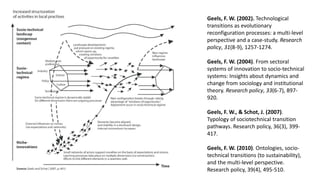
Geels, F. W. (2002). Technological
transitions as evolutionary
reconfiguration processes: a multi-level
perspective and a case-study. Research
policy, 31(8-9), 1257-1274.
Geels, F. W. (2004). From sectoral
systems of innovation to socio-technical
systems: Insights about dynamics and
change from sociology and institutional
theory. Research policy, 33(6-7), 897-
920.
Geels, F. W., & Schot, J. (2007).
Typology of sociotechnical transition
pathways. Research policy, 36(3), 399-
417.
Geels, F. W. (2010). Ontologies, socio-
technical transitions (to sustainability),
and the multi-level perspective.
Research policy, 39(4), 495-510.
Innovation
Experimentation
Socio-technical alignment
Protection
Diffusion
Socio-technical system
Co-evolution
Path-dependency
Stability
External factors
Future research: MLP as heuristic
Don’t replicate frameworks for the sake of it, focus on relevant
research questions, interesting empirical phenomena and
exchange with other communities
• Socio-technical, systemic perspective on transitions as ontology
• Interplay between stability and change, structure and agency
• Explaining path-dependency, co-evolution, persistence
• Explaining deviation, novelty creation, innovation
• Process perspective: Institutionalization and de-
institutionalization
• Factor in questions of space and time
• Use different methodology and methods
• Make use of vast case study repertoire: use secondary analysis
for further theorization

Fuenfschilling_MLP_NEST_Multi-Level Perspective (MLP).pptx

  • 1.
    Multi-level perspective (MLP) NESTSession for Newcomers to Sustainability Transitions Research June 23rd, 2019 Lea Fuenfschilling
  • 2.
    A little bitof history • Focus: understanding technological innovation and diffusion as well as industrial change from a socio-technical perspective • Combining insights from sociology of technology, STS, evolutionary economics • SCOT/ANT • Path-dependency, technological trajectories & paradigms • Co-evolution of technology and institutions • LTS • Development of central concepts: niche, regime, landscape
  • 3.
    Early references • Kemp,R., 1994. Technology and the transition to environmental sustainability: the problem of technological regime shifts. Futures 26, 1023–1046. • Schot, J.W., Hoogma, R., Elzen, B., 1994. Strategies for shifting technological systems: the case of the automobile system. Futures 26, 1060–1076. • Rip, A. (1995). Introduction of new technology: making use of recent insights from sociology and economics of technology. Technology analysis & Strategic management, 7(4), 417-432. • Rip, A., Kemp, R., 1998. Technological change. In: Rayner, S., Malone, E.L. (Eds), Human Choice and Climate Change, Vol. 2. Battelle Press, Columbus, OH, pp. 327–399. • Kemp, R., Schot, J.W., Hoogma, R., 1998. Regime shifts to sustain- ability through processes of niche formation: the approach of strategic niche management. Technology Analysis and Strategic Management 10, 175–196. • Schot, J.W., 1998. The usefulness of evolutionary models for explaining innovation: the case of The Netherlands in the nineteenth century. History of Technology 14, 173–200. • Van den Ende, J., Kemp, R., 1999. Technological transformations in history: how the computer regime grew out of existing computing regimes. Research Policy 28, 833–851a. • Kemp, R., Rip, A., Schot, J.W., 2001. Constructing transition paths through the management of niches. In: Garud, R., Karnoe, P. (Eds.), Path Dependence and Creation. Lawrence Erlbaum, Mahwah, NJ, pp. 269–299.
  • 4.
  • 5.
  • 6.
    Geels, F. W.(2002). Technological transitions as evolutionary reconfiguration processes: a multi-level perspective and a case-study. Research policy, 31(8-9), 1257-1274. Geels, F. W. (2004). From sectoral systems of innovation to socio-technical systems: Insights about dynamics and change from sociology and institutional theory. Research policy, 33(6-7), 897- 920. Geels, F. W., & Schot, J. (2007). Typology of sociotechnical transition pathways. Research policy, 36(3), 399- 417. Geels, F. W. (2010). Ontologies, socio- technical transitions (to sustainability), and the multi-level perspective. Research policy, 39(4), 495-510.
  • 7.
  • 8.
    Future research: MLPas heuristic Don’t replicate frameworks for the sake of it, focus on relevant research questions, interesting empirical phenomena and exchange with other communities • Socio-technical, systemic perspective on transitions as ontology • Interplay between stability and change, structure and agency • Explaining path-dependency, co-evolution, persistence • Explaining deviation, novelty creation, innovation • Process perspective: Institutionalization and de- institutionalization • Factor in questions of space and time • Use different methodology and methods • Make use of vast case study repertoire: use secondary analysis for further theorization