

…  and a star to steer her by? New ICT Governance and the Resilience Principles Pierre de Vries Sr. Adjunct Fellow, Silicon Flatirons Center Presentation at Silicon Flatirons 2010 Annual Conference “The Digital Broadband Migration: Examining the Internet's Ecosystem” 1 February 2010
“ Sea-Fever” John Masefield (1878-1967), English Poet Laureate, 1930-1967 I must down to the seas again, to the lonely sea and the sky, And all I ask is a tall ship and a star to steer her by, And the wheel's kick and the wind's song and the white sail's shaking, And a grey mist on the sea's face, and a grey dawn breaking. Reminded as thinking of governance, “kubernan” Tempting metaphor, but wrong No single ship of state, no single course to agreed destination Will propose alternative approach Yellow slides not shown in live presentation
New Models of Governance
Introduction Constant flux of new ideas for regulating ICT, internet/web  Jonathan Sallet’s hypothesis: new models of governance are emerging Led to Silicon Flatirons “ New Models of Governance ” meta-program Analyzed  bottoms-up policy discussions in the program, looking for top-down patterns
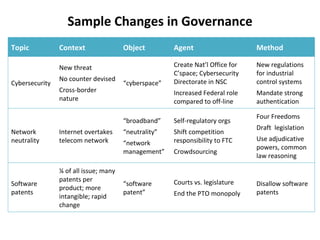
Sample Changes in Governance Topic Context Object Agent Method Cybersecurity New threat No counter devised Cross-border nature “ cyberspace” Create Nat’l Office for C’space; Cybersecurity Directorate in NSC Increased Federal role compared to off-line New regulations for industrial control systems Mandate strong authentication Network neutrality Internet overtakes telecom network “ broadband” “ neutrality” “ network management” Self-regulatory orgs Shift competition responsibility to FTC Crowdsourcing Four Freedoms Draft  legislation Use adjudicative powers, common law reasoning Software patents ¼ of all issue; many patents per product; more intangible; rapid change “ software patent” Courts vs. legislature End the PTO monopoly Disallow software patents
«Plus ça change,    plus c'est la même chose»  (?) 19 th  century journalist Jean-Baptiste Alphonse Karr
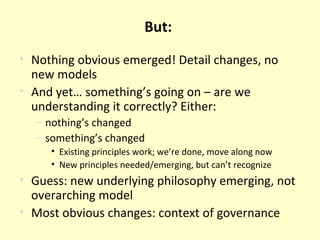
But:  Nothing obvious emerged! Detail changes, no new models And yet… something’s going on – are we understanding it correctly? Either: nothing’s changed something’s changed  Existing principles work; we’re done, move along now New principles needed/emerging, but can’t recognize Guess: new underlying philosophy emerging, not overarching model Most obvious changes: context of governance
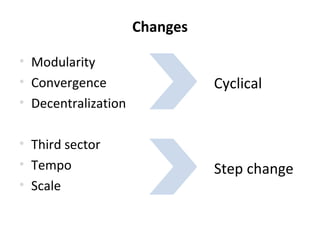
Changes Modularity Convergence Decentralization Third sector Tempo Scale Cyclical Step change
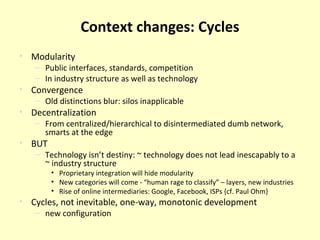
Context changes: Cycles Modularity Public interfaces, standards, competition In industry structure as well as technology Convergence Old distinctions blur: silos inapplicable Decentralization From centralized/hierarchical to disintermediated dumb network, smarts at the edge BUT Technology isn’t destiny: ~ technology does not lead inescapably to a ~ industry structure Proprietary integration will hide modularity New categories will come - “human rage to classify” – layers, new industries Rise of online intermediaries: Google, Facebook, ISPs {cf. Paul Ohm} Cycles, not inevitable, one-way, monotonic development new configuration
Context changes: Step changes Third sector Rise of NGOs, non-profits and civil society: “self-governing private  non-profit organizations, pursuing public purposes outside the formal apparatus of the state” (Salamon) Telecom-Internet: standards from ITU to IETF/W3C/IEEE Tempo William Scheuerman’s social acceleration of time tech innovation, patterns of social change (family, workplace), everyday life via new means of high-speed communication and transportation Institutions not built to cope with pace of life – rise of agencies, power shift to executive Scale Huge number & diversity of apps/devices/services per person Data aggregation/mining Characteristics accelerated by internet/ICT even if it doesn’t keep growing, unlikely to shrink: qualitative change
Complex Adaptive Systems Cycles & phase changes Incomplete knowledge Cross-linked hierarchy Novelty & surprise
Complex Adaptive Systems (CAS) CAS: a collection of interacting, adaptive agents e.g. human body, ecosystems, economy Cyclical & step changes similar to ecosystem cycles and state transitions: growth, maturity, collapse, reorganization Incomplete knowledge Deep uncertainty about how system works, what state it’s in, what the problem is, what counts as a solution Hierarchy and cross-linking Layers model, with linkages: security detection in network transport and in applications Concurrent changes at different scales: video services, player plug-ins, transports Novelty and surprise Rise of P2P traffic, Open Source/Linux Unintended consequences: TA96 supposed to increase competition, but reduced it Robust-yet-fragile behavior: e.g. subtle inconsistencies in protocol implementation or router configuration (Pakistan YouTube)
So What? Internet ≠ an Ecosystem but both have same underlying dynamics: CAS cf. Whale ≠ Elephant: both large mammals Response Take lessons from Complex Adaptive Systems theory Long literature: systems 50-60 yrs, complex systems 20-30 yrs, managed adaptive systems 10-20 yrs Focus on  managed  ecosystems, not autonomous closed systems (not just “nature red in tooth & claw”) Capture best practices in the “Resilience Principles”
The Resilience Principles Flexibility Delegation Big Picture Diversity
Why Resilience? Policy Imperatives: want innovation and stability BUT Innovation is disruptive Striving for immutability sets up the conditions for a catastrophic collapse, e.g. fire suppression, protecting fading industries Resilience: “maintaining structure and function in spite of experiencing disturbances” Top-level rule of thumb for dealing with complexity and contradiction Not efficiency: cf. choosing a solution Robust/resilient: performs reasonably well, compared to the alternatives, over a wide range of plausible scenarios Optimal/efficient: performs best in the most plausible scenario Cf. Cheney “One Percent doctrine”: treat a 1% chance as a certainty
Flexibility Long-term prediction is impossible; knowledge is inadequate; system adapts faster than controls can change; different parts in different stages “ Neutral, open-ended policies. Determine ends, not means. Describe and justify the outcomes sought, not the methods to be used to achieve them” Use principles rather than rules, e.g. solve  ex post  rather than guess  ex ante Mechanisms/Examples Flexible-use radio licenses Common law reasoning (Sallet, Weiser) in Network Neutrality (NN) Find the facts; ask if they are the same as or different from previous facts while isolating the difference between the facts that matter from those that do not; recognize the larger principle that arises from case-by-case decisions, and then, finally, ask whether the larger principle, as used in the past, still makes sense given societal changes Comcast NN case – styled as adjudication, but didn’t use ALJs for fact-finding Experiment
Delegation Regulator only has limited control close direct management often harmful, e.g. flood control, government-protected rates for intl call termination;  “ Harness discretion of local experts. M ost problems should be solved by the market and society, not by government. Government's role is to provide proper incentives and guidance, and to intervene to solve critical shortcomings.” Network neutrality example: self-regulatory orgs Silicon Flatirons network management (Aug 2008): develop norms and best practices, review net mgmt techniques, provide advisory opinions, enforce standards Verizon/Google TAGs (Jan 2010): develop best practices, act as a forum for dispute resolution, issue advisory opinions, and coordinate with standards bodies
Big Picture Emergent properties: overall behavior can’t be predicted from sub-systems; cannot optimize piecewise; narrow focus reduces robustness – e.g. protecting local manufacturing, 1950’s template for TDD accessibility “ Take a broad view of the problem and solution space. Prefer generic to sector-, technology-, or industry-specific legislation. ” Particularly useful when objects of governance are changing (e.g. periods of convergence) Moving from stable/compartmentalized industry structure requires new tools to account for feedback, non-linearities Example: Simulation/modeling Agent-based modeling, genetic algorithms, systems dynamics Way to grasp big picture, experiment with solutions NN example: J Bauer and K DeMaagd (2008): genetic programming techniques to model the co-evolution of platform operators, content providers, and consumers subject to specific policy rules governing the interactions
Diversity Diversity increases resilience Biodiversity; part of value of competition Needs to be maintained in socio-economic system: anti-trust Reduction in diversity amounts to an efficiency/resilience trade-off; the resulting system is more efficient (standards, stability), but less resistant to shocks “ Allow and support multiple solutions to policy problems. Encourage competition and market entry. ” Examples SMP analysis of NN: “European” approach Precedent in radio auctions: rules to preclude concetration Recruiting citizenry to policy making process New agent in the governance mix – Crowdsourcing: grassroots organizing SaveTheInternet.com, FCC’s soliciting input OpenInternet.gov But difficulties: theater; interpretation of input; capture (astroturf -> cyberturf)
Conclusions Underlying all the point changes we’re seeing is a shift to complex systems thinking in methods driven by changed characteristics Ecosystem management provides a framework for defining and implementing new models: the Resilience Principles Doesn’t mean previous approaches were wrong – explains why what some were right, and guides choices for new ones to come Even if ICT complexity isn’t without precedent, we now have tools we did not have before
“ Well, what do you know about that! These forty years now, I've been speaking in prose without knowing it! How grateful am I to you for teaching me that!” Monsieur Jourdain in Moliere's  The Bourgeois Gentleman  (1670)

New ICT Governance and the Resilience Principles

  • 1.
    … anda star to steer her by? New ICT Governance and the Resilience Principles Pierre de Vries Sr. Adjunct Fellow, Silicon Flatirons Center Presentation at Silicon Flatirons 2010 Annual Conference “The Digital Broadband Migration: Examining the Internet's Ecosystem” 1 February 2010
  • 2.
    “ Sea-Fever” JohnMasefield (1878-1967), English Poet Laureate, 1930-1967 I must down to the seas again, to the lonely sea and the sky, And all I ask is a tall ship and a star to steer her by, And the wheel's kick and the wind's song and the white sail's shaking, And a grey mist on the sea's face, and a grey dawn breaking. Reminded as thinking of governance, “kubernan” Tempting metaphor, but wrong No single ship of state, no single course to agreed destination Will propose alternative approach Yellow slides not shown in live presentation
  • 3.
    New Models ofGovernance
  • 4.
    Introduction Constant fluxof new ideas for regulating ICT, internet/web Jonathan Sallet’s hypothesis: new models of governance are emerging Led to Silicon Flatirons “ New Models of Governance ” meta-program Analyzed bottoms-up policy discussions in the program, looking for top-down patterns
  • 5.
    Sample Changes inGovernance Topic Context Object Agent Method Cybersecurity New threat No counter devised Cross-border nature “ cyberspace” Create Nat’l Office for C’space; Cybersecurity Directorate in NSC Increased Federal role compared to off-line New regulations for industrial control systems Mandate strong authentication Network neutrality Internet overtakes telecom network “ broadband” “ neutrality” “ network management” Self-regulatory orgs Shift competition responsibility to FTC Crowdsourcing Four Freedoms Draft legislation Use adjudicative powers, common law reasoning Software patents ¼ of all issue; many patents per product; more intangible; rapid change “ software patent” Courts vs. legislature End the PTO monopoly Disallow software patents
  • 6.
    «Plus ça change, plus c'est la même chose»  (?) 19 th century journalist Jean-Baptiste Alphonse Karr
  • 7.
    But: Nothingobvious emerged! Detail changes, no new models And yet… something’s going on – are we understanding it correctly? Either: nothing’s changed something’s changed Existing principles work; we’re done, move along now New principles needed/emerging, but can’t recognize Guess: new underlying philosophy emerging, not overarching model Most obvious changes: context of governance
  • 8.
    Changes Modularity ConvergenceDecentralization Third sector Tempo Scale Cyclical Step change
  • 9.
    Context changes: CyclesModularity Public interfaces, standards, competition In industry structure as well as technology Convergence Old distinctions blur: silos inapplicable Decentralization From centralized/hierarchical to disintermediated dumb network, smarts at the edge BUT Technology isn’t destiny: ~ technology does not lead inescapably to a ~ industry structure Proprietary integration will hide modularity New categories will come - “human rage to classify” – layers, new industries Rise of online intermediaries: Google, Facebook, ISPs {cf. Paul Ohm} Cycles, not inevitable, one-way, monotonic development new configuration
  • 10.
    Context changes: Stepchanges Third sector Rise of NGOs, non-profits and civil society: “self-governing private non-profit organizations, pursuing public purposes outside the formal apparatus of the state” (Salamon) Telecom-Internet: standards from ITU to IETF/W3C/IEEE Tempo William Scheuerman’s social acceleration of time tech innovation, patterns of social change (family, workplace), everyday life via new means of high-speed communication and transportation Institutions not built to cope with pace of life – rise of agencies, power shift to executive Scale Huge number & diversity of apps/devices/services per person Data aggregation/mining Characteristics accelerated by internet/ICT even if it doesn’t keep growing, unlikely to shrink: qualitative change
  • 11.
    Complex Adaptive SystemsCycles & phase changes Incomplete knowledge Cross-linked hierarchy Novelty & surprise
  • 12.
    Complex Adaptive Systems(CAS) CAS: a collection of interacting, adaptive agents e.g. human body, ecosystems, economy Cyclical & step changes similar to ecosystem cycles and state transitions: growth, maturity, collapse, reorganization Incomplete knowledge Deep uncertainty about how system works, what state it’s in, what the problem is, what counts as a solution Hierarchy and cross-linking Layers model, with linkages: security detection in network transport and in applications Concurrent changes at different scales: video services, player plug-ins, transports Novelty and surprise Rise of P2P traffic, Open Source/Linux Unintended consequences: TA96 supposed to increase competition, but reduced it Robust-yet-fragile behavior: e.g. subtle inconsistencies in protocol implementation or router configuration (Pakistan YouTube)
  • 13.
    So What? Internet≠ an Ecosystem but both have same underlying dynamics: CAS cf. Whale ≠ Elephant: both large mammals Response Take lessons from Complex Adaptive Systems theory Long literature: systems 50-60 yrs, complex systems 20-30 yrs, managed adaptive systems 10-20 yrs Focus on managed ecosystems, not autonomous closed systems (not just “nature red in tooth & claw”) Capture best practices in the “Resilience Principles”
  • 14.
    The Resilience PrinciplesFlexibility Delegation Big Picture Diversity
  • 15.
    Why Resilience? PolicyImperatives: want innovation and stability BUT Innovation is disruptive Striving for immutability sets up the conditions for a catastrophic collapse, e.g. fire suppression, protecting fading industries Resilience: “maintaining structure and function in spite of experiencing disturbances” Top-level rule of thumb for dealing with complexity and contradiction Not efficiency: cf. choosing a solution Robust/resilient: performs reasonably well, compared to the alternatives, over a wide range of plausible scenarios Optimal/efficient: performs best in the most plausible scenario Cf. Cheney “One Percent doctrine”: treat a 1% chance as a certainty
  • 16.
    Flexibility Long-term predictionis impossible; knowledge is inadequate; system adapts faster than controls can change; different parts in different stages “ Neutral, open-ended policies. Determine ends, not means. Describe and justify the outcomes sought, not the methods to be used to achieve them” Use principles rather than rules, e.g. solve ex post rather than guess ex ante Mechanisms/Examples Flexible-use radio licenses Common law reasoning (Sallet, Weiser) in Network Neutrality (NN) Find the facts; ask if they are the same as or different from previous facts while isolating the difference between the facts that matter from those that do not; recognize the larger principle that arises from case-by-case decisions, and then, finally, ask whether the larger principle, as used in the past, still makes sense given societal changes Comcast NN case – styled as adjudication, but didn’t use ALJs for fact-finding Experiment
  • 17.
    Delegation Regulator onlyhas limited control close direct management often harmful, e.g. flood control, government-protected rates for intl call termination; “ Harness discretion of local experts. M ost problems should be solved by the market and society, not by government. Government's role is to provide proper incentives and guidance, and to intervene to solve critical shortcomings.” Network neutrality example: self-regulatory orgs Silicon Flatirons network management (Aug 2008): develop norms and best practices, review net mgmt techniques, provide advisory opinions, enforce standards Verizon/Google TAGs (Jan 2010): develop best practices, act as a forum for dispute resolution, issue advisory opinions, and coordinate with standards bodies
  • 18.
    Big Picture Emergentproperties: overall behavior can’t be predicted from sub-systems; cannot optimize piecewise; narrow focus reduces robustness – e.g. protecting local manufacturing, 1950’s template for TDD accessibility “ Take a broad view of the problem and solution space. Prefer generic to sector-, technology-, or industry-specific legislation. ” Particularly useful when objects of governance are changing (e.g. periods of convergence) Moving from stable/compartmentalized industry structure requires new tools to account for feedback, non-linearities Example: Simulation/modeling Agent-based modeling, genetic algorithms, systems dynamics Way to grasp big picture, experiment with solutions NN example: J Bauer and K DeMaagd (2008): genetic programming techniques to model the co-evolution of platform operators, content providers, and consumers subject to specific policy rules governing the interactions
  • 19.
    Diversity Diversity increasesresilience Biodiversity; part of value of competition Needs to be maintained in socio-economic system: anti-trust Reduction in diversity amounts to an efficiency/resilience trade-off; the resulting system is more efficient (standards, stability), but less resistant to shocks “ Allow and support multiple solutions to policy problems. Encourage competition and market entry. ” Examples SMP analysis of NN: “European” approach Precedent in radio auctions: rules to preclude concetration Recruiting citizenry to policy making process New agent in the governance mix – Crowdsourcing: grassroots organizing SaveTheInternet.com, FCC’s soliciting input OpenInternet.gov But difficulties: theater; interpretation of input; capture (astroturf -> cyberturf)
  • 20.
    Conclusions Underlying allthe point changes we’re seeing is a shift to complex systems thinking in methods driven by changed characteristics Ecosystem management provides a framework for defining and implementing new models: the Resilience Principles Doesn’t mean previous approaches were wrong – explains why what some were right, and guides choices for new ones to come Even if ICT complexity isn’t without precedent, we now have tools we did not have before
  • 21.
    “ Well, whatdo you know about that! These forty years now, I've been speaking in prose without knowing it! How grateful am I to you for teaching me that!” Monsieur Jourdain in Moliere's The Bourgeois Gentleman (1670)

Editor's Notes

  • #5 Change in any element = change in governance “ New model” of governance: - More than one element changes - Reconfiguration results
  • #10 Modules: partial, separable and substitutable components … from independent vendors Blurring a symptom of reorganization of ecosystem after a collapse – inevitably followed again by growth, maturity, and collapse
  • #16 Policy Imperatives: Public Safety Consumer Protection Culture and Values Government Revenue Economic Vitality
  • #19 Rationale:
  • #22 Talking to “Philosophy Master” that he asked for help in writing a love letter