Transition management and
the multi-level perspective
Dr Gary Kerr
Transition Management
• The continuous process of transformation of socio-political
landscapes, socio-technical practices and the structural
character of society from one equilibrium to another
• Seeks to:
– Reduce uncertainty
– Produce desirable social outcomes
– Enhance resilience during transformation of socio-
technical systems
• Engages a wide range of stakeholders (actors) over the
multiple levels to create shared visions and goals
• Tested for practicality through the use of experimentation,
learning and adaptation at the niche level.
Key principles of transition
management
• Seeks to widen participation by taking a multi-actor
approach in order to encompass societal values and beliefs
• Takes a long term perspective creating visions in which
short term objectives can be identified
• Focused on learning at the niche level, experiments are
used to identify how successful a particular pathway could
be and uses the concept of “Learn by doing, doing by
learning”
• A systems thinking approach which identifies that problems
will span multiple domains, levels and actors
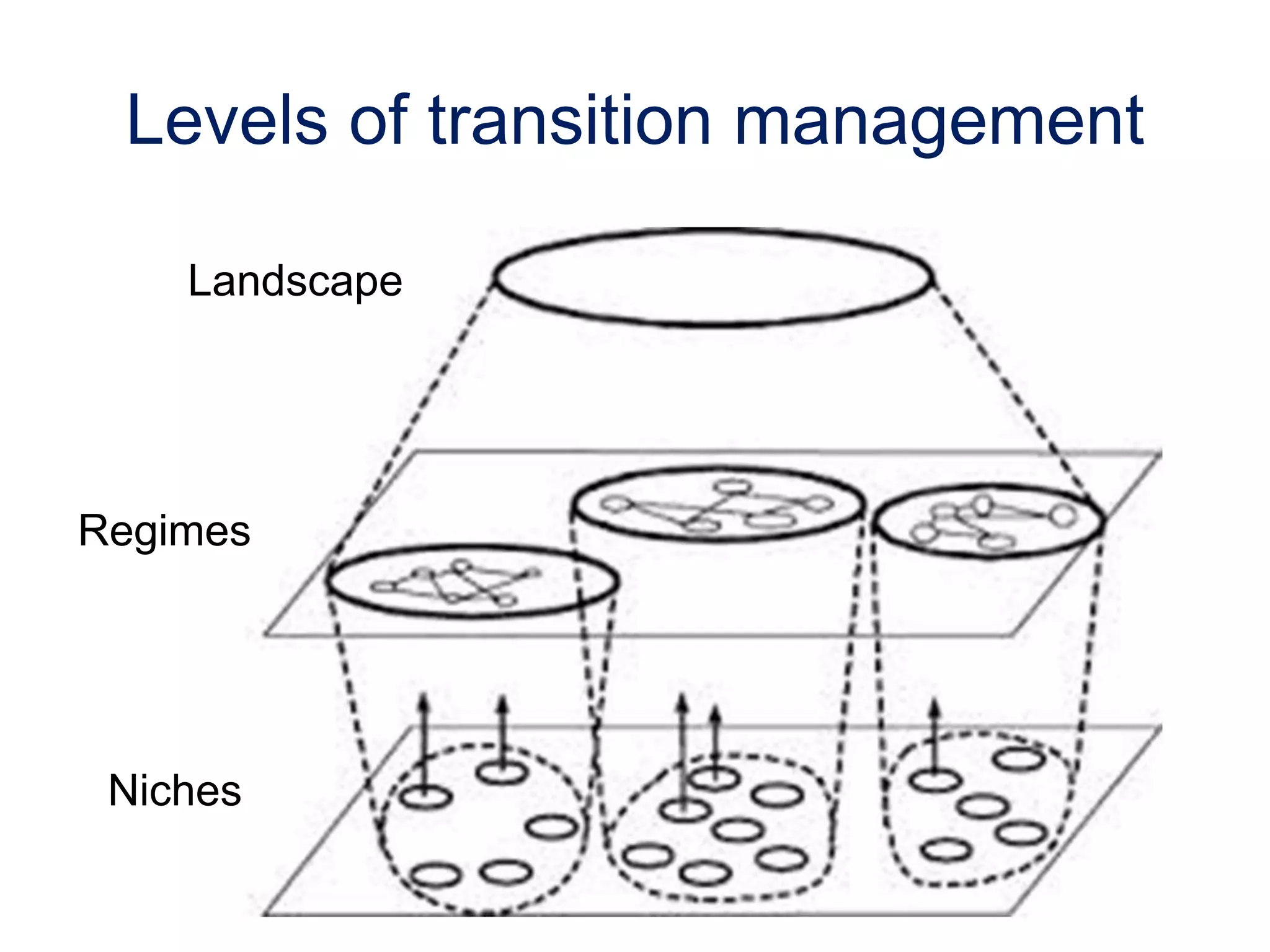
Levels of transition management
Niches
Regimes
Landscape
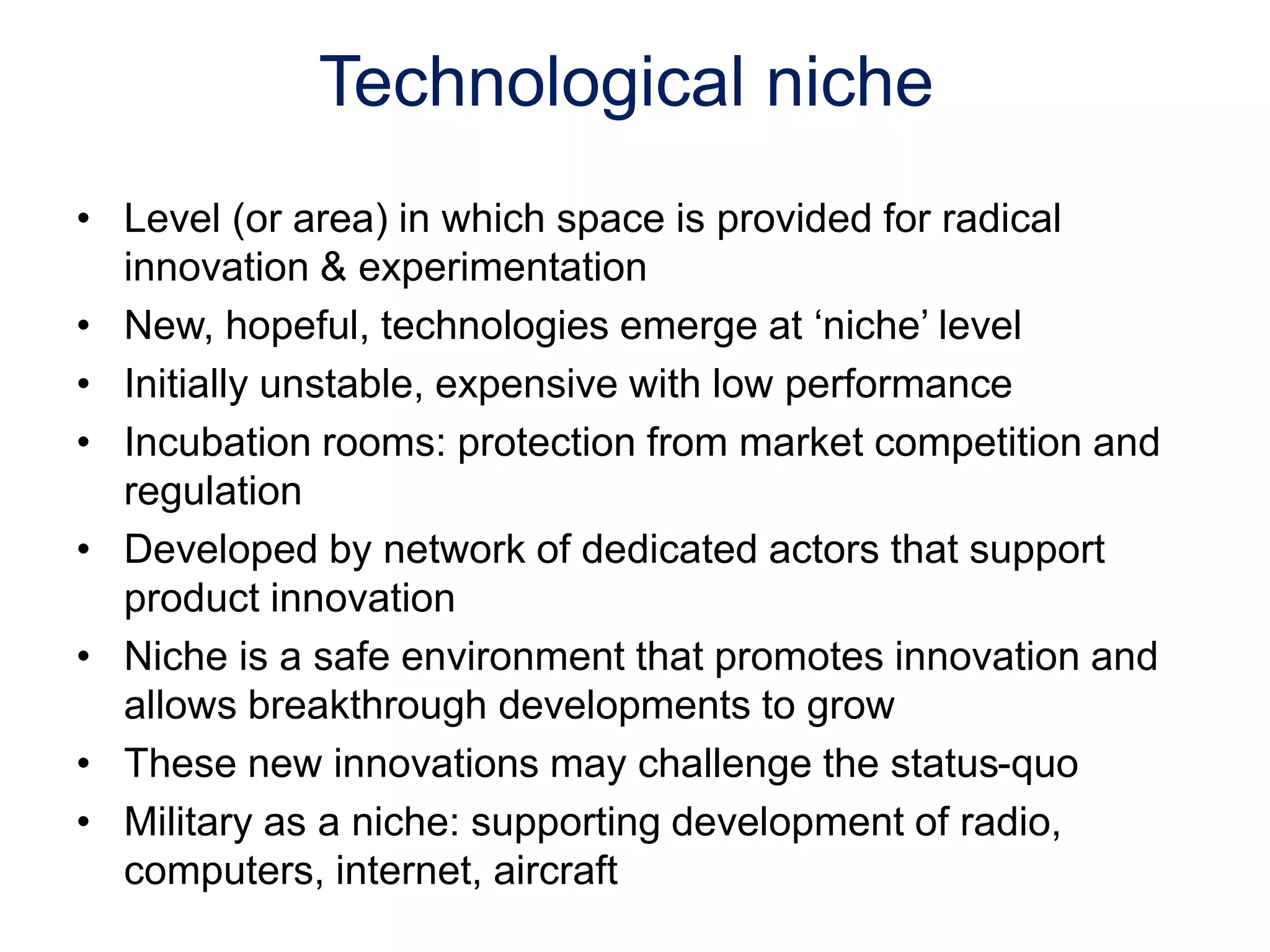
Technological niche
• Level (or area) in which space is provided for radical
innovation & experimentation
• New, hopeful, technologies emerge at ‘niche’ level
• Initially unstable, expensive with low performance
• Incubation rooms: protection from market competition and
regulation
• Developed by network of dedicated actors that support
product innovation
• Niche is a safe environment that promotes innovation and
allows breakthrough developments to grow
• These new innovations may challenge the status-quo
• Military as a niche: supporting development of radio,
computers, internet, aircraft
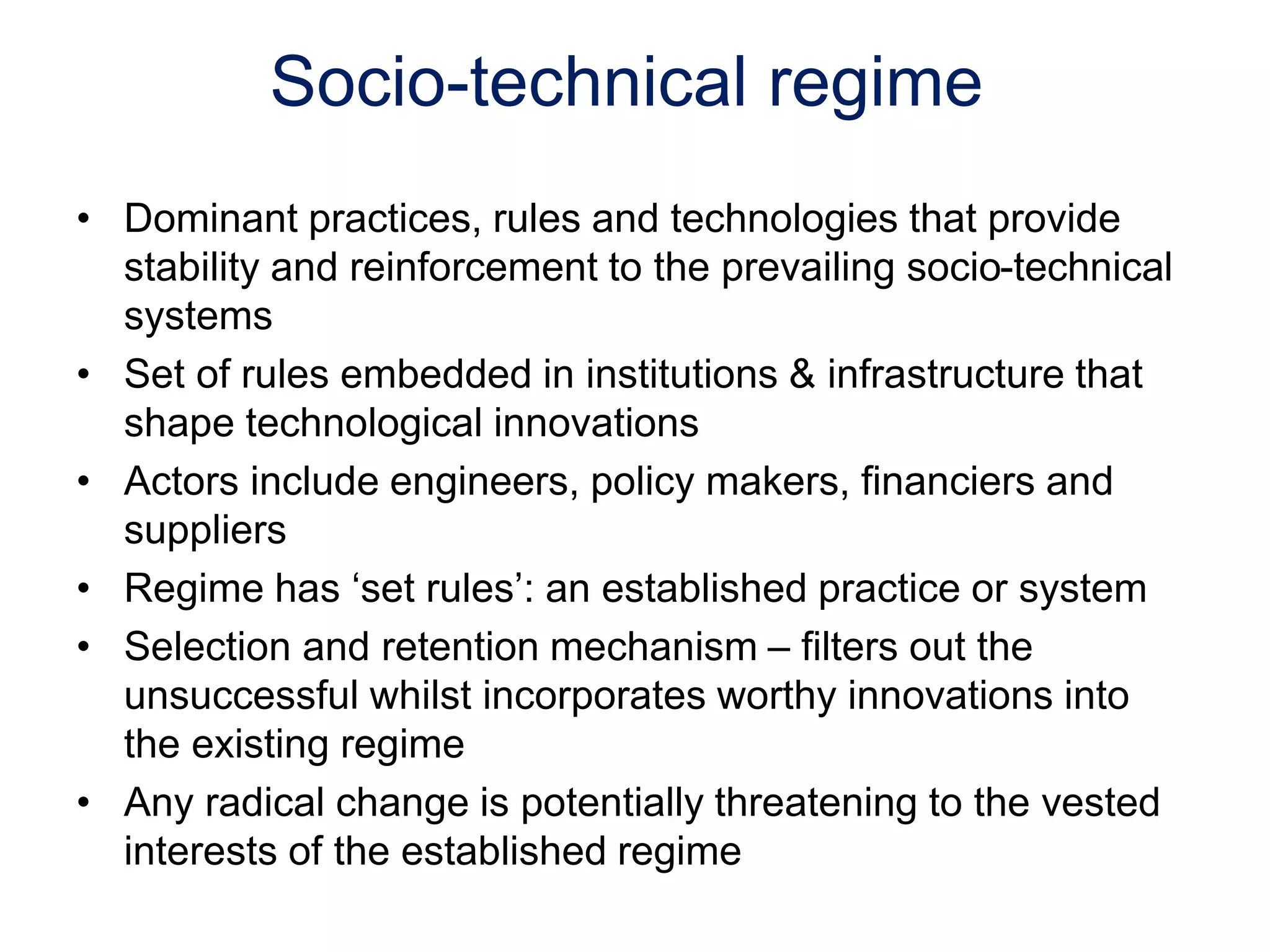
Socio-technical regime
• Dominant practices, rules and technologies that provide
stability and reinforcement to the prevailing socio-technical
systems
• Set of rules embedded in institutions & infrastructure that
shape technological innovations
• Actors include engineers, policy makers, financiers and
suppliers
• Regime has ‘set rules’: an established practice or system
• Selection and retention mechanism – filters out the
unsuccessful whilst incorporates worthy innovations into
the existing regime
• Any radical change is potentially threatening to the vested
interests of the established regime
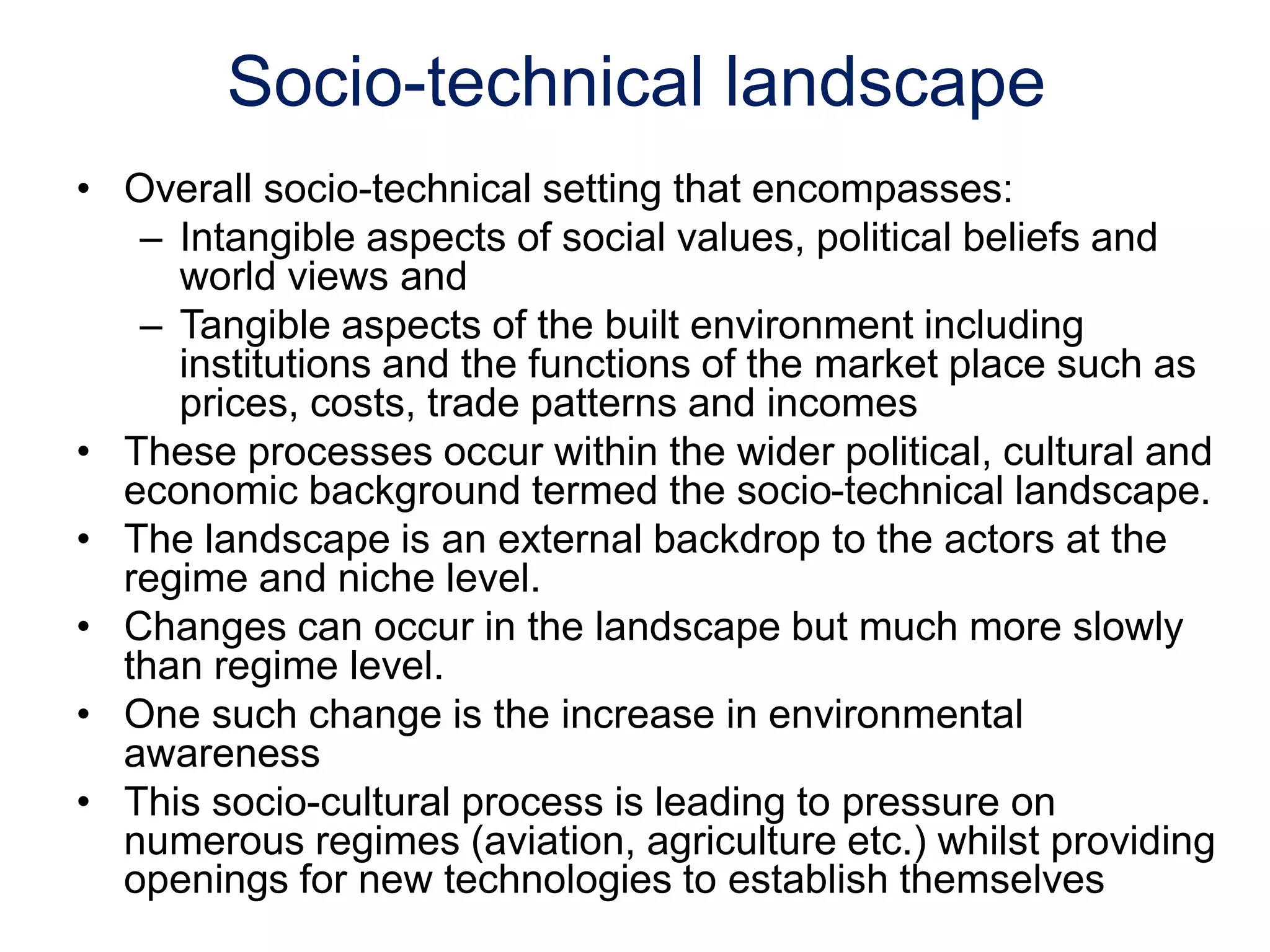
Socio-technical landscape
• Overall socio-technical setting that encompasses:
– Intangible aspects of social values, political beliefs and
world views and
– Tangible aspects of the built environment including
institutions and the functions of the market place such as
prices, costs, trade patterns and incomes
• These processes occur within the wider political, cultural and
economic background termed the socio-technical landscape.
• The landscape is an external backdrop to the actors at the
regime and niche level.
• Changes can occur in the landscape but much more slowly
than regime level.
• One such change is the increase in environmental
awareness
• This socio-cultural process is leading to pressure on
numerous regimes (aviation, agriculture etc.) whilst providing
openings for new technologies to establish themselves
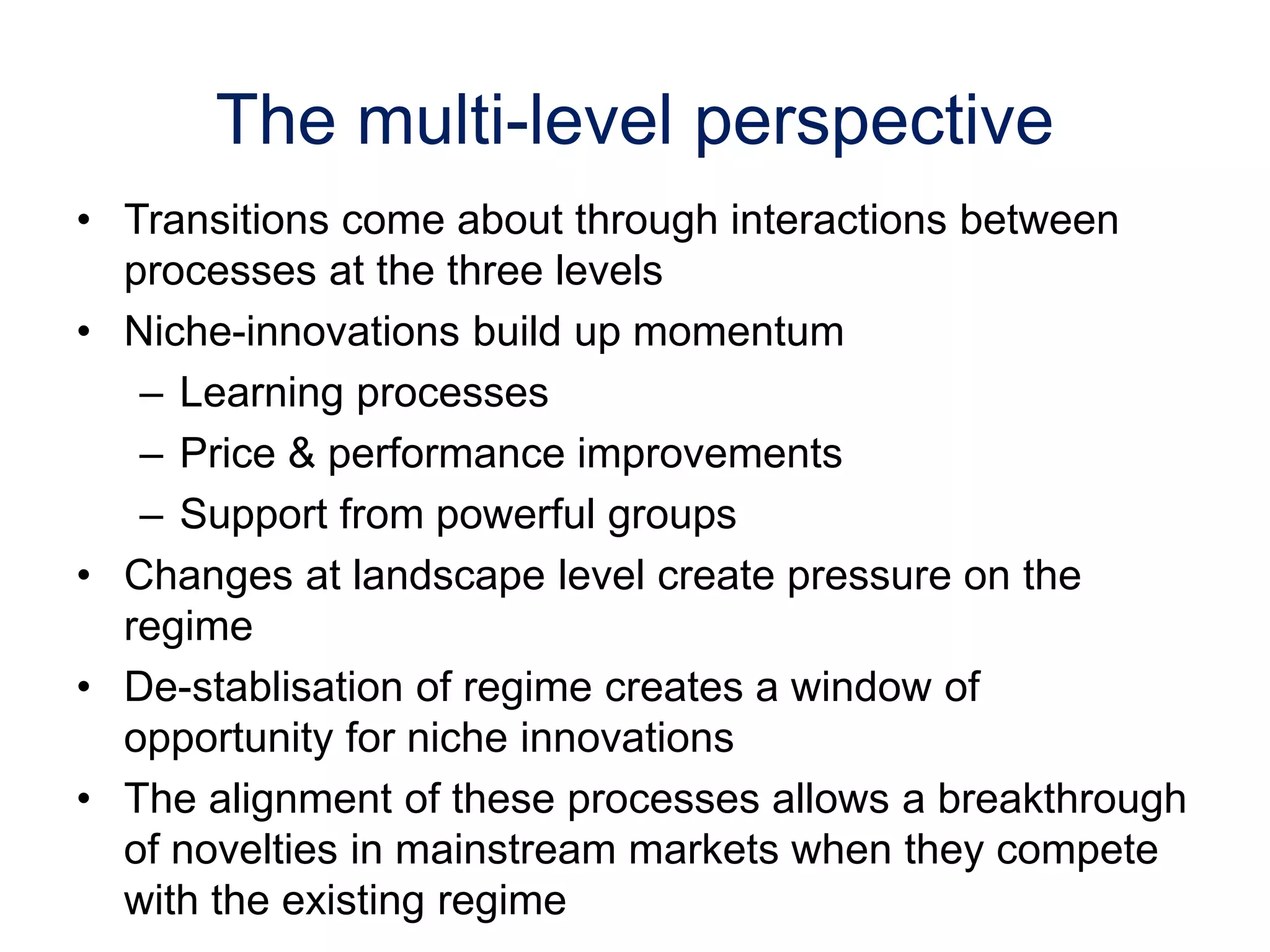
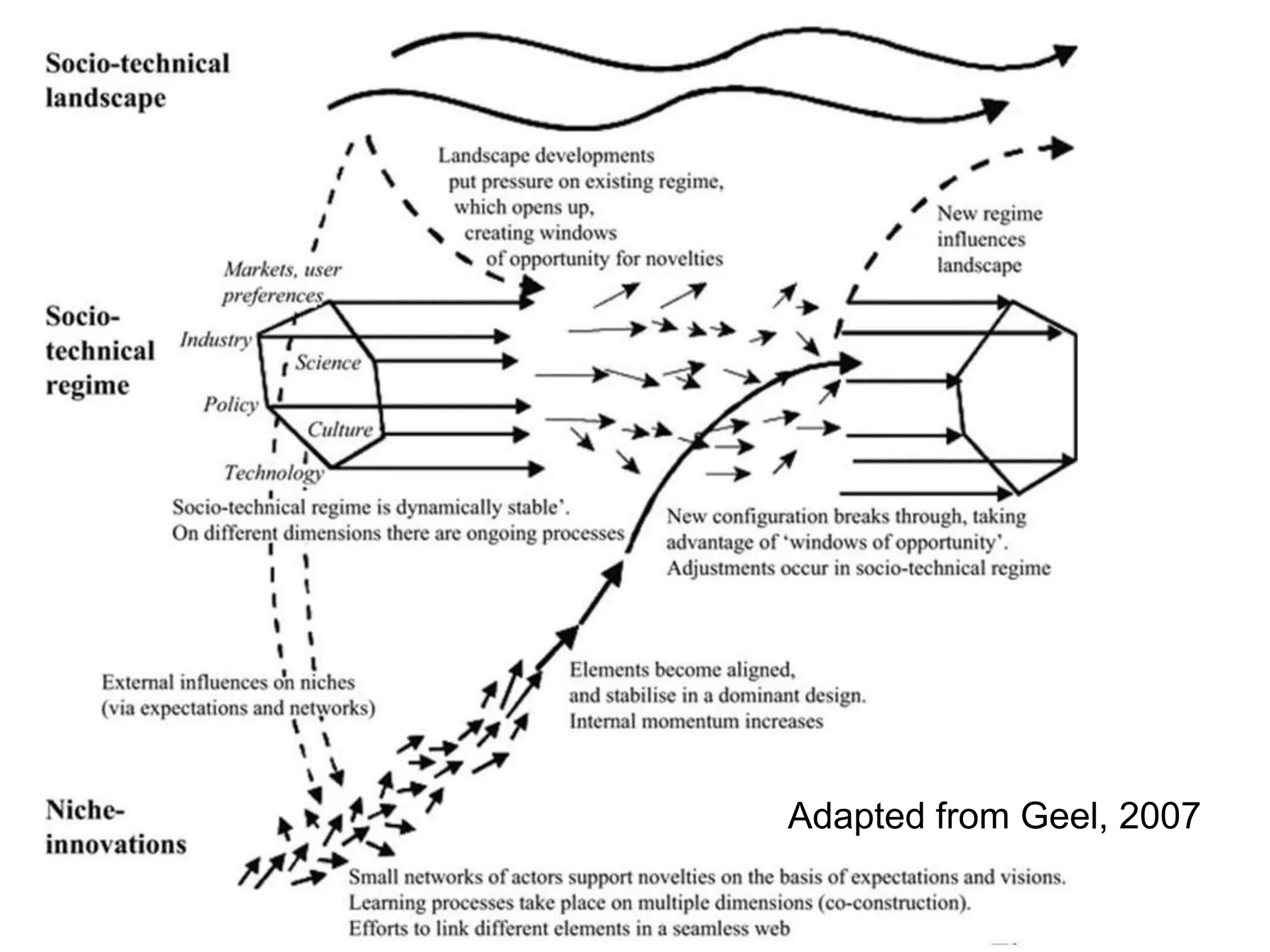
The multi-level perspective
• Transitions come about through interactions between
processes at the three levels
• Niche-innovations build up momentum
– Learning processes
– Price & performance improvements
– Support from powerful groups
• Changes at landscape level create pressure on the
regime
• De-stablisation of regime creates a window of
opportunity for niche innovations
• The alignment of these processes allows a breakthrough
of novelties in mainstream markets when they compete
with the existing regime
Adapted from Geel, 2007
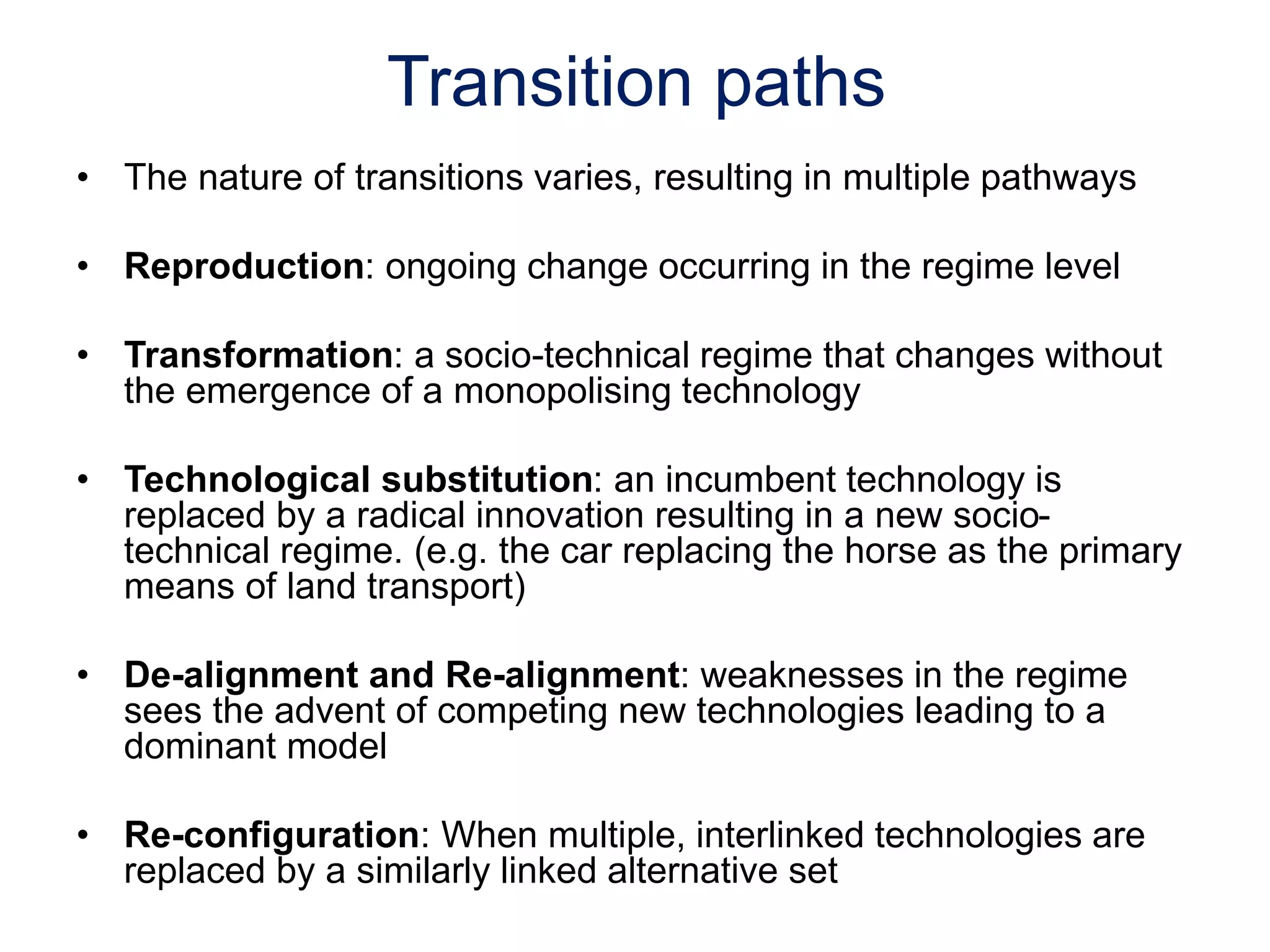
Transition paths
• The nature of transitions varies, resulting in multiple pathways
• Reproduction: ongoing change occurring in the regime level
• Transformation: a socio-technical regime that changes without
the emergence of a monopolising technology
• Technological substitution: an incumbent technology is
replaced by a radical innovation resulting in a new socio-
technical regime. (e.g. the car replacing the horse as the primary
means of land transport)
• De-alignment and Re-alignment: weaknesses in the regime
sees the advent of competing new technologies leading to a
dominant model
• Re-configuration: When multiple, interlinked technologies are
replaced by a similarly linked alternative set
Criticisms of the multi-level
perspective
• Empirical research on technological transitions occurring now has
been limited; focus has been on historic transitions.
• Depending on perspective on transition case studies they could be
presented as having occurred on a different transition path to what
was shown
• E.g. the bicycle could be considered an intermediate transport
technology between the horse and the car. Judged by a shorter
different time-frame this could appear a transition in its own right
• Determining the nature of a transition is problematic; when it
started and ended, or whether one occurred in the sense of a
radical innovation displacing an existing socio-technical regime.
• The perception of time casts doubt on whether a transition has
occurred.
Conclusion
• Continuous process of transformation of socio-political
landscapes, socio-technical practices and the structural
character of society from one equilibrium to another
• Transition management & multi-level perspective is a useful
tool for studying & understanding technological change
(and reducing risk of undesirable outcomes)
• Can be used to inform policy e.g. Dutch Government used
it as a practical tool to radically transform their energy
systems
• UK & Scottish Governments could incorporate this as a
framework to produce better policy around areas of
renewable energy technologies

Transition management & the multi-level perspective

  • 1.
    Transition management and themulti-level perspective Dr Gary Kerr
  • 2.
    Transition Management • Thecontinuous process of transformation of socio-political landscapes, socio-technical practices and the structural character of society from one equilibrium to another • Seeks to: – Reduce uncertainty – Produce desirable social outcomes – Enhance resilience during transformation of socio- technical systems • Engages a wide range of stakeholders (actors) over the multiple levels to create shared visions and goals • Tested for practicality through the use of experimentation, learning and adaptation at the niche level.
  • 3.
    Key principles oftransition management • Seeks to widen participation by taking a multi-actor approach in order to encompass societal values and beliefs • Takes a long term perspective creating visions in which short term objectives can be identified • Focused on learning at the niche level, experiments are used to identify how successful a particular pathway could be and uses the concept of “Learn by doing, doing by learning” • A systems thinking approach which identifies that problems will span multiple domains, levels and actors
  • 4.
    Levels of transitionmanagement Niches Regimes Landscape
  • 5.
    Technological niche • Level(or area) in which space is provided for radical innovation & experimentation • New, hopeful, technologies emerge at ‘niche’ level • Initially unstable, expensive with low performance • Incubation rooms: protection from market competition and regulation • Developed by network of dedicated actors that support product innovation • Niche is a safe environment that promotes innovation and allows breakthrough developments to grow • These new innovations may challenge the status-quo • Military as a niche: supporting development of radio, computers, internet, aircraft
  • 6.
    Socio-technical regime • Dominantpractices, rules and technologies that provide stability and reinforcement to the prevailing socio-technical systems • Set of rules embedded in institutions & infrastructure that shape technological innovations • Actors include engineers, policy makers, financiers and suppliers • Regime has ‘set rules’: an established practice or system • Selection and retention mechanism – filters out the unsuccessful whilst incorporates worthy innovations into the existing regime • Any radical change is potentially threatening to the vested interests of the established regime
  • 7.
    Socio-technical landscape • Overallsocio-technical setting that encompasses: – Intangible aspects of social values, political beliefs and world views and – Tangible aspects of the built environment including institutions and the functions of the market place such as prices, costs, trade patterns and incomes • These processes occur within the wider political, cultural and economic background termed the socio-technical landscape. • The landscape is an external backdrop to the actors at the regime and niche level. • Changes can occur in the landscape but much more slowly than regime level. • One such change is the increase in environmental awareness • This socio-cultural process is leading to pressure on numerous regimes (aviation, agriculture etc.) whilst providing openings for new technologies to establish themselves
  • 8.
    The multi-level perspective •Transitions come about through interactions between processes at the three levels • Niche-innovations build up momentum – Learning processes – Price & performance improvements – Support from powerful groups • Changes at landscape level create pressure on the regime • De-stablisation of regime creates a window of opportunity for niche innovations • The alignment of these processes allows a breakthrough of novelties in mainstream markets when they compete with the existing regime
  • 9.
  • 10.
    Transition paths • Thenature of transitions varies, resulting in multiple pathways • Reproduction: ongoing change occurring in the regime level • Transformation: a socio-technical regime that changes without the emergence of a monopolising technology • Technological substitution: an incumbent technology is replaced by a radical innovation resulting in a new socio- technical regime. (e.g. the car replacing the horse as the primary means of land transport) • De-alignment and Re-alignment: weaknesses in the regime sees the advent of competing new technologies leading to a dominant model • Re-configuration: When multiple, interlinked technologies are replaced by a similarly linked alternative set
  • 11.
    Criticisms of themulti-level perspective • Empirical research on technological transitions occurring now has been limited; focus has been on historic transitions. • Depending on perspective on transition case studies they could be presented as having occurred on a different transition path to what was shown • E.g. the bicycle could be considered an intermediate transport technology between the horse and the car. Judged by a shorter different time-frame this could appear a transition in its own right • Determining the nature of a transition is problematic; when it started and ended, or whether one occurred in the sense of a radical innovation displacing an existing socio-technical regime. • The perception of time casts doubt on whether a transition has occurred.
  • 12.
    Conclusion • Continuous processof transformation of socio-political landscapes, socio-technical practices and the structural character of society from one equilibrium to another • Transition management & multi-level perspective is a useful tool for studying & understanding technological change (and reducing risk of undesirable outcomes) • Can be used to inform policy e.g. Dutch Government used it as a practical tool to radically transform their energy systems • UK & Scottish Governments could incorporate this as a framework to produce better policy around areas of renewable energy technologies