LubricantsforaHealthierPlanet™
FuelManagement
www.hydrotexlube.com
•	TMC Recommended Practice RP 1109
•	Utilized Two (2)  Identical Freightliner Trucks (GVW 76,000 lbs)
•	Equipped with Identical Build Engines (365 Hp @ 1800 rpm)
•	Vehicle Speed:  61 mph (1600 rpm) with Cruise Control
•	Vehicle Gap:  15 to 45 seconds
•	210 Mile Round-trip Test Circuit
•	Drivers Switched Trucks/Leads at Turnaround Point  
•	Component Fluids on Both Trucks Switched at Same Time  
•	Fuel Amounts Corrected to 60°F
Fleet Treat® Program Fuel Economy Test Matrix
Fuel Economy Savings Documented
with Type IV Test Procedure
This test compares Hydrotex®
synthetic lubricants against mineral oil
based lubricants for fuel economy benefits.
CONCLUSION: Hydrotex synthetic lubricants significantly
improve fuel economy. In fact, the fuel economy savings
more than pays for the cost of the synthetic lubrication
program and using Hydrotex fuel improvers puts additional
money to the bottom-line.
Power-Kleen™
& Power-Kleen™
Arctic
Power-Kleen™
is a multi-functional diesel fuel improver
specially formulated for warm ambient temperatures to
protect, clean and lubricate fuel system components while
improving fuel economy and reducing emissions. The
added combination of pour point depressants and wax
crystal modifiers make the use of Power-Kleen Arctic critical
for winter maintenance and cold weather reliability.
•	Improve Fuel Economy
•	Prevent Fuel Pump and Injector Wear
•	Clean and Maintain Fuel Injectors
•	Reduce Smoke and Emissions
•	Enhance Fuel Stability
•	Protect Against Rust and Corrosion
•	Restore Lost Power
Essentialube®
Advanced Formula Blending Agent
Essentialube®
is a cost-effective performance improver for
both fuels and lubricants.
•	Provide More Power and Better Performance
•	Disperse Moisture
•	Neutralize Harmful Acids
•	Retard Formation of Gum, Varnish and Carbon
•	Improve Combustion
•	Reduce Emissions
Use Essentialube as a Flushing Agent to dissolve, neutralize
and suspend the sludge, varnish, gums, acid and other
destructive residues which are commonly found in
automotive crankcases and industrial equipment reservoirs.
Diesel Fuel Improvers
Improve Fuel Economy 4% - 10%
Other Fuel Improvers:
•	Power-Kleen™ Supreme	 	 • HydroSorb® II
•	Power Flo®	 	 	 • Bio-Pour PT™
•	Gel Melt™	 	 	 Only For B100 Use by
	 	 	 	 B100 Manufacturers & Blenders
FuelManagement
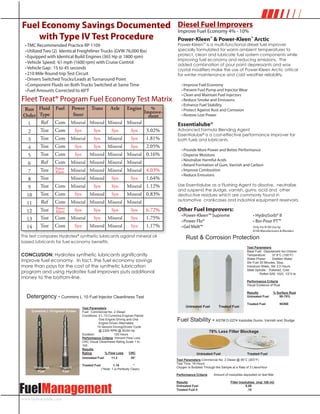
Detergency - Cummins L-10 Fuel Injector Cleanliness Test
Untreated Treated
Fuel Fuel
Cummins L-10 Injector Pintles
Test Parameters
Fuel: Commercial No. 2 Diesel
Conditions: 2 L-10 Cummins Engines Paired
One Engine Driving and One
Engine Driven Alternately
15 Second Driving/Driven Cycle
@ 2300 RPM @ 50-60 Hp
Duration: 125 Hours
Performance Criteria Percent Flow Loss
CRC Visual Cleanliness Rating Scale 1 to
100
Results
% Flow Loss CRCRating
Untreated Fuel 11.2 35*
Treated Fuel 1.16 *
(*Note: 1 is Perfectly Clean)
Rust & Corrosion Protection – NACE Test
Untreated Fuel Treated Fuel
Test Parameters
Base Fuel: Depolarized Iso-Octane
Temperature: 37.8°C (100°F)
Water Phase: Distilled Water
Stir Fuel 30 Minutes, Stop,
Introduce Water, Stir 3.5 Hours
Steel Spindle: Polished, Cold
Rolled SAE 1020, 1/2”d ia.
Performance Criteria
Visual Evidence of Rust
Results % Surface Rust
Untreated Fuel 50-75%
Treated Fuel NONE
Fuel Stability - ASTM D-2274 Insoluble Gums, Varnish and Sludge
Untreated Fuel Treated Fuel
Test Parameters Commercial No. 2 Diesel @ 95°C (203°F)
Test Time: 16 Hours
Oxygen Is Bubbled Through the Sample at a Rate of 3 Liters/Hour
Performance Criteria Amount of insolubles deposited on test filter
Results Filter Insolubles (mg/ 100 ml)
Untreated Fuel 0.69
Treated Fuel 0 .15
78% Less Filter Blockage
Port’s Study Shows Diesel Additive Increases Fuel Efficiency
and Reduces Emissions
Page 1
As released by Georgia Ports Authority
Port’s Study Shows Diesel Additive Increases Fuel Efficiency
and Reduces Emissions
Savannah, Ga. – August 13, 2010 – The Georgia Ports
Authority’s (GPA) Executive Director Curtis J. Foltz announced
today that its diesel additive study yielded a five percent
reduction in fuel consumption, as well as drastically decreased
emissions.
“We undertook this study as a proactive effort to reduce
our environmental footprint,” said GPA’s Executive
Director Curtis J. Foltz. “As we expand our operations to
accommodate increased cargo, we continue to look for
ways to improve efficiencies and operate in an even more
environmentally‑friendly manner.”
GPA’s engineering staff commissioned a study to determine
whether a fuel additive would be effective in reducing pollutant
emissions and increasing engine fuel efficiency for its diesel
equipment fleet. WPC of Savannah, Ga., was contracted to
conduct the test and provide analysis. This large-scale test
studied two of the most widely used container-handling
equipment at the Port of Savannah.
“We were pleasantly surprised to see these dramatic results;”
said GPA’s Senior Director of Engineering and Facilities
Maintenance, Wilson Tillotson. “With the large-scale nature
of this study, we are confident the additive will yield an
improvement in fuel efficiency and a significant reduction in
emissions.”
In January 2010, the GPA conducted a baseline monitoring
for its diesel vehicle fleet at Garden City Terminal. The study
included a diesel vehicle fleet of 64 rubber-tired gantry cranes
(RTGs) and 40 jockey trucks. Baseline monitoring consisted of
collecting emissions and fuel consumption data with all vehicles
using ultra-low-sulfur diesel without the additive.
For emissions monitoring, the test measured the Environmental
Protection Agency’s (EPA) criteria pollutants: nitrogen dioxide,
carbon monoxide, sulfur dioxide and particulate matter. Fuel
consumption and operating hours were measured to develop a
consumption rate in gallons per hour.
“The intent of the fuel additive is to yield a more complete
and efficient fuel combustion,” said Joseph R. Ross, Jr., Senior
Associate and Environmental Department Manager with WPC.
“By increasing the combustion efficiency, not only are fuel
savings evident, the formation of criteria air pollutants is also
reduced. These reductions will benefit all of Chatham County
by reducing pollutant concentrations and helping to maintain
compliance with state and federal attainment criteria.”
The result of the study indicated a decrease of approximately
five percent in fuel consumption. Reductions in EPA criteria
pollutants were more significant. Particulate matter reductions
averaged as high as 71 percent, while nitrogen dioxide
decreased as much as 20 percent and carbon monoxide
decreased an average of 19 percent. The study did not produce
conclusive results regarding the impact of the additive on sulfur
dioxide emissions. However, GPA’s conversion in 2008 to
ultra‑low‑sulfur diesel reduced the total sulfur content by 99
percent.
“The results are proof-positive that these additives work,” said
Tillotson. “We plan to continue using fuel additives for all diesel
consumed on GPA property.”
Through the GPA’s crane electrification, use of refrigerated
container racks, upcoming RTG repower project and use of fuel
additives, the Port of Savannah will avoid use of more than 4.5
million gallons of fuel annually.
Georgia’s deepwater ports and inland barge terminals support
more than 295,000 jobs throughout the state annually and
contribute $15.5 billion in income, $61.7 billion in revenue and
$2.6 billion in state and local taxes to Georgia’s economy.
About WPC, a Terracon company:
WPC joined Terracon in September of 2009 and provides
professional services to clients in the commercial development,
education, environmental, government/military, industrial
facilities, medical, power/utilities, residential and transportation
industries. Terracon is an employee-owned engineering
consulting firm with more than 2,700 employees providing
geotechnical, environmental, construction materials and
facilities services from more than 100 offices in 37 states
nationwide. Terracon provides value to its clients through the
following key benefits: reliability, responsiveness, convenience
and innovation. Terracon currently ranks 46th on Engineering
News-Record’s List of Top 500 Design Firms.
For more information contact: http://www.wpceng.com or http://
www.terracon.com.
Technical Data Sheet
Lubricants for a Healthier Planet™
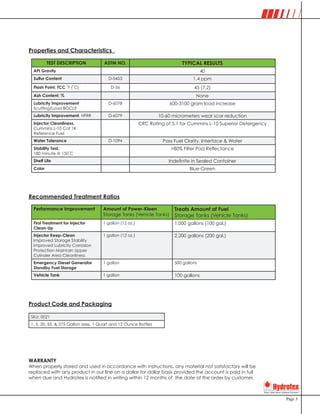
Power-Kleen™ is a multifunctional diesel fuel improver that can simplify the treatment of all diesel fuels:
High Sulfur Diesel Fuel (>500 ppm sulfur) , Low Sulfur Diesel Fuel (<500 ppm sulfur), Ultra Low Sulfur Diesel
Fuel (<15 ppm sulfur) and Biodiesel Blends B2 to B20. The NitroGenesis™ Additives keep the entire fuel
system clean. Powerful nitrogen cleaning molecules start immediately to dissolve existing deposits of
carbon, gum and varnish in fuel injectors, lines and tanks and prevent their reformation. Power-Kleen
diesel fuel additive complies with the federal low sulfur content requirements for use in diesel motor
vehicles and non-road engines using Ultra Low Sulfur Diesel fuel.
Give new life to your diesel Fuel System with Power-Kleen high nitrogen NitroGensis Additives.
www.hydrotexlube.com
Diesel Fuel Performance Improver
Features and Benefits
Cleans Diesel Fuel Injectors: HEUI
Injectors‑Hydraulically Actuated Electronic
Unit Injectors (HEUI) requires the superior
performance cleaning rating of Power-Kleen for
injector cleanliness as measured in the Cummins
L-10 Injector Test and the new Peugeot DW10
injection fouling test. Power-Kleen not only
cleans and prevents injection deposits, it also
restores lost power, inhibits corrosion, stabilizes
the fuel and extends the life of fuel filters and
fuels system components.
Reduces the Carbon Footprint and Increases
Fuel Economy of Diesel Engines: Improves
combustion with a 4% improvement in fuel
economy in scientifically measured laboratory
and field tests. Every gallon of diesel fuel
saved by reducing fuel consumption reduces
approximately 23 pounds of carbon dioxide
emissions.
Prevents Fuel System Corrosion, Filter Icing
and Injector Tip Fouling: Moisture is controlled
without using methanol or ethanol. Moisture
that enters storage and vehicle tanks from
condensation is also controlled.
Provides Biostatic Protection: While NOT a
biocide, Power-Kleen changes the pH at the
fuel water interface in storage tanks for extra
biostatic protection; helping to keep biologic
growth in check.
Provides Added Fuel Lubricity: Fuel pump and
injectors last longer; decreasing maintenance
costs
With a Typical 4% Improvement in Fuel Economy, Power-Kleen Pays for Itself and Increases Profitability
with Fuel Savings.
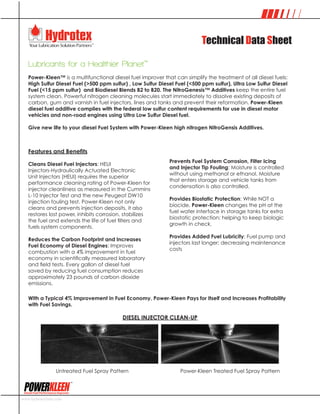
DIESEL INJECTOR CLEAN-UP
Untreated Fuel Spray Pattern			 Power-Kleen Treated Fuel Spray Pattern
Properties and Characteristics
Recommended Treatment Ratios
Product Code and Packaging
WARRANTY
When properly stored and used in accordance with instructions, any material not satisfactory will be
replaced with any product in our line on a dollar for dollar basis provided the account is paid in full
when due and Hydrotex is notified in writing within 12 months of the date of the order by customer.
TEST DESCRIPTION ASTM NO. TYPICAL RESULTS
API Gravity 40
Sulfur Content D-5453 1.4 ppm
Flash Point, TCC ˚F (˚C) D-56 45 (7.2)
Ash Content, % None
Lubricity Improvement
Scuffing/Load BOCLE
D-6078 600-3100 gram load increase
Lubricity Improvement, HFRR D-6079 10-60 micrometers wear scar reduction
Injector Cleanliness,
Cummins L-10 Cat 1K
Reference Fuel
CRC Rating of 5.1 for Cummins L-10 Superior Detergency
Water Tolerance D-1094 Pass Fuel Clarity, Interface & Water
Stability Test,
180 minute @ 150˚C
>80% Filter Pad Reflectance
Shelf Life Indefinite in Sealed Container
Color Blue-Green
Performance Improvement Amount of Power-Kleen
Storage Tanks (Vehicle Tanks)
Treats Amount of Fuel
Storage Tanks (Vehicle Tanks)
First Treatment for Injector
Clean-Up
1 gallon (12 oz.) 1,000 gallons (100 gal.)
Injector Keep-Clean
Improved Storage Stability
Improved Lubricity Corrosion
Protection Maintain Upper
Cylinder Area Cleanliness
1 gallon (12 oz.) 2,200 gallons (200 gal.)
Emergency Diesel Generator
Standby Fuel Storage
1 gallon 500 gallons
Vehicle Tank 1 gallon 100 gallons
SKU: 0021
1, 5, 20, 55, & 275 Gallon sizes. 1 Quart and 12 Ounce Bottles
Page 3
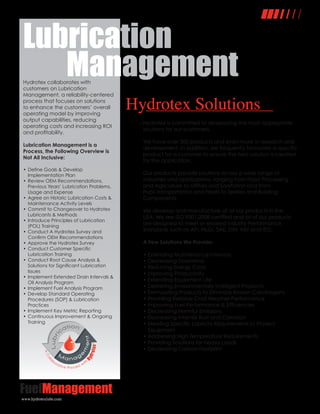
Hydrotex collaborates with
customers on Lubrication
Management, a reliability‑centered
process that focuses on solutions
to enhance the customers’ overall
operating model by improving
output capabilities, reducing
operating costs and increasing ROI
and profitability.
Lubrication Management is a
Process, the Following Overview is
Not All Inclusive:
•	Define Goals & Develop
Implementation Plan
•	Review OEM Recommendations,
Previous Years’ Lubrication Problems,
Usage and Expense
•	Agree on Historic Lubrication Costs &
Maintenance Activity Levels
•	Commit to Changeover to Hydrotex
Lubricants & Methods
•	Introduce Principles of Lubrication
(POL) Training
•	Conduct A Hydrotex Survey and
Confirm OEM Recommendations
•	Approve the Hydrotex Survey
•	Conduct Customer Specific
Lubrication Training
•	Conduct Root Cause Analysis &
Solutions for Significant Lubrication
Issues
•	Implement Extended Drain Intervals &
Oil Analysis Program
•	Implement Fuel Analysis Program
•	Develop Standard Operating
Procedures (SOP) & Lubrication
Practices
•	Implement Key Metric Reporting
•	Continuous Improvement & Ongoing
Training
Hydrotex is committed to developing the most appropriate
solutions for our customers.
We have over 300 products and even more in research and
development. In addition, we frequently formulate a specific
product for a customer to ensure the best solution is created
for the application.
Our products provide solutions across a wide range of
industries and applications, ranging from Food Processing
and Agriculture to Utilities and Sanitation and from
Pupil Transportation and Fleets to Textiles and Building
Components.
We develop and manufacture all of our products in the
USA. We are ISO 9001:2008 certified and all of our products
are designed to meet or exceed Industry Performance
Standards such as API, NLGI, SAE, DIN, NSF and ISO.
A Few Solutions We Provide:
•	Extending Maintenance Intervals
•	Decreasing Downtime
•	Reducing Energy Costs
•	Improving Productivity
•	Extending Equipment Life
•	Delivering Environmentally Intelligent Products
•	Formulating Products to Eliminate Known Carcinogens
•	Providing Reliable Cold Weather Performance
•	Improving Fuel Performance & Efficiencies
•	Decreasing Harmful Emissions
•	Decreasing Internal Rust and Corrosion
•	Meeting Specific Lubricity Requirements to Protect
Equipment
•	Addressing High Temperature Requirements
•	Providing Solutions for Heavy Loads
•	Decreasing Carbon Footprint
Lubrication
		 Management
Hydrotex Solutions
www.hydrotexlube.com
FuelManagement
Page 5
Lubrication Training is a Vital Step in Developing and Maintaining Successful Maintenance Programs and is
the Cornerstone to Our Reliability Centered Maintenance Approach.
Hydrotex Lubrication University offers fundamental and customized lubrication training. Either at our
corporate office or at our customers’ facilities across the nation, we present our lubrication training
seminars.
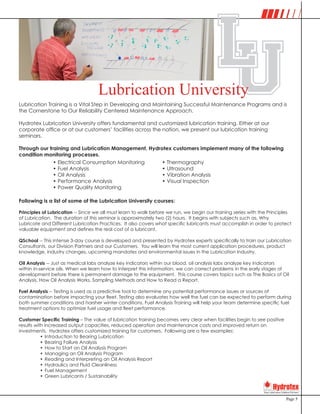
Through our training and Lubrication Management, Hydrotex customers implement many of the following
condition monitoring processes.
Following is a list of some of the Lubrication University courses:
Principles of Lubrication -- Since we all must learn to walk before we run, we begin our training series with the Principles
of Lubrication. The duration of this seminar is approximately two (2) hours. It begins with subjects such as, Why
Lubricate and Different Lubrication Practices. It also covers what specific lubricants must accomplish in order to protect
valuable equipment and defines the real cost of a lubricant.
QSchool -- This intense 3-day course is developed and presented by Hydrotex experts specifically to train our Lubrication
Consultants, our Division Partners and our Customers. You will learn the most current application procedures, product
knowledge, industry changes, upcoming mandates and environmental issues in the Lubrication Industry.
Oil Analysis -- Just as medical labs analyze key indicators within our blood, oil analysis labs analyze key indicators
within in-service oils. When we learn how to interpret this information, we can correct problems in the early stages of
development before there is permanent damage to the equipment. This course covers topics such as The Basics of Oil
Analysis, How Oil Analysis Works, Sampling Methods and How to Read a Report.
Fuel Analysis -- Testing is used as a predictive tool to determine any potential performance issues or sources of
contamination before impacting your fleet. Testing also evaluates how well the fuel can be expected to perform during
both summer conditions and harsher winter conditions. Fuel Analysis Training will help your team determine specific fuel
treatment options to optimize fuel usage and fleet performance.
Customer Specific Training – The value of lubrication training becomes very clear when facilities begin to see positive
results with increased output capacities, reduced operation and maintenance costs and improved return on
investments. Hydrotex offers customized training for customers. Following are a few examples:
•	Introduction to Bearing Lubrication
•	Bearing Failure Analysis
•	How to Start an Oil Analysis Program
•	Managing an Oil Analysis Program
•	Reading and Interpreting an Oil Analysis Report
•	Hydraulics and Fluid Cleanliness
•	Fuel Management
•	Green Lubricants / Sustainability
•	Electrical Consumption Monitoring
•	Fuel Analysis
•	Oil Analysis
•	Performance Analysis
•	Power Quality Monitoring
•	Thermography
•	Ultrasound
•	Vibration Analysis
•	Visual Inspection
ULLubrication University
Hydrotex name, design and related marks are trademarks of Hydrotex®
2011 Hydrotex All Rights Reserved.
12920 Senlac Dr. STE 190
Farmers Branch, TX 75234
800.527.9439
www.hydrotexlube.com
Don’t Pollute, Conserve Resources, Extend Maintenance Intervals
R e d u c e Y o u r C a r b o n F o o t p r i n t

Fuel Management

  • 1.
  • 2.
    www.hydrotexlube.com • TMC Recommended PracticeRP 1109 • Utilized Two (2) Identical Freightliner Trucks (GVW 76,000 lbs) • Equipped with Identical Build Engines (365 Hp @ 1800 rpm) • Vehicle Speed: 61 mph (1600 rpm) with Cruise Control • Vehicle Gap: 15 to 45 seconds • 210 Mile Round-trip Test Circuit • Drivers Switched Trucks/Leads at Turnaround Point • Component Fluids on Both Trucks Switched at Same Time • Fuel Amounts Corrected to 60°F Fleet Treat® Program Fuel Economy Test Matrix Fuel Economy Savings Documented with Type IV Test Procedure This test compares Hydrotex® synthetic lubricants against mineral oil based lubricants for fuel economy benefits. CONCLUSION: Hydrotex synthetic lubricants significantly improve fuel economy. In fact, the fuel economy savings more than pays for the cost of the synthetic lubrication program and using Hydrotex fuel improvers puts additional money to the bottom-line. Power-Kleen™ & Power-Kleen™ Arctic Power-Kleen™ is a multi-functional diesel fuel improver specially formulated for warm ambient temperatures to protect, clean and lubricate fuel system components while improving fuel economy and reducing emissions. The added combination of pour point depressants and wax crystal modifiers make the use of Power-Kleen Arctic critical for winter maintenance and cold weather reliability. • Improve Fuel Economy • Prevent Fuel Pump and Injector Wear • Clean and Maintain Fuel Injectors • Reduce Smoke and Emissions • Enhance Fuel Stability • Protect Against Rust and Corrosion • Restore Lost Power Essentialube® Advanced Formula Blending Agent Essentialube® is a cost-effective performance improver for both fuels and lubricants. • Provide More Power and Better Performance • Disperse Moisture • Neutralize Harmful Acids • Retard Formation of Gum, Varnish and Carbon • Improve Combustion • Reduce Emissions Use Essentialube as a Flushing Agent to dissolve, neutralize and suspend the sludge, varnish, gums, acid and other destructive residues which are commonly found in automotive crankcases and industrial equipment reservoirs. Diesel Fuel Improvers Improve Fuel Economy 4% - 10% Other Fuel Improvers: • Power-Kleen™ Supreme • HydroSorb® II • Power Flo® • Bio-Pour PT™ • Gel Melt™ Only For B100 Use by B100 Manufacturers & Blenders FuelManagement Detergency - Cummins L-10 Fuel Injector Cleanliness Test Untreated Treated Fuel Fuel Cummins L-10 Injector Pintles Test Parameters Fuel: Commercial No. 2 Diesel Conditions: 2 L-10 Cummins Engines Paired One Engine Driving and One Engine Driven Alternately 15 Second Driving/Driven Cycle @ 2300 RPM @ 50-60 Hp Duration: 125 Hours Performance Criteria Percent Flow Loss CRC Visual Cleanliness Rating Scale 1 to 100 Results % Flow Loss CRCRating Untreated Fuel 11.2 35* Treated Fuel 1.16 * (*Note: 1 is Perfectly Clean) Rust & Corrosion Protection – NACE Test Untreated Fuel Treated Fuel Test Parameters Base Fuel: Depolarized Iso-Octane Temperature: 37.8°C (100°F) Water Phase: Distilled Water Stir Fuel 30 Minutes, Stop, Introduce Water, Stir 3.5 Hours Steel Spindle: Polished, Cold Rolled SAE 1020, 1/2”d ia. Performance Criteria Visual Evidence of Rust Results % Surface Rust Untreated Fuel 50-75% Treated Fuel NONE Fuel Stability - ASTM D-2274 Insoluble Gums, Varnish and Sludge Untreated Fuel Treated Fuel Test Parameters Commercial No. 2 Diesel @ 95°C (203°F) Test Time: 16 Hours Oxygen Is Bubbled Through the Sample at a Rate of 3 Liters/Hour Performance Criteria Amount of insolubles deposited on test filter Results Filter Insolubles (mg/ 100 ml) Untreated Fuel 0.69 Treated Fuel 0 .15 78% Less Filter Blockage
  • 3.
    Port’s Study ShowsDiesel Additive Increases Fuel Efficiency and Reduces Emissions Page 1 As released by Georgia Ports Authority Port’s Study Shows Diesel Additive Increases Fuel Efficiency and Reduces Emissions Savannah, Ga. – August 13, 2010 – The Georgia Ports Authority’s (GPA) Executive Director Curtis J. Foltz announced today that its diesel additive study yielded a five percent reduction in fuel consumption, as well as drastically decreased emissions. “We undertook this study as a proactive effort to reduce our environmental footprint,” said GPA’s Executive Director Curtis J. Foltz. “As we expand our operations to accommodate increased cargo, we continue to look for ways to improve efficiencies and operate in an even more environmentally‑friendly manner.” GPA’s engineering staff commissioned a study to determine whether a fuel additive would be effective in reducing pollutant emissions and increasing engine fuel efficiency for its diesel equipment fleet. WPC of Savannah, Ga., was contracted to conduct the test and provide analysis. This large-scale test studied two of the most widely used container-handling equipment at the Port of Savannah. “We were pleasantly surprised to see these dramatic results;” said GPA’s Senior Director of Engineering and Facilities Maintenance, Wilson Tillotson. “With the large-scale nature of this study, we are confident the additive will yield an improvement in fuel efficiency and a significant reduction in emissions.” In January 2010, the GPA conducted a baseline monitoring for its diesel vehicle fleet at Garden City Terminal. The study included a diesel vehicle fleet of 64 rubber-tired gantry cranes (RTGs) and 40 jockey trucks. Baseline monitoring consisted of collecting emissions and fuel consumption data with all vehicles using ultra-low-sulfur diesel without the additive. For emissions monitoring, the test measured the Environmental Protection Agency’s (EPA) criteria pollutants: nitrogen dioxide, carbon monoxide, sulfur dioxide and particulate matter. Fuel consumption and operating hours were measured to develop a consumption rate in gallons per hour. “The intent of the fuel additive is to yield a more complete and efficient fuel combustion,” said Joseph R. Ross, Jr., Senior Associate and Environmental Department Manager with WPC. “By increasing the combustion efficiency, not only are fuel savings evident, the formation of criteria air pollutants is also reduced. These reductions will benefit all of Chatham County by reducing pollutant concentrations and helping to maintain compliance with state and federal attainment criteria.” The result of the study indicated a decrease of approximately five percent in fuel consumption. Reductions in EPA criteria pollutants were more significant. Particulate matter reductions averaged as high as 71 percent, while nitrogen dioxide decreased as much as 20 percent and carbon monoxide decreased an average of 19 percent. The study did not produce conclusive results regarding the impact of the additive on sulfur dioxide emissions. However, GPA’s conversion in 2008 to ultra‑low‑sulfur diesel reduced the total sulfur content by 99 percent. “The results are proof-positive that these additives work,” said Tillotson. “We plan to continue using fuel additives for all diesel consumed on GPA property.” Through the GPA’s crane electrification, use of refrigerated container racks, upcoming RTG repower project and use of fuel additives, the Port of Savannah will avoid use of more than 4.5 million gallons of fuel annually. Georgia’s deepwater ports and inland barge terminals support more than 295,000 jobs throughout the state annually and contribute $15.5 billion in income, $61.7 billion in revenue and $2.6 billion in state and local taxes to Georgia’s economy. About WPC, a Terracon company: WPC joined Terracon in September of 2009 and provides professional services to clients in the commercial development, education, environmental, government/military, industrial facilities, medical, power/utilities, residential and transportation industries. Terracon is an employee-owned engineering consulting firm with more than 2,700 employees providing geotechnical, environmental, construction materials and facilities services from more than 100 offices in 37 states nationwide. Terracon provides value to its clients through the following key benefits: reliability, responsiveness, convenience and innovation. Terracon currently ranks 46th on Engineering News-Record’s List of Top 500 Design Firms. For more information contact: http://www.wpceng.com or http:// www.terracon.com.
  • 4.
    Technical Data Sheet Lubricantsfor a Healthier Planet™ Power-Kleen™ is a multifunctional diesel fuel improver that can simplify the treatment of all diesel fuels: High Sulfur Diesel Fuel (>500 ppm sulfur) , Low Sulfur Diesel Fuel (<500 ppm sulfur), Ultra Low Sulfur Diesel Fuel (<15 ppm sulfur) and Biodiesel Blends B2 to B20. The NitroGenesis™ Additives keep the entire fuel system clean. Powerful nitrogen cleaning molecules start immediately to dissolve existing deposits of carbon, gum and varnish in fuel injectors, lines and tanks and prevent their reformation. Power-Kleen diesel fuel additive complies with the federal low sulfur content requirements for use in diesel motor vehicles and non-road engines using Ultra Low Sulfur Diesel fuel. Give new life to your diesel Fuel System with Power-Kleen high nitrogen NitroGensis Additives. www.hydrotexlube.com Diesel Fuel Performance Improver Diesel Fuel Performance Improver Features and Benefits Cleans Diesel Fuel Injectors: HEUI Injectors‑Hydraulically Actuated Electronic Unit Injectors (HEUI) requires the superior performance cleaning rating of Power-Kleen for injector cleanliness as measured in the Cummins L-10 Injector Test and the new Peugeot DW10 injection fouling test. Power-Kleen not only cleans and prevents injection deposits, it also restores lost power, inhibits corrosion, stabilizes the fuel and extends the life of fuel filters and fuels system components. Reduces the Carbon Footprint and Increases Fuel Economy of Diesel Engines: Improves combustion with a 4% improvement in fuel economy in scientifically measured laboratory and field tests. Every gallon of diesel fuel saved by reducing fuel consumption reduces approximately 23 pounds of carbon dioxide emissions. Prevents Fuel System Corrosion, Filter Icing and Injector Tip Fouling: Moisture is controlled without using methanol or ethanol. Moisture that enters storage and vehicle tanks from condensation is also controlled. Provides Biostatic Protection: While NOT a biocide, Power-Kleen changes the pH at the fuel water interface in storage tanks for extra biostatic protection; helping to keep biologic growth in check. Provides Added Fuel Lubricity: Fuel pump and injectors last longer; decreasing maintenance costs With a Typical 4% Improvement in Fuel Economy, Power-Kleen Pays for Itself and Increases Profitability with Fuel Savings. DIESEL INJECTOR CLEAN-UP Untreated Fuel Spray Pattern Power-Kleen Treated Fuel Spray Pattern
  • 5.
    Properties and Characteristics RecommendedTreatment Ratios Product Code and Packaging WARRANTY When properly stored and used in accordance with instructions, any material not satisfactory will be replaced with any product in our line on a dollar for dollar basis provided the account is paid in full when due and Hydrotex is notified in writing within 12 months of the date of the order by customer. TEST DESCRIPTION ASTM NO. TYPICAL RESULTS API Gravity 40 Sulfur Content D-5453 1.4 ppm Flash Point, TCC ˚F (˚C) D-56 45 (7.2) Ash Content, % None Lubricity Improvement Scuffing/Load BOCLE D-6078 600-3100 gram load increase Lubricity Improvement, HFRR D-6079 10-60 micrometers wear scar reduction Injector Cleanliness, Cummins L-10 Cat 1K Reference Fuel CRC Rating of 5.1 for Cummins L-10 Superior Detergency Water Tolerance D-1094 Pass Fuel Clarity, Interface & Water Stability Test, 180 minute @ 150˚C >80% Filter Pad Reflectance Shelf Life Indefinite in Sealed Container Color Blue-Green Performance Improvement Amount of Power-Kleen Storage Tanks (Vehicle Tanks) Treats Amount of Fuel Storage Tanks (Vehicle Tanks) First Treatment for Injector Clean-Up 1 gallon (12 oz.) 1,000 gallons (100 gal.) Injector Keep-Clean Improved Storage Stability Improved Lubricity Corrosion Protection Maintain Upper Cylinder Area Cleanliness 1 gallon (12 oz.) 2,200 gallons (200 gal.) Emergency Diesel Generator Standby Fuel Storage 1 gallon 500 gallons Vehicle Tank 1 gallon 100 gallons SKU: 0021 1, 5, 20, 55, & 275 Gallon sizes. 1 Quart and 12 Ounce Bottles Page 3
  • 6.
    Hydrotex collaborates with customerson Lubrication Management, a reliability‑centered process that focuses on solutions to enhance the customers’ overall operating model by improving output capabilities, reducing operating costs and increasing ROI and profitability. Lubrication Management is a Process, the Following Overview is Not All Inclusive: • Define Goals & Develop Implementation Plan • Review OEM Recommendations, Previous Years’ Lubrication Problems, Usage and Expense • Agree on Historic Lubrication Costs & Maintenance Activity Levels • Commit to Changeover to Hydrotex Lubricants & Methods • Introduce Principles of Lubrication (POL) Training • Conduct A Hydrotex Survey and Confirm OEM Recommendations • Approve the Hydrotex Survey • Conduct Customer Specific Lubrication Training • Conduct Root Cause Analysis & Solutions for Significant Lubrication Issues • Implement Extended Drain Intervals & Oil Analysis Program • Implement Fuel Analysis Program • Develop Standard Operating Procedures (SOP) & Lubrication Practices • Implement Key Metric Reporting • Continuous Improvement & Ongoing Training Hydrotex is committed to developing the most appropriate solutions for our customers. We have over 300 products and even more in research and development. In addition, we frequently formulate a specific product for a customer to ensure the best solution is created for the application. Our products provide solutions across a wide range of industries and applications, ranging from Food Processing and Agriculture to Utilities and Sanitation and from Pupil Transportation and Fleets to Textiles and Building Components. We develop and manufacture all of our products in the USA. We are ISO 9001:2008 certified and all of our products are designed to meet or exceed Industry Performance Standards such as API, NLGI, SAE, DIN, NSF and ISO. A Few Solutions We Provide: • Extending Maintenance Intervals • Decreasing Downtime • Reducing Energy Costs • Improving Productivity • Extending Equipment Life • Delivering Environmentally Intelligent Products • Formulating Products to Eliminate Known Carcinogens • Providing Reliable Cold Weather Performance • Improving Fuel Performance & Efficiencies • Decreasing Harmful Emissions • Decreasing Internal Rust and Corrosion • Meeting Specific Lubricity Requirements to Protect Equipment • Addressing High Temperature Requirements • Providing Solutions for Heavy Loads • Decreasing Carbon Footprint Lubrication Management Hydrotex Solutions www.hydrotexlube.com FuelManagement
  • 7.
    Page 5 Lubrication Trainingis a Vital Step in Developing and Maintaining Successful Maintenance Programs and is the Cornerstone to Our Reliability Centered Maintenance Approach. Hydrotex Lubrication University offers fundamental and customized lubrication training. Either at our corporate office or at our customers’ facilities across the nation, we present our lubrication training seminars. Through our training and Lubrication Management, Hydrotex customers implement many of the following condition monitoring processes. Following is a list of some of the Lubrication University courses: Principles of Lubrication -- Since we all must learn to walk before we run, we begin our training series with the Principles of Lubrication. The duration of this seminar is approximately two (2) hours. It begins with subjects such as, Why Lubricate and Different Lubrication Practices. It also covers what specific lubricants must accomplish in order to protect valuable equipment and defines the real cost of a lubricant. QSchool -- This intense 3-day course is developed and presented by Hydrotex experts specifically to train our Lubrication Consultants, our Division Partners and our Customers. You will learn the most current application procedures, product knowledge, industry changes, upcoming mandates and environmental issues in the Lubrication Industry. Oil Analysis -- Just as medical labs analyze key indicators within our blood, oil analysis labs analyze key indicators within in-service oils. When we learn how to interpret this information, we can correct problems in the early stages of development before there is permanent damage to the equipment. This course covers topics such as The Basics of Oil Analysis, How Oil Analysis Works, Sampling Methods and How to Read a Report. Fuel Analysis -- Testing is used as a predictive tool to determine any potential performance issues or sources of contamination before impacting your fleet. Testing also evaluates how well the fuel can be expected to perform during both summer conditions and harsher winter conditions. Fuel Analysis Training will help your team determine specific fuel treatment options to optimize fuel usage and fleet performance. Customer Specific Training – The value of lubrication training becomes very clear when facilities begin to see positive results with increased output capacities, reduced operation and maintenance costs and improved return on investments. Hydrotex offers customized training for customers. Following are a few examples: • Introduction to Bearing Lubrication • Bearing Failure Analysis • How to Start an Oil Analysis Program • Managing an Oil Analysis Program • Reading and Interpreting an Oil Analysis Report • Hydraulics and Fluid Cleanliness • Fuel Management • Green Lubricants / Sustainability • Electrical Consumption Monitoring • Fuel Analysis • Oil Analysis • Performance Analysis • Power Quality Monitoring • Thermography • Ultrasound • Vibration Analysis • Visual Inspection ULLubrication University
  • 8.
    Hydrotex name, designand related marks are trademarks of Hydrotex® 2011 Hydrotex All Rights Reserved. 12920 Senlac Dr. STE 190 Farmers Branch, TX 75234 800.527.9439 www.hydrotexlube.com Don’t Pollute, Conserve Resources, Extend Maintenance Intervals R e d u c e Y o u r C a r b o n F o o t p r i n t