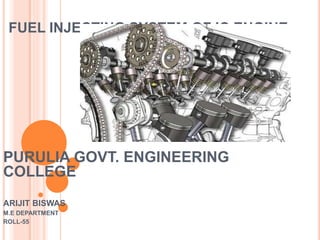
FUEL INJECTING SYSTEM OF IC ENGINE
PURULIA GOVT. ENGINEERING
COLLEGE
ARIJIT BISWAS
M.E DEPARTMENT
ROLL-55
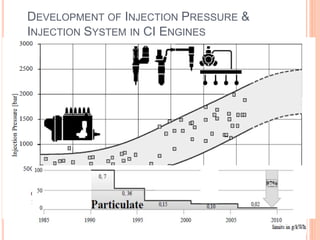
DEVELOPMENT OF INJECTION PRESSURE &
INJECTION SYSTEM IN CI ENGINES
TYPES OF CI ENGINE INJECTION SYSTEMS
 Air assisted Fuel-Injection Systems.
 Unit Injector System (UIS) – Single-Cylinder CI Engine.
 Unit Pump System (UPS) – Multi-cylinder CI Engine.
 Common Rail Injection System (CRS) – Multi-cylinder CI Engine.
 The Unit Injector System (UIS) and the Unit Pump System (UPS)
are among the most significant innovations in this field.
 They inject precisely the right amount of fuel individually into each
cylinder, at very high pressure, and at exactly the right moment in
time.
 This results in considerably more efficient combustion than is the
case with conventional injection systems.
 This, in turn, equates to higher output, less fuel consumption, and
lower levels of noise and exhaust-gas emissions.
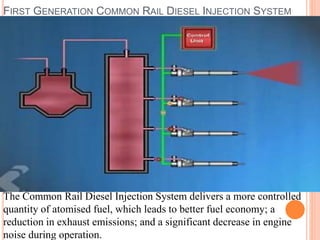
FIRST GENERATION COMMON RAIL DIESEL INJECTION SYSTEM
The Common Rail Diesel Injection System delivers a more controlled
quantity of atomised fuel, which leads to better fuel economy; a
reduction in exhaust emissions; and a significant decrease in engine
noise during operation.
HISTORY OF CRDI
 The common rail system prototype was developed
in the 1960's by Robert Huber of Switzerland.
 The technology was further developed by Dr.Marco
Ganser at the swiss Federal Institute of Technology
in Zurich.
 The first successful usage in production vehicle
began in Japan in the mid-1990's by Dr.Shohei Itoh
& Masahina Miyaki of the Denso Corporation.
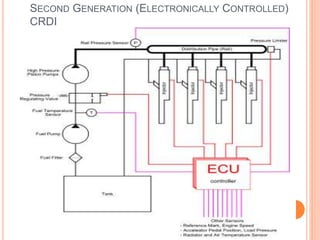
SECOND GENERATION (ELECTRONICALLY CONTROLLED)
CRDI
COMMON RAIL DIESEL INJECTION SYSTEM
 In the Common Rail system, an accumulator, or rail, is
used to create a common reservoir of fuel under a
consistent controlled pressure that is separate from
the fuel injection points.
 A high-pressure pump increases the fuel pressure in
the accumulator up to 1,600 bar .
 The pressure is set by the engine control unit and is
independent of the engine speed and quantity of fuel
being injected into any of the cylinders.
 The fuel is then transferred through rigid pipes to the
fuel injectors, which inject the correct amount of fuel
into the combustion chambers.
INJECTORS FOR CRDI
 The injectors used in Common Rail systems are triggered
externally by an Electronic Diesel Control, (EDC) unit.
 EDC controls all the engine injection parameters including
the pressure in the fuel rail and the timing and duration of
injection.
 Some common rail injectors are controlled by a magnetic
solenoid on the injector.
 In some injectors, hydraulic force from the pressure in the
system is used to open and close the injector, but the
available pressure is controlled by the solenoid triggered by
the Electronic Diesel Control unit.
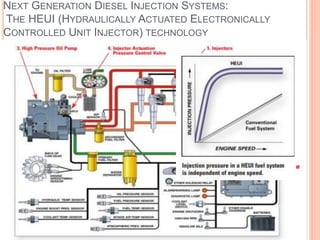
NEXT GENERATION DIESEL INJECTION SYSTEMS:
THE HEUI (HYDRAULICALLY ACTUATED ELECTRONICALLY
CONTROLLED UNIT INJECTOR) TECHNOLOGY
THANK YOU

FUEL INJECTION SYSTEM OF IC ENGINE.ppt

  • 1.
    FUEL INJECTING SYSTEMOF IC ENGINE PURULIA GOVT. ENGINEERING COLLEGE ARIJIT BISWAS M.E DEPARTMENT ROLL-55
  • 3.
    DEVELOPMENT OF INJECTIONPRESSURE & INJECTION SYSTEM IN CI ENGINES
  • 4.
    TYPES OF CIENGINE INJECTION SYSTEMS  Air assisted Fuel-Injection Systems.  Unit Injector System (UIS) – Single-Cylinder CI Engine.  Unit Pump System (UPS) – Multi-cylinder CI Engine.  Common Rail Injection System (CRS) – Multi-cylinder CI Engine.  The Unit Injector System (UIS) and the Unit Pump System (UPS) are among the most significant innovations in this field.  They inject precisely the right amount of fuel individually into each cylinder, at very high pressure, and at exactly the right moment in time.  This results in considerably more efficient combustion than is the case with conventional injection systems.  This, in turn, equates to higher output, less fuel consumption, and lower levels of noise and exhaust-gas emissions.
  • 5.
    FIRST GENERATION COMMONRAIL DIESEL INJECTION SYSTEM The Common Rail Diesel Injection System delivers a more controlled quantity of atomised fuel, which leads to better fuel economy; a reduction in exhaust emissions; and a significant decrease in engine noise during operation.
  • 6.
    HISTORY OF CRDI The common rail system prototype was developed in the 1960's by Robert Huber of Switzerland.  The technology was further developed by Dr.Marco Ganser at the swiss Federal Institute of Technology in Zurich.  The first successful usage in production vehicle began in Japan in the mid-1990's by Dr.Shohei Itoh & Masahina Miyaki of the Denso Corporation.
  • 7.
  • 8.
    COMMON RAIL DIESELINJECTION SYSTEM  In the Common Rail system, an accumulator, or rail, is used to create a common reservoir of fuel under a consistent controlled pressure that is separate from the fuel injection points.  A high-pressure pump increases the fuel pressure in the accumulator up to 1,600 bar .  The pressure is set by the engine control unit and is independent of the engine speed and quantity of fuel being injected into any of the cylinders.  The fuel is then transferred through rigid pipes to the fuel injectors, which inject the correct amount of fuel into the combustion chambers.
  • 9.
    INJECTORS FOR CRDI The injectors used in Common Rail systems are triggered externally by an Electronic Diesel Control, (EDC) unit.  EDC controls all the engine injection parameters including the pressure in the fuel rail and the timing and duration of injection.  Some common rail injectors are controlled by a magnetic solenoid on the injector.  In some injectors, hydraulic force from the pressure in the system is used to open and close the injector, but the available pressure is controlled by the solenoid triggered by the Electronic Diesel Control unit.
  • 10.
    NEXT GENERATION DIESELINJECTION SYSTEMS: THE HEUI (HYDRAULICALLY ACTUATED ELECTRONICALLY CONTROLLED UNIT INJECTOR) TECHNOLOGY
  • 11.