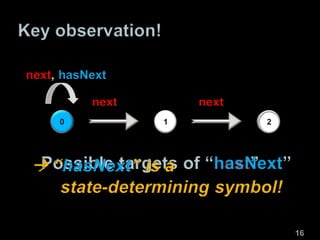
0 1 2 0 1 2


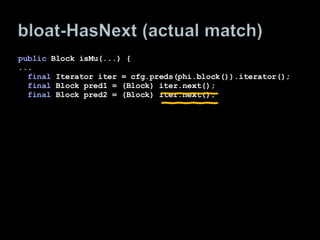
public  Block isMu(...) { ... final  Iterator iter = cfg.preds(phi.block()).iterator(); final  Block pred1 = (Block) iter.next(); final  Block pred2 = (Block) iter.next();
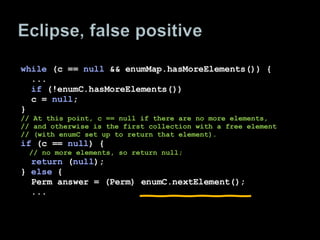
while  (c ==  null  && enumMap.hasMoreElements()) { ...  if  (!enumC.hasMoreElements()) c =  null ; } // At this point, c == null if there are no more elements, // and otherwise is the first collection with a free element // (with enumC set up to return that element). if  (c ==  null ) { // no more elements, so return null; return  ( null ); }  else  { Perm answer = (Perm) enumC.nextElement(); ...
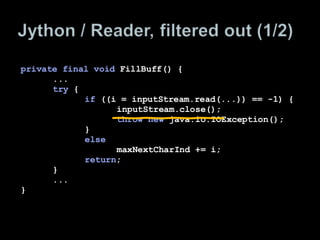
private final void  FillBuff() { ... try  { if  ((i = inputStream.read(...)) == -1) { inputStream.close(); throw new  java.io.IOException(); } else maxNextCharInd += i; return ; } ...  }
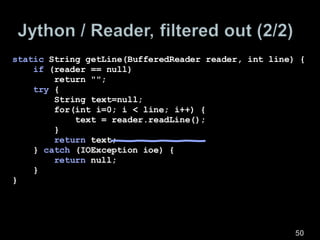
static  String getLine(BufferedReader reader, int line) { if  (reader == null) return &quot;&quot;; try  { String text=null; for(int i=0; i < line; i++) { text = reader.readLine(); } return  text; }  catch  (IOException ioe) { return  null; } }
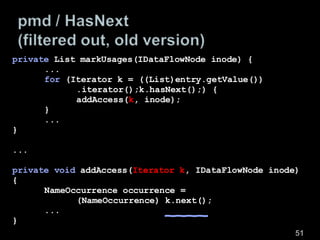
private  List markUsages(IDataFlowNode inode) { ... for  (Iterator k = ((List)entry.getValue()) .iterator();k.hasNext();) { addAccess( k , inode); } ... } ... private void  addAccess( Iterator k , IDataFlowNode inode) { NameOccurrence occurrence = (NameOccurrence) k.next(); ...  }
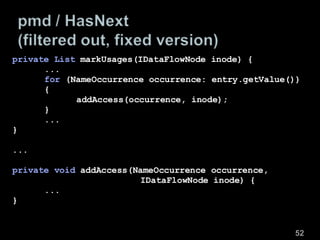
private List  markUsages(IDataFlowNode inode) { ... for  (NameOccurrence occurrence: entry.getValue())  { addAccess(occurrence, inode); } ... } ... private void  addAccess(NameOccurrence occurrence, IDataFlowNode inode) { ...  }
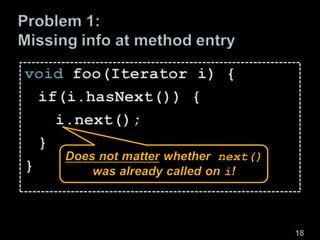
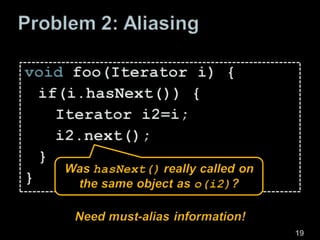
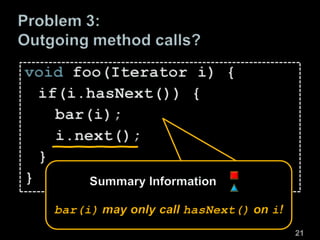
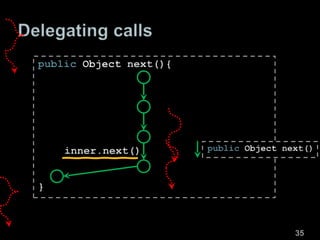
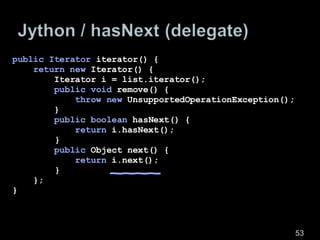
public Iterator  iterator() { return new  Iterator() { Iterator i = list.iterator(); public void  remove() { throw new  UnsupportedOperationException(); } public boolean  hasNext() { return  i.hasNext();   } public  Object next() { return  i.next();   } }; }
FSE 2008
FSE 2008
FSE 2008
FSE 2008
FSE 2008
FSE 2008

FSE 2008

  • 1.
  • 2.
  • 6.
  • 11.
  • 12.
  • 16.
    0 1 20 1 2
  • 29.
  • 30.
  • 31.
  • 39.
  • 45.
  • 46.
  • 47.
    public BlockisMu(...) { ... final Iterator iter = cfg.preds(phi.block()).iterator(); final Block pred1 = (Block) iter.next(); final Block pred2 = (Block) iter.next();
  • 48.
    while (c== null && enumMap.hasMoreElements()) { ... if (!enumC.hasMoreElements()) c = null ; } // At this point, c == null if there are no more elements, // and otherwise is the first collection with a free element // (with enumC set up to return that element). if (c == null ) { // no more elements, so return null; return ( null ); } else { Perm answer = (Perm) enumC.nextElement(); ...
  • 49.
    private final void FillBuff() { ... try { if ((i = inputStream.read(...)) == -1) { inputStream.close(); throw new java.io.IOException(); } else maxNextCharInd += i; return ; } ... }
  • 50.
    static StringgetLine(BufferedReader reader, int line) { if (reader == null) return &quot;&quot;; try { String text=null; for(int i=0; i < line; i++) { text = reader.readLine(); } return text; } catch (IOException ioe) { return null; } }
  • 51.
    private ListmarkUsages(IDataFlowNode inode) { ... for (Iterator k = ((List)entry.getValue()) .iterator();k.hasNext();) { addAccess( k , inode); } ... } ... private void addAccess( Iterator k , IDataFlowNode inode) { NameOccurrence occurrence = (NameOccurrence) k.next(); ... }
  • 52.
    private List markUsages(IDataFlowNode inode) { ... for (NameOccurrence occurrence: entry.getValue()) { addAccess(occurrence, inode); } ... } ... private void addAccess(NameOccurrence occurrence, IDataFlowNode inode) { ... }
  • 53.
    public Iterator iterator() { return new Iterator() { Iterator i = list.iterator(); public void remove() { throw new UnsupportedOperationException(); } public boolean hasNext() { return i.hasNext(); } public Object next() { return i.next(); } }; }