Hamlet D'Arcy, Canoo Engineering AG @HamletDRC
http://hamletdarcy.blogspot.com AST Transformations
Agenda Lombok and Groovy AST Transformations –  Abstract Syntax Trees CodeNarc and Groovy 2.0 –  Static Analysis and Type Checking Mirah –  Macros and Static Typing
About Me
I shot an elephant in my pajamas.
Subject: I Verb: shot Direct Object: an elephant Indirect Object: in my pajamas
I shot an elephant in my pajamas. How he got in my pajamas,  I'll never know.
Subject: I Verb: shot an elephant in my pajamas Participle Phrase
I want to thank my parents,  Jesus and Oprah Winfrey
Subject: I Verb: want Participle: God my parents Oprah Winfrey Infinitive: to thank
I want to thank my parents,  Jesus and Oprah Winfrey
I want to thank my parents,  Jesus and Oprah Winfrey You b. 1976 You b. 1954 God b. ?
Subject: I Verb: want Participle Phrase: my parents God Oprah Winfrey Infinitive: to thank
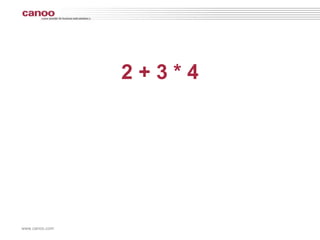
2 + 3 * 4
2 + 3 * 4 2 + * 3 4
2 + 3 * 4 2 + * 3 4 4 * + 2 3
(+ 2 (* 3 4)) 2 + * 3 4 4 * + 2 3
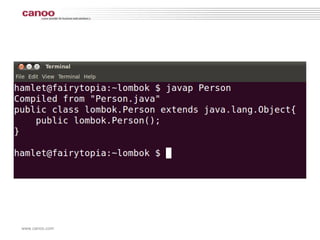
public class   Person { private  String name;  public void  setName(String name) {  this .name = name;} public  String getNameName() {  return   name ;  } public   static   void  main(String[] args) { Person p =  new  Person();   p.setName( “Hamlet” );  System. out .println(p);  } }
Project Lombok


@Data public   class  Person { private  String  firstName ; private  String  lastName ; } public   class  Person { private  String  firstName ; private  String  lastName ; public  String getFirstName() { return   this . firstName ; } public  void setFirstName(String paramString) { this . firstName  = paramString; } public  String getLastName() { return   this . lastName ; } public  void setLastName(String paramString) { this . lastName  = paramString; } public  boolean equals(Object paramObject) { if (paramObject ==  this ) return   true ; if (paramObject ==  null ) return   false ; if (paramObject.getClass() != getClass()) return   false ; Person localPerson = (Person) paramObject; if ( this . firstName  ==  null  ? localPerson. firstName  !=  null     : ! this . firstName .equals(localPerson. firstName )) return   false ; return   this . lastName  ==  null  ? localPerson. lastName  ==  null   :  this . lastName .equals(localPerson. lastName ); } public  int hashCode() { int i =  1 ; i = i *  31  + ( this . firstName  ==  null  ?  0  :  this . firstName .hashCode()); i = i *  31  + ( this . lastName  ==  null  ?  0  :  this . lastName .hashCode()); return  i; } public  String toString() { return   "Person(firstName=" + this . firstName + ", lastName=" + this . lastName  +  ")" ; } }
@Getter / @Setter @ToString @EqualsAndHashCode @NoArgsConstructor @RequiredArgsConstructor  @AllArgsConstructor @Data @Cleanup @Synchronized @SneakyThrows @Log @Delegate val
Generates Java Boilerplate Compile Time Only –  For Eclipse and javac –  IDEA & NetBeans too Removable with delombok –  Javadoc –  GWT? Read the fine print –  Know what is generated –  Slows compilation times?
How it Works Annotation Processor Javac Handler Eclipse Handler


// javac private   void  generatePropertyChangeSupportField(JavacNode node) { if  (fieldAlreadyExists( PROPERTY_SUPPORT_FIELD_NAME , node))  return ; JCExpression exp = chainDots(node.getTreeMaker(), node,  "this" ); JCVariableDecl fieldDecl = newField() .ofType(PropertyChangeSupport. class ) .withName( PROPERTY_SUPPORT_FIELD_NAME ) .withModifiers( PRIVATE  |  FINAL ) .withArgs(exp) .buildWith(node); injectField(node, fieldDecl); } // ECJ private   void  generatePropertyChangeSupportField(EclipseNode node) { if  (fieldAlreadyExists( PROPERTY_SUPPORT_FIELD_NAME , node))  return ; Expression exp = referenceForThis(node.get()); FieldDeclaration fieldDecl = newField() .ofType(PropertyChangeSupport. class ) .withName( PROPERTY_SUPPORT_FIELD_NAME ) .withModifiers( PRIVATE  |  FINAL ) .withArgs(exp) .buildWith(node); injectField(node, fieldDecl); } Alex Ruiz – Custom AST  Transformations with Project Lombok http://www.ibm.com/developerworks/java/library/j-lombok/
class  Event { String  title } public class  Event { String  title public  void getTitle() { title } public  String setTitle(String t) { this. title  = t  } }
class  Event { @Delegate  Date  when } class  Event implements Comparable, Clonable { Date  when boolean  after(Date when) {  this . when .after(when) } boolean  before(Date when)  {  this . when .before(when) } Object clone() {  this . when .clone() }  int  getDate()  {  this . when .date } int  getDay()  {  this . when .day } int  getHours()  {  this . when .hours } int  getMinutes()  {  this . when .minutes } int  getMonth()  {  this . when .month } int  getSeconds()  {  this . when .seconds } long  getTime()  {  this . when .time } int  getTimezoneOffset() {  this . when .timezoneOffset }  int  getYear() {  this . when .year } void  setDate( int  date) {  this . when .date = date }  void  setHours( int  hours)  {  this . when .hours = hours } void  setMonth( int  month)  {  this . when .month = month } void  setTime( long  time) {  this . when .time = time }  void  setYear( int  year)  {  this . when .year = year } String toGMTString()  {  this . when .toGMTString() } String toLocaleString() {  this . when .toLocaleString() }  void  setSeconds( int  seconds) {  this . when .seconds = seconds  }  void  setMinutes( int  minutes)  {  this . when .minutes = minutes  } int  compareTo(Date anotherDate)  {  this . when .compareTo(otherDate)  } }
class Event { @Lazy ArrayList speakers } class Event { ArrayList speakers  def getSpeakers() { if (speakers != null) { return speakers } else { synchronized(this) { if (speakers == null) { speakers = [] }  return speakers } } } }
@Immutable  class Event { String title } –  Class is final –  Properties must be @Immutable or effectively immutable –  Properties are private –  Mutatators throw ReadOnlyPropertyException –  Map constructor created –  Tuple constructor created –  Equals(), hashCode() & toString() created –  Dates, Clonables, & arrays are defensively copied on way in & out (but not deeply cloned) –  Collections & Maps are wrapped in Immutable variants –  Non-immutable fields force an error –  Special handling for Date, Color, etc –  Many generated methods configurable
Code Generation Transformations @ToString @EqualsAndHashCode @Canonical @Lazy @InheritConstructors @TupleConstructor
Class Design Annotations @Delegate @Singleton @groovy.transform.Immutable Logging Improvements @Log @Log4j @Slf4j @Commons
Declarative Concurrency @Synchronized @WithReadLock @WithWriteLock Easier Cloning and Externalizing @AutoClone @AutoExternalize Safer Scripting @TimedInterrupt @ThreadInterrupt @ConditionalInterrupt
How it Works Local AST Transformations


class  Event {   @Delegate  Date  when } @GroovyASTTransformationClass ( "org.pkg.DelegateTransform" ) public   @ interface  Delegate {   ... } @GroovyASTTransformation (phase =  CANONICALIZATION ) public   class   DelegateTransform   implements  ASTTransformation {   public   void  visit(ASTNode[] nodes, SourceUnit source) {   ...   } }
Generating a main(...) Method class  MainExample { @Main public   void  greet() { println  "Hello from greet()!" } } $ groovy MainExample.groovy  Hello from greet()!
MethodNode makeMainMethod(MethodNode source) { def  className = source.declaringClass.name def  methodName = source.name def  ast =  new  AstBuilder().buildFromString( INSTRUCTION_SELECTION ,  false ,  """ package $source.declaringClass.packageName class $source.declaringClass.nameWithoutPackage { public static void main(String[] args) { new $className().$methodName() } } """ ) ast[ 1 ].methods.find { it.name ==  'main'  } }
Static Analysis with CodeNarc
–  Dead Code –  Defects like Gstring as Map Key, Duplicate Map Key –  Return path analysis (null returns) –  Type inference (and improving) –  Concurrency Problems (busy wait, etc) –  Poor Testing Practices –  Un-Groovy code …  and 260+ more rules
How it works CodeNarc Rule:  Ban new java.util.Random() calls @Override void   visitConstructorCallExpression(   ConstructorCallExpression call) { if   (AstUtil.classNodeImplementsType(call. type , Random)) {   addViolation(call,  'Using Random is insecure...' )   }   super .visitConstructorCallExpression(call) }
How it works
Embedded Languages def  s =  new  ArithmeticShell() assert 2 == s.evaluate( ' 1+1 ' ) assert 1.0 == s.evaluate( 'cos(2*PI)' ) public interface   GroovyCodeVisitor {   void  visitBlockStatement(BlockStatement statement);   void  visitForLoop(ForStatement forLoop);   void  visitWhileLoop(WhileStatement loop);   void  visitDoWhileLoop(DoWhileStatement loop);   ... }
Tree Pattern Matcher – PMD //FinallyStatement//ReturnStatement //SynchronizedStatement/Block[1][count(*) = 0] //AllocationExpression/ClassOrInterfaceType   [contains(@Image,'ThreadGroup')] | //PrimarySuffix   [contains(@Image, 'getThreadGroup')]
How it Works Compiles Groovy to AST Analyzes AST Nodes –  Not well typed –  Not many tokens –  unreliable with other AST Transforms
Java Perversions def   "Does simple math work?" () {   expect:   def  s =  new  ArithmeticShell()   s.evaluate(input) == output   where:   input  | output   '1 + 1'   | 2   'cos(2*PI)'   | 1.0 }
2.0
void  method(String message) { if  (message !=  null ) { log .info( "Received input: ${ message.toUppercase() }" ) } }
@groovy.transform.TypeChecked void  method(String message) { if  (message !=  null ) { log .info( "Received input: ${ message.toUppercase() }" ) } }
@groovy.transform.TypeChecked void  method(String message) { if  (message !=  null ) { log .info( "Received input: ${ message.toUppercase() }" ) } } 1 compilation error: [Static type checking] - Cannot find matching  method java.lang.String#toUppercase() at line: 4, column: 43
void  method(Object message) { if  (message  instanceof  String) { log .info( "Received input: "  + message.toUpperCase() ); } }
@groovy.transform.TypeChecked void  method(Object message) { if  (message  instanceof  String) { log .info( "Received input: ${ message.toUpperCase() }" ) } }
@Log class  MyClass { def   message @groovy.transform.TypeChecked void   method() { if   ( message   instanceof   String) { doSomething()  log .info( "Received input: ${ message .toUpperCase() }" ) } } def  doSomething() { // ... } }
@Log class  MyClass { def   message @groovy.transform.TypeChecked void   method() { if   ( message   instanceof   String) { doSomething()  log .info( "Received input: ${ message .toUpperCase() }" ) } } def  doSomething() { message  =  5 } }
def  map = [x: 1 ,y: 2 ,z: 3 ]  def   keys = map*.key def   values = map*.value keys*.toUpperCase()
def  map = [x: 1 ,y: 2 ,z: 3 ]  def   keys = map*.key def   values = map*.value keys*.toUpperCase() values*.toUpperCase()
Dimension d1 = [ 100 ]  Dimension d2 = [ '100' , '200' ]  Dimension d3 =  new   Dimension(   width:  100 ,    height:  100 ,    depth:  100 )
- Local AST ransformation –  Not a static compiler –  No new syntax  –  No new semantics –  Bytecode not changed –  Targeted at Java developers @groovy.transform.TypeChecked
def   v =   1 v = v.toString() println v.toUpperCase()
def   v =   1 v = v.toString() println v.toUpperCase() Flow Sensitive Typing –  Under Discussion
int   fib(int i) { i <  2   ?  1   : fib(i -  2 ) + fib(i -  1 ) }
@groovy.transform.CompileStatic int  fib(int i) { i <  2  ?  1  : fib(i -  2 ) + fib(i -  1 ) }
@groovy.transform.CompileStatic – Is a static compiler – No new syntax  – Requires new semantics – Bytecode is changed
Mirah
Ruby FizzBuzz 1.upto(100) do |n| print &quot;Fizz&quot; if a = ((n % 3) == 0) print &quot;Buzz&quot; if b = ((n % 5) == 0)  print n unless (a || b) print &quot;\n&quot; end
Mirah FizzBuzz 1.upto(100) do |n| print &quot;Fizz&quot; if a = ((n % 3) == 0) print &quot;Buzz&quot; if b = ((n % 5) == 0)  print n unless (a || b) print &quot;\n&quot; end
Mirah: Pure JVM Class Output public class Fizz-buzz { public static void main(String[] argv) { ... do { n = __xform_tmp_4; ... if (n % 15 == 0) System.out.println(&quot;FizzBuzz&quot;); else if (n % 5 == 0) System.out.println(&quot;Buzz&quot;); else if (n % 3 == 0) System.out.println(&quot;Fizz&quot;); else System.out.println(n); ... } while (__xform_tmp_4 <= __xform_tmp_5); } }
Mirah: .java File Output if (((n % 15) == 0)) { PrintStream temp$10 = System.out; temp$10.println(&quot;FizzBuzz&quot;); } else { if (((n % 5) == 0)) { PrintStream temp$11 = System.out; temp$11.println(&quot;Buzz&quot;); } else { if (((n % 3) == 0)) { PrintStream temp$12 = System.out; temp$12.println(&quot;Fizz&quot;); } else { PrintStream temp$13 = System.out; temp$13.println(n); } } }
What it Means –  Fast –  Lightweight –  Uses JDK –  Android? –  GWT?
How it Works
How it Works
 
Mirah Macros macro def eachChar(value, &block) quote {  `value`.toCharArray.each do | my_char | `block.body` end  } end eachChar('laat de leeeuw niet ...') do | my_char | puts my_char end
Mirah Macros class Person  make_attr :firstName, :string  end  p = Person.new p.firstName = 'hamlet' puts p.firstName
Mirah Macros macro def make_attr(name, type)  attribute_name = name.string_value() quote { def `name`  @`name`  end  def `&quot;#{attribute_name}_set&quot;`(value:`type`)  @`name` = value end  } end
Summary AST Transformations are Framework oriented Easily transform classes and fields
Difficult to find call-sites
Still Difficult to generate AST Macros are more general Compiler handles invocation

AST Transformations at JFokus

  • 1.
    Hamlet D'Arcy, CanooEngineering AG @HamletDRC
  • 2.
  • 3.
    Agenda Lombok andGroovy AST Transformations – Abstract Syntax Trees CodeNarc and Groovy 2.0 – Static Analysis and Type Checking Mirah – Macros and Static Typing
  • 4.
  • 5.
    I shot anelephant in my pajamas.
  • 6.
    Subject: I Verb:shot Direct Object: an elephant Indirect Object: in my pajamas
  • 7.
    I shot anelephant in my pajamas. How he got in my pajamas, I'll never know.
  • 8.
    Subject: I Verb:shot an elephant in my pajamas Participle Phrase
  • 9.
    I want tothank my parents, Jesus and Oprah Winfrey
  • 10.
    I want tothank my parents, Jesus and Oprah Winfrey
  • 11.
    Subject: I Verb:want Participle: God my parents Oprah Winfrey Infinitive: to thank
  • 12.
    I want tothank my parents, Jesus and Oprah Winfrey
  • 13.
    I want tothank my parents, Jesus and Oprah Winfrey You b. 1976 You b. 1954 God b. ?
  • 14.
    Subject: I Verb:want Participle Phrase: my parents God Oprah Winfrey Infinitive: to thank
  • 17.
    2 + 3* 4
  • 18.
    2 + 3* 4 2 + * 3 4
  • 19.
    2 + 3* 4 2 + * 3 4 4 * + 2 3
  • 20.
    (+ 2 (*3 4)) 2 + * 3 4 4 * + 2 3
  • 22.
    public class Person { private String name; public void setName(String name) { this .name = name;} public String getNameName() { return name ; } public static void main(String[] args) { Person p = new Person(); p.setName( “Hamlet” ); System. out .println(p); } }
  • 24.
  • 25.
  • 26.
  • 27.
  • 28.
  • 29.
  • 30.
  • 31.
  • 32.
  • 33.
  • 34.
  • 35.
  • 36.
  • 37.
    @Data public class Person { private String firstName ; private String lastName ; } public class Person { private String firstName ; private String lastName ; public String getFirstName() { return this . firstName ; } public void setFirstName(String paramString) { this . firstName = paramString; } public String getLastName() { return this . lastName ; } public void setLastName(String paramString) { this . lastName = paramString; } public boolean equals(Object paramObject) { if (paramObject == this ) return true ; if (paramObject == null ) return false ; if (paramObject.getClass() != getClass()) return false ; Person localPerson = (Person) paramObject; if ( this . firstName == null ? localPerson. firstName != null : ! this . firstName .equals(localPerson. firstName )) return false ; return this . lastName == null ? localPerson. lastName == null : this . lastName .equals(localPerson. lastName ); } public int hashCode() { int i = 1 ; i = i * 31 + ( this . firstName == null ? 0 : this . firstName .hashCode()); i = i * 31 + ( this . lastName == null ? 0 : this . lastName .hashCode()); return i; } public String toString() { return &quot;Person(firstName=&quot; + this . firstName + &quot;, lastName=&quot; + this . lastName + &quot;)&quot; ; } }
  • 38.
    @Getter / @Setter@ToString @EqualsAndHashCode @NoArgsConstructor @RequiredArgsConstructor @AllArgsConstructor @Data @Cleanup @Synchronized @SneakyThrows @Log @Delegate val
  • 39.
    Generates Java BoilerplateCompile Time Only – For Eclipse and javac – IDEA & NetBeans too Removable with delombok – Javadoc – GWT? Read the fine print – Know what is generated – Slows compilation times?
  • 40.
    How it WorksAnnotation Processor Javac Handler Eclipse Handler
  • 41.
  • 42.
  • 43.
  • 44.
  • 45.
    // javac private void generatePropertyChangeSupportField(JavacNode node) { if (fieldAlreadyExists( PROPERTY_SUPPORT_FIELD_NAME , node)) return ; JCExpression exp = chainDots(node.getTreeMaker(), node, &quot;this&quot; ); JCVariableDecl fieldDecl = newField() .ofType(PropertyChangeSupport. class ) .withName( PROPERTY_SUPPORT_FIELD_NAME ) .withModifiers( PRIVATE | FINAL ) .withArgs(exp) .buildWith(node); injectField(node, fieldDecl); } // ECJ private void generatePropertyChangeSupportField(EclipseNode node) { if (fieldAlreadyExists( PROPERTY_SUPPORT_FIELD_NAME , node)) return ; Expression exp = referenceForThis(node.get()); FieldDeclaration fieldDecl = newField() .ofType(PropertyChangeSupport. class ) .withName( PROPERTY_SUPPORT_FIELD_NAME ) .withModifiers( PRIVATE | FINAL ) .withArgs(exp) .buildWith(node); injectField(node, fieldDecl); } Alex Ruiz – Custom AST Transformations with Project Lombok http://www.ibm.com/developerworks/java/library/j-lombok/
  • 47.
    class Event{ String title } public class Event { String title public void getTitle() { title } public String setTitle(String t) { this. title = t } }
  • 48.
    class Event{ @Delegate Date when } class Event implements Comparable, Clonable { Date when boolean after(Date when) { this . when .after(when) } boolean before(Date when) { this . when .before(when) } Object clone() { this . when .clone() } int getDate() { this . when .date } int getDay() { this . when .day } int getHours() { this . when .hours } int getMinutes() { this . when .minutes } int getMonth() { this . when .month } int getSeconds() { this . when .seconds } long getTime() { this . when .time } int getTimezoneOffset() { this . when .timezoneOffset } int getYear() { this . when .year } void setDate( int date) { this . when .date = date } void setHours( int hours) { this . when .hours = hours } void setMonth( int month) { this . when .month = month } void setTime( long time) { this . when .time = time } void setYear( int year) { this . when .year = year } String toGMTString() { this . when .toGMTString() } String toLocaleString() { this . when .toLocaleString() } void setSeconds( int seconds) { this . when .seconds = seconds } void setMinutes( int minutes) { this . when .minutes = minutes } int compareTo(Date anotherDate) { this . when .compareTo(otherDate) } }
  • 49.
    class Event {@Lazy ArrayList speakers } class Event { ArrayList speakers def getSpeakers() { if (speakers != null) { return speakers } else { synchronized(this) { if (speakers == null) { speakers = [] } return speakers } } } }
  • 50.
    @Immutable classEvent { String title } – Class is final – Properties must be @Immutable or effectively immutable – Properties are private – Mutatators throw ReadOnlyPropertyException – Map constructor created – Tuple constructor created – Equals(), hashCode() & toString() created – Dates, Clonables, & arrays are defensively copied on way in & out (but not deeply cloned) – Collections & Maps are wrapped in Immutable variants – Non-immutable fields force an error – Special handling for Date, Color, etc – Many generated methods configurable
  • 51.
    Code Generation Transformations@ToString @EqualsAndHashCode @Canonical @Lazy @InheritConstructors @TupleConstructor
  • 52.
    Class Design Annotations@Delegate @Singleton @groovy.transform.Immutable Logging Improvements @Log @Log4j @Slf4j @Commons
  • 53.
    Declarative Concurrency @Synchronized@WithReadLock @WithWriteLock Easier Cloning and Externalizing @AutoClone @AutoExternalize Safer Scripting @TimedInterrupt @ThreadInterrupt @ConditionalInterrupt
  • 54.
    How it WorksLocal AST Transformations
  • 55.
  • 56.
  • 57.
  • 58.
  • 59.
    class Event{ @Delegate Date when } @GroovyASTTransformationClass ( &quot;org.pkg.DelegateTransform&quot; ) public @ interface Delegate { ... } @GroovyASTTransformation (phase = CANONICALIZATION ) public class DelegateTransform implements ASTTransformation { public void visit(ASTNode[] nodes, SourceUnit source) { ... } }
  • 60.
    Generating a main(...)Method class MainExample { @Main public void greet() { println &quot;Hello from greet()!&quot; } } $ groovy MainExample.groovy Hello from greet()!
  • 61.
    MethodNode makeMainMethod(MethodNode source){ def className = source.declaringClass.name def methodName = source.name def ast = new AstBuilder().buildFromString( INSTRUCTION_SELECTION , false , &quot;&quot;&quot; package $source.declaringClass.packageName class $source.declaringClass.nameWithoutPackage { public static void main(String[] args) { new $className().$methodName() } } &quot;&quot;&quot; ) ast[ 1 ].methods.find { it.name == 'main' } }
  • 62.
  • 63.
    – DeadCode – Defects like Gstring as Map Key, Duplicate Map Key – Return path analysis (null returns) – Type inference (and improving) – Concurrency Problems (busy wait, etc) – Poor Testing Practices – Un-Groovy code … and 260+ more rules
  • 64.
    How it worksCodeNarc Rule: Ban new java.util.Random() calls @Override void visitConstructorCallExpression( ConstructorCallExpression call) { if (AstUtil.classNodeImplementsType(call. type , Random)) { addViolation(call, 'Using Random is insecure...' ) } super .visitConstructorCallExpression(call) }
  • 65.
  • 66.
    Embedded Languages def s = new ArithmeticShell() assert 2 == s.evaluate( ' 1+1 ' ) assert 1.0 == s.evaluate( 'cos(2*PI)' ) public interface GroovyCodeVisitor { void visitBlockStatement(BlockStatement statement); void visitForLoop(ForStatement forLoop); void visitWhileLoop(WhileStatement loop); void visitDoWhileLoop(DoWhileStatement loop); ... }
  • 67.
    Tree Pattern Matcher– PMD //FinallyStatement//ReturnStatement //SynchronizedStatement/Block[1][count(*) = 0] //AllocationExpression/ClassOrInterfaceType [contains(@Image,'ThreadGroup')] | //PrimarySuffix [contains(@Image, 'getThreadGroup')]
  • 68.
    How it WorksCompiles Groovy to AST Analyzes AST Nodes – Not well typed – Not many tokens – unreliable with other AST Transforms
  • 69.
    Java Perversions def &quot;Does simple math work?&quot; () { expect: def s = new ArithmeticShell() s.evaluate(input) == output where: input | output '1 + 1' | 2 'cos(2*PI)' | 1.0 }
  • 70.
  • 71.
    void method(Stringmessage) { if (message != null ) { log .info( &quot;Received input: ${ message.toUppercase() }&quot; ) } }
  • 72.
    @groovy.transform.TypeChecked void method(String message) { if (message != null ) { log .info( &quot;Received input: ${ message.toUppercase() }&quot; ) } }
  • 73.
    @groovy.transform.TypeChecked void method(String message) { if (message != null ) { log .info( &quot;Received input: ${ message.toUppercase() }&quot; ) } } 1 compilation error: [Static type checking] - Cannot find matching method java.lang.String#toUppercase() at line: 4, column: 43
  • 74.
    void method(Objectmessage) { if (message instanceof String) { log .info( &quot;Received input: &quot; + message.toUpperCase() ); } }
  • 75.
    @groovy.transform.TypeChecked void method(Object message) { if (message instanceof String) { log .info( &quot;Received input: ${ message.toUpperCase() }&quot; ) } }
  • 76.
    @Log class MyClass { def message @groovy.transform.TypeChecked void method() { if ( message instanceof String) { doSomething() log .info( &quot;Received input: ${ message .toUpperCase() }&quot; ) } } def doSomething() { // ... } }
  • 77.
    @Log class MyClass { def message @groovy.transform.TypeChecked void method() { if ( message instanceof String) { doSomething() log .info( &quot;Received input: ${ message .toUpperCase() }&quot; ) } } def doSomething() { message = 5 } }
  • 78.
    def map= [x: 1 ,y: 2 ,z: 3 ] def keys = map*.key def values = map*.value keys*.toUpperCase()
  • 79.
    def map= [x: 1 ,y: 2 ,z: 3 ] def keys = map*.key def values = map*.value keys*.toUpperCase() values*.toUpperCase()
  • 80.
    Dimension d1 =[ 100 ] Dimension d2 = [ '100' , '200' ] Dimension d3 = new Dimension( width: 100 , height: 100 , depth: 100 )
  • 81.
    - Local ASTransformation – Not a static compiler – No new syntax – No new semantics – Bytecode not changed – Targeted at Java developers @groovy.transform.TypeChecked
  • 82.
    def v = 1 v = v.toString() println v.toUpperCase()
  • 83.
    def v = 1 v = v.toString() println v.toUpperCase() Flow Sensitive Typing – Under Discussion
  • 84.
    int fib(int i) { i < 2 ? 1 : fib(i - 2 ) + fib(i - 1 ) }
  • 85.
    @groovy.transform.CompileStatic int fib(int i) { i < 2 ? 1 : fib(i - 2 ) + fib(i - 1 ) }
  • 86.
    @groovy.transform.CompileStatic – Isa static compiler – No new syntax – Requires new semantics – Bytecode is changed
  • 87.
  • 88.
    Ruby FizzBuzz 1.upto(100)do |n| print &quot;Fizz&quot; if a = ((n % 3) == 0) print &quot;Buzz&quot; if b = ((n % 5) == 0) print n unless (a || b) print &quot;\n&quot; end
  • 89.
    Mirah FizzBuzz 1.upto(100)do |n| print &quot;Fizz&quot; if a = ((n % 3) == 0) print &quot;Buzz&quot; if b = ((n % 5) == 0) print n unless (a || b) print &quot;\n&quot; end
  • 90.
    Mirah: Pure JVMClass Output public class Fizz-buzz { public static void main(String[] argv) { ... do { n = __xform_tmp_4; ... if (n % 15 == 0) System.out.println(&quot;FizzBuzz&quot;); else if (n % 5 == 0) System.out.println(&quot;Buzz&quot;); else if (n % 3 == 0) System.out.println(&quot;Fizz&quot;); else System.out.println(n); ... } while (__xform_tmp_4 <= __xform_tmp_5); } }
  • 91.
    Mirah: .java FileOutput if (((n % 15) == 0)) { PrintStream temp$10 = System.out; temp$10.println(&quot;FizzBuzz&quot;); } else { if (((n % 5) == 0)) { PrintStream temp$11 = System.out; temp$11.println(&quot;Buzz&quot;); } else { if (((n % 3) == 0)) { PrintStream temp$12 = System.out; temp$12.println(&quot;Fizz&quot;); } else { PrintStream temp$13 = System.out; temp$13.println(n); } } }
  • 92.
    What it Means– Fast – Lightweight – Uses JDK – Android? – GWT?
  • 93.
  • 94.
  • 95.
  • 96.
    Mirah Macros macrodef eachChar(value, &block) quote { `value`.toCharArray.each do | my_char | `block.body` end } end eachChar('laat de leeeuw niet ...') do | my_char | puts my_char end
  • 97.
    Mirah Macros classPerson make_attr :firstName, :string end p = Person.new p.firstName = 'hamlet' puts p.firstName
  • 98.
    Mirah Macros macrodef make_attr(name, type) attribute_name = name.string_value() quote { def `name` @`name` end def `&quot;#{attribute_name}_set&quot;`(value:`type`) @`name` = value end } end
  • 99.
    Summary AST Transformationsare Framework oriented Easily transform classes and fields
  • 100.
  • 101.
    Still Difficult togenerate AST Macros are more general Compiler handles invocation