Download as PDF, PPTX



![Is that easy?
(defn select
"Returns a set of the elements for which pred is true"
{:added "1.0"}
[pred xset]
(reduce (fn [s k] (if (pred k) s (disj s k)))
xset xset))](https://image.slidesharecdn.com/pivorak-161125112042/85/Pivorak-Clojure-by-Dmytro-Bignyak-6-320.jpg)

![• Clojure can used as functional style
(map (partial * 10) [1 2 3]) ; => [10 20 30]
• It also can be used for structures
(defrecord Color [red green blue])
(def b (assoc a :alpha 0.1))
; b => {:alpha 0.1, :red 0.5 :green 0.6, :blue 0.7}](https://image.slidesharecdn.com/pivorak-161125112042/85/Pivorak-Clojure-by-Dmytro-Bignyak-9-320.jpg)
![atom
(let [x (atom 0)]
(println @x) ; => 0
(swap! x inc)
(println @x)) ; => 1](https://image.slidesharecdn.com/pivorak-161125112042/85/Pivorak-Clojure-by-Dmytro-Bignyak-13-320.jpg)
![agent
(def a (agent 0)) ; initial state
(send a inc)
(println @a) ; => 1
(send a (fn [x] (Thread/sleep 100) (inc x)))
(println @a) ; => 1
; in 100ms
(println @a) ; => 2](https://image.slidesharecdn.com/pivorak-161125112042/85/Pivorak-Clojure-by-Dmytro-Bignyak-14-320.jpg)

![Example core.async
(defonce log-chan (chan))
(defn loop-worker [msg]
(println msg))
(go-loop []
(let [msg (<! log-chan)]
(loop-worker msg)
(recur)))](https://image.slidesharecdn.com/pivorak-161125112042/85/Pivorak-Clojure-by-Dmytro-Bignyak-18-320.jpg)
![Clojure (as all Lisps) is very
powerful in metaprogramming
(defmacro unless [pred a b]
`(if (not ~pred)
~a
~b))
(unless (> 1 10)
(println "1 > 10. ok")
(println "1 < 10. wat"))](https://image.slidesharecdn.com/pivorak-161125112042/85/Pivorak-Clojure-by-Dmytro-Bignyak-19-320.jpg)




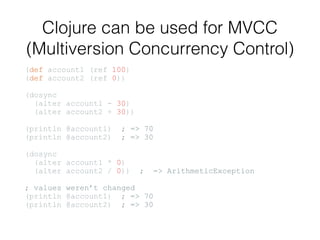
(1) Clojure is a functional programming language that uses parentheses syntax and runs on the JVM; (2) It has features like immutability, concurrency constructs like atoms and agents, and support for functional programming patterns; (3) Clojure can be used for both functional programming and object-oriented programming with records, and has tools for metaprogramming, async programming with core.async, and compiling to JavaScript with ClojureScript.


![Clojure through the eyes of a Java Nut | [Mixed Nuts] at Pramati Technologies](https://cdn.slidesharecdn.com/ss_thumbnails/clojurefpthrougheyesofajavanut-191017124514-thumbnail.jpg?width=640&height=640&fit=bounds)


