Designing for Resiliency
3 Principles
edjez, InSTEDD
Encourage Unexpected Use
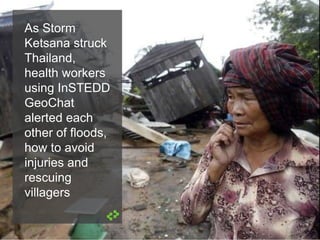
As Storm
Ketsana struck
Thailand,
health workers
using InSTEDD
GeoChat
alerted each
other of floods,
how to avoid
injuries and
rescuing
villagers
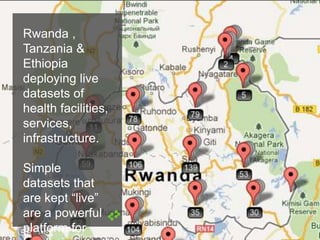
Rwanda ,
Tanzania &
Ethiopia
deploying live
datasets of
health facilities,
services,
infrastructure.
Simple
datasets that
are kept “live”
are a powerful
platform for
Empower the Edge
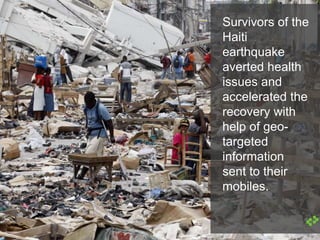
Survivors of the
Haiti
earthquake
averted health
issues and
accelerated the
recovery with
help of geo-
targeted
information
sent to their
mobiles.
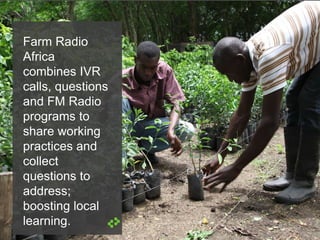
Farm Radio
Africa
combines IVR
calls, questions
and FM Radio
programs to
share working
practices and
collect
questions to
address;
boosting local
learning.
Design for Everyday
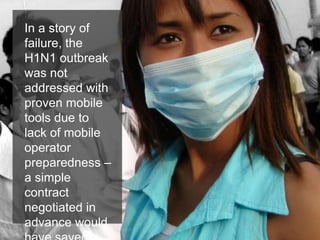
In a story of
failure, the
H1N1 outbreak
was not
addressed with
proven mobile
tools due to
lack of mobile
operator
preparedness –
a simple
contract
negotiated in
advance would
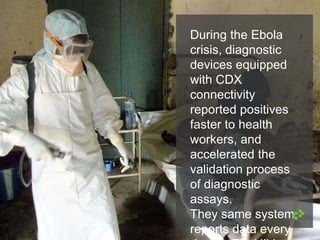
During the Ebola
crisis, diagnostic
devices equipped
with CDX
connectivity
reported positives
faster to health
workers, and
accelerated the
validation process
of diagnostic
assays.
They same system
reports data every
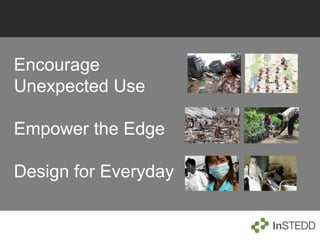
Encourage
Unexpected Use
Empower the Edge
Design for Everyday

Frugal Innovation - Design for Resilience

Editor's Notes

  • #4 Apps they design end up being simple, robust, easy, and multi-use. People USE THEM FOR WHAT THEY FEEL IS RIGHT. For example, a health monitoring tool became the prime LOCAL DISASTER RELIEF NETWORK
  • #10 Health Foo – EARLY DETECTION EARLY RESPONSE Is key to containing outbreaks If people are your first SENSORS AND ACTUATORS, creating LOCAL FEEDBACK LOOPS saves lives You have to LET THEM CREATE THOSE LOOPS