Consumers and clinical handover How consumers can participate in  GP/Hospital handover Russell McGowan 15 April 2011
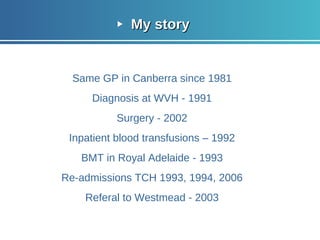
My story Same GP in Canberra since 1981 Diagnosis at WVH - 1991 Surgery - 2002 Inpatient blood transfusions – 1992 BMT in Royal Adelaide - 1993 Re-admissions TCH 1993, 1994, 2006 Referal to Westmead - 2003
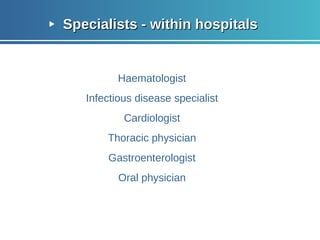
Specialists - within hospitals Haematologist Infectious disease specialist Cardiologist Thoracic physician Gastroenterologist Oral physician
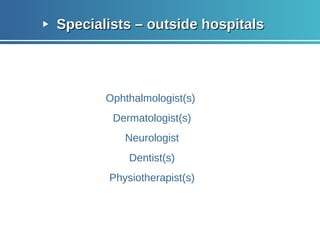
Specialists – outside hospitals Ophthalmologist(s)  Dermatologist(s) Neurologist Dentist(s) Physiotherapist(s)
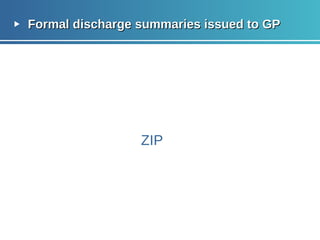
Formal discharge summaries issued to GP ZIP
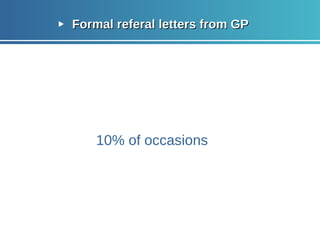
Formal referal letters from GP 10% of occasions
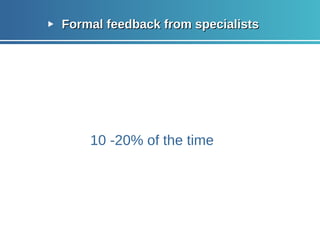
Formal feedback from specialists 10 -20% of the time
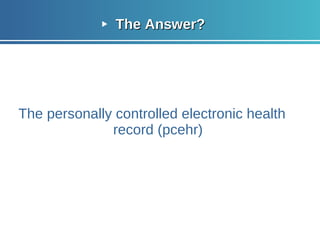
The Answer? The personally controlled electronic health record (pcehr)
Personally Controlled E-Health Records Safer healthcare Improving direct patient care by more timely access to clinical information Capacity to share information more readily Clinical decision support  systems Higher quality healthcare Supports and enables better team base care Supports chronic disease management initiatives  Shares knowledge amongst health professionals Page
E-Health more generally Direct patient care: better, more timely & accurate - Transfer of clinical information Better patient care:  Safety & Quality:- Clinical decision support  Cost savings in terms of less “re-do” of tests and better safety and quality so potentially less unplanned re-admissions Support for chronic condition management Support for team based care / engaging health professions in health care delivery:- Improved sharing of clinical information Management and planning of healthcare services:- improved, accurate, relevant and up to date information. Page
Foundations for e-health Healthcare Identifiers – IHI, HPI-I, HPI-O National Authentication Service for Health (NASH) Secure Messaging Clinical Terminology National Product Catalogue Compliance, Certification & Accreditation  Page
Healthcare Identifiers • Individual Healthcare Identifier (IHI) – for individuals receiving healthcare services. • Healthcare Provider Identifier – Individual (HPI-I) – for healthcare professionals and other health personnel involved in providing patient care.  • Healthcare Provider Identifier – Organisation (HPI-O) – for organisations (such as the hospital or health clinic) where healthcare is provided. Page
Secure messaging Enables connectivity for e-health solutions Needs to form part of contractual arrangements for IT products Hospitals must have contracts with vendors meet NeHTA standards  Vendors must be compliance checked by NATA accredited laboratories Staff must understand what the secure messaging delivers IT breaches must be identified and remediated  Page
Clinical terminology AMT  AMT – Australian Medicines terminology Provides a unique identification regime for medicines in clinical systems to support prescribing, recording, reviewing, supply and administration of medications Extension of SNOMED-CT-AU  Works on a relational model for medications/ingredients Covers all listed TGA products & items listed by the PBS Focus is to define & codify the information care providers need to prescribe medications It does not cover-  devices, special access products, over the counter medications, dietary supplements, alternative medicines, blood products & onsite manufactured medicines  Page
Medications  Current NEHTA work focusing on Electronic Transfer of Prescriptions (ETP) Significant progress in hospitals on e-medication management – decision support Utilisation  of National Medication chart in paper form and electronically Medications must be transferred and displayed in the discharge summary Issues for divisions of general practice accreditation Page
Diagnostic Imaging Radiological images are not strictly part of the medical record, only the report. Access to images are an essential part of care delivery. Where the images are stored in a PACS system it is important that they are accessible for patient care at all hours.  Staff need to be trained on access and retrieval of images from the system, including those from the current episode of care and those from previous episodes of care Page
Pathology  Improvement issues Better clinical decision making – complete information at point of care Efficient practices – tests not needing repeating Improved consumer satisfaction Standardised test names and result formats Collation of appropriate data into meaningful cumulative reports Consumer choice of provider Page
Benefits of eHealth Safe clinical handover Clinical decision support Improved medication management Minimisation of duplicated tests Page
Risks of eHealth Automated duplication of errors Unauthorised disclosures Vendor capture of function Minimal early efficiencies Page
Challenges Consent Privacy Waste Slow uptake  Page
What consumers say they want Page  •  eHealth should improve health outcomes by partnerships between consumers and health professionals Consumers should be informed about eHealth initiatives, including information contained in electronic health records •  Consumers should have access to their own health information •  Consumers should be able to decide who accesses their health information. •  Health information should be held and transferred securely.
Governance that consumers expect Page  Governance of eHealth systems and networks should be transparent and accountable •  Audit and monitoring systems must be in place to protect against privacy breaches, and consumers must be fully informed about any privacy breaches that occur in relation to their information •  Consumers should be able to access independent complaints handling. •  There should be strong penalties for the misuse of consumer information •  Development and operation of eHealth systems must be evaluated – including the impact on consumers .
ACSQHC Commission Programs Australian Charter of Healthcare Rights Open Disclosure Basic Care Issues Healthcare Associated Infection Patient Identification Medication Safety Clinical Handover Patient at   risk Falls Guidelines Tools Accreditation and credentialing Information Strategy
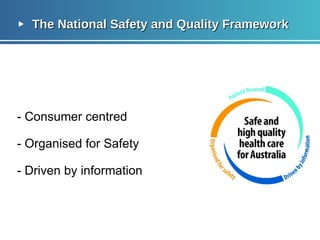
The National Safety and Quality Framework - Consumer centred - Organised for Safety Driven by information

Clinical Handover 2011(Rmcg)

  • 1.
    Consumers and clinicalhandover How consumers can participate in GP/Hospital handover Russell McGowan 15 April 2011
  • 2.
    My story SameGP in Canberra since 1981 Diagnosis at WVH - 1991 Surgery - 2002 Inpatient blood transfusions – 1992 BMT in Royal Adelaide - 1993 Re-admissions TCH 1993, 1994, 2006 Referal to Westmead - 2003
  • 3.
    Specialists - withinhospitals Haematologist Infectious disease specialist Cardiologist Thoracic physician Gastroenterologist Oral physician
  • 4.
    Specialists – outsidehospitals Ophthalmologist(s) Dermatologist(s) Neurologist Dentist(s) Physiotherapist(s)
  • 5.
  • 6.
    Formal referal lettersfrom GP 10% of occasions
  • 7.
    Formal feedback fromspecialists 10 -20% of the time
  • 8.
    The Answer? Thepersonally controlled electronic health record (pcehr)
  • 9.
    Personally Controlled E-HealthRecords Safer healthcare Improving direct patient care by more timely access to clinical information Capacity to share information more readily Clinical decision support systems Higher quality healthcare Supports and enables better team base care Supports chronic disease management initiatives Shares knowledge amongst health professionals Page
  • 10.
    E-Health more generallyDirect patient care: better, more timely & accurate - Transfer of clinical information Better patient care: Safety & Quality:- Clinical decision support Cost savings in terms of less “re-do” of tests and better safety and quality so potentially less unplanned re-admissions Support for chronic condition management Support for team based care / engaging health professions in health care delivery:- Improved sharing of clinical information Management and planning of healthcare services:- improved, accurate, relevant and up to date information. Page
  • 11.
    Foundations for e-healthHealthcare Identifiers – IHI, HPI-I, HPI-O National Authentication Service for Health (NASH) Secure Messaging Clinical Terminology National Product Catalogue Compliance, Certification & Accreditation Page
  • 12.
    Healthcare Identifiers •Individual Healthcare Identifier (IHI) – for individuals receiving healthcare services. • Healthcare Provider Identifier – Individual (HPI-I) – for healthcare professionals and other health personnel involved in providing patient care. • Healthcare Provider Identifier – Organisation (HPI-O) – for organisations (such as the hospital or health clinic) where healthcare is provided. Page
  • 13.
    Secure messaging Enablesconnectivity for e-health solutions Needs to form part of contractual arrangements for IT products Hospitals must have contracts with vendors meet NeHTA standards Vendors must be compliance checked by NATA accredited laboratories Staff must understand what the secure messaging delivers IT breaches must be identified and remediated Page
  • 14.
    Clinical terminology AMT AMT – Australian Medicines terminology Provides a unique identification regime for medicines in clinical systems to support prescribing, recording, reviewing, supply and administration of medications Extension of SNOMED-CT-AU Works on a relational model for medications/ingredients Covers all listed TGA products & items listed by the PBS Focus is to define & codify the information care providers need to prescribe medications It does not cover- devices, special access products, over the counter medications, dietary supplements, alternative medicines, blood products & onsite manufactured medicines Page
  • 15.
    Medications CurrentNEHTA work focusing on Electronic Transfer of Prescriptions (ETP) Significant progress in hospitals on e-medication management – decision support Utilisation of National Medication chart in paper form and electronically Medications must be transferred and displayed in the discharge summary Issues for divisions of general practice accreditation Page
  • 16.
    Diagnostic Imaging Radiologicalimages are not strictly part of the medical record, only the report. Access to images are an essential part of care delivery. Where the images are stored in a PACS system it is important that they are accessible for patient care at all hours. Staff need to be trained on access and retrieval of images from the system, including those from the current episode of care and those from previous episodes of care Page
  • 17.
    Pathology Improvementissues Better clinical decision making – complete information at point of care Efficient practices – tests not needing repeating Improved consumer satisfaction Standardised test names and result formats Collation of appropriate data into meaningful cumulative reports Consumer choice of provider Page
  • 18.
    Benefits of eHealthSafe clinical handover Clinical decision support Improved medication management Minimisation of duplicated tests Page
  • 19.
    Risks of eHealthAutomated duplication of errors Unauthorised disclosures Vendor capture of function Minimal early efficiencies Page
  • 20.
    Challenges Consent PrivacyWaste Slow uptake Page
  • 21.
    What consumers saythey want Page • eHealth should improve health outcomes by partnerships between consumers and health professionals Consumers should be informed about eHealth initiatives, including information contained in electronic health records • Consumers should have access to their own health information • Consumers should be able to decide who accesses their health information. • Health information should be held and transferred securely.
  • 22.
    Governance that consumersexpect Page Governance of eHealth systems and networks should be transparent and accountable • Audit and monitoring systems must be in place to protect against privacy breaches, and consumers must be fully informed about any privacy breaches that occur in relation to their information • Consumers should be able to access independent complaints handling. • There should be strong penalties for the misuse of consumer information • Development and operation of eHealth systems must be evaluated – including the impact on consumers .
  • 23.
    ACSQHC Commission ProgramsAustralian Charter of Healthcare Rights Open Disclosure Basic Care Issues Healthcare Associated Infection Patient Identification Medication Safety Clinical Handover Patient at risk Falls Guidelines Tools Accreditation and credentialing Information Strategy
  • 24.
    The National Safetyand Quality Framework - Consumer centred - Organised for Safety Driven by information