Dr K M Sherrif
Dept. of English
University of Calicut
1. Andre Lefevere
2. Susan Bassnett
3. Mary Snell-Hornby
4. Theo Hermans
5. Lawrence Venuti
6. Michael Cronin
7. Jeremy Munday
8. Anthony Pym
1. Translation as a form of rewriting
2. Translation as a cross-cultural event.
3. Ideology and aesthetics as determining
factors
4. Barriers and Gateways between
cultures
5. Translation facilitates canonization
1. Brings in history and politics
2. Continues the binary of the
 original-translation/rewriting
3. Continues to privilege the original
4. Continues the Systemic Approch of
Polysystemists
1. Gave a theoretical basis to an old
cultural practice.
2. A vaster domain than Translation
Studies
3. Another name for ‘rewriting’?
3. Early attempts which limited studies to
film adaptation.
4. History, politics, ideology, aesthetics –
still the key words.
5. Two new key words: market, medium
1. The ways of adaptation:
abridgement, appropriation,
canibalization, condensation,
dramatization , musical rendering offshoot,
performance, realization, reference,
remediation, rendering, re-telling,,
reworking, rewriting, simplification ,
spinoff, tradaptation, visual rendering,
1. Across genres
2. Across Media
3. Across sign systems (Inter-semiotic)
Telling
Showing
Interacting
1. The ‘original’ is not privileged.
2. The very notion of ‘original’ is
interrogated.
3. Emergence of a new binary:
 Antecedent text(s) – Rewriting/Adaptation
4. Unlimited Intertextuality
1. The play of several intertexts
2. Invoking and reworking several
intertexts.
3. The disappearance of ‘copyright.’
4. Death of the author revisited: SMS
Jokes, Tintumon, free software, computer
games etc.
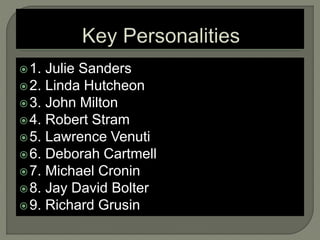
1. Julie Sanders
2. Linda Hutcheon
3. John Milton
4. Robert Stram
5. Lawrence Venuti
6. Deborah Cartmell
7. Michael Cronin
8. Jay David Bolter
9. Richard Grusin
From translation to adaptation

From translation to adaptation

  • 1.
    Dr K MSherrif Dept. of English University of Calicut
  • 2.
    1. Andre Lefevere 2.Susan Bassnett 3. Mary Snell-Hornby 4. Theo Hermans 5. Lawrence Venuti 6. Michael Cronin 7. Jeremy Munday 8. Anthony Pym
  • 3.
    1. Translation asa form of rewriting 2. Translation as a cross-cultural event. 3. Ideology and aesthetics as determining factors 4. Barriers and Gateways between cultures 5. Translation facilitates canonization
  • 4.
    1. Brings inhistory and politics 2. Continues the binary of the  original-translation/rewriting 3. Continues to privilege the original 4. Continues the Systemic Approch of Polysystemists
  • 5.
    1. Gave atheoretical basis to an old cultural practice. 2. A vaster domain than Translation Studies 3. Another name for ‘rewriting’? 3. Early attempts which limited studies to film adaptation. 4. History, politics, ideology, aesthetics – still the key words. 5. Two new key words: market, medium
  • 6.
    1. The waysof adaptation: abridgement, appropriation, canibalization, condensation, dramatization , musical rendering offshoot, performance, realization, reference, remediation, rendering, re-telling,, reworking, rewriting, simplification , spinoff, tradaptation, visual rendering,
  • 7.
    1. Across genres 2.Across Media 3. Across sign systems (Inter-semiotic)
  • 8.
  • 9.
    1. The ‘original’is not privileged. 2. The very notion of ‘original’ is interrogated. 3. Emergence of a new binary:  Antecedent text(s) – Rewriting/Adaptation 4. Unlimited Intertextuality
  • 10.
    1. The playof several intertexts 2. Invoking and reworking several intertexts. 3. The disappearance of ‘copyright.’ 4. Death of the author revisited: SMS Jokes, Tintumon, free software, computer games etc.
  • 11.
    1. Julie Sanders 2.Linda Hutcheon 3. John Milton 4. Robert Stram 5. Lawrence Venuti 6. Deborah Cartmell 7. Michael Cronin 8. Jay David Bolter 9. Richard Grusin