From Re-Identification Risk to Compliance: A Guide
to Data Anonymization
A technical guide for data scientists and compliance officers on mitigating re-identification risks through advanced anonymization
techniques. This presentation will cover the fundamentals of indirect identifiers, key anonymization strategies, and tools for ensuring data
privacy.
Understanding Indirect
Identifiers
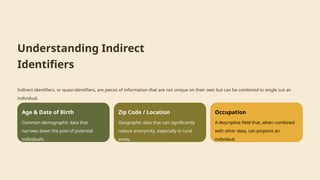
Indirect identifiers, or quasi-identifiers, are pieces of information that are not unique on their own but can be combined to single out an
individual.
Age & Date of Birth
Common demographic data that
narrows down the pool of potential
individuals.
Zip Code / Location
Geographic data that can significantly
reduce anonymity, especially in rural
areas.
Occupation
A descriptive field that, when combined
with other data, can pinpoint an
individual.
Core Anonymization Strategies in IRI
FieldShield
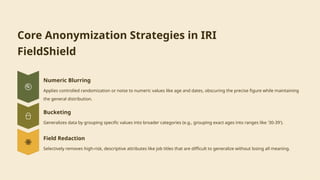
Numeric Blurring
Applies controlled randomization or noise to numeric values like age and dates, obscuring the precise figure while maintaining
the general distribution.
Bucketing
Generalizes data by grouping specific values into broader categories (e.g., grouping exact ages into ranges like '30-39').
Field Redaction
Selectively removes high-risk, descriptive attributes like job titles that are difficult to generalize without losing all meaning.
Technique in Detail: Numeric Blurring &
Bucketing
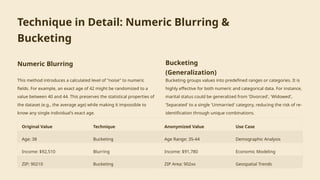
Numeric Blurring
This method introduces a calculated level of "noise" to numeric
fields. For example, an exact age of 42 might be randomized to a
value between 40 and 44. This preserves the statistical properties of
the dataset (e.g., the average age) while making it impossible to
know any single individual's exact age.
Bucketing
(Generalization)
Bucketing groups values into predefined ranges or categories. It is
highly effective for both numeric and categorical data. For instance,
marital status could be generalized from 'Divorced', 'Widowed',
'Separated' to a single 'Unmarried' category, reducing the risk of re-
identification through unique combinations.
Original Value Technique Anonymized Value Use Case
Age: 38 Bucketing Age Range: 35-44 Demographic Analysis
Income: $92,510 Blurring Income: $91,780 Economic Modeling
ZIP: 90210 Bucketing ZIP Area: 902xx Geospatial Trends
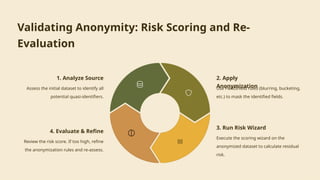
Validating Anonymity: Risk Scoring and Re-
Evaluation
1. Analyze Source
Assess the initial dataset to identify all
potential quasi-identifiers.
2. Apply
Anonymization
Use FieldShield rules (blurring, bucketing,
etc.) to mask the identified fields.
3. Run Risk Wizard
Execute the scoring wizard on the
anonymized dataset to calculate residual
risk.
4. Evaluate & Refine
Review the risk score. If too high, refine
the anonymization rules and re-assess.
Alignment with Differential Privacy
Frameworks
The techniques discussed, such as numeric blurring and generalization, are foundational methods that align with the principles of
differential privacy. Differential privacy provides a mathematical guarantee that the output of an analysis will not significantly change if any
single individual's data is removed. By introducing controlled noise and reducing granularity, IRI's tools help organizations move towards this
gold standard of privacy protection, facilitating compliance with regulations like GDPR and CCPA.
Real-World Applications and
Benefits
Effective data anonymization unlocks the value of sensitive data across various industries, enabling innovation while upholding ethical
standards and legal compliance. By de-risking datasets, organizations can fuel research, enhance marketing strategies, and improve
products safely.
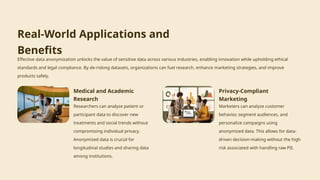
Medical and Academic
Research
Researchers can analyze patient or
participant data to discover new
treatments and social trends without
compromising individual privacy.
Anonymized data is crucial for
longitudinal studies and sharing data
among institutions.
Privacy-Compliant
Marketing
Marketers can analyze customer
behavior, segment audiences, and
personalize campaigns using
anonymized data. This allows for data-
driven decision-making without the high
risk associated with handling raw PII.
Key Takeaways and Next
Steps
By understanding and applying robust anonymization techniques, you can protect individuals, ensure compliance, and continue to derive
value from your data assets.
1 Identify Your Quasi-
Identifiers
Recognize that combined, non-
sensitive data can become highly
sensitive.
2 Choose the Right
Technique
Balance data utility and privacy needs
by selecting appropriate methods like
blurring or bucketing.
3 Validate and Iterate
Use risk scoring tools to measure the
effectiveness of your anonymization
and refine your approach.
Thank You!

From Re-Identification Risk to Compliance: A Guide to Data Anonymization

  • 1.
    From Re-Identification Riskto Compliance: A Guide to Data Anonymization A technical guide for data scientists and compliance officers on mitigating re-identification risks through advanced anonymization techniques. This presentation will cover the fundamentals of indirect identifiers, key anonymization strategies, and tools for ensuring data privacy.
  • 2.
    Understanding Indirect Identifiers Indirect identifiers,or quasi-identifiers, are pieces of information that are not unique on their own but can be combined to single out an individual. Age & Date of Birth Common demographic data that narrows down the pool of potential individuals. Zip Code / Location Geographic data that can significantly reduce anonymity, especially in rural areas. Occupation A descriptive field that, when combined with other data, can pinpoint an individual.
  • 3.
    Core Anonymization Strategiesin IRI FieldShield Numeric Blurring Applies controlled randomization or noise to numeric values like age and dates, obscuring the precise figure while maintaining the general distribution. Bucketing Generalizes data by grouping specific values into broader categories (e.g., grouping exact ages into ranges like '30-39'). Field Redaction Selectively removes high-risk, descriptive attributes like job titles that are difficult to generalize without losing all meaning.
  • 4.
    Technique in Detail:Numeric Blurring & Bucketing Numeric Blurring This method introduces a calculated level of "noise" to numeric fields. For example, an exact age of 42 might be randomized to a value between 40 and 44. This preserves the statistical properties of the dataset (e.g., the average age) while making it impossible to know any single individual's exact age. Bucketing (Generalization) Bucketing groups values into predefined ranges or categories. It is highly effective for both numeric and categorical data. For instance, marital status could be generalized from 'Divorced', 'Widowed', 'Separated' to a single 'Unmarried' category, reducing the risk of re- identification through unique combinations. Original Value Technique Anonymized Value Use Case Age: 38 Bucketing Age Range: 35-44 Demographic Analysis Income: $92,510 Blurring Income: $91,780 Economic Modeling ZIP: 90210 Bucketing ZIP Area: 902xx Geospatial Trends
  • 5.
    Validating Anonymity: RiskScoring and Re- Evaluation 1. Analyze Source Assess the initial dataset to identify all potential quasi-identifiers. 2. Apply Anonymization Use FieldShield rules (blurring, bucketing, etc.) to mask the identified fields. 3. Run Risk Wizard Execute the scoring wizard on the anonymized dataset to calculate residual risk. 4. Evaluate & Refine Review the risk score. If too high, refine the anonymization rules and re-assess.
  • 6.
    Alignment with DifferentialPrivacy Frameworks The techniques discussed, such as numeric blurring and generalization, are foundational methods that align with the principles of differential privacy. Differential privacy provides a mathematical guarantee that the output of an analysis will not significantly change if any single individual's data is removed. By introducing controlled noise and reducing granularity, IRI's tools help organizations move towards this gold standard of privacy protection, facilitating compliance with regulations like GDPR and CCPA.
  • 7.
    Real-World Applications and Benefits Effectivedata anonymization unlocks the value of sensitive data across various industries, enabling innovation while upholding ethical standards and legal compliance. By de-risking datasets, organizations can fuel research, enhance marketing strategies, and improve products safely. Medical and Academic Research Researchers can analyze patient or participant data to discover new treatments and social trends without compromising individual privacy. Anonymized data is crucial for longitudinal studies and sharing data among institutions. Privacy-Compliant Marketing Marketers can analyze customer behavior, segment audiences, and personalize campaigns using anonymized data. This allows for data- driven decision-making without the high risk associated with handling raw PII.
  • 8.
    Key Takeaways andNext Steps By understanding and applying robust anonymization techniques, you can protect individuals, ensure compliance, and continue to derive value from your data assets. 1 Identify Your Quasi- Identifiers Recognize that combined, non- sensitive data can become highly sensitive. 2 Choose the Right Technique Balance data utility and privacy needs by selecting appropriate methods like blurring or bucketing. 3 Validate and Iterate Use risk scoring tools to measure the effectiveness of your anonymization and refine your approach.
  • 9.