High
Medium
Low
Very Low
No data/n.a.
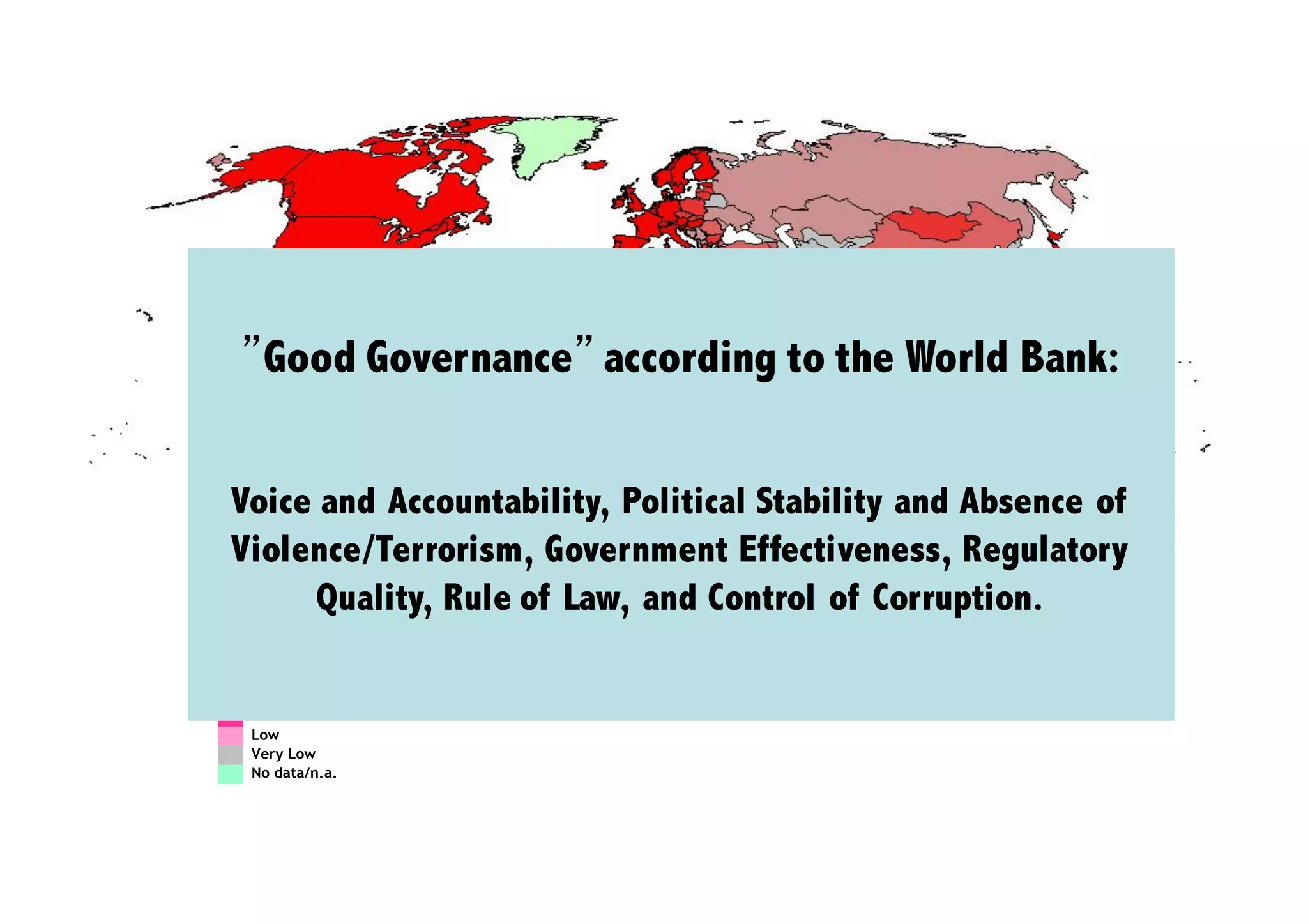
”Good Governance” according to the World Bank:
Voice and Accountability, Political Stability and Absence of
Violence/Terrorism, Government Effectiveness, Regulatory
Quality, Rule of Law, and Control of Corruption.
High
Medium
Low
Very Low
No data/n.a.
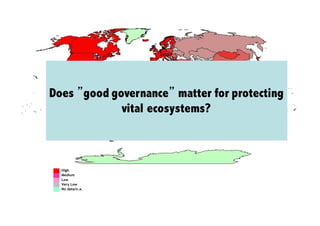
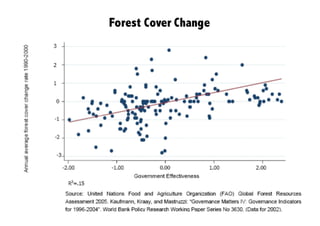
Does ”good governance” matter for protecting
vital ecosystems?
Forest Cover Change
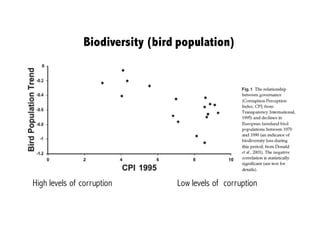
Biodiversity (bird population)
High levels of corruption Low levels of corruption
Spatial misfit
Local institutions vs. global driver/s
Global Fisheries? ”Land grab”?
Municipal institutions vs. Water
catchment
Temporal misfits
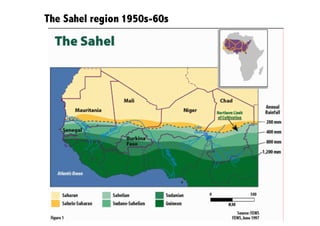
The Sahel region 1950s-60s
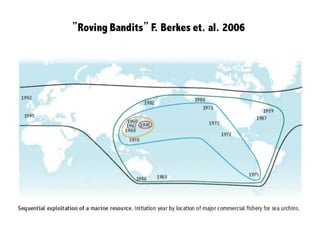
”Roving Bandits” F. Berkes et. al. 2006
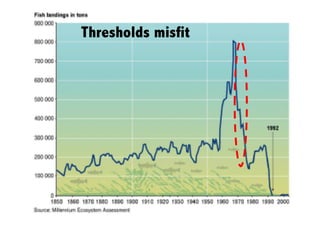
Cod stock collapse, Newfoundland, (Canada)Thresholds misfit
Cascading dynamics and
misfits
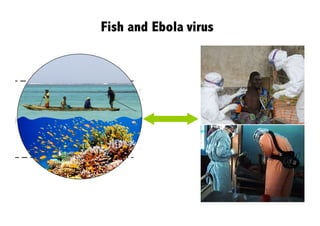
Fish and Ebola virus
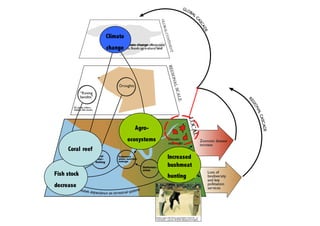
Fish stock
decrease
Increased
bushmeat
hunting
Coral reef
Agro-
ecosystems
Climate
change
Is it at all possible?
Institutions, polycentric order,
social networks, global
governance, bridging
organizations, innovation and
learning in social networks,
transformation.
Difference institutions and governance?
Institutions are ”the rules of the game”.
’Governance’ implies collaborationpatterns,
steering, and coordination at multiple levels.
Institutional in governancetend to be
”clusters” or ”complexes”, rather than simple
set of rules.
Think about how they relate to the dynamics
behavior of SES a.k.a. ”problem of fit”
What is adaptive governance?
“Adaptive governance denote models
of steering, coordination and
information sharing that are able to
respond, and sometimes even
transform systems in the face of
uncertainty, change and surprise.”
(Folke et al. 2005, Dietz et al. 2003).
How is it different from
“adaptive management”?
Adaptive governance differs from “adaptive
management" because the idea of "governance”
conveys the difficulty of control, the need to
proceed in the face of substantial uncertainty, and
the importance of dealing with diversity and
reconciling conflict among people and groups who
differ in values, interests, perspectives, power, and
the kinds of information they bring to situations
(from Dietz et al. 2003, p. 1911).
How is it different from
adaptive co-management?
Adaptive co-management entail flexible
community-based systems of resource management
tailored to specific places and situations, and they
are supported by and work with various
organizations at different levels. (from Folke et al.
2005: 448).
It differs from adaptive governance as the latter is
not necessarily place-bound, and places more
emphasis on theory development and exploration of
the interplay between actors, institutions and social-
ecological dynamics in polycentric settings (Folke et
al. 2005, Galaz et al. 2008) .
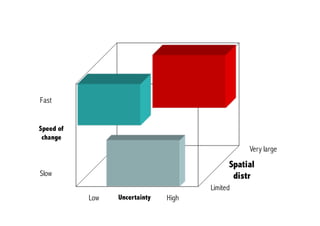
Speed of
change
Fast
Slow
UncertaintyLow High
Spatial
distr
Limited
Very large

From institutions to governance, Part 2

  • 1.
    High Medium Low Very Low No data/n.a. ”GoodGovernance” according to the World Bank: Voice and Accountability, Political Stability and Absence of Violence/Terrorism, Government Effectiveness, Regulatory Quality, Rule of Law, and Control of Corruption.
  • 2.
    High Medium Low Very Low No data/n.a. Does”good governance” matter for protecting vital ecosystems?
  • 3.
  • 4.
    Biodiversity (bird population) Highlevels of corruption Low levels of corruption
  • 6.
    Spatial misfit Local institutionsvs. global driver/s Global Fisheries? ”Land grab”? Municipal institutions vs. Water catchment
  • 7.
  • 8.
  • 9.
    ”Roving Bandits” F.Berkes et. al. 2006
  • 10.
    Cod stock collapse,Newfoundland, (Canada)Thresholds misfit
  • 13.
  • 14.
  • 15.
  • 16.
    Is it atall possible? Institutions, polycentric order, social networks, global governance, bridging organizations, innovation and learning in social networks, transformation.
  • 17.
    Difference institutions andgovernance? Institutions are ”the rules of the game”. ’Governance’ implies collaborationpatterns, steering, and coordination at multiple levels. Institutional in governancetend to be ”clusters” or ”complexes”, rather than simple set of rules. Think about how they relate to the dynamics behavior of SES a.k.a. ”problem of fit”
  • 18.
    What is adaptivegovernance? “Adaptive governance denote models of steering, coordination and information sharing that are able to respond, and sometimes even transform systems in the face of uncertainty, change and surprise.” (Folke et al. 2005, Dietz et al. 2003).
  • 19.
    How is itdifferent from “adaptive management”? Adaptive governance differs from “adaptive management" because the idea of "governance” conveys the difficulty of control, the need to proceed in the face of substantial uncertainty, and the importance of dealing with diversity and reconciling conflict among people and groups who differ in values, interests, perspectives, power, and the kinds of information they bring to situations (from Dietz et al. 2003, p. 1911).
  • 20.
    How is itdifferent from adaptive co-management? Adaptive co-management entail flexible community-based systems of resource management tailored to specific places and situations, and they are supported by and work with various organizations at different levels. (from Folke et al. 2005: 448). It differs from adaptive governance as the latter is not necessarily place-bound, and places more emphasis on theory development and exploration of the interplay between actors, institutions and social- ecological dynamics in polycentric settings (Folke et al. 2005, Galaz et al. 2008) .
  • 21.