G.H PATEL COLLEGE OF ENGINEERING & TECHNOLOGY
ALA OF OOPC(2140705)
COMPUTER DEPARTMENT
ACADEMIC YEAR:2017-18
TOPIC: FRIEND FUNCTION
• Prepared By:
NAME: ENROLLMENT NO:
HEET PATEL 160110107038
UMANG KUNDARIA 160110107023
WHAT IS FRIEND FUNCTION ?
• A Friend function is a non-member function of the class that has been granted
access to all private members of the class.
• We simply declare the function within the class by a prefixing its declaration
with keyword friend.
• Function definition must not use keyword friend.
• Definition of friend function is specified outside the class body and is not treated
as a part of the class.
• The major difference b/w member function and friend function is that the
member function is accessed through the object while friend function requires
object to be passed as parameter.
WHY IT IS NEEDED ?
• You have access privileges in C++ such as public, protected and private that helps in
encapsulation of data at various level.
• Private
• If data are declared as private in a class then it is accessible by the member functions of the
class where they are declared.
• The private member functions can be accessed only by the members of the class. By default,
any member of the class is considered as private by the C+ + compiler, if no specifier is
declared for the member.
Public:
• The member functions with public access specifier can be accessed outside of the class. This
kind of members is accessed by creating instance of the cass.
Protected
• Protected members are accessible by the class itself and it's subclasses.
• The members with protected specifier act exactly like private as long as they are referenced
within the class or from the instance of the class. This specifier specially used when you
need to use inheritance facility of C++. The protected members become private of a child
class in case of private inheritance, public in case of public inheritance, and stay protected in
case of protected inheritance.
• When we want our private data to be shared by a non member function Then:
• Basically, we declare something as a friend, you give it access to your private data members.
• Single functions or entire classes may be declared as friends of a class.
• Syntax:
• class ABC
• {
………….
public:
friend void xyz(object of class);
};
CHARACTERICS OF FRIEND FUNCTION:
• It is not in scope of class.
• It cannot be called using object of that class.
• It can be invoked like a normal function.
• It should use a dot operator for accessing members.
• It can be public or private.
• It has objects as arguments.
• Perhaps the most common use of friend functions is overloading << and >> for I/O.
EXAMPLE:
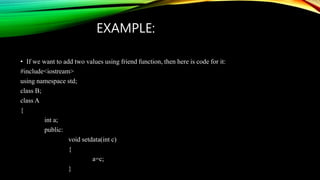
• If we want to add two values using friend function, then here is code for it:
#include<iostream>
using namespace std;
class B;
class A
{
int a;
public:
void setdata(int c)
{
a=c;
}
friend void sum();
};
class B
{
int b;
public:
void getdata(int d)
{
b=d;
}
friend void sum();
};
void sum(A c1,B c2)
{
int c;
c=c1.a+c2.b;
cout<<“Sum of two values is:<<c;
}
int main()
{
A a;
B b;
a.setdata(4);
b.getdata(5);
sum(a,b);
return 0;
}
THANK YOU..!!

Friend function

  • 1.
    G.H PATEL COLLEGEOF ENGINEERING & TECHNOLOGY ALA OF OOPC(2140705) COMPUTER DEPARTMENT ACADEMIC YEAR:2017-18
  • 2.
    TOPIC: FRIEND FUNCTION •Prepared By: NAME: ENROLLMENT NO: HEET PATEL 160110107038 UMANG KUNDARIA 160110107023
  • 3.
    WHAT IS FRIENDFUNCTION ? • A Friend function is a non-member function of the class that has been granted access to all private members of the class. • We simply declare the function within the class by a prefixing its declaration with keyword friend. • Function definition must not use keyword friend. • Definition of friend function is specified outside the class body and is not treated as a part of the class. • The major difference b/w member function and friend function is that the member function is accessed through the object while friend function requires object to be passed as parameter.
  • 4.
    WHY IT ISNEEDED ? • You have access privileges in C++ such as public, protected and private that helps in encapsulation of data at various level. • Private • If data are declared as private in a class then it is accessible by the member functions of the class where they are declared. • The private member functions can be accessed only by the members of the class. By default, any member of the class is considered as private by the C+ + compiler, if no specifier is declared for the member.
  • 5.
    Public: • The memberfunctions with public access specifier can be accessed outside of the class. This kind of members is accessed by creating instance of the cass. Protected • Protected members are accessible by the class itself and it's subclasses. • The members with protected specifier act exactly like private as long as they are referenced within the class or from the instance of the class. This specifier specially used when you need to use inheritance facility of C++. The protected members become private of a child class in case of private inheritance, public in case of public inheritance, and stay protected in case of protected inheritance.
  • 6.
    • When wewant our private data to be shared by a non member function Then: • Basically, we declare something as a friend, you give it access to your private data members. • Single functions or entire classes may be declared as friends of a class. • Syntax: • class ABC • { …………. public: friend void xyz(object of class); };
  • 7.
    CHARACTERICS OF FRIENDFUNCTION: • It is not in scope of class. • It cannot be called using object of that class. • It can be invoked like a normal function. • It should use a dot operator for accessing members. • It can be public or private. • It has objects as arguments. • Perhaps the most common use of friend functions is overloading << and >> for I/O.
  • 8.
    EXAMPLE: • If wewant to add two values using friend function, then here is code for it: #include<iostream> using namespace std; class B; class A { int a; public: void setdata(int c) { a=c; }
  • 9.
    friend void sum(); }; classB { int b; public: void getdata(int d) { b=d; } friend void sum(); };
  • 10.
    void sum(A c1,Bc2) { int c; c=c1.a+c2.b; cout<<“Sum of two values is:<<c; } int main() { A a; B b; a.setdata(4); b.getdata(5); sum(a,b); return 0; }
  • 11.