Frida Kahlo 1907-1954
Frida Kahlo was born on July 6, 1907, in
Coyoacan, a suburb of Mexico City. When
she was six years old she contracted polio
which left her with a deformed right foot
and the cruel nickname, “Peg-leg Frida”.
Her original ambition was to be a doctor
but a streetcar accident in 1925 left her
disabled and changed the path of her life.
It was after this accident that Kahlo began
to paint in order to relieve the boredom
during her convalescence.
Frida Kahlo underwent more than thirty
operations in the course of her life, and
most of her paintings relate to her
experiences with physical and
psychological suffering.
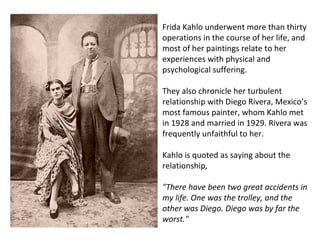
They also chronicle her turbulent
relationship with Diego Rivera, Mexico’s
most famous painter, whom Kahlo met
in 1928 and married in 1929. Rivera was
frequently unfaithful to her.
Kahlo is quoted as saying about the
relationship,
"There have been two great accidents in
my life. One was the trolley, and the
other was Diego. Diego was by far the
worst."
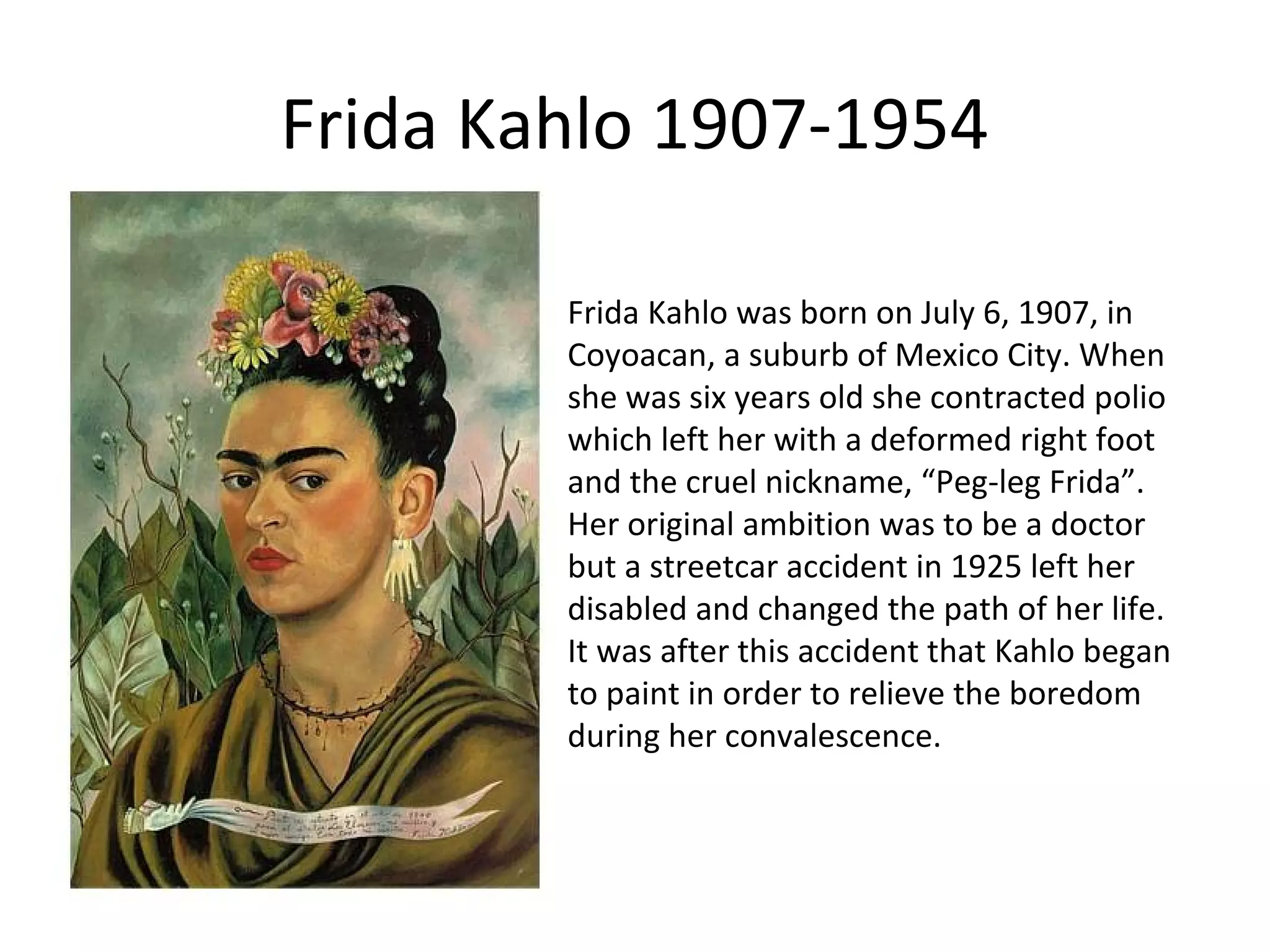
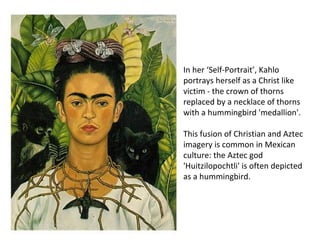
In her ‘Self-Portrait’, Kahlo
portrays herself as a Christ like
victim - the crown of thorns
replaced by a necklace of thorns
with a hummingbird 'medallion'.
This fusion of Christian and Aztec
imagery is common in Mexican
culture: the Aztec god
'Huitzilopochtli' is often depicted
as a hummingbird.
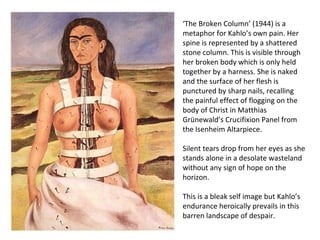
‘The Broken Column’ (1944) is a
metaphor for Kahlo’s own pain. Her
spine is represented by a shattered
stone column. This is visible through
her broken body which is only held
together by a harness. She is naked
and the surface of her flesh is
punctured by sharp nails, recalling
the painful effect of flogging on the
body of Christ in Matthias
Grünewald’s Crucifixion Panel from
the Isenheim Altarpiece.
Silent tears drop from her eyes as she
stands alone in a desolate wasteland
without any sign of hope on the
horizon.
This is a bleak self image but Kahlo’s
endurance heroically prevails in this
barren landscape of despair.
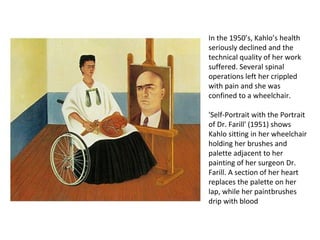
In the 1950’s, Kahlo’s health
seriously declined and the
technical quality of her work
suffered. Several spinal
operations left her crippled
with pain and she was
confined to a wheelchair.
'Self-Portrait with the Portrait
of Dr. Farill' (1951) shows
Kahlo sitting in her wheelchair
holding her brushes and
palette adjacent to her
painting of her surgeon Dr.
Farill. A section of her heart
replaces the palette on her
lap, while her paintbrushes
drip with blood
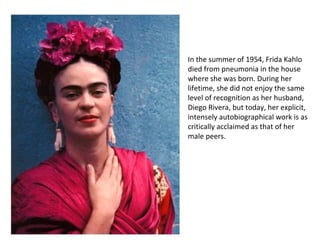
In the summer of 1954, Frida Kahlo
died from pneumonia in the house
where she was born. During her
lifetime, she did not enjoy the same
level of recognition as her husband,
Diego Rivera, but today, her explicit,
intensely autobiographical work is as
critically acclaimed as that of her
male peers.
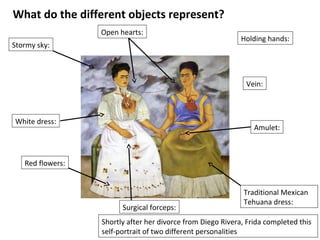
Stormy sky:
White dress:
Red flowers:
Surgical forceps:
Traditional Mexican
Tehuana dress:
Open hearts:
Amulet:
Holding hands:
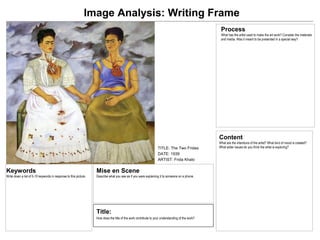
Shortly after her divorce from Diego Rivera, Frida completed this
self-portrait of two different personalities
Vein:
What do the different objects represent?
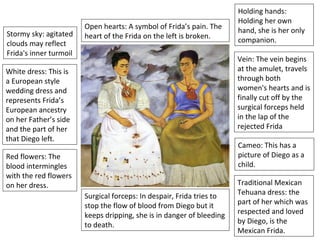
Stormy sky: agitated
clouds may reflect
Frida's inner turmoil
White dress: This is
a European style
wedding dress and
represents Frida’s
European ancestry
on her Father’s side
and the part of her
that Diego left.
Red flowers: The
blood intermingles
with the red flowers
on her dress.
Surgical forceps: In despair, Frida tries to
stop the flow of blood from Diego but it
keeps dripping, she is in danger of bleeding
to death.
Traditional Mexican
Tehuana dress: the
part of her which was
respected and loved
by Diego, is the
Mexican Frida.
Open hearts: A symbol of Frida’s pain. The
heart of the Frida on the left is broken.
Cameo: This has a
picture of Diego as a
child.
Holding hands:
Holding her own
hand, she is her only
companion.
Vein: The vein begins
at the amulet, travels
through both
women's hearts and is
finally cut off by the
surgical forceps held
in the lap of the
rejected Frida
Mise en Scene
Describe what you see as if you were explaining it to someone on a phone.
Process
What has the artist used to make the art work? Consider the materials
and media. Was it meant to be presented in a special way?
Keywords
Write down a list of 5-10 keywords in response to this picture:
Image Analysis: Writing Frame
TITLE: The Two Fridas
DATE: 1939
ARTIST: Frida Khalo
Title:
How does the title of the work contribute to your understanding of the work?
Content
What are the intentions of the artist? What kind of mood is created?
What wider issues do you think the artist is exploring?
Content
What are Kahlo’s intentions in this piece? There may be more than one.
‘PEC’ each intention.
Frida Khalo intended to…
She did this by… (describe something in the image)
She wanted us to think / react …
What wider social, political or cultural issues was the Frida Kahlo
addressing?
Frida Kahlo is considering ______ in this piece of work.
This is shown by _____
She wanted to explore _____
How do the materials and techniques used by the Kahlo
contribute to the work and her intentions?
Frida Kahlo has used ______ in creating this work.
This creates a ______ effect.
This helps to support Kahlo’s point about _____
P
E
C
P
E
C
P
E
C

Frida Khalo

  • 1.
    Frida Kahlo 1907-1954 FridaKahlo was born on July 6, 1907, in Coyoacan, a suburb of Mexico City. When she was six years old she contracted polio which left her with a deformed right foot and the cruel nickname, “Peg-leg Frida”. Her original ambition was to be a doctor but a streetcar accident in 1925 left her disabled and changed the path of her life. It was after this accident that Kahlo began to paint in order to relieve the boredom during her convalescence.
  • 2.
    Frida Kahlo underwentmore than thirty operations in the course of her life, and most of her paintings relate to her experiences with physical and psychological suffering. They also chronicle her turbulent relationship with Diego Rivera, Mexico’s most famous painter, whom Kahlo met in 1928 and married in 1929. Rivera was frequently unfaithful to her. Kahlo is quoted as saying about the relationship, "There have been two great accidents in my life. One was the trolley, and the other was Diego. Diego was by far the worst."
  • 3.
    In her ‘Self-Portrait’,Kahlo portrays herself as a Christ like victim - the crown of thorns replaced by a necklace of thorns with a hummingbird 'medallion'. This fusion of Christian and Aztec imagery is common in Mexican culture: the Aztec god 'Huitzilopochtli' is often depicted as a hummingbird.
  • 4.
    ‘The Broken Column’(1944) is a metaphor for Kahlo’s own pain. Her spine is represented by a shattered stone column. This is visible through her broken body which is only held together by a harness. She is naked and the surface of her flesh is punctured by sharp nails, recalling the painful effect of flogging on the body of Christ in Matthias Grünewald’s Crucifixion Panel from the Isenheim Altarpiece. Silent tears drop from her eyes as she stands alone in a desolate wasteland without any sign of hope on the horizon. This is a bleak self image but Kahlo’s endurance heroically prevails in this barren landscape of despair.
  • 5.
    In the 1950’s,Kahlo’s health seriously declined and the technical quality of her work suffered. Several spinal operations left her crippled with pain and she was confined to a wheelchair. 'Self-Portrait with the Portrait of Dr. Farill' (1951) shows Kahlo sitting in her wheelchair holding her brushes and palette adjacent to her painting of her surgeon Dr. Farill. A section of her heart replaces the palette on her lap, while her paintbrushes drip with blood
  • 6.
    In the summerof 1954, Frida Kahlo died from pneumonia in the house where she was born. During her lifetime, she did not enjoy the same level of recognition as her husband, Diego Rivera, but today, her explicit, intensely autobiographical work is as critically acclaimed as that of her male peers.
  • 7.
    Stormy sky: White dress: Redflowers: Surgical forceps: Traditional Mexican Tehuana dress: Open hearts: Amulet: Holding hands: Shortly after her divorce from Diego Rivera, Frida completed this self-portrait of two different personalities Vein: What do the different objects represent?
  • 8.
    Stormy sky: agitated cloudsmay reflect Frida's inner turmoil White dress: This is a European style wedding dress and represents Frida’s European ancestry on her Father’s side and the part of her that Diego left. Red flowers: The blood intermingles with the red flowers on her dress. Surgical forceps: In despair, Frida tries to stop the flow of blood from Diego but it keeps dripping, she is in danger of bleeding to death. Traditional Mexican Tehuana dress: the part of her which was respected and loved by Diego, is the Mexican Frida. Open hearts: A symbol of Frida’s pain. The heart of the Frida on the left is broken. Cameo: This has a picture of Diego as a child. Holding hands: Holding her own hand, she is her only companion. Vein: The vein begins at the amulet, travels through both women's hearts and is finally cut off by the surgical forceps held in the lap of the rejected Frida
  • 9.
    Mise en Scene Describewhat you see as if you were explaining it to someone on a phone. Process What has the artist used to make the art work? Consider the materials and media. Was it meant to be presented in a special way? Keywords Write down a list of 5-10 keywords in response to this picture: Image Analysis: Writing Frame TITLE: The Two Fridas DATE: 1939 ARTIST: Frida Khalo Title: How does the title of the work contribute to your understanding of the work? Content What are the intentions of the artist? What kind of mood is created? What wider issues do you think the artist is exploring?
  • 10.
    Content What are Kahlo’sintentions in this piece? There may be more than one. ‘PEC’ each intention. Frida Khalo intended to… She did this by… (describe something in the image) She wanted us to think / react … What wider social, political or cultural issues was the Frida Kahlo addressing? Frida Kahlo is considering ______ in this piece of work. This is shown by _____ She wanted to explore _____ How do the materials and techniques used by the Kahlo contribute to the work and her intentions? Frida Kahlo has used ______ in creating this work. This creates a ______ effect. This helps to support Kahlo’s point about _____ P E C P E C P E C

Editor's Notes

  • #9 After returning home from an exhibit in paris, Kahlo divorced Diego Rivera. This painting illustrates a literal split between her two selves is from this period of turmoil and self-doubt. On the right of the painting is the Mexican Frida in traditional clothing. Whilst on the left there is an image of a European Frida in a colonial white dress which I think is intended to be a wedding garb (as its similar to her mothers wedding dress in “Family Tree”). In this image the two women are sitting on a green bench holding hands. The anotomy of their hearts is superimposed on them both; the European self is seen through a hole in her dress at the breast. A blood line originates at the cameo of Diego as a child held by the Frida on the right. This twines between them both and is ultimately terminated by a medical implement held by Frida on the left, whilst blood stains with red flowers intermingle at the hem of the dress. The clouds and look on the two Frida’s faces are juxtaposed with the graphic medical imagery to illustrate her internal conflict. The blood also shows us her pain she went through during all her miscarriages and abortions.Kahlo’s work often refers to powerful mythologies of Mexican identity; the Tehuana woman represented for Kahlo a new positive future of a postcolonial state. The political message of this painting suggests that through adopting an anti-colonial position, a healing of the pains of the past can take place. In the analogy of self and nation, Kahlo characterises her own emotional and physical problems as symptomatic of the post-colonial condition. Thus the European-style wedding gown and the Tehuana dress of the ‘The Two Fridas’ reflect ideological positions as much as the historical realities of Mexico’s past. The famous painting is currently at the San Francisco Museum of Modern Art.Frida Kahlo lived in a society that allowed her to aspire to be a listening wife and ideal mother. She used her weak points, her realization in life to gather more strength and stand up from every fall and produce one of the most valuable feminist paintings I have ever seen. Colour was used to provide distinction between the two Fridas. The historical context helped in unveiling the semiotics lying within the artwork. The premises of art were all inscribed in a circle of real-life experiences, stating that this artwork is the outcome of the feelings evoked by an unfortunate women who only dreamed of becoming a wonderful person in her lifetime – which she achieved on her death. Frida Kahlo herself is considered by many as a symbol of strong will, headship and rough individuality.