Disclaimer: The information on this page has not been checked by an independent person. Use this
information at your own risk.
ROYMECH
Home
Tribology_Index
Friction FactorsFriction FactorsFriction FactorsFriction Factors
Note: I have tried to include a wide range of relevant information on this topic. It will be noted that friction values in one
section do not necessarily agree with values in another section...Please use the linked references at the bottom of the
page for more detailed information.
Factors Affecting friction..... Static Friction..... Sliding/dynamic/kinetic friction..... Coefficients of Friction..... Rolling
Friction..... Plain Bearings Friction.....
Rolling Bearing Friction..... Clutch Brake Friction..... Bolted Joints..... Power Screws..... Press Fits.... Test Methods....
Linked Reference Info
Factors affecting the friction between surfacesFactors affecting the friction between surfacesFactors affecting the friction between surfacesFactors affecting the friction between surfaces
Dry surfaces
1. For low surface pressures the friction is directly proportional to the pressure between the surfaces. As the
pressure rises the friction factor rises slightly. At very high pressure the friction factor then quickly increases to
seizing
2. For low surface pressures the coefficient of friction is independent of surface area.
3. At low velocities the friction is independent of the relative surface velocity. At higher velocities the coefficent of
friction decreases.
Well lubricated surfaces
1. The friction resistance is almost independent of the specific pressure between the surfaces.
2. At low pressures the friction varies directly as the relative surface speed
3. At high pressures the friction is high at low velocities falling as the velocity increases to a minimum at about
0,6m/s. The friction then rises in proportion the velocity 2
.
4. The friction is not so dependent of the surface materials
5. The friction is related to the temperature which affects the viscosity of the lubricant
Surface Friction Notes
Static Coefficient of FrictionStatic Coefficient of FrictionStatic Coefficient of FrictionStatic Coefficient of Friction
The static friction coefficient (µ) between two solid surfaces is defined as the ratio of the tangential force (F) required to
produce sliding divided by the normal force between the surfaces (N)
µ = F /N
For a horizontal surface the horizontal force (F) to move a solid resting on a flat surface
F= µ x mass of solid x g.
If a body rests on an incline plane the body is prevented from sliding down because of the frictional resistance. If the
angle of the plane is increased there will be an angle at which the body begins to slide down the plane. This is the angle
of repose and the tangent of this angle is the same as the coefficient of friction.
.
SlSlSlSliding Coefficient of Frictioniding Coefficient of Frictioniding Coefficient of Frictioniding Coefficient of Friction
When the tangential force F overcomes the frictional force between two surfaces then the surfaces begins to slide relative
to each other. In the case of a body resting on a flat surface the body starts to move. The sliding frictional resistance is
normally different to the static frictional resistance. The coefficient of sliding friction is expressed using the same formula
as the static coefficient and is generally lower than the static coefficient of friction..
Friction CoefficientsFriction CoefficientsFriction CoefficientsFriction Coefficients
A table below shows approximate friction coefficients for various materials. All values are approximate and are only
suitable for guidance only. The sliding/lubricated values must be used with extreme care. The only way to determine
the accurate coefficient of friction between two materials is to conduct experiments.
Coefficients of friction are sensitive to atmospheric dust and humidity, oxide films, surface finish, velocity of sliding,
temperature, vibration, and extent of contamination. In many cases the degree of contamination is perhaps the most
important single variable.. Link Table of Coefficients of Friction
The friction values provided are obtained by different test methods under different ambient conditions. This factor can also
affect the results. Link Test Methods
Rolling FrictionRolling FrictionRolling FrictionRolling Friction
When a cylinder rolls on a surface the force resisting motion is termed rolling friction. Rolling friction is generally
considerably less than sliding friction. If W is the weight of the cylinder converted to force, or the force between the
cylinder and the flat surface, and R is radius of the cylinder and F is the force required to overcome the rolling friction then.
F = f x W/R
f is the coefficient of rolling friction and has the same unit of length as the radius R -in the example below m (metres)
Typical values for f are listed below
Note: Values for rolling friction from various sources are not consistent and the following values should only be used for
approximate calculations.
• Steel on Steel f = 0,0005m
• Wood on Steel f = 0,0012m
• Wood on Wood f = 0,0015m
• Iron on iron f = 0,00051m
• Iron on granite f = 0,0021m
• Iron on Wood f = 0,0056m
• Polymer of steel f = 0,002m
• Hardrubber on Steel f = 0,0077m
• Hardrubber on Concrete f = 0,01 -0,02m
• Rubber on Concrete f = 0,015 -0,035m
Plain Bearing Friction factorsPlain Bearing Friction factorsPlain Bearing Friction factorsPlain Bearing Friction factors
For values of rolling bearing friction Plain Bearing Friction Values
Rolling Bearing FrictionRolling Bearing FrictionRolling Bearing FrictionRolling Bearing Friction
For values of rolling bearing friction Rolling Bearing Friction Values
ClutchClutchClutchClutch ---- Brake Friction ValuesBrake Friction ValuesBrake Friction ValuesBrake Friction Values
The coefficient of friction value is important in the design and brakes and clutches.
Various values are provided on the following linked page Clutch/Brake Materials
FrictiFrictiFrictiFriction coefficient Bolted Jointson coefficient Bolted Jointson coefficient Bolted Jointson coefficient Bolted Joints
The coefficient of friction is required in calculating tightening torques and resulting bolt tensile forces and stress and in
calculating the resulting friction between the connected surfaces. Below are provided a small number of values showing
approximate values of friction coefficients to be used for steel screw fastened connections. The values are only
representative values and should be confirmed against other sources of information and preferably testing.
Coefficient of Friction for screw threads
Female Thread -Nut or Tapped Hole in steel(untreated)
Male screw
Friction Coefficient
(Dry)
Friction Coefficient
(lub)
Untreated Steel 0,12 - 0,18 0,10 - 0,17
Phosphated Steel 0,12 - 0,18 0,10 - 0,17
Cadmium Plated
Steel
0,09 - 0,14 0,08 -0,23
Galvanised steel 0,14 - 0,23 0,12 - 0,2
Degreased steel 0,19 - 0,25
Female Thread -Nut or Tapped Hole in steel(Galvanised)
Male screw
Friction Coeffient
(Dry)
Friction
Coefficient(Lub.)
Untreated Steel 0,14 - 0,2 0,12 - 0,18
Phosphated Steel 0,14 - 0,2 0,12 - 0,18
Cadmium Plated
Steel
0,1 - 0,16 0,09 - 0,15
Galvanised steel 0,14 - 0,25 0,12 - 0,2
Degreased steel 0,19 - 0,25
Coefficient of Friction Nut/Bolt Face against Clamped surface
Clamped Surface = Steel
Bolt/Nut Mat'l
Friction Coeffient
(Dry)
Friction
Coefficient(Lub.)
Untreated Steel 0,10 - 0,18 0,08 - 0.15
Phosphated Steel 0,10 - 0,18 0,08 - 0,15
Galvanised steel 0,10 - 0,2 0,09 - 0,18
Clamped Surface -Galvanised Steel
Bolt/Nut Mat'l
Friction Coefficient
(Dry)
Friction Coefficient
(lub)
Untreated Steel 0,10 - 0,18 0,08 - 0,15
Phosphated Steel 0,10 - 0,18 0,08 - 0,15
Galvanised steel 0,16 - 0,22 0,09 - 0,18
Coefficient of friction between surfaces clamped by bolts /screws.
These values allow calculation of the shear force necessary to cause slip between surfaces when clamped by bolts.
Contact Surfaces slip coefficient
Steel On Steel- No treatment 0,15- 0,25
Steel On Cast Iron- No treatment 0,18 - 0,3
Steel On Steel- Machined (Degreased) 0,12- 0,18
Steel On Cast Iron- Machined (Degreased) 0,15 - 0,25
Grit -Sandblasted surfaces 0,48 - 0,55
Friction Factors for Power ScrewsFriction Factors for Power ScrewsFriction Factors for Power ScrewsFriction Factors for Power Screws
The following factors are typical friction factors for power screw torque and efficiency calculations..
1) Screw Thread Friction values (µs)
(Friction factors apply mainly for screw thread friction (µs) - can be applied to collar friction(µc)
Nut Material
Screw Material
Steel Brass Bronze
Cast
Iron
Steel(Dry)
0,15-
0,25
0,15-
0,23
0,15-
0,19
0,15-
0,25
Steel (Lubricated)
0,11-
0,17
0,10-
0,16
0,10-
0,15
0,11-
0,17
Bronze (Lubricated)
0,08-
0,12
0,04-
0,06
-
0,06-
0,09
2) Thrust collar Friction values (µc)
Surface Combinations Moving Starting
Soft Steel on Cast Iron 0,12 0,17
Hard Steel on Cast Iron 0,09 0,15
Soft Steel on Bronze 0,08 0,10
Hard Steel on Bronze 0,06 0,08
Press Fit Mechanical JointsPress Fit Mechanical JointsPress Fit Mechanical JointsPress Fit Mechanical Joints
In mechanical engineering rotary motion can be transferred by mechanical connections between a shaft and hub using
only a tight fit. Methods of achieving this type of connection include the engineered interference fit, the taper lock bush
and hydraulic fit bush. These keyless shaft/hub connections all transfer torque by friction.
The coefficient of friction used for designing these types of connections is dependent on the interface pressure, materials,
surface condition, surface coatings etc. The coefficient of friction is also dependent on the method of installation. A
different value result if the shaft is forced into the hub (force fit) compared to the value if the assemble is completed by
heating the hub or freezing the shaft prior to assembly (shrink fit)...
Various values of relevant coefficients of friction are provided below;
• Steel Hub , Steel Shaft unlubricated - force fit ...C. of Friction = 0,07 to 0,16
• Steel Hub , Steel Shaft greased - force fit ...C. of Friction = 0,05 to 0,12
• Steel Hub , Steel Shaft unlubricated - Shrink fit ...C. of Friction = 0,15 to 0,25
• Steel Hub , Steel Shaft greased - Shrink fit ...C. of Friction = 0,08 to 0,16
The manufacturers of the proprietary keyless hub/shaft systems indicate that their products are based on a coefficient of
friction of 0,12 for lightly oiled connections and 0,15 for dry assemblies. These companies can provide surface coating
fluids containing particles to increase theie coefficient of friction to 0,25 to 0,3. (ref links 1 & 2 below)
The American Gear Manufactures Association (AGMA) recommends a value of between 0,12-0,15 for hydraulically
expanded hubs and 0,15-0,20 for shrink or press fit hubs.
Testing MethoTesting MethoTesting MethoTesting Methodsdsdsds
There are a number of test methods for coefficient of frictions as some of which are listed below
• Flat block pressed against a OD of rotating ring (FOR)
• Flat block against another flat block (FOF)
• Flat block sliding down an inclined runway(IS)
• Pin pressed against a OD of rotating ring (POR
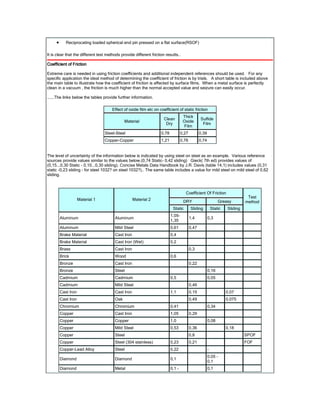
• Reciprocating loaded spherical end pin pressed on a flat surface(RSOF)
It is clear that the different test methods provide different friction results..
Coefficient of FrictionCoefficient of FrictionCoefficient of FrictionCoefficient of Friction
Extreme care is needed in using friction coefficients and additional independent references should be used. For any
specific application the ideal method of determining the coefficient of friction is by trials. A short table is included above
the main table to illustrate how the coefficient of friction is affected by surface films. When a metal surface is perfectly
clean in a vacuum , the friction is much higher than the normal accepted value and seizure can easily occur.
......The links below the tables provide further information.
Effect of oxide film etc on coefficient of static friction
Material
Clean
Dry
Thick
Oxide
Film
Sulfide
Film
Steel-Steel 0,78 0,27 0,39
Copper-Copper 1,21 0,76 0,74
The level of uncertainty of the information below is indicated by using steel on steel as an example. Various reference
sources provide values similar to the values below.(0,74 Static- 0,42 sliding) Gieck( 7th ed) provides values of
(0,15...0,30 Static - 0,10...0,30 sliding). Concise Metals Data Handbook by J.R. Davis (table 14,1) includes values (0,31
static -0,23 sliding - for steel 1032? on steel 1032?).. The same table includes a value for mild steel on mild steel of 0,62
sliding.
Coefficient Of Friction
DRY GreasyMaterial 1 Material 2
Static Sliding Static Sliding
Test
method
Aluminum Aluminum
1,05-
1,35
1,4 0,3
Aluminum Mild Steel 0,61 0,47
Brake Material Cast Iron 0,4
Brake Material Cast Iron (Wet) 0,2
Brass Cast Iron 0,3
Brick Wood 0,6
Bronze Cast Iron 0,22
Bronze Steel 0,16
Cadmium Cadmium 0,5 0,05
Cadmium Mild Steel 0,46
Cast Iron Cast Iron 1,1 0,15 0,07
Cast Iron Oak 0,49 0,075
Chromium Chromium 0,41 0,34
Copper Cast Iron 1,05 0,29
Copper Copper 1,0 0,08
Copper Mild Steel 0,53 0,36 0,18
Copper Steel 0,8 SPOF
Copper Steel (304 stainless) 0,23 0,21 FOF
Copper-Lead Alloy Steel 0,22 -
Diamond Diamond 0,1
0,05 -
0,1
Diamond Metal 0,1 - 0,1
0,15
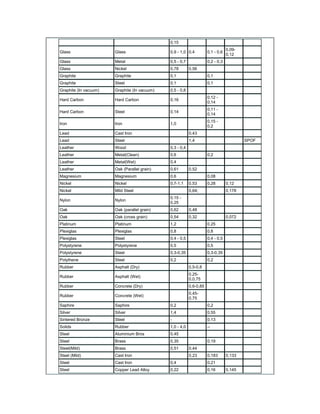
Glass Glass 0,9 - 1,0 0,4 0,1 - 0,6
0,09-
0,12
Glass Metal 0,5 - 0,7 0,2 - 0,3
Glass Nickel 0,78 0,56
Graphite Graphite 0,1 0,1
Graphite Steel 0,1 0,1
Graphite (In vacuum) Graphite (In vacuum) 0,5 - 0,8
Hard Carbon Hard Carbon 0,16
0,12 -
0,14
Hard Carbon Steel 0,14
0,11 -
0,14
Iron Iron 1,0
0,15 -
0,2
Lead Cast Iron 0,43
Lead Steel 1,4 SPOF
Leather Wood 0,3 - 0,4
Leather Metal(Clean) 0,6 0,2
Leather Metal(Wet) 0,4
Leather Oak (Parallel grain) 0,61 0,52
Magnesium Magnesium 0,6 0,08
Nickel Nickel 0,7-1,1 0,53 0,28 0,12
Nickel Mild Steel 0,64; 0,178
Nylon Nylon
0,15 -
0,25
Oak Oak (parallel grain) 0,62 0,48
Oak Oak (cross grain) 0,54 0,32 0,072
Platinum Platinum 1,2 0,25
Plexiglas Plexiglas 0,8 0,8
Plexiglas Steel 0,4 - 0,5 0,4 - 0,5
Polystyrene Polystyrene 0,5 0,5
Polystyrene Steel 0,3-0,35 0,3-0,35
Polythene Steel 0,2 0,2
Rubber Asphalt (Dry) 0,5-0,8
Rubber Asphalt (Wet)
0,25-
0,0,75
Rubber Concrete (Dry) 0,6-0,85
Rubber Concrete (Wet)
0,45-
0,75
Saphire Saphire 0,2 0,2
Silver Silver 1,4 0,55
Sintered Bronze Steel - 0,13
Solids Rubber 1,0 - 4,0 --
Steel Aluminium Bros 0,45
Steel Brass 0,35 0,19
Steel(Mild) Brass 0,51 0,44
Steel (Mild) Cast Iron 0,23 0,183 0,133
Steel Cast Iron 0,4 0,21
Steel Copper Lead Alloy 0,22 0,16 0,145
Steel (Hard) Graphite 0,21 0,09
Steel Graphite 0,1 0,1
Steel (Mild) Lead 0,95 0,95 0,5 0,3
Steel (Mild) Phos. Bros 0,34 0,173
Steel Phos Bros 0,35
Steel(Hard) Polythened 0,2 0,2
Steel(Hard) Polystyrene 0,3-0,35 0,3-0,35
Steel (Mild) Steel (Mild) 0,74 0,57
0,09-
0,19
Steel (Mild) Steel (Mild) - 0,62 FOR
Steel(Hard) Steel (Hard) 0,78 0,42
0,05 -
0,11
0,029-
,12
Steel Zinc (Plated on steel) 0,5 0,45 - -
Teflon Steel 0,04 0,04 0,04
Teflon Teflon 0,04 0,04 0,04
Tin Cast Iron ,32
Titanium Alloy Ti-6Al-
4V(Grade 5)
Aluminium Alloy 6061-T6 0,41 0,38 FOF
Titanium Alloy Ti-6Al-
4V(Grade 5)
Titanium Alloy Ti-6Al-
4V(Grade 5)
0,36 0,30 FOF
Titanium Alloy Ti-6Al-
4V(Grade 5)
Bronze 0,36 0,27 FOF
Tungsten Carbide Tungsten Carbide 0,2-0,25 0,12
Tungsten Carbide Steel 0,4 - 0,6
0,08 -
0,2
Tungsten Carbide Copper 0,35
Tungsten Carbide Iron 0,8
Wood Wood(clean)
0,25 -
0,5
Wood Wood (Wet) 0,2
Wood Metals(Clean) 0,2-0,6
Wood Metals (Wet) 0,2
Wood Brick 0,6
Wood Concrete 0,62
Zinc Zinc 0,6 0,04
Zinc Cast Iron 0,85 0,21
Coefficient Of Friction
DRY LUBRICATEDMaterial 1 Material 2
Static Sliding Static Sliding
Test
method
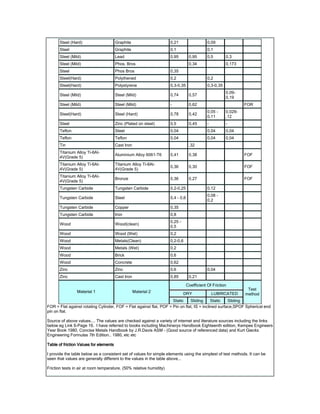
FOR = Flat against rotating Cylinder, FOF = Flat against flat, POF = Pin on flat, IS = inclined surface,SPOF Spherical end
pin on flat.
Source of above values.... The values are checked against a variety of internet and literature sources including the links
below eg Link 6-Page 16. I have referred to books including Machinerys Handbook Eighteenth edition, Kempes Engineers
Year Book 1980, Concise Metals Handbook by J.R.Davis ASM - (Good source of referenced data) and Kurt Giecks
Engineering Formulas 7th Edition.. 1980, etc etc
Table of friction Values for elementsTable of friction Values for elementsTable of friction Values for elementsTable of friction Values for elements
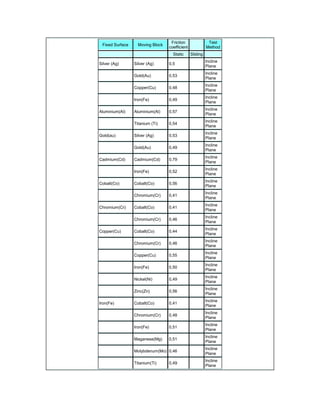
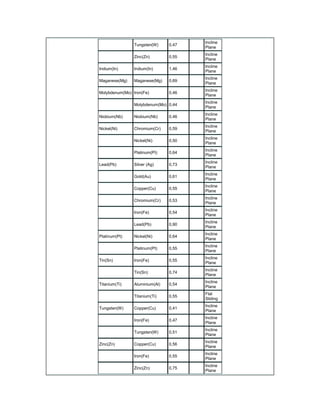
I provide the table below as a consistent set of values for simple elements using the simplest of test methods. It can be
seen that values are generally different to the values in the table above...
Friction tests in air at room temperature. (50% relative humidity)
Fixed Surface Moving Block
Friction
coefficient
Test
Method
Static Sliding
Silver (Ag) Silver (Ag) 0,5
Incline
Plane
Gold(Au) 0,53
Incline
Plane
Copper(Cu) 0,48
Incline
Plane
Iron(Fe) 0,49
Incline
Plane
Aluminium(Al) Aluminium(Al) 0,57
Incline
Plane
Titanium (Ti) 0,54
Incline
Plane
Gold(au) Silver (Ag) 0,53
Incline
Plane
Gold(Au) 0,49
Incline
Plane
Cadmium(Cd) Cadmium(Cd) 0,79
Incline
Plane
Iron(Fe) 0,52
Incline
Plane
Cobalt(Co) Cobalt(Co) 0,56
Incline
Plane
Chromium(Cr) 0,41
Incline
Plane
Chromium(Cr) Cobalt(Co) 0,41
Incline
Plane
Chromium(Cr) 0,46
Incline
Plane
Copper(Cu) Cobalt(Co) 0,44
Incline
Plane
Chromium(Cr) 0,46
Incline
Plane
Copper(Cu) 0,55
Incline
Plane
Iron(Fe) 0,50
Incline
Plane
Nickel(Ni) 0,49
Incline
Plane
Zinc(Zn) 0,56
Incline
Plane
Iron(Fe) Cobalt(Co) 0,41
Incline
Plane
Chromium(Cr) 0,48
Incline
Plane
Iron(Fe) 0,51
Incline
Plane
Maganese(Mg) 0,51
Incline
Plane
Molybdenum(Mo) 0,46
Incline
Plane
Titanium(Ti) 0,49
Incline
Plane
Tungsten(W) 0,47
Incline
Plane
Zinc(Zn) 0,55
Incline
Plane
Indium(In) Indium(In) 1,46
Incline
Plane
Maganese(Mg) Maganese(Mg) 0,69
Incline
Plane
Molybdenum(Mo) Iron(Fe) 0,46
Incline
Plane
Molybdenum(Mo) 0,44
Incline
Plane
Niobium(Nb) Niobium(Nb) 0,46
Incline
Plane
Nickel(Ni) Chromium(Cr) 0,59
Incline
Plane
Nickel(Ni) 0,50
Incline
Plane
Platinum(Pt) 0,64
Incline
Plane
Lead(Pb) Silver (Ag) 0,73
Incline
Plane
Gold(Au) 0,61
Incline
Plane
Copper(Cu) 0,55
Incline
Plane
Chromium(Cr) 0,53
Incline
Plane
Iron(Fe) 0,54
Incline
Plane
Lead(Pb) 0,90
Incline
Plane
Platinum(Pt) Nickel(Ni) 0,64
Incline
Plane
Platinum(Pt) 0,55
Incline
Plane
Tin(Sn) Iron(Fe) 0,55
Incline
Plane
Tin(Sn) 0,74
Incline
Plane
Titanium(Ti) Aluminium(Al) 0,54
Incline
Plane
Titanium(Ti) 0,55
Flat
Sliding
Tungsten(W) Copper(Cu) 0,41
Incline
Plane
Iron(Fe) 0,47
Incline
Plane
Tungsten(W) 0,51
Incline
Plane
Zinc(Zn) Copper(Cu) 0,56
Incline
Plane
Iron(Fe) 0,55
Incline
Plane
Zinc(Zn) 0,75
Incline
Plane
Links to Friction Information
1. Friction Joint Theory... An informative article
2. RingFeder ...Keyless Shaft Hub Connection-including relevant friction values
3. Carbide Depot.. Friction Coefficients
4. NORD-SKG.. Download manual with various Calculations involving sliding and rolling
friction
5. Supercivilcd Com.. Coefficient of Sliding Friction for various civil Materials
6. Fastener Design Manual...NASA GRC RP-1228 (9,6 Mbyte pdf file) Includes
comprehensive table with friction values.
7. Physlinks - Coefficient of Friction...A Table of Friction Coefficients
8. Engineers Edge- Coefficient of Friction...A Table of Friction Coefficients
9. FrictionCenter- Coefficient of Friction...A Table of Friction Coefficients
10. School for Champions...Lots of very useful Notes
11. Investigation of the press fit joints by tribology aspect...A Very Informative paper
12. Bolt Council...Guide to Design Criteria for Bolted and Riveted Joints.(6,7 Mbyte pdf ). Info
on Slip coefficients (P.82) etc
13. MD Metric...Datasheet for PTFE
14. Friction coefficients in "Rail- Wheel" contacts .......Downloadable paper providing very
theoretical information
15. Hypertextbooks _Physics Factbooks.....Physics Factbook .A page inlcuding a number of
very good (school) articles on coe-fficents of friction of different materials
16. 3M Mill Rolls Coef't of Fr'n Study .."...Coefficient of friction values for real applications
17. NACA Research Memorandum .....Paper Download ..Friction value and surface damage of
several corrosion resistant materials
18. Wear Research Paper .....Paper Download ..A study of the tribological behaviour of
polyamide 66 with varying injection-moulding parameters
19. Fund'ls of Friction and Wear of Automobile Brake Materials .....Paper Download ..Very
informative document
20. Friction in Metal Forming...Chapter 4-aces, Tribology, DimensionalCharacteristics,
Inspection and Product Quality Assurance ..
21. Classical Friction...A very simple and clear description of what determines the coefficient of
friction.
22. 12 Friction...Brown University-Division of Engineering..Very clear document on friction
23. Rolling Friction...Very useful notes on rolling friction
24. co-design-5. Mechanics of Screw Threads ...Web page include screw friction values
This Page is being developedThis Page is being developedThis Page is being developedThis Page is being developed
Home
Tribology_Index
Please Send Comments to Roy@roymech.co.uk
Last Updated 07/05/2007

Friction factors

  • 1.
    Disclaimer: The informationon this page has not been checked by an independent person. Use this information at your own risk. ROYMECH Home Tribology_Index Friction FactorsFriction FactorsFriction FactorsFriction Factors Note: I have tried to include a wide range of relevant information on this topic. It will be noted that friction values in one section do not necessarily agree with values in another section...Please use the linked references at the bottom of the page for more detailed information. Factors Affecting friction..... Static Friction..... Sliding/dynamic/kinetic friction..... Coefficients of Friction..... Rolling Friction..... Plain Bearings Friction..... Rolling Bearing Friction..... Clutch Brake Friction..... Bolted Joints..... Power Screws..... Press Fits.... Test Methods.... Linked Reference Info Factors affecting the friction between surfacesFactors affecting the friction between surfacesFactors affecting the friction between surfacesFactors affecting the friction between surfaces Dry surfaces 1. For low surface pressures the friction is directly proportional to the pressure between the surfaces. As the pressure rises the friction factor rises slightly. At very high pressure the friction factor then quickly increases to seizing 2. For low surface pressures the coefficient of friction is independent of surface area. 3. At low velocities the friction is independent of the relative surface velocity. At higher velocities the coefficent of friction decreases. Well lubricated surfaces 1. The friction resistance is almost independent of the specific pressure between the surfaces. 2. At low pressures the friction varies directly as the relative surface speed 3. At high pressures the friction is high at low velocities falling as the velocity increases to a minimum at about 0,6m/s. The friction then rises in proportion the velocity 2 . 4. The friction is not so dependent of the surface materials 5. The friction is related to the temperature which affects the viscosity of the lubricant Surface Friction Notes Static Coefficient of FrictionStatic Coefficient of FrictionStatic Coefficient of FrictionStatic Coefficient of Friction The static friction coefficient (µ) between two solid surfaces is defined as the ratio of the tangential force (F) required to produce sliding divided by the normal force between the surfaces (N) µ = F /N For a horizontal surface the horizontal force (F) to move a solid resting on a flat surface F= µ x mass of solid x g. If a body rests on an incline plane the body is prevented from sliding down because of the frictional resistance. If the angle of the plane is increased there will be an angle at which the body begins to slide down the plane. This is the angle of repose and the tangent of this angle is the same as the coefficient of friction. . SlSlSlSliding Coefficient of Frictioniding Coefficient of Frictioniding Coefficient of Frictioniding Coefficient of Friction When the tangential force F overcomes the frictional force between two surfaces then the surfaces begins to slide relative to each other. In the case of a body resting on a flat surface the body starts to move. The sliding frictional resistance is normally different to the static frictional resistance. The coefficient of sliding friction is expressed using the same formula
  • 2.
    as the staticcoefficient and is generally lower than the static coefficient of friction.. Friction CoefficientsFriction CoefficientsFriction CoefficientsFriction Coefficients A table below shows approximate friction coefficients for various materials. All values are approximate and are only suitable for guidance only. The sliding/lubricated values must be used with extreme care. The only way to determine the accurate coefficient of friction between two materials is to conduct experiments. Coefficients of friction are sensitive to atmospheric dust and humidity, oxide films, surface finish, velocity of sliding, temperature, vibration, and extent of contamination. In many cases the degree of contamination is perhaps the most important single variable.. Link Table of Coefficients of Friction The friction values provided are obtained by different test methods under different ambient conditions. This factor can also affect the results. Link Test Methods Rolling FrictionRolling FrictionRolling FrictionRolling Friction When a cylinder rolls on a surface the force resisting motion is termed rolling friction. Rolling friction is generally considerably less than sliding friction. If W is the weight of the cylinder converted to force, or the force between the cylinder and the flat surface, and R is radius of the cylinder and F is the force required to overcome the rolling friction then. F = f x W/R f is the coefficient of rolling friction and has the same unit of length as the radius R -in the example below m (metres) Typical values for f are listed below Note: Values for rolling friction from various sources are not consistent and the following values should only be used for approximate calculations. • Steel on Steel f = 0,0005m • Wood on Steel f = 0,0012m • Wood on Wood f = 0,0015m • Iron on iron f = 0,00051m • Iron on granite f = 0,0021m • Iron on Wood f = 0,0056m • Polymer of steel f = 0,002m • Hardrubber on Steel f = 0,0077m • Hardrubber on Concrete f = 0,01 -0,02m
  • 3.
    • Rubber onConcrete f = 0,015 -0,035m Plain Bearing Friction factorsPlain Bearing Friction factorsPlain Bearing Friction factorsPlain Bearing Friction factors For values of rolling bearing friction Plain Bearing Friction Values Rolling Bearing FrictionRolling Bearing FrictionRolling Bearing FrictionRolling Bearing Friction For values of rolling bearing friction Rolling Bearing Friction Values ClutchClutchClutchClutch ---- Brake Friction ValuesBrake Friction ValuesBrake Friction ValuesBrake Friction Values The coefficient of friction value is important in the design and brakes and clutches. Various values are provided on the following linked page Clutch/Brake Materials FrictiFrictiFrictiFriction coefficient Bolted Jointson coefficient Bolted Jointson coefficient Bolted Jointson coefficient Bolted Joints The coefficient of friction is required in calculating tightening torques and resulting bolt tensile forces and stress and in calculating the resulting friction between the connected surfaces. Below are provided a small number of values showing approximate values of friction coefficients to be used for steel screw fastened connections. The values are only representative values and should be confirmed against other sources of information and preferably testing. Coefficient of Friction for screw threads Female Thread -Nut or Tapped Hole in steel(untreated) Male screw Friction Coefficient (Dry) Friction Coefficient (lub) Untreated Steel 0,12 - 0,18 0,10 - 0,17 Phosphated Steel 0,12 - 0,18 0,10 - 0,17 Cadmium Plated Steel 0,09 - 0,14 0,08 -0,23 Galvanised steel 0,14 - 0,23 0,12 - 0,2 Degreased steel 0,19 - 0,25 Female Thread -Nut or Tapped Hole in steel(Galvanised) Male screw Friction Coeffient (Dry) Friction Coefficient(Lub.) Untreated Steel 0,14 - 0,2 0,12 - 0,18 Phosphated Steel 0,14 - 0,2 0,12 - 0,18 Cadmium Plated Steel 0,1 - 0,16 0,09 - 0,15 Galvanised steel 0,14 - 0,25 0,12 - 0,2 Degreased steel 0,19 - 0,25 Coefficient of Friction Nut/Bolt Face against Clamped surface Clamped Surface = Steel Bolt/Nut Mat'l Friction Coeffient (Dry) Friction Coefficient(Lub.) Untreated Steel 0,10 - 0,18 0,08 - 0.15 Phosphated Steel 0,10 - 0,18 0,08 - 0,15 Galvanised steel 0,10 - 0,2 0,09 - 0,18 Clamped Surface -Galvanised Steel Bolt/Nut Mat'l Friction Coefficient (Dry) Friction Coefficient (lub) Untreated Steel 0,10 - 0,18 0,08 - 0,15 Phosphated Steel 0,10 - 0,18 0,08 - 0,15 Galvanised steel 0,16 - 0,22 0,09 - 0,18 Coefficient of friction between surfaces clamped by bolts /screws. These values allow calculation of the shear force necessary to cause slip between surfaces when clamped by bolts.
  • 4.
    Contact Surfaces slipcoefficient Steel On Steel- No treatment 0,15- 0,25 Steel On Cast Iron- No treatment 0,18 - 0,3 Steel On Steel- Machined (Degreased) 0,12- 0,18 Steel On Cast Iron- Machined (Degreased) 0,15 - 0,25 Grit -Sandblasted surfaces 0,48 - 0,55 Friction Factors for Power ScrewsFriction Factors for Power ScrewsFriction Factors for Power ScrewsFriction Factors for Power Screws The following factors are typical friction factors for power screw torque and efficiency calculations.. 1) Screw Thread Friction values (µs) (Friction factors apply mainly for screw thread friction (µs) - can be applied to collar friction(µc) Nut Material Screw Material Steel Brass Bronze Cast Iron Steel(Dry) 0,15- 0,25 0,15- 0,23 0,15- 0,19 0,15- 0,25 Steel (Lubricated) 0,11- 0,17 0,10- 0,16 0,10- 0,15 0,11- 0,17 Bronze (Lubricated) 0,08- 0,12 0,04- 0,06 - 0,06- 0,09 2) Thrust collar Friction values (µc) Surface Combinations Moving Starting Soft Steel on Cast Iron 0,12 0,17 Hard Steel on Cast Iron 0,09 0,15 Soft Steel on Bronze 0,08 0,10 Hard Steel on Bronze 0,06 0,08 Press Fit Mechanical JointsPress Fit Mechanical JointsPress Fit Mechanical JointsPress Fit Mechanical Joints In mechanical engineering rotary motion can be transferred by mechanical connections between a shaft and hub using only a tight fit. Methods of achieving this type of connection include the engineered interference fit, the taper lock bush and hydraulic fit bush. These keyless shaft/hub connections all transfer torque by friction. The coefficient of friction used for designing these types of connections is dependent on the interface pressure, materials, surface condition, surface coatings etc. The coefficient of friction is also dependent on the method of installation. A different value result if the shaft is forced into the hub (force fit) compared to the value if the assemble is completed by heating the hub or freezing the shaft prior to assembly (shrink fit)... Various values of relevant coefficients of friction are provided below; • Steel Hub , Steel Shaft unlubricated - force fit ...C. of Friction = 0,07 to 0,16 • Steel Hub , Steel Shaft greased - force fit ...C. of Friction = 0,05 to 0,12 • Steel Hub , Steel Shaft unlubricated - Shrink fit ...C. of Friction = 0,15 to 0,25 • Steel Hub , Steel Shaft greased - Shrink fit ...C. of Friction = 0,08 to 0,16 The manufacturers of the proprietary keyless hub/shaft systems indicate that their products are based on a coefficient of friction of 0,12 for lightly oiled connections and 0,15 for dry assemblies. These companies can provide surface coating fluids containing particles to increase theie coefficient of friction to 0,25 to 0,3. (ref links 1 & 2 below) The American Gear Manufactures Association (AGMA) recommends a value of between 0,12-0,15 for hydraulically expanded hubs and 0,15-0,20 for shrink or press fit hubs. Testing MethoTesting MethoTesting MethoTesting Methodsdsdsds There are a number of test methods for coefficient of frictions as some of which are listed below • Flat block pressed against a OD of rotating ring (FOR) • Flat block against another flat block (FOF) • Flat block sliding down an inclined runway(IS) • Pin pressed against a OD of rotating ring (POR
  • 5.
    • Reciprocating loadedspherical end pin pressed on a flat surface(RSOF) It is clear that the different test methods provide different friction results.. Coefficient of FrictionCoefficient of FrictionCoefficient of FrictionCoefficient of Friction Extreme care is needed in using friction coefficients and additional independent references should be used. For any specific application the ideal method of determining the coefficient of friction is by trials. A short table is included above the main table to illustrate how the coefficient of friction is affected by surface films. When a metal surface is perfectly clean in a vacuum , the friction is much higher than the normal accepted value and seizure can easily occur. ......The links below the tables provide further information. Effect of oxide film etc on coefficient of static friction Material Clean Dry Thick Oxide Film Sulfide Film Steel-Steel 0,78 0,27 0,39 Copper-Copper 1,21 0,76 0,74 The level of uncertainty of the information below is indicated by using steel on steel as an example. Various reference sources provide values similar to the values below.(0,74 Static- 0,42 sliding) Gieck( 7th ed) provides values of (0,15...0,30 Static - 0,10...0,30 sliding). Concise Metals Data Handbook by J.R. Davis (table 14,1) includes values (0,31 static -0,23 sliding - for steel 1032? on steel 1032?).. The same table includes a value for mild steel on mild steel of 0,62 sliding. Coefficient Of Friction DRY GreasyMaterial 1 Material 2 Static Sliding Static Sliding Test method Aluminum Aluminum 1,05- 1,35 1,4 0,3 Aluminum Mild Steel 0,61 0,47 Brake Material Cast Iron 0,4 Brake Material Cast Iron (Wet) 0,2 Brass Cast Iron 0,3 Brick Wood 0,6 Bronze Cast Iron 0,22 Bronze Steel 0,16 Cadmium Cadmium 0,5 0,05 Cadmium Mild Steel 0,46 Cast Iron Cast Iron 1,1 0,15 0,07 Cast Iron Oak 0,49 0,075 Chromium Chromium 0,41 0,34 Copper Cast Iron 1,05 0,29 Copper Copper 1,0 0,08 Copper Mild Steel 0,53 0,36 0,18 Copper Steel 0,8 SPOF Copper Steel (304 stainless) 0,23 0,21 FOF Copper-Lead Alloy Steel 0,22 - Diamond Diamond 0,1 0,05 - 0,1 Diamond Metal 0,1 - 0,1
  • 6.
    0,15 Glass Glass 0,9- 1,0 0,4 0,1 - 0,6 0,09- 0,12 Glass Metal 0,5 - 0,7 0,2 - 0,3 Glass Nickel 0,78 0,56 Graphite Graphite 0,1 0,1 Graphite Steel 0,1 0,1 Graphite (In vacuum) Graphite (In vacuum) 0,5 - 0,8 Hard Carbon Hard Carbon 0,16 0,12 - 0,14 Hard Carbon Steel 0,14 0,11 - 0,14 Iron Iron 1,0 0,15 - 0,2 Lead Cast Iron 0,43 Lead Steel 1,4 SPOF Leather Wood 0,3 - 0,4 Leather Metal(Clean) 0,6 0,2 Leather Metal(Wet) 0,4 Leather Oak (Parallel grain) 0,61 0,52 Magnesium Magnesium 0,6 0,08 Nickel Nickel 0,7-1,1 0,53 0,28 0,12 Nickel Mild Steel 0,64; 0,178 Nylon Nylon 0,15 - 0,25 Oak Oak (parallel grain) 0,62 0,48 Oak Oak (cross grain) 0,54 0,32 0,072 Platinum Platinum 1,2 0,25 Plexiglas Plexiglas 0,8 0,8 Plexiglas Steel 0,4 - 0,5 0,4 - 0,5 Polystyrene Polystyrene 0,5 0,5 Polystyrene Steel 0,3-0,35 0,3-0,35 Polythene Steel 0,2 0,2 Rubber Asphalt (Dry) 0,5-0,8 Rubber Asphalt (Wet) 0,25- 0,0,75 Rubber Concrete (Dry) 0,6-0,85 Rubber Concrete (Wet) 0,45- 0,75 Saphire Saphire 0,2 0,2 Silver Silver 1,4 0,55 Sintered Bronze Steel - 0,13 Solids Rubber 1,0 - 4,0 -- Steel Aluminium Bros 0,45 Steel Brass 0,35 0,19 Steel(Mild) Brass 0,51 0,44 Steel (Mild) Cast Iron 0,23 0,183 0,133 Steel Cast Iron 0,4 0,21 Steel Copper Lead Alloy 0,22 0,16 0,145
  • 7.
    Steel (Hard) Graphite0,21 0,09 Steel Graphite 0,1 0,1 Steel (Mild) Lead 0,95 0,95 0,5 0,3 Steel (Mild) Phos. Bros 0,34 0,173 Steel Phos Bros 0,35 Steel(Hard) Polythened 0,2 0,2 Steel(Hard) Polystyrene 0,3-0,35 0,3-0,35 Steel (Mild) Steel (Mild) 0,74 0,57 0,09- 0,19 Steel (Mild) Steel (Mild) - 0,62 FOR Steel(Hard) Steel (Hard) 0,78 0,42 0,05 - 0,11 0,029- ,12 Steel Zinc (Plated on steel) 0,5 0,45 - - Teflon Steel 0,04 0,04 0,04 Teflon Teflon 0,04 0,04 0,04 Tin Cast Iron ,32 Titanium Alloy Ti-6Al- 4V(Grade 5) Aluminium Alloy 6061-T6 0,41 0,38 FOF Titanium Alloy Ti-6Al- 4V(Grade 5) Titanium Alloy Ti-6Al- 4V(Grade 5) 0,36 0,30 FOF Titanium Alloy Ti-6Al- 4V(Grade 5) Bronze 0,36 0,27 FOF Tungsten Carbide Tungsten Carbide 0,2-0,25 0,12 Tungsten Carbide Steel 0,4 - 0,6 0,08 - 0,2 Tungsten Carbide Copper 0,35 Tungsten Carbide Iron 0,8 Wood Wood(clean) 0,25 - 0,5 Wood Wood (Wet) 0,2 Wood Metals(Clean) 0,2-0,6 Wood Metals (Wet) 0,2 Wood Brick 0,6 Wood Concrete 0,62 Zinc Zinc 0,6 0,04 Zinc Cast Iron 0,85 0,21 Coefficient Of Friction DRY LUBRICATEDMaterial 1 Material 2 Static Sliding Static Sliding Test method FOR = Flat against rotating Cylinder, FOF = Flat against flat, POF = Pin on flat, IS = inclined surface,SPOF Spherical end pin on flat. Source of above values.... The values are checked against a variety of internet and literature sources including the links below eg Link 6-Page 16. I have referred to books including Machinerys Handbook Eighteenth edition, Kempes Engineers Year Book 1980, Concise Metals Handbook by J.R.Davis ASM - (Good source of referenced data) and Kurt Giecks Engineering Formulas 7th Edition.. 1980, etc etc Table of friction Values for elementsTable of friction Values for elementsTable of friction Values for elementsTable of friction Values for elements I provide the table below as a consistent set of values for simple elements using the simplest of test methods. It can be seen that values are generally different to the values in the table above... Friction tests in air at room temperature. (50% relative humidity)
  • 8.
    Fixed Surface MovingBlock Friction coefficient Test Method Static Sliding Silver (Ag) Silver (Ag) 0,5 Incline Plane Gold(Au) 0,53 Incline Plane Copper(Cu) 0,48 Incline Plane Iron(Fe) 0,49 Incline Plane Aluminium(Al) Aluminium(Al) 0,57 Incline Plane Titanium (Ti) 0,54 Incline Plane Gold(au) Silver (Ag) 0,53 Incline Plane Gold(Au) 0,49 Incline Plane Cadmium(Cd) Cadmium(Cd) 0,79 Incline Plane Iron(Fe) 0,52 Incline Plane Cobalt(Co) Cobalt(Co) 0,56 Incline Plane Chromium(Cr) 0,41 Incline Plane Chromium(Cr) Cobalt(Co) 0,41 Incline Plane Chromium(Cr) 0,46 Incline Plane Copper(Cu) Cobalt(Co) 0,44 Incline Plane Chromium(Cr) 0,46 Incline Plane Copper(Cu) 0,55 Incline Plane Iron(Fe) 0,50 Incline Plane Nickel(Ni) 0,49 Incline Plane Zinc(Zn) 0,56 Incline Plane Iron(Fe) Cobalt(Co) 0,41 Incline Plane Chromium(Cr) 0,48 Incline Plane Iron(Fe) 0,51 Incline Plane Maganese(Mg) 0,51 Incline Plane Molybdenum(Mo) 0,46 Incline Plane Titanium(Ti) 0,49 Incline Plane
  • 9.
    Tungsten(W) 0,47 Incline Plane Zinc(Zn) 0,55 Incline Plane Indium(In)Indium(In) 1,46 Incline Plane Maganese(Mg) Maganese(Mg) 0,69 Incline Plane Molybdenum(Mo) Iron(Fe) 0,46 Incline Plane Molybdenum(Mo) 0,44 Incline Plane Niobium(Nb) Niobium(Nb) 0,46 Incline Plane Nickel(Ni) Chromium(Cr) 0,59 Incline Plane Nickel(Ni) 0,50 Incline Plane Platinum(Pt) 0,64 Incline Plane Lead(Pb) Silver (Ag) 0,73 Incline Plane Gold(Au) 0,61 Incline Plane Copper(Cu) 0,55 Incline Plane Chromium(Cr) 0,53 Incline Plane Iron(Fe) 0,54 Incline Plane Lead(Pb) 0,90 Incline Plane Platinum(Pt) Nickel(Ni) 0,64 Incline Plane Platinum(Pt) 0,55 Incline Plane Tin(Sn) Iron(Fe) 0,55 Incline Plane Tin(Sn) 0,74 Incline Plane Titanium(Ti) Aluminium(Al) 0,54 Incline Plane Titanium(Ti) 0,55 Flat Sliding Tungsten(W) Copper(Cu) 0,41 Incline Plane Iron(Fe) 0,47 Incline Plane Tungsten(W) 0,51 Incline Plane Zinc(Zn) Copper(Cu) 0,56 Incline Plane Iron(Fe) 0,55 Incline Plane Zinc(Zn) 0,75 Incline Plane
  • 10.
    Links to FrictionInformation 1. Friction Joint Theory... An informative article 2. RingFeder ...Keyless Shaft Hub Connection-including relevant friction values 3. Carbide Depot.. Friction Coefficients 4. NORD-SKG.. Download manual with various Calculations involving sliding and rolling friction 5. Supercivilcd Com.. Coefficient of Sliding Friction for various civil Materials 6. Fastener Design Manual...NASA GRC RP-1228 (9,6 Mbyte pdf file) Includes comprehensive table with friction values. 7. Physlinks - Coefficient of Friction...A Table of Friction Coefficients 8. Engineers Edge- Coefficient of Friction...A Table of Friction Coefficients 9. FrictionCenter- Coefficient of Friction...A Table of Friction Coefficients 10. School for Champions...Lots of very useful Notes 11. Investigation of the press fit joints by tribology aspect...A Very Informative paper 12. Bolt Council...Guide to Design Criteria for Bolted and Riveted Joints.(6,7 Mbyte pdf ). Info on Slip coefficients (P.82) etc 13. MD Metric...Datasheet for PTFE 14. Friction coefficients in "Rail- Wheel" contacts .......Downloadable paper providing very theoretical information 15. Hypertextbooks _Physics Factbooks.....Physics Factbook .A page inlcuding a number of very good (school) articles on coe-fficents of friction of different materials 16. 3M Mill Rolls Coef't of Fr'n Study .."...Coefficient of friction values for real applications 17. NACA Research Memorandum .....Paper Download ..Friction value and surface damage of several corrosion resistant materials 18. Wear Research Paper .....Paper Download ..A study of the tribological behaviour of polyamide 66 with varying injection-moulding parameters 19. Fund'ls of Friction and Wear of Automobile Brake Materials .....Paper Download ..Very informative document 20. Friction in Metal Forming...Chapter 4-aces, Tribology, DimensionalCharacteristics, Inspection and Product Quality Assurance .. 21. Classical Friction...A very simple and clear description of what determines the coefficient of friction. 22. 12 Friction...Brown University-Division of Engineering..Very clear document on friction 23. Rolling Friction...Very useful notes on rolling friction 24. co-design-5. Mechanics of Screw Threads ...Web page include screw friction values This Page is being developedThis Page is being developedThis Page is being developedThis Page is being developed Home Tribology_Index Please Send Comments to Roy@roymech.co.uk Last Updated 07/05/2007