Presented by
Mr. T. GOPINATH,
ASSISTANT TRAINING OFFICER,
GOVT. I T I , AMBATTUR.
+91 9444224363 gopinathmalliga@gmail.com
FRICTION
உராய்வு
Definition
If a solid surface rubbed with a another solid , a force is
created between the two solids which acts in the opposite
direction of motion or tries to obstruct the motion of the object, this
force is called frictional force. This happens due to roughness of the
two surfaces.
• The act of rubbing one thing against another is called as FRICTION.
• The force that causes a moving object to slow down when it is
touching another object
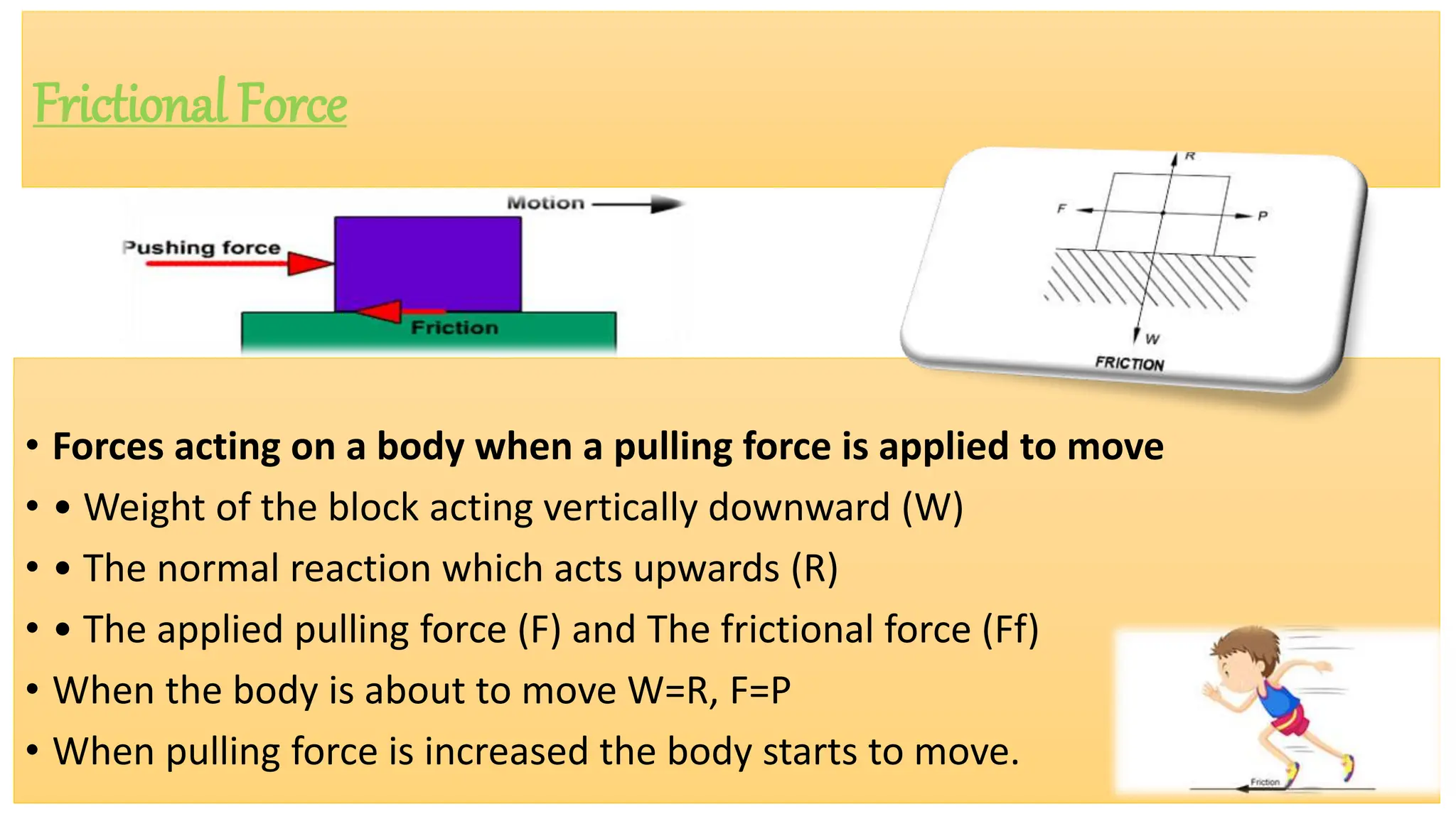
• It depends upon the normal reaction between the contacting
surfaces and the nature of the surfaces. No surface is absolutely
friction less.
Friction is the force resisting the relative motion of
solid surfaces, fluid layers, and material elements
sliding against each other. There are several types of
friction:
• The friction between the two surfaces
converts kinetic energy into thermal energy
•Friction plays an important role in our daily life. It
would not be possible to walk without friction
between our foot and floor. Vehicles are able to run
on roads because of the friction between the wheels
and road.
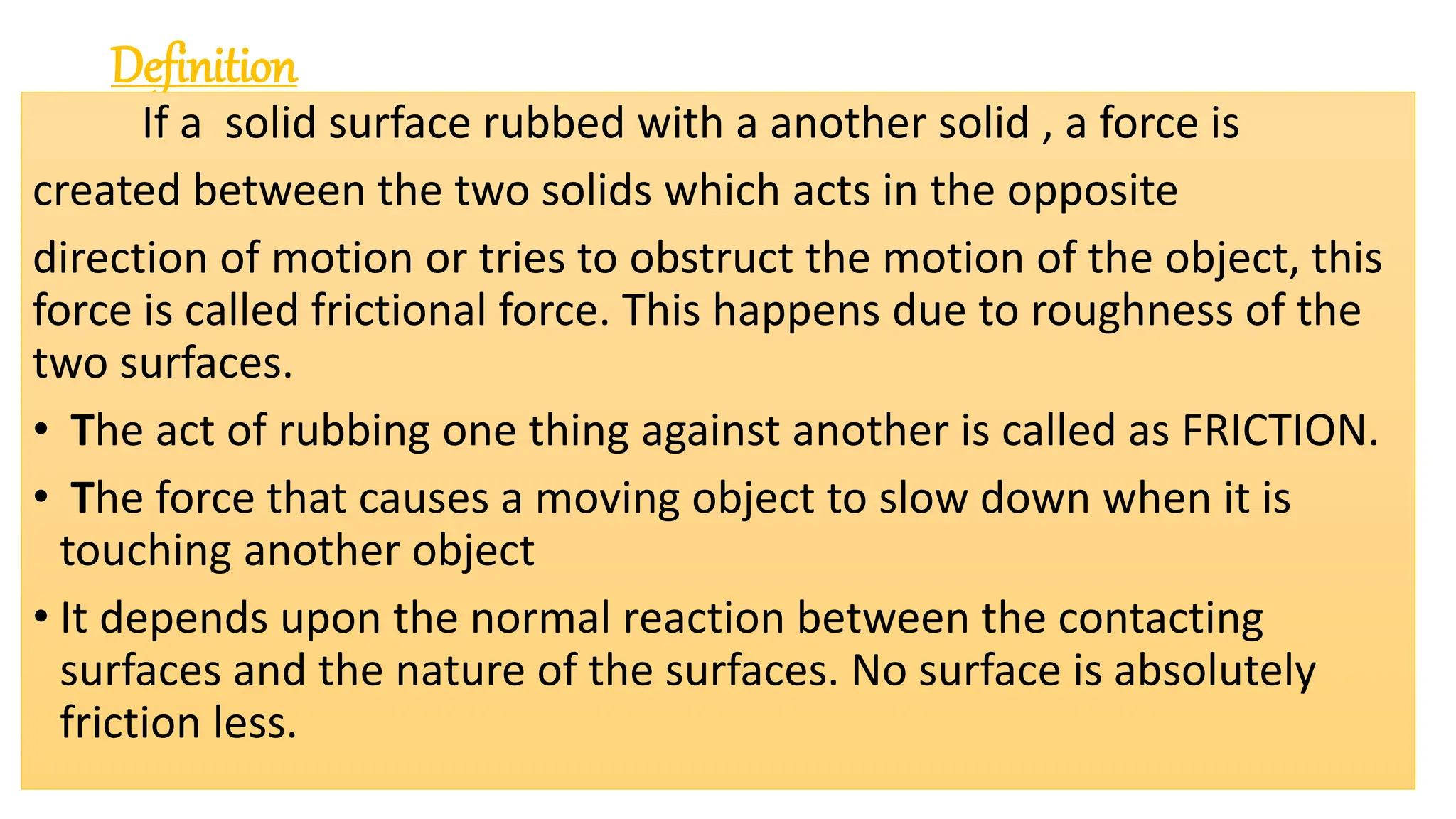
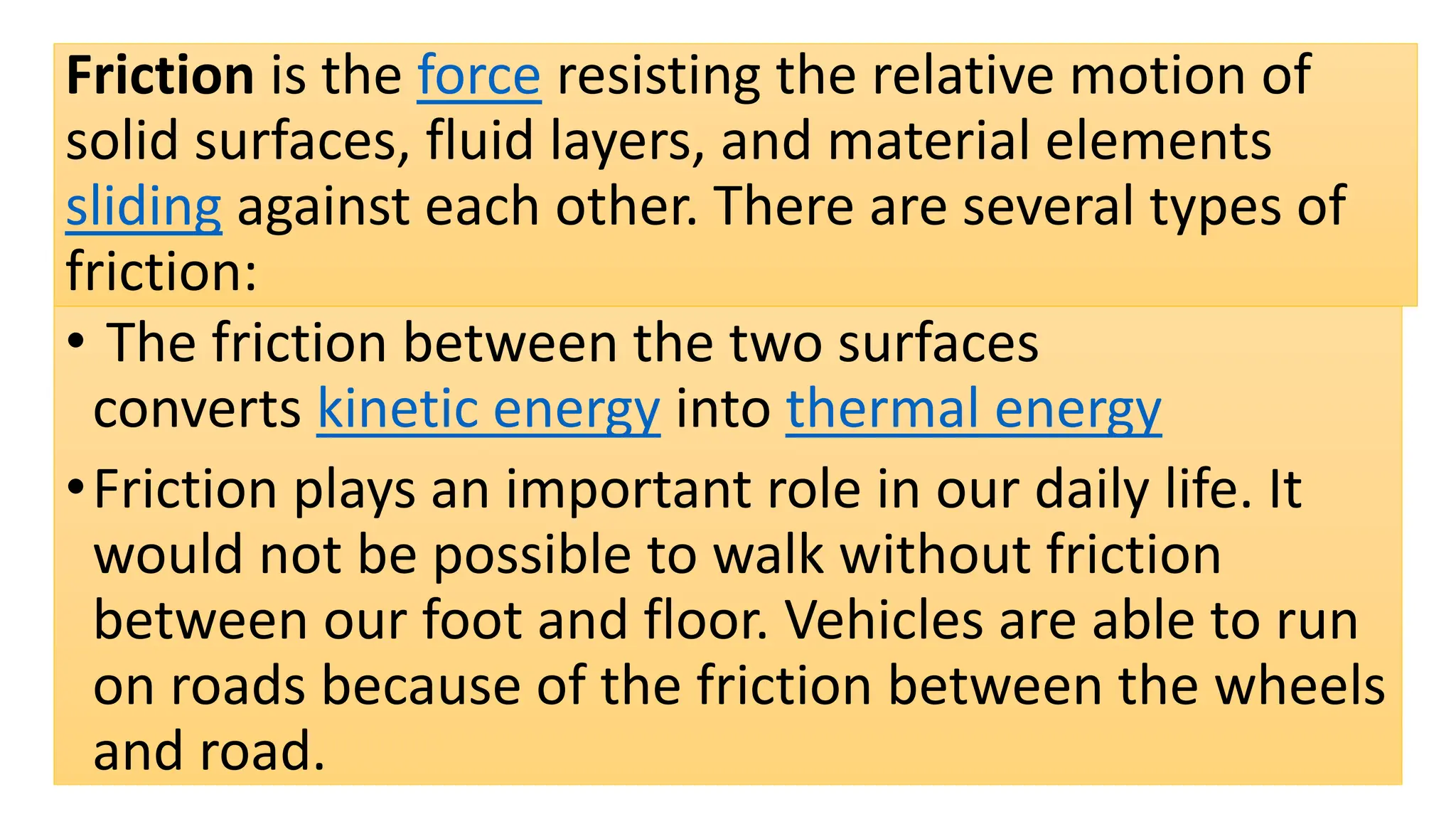
Frictional Force
• Forces acting on a body when a pulling force is applied to move
• • Weight of the block acting vertically downward (W)
• • The normal reaction which acts upwards (R)
• • The applied pulling force (F) and The frictional force (Ff)
• When the body is about to move W=R, F=P
• When pulling force is increased the body starts to move.
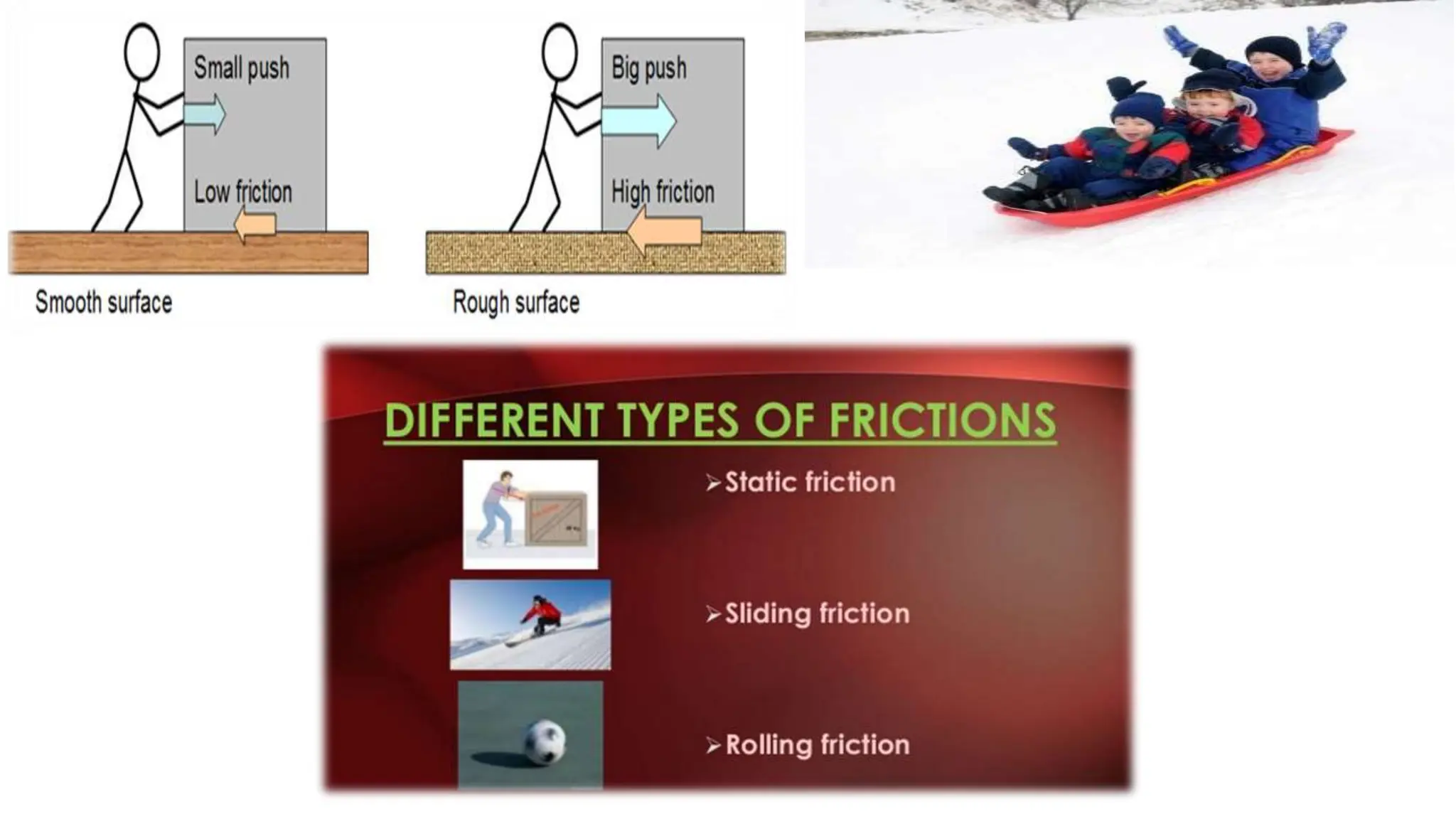
Types of friction
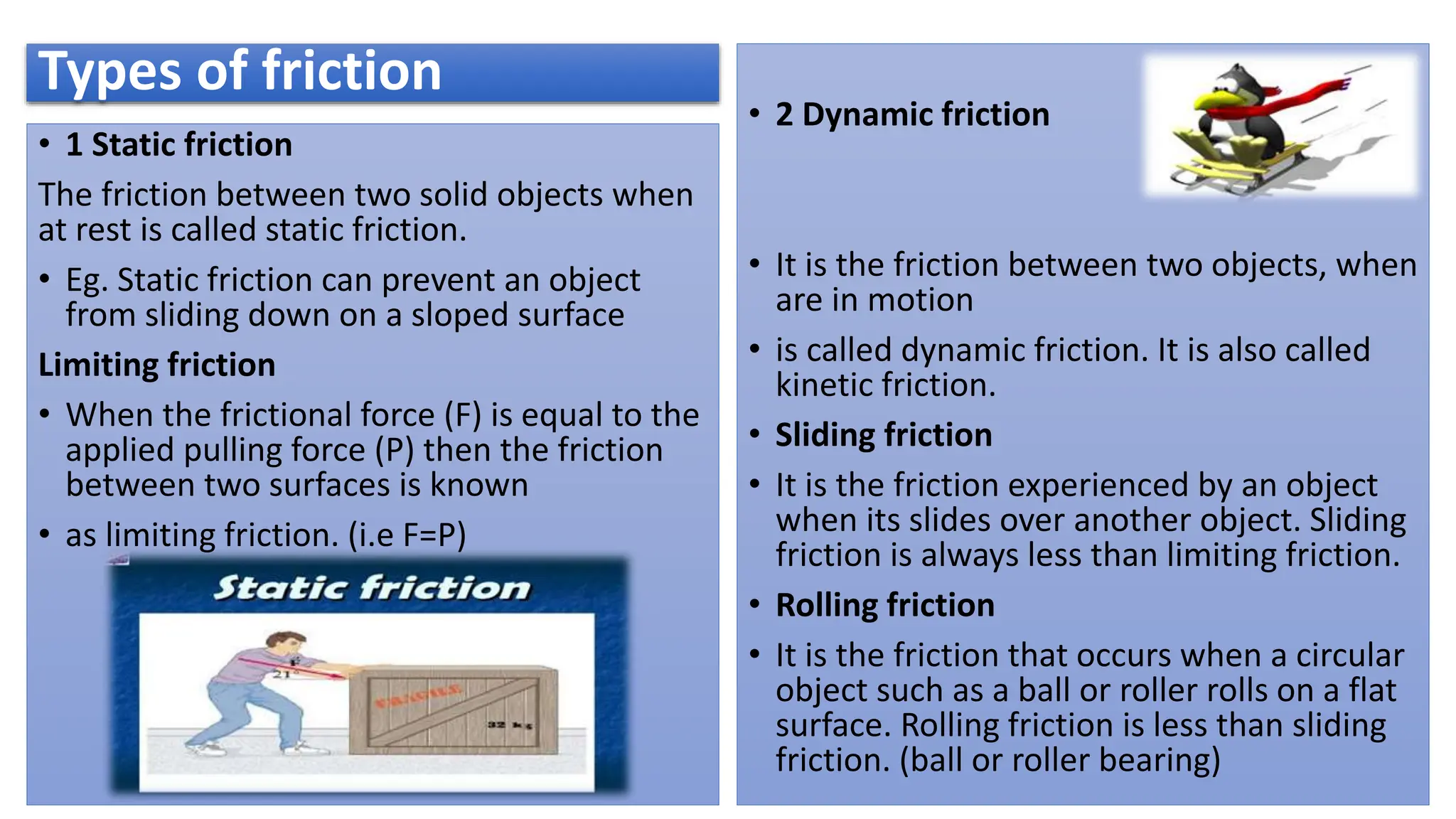
• 1 Static friction
The friction between two solid objects when
at rest is called static friction.
• Eg. Static friction can prevent an object
from sliding down on a sloped surface
Limiting friction
• When the frictional force (F) is equal to the
applied pulling force (P) then the friction
between two surfaces is known
• as limiting friction. (i.e F=P)
• 2 Dynamic friction
• It is the friction between two objects, when
are in motion
• is called dynamic friction. It is also called
kinetic friction.
• Sliding friction
• It is the friction experienced by an object
when its slides over another object. Sliding
friction is always less than limiting friction.
• Rolling friction
• It is the friction that occurs when a circular
object such as a ball or roller rolls on a flat
surface. Rolling friction is less than sliding
friction. (ball or roller bearing)
LAWS OF FRICTION
• • Frictional force is directly proportional to the normal
reaction between contacting surfaces.
• • Frictional force acts opposite to the direction of motion.
• • Frictional force depends on the nature of contacting
surfaces.
• • Frictional force is independent over the area and shape
of contacting surfaces.
Applications
Friction is an important factor in many engineering disciplines.
• Transportation
Automobile brakes inherently rely on friction, slowing a vehicle by converting its
kinetic energy into heat. Incidentally, dispersing this large amount of heat safely
is one technical challenge in designing brake systems. Disk brakes rely on friction
between a disc and brake pads that are squeezed transversely against the
rotating disc. In drum brakes, brake shoes or pads are pressed outwards against a
rotating cylinder (brake drum) to create friction. Since braking discs can be more
efficiently cooled than drums, disc brakes have better stopping performance.
• Rail adhesion refers to the grip wheels of a train have on the rails
• Road slipperiness is an important design and safety factor for automobiles
• Road texture affects the interaction of tires and the driving surface
Measurement
A tribometer is an instrument that measures friction on a
surface.
A profilograph is a device used to measure pavement
surface roughness.
Household usage
• Friction is used to heat and ignite matchsticks (friction between
the head of a matchstick and the rubbing surface of the match
box).
• Sticky pads are used to prevent object from slipping off smooth
surfaces by effectively increasing the friction coefficient between
the surface and the object.
Coefficient of friction
• It is a ratio between the frictional force to the normal reaction
when the body is just about to move but at equilibrium. It is
represented by symbol 𝝁 (read as ‘meu’) and it is the ratio of
same units it has NO UNIT
Therefore
• Co - efficient of friction =
Limiting friction(or)force
Normal reaction(or) weight
= 𝝁 =
𝑭
𝑾
Angle of friction
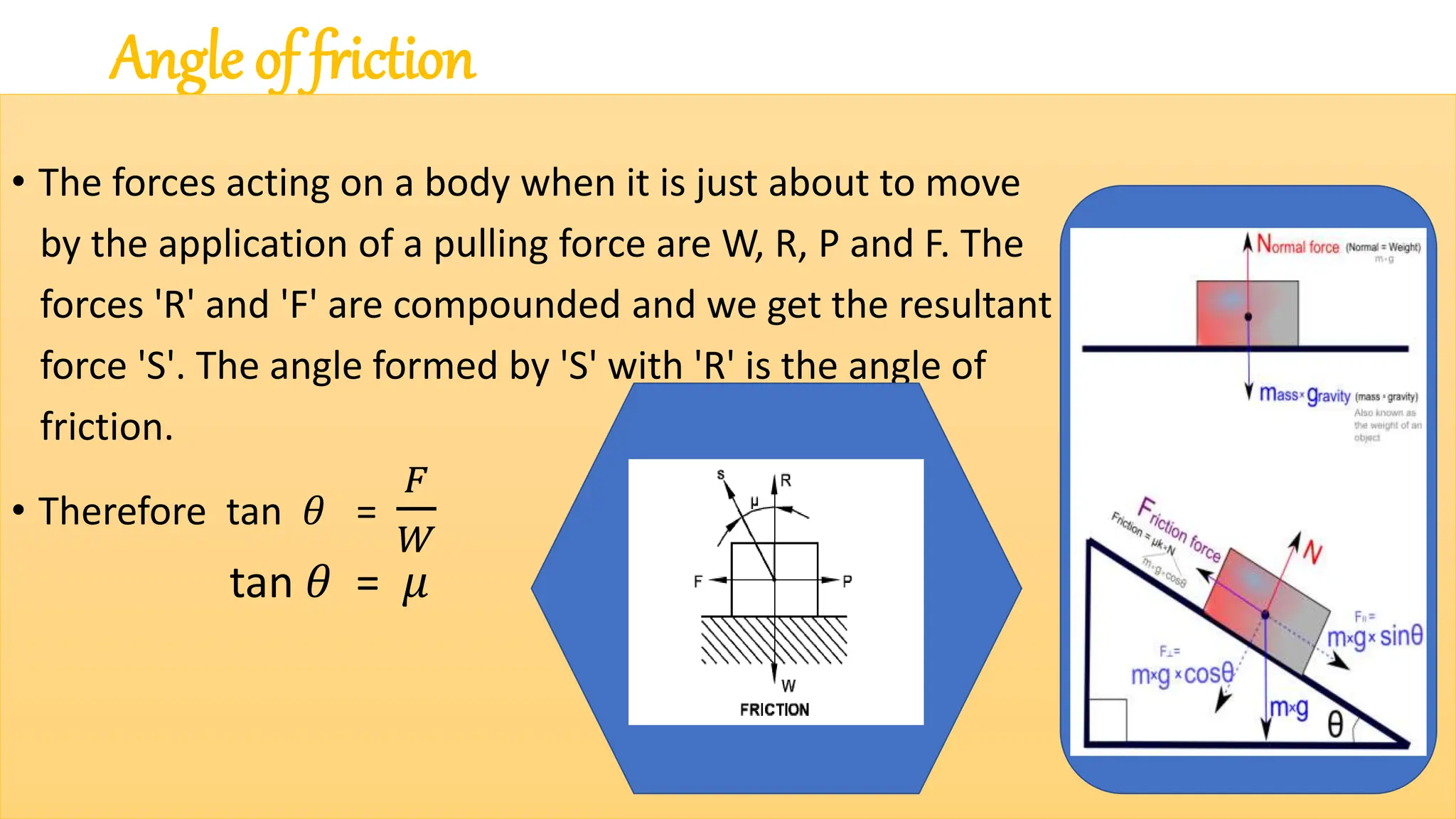
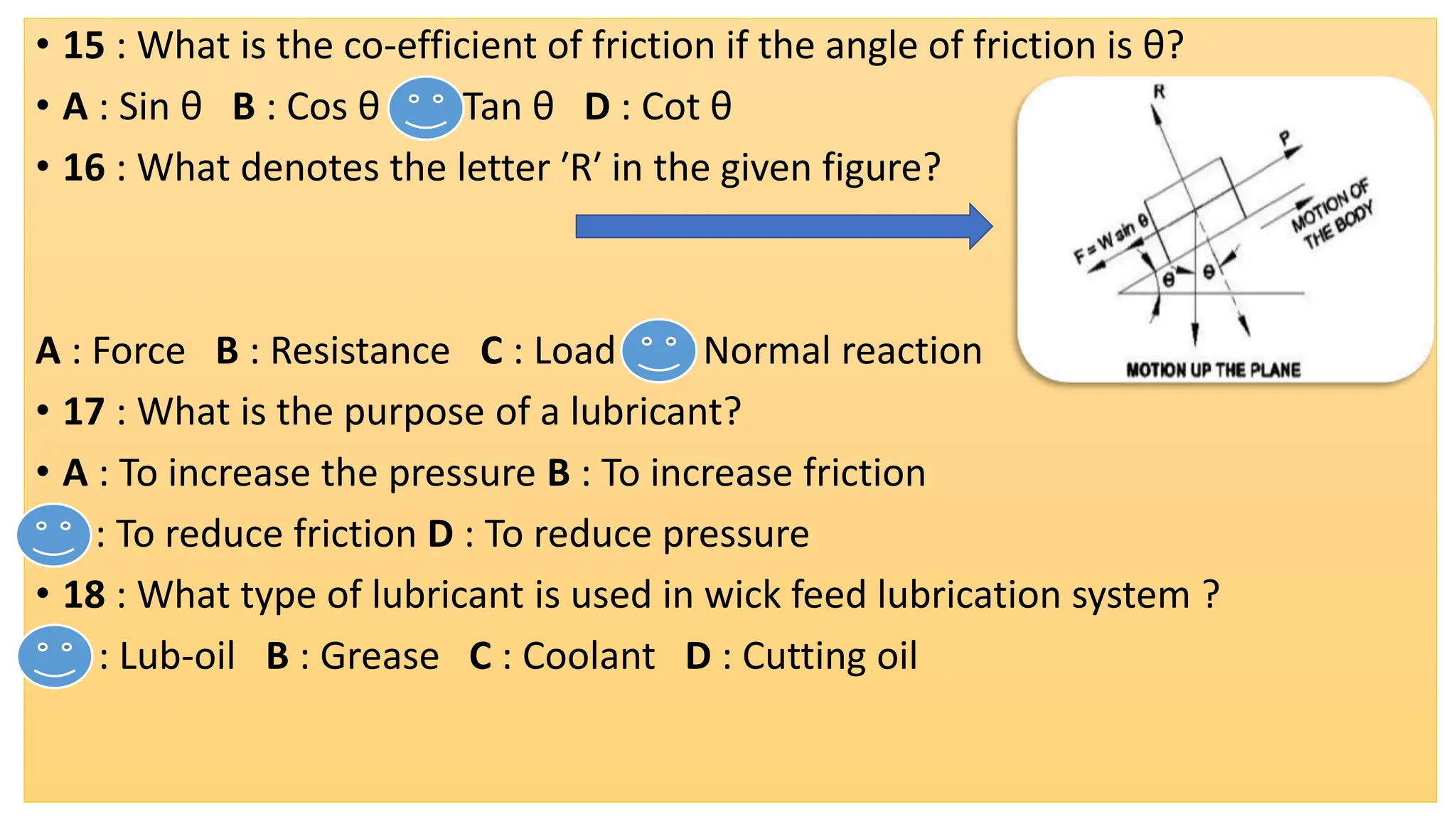
• The forces acting on a body when it is just about to move
by the application of a pulling force are W, R, P and F. The
forces 'R' and 'F' are compounded and we get the resultant
force 'S'. The angle formed by 'S' with 'R' is the angle of
friction.
• Therefore tan 𝜃 =
𝐹
𝑊
tan 𝜃 = 𝜇
Angle of repose
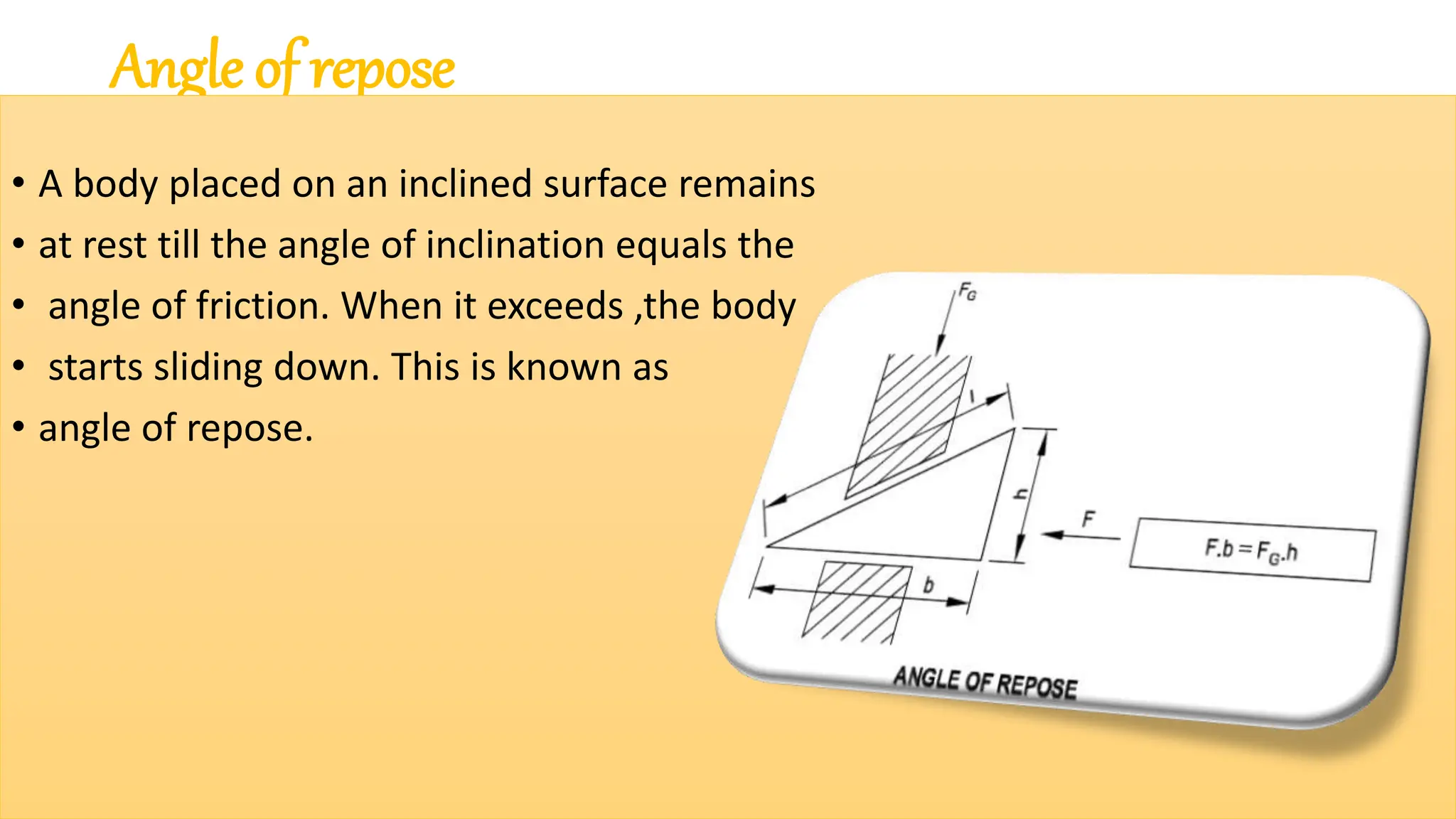
• A body placed on an inclined surface remains
• at rest till the angle of inclination equals the
• angle of friction. When it exceeds ,the body
• starts sliding down. This is known as
• angle of repose.
• Advantages of friction
• 1 .Helps us to walk without slipping.
• 2 .Used to stop vehicles when brakes
are applied.
• 3 .Movement of vehicles due to
friction between revolving wheels with
tyres and the road.
• 4 .Power transmission using gear drive
or belt pulley drive.
• 5 .Using friction we can sharp any
object and also to hold it.
• 6 .Nails and screws are held in wood
by friction.
• 7 .Heat is produced when two rough
surfaces are rubbed against each
other.
• Disadvantages of friction
• 1. It causes wear and tear of the
machine parts.
• 2. It produces heat and may cause
melting of machine
• parts. To avoid production of heat
using of coolant is necessary.
• 3. It reduces efficiency of a machine.
• 4 It reduces speed of the moving
object. eg. spindle, shaft, piston etc.
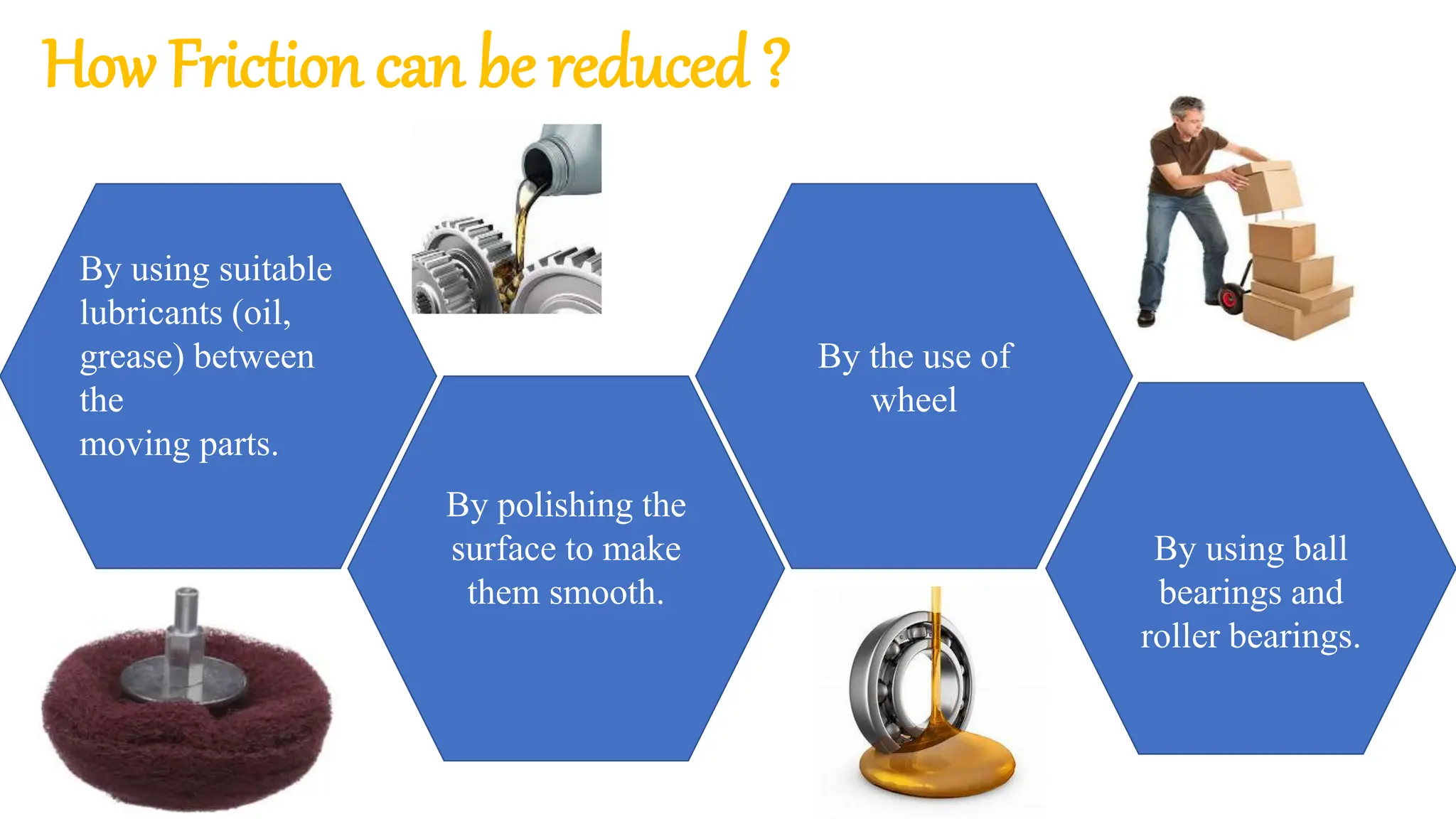
How Friction can be reduced ?
By polishing the
surface to make
them smooth.
By using suitable
lubricants (oil,
grease) between
the
moving parts.
By the use of
wheel
By using ball
bearings and
roller bearings.
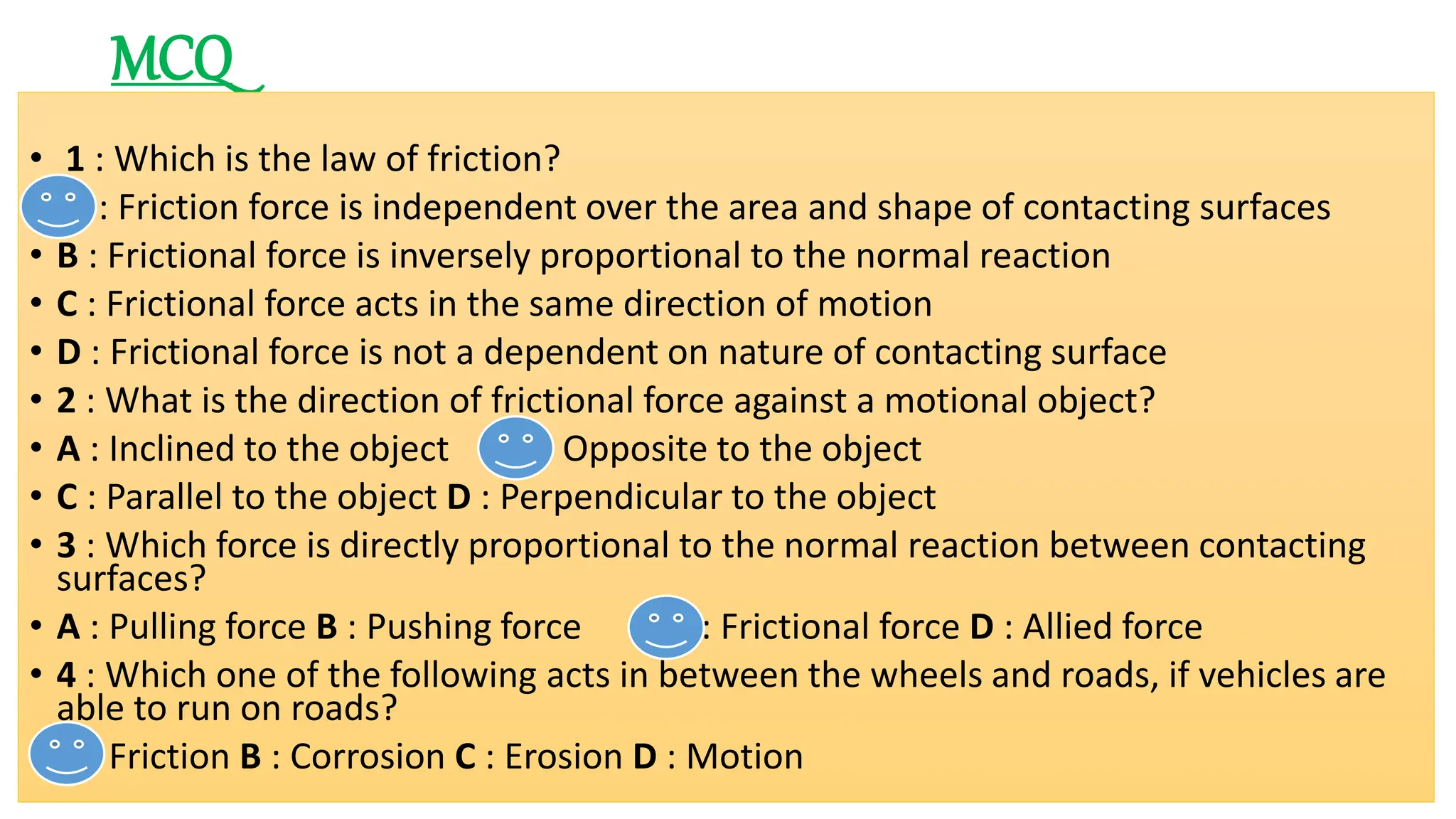
MCQ
• 1 : Which is the law of friction?
• A : Friction force is independent over the area and shape of contacting surfaces
• B : Frictional force is inversely proportional to the normal reaction
• C : Frictional force acts in the same direction of motion
• D : Frictional force is not a dependent on nature of contacting surface
• 2 : What is the direction of frictional force against a motional object?
• A : Inclined to the object B : Opposite to the object
• C : Parallel to the object D : Perpendicular to the object
• 3 : Which force is directly proportional to the normal reaction between contacting
surfaces?
• A : Pulling force B : Pushing force C : Frictional force D : Allied force
• 4 : Which one of the following acts in between the wheels and roads, if vehicles are
able to run on roads?
• A : Friction B : Corrosion C : Erosion D : Motion
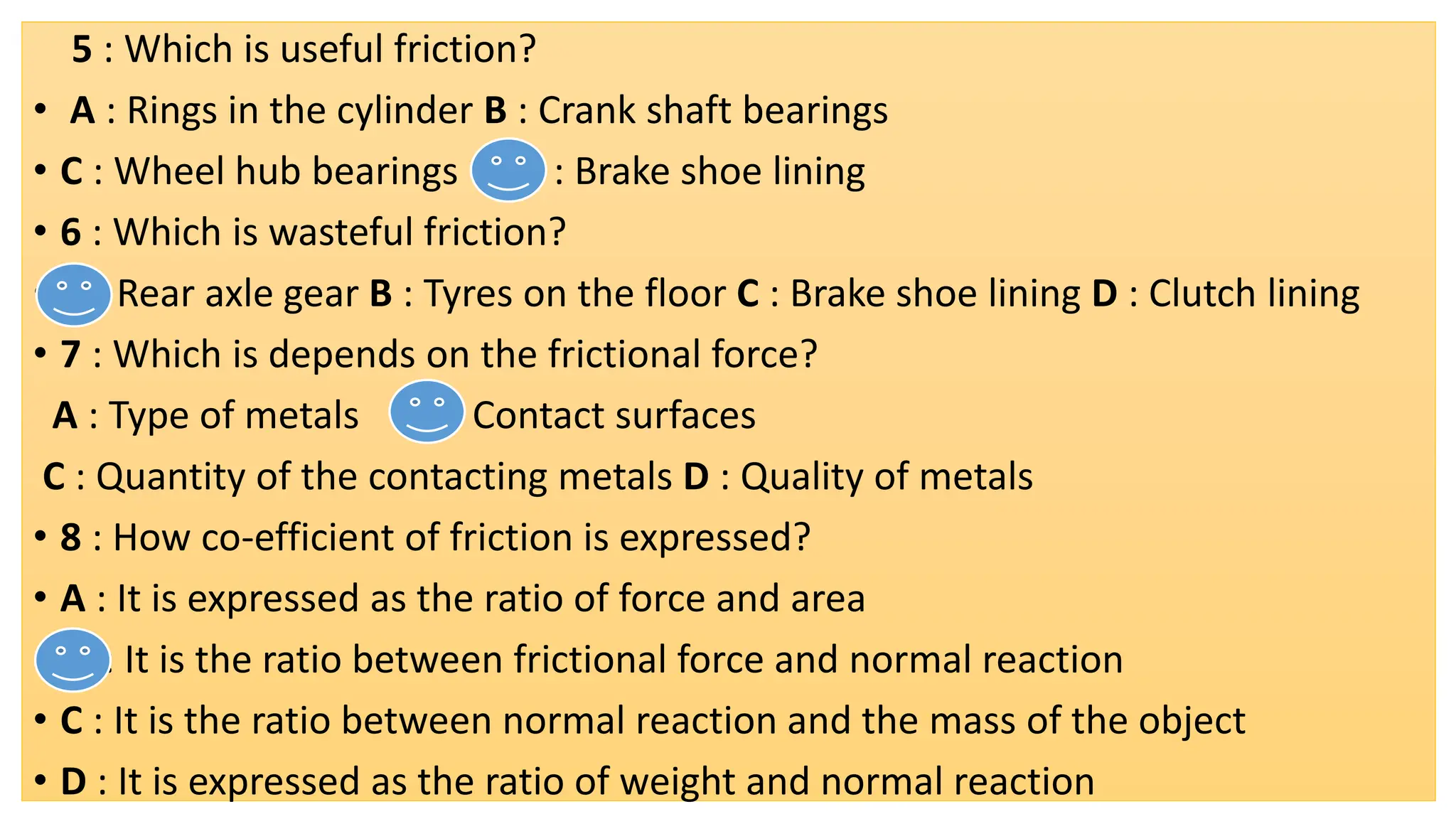
5 : Which is useful friction?
• A : Rings in the cylinder B : Crank shaft bearings
• C : Wheel hub bearings D : Brake shoe lining
• 6 : Which is wasteful friction?
• A : Rear axle gear B : Tyres on the floor C : Brake shoe lining D : Clutch lining
• 7 : Which is depends on the frictional force?
A : Type of metals B : Contact surfaces
C : Quantity of the contacting metals D : Quality of metals
• 8 : How co-efficient of friction is expressed?
• A : It is expressed as the ratio of force and area
• B : It is the ratio between frictional force and normal reaction
• C : It is the ratio between normal reaction and the mass of the object
• D : It is expressed as the ratio of weight and normal reaction
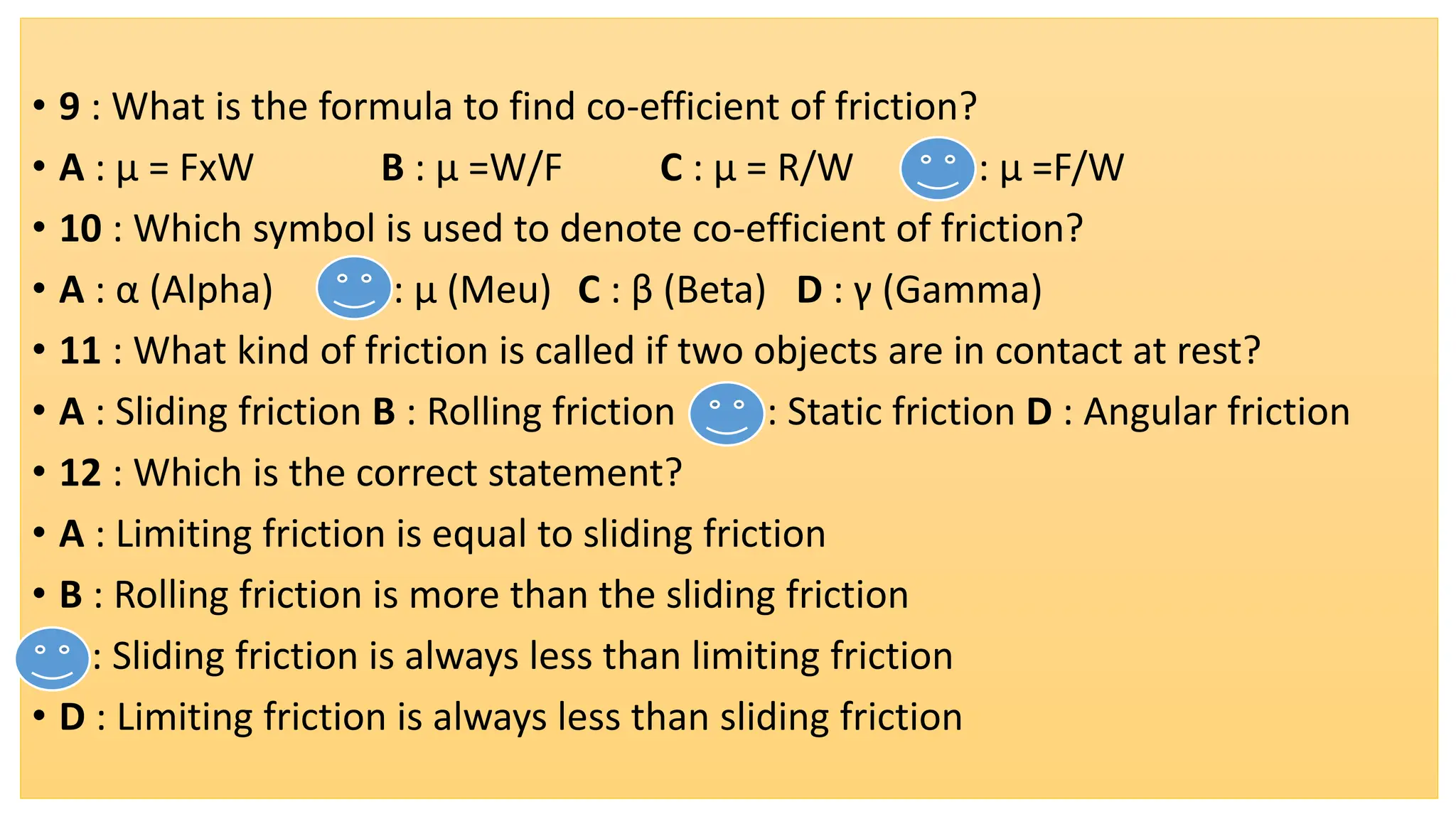
• 9 : What is the formula to find co-efficient of friction?
• A : μ = FxW B : μ =W/F C : μ = R/W D : μ =F/W
• 10 : Which symbol is used to denote co-efficient of friction?
• A : α (Alpha) B : μ (Meu) C : β (Beta) D : γ (Gamma)
• 11 : What kind of friction is called if two objects are in contact at rest?
• A : Sliding friction B : Rolling friction C : Static friction D : Angular friction
• 12 : Which is the correct statement?
• A : Limiting friction is equal to sliding friction
• B : Rolling friction is more than the sliding friction
• C : Sliding friction is always less than limiting friction
• D : Limiting friction is always less than sliding friction
13 : What is the formula to find the force if the object is just move up the
plane?
A : W( Sinθ-∅ )/Cos ∅ B : W( Sinθ+∅ )/Cos ∅
C : W( Sinθ+∅ )/Sin ∅ D : W( Cosθ+∅ )/Cos ∅
14 : Which of the angle is called angle of friction?
A : Angle – FOS B : Angle - ROS C : Angle - POS D : Angle - ROF
• 15 : What is the co-efficient of friction if the angle of friction is θ?
• A : Sin θ B : Cos θ C : Tan θ D : Cot θ
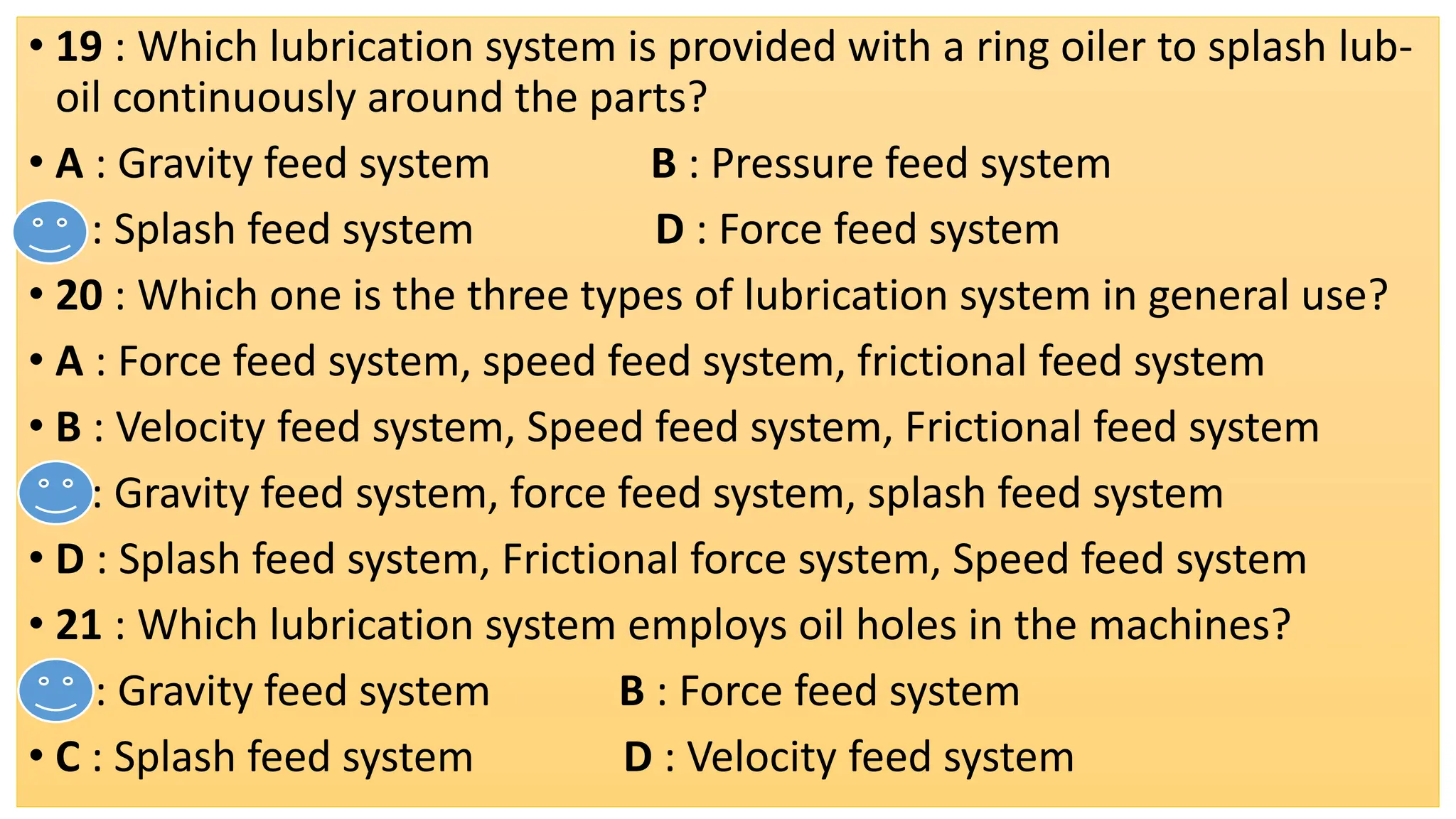
• 16 : What denotes the letter ʹRʹ in the given figure?
A : Force B : Resistance C : Load D : Normal reaction
• 17 : What is the purpose of a lubricant?
• A : To increase the pressure B : To increase friction
• C : To reduce friction D : To reduce pressure
• 18 : What type of lubricant is used in wick feed lubrication system ?
• A : Lub-oil B : Grease C : Coolant D : Cutting oil
• 19 : Which lubrication system is provided with a ring oiler to splash lub-
oil continuously around the parts?
• A : Gravity feed system B : Pressure feed system
• C : Splash feed system D : Force feed system
• 20 : Which one is the three types of lubrication system in general use?
• A : Force feed system, speed feed system, frictional feed system
• B : Velocity feed system, Speed feed system, Frictional feed system
• C : Gravity feed system, force feed system, splash feed system
• D : Splash feed system, Frictional force system, Speed feed system
• 21 : Which lubrication system employs oil holes in the machines?
• A : Gravity feed system B : Force feed system
• C : Splash feed system D : Velocity feed system
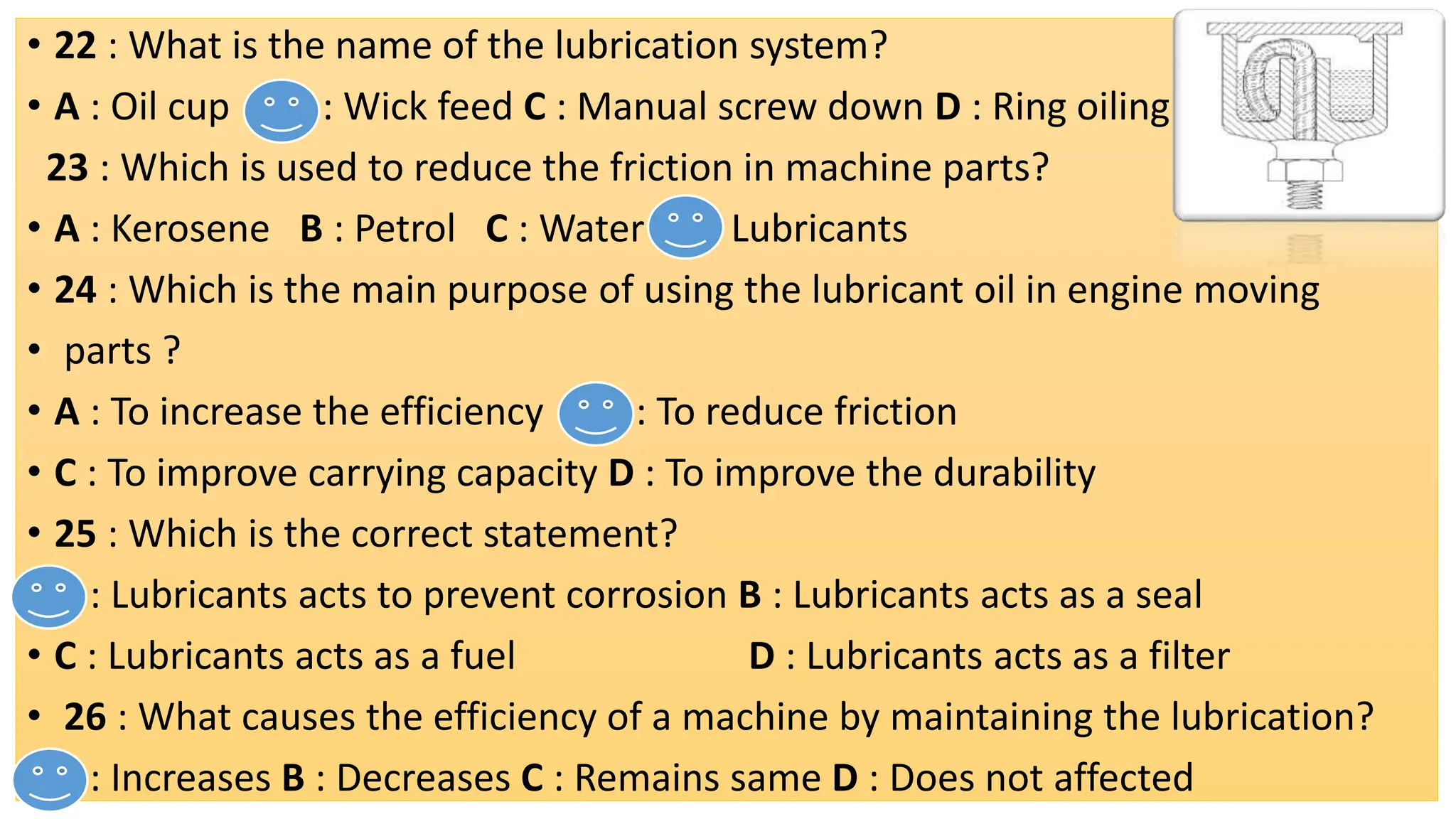
• 22 : What is the name of the lubrication system?
• A : Oil cup B : Wick feed C : Manual screw down D : Ring oiling
23 : Which is used to reduce the friction in machine parts?
• A : Kerosene B : Petrol C : Water D : Lubricants
• 24 : Which is the main purpose of using the lubricant oil in engine moving
• parts ?
• A : To increase the efficiency B : To reduce friction
• C : To improve carrying capacity D : To improve the durability
• 25 : Which is the correct statement?
• A : Lubricants acts to prevent corrosion B : Lubricants acts as a seal
• C : Lubricants acts as a fuel D : Lubricants acts as a filter
• 26 : What causes the efficiency of a machine by maintaining the lubrication?
• A : Increases B : Decreases C : Remains same D : Does not affected
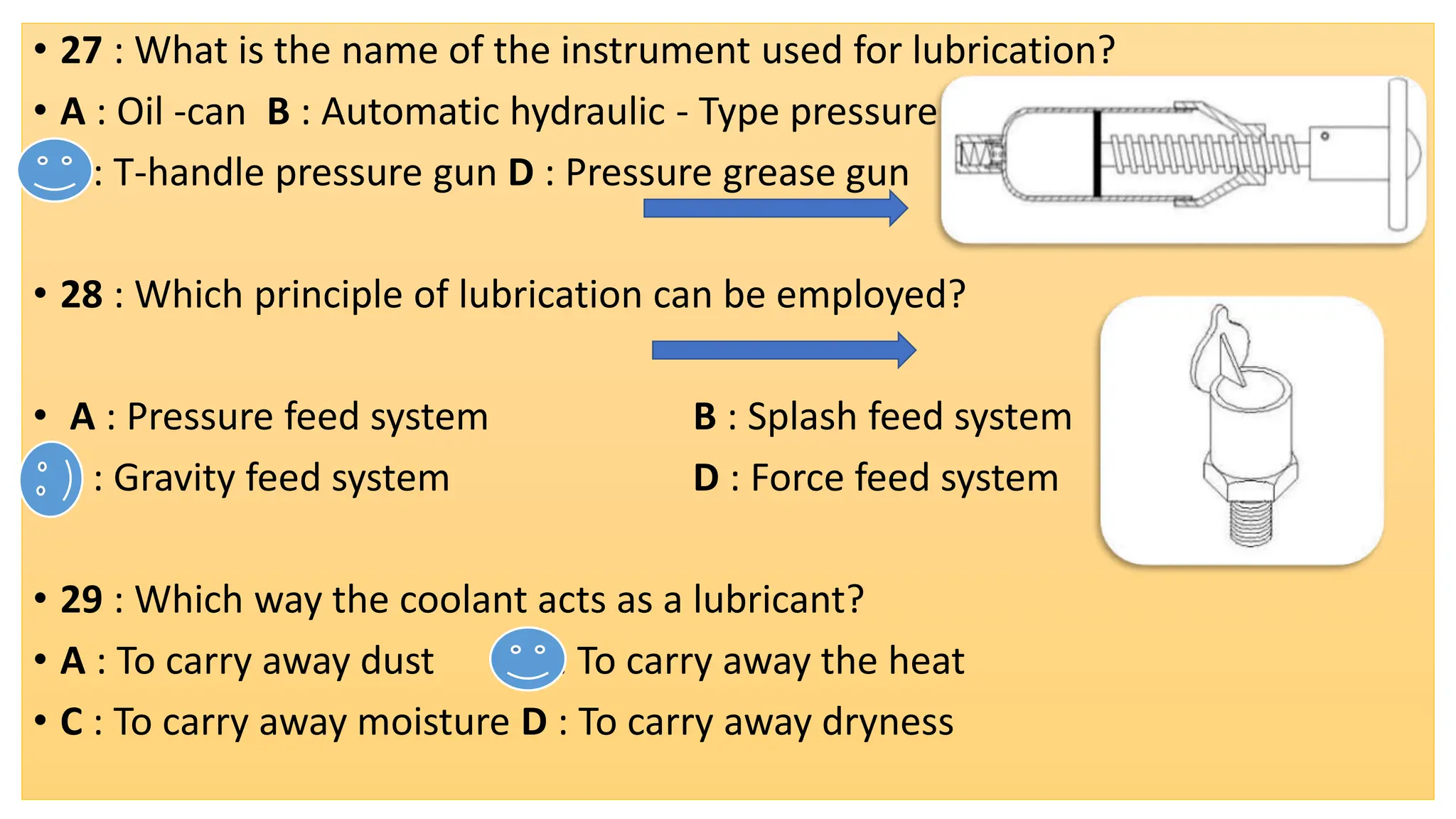
• 27 : What is the name of the instrument used for lubrication?
• A : Oil -can B : Automatic hydraulic - Type pressure gun
• C : T-handle pressure gun D : Pressure grease gun
• 28 : Which principle of lubrication can be employed?
• A : Pressure feed system B : Splash feed system
• C : Gravity feed system D : Force feed system
• 29 : Which way the coolant acts as a lubricant?
• A : To carry away dust B : To carry away the heat
• C : To carry away moisture D : To carry away dryness
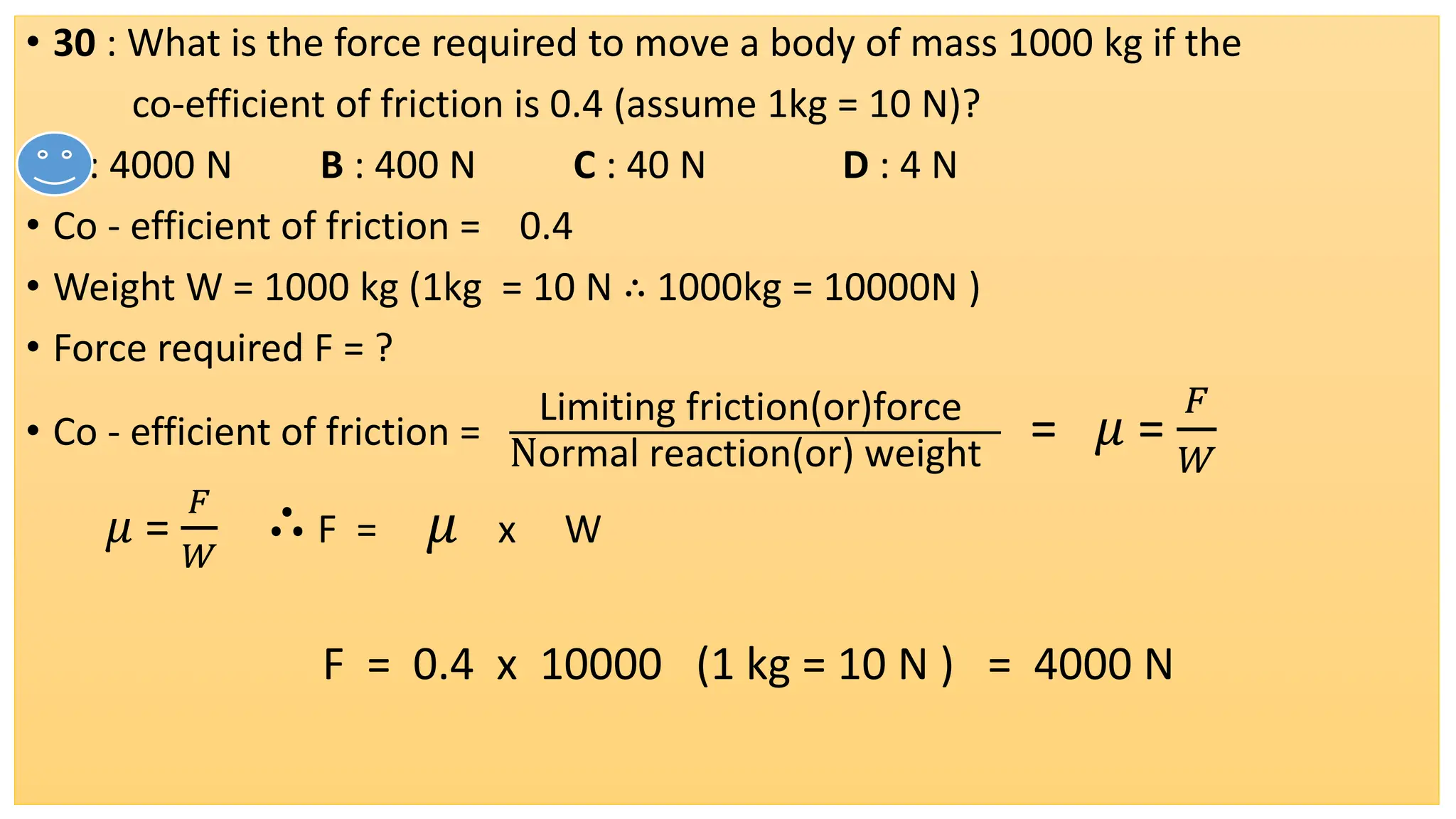
• 30 : What is the force required to move a body of mass 1000 kg if the
co-efficient of friction is 0.4 (assume 1kg = 10 N)?
• A : 4000 N B : 400 N C : 40 N D : 4 N
• Co - efficient of friction = 0.4
• Weight W = 1000 kg (1kg = 10 N ∴ 1000kg = 10000N )
• Force required F = ?
• Co - efficient of friction =
Limiting friction(or)force
Normal reaction(or) weight
= 𝜇 =
𝐹
𝑊
𝜇 =
𝐹
𝑊
∴F = 𝜇 x W
F = 0.4 x 10000 (1 kg = 10 N ) = 4000 N
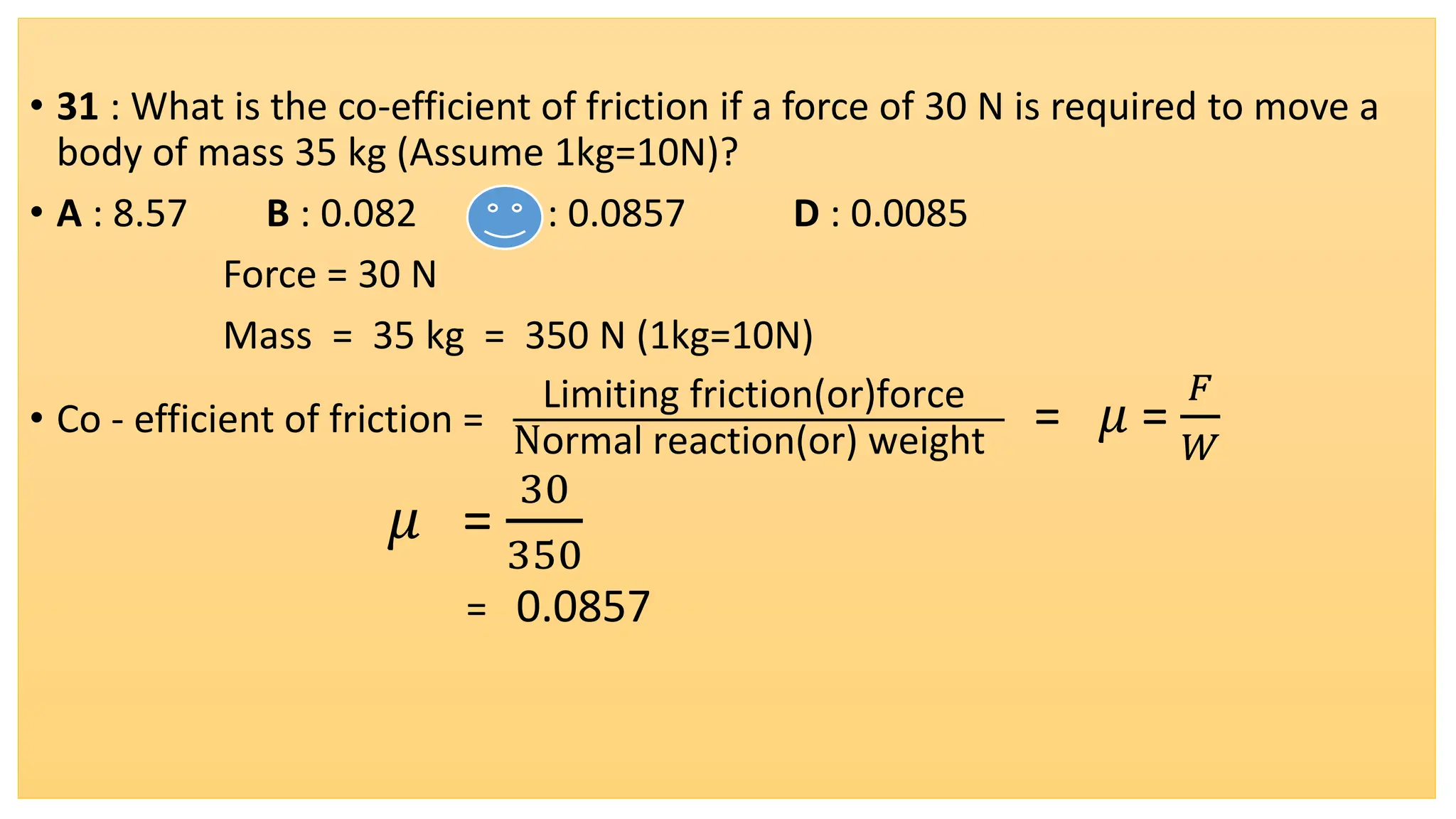
• 31 : What is the co-efficient of friction if a force of 30 N is required to move a
body of mass 35 kg (Assume 1kg=10N)?
• A : 8.57 B : 0.082 C : 0.0857 D : 0.0085
Force = 30 N
Mass = 35 kg = 350 N (1kg=10N)
• Co - efficient of friction =
Limiting friction(or)force
Normal reaction(or) weight
= 𝜇 =
𝐹
𝑊
𝜇 =
30
350
= 0.0857
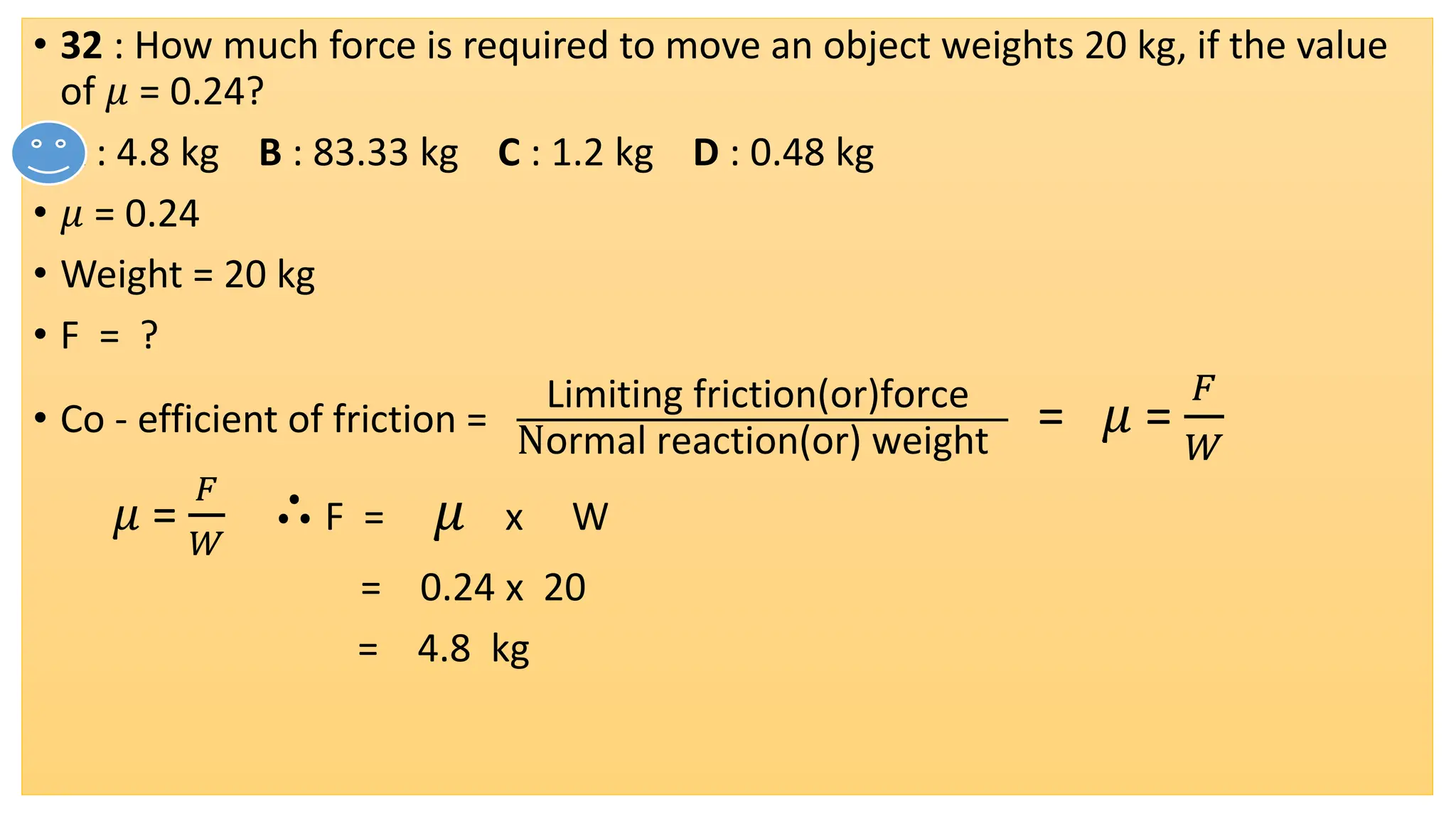
• 32 : How much force is required to move an object weights 20 kg, if the value
of 𝜇 = 0.24?
• A : 4.8 kg B : 83.33 kg C : 1.2 kg D : 0.48 kg
• 𝜇 = 0.24
• Weight = 20 kg
• F = ?
• Co - efficient of friction =
Limiting friction(or)force
Normal reaction(or) weight
= 𝜇 =
𝐹
𝑊
𝜇 =
𝐹
𝑊
∴F = 𝜇 x W
= 0.24 x 20
= 4.8 kg
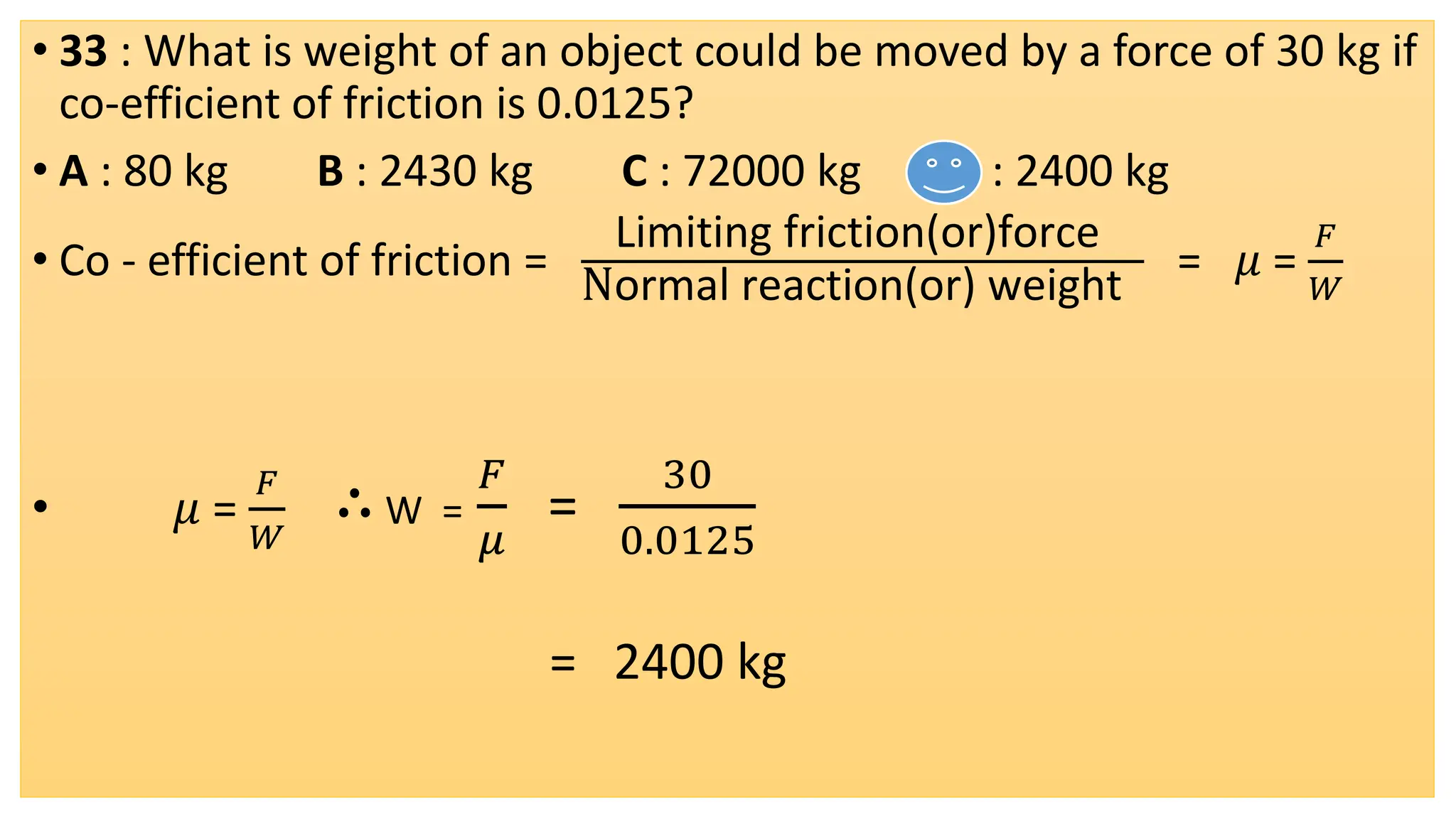
• 33 : What is weight of an object could be moved by a force of 30 kg if
co-efficient of friction is 0.0125?
• A : 80 kg B : 2430 kg C : 72000 kg D : 2400 kg
• Co - efficient of friction =
Limiting friction(or)force
Normal reaction(or) weight
= 𝜇 =
𝐹
𝑊
• 𝜇 =
𝐹
𝑊
∴W =
𝐹
𝜇
=
30
0.0125
= 2400 kg
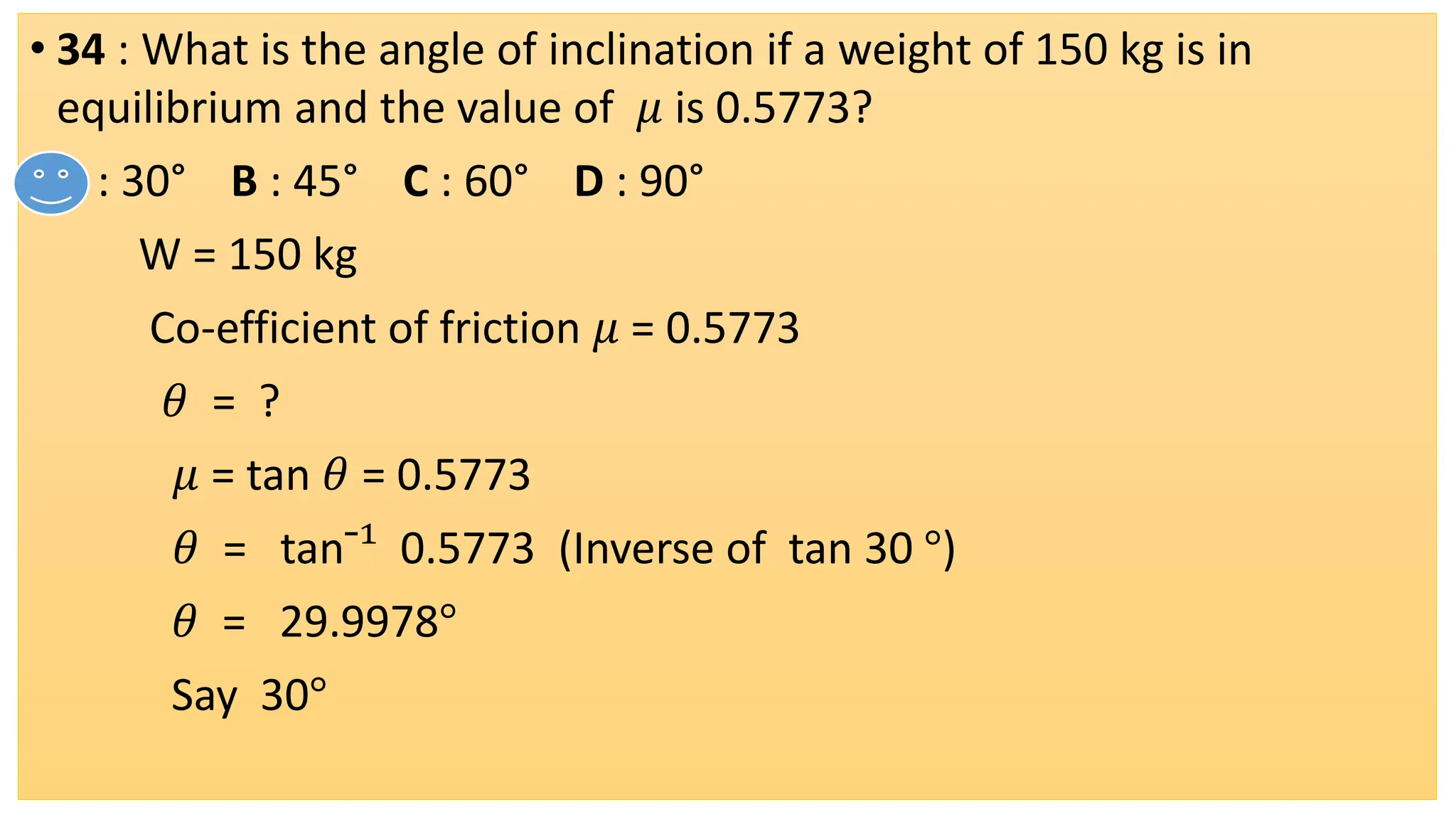
• 34 : What is the angle of inclination if a weight of 150 kg is in
equilibrium and the value of 𝜇 is 0.5773?
• A : 30° B : 45° C : 60° D : 90°
W = 150 kg
Co-efficient of friction 𝜇 = 0.5773
𝜃 = ?
𝜇 = tan 𝜃 = 0.5773
𝜃 = tan¯¹ 0.5773 (Inverse of tan 30 °)
𝜃 = 29.9978°
Say 30°
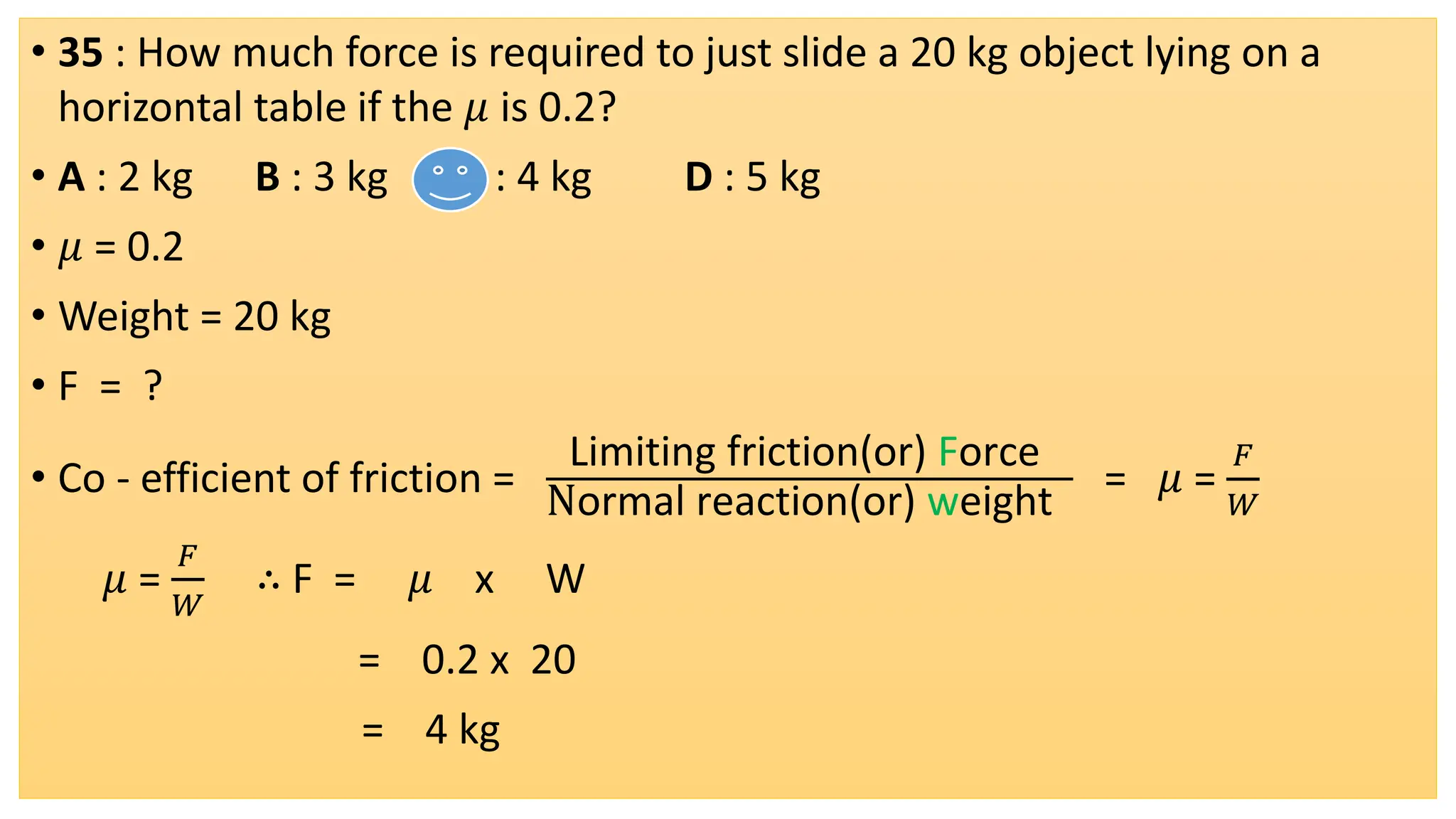
• 35 : How much force is required to just slide a 20 kg object lying on a
horizontal table if the 𝜇 is 0.2?
• A : 2 kg B : 3 kg C : 4 kg D : 5 kg
• 𝜇 = 0.2
• Weight = 20 kg
• F = ?
• Co - efficient of friction =
Limiting friction(or) Force
Normal reaction(or) weight
= 𝜇 =
𝐹
𝑊
𝜇 =
𝐹
𝑊
∴ F = 𝜇 x W
= 0.2 x 20
= 4 kg
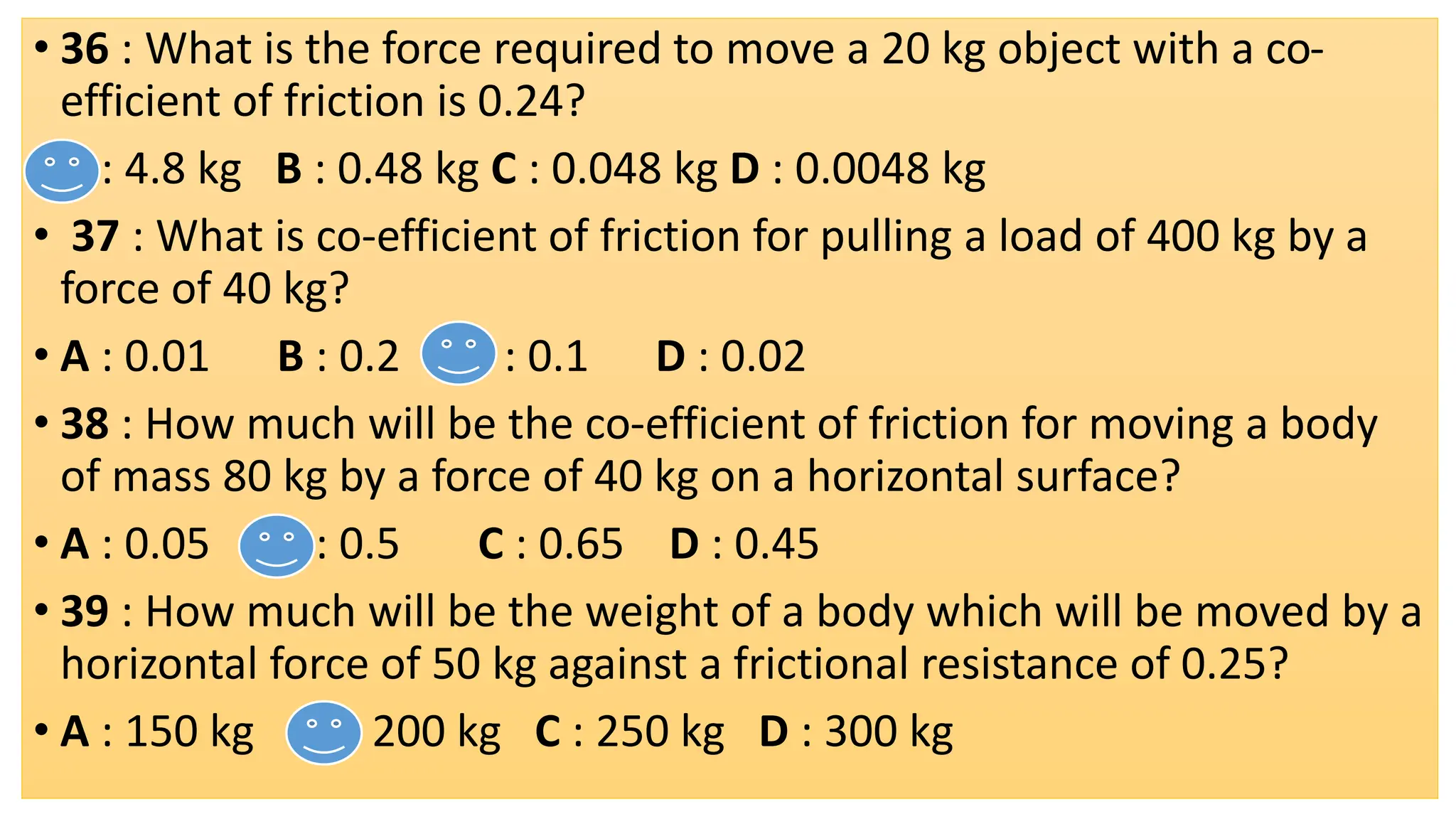
• 36 : What is the force required to move a 20 kg object with a co-
efficient of friction is 0.24?
• A : 4.8 kg B : 0.48 kg C : 0.048 kg D : 0.0048 kg
• 37 : What is co-efficient of friction for pulling a load of 400 kg by a
force of 40 kg?
• A : 0.01 B : 0.2 C : 0.1 D : 0.02
• 38 : How much will be the co-efficient of friction for moving a body
of mass 80 kg by a force of 40 kg on a horizontal surface?
• A : 0.05 B : 0.5 C : 0.65 D : 0.45
• 39 : How much will be the weight of a body which will be moved by a
horizontal force of 50 kg against a frictional resistance of 0.25?
• A : 150 kg B : 200 kg C : 250 kg D : 300 kg
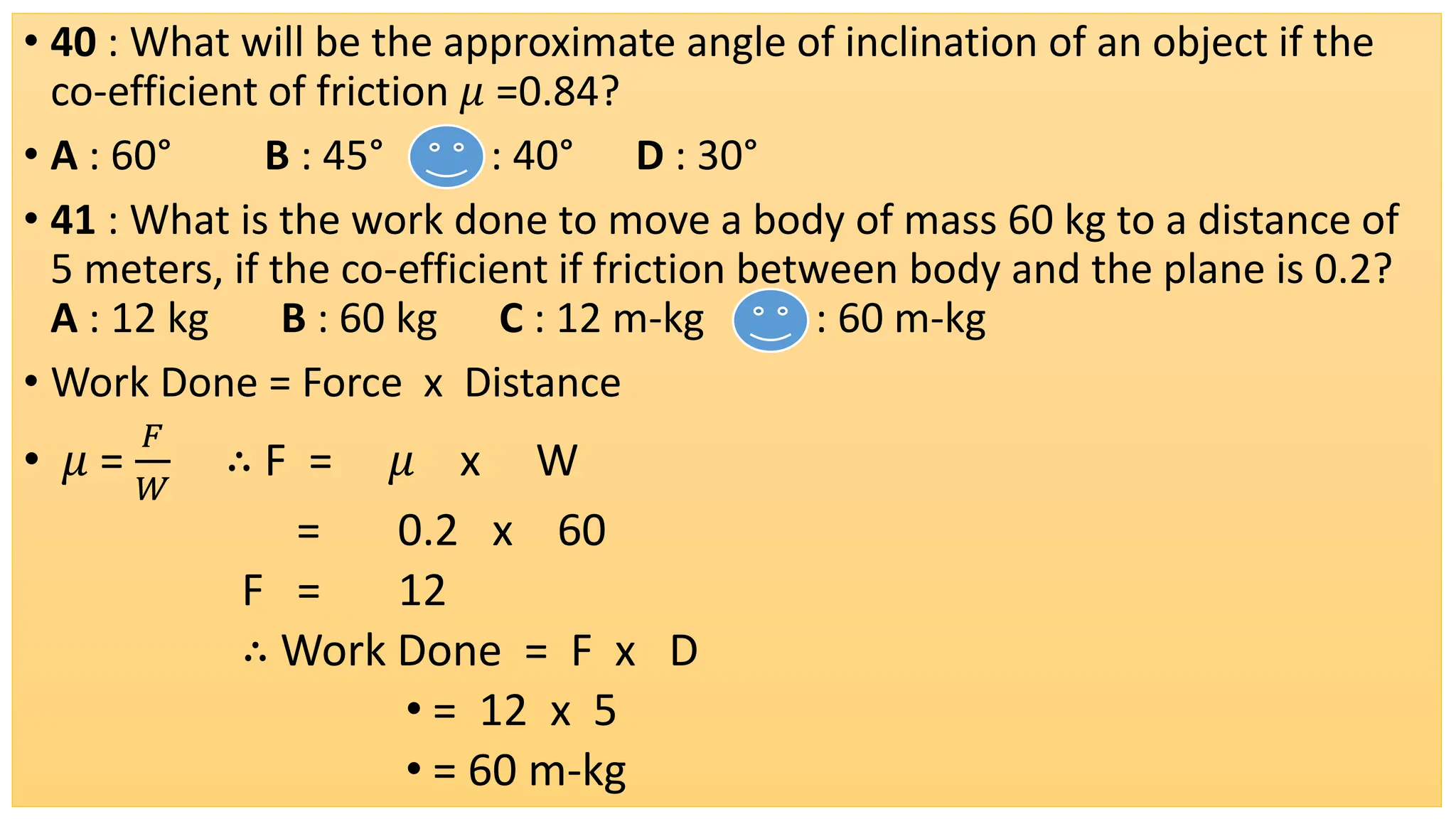
• 40 : What will be the approximate angle of inclination of an object if the
co-efficient of friction 𝜇 =0.84?
• A : 60° B : 45° C : 40° D : 30°
• 41 : What is the work done to move a body of mass 60 kg to a distance of
5 meters, if the co-efficient if friction between body and the plane is 0.2?
A : 12 kg B : 60 kg C : 12 m-kg D : 60 m-kg
• Work Done = Force x Distance
• 𝜇 =
𝐹
𝑊
∴ F = 𝜇 x W
= 0.2 x 60
F = 12
∴ Work Done = F x D
• = 12 x 5
• = 60 m-kg
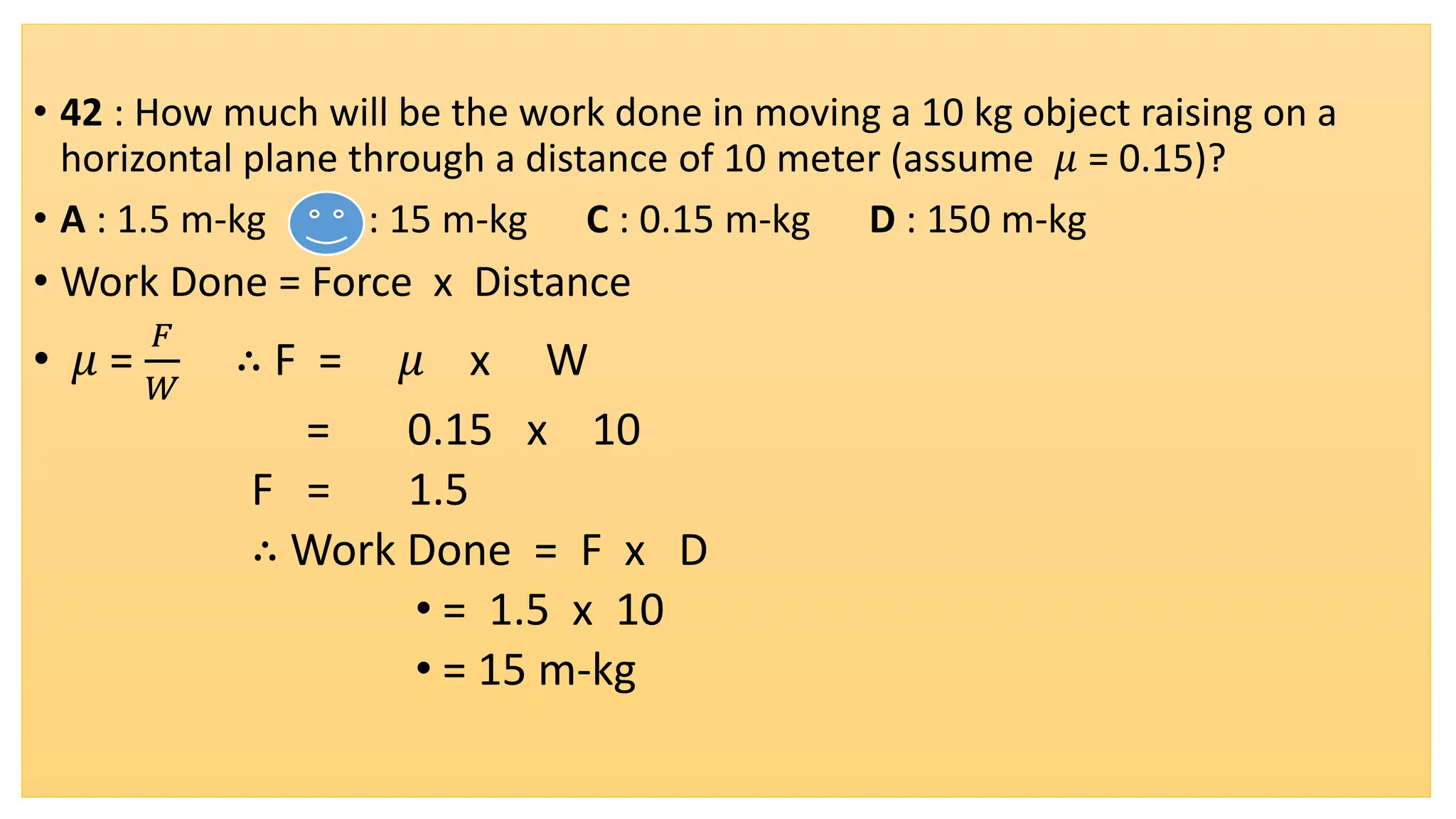
• 42 : How much will be the work done in moving a 10 kg object raising on a
horizontal plane through a distance of 10 meter (assume 𝜇 = 0.15)?
• A : 1.5 m-kg B : 15 m-kg C : 0.15 m-kg D : 150 m-kg
• Work Done = Force x Distance
• 𝜇 =
𝐹
𝑊
∴ F = 𝜇 x W
= 0.15 x 10
F = 1.5
∴ Work Done = F x D
• = 1.5 x 10
• = 15 m-kg
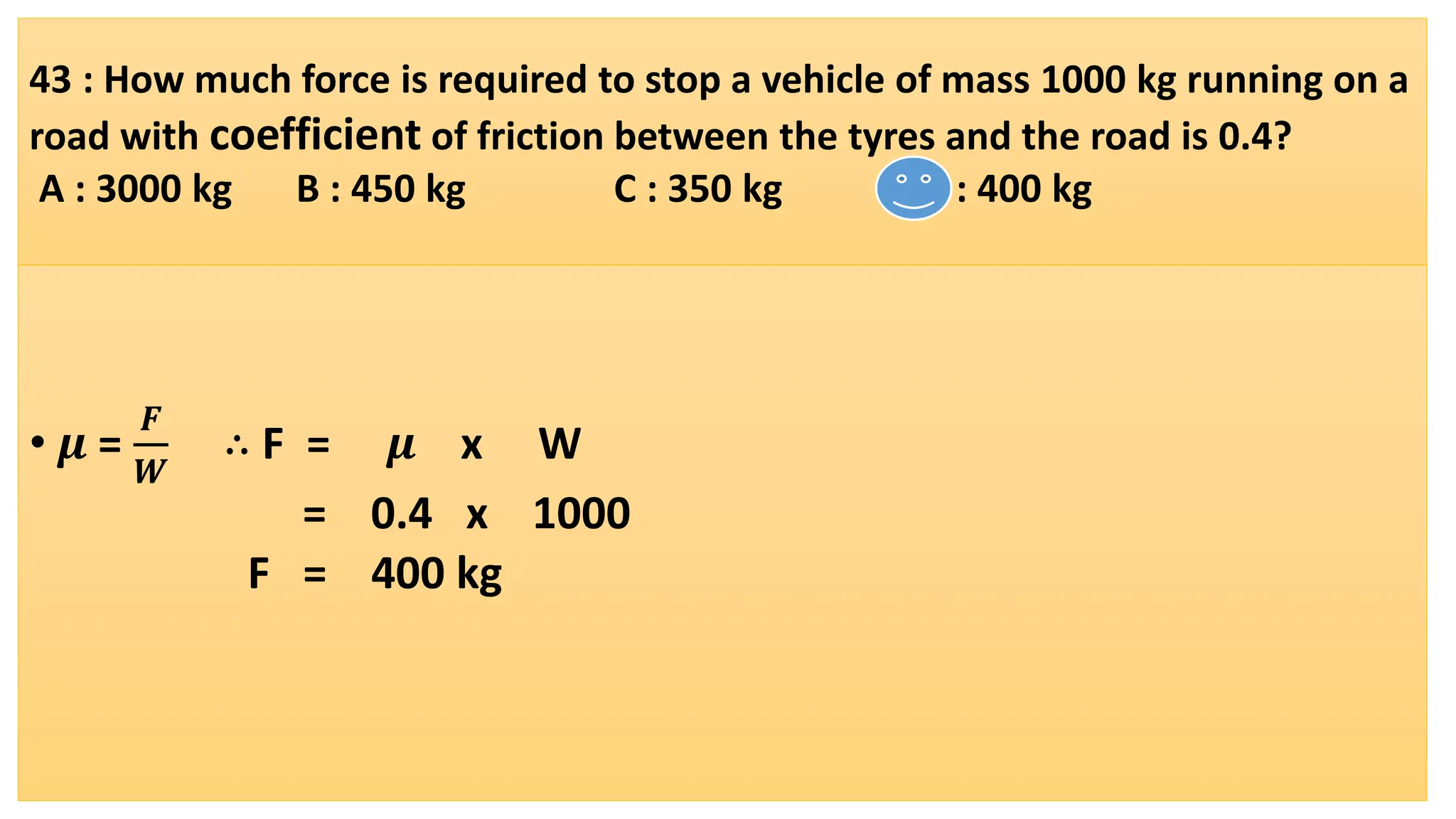
43 : How much force is required to stop a vehicle of mass 1000 kg running on a
road with coefficient of friction between the tyres and the road is 0.4?
A : 3000 kg B : 450 kg C : 350 kg D : 400 kg
• 𝝁 =
𝑭
𝑾
∴ F = 𝝁 x W
= 0.4 x 1000
F = 400 kg
THANK YOU
ALL
FOR ANY DOUBTS
Please don’t hesitate to contact me
by
9444224363
GOPINATHMALLIGA@GMAIL.COM
FRICTION - WORKSHOP CALCUALTION AND SCIENCE 2ND YEAR

FRICTION - WORKSHOP CALCUALTION AND SCIENCE 2ND YEAR

  • 1.
    Presented by Mr. T.GOPINATH, ASSISTANT TRAINING OFFICER, GOVT. I T I , AMBATTUR. +91 9444224363 gopinathmalliga@gmail.com FRICTION உராய்வு
  • 2.
    Definition If a solidsurface rubbed with a another solid , a force is created between the two solids which acts in the opposite direction of motion or tries to obstruct the motion of the object, this force is called frictional force. This happens due to roughness of the two surfaces. • The act of rubbing one thing against another is called as FRICTION. • The force that causes a moving object to slow down when it is touching another object • It depends upon the normal reaction between the contacting surfaces and the nature of the surfaces. No surface is absolutely friction less.
  • 3.
    Friction is theforce resisting the relative motion of solid surfaces, fluid layers, and material elements sliding against each other. There are several types of friction: • The friction between the two surfaces converts kinetic energy into thermal energy •Friction plays an important role in our daily life. It would not be possible to walk without friction between our foot and floor. Vehicles are able to run on roads because of the friction between the wheels and road.
  • 4.
    Frictional Force • Forcesacting on a body when a pulling force is applied to move • • Weight of the block acting vertically downward (W) • • The normal reaction which acts upwards (R) • • The applied pulling force (F) and The frictional force (Ff) • When the body is about to move W=R, F=P • When pulling force is increased the body starts to move.
  • 6.
    Types of friction •1 Static friction The friction between two solid objects when at rest is called static friction. • Eg. Static friction can prevent an object from sliding down on a sloped surface Limiting friction • When the frictional force (F) is equal to the applied pulling force (P) then the friction between two surfaces is known • as limiting friction. (i.e F=P) • 2 Dynamic friction • It is the friction between two objects, when are in motion • is called dynamic friction. It is also called kinetic friction. • Sliding friction • It is the friction experienced by an object when its slides over another object. Sliding friction is always less than limiting friction. • Rolling friction • It is the friction that occurs when a circular object such as a ball or roller rolls on a flat surface. Rolling friction is less than sliding friction. (ball or roller bearing)
  • 7.
    LAWS OF FRICTION •• Frictional force is directly proportional to the normal reaction between contacting surfaces. • • Frictional force acts opposite to the direction of motion. • • Frictional force depends on the nature of contacting surfaces. • • Frictional force is independent over the area and shape of contacting surfaces.
  • 8.
    Applications Friction is animportant factor in many engineering disciplines. • Transportation Automobile brakes inherently rely on friction, slowing a vehicle by converting its kinetic energy into heat. Incidentally, dispersing this large amount of heat safely is one technical challenge in designing brake systems. Disk brakes rely on friction between a disc and brake pads that are squeezed transversely against the rotating disc. In drum brakes, brake shoes or pads are pressed outwards against a rotating cylinder (brake drum) to create friction. Since braking discs can be more efficiently cooled than drums, disc brakes have better stopping performance. • Rail adhesion refers to the grip wheels of a train have on the rails • Road slipperiness is an important design and safety factor for automobiles • Road texture affects the interaction of tires and the driving surface
  • 9.
    Measurement A tribometer isan instrument that measures friction on a surface. A profilograph is a device used to measure pavement surface roughness. Household usage • Friction is used to heat and ignite matchsticks (friction between the head of a matchstick and the rubbing surface of the match box). • Sticky pads are used to prevent object from slipping off smooth surfaces by effectively increasing the friction coefficient between the surface and the object.
  • 10.
    Coefficient of friction •It is a ratio between the frictional force to the normal reaction when the body is just about to move but at equilibrium. It is represented by symbol 𝝁 (read as ‘meu’) and it is the ratio of same units it has NO UNIT Therefore • Co - efficient of friction = Limiting friction(or)force Normal reaction(or) weight = 𝝁 = 𝑭 𝑾
  • 11.
    Angle of friction •The forces acting on a body when it is just about to move by the application of a pulling force are W, R, P and F. The forces 'R' and 'F' are compounded and we get the resultant force 'S'. The angle formed by 'S' with 'R' is the angle of friction. • Therefore tan 𝜃 = 𝐹 𝑊 tan 𝜃 = 𝜇
  • 12.
    Angle of repose •A body placed on an inclined surface remains • at rest till the angle of inclination equals the • angle of friction. When it exceeds ,the body • starts sliding down. This is known as • angle of repose.
  • 13.
    • Advantages offriction • 1 .Helps us to walk without slipping. • 2 .Used to stop vehicles when brakes are applied. • 3 .Movement of vehicles due to friction between revolving wheels with tyres and the road. • 4 .Power transmission using gear drive or belt pulley drive. • 5 .Using friction we can sharp any object and also to hold it. • 6 .Nails and screws are held in wood by friction. • 7 .Heat is produced when two rough surfaces are rubbed against each other. • Disadvantages of friction • 1. It causes wear and tear of the machine parts. • 2. It produces heat and may cause melting of machine • parts. To avoid production of heat using of coolant is necessary. • 3. It reduces efficiency of a machine. • 4 It reduces speed of the moving object. eg. spindle, shaft, piston etc.
  • 14.
    How Friction canbe reduced ? By polishing the surface to make them smooth. By using suitable lubricants (oil, grease) between the moving parts. By the use of wheel By using ball bearings and roller bearings.
  • 15.
    MCQ • 1 :Which is the law of friction? • A : Friction force is independent over the area and shape of contacting surfaces • B : Frictional force is inversely proportional to the normal reaction • C : Frictional force acts in the same direction of motion • D : Frictional force is not a dependent on nature of contacting surface • 2 : What is the direction of frictional force against a motional object? • A : Inclined to the object B : Opposite to the object • C : Parallel to the object D : Perpendicular to the object • 3 : Which force is directly proportional to the normal reaction between contacting surfaces? • A : Pulling force B : Pushing force C : Frictional force D : Allied force • 4 : Which one of the following acts in between the wheels and roads, if vehicles are able to run on roads? • A : Friction B : Corrosion C : Erosion D : Motion
  • 16.
    5 : Whichis useful friction? • A : Rings in the cylinder B : Crank shaft bearings • C : Wheel hub bearings D : Brake shoe lining • 6 : Which is wasteful friction? • A : Rear axle gear B : Tyres on the floor C : Brake shoe lining D : Clutch lining • 7 : Which is depends on the frictional force? A : Type of metals B : Contact surfaces C : Quantity of the contacting metals D : Quality of metals • 8 : How co-efficient of friction is expressed? • A : It is expressed as the ratio of force and area • B : It is the ratio between frictional force and normal reaction • C : It is the ratio between normal reaction and the mass of the object • D : It is expressed as the ratio of weight and normal reaction
  • 17.
    • 9 :What is the formula to find co-efficient of friction? • A : μ = FxW B : μ =W/F C : μ = R/W D : μ =F/W • 10 : Which symbol is used to denote co-efficient of friction? • A : α (Alpha) B : μ (Meu) C : β (Beta) D : γ (Gamma) • 11 : What kind of friction is called if two objects are in contact at rest? • A : Sliding friction B : Rolling friction C : Static friction D : Angular friction • 12 : Which is the correct statement? • A : Limiting friction is equal to sliding friction • B : Rolling friction is more than the sliding friction • C : Sliding friction is always less than limiting friction • D : Limiting friction is always less than sliding friction
  • 18.
    13 : Whatis the formula to find the force if the object is just move up the plane? A : W( Sinθ-∅ )/Cos ∅ B : W( Sinθ+∅ )/Cos ∅ C : W( Sinθ+∅ )/Sin ∅ D : W( Cosθ+∅ )/Cos ∅ 14 : Which of the angle is called angle of friction? A : Angle – FOS B : Angle - ROS C : Angle - POS D : Angle - ROF
  • 19.
    • 15 :What is the co-efficient of friction if the angle of friction is θ? • A : Sin θ B : Cos θ C : Tan θ D : Cot θ • 16 : What denotes the letter ʹRʹ in the given figure? A : Force B : Resistance C : Load D : Normal reaction • 17 : What is the purpose of a lubricant? • A : To increase the pressure B : To increase friction • C : To reduce friction D : To reduce pressure • 18 : What type of lubricant is used in wick feed lubrication system ? • A : Lub-oil B : Grease C : Coolant D : Cutting oil
  • 20.
    • 19 :Which lubrication system is provided with a ring oiler to splash lub- oil continuously around the parts? • A : Gravity feed system B : Pressure feed system • C : Splash feed system D : Force feed system • 20 : Which one is the three types of lubrication system in general use? • A : Force feed system, speed feed system, frictional feed system • B : Velocity feed system, Speed feed system, Frictional feed system • C : Gravity feed system, force feed system, splash feed system • D : Splash feed system, Frictional force system, Speed feed system • 21 : Which lubrication system employs oil holes in the machines? • A : Gravity feed system B : Force feed system • C : Splash feed system D : Velocity feed system
  • 21.
    • 22 :What is the name of the lubrication system? • A : Oil cup B : Wick feed C : Manual screw down D : Ring oiling 23 : Which is used to reduce the friction in machine parts? • A : Kerosene B : Petrol C : Water D : Lubricants • 24 : Which is the main purpose of using the lubricant oil in engine moving • parts ? • A : To increase the efficiency B : To reduce friction • C : To improve carrying capacity D : To improve the durability • 25 : Which is the correct statement? • A : Lubricants acts to prevent corrosion B : Lubricants acts as a seal • C : Lubricants acts as a fuel D : Lubricants acts as a filter • 26 : What causes the efficiency of a machine by maintaining the lubrication? • A : Increases B : Decreases C : Remains same D : Does not affected
  • 22.
    • 27 :What is the name of the instrument used for lubrication? • A : Oil -can B : Automatic hydraulic - Type pressure gun • C : T-handle pressure gun D : Pressure grease gun • 28 : Which principle of lubrication can be employed? • A : Pressure feed system B : Splash feed system • C : Gravity feed system D : Force feed system • 29 : Which way the coolant acts as a lubricant? • A : To carry away dust B : To carry away the heat • C : To carry away moisture D : To carry away dryness
  • 23.
    • 30 :What is the force required to move a body of mass 1000 kg if the co-efficient of friction is 0.4 (assume 1kg = 10 N)? • A : 4000 N B : 400 N C : 40 N D : 4 N • Co - efficient of friction = 0.4 • Weight W = 1000 kg (1kg = 10 N ∴ 1000kg = 10000N ) • Force required F = ? • Co - efficient of friction = Limiting friction(or)force Normal reaction(or) weight = 𝜇 = 𝐹 𝑊 𝜇 = 𝐹 𝑊 ∴F = 𝜇 x W F = 0.4 x 10000 (1 kg = 10 N ) = 4000 N
  • 24.
    • 31 :What is the co-efficient of friction if a force of 30 N is required to move a body of mass 35 kg (Assume 1kg=10N)? • A : 8.57 B : 0.082 C : 0.0857 D : 0.0085 Force = 30 N Mass = 35 kg = 350 N (1kg=10N) • Co - efficient of friction = Limiting friction(or)force Normal reaction(or) weight = 𝜇 = 𝐹 𝑊 𝜇 = 30 350 = 0.0857
  • 25.
    • 32 :How much force is required to move an object weights 20 kg, if the value of 𝜇 = 0.24? • A : 4.8 kg B : 83.33 kg C : 1.2 kg D : 0.48 kg • 𝜇 = 0.24 • Weight = 20 kg • F = ? • Co - efficient of friction = Limiting friction(or)force Normal reaction(or) weight = 𝜇 = 𝐹 𝑊 𝜇 = 𝐹 𝑊 ∴F = 𝜇 x W = 0.24 x 20 = 4.8 kg
  • 26.
    • 33 :What is weight of an object could be moved by a force of 30 kg if co-efficient of friction is 0.0125? • A : 80 kg B : 2430 kg C : 72000 kg D : 2400 kg • Co - efficient of friction = Limiting friction(or)force Normal reaction(or) weight = 𝜇 = 𝐹 𝑊 • 𝜇 = 𝐹 𝑊 ∴W = 𝐹 𝜇 = 30 0.0125 = 2400 kg
  • 27.
    • 34 :What is the angle of inclination if a weight of 150 kg is in equilibrium and the value of 𝜇 is 0.5773? • A : 30° B : 45° C : 60° D : 90° W = 150 kg Co-efficient of friction 𝜇 = 0.5773 𝜃 = ? 𝜇 = tan 𝜃 = 0.5773 𝜃 = tan¯¹ 0.5773 (Inverse of tan 30 °) 𝜃 = 29.9978° Say 30°
  • 28.
    • 35 :How much force is required to just slide a 20 kg object lying on a horizontal table if the 𝜇 is 0.2? • A : 2 kg B : 3 kg C : 4 kg D : 5 kg • 𝜇 = 0.2 • Weight = 20 kg • F = ? • Co - efficient of friction = Limiting friction(or) Force Normal reaction(or) weight = 𝜇 = 𝐹 𝑊 𝜇 = 𝐹 𝑊 ∴ F = 𝜇 x W = 0.2 x 20 = 4 kg
  • 29.
    • 36 :What is the force required to move a 20 kg object with a co- efficient of friction is 0.24? • A : 4.8 kg B : 0.48 kg C : 0.048 kg D : 0.0048 kg • 37 : What is co-efficient of friction for pulling a load of 400 kg by a force of 40 kg? • A : 0.01 B : 0.2 C : 0.1 D : 0.02 • 38 : How much will be the co-efficient of friction for moving a body of mass 80 kg by a force of 40 kg on a horizontal surface? • A : 0.05 B : 0.5 C : 0.65 D : 0.45 • 39 : How much will be the weight of a body which will be moved by a horizontal force of 50 kg against a frictional resistance of 0.25? • A : 150 kg B : 200 kg C : 250 kg D : 300 kg
  • 30.
    • 40 :What will be the approximate angle of inclination of an object if the co-efficient of friction 𝜇 =0.84? • A : 60° B : 45° C : 40° D : 30° • 41 : What is the work done to move a body of mass 60 kg to a distance of 5 meters, if the co-efficient if friction between body and the plane is 0.2? A : 12 kg B : 60 kg C : 12 m-kg D : 60 m-kg • Work Done = Force x Distance • 𝜇 = 𝐹 𝑊 ∴ F = 𝜇 x W = 0.2 x 60 F = 12 ∴ Work Done = F x D • = 12 x 5 • = 60 m-kg
  • 31.
    • 42 :How much will be the work done in moving a 10 kg object raising on a horizontal plane through a distance of 10 meter (assume 𝜇 = 0.15)? • A : 1.5 m-kg B : 15 m-kg C : 0.15 m-kg D : 150 m-kg • Work Done = Force x Distance • 𝜇 = 𝐹 𝑊 ∴ F = 𝜇 x W = 0.15 x 10 F = 1.5 ∴ Work Done = F x D • = 1.5 x 10 • = 15 m-kg
  • 32.
    43 : Howmuch force is required to stop a vehicle of mass 1000 kg running on a road with coefficient of friction between the tyres and the road is 0.4? A : 3000 kg B : 450 kg C : 350 kg D : 400 kg • 𝝁 = 𝑭 𝑾 ∴ F = 𝝁 x W = 0.4 x 1000 F = 400 kg
  • 33.
    THANK YOU ALL FOR ANYDOUBTS Please don’t hesitate to contact me by 9444224363 GOPINATHMALLIGA@GMAIL.COM