Freshmen -15
By Christina Hwang, Joanne Kim, Hye Jin Lee, Audrey Park, Ji Young
                              Park
Overview
• Problem: First year students at Rutgers University—New
  Brunswick gaining weight

• Population: First year students at Rutgers University—New
  Brunswick

• Paradigm: Freshman 15 Program at University of West
  Virginia, Cornell University Wellness Program, Sunday Workout
  Program at BEST Hall

• Plan: College weight gain prevention program for first year
  students

• Patron: Centers for Disease Control and Prevention (CDC), Health
  Outreach, Promotion and Education (H.O.P.E.), New Jersey
  Department of Health and Senior Services

• Price: $1,787
problem
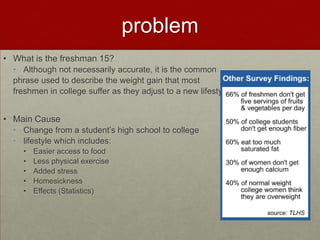
• What is the freshman 15?
  • Although not necessarily accurate, it is the common
  phrase used to describe the weight gain that most
  freshmen in college suffer as they adjust to a new lifestyle.


• Main Cause
  • Change from a student’s high school to college
  • lifestyle which includes:
    •   Easier access to food
    •   Less physical exercise
    •   Added stress
    •   Homesickness
    •   Effects (Statistics)
problem


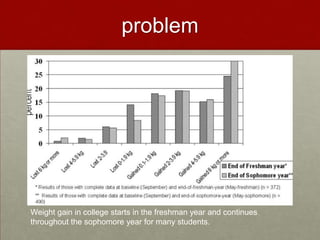
Weight gain in college starts in the freshman year and continues
throughout the sophomore year for many students.
PROBLEM
problem
• Scholar #4, Scholar #1
  • Mental and emotional effects
  • Lead to eating disorders
• Scholarly #5:
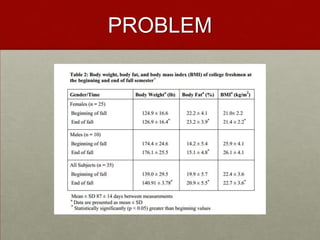
  • Study on female freshman students, body mass index was
    recorded
  • Questionnaire for relationship between weight gain and
    eating disorder

• Scholarly #2, Scholar #3, Popular #1:
  • The rate of weight gain was rapid in the first semester
  • Not dependent on gender, in age, ethnicity.
population

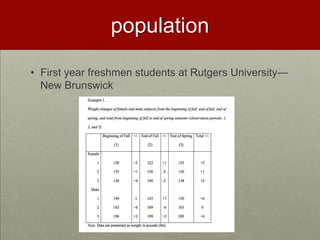
• First year freshmen students at Rutgers University—
  New Brunswick
population

• Popular #3, Popular #5, Popular #2:
 • Research in Cornell University
 • Average of 4 pounds/12 weeks
 • Research by the federal government
 • Factors of weight gain during freshman year: evening
   snacks, lack of sleep due to studying
 • Significant weight gain
paradigm
• West Virginia University: Freshman Fifteen Program
  • 14-week program based on a point system. Each pound of
    weight, percent body fat, and circumference measurement
    will be worth points.
  • Winner receives a prize.

• Rutgers University: B.E.S.T. Sunday Workout Program
  • Workout event every Sunday.
  • Credits to participants.


• Cornell University Wellness Program
  • Two Weight Watchers groups on Cornell campus.
  • In-person guidance, strategies, and tips.
paradigm

• Popular #4
 • Weight gain amongst freshmen students in Rutgers
   University and possible ways to prevent it.
 • Different programs running on campus in order to
   prevent “Freshman 15.”
PLAN


Using Social media platforms to reach out to people
PLAN

• To create a college weight gain prevention program
  for first year students
  • Point System: 10 people with the most points will
    receive a prize (gift card)
  • Programs/events: promote healthy lifestyle and weight
    loss
  • Personal Mentors: provide individuals in need of help
    with tips and encouragement
patron

• Centers for Disease Control and Prevention
  • (http://www.cdc.gov/)

• Health Outreach, Promotion and Education
  (H.O.P.E.)
  • (http://rhshope.rutgers.edu/)

• New Jersey Department of Health and Senior
  Services
  • (http://www.state.nj.us/health/)
Prices/budget
• $200
  •   Gift cards for RU Express

• $600
  •   $150 per guest speaker in the programs (1 per month for 1 semester)

• $800
  •   Goodie bags (Welch's fruit snacks, Nature Valley, Water)

• $187
  •   500 Flyers

• $0
  •   Student interns majoring in Nutrition to be personal mentors

                                                         Total: $1,787
Call to action

• Weight gain in college is significant


• “Triple P program”
  • Point System, Programs/events, Personal Mentors


• Acknowledge the significance of weight gain in
  college and encourage students to maintain a
  healthy lifestyle through social media
IF YOU SUPPORT US…

• You will see changes in the following ways:
  • Students will be more educated in ways to have
    healthier lifestyles

  • Personal mentors can continue to help students even
    after the program ends

  • Fun way for students to gain support from peers

Freshmen 15 final final

  • 1.
    Freshmen -15 By ChristinaHwang, Joanne Kim, Hye Jin Lee, Audrey Park, Ji Young Park
  • 2.
    Overview • Problem: Firstyear students at Rutgers University—New Brunswick gaining weight • Population: First year students at Rutgers University—New Brunswick • Paradigm: Freshman 15 Program at University of West Virginia, Cornell University Wellness Program, Sunday Workout Program at BEST Hall • Plan: College weight gain prevention program for first year students • Patron: Centers for Disease Control and Prevention (CDC), Health Outreach, Promotion and Education (H.O.P.E.), New Jersey Department of Health and Senior Services • Price: $1,787
  • 3.
    problem • What isthe freshman 15? • Although not necessarily accurate, it is the common phrase used to describe the weight gain that most freshmen in college suffer as they adjust to a new lifestyle. • Main Cause • Change from a student’s high school to college • lifestyle which includes: • Easier access to food • Less physical exercise • Added stress • Homesickness • Effects (Statistics)
  • 4.
    problem Weight gain incollege starts in the freshman year and continues throughout the sophomore year for many students.
  • 5.
  • 6.
    problem • Scholar #4,Scholar #1 • Mental and emotional effects • Lead to eating disorders • Scholarly #5: • Study on female freshman students, body mass index was recorded • Questionnaire for relationship between weight gain and eating disorder • Scholarly #2, Scholar #3, Popular #1: • The rate of weight gain was rapid in the first semester • Not dependent on gender, in age, ethnicity.
  • 7.
    population • First yearfreshmen students at Rutgers University— New Brunswick
  • 8.
    population • Popular #3,Popular #5, Popular #2: • Research in Cornell University • Average of 4 pounds/12 weeks • Research by the federal government • Factors of weight gain during freshman year: evening snacks, lack of sleep due to studying • Significant weight gain
  • 9.
    paradigm • West VirginiaUniversity: Freshman Fifteen Program • 14-week program based on a point system. Each pound of weight, percent body fat, and circumference measurement will be worth points. • Winner receives a prize. • Rutgers University: B.E.S.T. Sunday Workout Program • Workout event every Sunday. • Credits to participants. • Cornell University Wellness Program • Two Weight Watchers groups on Cornell campus. • In-person guidance, strategies, and tips.
  • 10.
    paradigm • Popular #4 • Weight gain amongst freshmen students in Rutgers University and possible ways to prevent it. • Different programs running on campus in order to prevent “Freshman 15.”
  • 11.
    PLAN Using Social mediaplatforms to reach out to people
  • 12.
    PLAN • To createa college weight gain prevention program for first year students • Point System: 10 people with the most points will receive a prize (gift card) • Programs/events: promote healthy lifestyle and weight loss • Personal Mentors: provide individuals in need of help with tips and encouragement
  • 13.
    patron • Centers forDisease Control and Prevention • (http://www.cdc.gov/) • Health Outreach, Promotion and Education (H.O.P.E.) • (http://rhshope.rutgers.edu/) • New Jersey Department of Health and Senior Services • (http://www.state.nj.us/health/)
  • 14.
    Prices/budget • $200 • Gift cards for RU Express • $600 • $150 per guest speaker in the programs (1 per month for 1 semester) • $800 • Goodie bags (Welch's fruit snacks, Nature Valley, Water) • $187 • 500 Flyers • $0 • Student interns majoring in Nutrition to be personal mentors Total: $1,787
  • 15.
    Call to action •Weight gain in college is significant • “Triple P program” • Point System, Programs/events, Personal Mentors • Acknowledge the significance of weight gain in college and encourage students to maintain a healthy lifestyle through social media
  • 16.
    IF YOU SUPPORTUS… • You will see changes in the following ways: • Students will be more educated in ways to have healthier lifestyles • Personal mentors can continue to help students even after the program ends • Fun way for students to gain support from peers