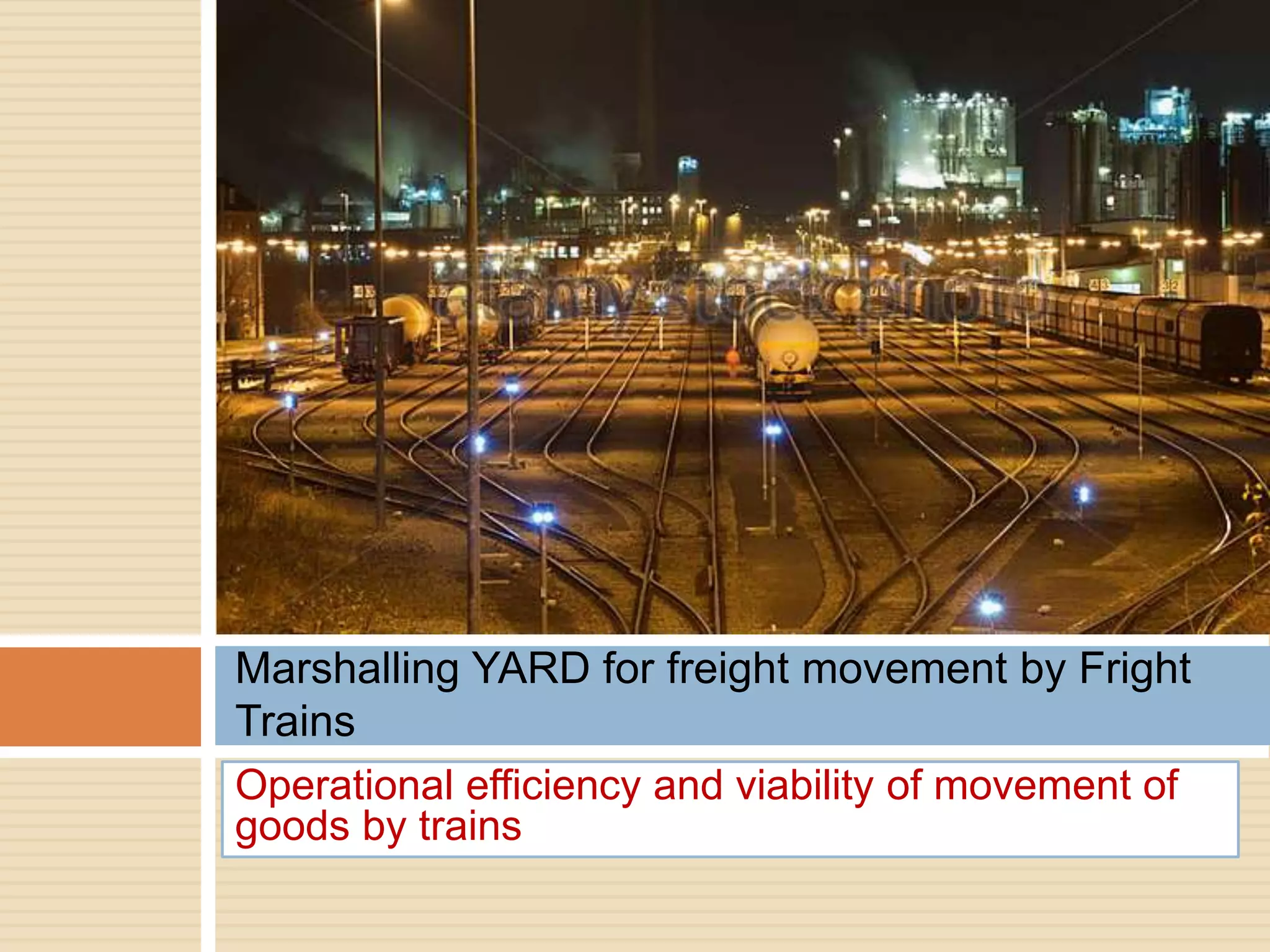
Operational efficiency and viability of movement of
goods by trains
Marshalling YARD for freight movement by Fright
Trains
Introduction
Discussion
Paper 2015 •
12
Dejan
Makovsek,
Vincent
Benezech
and Stephen
Perkins
International
Transport
Forum,
Paris,
France
 The International Transport Forum
has produced a series of reports
and discussion papers addressing
the interrelated issues of railway
structure and performance.
 Efficiency entails maximizing the
outputs from a set of inputs
(technical efficiency) or creating an
optimal mix of inputs to maximize
output (allocative efficiency
Is There a Simple Approach to Assessing Railway
Efficiency?
Discussion
Paper 2015 •
12
Dejan
Makovsek,
Vincent
Benezech
and Stephen
Perkins
International
Transport
Forum,
Paris,
France
 The simplest approach would be to derive key
performance indicators (KPIs) from published
data. Thompson and Bente (2014)
 A basic but balanced score card of railway efficiency
that would consist of six types of indicators (Bente &
Thompson 2014):
 system scope;
 asset utilisation;
 human resource utilisation;
 operational performance;
 financial performance;
 customer-centric service quality.
Best Operating Industrial Ratio
Discussion
Paper 2015 •
12
Dejan
Makovsek,
Vincent
Benezech
and Stephen
Perkins
International
Transport
Forum,
Paris,
France
 "Better output per employee, more efficient
utilization of infrastructure, and improved
 locomotive fuel efficiency helped freight
railroads attain their best industry operating
ratio (78.6%) since World War II. The
resulting financial performance, which
included a return on equity of 11.3 percent
and a return on investment of 10.2%, was a
welcome and long-sought
 improvement after a disappointing record
over the last forty years.
Approaches to enlarge the rail freight market
and improve profitability
Activity-
Based Rail
Freight
Costing
By Gerhard
Troche
Stockholm,
Feb 2009
 Measures on the
technical/operational level and
those on organizational/ political
level are often to some extent
interconnected with each other. The
latter are important when it comes
to implementing.
Technical improvements refer to
changes in the physical resources
in the form of wagons, locomotives,
etc.
Approaches to enlarge the rail freight market
and improve profitability
Activity-
Based Rail
Freight
Costing
By
Gerhard
Troche
Stockholm
Feb 2009
 Operational improvements refer to
how the physical resources are
deployed,
 for example how the trains run
(routes, speeds, train formation,
train lengths, stopping pattern, etc.).
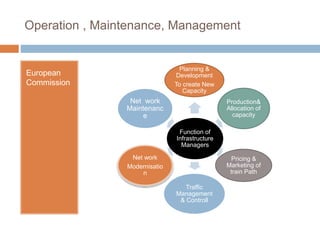
Operation , Maintenance, Management
European
Commission
Function of
Infrastructure
Managers
Planning &
Development
To create New
Capacity
Production&
Allocation of
capacity
Pricing &
Marketing of
train Path
Traffic
Management
& Controll
Net work
Modernisatio
n
Net work
Maintenanc
e
The Rail Freight Corridors – promoting high quality freight
services
European
Commission
 Rail Freight Corridor sets up
common punctuality targets for
freight trains, defines and applies
joint traffic management and priority
rules in order to ensure that these
targets are
 met, coordinates movement and
maintenance works along the
corridor to reduce traffic disruptions
and monitors traffic performance
and customer satisfaction.
Capacity of Rail freight Corridor
National Rail
Freight
Infrastructur
e Capacity
and
Investment
Study
 The capacity of rail corridors is determined
by a large number of factors, including the
 number of tracks, the frequency and length
of sidings, the capacity of the yards and
 terminals along a corridor to receive the
traffic, the type of control systems, the
terrain,the mix of train types, the power of
the locomotives, track speed, and
individual
Capacity of Rail freight Corridor
National Rail
Freight
Infrastructur
e Capacity
and
Investment
Study
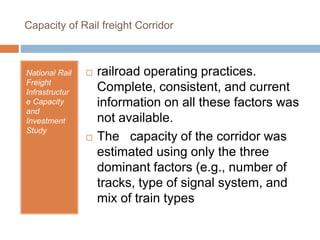
 railroad operating practices.
Complete, consistent, and current
information on all these factors was
not available.
 The capacity of the corridor was
estimated using only the three
dominant factors (e.g., number of
tracks, type of signal system, and
mix of train types
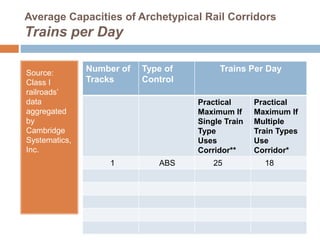
Average Capacities of Archetypical Rail Corridors
Trains per Day
Source:
Class I
railroads’
data
aggregated
by
Cambridge
Systematics,
Inc.
Number of
Tracks
Type of
Control
Trains Per Day
Practical
Maximum If
Single Train
Type
Uses
Corridor**
Practical
Maximum If
Multiple
Train Types
Use
Corridor*
1 ABS 25 18
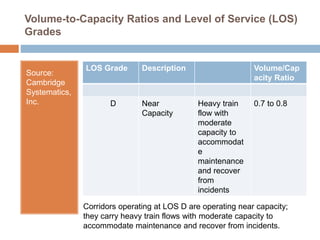
Volume-to-Capacity Ratios and Level of Service (LOS)
Grades
Source:
Cambridge
Systematics,
Inc.
LOS Grade Description Volume/Cap
acity Ratio
D Near
Capacity
Heavy train
flow with
moderate
capacity to
accommodat
e
maintenance
and recover
from
incidents
0.7 to 0.8
Corridors operating at LOS D are operating near capacity;
they carry heavy train flows with moderate capacity to
accommodate maintenance and recover from incidents.
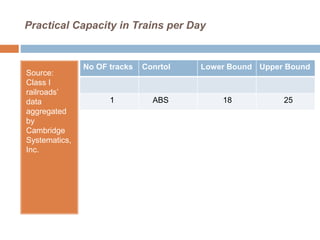
Practical Capacity in Trains per Day
Source:
Class I
railroads’
data
aggregated
by
Cambridge
Systematics,
Inc.
No OF tracks Conrtol Lower Bound Upper Bound
1 ABS 18 25
T o be
continued

Freight movement

  • 1.
    Operational efficiency andviability of movement of goods by trains Marshalling YARD for freight movement by Fright Trains
  • 2.
    Introduction Discussion Paper 2015 • 12 Dejan Makovsek, Vincent Benezech andStephen Perkins International Transport Forum, Paris, France  The International Transport Forum has produced a series of reports and discussion papers addressing the interrelated issues of railway structure and performance.  Efficiency entails maximizing the outputs from a set of inputs (technical efficiency) or creating an optimal mix of inputs to maximize output (allocative efficiency
  • 3.
    Is There aSimple Approach to Assessing Railway Efficiency? Discussion Paper 2015 • 12 Dejan Makovsek, Vincent Benezech and Stephen Perkins International Transport Forum, Paris, France  The simplest approach would be to derive key performance indicators (KPIs) from published data. Thompson and Bente (2014)  A basic but balanced score card of railway efficiency that would consist of six types of indicators (Bente & Thompson 2014):  system scope;  asset utilisation;  human resource utilisation;  operational performance;  financial performance;  customer-centric service quality.
  • 4.
    Best Operating IndustrialRatio Discussion Paper 2015 • 12 Dejan Makovsek, Vincent Benezech and Stephen Perkins International Transport Forum, Paris, France  "Better output per employee, more efficient utilization of infrastructure, and improved  locomotive fuel efficiency helped freight railroads attain their best industry operating ratio (78.6%) since World War II. The resulting financial performance, which included a return on equity of 11.3 percent and a return on investment of 10.2%, was a welcome and long-sought  improvement after a disappointing record over the last forty years.
  • 5.
    Approaches to enlargethe rail freight market and improve profitability Activity- Based Rail Freight Costing By Gerhard Troche Stockholm, Feb 2009  Measures on the technical/operational level and those on organizational/ political level are often to some extent interconnected with each other. The latter are important when it comes to implementing. Technical improvements refer to changes in the physical resources in the form of wagons, locomotives, etc.
  • 6.
    Approaches to enlargethe rail freight market and improve profitability Activity- Based Rail Freight Costing By Gerhard Troche Stockholm Feb 2009  Operational improvements refer to how the physical resources are deployed,  for example how the trains run (routes, speeds, train formation, train lengths, stopping pattern, etc.).
  • 7.
    Operation , Maintenance,Management European Commission Function of Infrastructure Managers Planning & Development To create New Capacity Production& Allocation of capacity Pricing & Marketing of train Path Traffic Management & Controll Net work Modernisatio n Net work Maintenanc e
  • 8.
    The Rail FreightCorridors – promoting high quality freight services European Commission  Rail Freight Corridor sets up common punctuality targets for freight trains, defines and applies joint traffic management and priority rules in order to ensure that these targets are  met, coordinates movement and maintenance works along the corridor to reduce traffic disruptions and monitors traffic performance and customer satisfaction.
  • 9.
    Capacity of Railfreight Corridor National Rail Freight Infrastructur e Capacity and Investment Study  The capacity of rail corridors is determined by a large number of factors, including the  number of tracks, the frequency and length of sidings, the capacity of the yards and  terminals along a corridor to receive the traffic, the type of control systems, the terrain,the mix of train types, the power of the locomotives, track speed, and individual
  • 10.
    Capacity of Railfreight Corridor National Rail Freight Infrastructur e Capacity and Investment Study  railroad operating practices. Complete, consistent, and current information on all these factors was not available.  The capacity of the corridor was estimated using only the three dominant factors (e.g., number of tracks, type of signal system, and mix of train types
  • 11.
    Average Capacities ofArchetypical Rail Corridors Trains per Day Source: Class I railroads’ data aggregated by Cambridge Systematics, Inc. Number of Tracks Type of Control Trains Per Day Practical Maximum If Single Train Type Uses Corridor** Practical Maximum If Multiple Train Types Use Corridor* 1 ABS 25 18
  • 12.
    Volume-to-Capacity Ratios andLevel of Service (LOS) Grades Source: Cambridge Systematics, Inc. LOS Grade Description Volume/Cap acity Ratio D Near Capacity Heavy train flow with moderate capacity to accommodat e maintenance and recover from incidents 0.7 to 0.8 Corridors operating at LOS D are operating near capacity; they carry heavy train flows with moderate capacity to accommodate maintenance and recover from incidents.
  • 13.
    Practical Capacity inTrains per Day Source: Class I railroads’ data aggregated by Cambridge Systematics, Inc. No OF tracks Conrtol Lower Bound Upper Bound 1 ABS 18 25
  • 14.