The Indian Contract Act, 1872
Introduction
 We enter into contracts day after day.
 Taking a seat in bus amounts to entering into a contract.
 When you put a coin in the slot of a weighing machine, you
have entered into a contract.
 You go to a resturant and take snacks, you entered into a
contract.
 In such cases, we do not even realise that we are making a
contract.
Definition
Contract :-
According to section.2(h), a contract is defined as
an agreement enforceable by law.
Agreement:-
According to sec.2(e), every promise and every
set of promises forming consideration for each other.
Consideration is the return benefit the parties to the contract get.
Agreement = Offer + Acceptance.
Promise:-
According to sec.2(b), a proposal when accepted
becomes a promise.
Essential Elements of a Valid Contract
The essential elements of a valid contract can be summed up as
follows:
 Aggrement.
 Intention to create legal relationship.
 Free and genuine consent.
 Parties competent to contract.
 Lawful consideration.
 Lawful object.
 Aggrements not declared illegal or void.
 Certainity of meaning.
 Possibility of performance.
 Necessary Legal Formalities.
Classification of Contracts
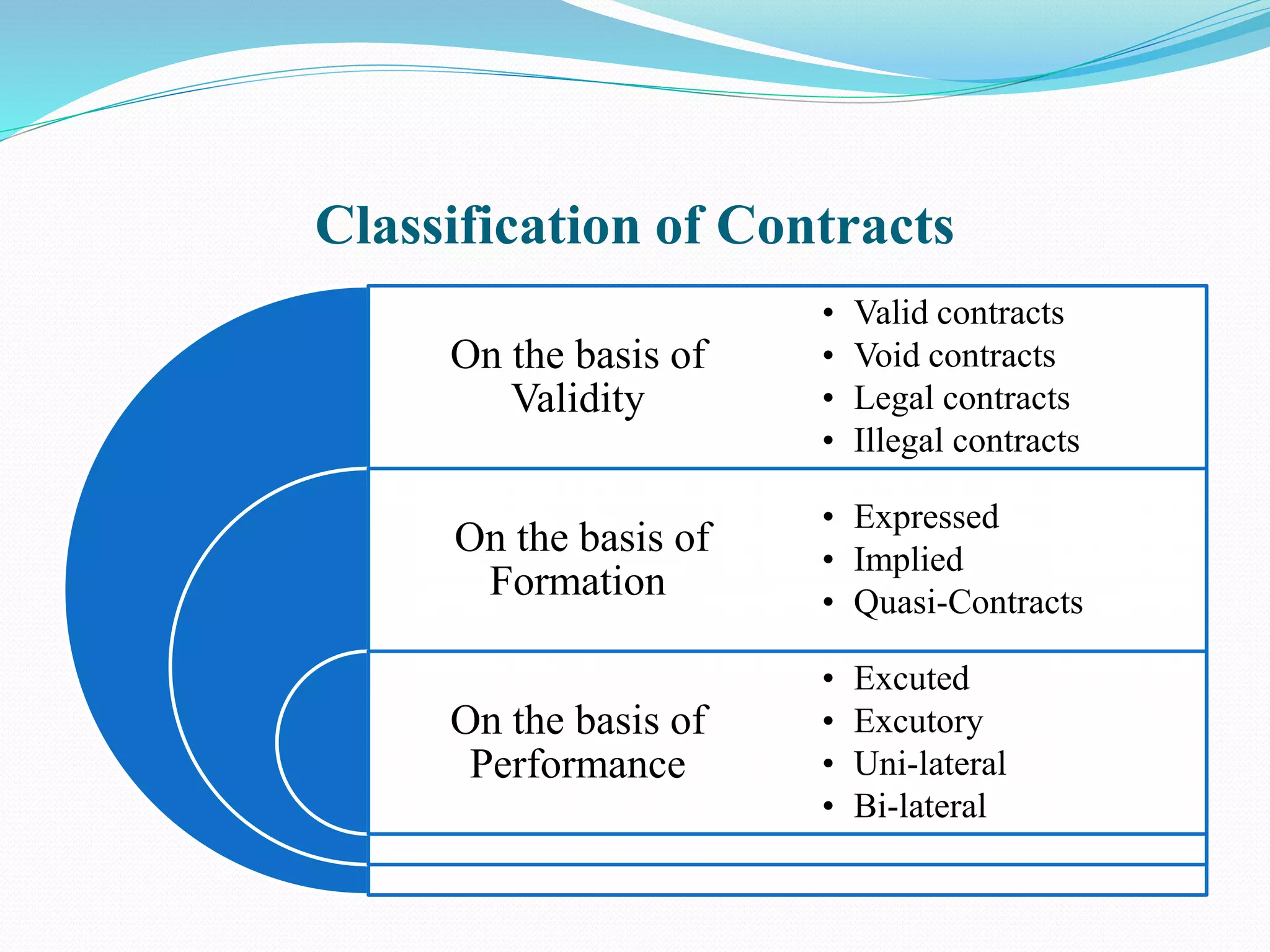
On the basis of
Validity
On the basis of
Formation
On the basis of
Performance
• Valid contracts
• Void contracts
• Legal contracts
• Illegal contracts
• Expressed
• Implied
• Quasi-Contracts
• Excuted
• Excutory
• Uni-lateral
• Bi-lateral
On the basis of validity:
Valid contract: an agreement which fulfills all the essential
elements of a contract is said to be a valid contract
It must qualify all the essentials of a contract.
Void contract: a contract which ceases to be enforceable b law
becomes void when it ceases to be enforceable.
this makes all those contracts that are not enforceable by a
court of law as void.
Legal contracts: an agreement which is fully enforceable by is
is a legal contract.
.
Illegal contracts: an agreement that leads to one or all the parties
breaking the law or not conforming to the norms of the
society is deemed to be illegal by the court.
A contract opposed to public policy is also illegal.
On The Basis Of Formation:
Expresssed: proposal or acceptance of any promise is made by
words spoken or written, the promise is said to be expressed.
Implied: proposal or acceptance is made otherwise than in
words, the promise is said to be implied.
Quasi-contract: they are the contracts in the sense that no
agreements are made between any of the parties.
in fact, there is no contract prior to some court order.
On the basis of performance:
Executed contract: a contract in which both the parties have
fulfilled their obligations under the contracted.
Executory contract: a contract in which both the parties are yet
to fulfill their obligations.
Uniteral contract: is a one sided contract in which only one
party has performed his promise or obligation, the other party
has to perform his promise or obligation.
Bilateral contract: a contract in which both the parties commit
to perform their respective promises is called bilateral contract.

types of contract

  • 1.
  • 2.
    Introduction  We enterinto contracts day after day.  Taking a seat in bus amounts to entering into a contract.  When you put a coin in the slot of a weighing machine, you have entered into a contract.  You go to a resturant and take snacks, you entered into a contract.  In such cases, we do not even realise that we are making a contract.
  • 3.
    Definition Contract :- According tosection.2(h), a contract is defined as an agreement enforceable by law. Agreement:- According to sec.2(e), every promise and every set of promises forming consideration for each other. Consideration is the return benefit the parties to the contract get. Agreement = Offer + Acceptance. Promise:- According to sec.2(b), a proposal when accepted becomes a promise.
  • 4.
    Essential Elements ofa Valid Contract The essential elements of a valid contract can be summed up as follows:  Aggrement.  Intention to create legal relationship.  Free and genuine consent.  Parties competent to contract.  Lawful consideration.  Lawful object.  Aggrements not declared illegal or void.  Certainity of meaning.  Possibility of performance.  Necessary Legal Formalities.
  • 5.
    Classification of Contracts Onthe basis of Validity On the basis of Formation On the basis of Performance • Valid contracts • Void contracts • Legal contracts • Illegal contracts • Expressed • Implied • Quasi-Contracts • Excuted • Excutory • Uni-lateral • Bi-lateral
  • 6.
    On the basisof validity: Valid contract: an agreement which fulfills all the essential elements of a contract is said to be a valid contract It must qualify all the essentials of a contract. Void contract: a contract which ceases to be enforceable b law becomes void when it ceases to be enforceable. this makes all those contracts that are not enforceable by a court of law as void. Legal contracts: an agreement which is fully enforceable by is is a legal contract. .
  • 7.
    Illegal contracts: anagreement that leads to one or all the parties breaking the law or not conforming to the norms of the society is deemed to be illegal by the court. A contract opposed to public policy is also illegal. On The Basis Of Formation: Expresssed: proposal or acceptance of any promise is made by words spoken or written, the promise is said to be expressed. Implied: proposal or acceptance is made otherwise than in words, the promise is said to be implied. Quasi-contract: they are the contracts in the sense that no agreements are made between any of the parties. in fact, there is no contract prior to some court order.
  • 8.
    On the basisof performance: Executed contract: a contract in which both the parties have fulfilled their obligations under the contracted. Executory contract: a contract in which both the parties are yet to fulfill their obligations. Uniteral contract: is a one sided contract in which only one party has performed his promise or obligation, the other party has to perform his promise or obligation. Bilateral contract: a contract in which both the parties commit to perform their respective promises is called bilateral contract.