Healthcare Social Communications


                               1
Provider Social Communications Adoption

• Use Internet for continuing education, medical
  reference and e-mail with colleagues.
• 80% providers will have smart phones by 2012
• 55% of are using a downloaded app such as a
  medical calculator, diagram, or other clinical tool.
• 50% using EMR
• Numerous provider specific social networks
Patient/Consumer Adoption
• Patients are using online and mobile health tools
  (static & interactive) without referral from MDs
  to supplement gaps in care.
  – Seek health information
  – Over 200 million mobile healthcare applications are
    in use today (500m by 2015).
  – Using web-based & mobile tools (e.g. StickK)
  – Patients are using targeted online communities –
    especially specific subgroups.
  – Patients are not using PHR…….yet.
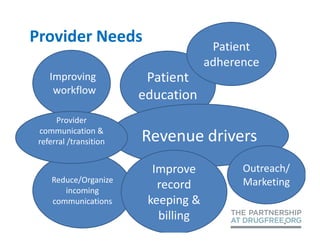
Provider Needs                        Patient
                                     adherence
    Improving            Patient
     workflow           education
      Provider
 communication &
 referral /transition   Revenue drivers
                          Improve          Outreach/
     Reduce/Organize                       Marketing
        incoming
                           record
     communications      keeping &
                           billing
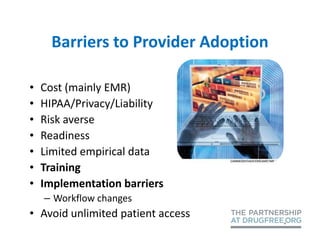
Barriers to Provider Adoption

•   Cost (mainly EMR)
•   HIPAA/Privacy/Liability
•   Risk averse
•   Readiness
•   Limited empirical data
•   Training
•   Implementation barriers
    – Workflow changes
• Avoid unlimited patient access
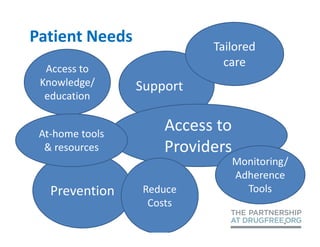
Patient Needs              Tailored
  Access to
                             care
 Knowledge/      Support
  education


 At-home tools
                     Access to
  & resources        Providers
                                 Monitoring/
                                 Adherence
   Prevention     Reduce           Tools
                   Costs
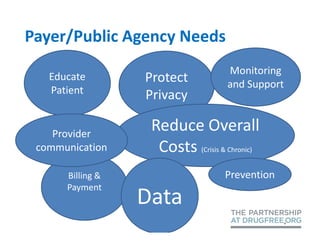
Payer/Public Agency Needs
                                    Monitoring
   Educate        Protect           and Support
   Patient        Privacy

    Provider
                   Reduce Overall
 communication      Costs (Crisis & Chronic)
      Billing &                     Prevention
      Payment
                  Data
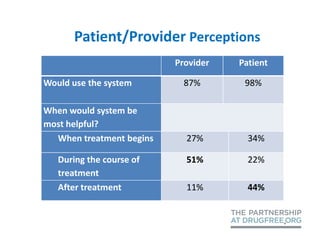
Patient/Provider Perceptions
                          Provider   Patient

Would use the system        87%       98%

When would system be
most helpful?
  When treatment begins     27%        34%

   During the course of     51%        22%
   treatment
   After treatment          11%        44%
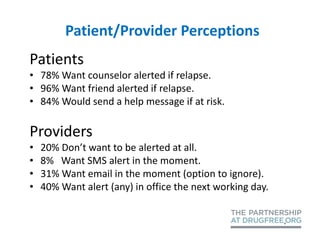
Patient/Provider Perceptions
Patients
• 78% Want counselor alerted if relapse.
• 96% Want friend alerted if relapse.
• 84% Would send a help message if at risk.

Providers
•   20% Don’t want to be alerted at all.
•   8% Want SMS alert in the moment.
•   31% Want email in the moment (option to ignore).
•   40% Want alert (any) in office the next working day.
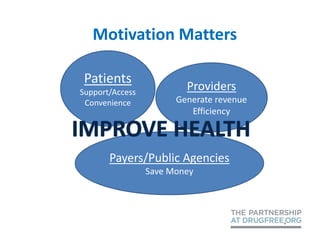
Motivation Matters

 Patients
Support/Access
                         Providers
 Convenience           Generate revenue
                          Efficiency


       Payers/Public Agencies
                 Save Money
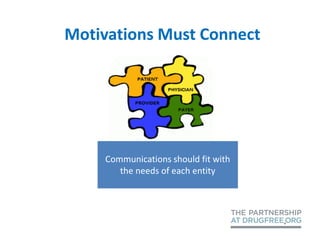
Motivations Must Connect


    Communications should fit with
       the needs of each entity
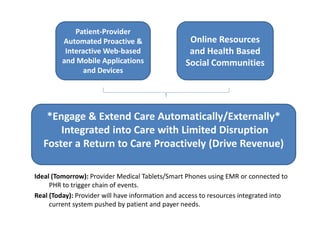
Patient-Provider
         Automated Proactive &                     Online Resources
          Interactive Web-based                    and Health Based
         and Mobile Applications                  Social Communities
               and Devices


   *Engage & Extend Care Automatically/Externally*
      Integrated into Care with Limited Disruption
  Foster a Return to Care Proactively (Drive Revenue)

Ideal (Tomorrow): Provider Medical Tablets/Smart Phones using EMR or connected to
     PHR to trigger chain of events.
Real (Today): Provider will have information and access to resources integrated into
     current system pushed by patient and payer needs.
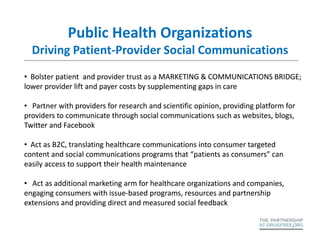
Public Health Organizations
  Driving Patient-Provider Social Communications
• Bolster patient and provider trust as a MARKETING & COMMUNICATIONS BRIDGE;
lower provider lift and payer costs by supplementing gaps in care

• Partner with providers for research and scientific opinion, providing platform for
providers to communicate through social communications such as websites, blogs,
Twitter and Facebook

• Act as B2C, translating healthcare communications into consumer targeted
content and social communications programs that “patients as consumers” can
easily access to support their health maintenance

• Act as additional marketing arm for healthcare organizations and companies,
engaging consumers with issue-based programs, resources and partnership
extensions and providing direct and measured social feedback
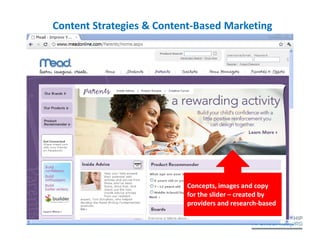
Content Strategies & Content-Based Marketing


                          Concepts, images and copy
                          for the slider – created by
                          providers and research-based
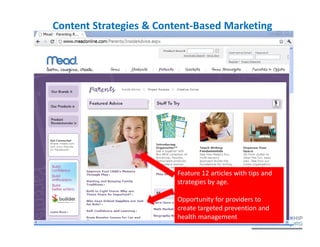
Content Strategies & Content-Based Marketing


                         Feature 12 articles with tips and
                         strategies by age.

                         Opportunity for providers to
                         create targeted prevention and
                         health management
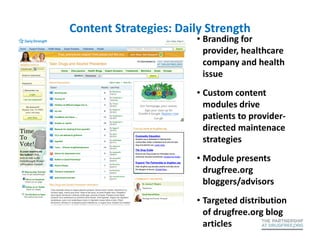
Content Strategies: Daily Strength
                       • Branding for
                         provider, healthcare
                         company and health
                         issue
                       • Custom content
                         modules drive
                         patients to provider-
                         directed maintenace
                         strategies
                       • Module presents
                         drugfree.org
                         bloggers/advisors
                       • Targeted distribution
                         of drugfree.org blog
                         articles
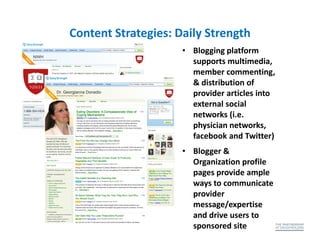
Content Strategies: Daily Strength
                     • Blogging platform
                       supports multimedia,
                       member commenting,
                       & distribution of
                       provider articles into
                       external social
                       networks (i.e.
                       physician networks,
                       facebook and Twitter)
                     • Blogger &
                       Organization profile
                       pages provide ample
                       ways to communicate
                       provider
                       message/expertise
                       and drive users to
                       sponsored site
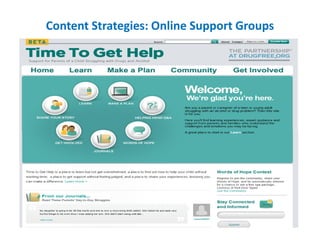
Content Strategies: Online Support Groups
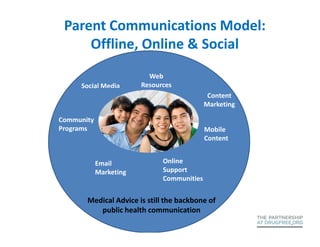
Parent Communications Model:
     Offline, Online & Social
                           Web
     Social Media        Resources
                                                  Content
                                                 Marketing

Community
Programs                                         Mobile
                           M                     Content
                        Helpline
            Email                  Online
            Marketing              Support
                                   Communities


       Medical Advice is still the backbone of
          public health communication
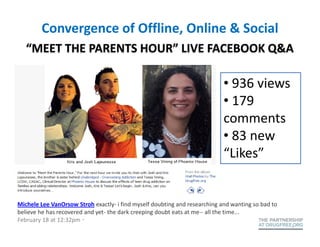
Convergence of Offline, Online & Social
   “MEET THE PARENTS HOUR” LIVE FACEBOOK Q&A

                                                                            • 936 views
                                                                            • 179
                                                                            comments
                                                                            • 83 new
                                                                            “Likes”


Michele Lee VanOrsow Stroh exactly- i find myself doubting and researching and wanting so bad to
believe he has recovered and yet- the dark creeping doubt eats at me-- all the time...
February 18 at 12:32pm ·
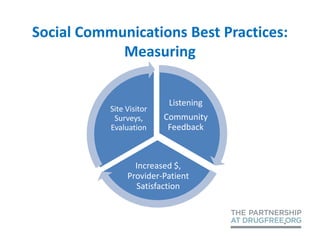
Social Communications Best Practices:
            Measuring


                           Listening
           Site Visitor
            Surveys,      Community
           Evaluation      Feedback


                  Increased $,
                Provider-Patient
                  Satisfaction

Fred Muench, The Partnership at Drugfree.org Presentation - BDI 3/23/11 Healthcare Social Communications Leadership Forum

  • 1.
  • 2.
    Provider Social CommunicationsAdoption • Use Internet for continuing education, medical reference and e-mail with colleagues. • 80% providers will have smart phones by 2012 • 55% of are using a downloaded app such as a medical calculator, diagram, or other clinical tool. • 50% using EMR • Numerous provider specific social networks
  • 3.
    Patient/Consumer Adoption • Patientsare using online and mobile health tools (static & interactive) without referral from MDs to supplement gaps in care. – Seek health information – Over 200 million mobile healthcare applications are in use today (500m by 2015). – Using web-based & mobile tools (e.g. StickK) – Patients are using targeted online communities – especially specific subgroups. – Patients are not using PHR…….yet.
  • 4.
    Provider Needs Patient adherence Improving Patient workflow education Provider communication & referral /transition Revenue drivers Improve Outreach/ Reduce/Organize Marketing incoming record communications keeping & billing
  • 5.
    Barriers to ProviderAdoption • Cost (mainly EMR) • HIPAA/Privacy/Liability • Risk averse • Readiness • Limited empirical data • Training • Implementation barriers – Workflow changes • Avoid unlimited patient access
  • 6.
    Patient Needs Tailored Access to care Knowledge/ Support education At-home tools Access to & resources Providers Monitoring/ Adherence Prevention Reduce Tools Costs
  • 7.
    Payer/Public Agency Needs Monitoring Educate Protect and Support Patient Privacy Provider Reduce Overall communication Costs (Crisis & Chronic) Billing & Prevention Payment Data
  • 8.
    Patient/Provider Perceptions Provider Patient Would use the system 87% 98% When would system be most helpful? When treatment begins 27% 34% During the course of 51% 22% treatment After treatment 11% 44%
  • 9.
    Patient/Provider Perceptions Patients • 78%Want counselor alerted if relapse. • 96% Want friend alerted if relapse. • 84% Would send a help message if at risk. Providers • 20% Don’t want to be alerted at all. • 8% Want SMS alert in the moment. • 31% Want email in the moment (option to ignore). • 40% Want alert (any) in office the next working day.
  • 10.
    Motivation Matters Patients Support/Access Providers Convenience Generate revenue Efficiency Payers/Public Agencies Save Money
  • 11.
    Motivations Must Connect Communications should fit with the needs of each entity
  • 12.
    Patient-Provider Automated Proactive & Online Resources Interactive Web-based and Health Based and Mobile Applications Social Communities and Devices *Engage & Extend Care Automatically/Externally* Integrated into Care with Limited Disruption Foster a Return to Care Proactively (Drive Revenue) Ideal (Tomorrow): Provider Medical Tablets/Smart Phones using EMR or connected to PHR to trigger chain of events. Real (Today): Provider will have information and access to resources integrated into current system pushed by patient and payer needs.
  • 13.
    Public Health Organizations Driving Patient-Provider Social Communications • Bolster patient and provider trust as a MARKETING & COMMUNICATIONS BRIDGE; lower provider lift and payer costs by supplementing gaps in care • Partner with providers for research and scientific opinion, providing platform for providers to communicate through social communications such as websites, blogs, Twitter and Facebook • Act as B2C, translating healthcare communications into consumer targeted content and social communications programs that “patients as consumers” can easily access to support their health maintenance • Act as additional marketing arm for healthcare organizations and companies, engaging consumers with issue-based programs, resources and partnership extensions and providing direct and measured social feedback
  • 14.
    Content Strategies &Content-Based Marketing Concepts, images and copy for the slider – created by providers and research-based
  • 15.
    Content Strategies &Content-Based Marketing Feature 12 articles with tips and strategies by age. Opportunity for providers to create targeted prevention and health management
  • 16.
    Content Strategies: DailyStrength • Branding for provider, healthcare company and health issue • Custom content modules drive patients to provider- directed maintenace strategies • Module presents drugfree.org bloggers/advisors • Targeted distribution of drugfree.org blog articles
  • 17.
    Content Strategies: DailyStrength • Blogging platform supports multimedia, member commenting, & distribution of provider articles into external social networks (i.e. physician networks, facebook and Twitter) • Blogger & Organization profile pages provide ample ways to communicate provider message/expertise and drive users to sponsored site
  • 18.
  • 19.
    Parent Communications Model: Offline, Online & Social Web Social Media Resources Content Marketing Community Programs Mobile M Content Helpline Email Online Marketing Support Communities Medical Advice is still the backbone of public health communication
  • 20.
    Convergence of Offline,Online & Social “MEET THE PARENTS HOUR” LIVE FACEBOOK Q&A • 936 views • 179 comments • 83 new “Likes” Michele Lee VanOrsow Stroh exactly- i find myself doubting and researching and wanting so bad to believe he has recovered and yet- the dark creeping doubt eats at me-- all the time... February 18 at 12:32pm ·
  • 21.
    Social Communications BestPractices: Measuring Listening Site Visitor Surveys, Community Evaluation Feedback Increased $, Provider-Patient Satisfaction