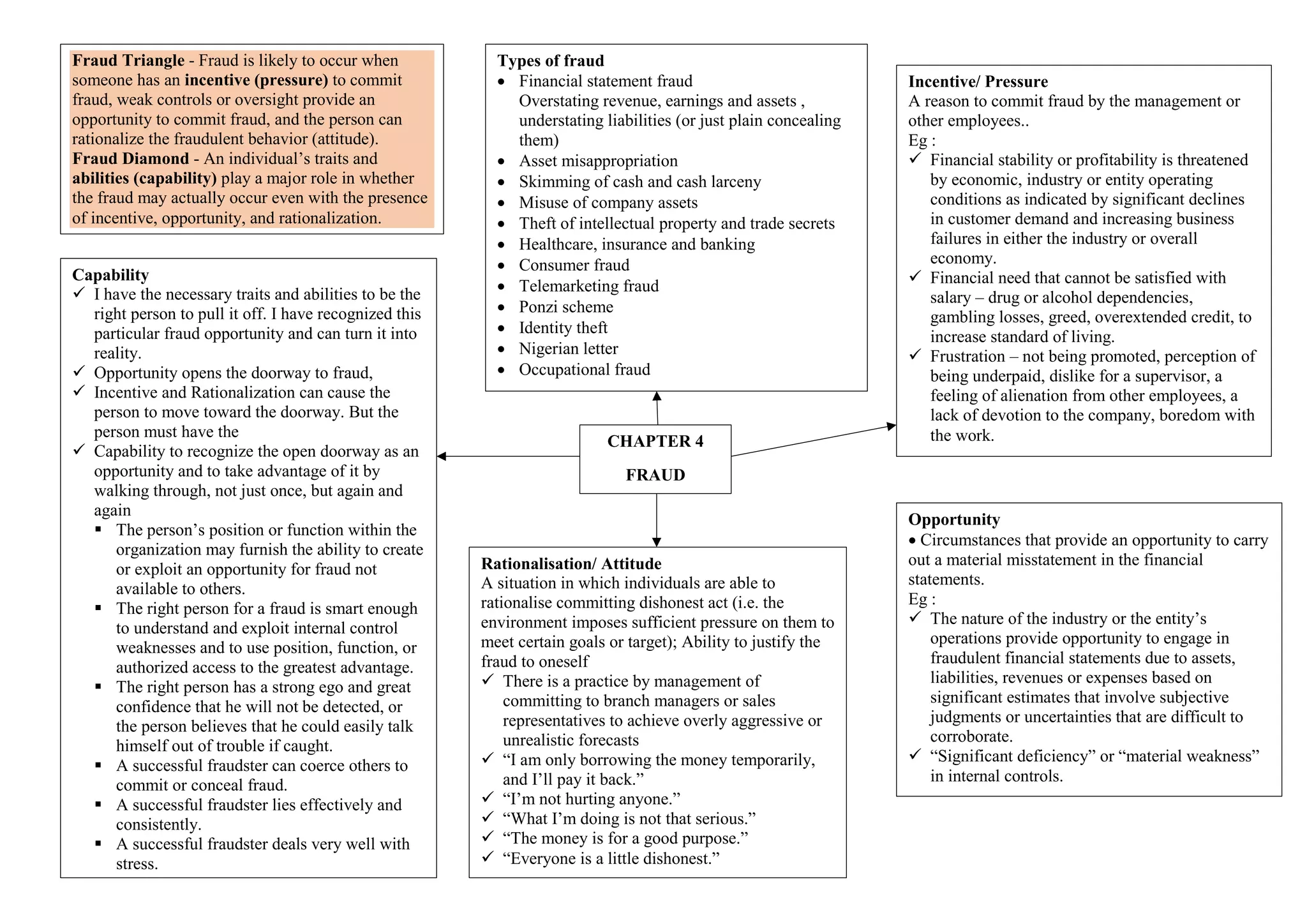
CHAPTER 4
FRAUD
Incentive/ Pressure
A reason to commit fraud by the management or
other employees..
Eg :
 Financial stability or profitability is threatened
by economic, industry or entity operating
conditions as indicated by significant declines
in customer demand and increasing business
failures in either the industry or overall
economy.
 Financial need that cannot be satisfied with
salary – drug or alcohol dependencies,
gambling losses, greed, overextended credit, to
increase standard of living.
 Frustration – not being promoted, perception of
being underpaid, dislike for a supervisor, a
feeling of alienation from other employees, a
lack of devotion to the company, boredom with
the work.
Opportunity
 Circumstances that provide an opportunity to carry
out a material misstatement in the financial
statements.
Eg :
 The nature of the industry or the entity’s
operations provide opportunity to engage in
fraudulent financial statements due to assets,
liabilities, revenues or expenses based on
significant estimates that involve subjective
judgments or uncertainties that are difficult to
corroborate.
 “Significant deficiency” or “material weakness”
in internal controls.
Rationalisation/ Attitude
A situation in which individuals are able to
rationalise committing dishonest act (i.e. the
environment imposes sufficient pressure on them to
meet certain goals or target); Ability to justify the
fraud to oneself
 There is a practice by management of
committing to branch managers or sales
representatives to achieve overly aggressive or
unrealistic forecasts
 “I am only borrowing the money temporarily,
and I’ll pay it back.”
 “I’m not hurting anyone.”
 “What I’m doing is not that serious.”
 “The money is for a good purpose.”
 “Everyone is a little dishonest.”
Capability
 I have the necessary traits and abilities to be the
right person to pull it off. I have recognized this
particular fraud opportunity and can turn it into
reality.
 Opportunity opens the doorway to fraud,
 Incentive and Rationalization can cause the
person to move toward the doorway. But the
person must have the
 Capability to recognize the open doorway as an
opportunity and to take advantage of it by
walking through, not just once, but again and
again
 The person’s position or function within the
organization may furnish the ability to create
or exploit an opportunity for fraud not
available to others.
 The right person for a fraud is smart enough
to understand and exploit internal control
weaknesses and to use position, function, or
authorized access to the greatest advantage.
 The right person has a strong ego and great
confidence that he will not be detected, or
the person believes that he could easily talk
himself out of trouble if caught.
 A successful fraudster can coerce others to
commit or conceal fraud.
 A successful fraudster lies effectively and
consistently.
 A successful fraudster deals very well with
stress.
Fraud Triangle - Fraud is likely to occur when
someone has an incentive (pressure) to commit
fraud, weak controls or oversight provide an
opportunity to commit fraud, and the person can
rationalize the fraudulent behavior (attitude).
Fraud Diamond - An individual’s traits and
abilities (capability) play a major role in whether
the fraud may actually occur even with the presence
of incentive, opportunity, and rationalization.
Types of fraud
 Financial statement fraud
Overstating revenue, earnings and assets ,
understating liabilities (or just plain concealing
them)
 Asset misappropriation
 Skimming of cash and cash larceny
 Misuse of company assets
 Theft of intellectual property and trade secrets
 Healthcare, insurance and banking
 Consumer fraud
 Telemarketing fraud
 Ponzi scheme
 Identity theft
 Nigerian letter
 Occupational fraud


Fraud Triangle.docx

  • 1.
    CHAPTER 4 FRAUD Incentive/ Pressure Areason to commit fraud by the management or other employees.. Eg :  Financial stability or profitability is threatened by economic, industry or entity operating conditions as indicated by significant declines in customer demand and increasing business failures in either the industry or overall economy.  Financial need that cannot be satisfied with salary – drug or alcohol dependencies, gambling losses, greed, overextended credit, to increase standard of living.  Frustration – not being promoted, perception of being underpaid, dislike for a supervisor, a feeling of alienation from other employees, a lack of devotion to the company, boredom with the work. Opportunity  Circumstances that provide an opportunity to carry out a material misstatement in the financial statements. Eg :  The nature of the industry or the entity’s operations provide opportunity to engage in fraudulent financial statements due to assets, liabilities, revenues or expenses based on significant estimates that involve subjective judgments or uncertainties that are difficult to corroborate.  “Significant deficiency” or “material weakness” in internal controls. Rationalisation/ Attitude A situation in which individuals are able to rationalise committing dishonest act (i.e. the environment imposes sufficient pressure on them to meet certain goals or target); Ability to justify the fraud to oneself  There is a practice by management of committing to branch managers or sales representatives to achieve overly aggressive or unrealistic forecasts  “I am only borrowing the money temporarily, and I’ll pay it back.”  “I’m not hurting anyone.”  “What I’m doing is not that serious.”  “The money is for a good purpose.”  “Everyone is a little dishonest.” Capability  I have the necessary traits and abilities to be the right person to pull it off. I have recognized this particular fraud opportunity and can turn it into reality.  Opportunity opens the doorway to fraud,  Incentive and Rationalization can cause the person to move toward the doorway. But the person must have the  Capability to recognize the open doorway as an opportunity and to take advantage of it by walking through, not just once, but again and again  The person’s position or function within the organization may furnish the ability to create or exploit an opportunity for fraud not available to others.  The right person for a fraud is smart enough to understand and exploit internal control weaknesses and to use position, function, or authorized access to the greatest advantage.  The right person has a strong ego and great confidence that he will not be detected, or the person believes that he could easily talk himself out of trouble if caught.  A successful fraudster can coerce others to commit or conceal fraud.  A successful fraudster lies effectively and consistently.  A successful fraudster deals very well with stress. Fraud Triangle - Fraud is likely to occur when someone has an incentive (pressure) to commit fraud, weak controls or oversight provide an opportunity to commit fraud, and the person can rationalize the fraudulent behavior (attitude). Fraud Diamond - An individual’s traits and abilities (capability) play a major role in whether the fraud may actually occur even with the presence of incentive, opportunity, and rationalization. Types of fraud  Financial statement fraud Overstating revenue, earnings and assets , understating liabilities (or just plain concealing them)  Asset misappropriation  Skimming of cash and cash larceny  Misuse of company assets  Theft of intellectual property and trade secrets  Healthcare, insurance and banking  Consumer fraud  Telemarketing fraud  Ponzi scheme  Identity theft  Nigerian letter  Occupational fraud 