Work Without WallAssignment
Date: 23/12/2023
UNIVERSITI TEKNOLOGI MARA
FINAL ASSESSMENT
2.
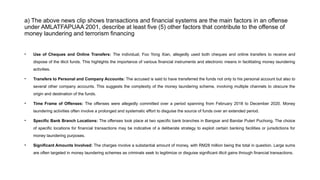
a) The abovenews clip shows transactions and financial systems are the main factors in an offense
under AMLATFAPUAA 2001, describe at least five (5) other factors that contribute to the offense of
money laundering and terrorism financing
• Use of Cheques and Online Transfers: The individual, Foo Yong Xian, allegedly used both cheques and online transfers to receive and
dispose of the illicit funds. This highlights the importance of various financial instruments and electronic means in facilitating money laundering
activities.
• Transfers to Personal and Company Accounts: The accused is said to have transferred the funds not only to his personal account but also to
several other company accounts. This suggests the complexity of the money laundering scheme, involving multiple channels to obscure the
origin and destination of the funds.
• Time Frame of Offenses: The offenses were allegedly committed over a period spanning from February 2018 to December 2020. Money
laundering activities often involve a prolonged and systematic effort to disguise the source of funds over an extended period.
• Specific Bank Branch Locations: The offenses took place at two specific bank branches in Bangsar and Bandar Puteri Puchong. The choice
of specific locations for financial transactions may be indicative of a deliberate strategy to exploit certain banking facilities or jurisdictions for
money laundering purposes.
• Significant Amounts Involved: The charges involve a substantial amount of money, with RM28 million being the total in question. Large sums
are often targeted in money laundering schemes as criminals seek to legitimize or disguise significant illicit gains through financial transactions.
3.
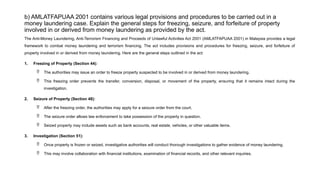
b) AMLATFAPUAA 2001contains various legal provisions and procedures to be carried out in a
money laundering case. Explain the general steps for freezing, seizure, and forfeiture of property
involved in or derived from money laundering as provided by the act.
The Anti-Money Laundering, Anti-Terrorism Financing and Proceeds of Unlawful Activities Act 2001 (AMLATFAPUAA 2001) in Malaysia provides a legal
framework to combat money laundering and terrorism financing. The act includes provisions and procedures for freezing, seizure, and forfeiture of
property involved in or derived from money laundering. Here are the general steps outlined in the act:
1. Freezing of Property (Section 44):
The authorities may issue an order to freeze property suspected to be involved in or derived from money laundering.
This freezing order prevents the transfer, conversion, disposal, or movement of the property, ensuring that it remains intact during the
investigation.
2. Seizure of Property (Section 48):
After the freezing order, the authorities may apply for a seizure order from the court.
The seizure order allows law enforcement to take possession of the property in question.
Seized property may include assets such as bank accounts, real estate, vehicles, or other valuable items.
3. Investigation (Section 51):
Once property is frozen or seized, investigative authorities will conduct thorough investigations to gather evidence of money laundering.
This may involve collaboration with financial institutions, examination of financial records, and other relevant inquiries.
4.
Cont”d
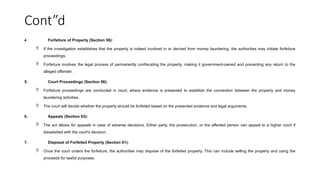
4 Forfeiture ofProperty (Section 56):
If the investigation establishes that the property is indeed involved in or derived from money laundering, the authorities may initiate forfeiture
proceedings.
Forfeiture involves the legal process of permanently confiscating the property, making it government-owned and preventing any return to the
alleged offender.
5. Court Proceedings (Section 56):
Forfeiture proceedings are conducted in court, where evidence is presented to establish the connection between the property and money
laundering activities.
The court will decide whether the property should be forfeited based on the presented evidence and legal arguments.
6. Appeals (Section 63):
The act allows for appeals in case of adverse decisions. Either party, the prosecution, or the affected person can appeal to a higher court if
dissatisfied with the court's decision.
7. Disposal of Forfeited Property (Section 61):
Once the court orders the forfeiture, the authorities may dispose of the forfeited property. This can include selling the property and using the
proceeds for lawful purposes.
5.
Question 2
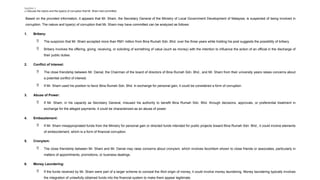
a) Discussthe nature and the type(s) of corruption that Mr. Sham had committed.
Based on the provided information, it appears that Mr. Sham, the Secretary General of the Ministry of Local Government Development of Malaysia, is suspected of being involved in
corruption. The nature and type(s) of corruption that Mr. Sham may have committed can be analyzed as follows:
1. Bribery:
The suspicion that Mr. Sham accepted more than RM1 million from Bina Rumah Sdn. Bhd. over the three years while holding his post suggests the possibility of bribery.
Bribery involves the offering, giving, receiving, or soliciting of something of value (such as money) with the intention to influence the action of an official in the discharge of
their public duties.
2. Conflict of Interest:
The close friendship between Mr. Danial, the Chairman of the board of directors of Bina Rumah Sdn. Bhd., and Mr. Sham from their university years raises concerns about
a potential conflict of interest.
If Mr. Sham used his position to favor Bina Rumah Sdn. Bhd. in exchange for personal gain, it could be considered a form of corruption.
3. Abuse of Power:
If Mr. Sham, in his capacity as Secretary General, misused his authority to benefit Bina Rumah Sdn. Bhd. through decisions, approvals, or preferential treatment in
exchange for the alleged payments, it could be characterized as an abuse of power.
4. Embezzlement:
If Mr. Sham misappropriated funds from the Ministry for personal gain or directed funds intended for public projects toward Bina Rumah Sdn. Bhd., it could involve elements
of embezzlement, which is a form of financial corruption.
5. Cronyism:
The close friendship between Mr. Sham and Mr. Danial may raise concerns about cronyism, which involves favoritism shown to close friends or associates, particularly in
matters of appointments, promotions, or business dealings.
6. Money Laundering:
If the funds received by Mr. Sham were part of a larger scheme to conceal the illicit origin of money, it could involve money laundering. Money laundering typically involves
the integration of unlawfully obtained funds into the financial system to make them appear legitimate.
6.
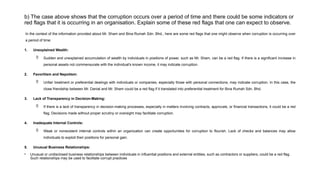
b) The caseabove shows that the corruption occurs over a period of time and there could be some indicators or
red flags that it is occurring in an organisation. Explain some of these red flags that one can expect to observe.
In the context of the information provided about Mr. Sham and Bina Rumah Sdn. Bhd., here are some red flags that one might observe when corruption is occurring over
a period of time:
1. Unexplained Wealth:
Sudden and unexplained accumulation of wealth by individuals in positions of power, such as Mr. Sham, can be a red flag. If there is a significant increase in
personal assets not commensurate with the individual's known income, it may indicate corruption.
2. Favoritism and Nepotism:
Unfair treatment or preferential dealings with individuals or companies, especially those with personal connections, may indicate corruption. In this case, the
close friendship between Mr. Danial and Mr. Sham could be a red flag if it translated into preferential treatment for Bina Rumah Sdn. Bhd.
3. Lack of Transparency in Decision-Making:
If there is a lack of transparency in decision-making processes, especially in matters involving contracts, approvals, or financial transactions, it could be a red
flag. Decisions made without proper scrutiny or oversight may facilitate corruption.
4. Inadequate Internal Controls:
Weak or nonexistent internal controls within an organization can create opportunities for corruption to flourish. Lack of checks and balances may allow
individuals to exploit their positions for personal gain.
5. Unusual Business Relationships:
• Unusual or undisclosed business relationships between individuals in influential positions and external entities, such as contractors or suppliers, could be a red flag.
Such relationships may be used to facilitate corrupt practices
7.
CONT’D
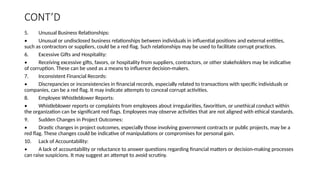
5. Unusual BusinessRelationships:
• Unusual or undisclosed business relationships between individuals in influential positions and external entities,
such as contractors or suppliers, could be a red flag. Such relationships may be used to facilitate corrupt practices.
6. Excessive Gifts and Hospitality:
• Receiving excessive gifts, favors, or hospitality from suppliers, contractors, or other stakeholders may be indicative
of corruption. These can be used as a means to influence decision-makers.
7. Inconsistent Financial Records:
• Discrepancies or inconsistencies in financial records, especially related to transactions with specific individuals or
companies, can be a red flag. It may indicate attempts to conceal corrupt activities.
8. Employee Whistleblower Reports:
• Whistleblower reports or complaints from employees about irregularities, favoritism, or unethical conduct within
the organization can be significant red flags. Employees may observe activities that are not aligned with ethical standards.
9. Sudden Changes in Project Outcomes:
• Drastic changes in project outcomes, especially those involving government contracts or public projects, may be a
red flag. These changes could be indicative of manipulations or compromises for personal gain.
10. Lack of Accountability:
• A lack of accountability or reluctance to answer questions regarding financial matters or decision-making processes
can raise suspicions. It may suggest an attempt to avoid scrutiny.




![Anti Money Laundering training [Autosaved].pptx](https://cdn.slidesharecdn.com/ss_thumbnails/antimoneylaunderingautosaved-240728064239-49bf3fa4-thumbnail.jpg?width=640&height=640&fit=bounds)


![ECONOMIC AND FINANCIAL CRIMES [Autosaved].pptx](https://cdn.slidesharecdn.com/ss_thumbnails/economicandfinancialcrimesautosaved-240831075905-4826650f-thumbnail.jpg?width=640&height=640&fit=bounds)


