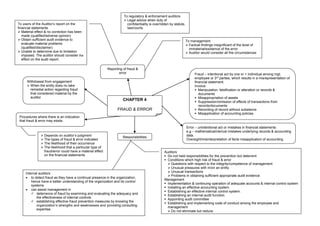
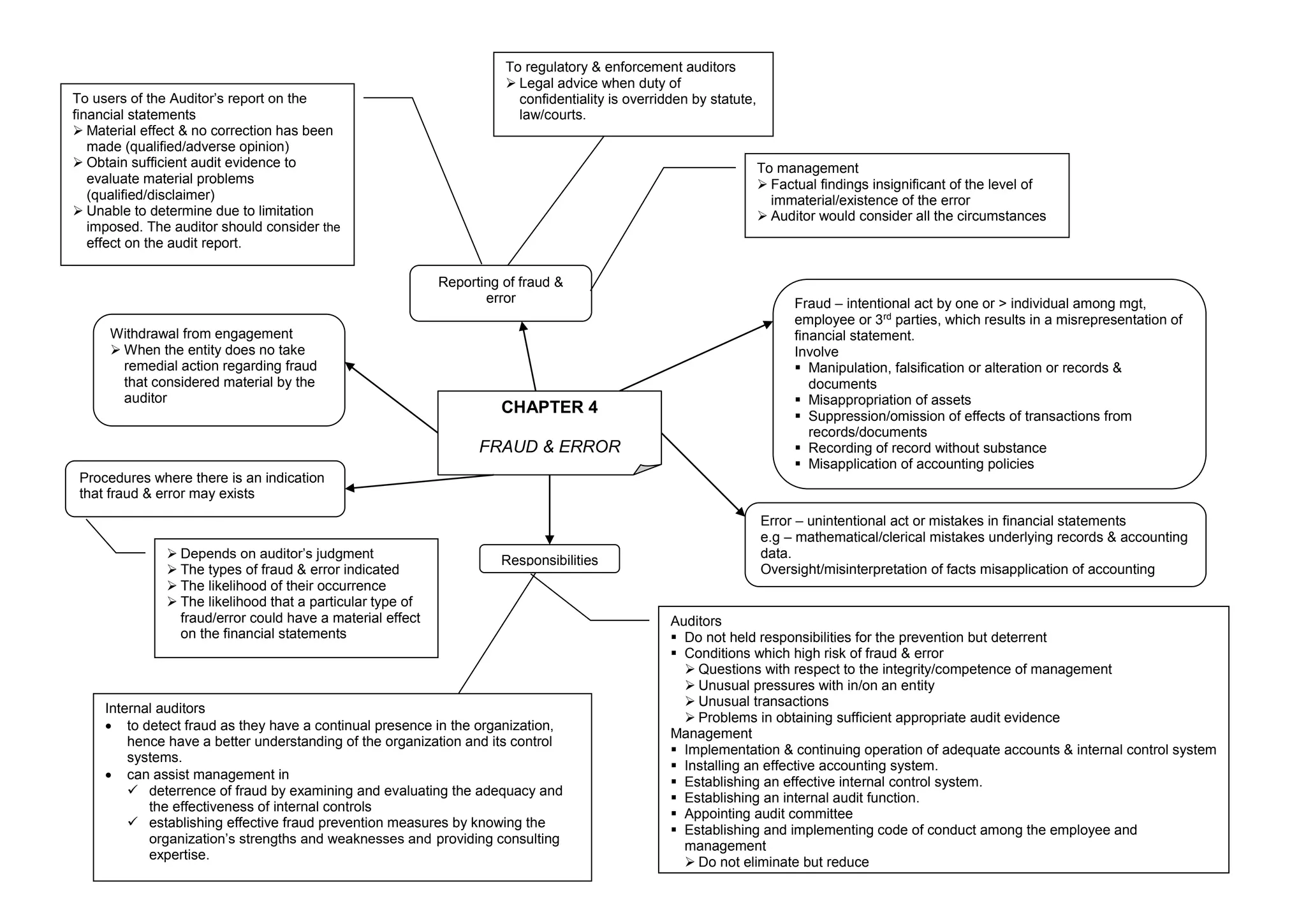
CHAPTER 4
FRAUD & ERROR
Fraud – intentional act by one or > individual among mgt,
employee or 3rd
parties, which results in a misrepresentation of
financial statement.
Involve
 Manipulation, falsification or alteration or records &
documents
 Misappropriation of assets
 Suppression/omission of effects of transactions from
records/documents
 Recording of record without substance
 Misapplication of accounting policies
Error – unintentional act or mistakes in financial statements
e.g – mathematical/clerical mistakes underlying records & accounting
data.
Oversight/misinterpretation of facts misapplication of accounting
policies
Withdrawal from engagement
 When the entity does no take
remedial action regarding fraud
that considered material by the
auditor
Procedures where there is an indication
that fraud & error may exists
Responsibilities
Reporting of fraud &
error
Auditors
 Do not held responsibilities for the prevention but deterrent
 Conditions which high risk of fraud & error
 Questions with respect to the integrity/competence of management
 Unusual pressures with in/on an entity
 Unusual transactions
 Problems in obtaining sufficient appropriate audit evidence
Management
 Implementation & continuing operation of adequate accounts & internal control system
 Installing an effective accounting system.
 Establishing an effective internal control system.
 Establishing an internal audit function.
 Appointing audit committee
 Establishing and implementing code of conduct among the employee and
management
 Do not eliminate but reduce
 Depends on auditor’s judgment
 The types of fraud & error indicated
 The likelihood of their occurrence
 The likelihood that a particular type of
fraud/error could have a material effect
on the financial statements
To management
 Factual findings insignificant of the level of
immaterial/existence of the error
 Auditor would consider all the circumstances
To users of the Auditor’s report on the
financial statements
 Material effect & no correction has been
made (qualified/adverse opinion)
 Obtain sufficient audit evidence to
evaluate material problems
(qualified/disclaimer)
 Unable to determine due to limitation
imposed. The auditor should consider the
effect on the audit report.
To regulatory & enforcement auditors
 Legal advice when duty of
confidentiality is overridden by statute,
law/courts.
Internal auditors
 to detect fraud as they have a continual presence in the organization,
hence have a better understanding of the organization and its control
systems.
 can assist management in
 deterrence of fraud by examining and evaluating the adequacy and
the effectiveness of internal controls
 establishing effective fraud prevention measures by knowing the
organization’s strengths and weaknesses and providing consulting
expertise.

Fraud & Error.doc

  • 1.
    CHAPTER 4 FRAUD &ERROR Fraud – intentional act by one or > individual among mgt, employee or 3rd parties, which results in a misrepresentation of financial statement. Involve  Manipulation, falsification or alteration or records & documents  Misappropriation of assets  Suppression/omission of effects of transactions from records/documents  Recording of record without substance  Misapplication of accounting policies Error – unintentional act or mistakes in financial statements e.g – mathematical/clerical mistakes underlying records & accounting data. Oversight/misinterpretation of facts misapplication of accounting policies Withdrawal from engagement  When the entity does no take remedial action regarding fraud that considered material by the auditor Procedures where there is an indication that fraud & error may exists Responsibilities Reporting of fraud & error Auditors  Do not held responsibilities for the prevention but deterrent  Conditions which high risk of fraud & error  Questions with respect to the integrity/competence of management  Unusual pressures with in/on an entity  Unusual transactions  Problems in obtaining sufficient appropriate audit evidence Management  Implementation & continuing operation of adequate accounts & internal control system  Installing an effective accounting system.  Establishing an effective internal control system.  Establishing an internal audit function.  Appointing audit committee  Establishing and implementing code of conduct among the employee and management  Do not eliminate but reduce  Depends on auditor’s judgment  The types of fraud & error indicated  The likelihood of their occurrence  The likelihood that a particular type of fraud/error could have a material effect on the financial statements To management  Factual findings insignificant of the level of immaterial/existence of the error  Auditor would consider all the circumstances To users of the Auditor’s report on the financial statements  Material effect & no correction has been made (qualified/adverse opinion)  Obtain sufficient audit evidence to evaluate material problems (qualified/disclaimer)  Unable to determine due to limitation imposed. The auditor should consider the effect on the audit report. To regulatory & enforcement auditors  Legal advice when duty of confidentiality is overridden by statute, law/courts. Internal auditors  to detect fraud as they have a continual presence in the organization, hence have a better understanding of the organization and its control systems.  can assist management in  deterrence of fraud by examining and evaluating the adequacy and the effectiveness of internal controls  establishing effective fraud prevention measures by knowing the organization’s strengths and weaknesses and providing consulting expertise.