Vulgar Fractions
IGCSE MATHEMATICS
0580
Digitized Notes
Fractions and Equivalent
Fractions
How to write fractions
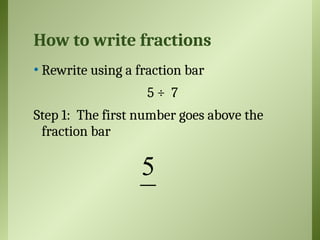
• Rewrite using a fraction bar
5 ÷ 7
Step 1: The first number goes above the
fraction bar
5
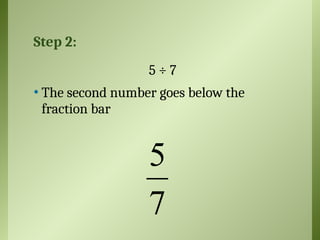
Step 2:
5 ÷ 7
• The second number goes below the
fraction bar
5
7
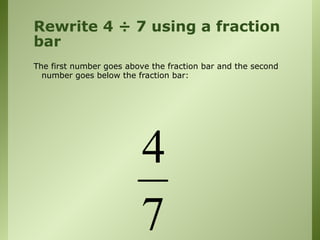
Rewrite 4 ÷ 7 using a fraction
bar
The first number goes above the fraction bar and the second
number goes below the fraction bar:
4
7
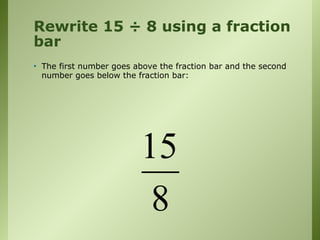
Rewrite 15 ÷ 8 using a fraction
bar
• The first number goes above the fraction bar and the second
number goes below the fraction bar:
15
8
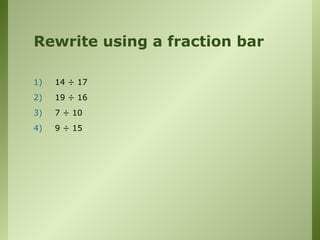
Rewrite using a fraction bar
1) 14 ÷ 17
2) 19 ÷ 16
3) 7 ÷ 10
4) 9 ÷ 15
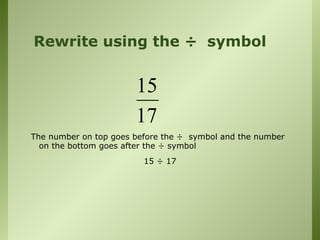
Rewrite using the ÷ symbol
The number on top goes before the ÷ symbol and the number
on the bottom goes after the ÷ symbol
15 ÷ 17
15
17
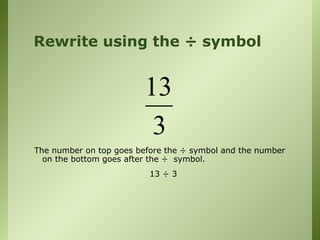
Rewrite using the ÷ symbol
The number on top goes before the ÷ symbol and the number
on the bottom goes after the ÷ symbol.
13 ÷ 3
13
3
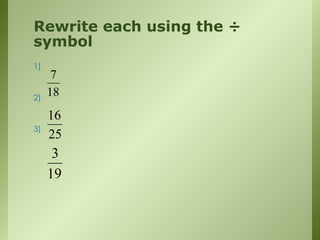
Rewrite each using the ÷
symbol
1)
2)
3)
7
18
16
25
3
19
Equivalent Fractions
• Equivalent – equal or the same
• Definition: two fraction that name the same amount are
called equivalent fractions.
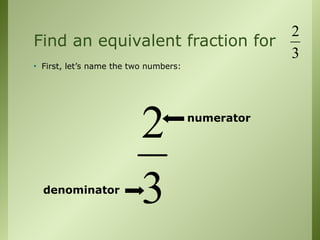
Find an equivalent fraction for
• First, let’s name the two numbers:
2
3
2
3
numerator
denominator
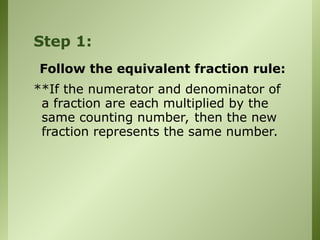
Step 1:
Follow the equivalent fraction rule:
**If the numerator and denominator of
a fraction are each multiplied by the
same counting number, then the new
fraction represents the same number.
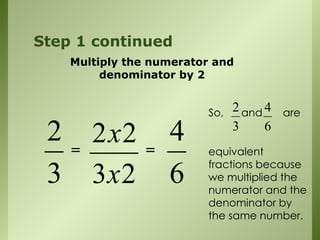
Step 1 continued
2
3
Multiply the numerator and
denominator by 2
=
2 2
3 2
x
x
=
4
6
2
3
4
6
So, and are
equivalent
fractions because
we multiplied the
numerator and the
denominator by
the same number.
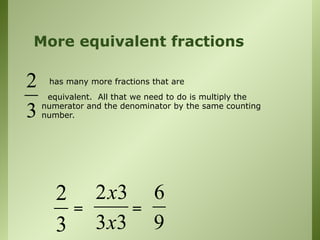
More equivalent fractions
has many more fractions that are
equivalent. All that we need to do is multiply the
numerator and the denominator by the same counting
number.
2
3
2
3
2 3
3 3
x
x
6
9
= =
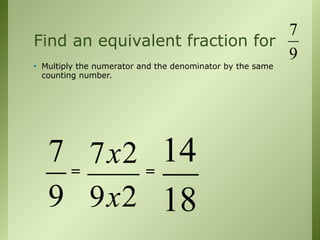
Find an equivalent fraction for
• Multiply the numerator and the denominator by the same
counting number.
7
9
7
9
7 2
9 2
x
x
14
18
= =
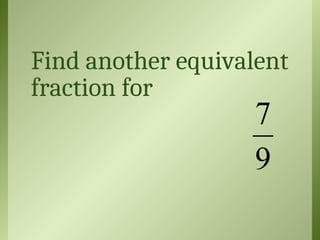
Find another equivalent
fraction for
7
9

Fractions- Calculating Equivalent Fractions.ppt

  • 1.
    Vulgar Fractions IGCSE MATHEMATICS 0580 DigitizedNotes Fractions and Equivalent Fractions
  • 2.
    How to writefractions • Rewrite using a fraction bar 5 ÷ 7 Step 1: The first number goes above the fraction bar 5
  • 3.
    Step 2: 5 ÷7 • The second number goes below the fraction bar 5 7
  • 4.
    Rewrite 4 ÷7 using a fraction bar The first number goes above the fraction bar and the second number goes below the fraction bar: 4 7
  • 5.
    Rewrite 15 ÷8 using a fraction bar • The first number goes above the fraction bar and the second number goes below the fraction bar: 15 8
  • 6.
    Rewrite using afraction bar 1) 14 ÷ 17 2) 19 ÷ 16 3) 7 ÷ 10 4) 9 ÷ 15
  • 7.
    Rewrite using the÷ symbol The number on top goes before the ÷ symbol and the number on the bottom goes after the ÷ symbol 15 ÷ 17 15 17
  • 8.
    Rewrite using the÷ symbol The number on top goes before the ÷ symbol and the number on the bottom goes after the ÷ symbol. 13 ÷ 3 13 3
  • 9.
    Rewrite each usingthe ÷ symbol 1) 2) 3) 7 18 16 25 3 19
  • 10.
    Equivalent Fractions • Equivalent– equal or the same • Definition: two fraction that name the same amount are called equivalent fractions.
  • 11.
    Find an equivalentfraction for • First, let’s name the two numbers: 2 3 2 3 numerator denominator
  • 12.
    Step 1: Follow theequivalent fraction rule: **If the numerator and denominator of a fraction are each multiplied by the same counting number, then the new fraction represents the same number.
  • 13.
    Step 1 continued 2 3 Multiplythe numerator and denominator by 2 = 2 2 3 2 x x = 4 6 2 3 4 6 So, and are equivalent fractions because we multiplied the numerator and the denominator by the same number.
  • 14.
    More equivalent fractions hasmany more fractions that are equivalent. All that we need to do is multiply the numerator and the denominator by the same counting number. 2 3 2 3 2 3 3 3 x x 6 9 = =
  • 15.
    Find an equivalentfraction for • Multiply the numerator and the denominator by the same counting number. 7 9 7 9 7 2 9 2 x x 14 18 = =
  • 16.