Equivalent Fractions
Vocabulary
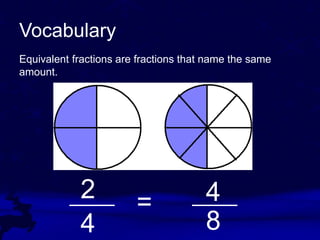
Equivalent fractions are fractions that name the same
amount.
2
4
= 4
8
Creating Equivalent Fractions
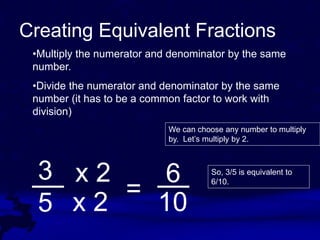
•Multiply the numerator and denominator by the same
number.
•Divide the numerator and denominator by the same
number (it has to be a common factor to work with
division)
3
5
We can choose any number to multiply
by. Let’s multiply by 2.
x 2
x 2
=
6
10
So, 3/5 is equivalent to
6/10.
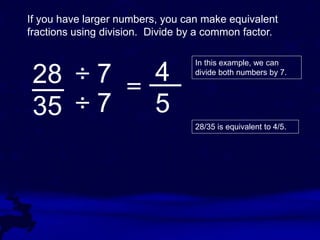
If you have larger numbers, you can make equivalent
fractions using division. Divide by a common factor.
28
35
In this example, we can
divide both numbers by 7.
÷ 7
÷ 7
=
4
5
28/35 is equivalent to 4/5.
Fractions in Simplest Form
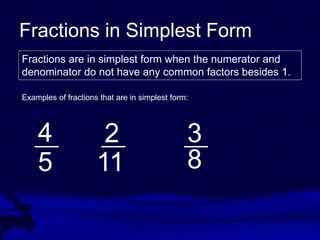
Fractions are in simplest form when the numerator and
denominator do not have any common factors besides 1.
Examples of fractions that are in simplest form:
4
5
2
11
3
8
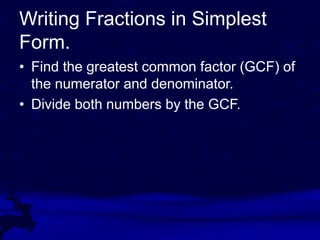
Writing Fractions in Simplest
Form.
• Find the greatest common factor (GCF) of
the numerator and denominator.
• Divide both numbers by the GCF.
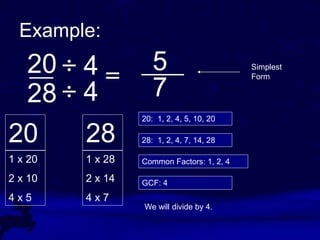
Example:
20
28
20
1 x 20
2 x 10
4 x 5
28
1 x 28
2 x 14
4 x 7
20: 1, 2, 4, 5, 10, 20
28: 1, 2, 4, 7, 14, 28
Common Factors: 1, 2, 4
GCF: 4
We will divide by 4.
÷ 4
÷ 4
=
5
7
Simplest
Form

Equivalent fractions

  • 1.
  • 2.
    Vocabulary Equivalent fractions arefractions that name the same amount. 2 4 = 4 8
  • 3.
    Creating Equivalent Fractions •Multiplythe numerator and denominator by the same number. •Divide the numerator and denominator by the same number (it has to be a common factor to work with division) 3 5 We can choose any number to multiply by. Let’s multiply by 2. x 2 x 2 = 6 10 So, 3/5 is equivalent to 6/10.
  • 4.
    If you havelarger numbers, you can make equivalent fractions using division. Divide by a common factor. 28 35 In this example, we can divide both numbers by 7. ÷ 7 ÷ 7 = 4 5 28/35 is equivalent to 4/5.
  • 5.
    Fractions in SimplestForm Fractions are in simplest form when the numerator and denominator do not have any common factors besides 1. Examples of fractions that are in simplest form: 4 5 2 11 3 8
  • 6.
    Writing Fractions inSimplest Form. • Find the greatest common factor (GCF) of the numerator and denominator. • Divide both numbers by the GCF.
  • 7.
    Example: 20 28 20 1 x 20 2x 10 4 x 5 28 1 x 28 2 x 14 4 x 7 20: 1, 2, 4, 5, 10, 20 28: 1, 2, 4, 7, 14, 28 Common Factors: 1, 2, 4 GCF: 4 We will divide by 4. ÷ 4 ÷ 4 = 5 7 Simplest Form