Head Office
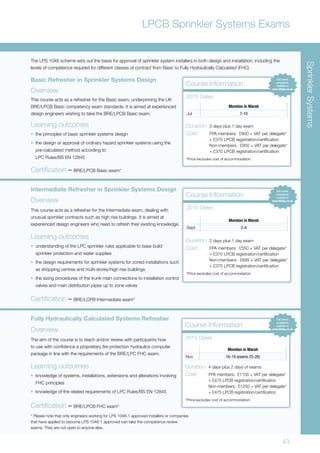
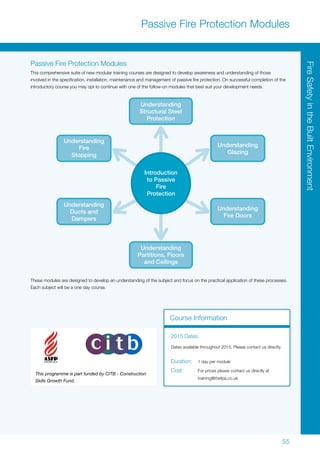
Fire Protection Association
London Road
Moreton in Marsh
Gloucestershire
GL56 0RH
T: +44 (0)1608 812 500
F: +44 (0)1608 812 501
E: training@thefpa.co.uk
www.thefpa.co.uk
TrainingandQualificationsProspectus2015
Welcome
Develop your knowledge and understanding of fire safety with the UK’s national fire safety organisation
FPA is proud to work with the institutions below:
Many of our courses can now be
booked securely online at
www.thefpa.co.uk
If you pay no less than 7 weeks before the course start
date you will receive a 10% discount. Look out for the early
bird for courses that apply.
Training and Qualifications
Prospectus 2015
THE UK’s NATIONAL FIRE SAFETY ORGANISATION
Protecting people, property, business and the environment
Your route to fire safety excellence
Fire safety awareness | Fire risk assessment | Fire safety management | Fire extinguisher maintenance
Emergency lighting | Fire detection and alarm systems | Fire in the built environment | Sprinkler systems
Fire safety audit and enforcement | Bespoke training | e-learning | Qualifications
Welcome to the 2015 FPA Training Prospectus
To start, I would like to thank the many individuals, employers
and organisations that chose to train with us in 2014. The
competency of staff with a fire safety remit remains a key
aspect of fire risk management in the workplace and we are
delighted that increasing numbers of employers continue to
work with us on a long term basis so that, together, we are
continually driving up standards of fire safety. Before we move
on to look at what’s new for 2015, I will touch on just a few of
the highlights from last year.
FPA training highlights for 2014 included:
•	 the new Level 3 Award in Fire Risk Management in
Residential Properties proved popular with housing
associations across the country
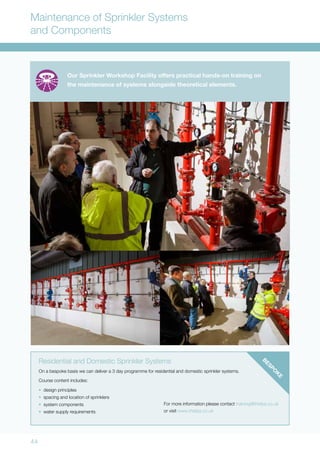
•	 the FPA’s state-of-the-art new sprinkler training workshop
opened and received excellent feedback from learners
attending courses on sprinkler systems maintenance
•	 a new Level 5 Diploma in Fire Investigation was launched
using FPA’s new practical burn facilities
•	 the Fire Sector Summit continues to be seen as the
must-attend event of the year with numbers in 2014 at
Sopwell House far exceeding previous years.
Whilst you will find many of our most popular courses and
events appearing again for 2015, we are continually listening to
the sector and once again will be adding to the range of training
and services that we offer.
New for 2015 are:
•	 a revised suite of fire detection and alarm systems
qualification-based courses which allow hands-on training in
purpose built booths
•	 clear routes to achievement of qualifications via Recognition
of Prior Learning
•	 a suite of practical modules to develop understanding of
passive fire protection
•	 the Level 5 Diploma in Fire Investigation which has course
dates available throughout the year
•	 Level 3 and 4 Certificate in Fire Risk Management in
Residential Properties
•	 a new hands-on five-day healthcare course on fire risk
management for practitioners
Our credentials speak for themselves:
•	 we are an Institution of Fire Engineers (IFE) Recognised
Training Provider and an Institution of Fire Safety Managers
(IFSM) Approved Training Centre
•	 we have significant experience of delivering fire safety
training, from major blue chip companies to the public sector
and SMEs
•	 we operate a quality management system in accordance
with BS/EN/ISO 9001, assessed and approved by Lloyds
Register
•	 we are a constituent member of the Confederation of Fire
Protection Associations Europe (CFPA Europe)
•	 we are a NEBOSH Accredited Centre
•	 we are an SFJ Awards Accredited Centre
•	 we run Higher Education programmes validated by
University of Derby Corporate (UDC)
•	 we have achieved the Investors in People Award
•	 the majority of our courses offer CPD points
Whether you are an established client returning to us for more
training or a new customer making enquiries for the first time,
we look forward to working with you in the coming year and
hope that you will find this year’s training offering bigger and
better than ever.
With best wishes for a very successful year.
Sue Tyley
Associate Director, Training
Email: styley@thefpa.co.uk
Course Title January February March April May June July August September October November December
Fire Safety Awareness
Fire Safety for Fire Wardens 20 Lon 2 Lon 11 Lon 14 Lon 12 Lon 2 Lon 7 Lon 8 Lon 6 Lon 3 Lon 1 Lon
Train the Trainer (Fire Safety) 20-22 MiM 3-5 Lon 4-6 MiM 14-16 Glas 6-8 MiM 3-5 Lon 1-3 MiM 2-4 MiM, 15-17 Glas 7-9 Lon 4-6 MiM
Hot Work Passport 19 MiM 16 Lon 3 MiM 16 Man 13 Lon 10 MIM 9 Man 9 Lon 13 MIM 11 Man
Introduction to DSEAR 24 MiM 28 Lon 26 Man 10 Glas 14 MiM
Fire Risk Assessment
Fire Risk Assessment for Simple Premises 12 Lon 17 Man 11 MIM 13 MiM 20 Glas 2 Lon
Fire Risk Assessment 12-14 MiM, 26-28 Lon 23-25 MiM
2-4 Dub, 16-18 Lon,
23-25 MiM
20-22 Lon, 27-29 Glas 12-14 Man, 18-20 MiM 22-24 MiM 27-29 Lon 3-5 MiM 21-23 Lon, 28-30 MiM 12-14 Glas, 19-21 Man
9-11 MIM,
16-18 Bel, 30- 2 Lon
Advanced Fire Risk Assessment 4-5 MiM 23-24 Lon 6-7 Glas 3-4 MiM 2-3 Lon 8-10 MiM 4-5 Man
Certificate in Applied Fire Risk Assessment 19-23 MiM 9-13 Lon 2-6 MiM, 9-13 Glas 20-24 MiM 11-15 Lon 15-19 MiM,	 29- 3 Lon, 13-17 MiM 7-11 Glas,14-18 MiM 19-23 Lon, 26- 2 MIM, 23-28 Lon
Fire Risk Assessment for the Common Areas in Flats and HMOs 16-18 Lon 13-15 MiM 11-13 Lon 8-10 Man 14-16 Lon 5-7 MiM 9-11 Glas
Advanced Fire Risk Assessment in HMOs 19-20 Lon 15-16 MIM 8-9 Lon 27-29 MiM 8-10 MIM
Risk Management in Residential Properties 18 MiM 17-18/24-25 MiM 13/22/28 MiM 19/21 MiM 6 Lon 7/15-16/29-30 Lon 13/29 Lon 2/4/10/25 Lon
Fire Risk Assessment and Maintenance of Fire Systems for Facilities Managers 10-12 MiM 7-9 Lon 25-27 MiM
Fire Risk Assessment for Healthcare Premises 18-23 MIM 16-20 MIM
Fire Safety Management
NEBOSH Certificate in Fire Safety and Risk Management Exams 4 MIM 3 MiM 2 MiM 2 MiM
Level 4 CFPA Europe Diploma in Fire Prevention 16 MiM 10 MiM 10 MiM 11 MiM 20 MiM
Advanced Fire Safety Management 13-17 MiM 12-16 MiM
Fire Extinguisher Maintenance
Portable Fire Extinguisher Recharging and Maintenance 26-29 MIM 	 23-26 Lon 16-19 Man, 23-26 Dub 20-23 MiM 11-14 Lon 13-16 Man, 20-23 Glas 21-24 MiM 12-15 Dub	 9-12 Lon, 16-19 Glas 7-10 MiM
Portable Fire Extinguisher Technicians Refresher 10 MIM 24 Lon 1 MIM 20 Glas
Sprinkler Systems
Introduction to Sprinkler Systems 28-29 MIM 3-4 MIM 13-14 MIM 2-3 MIM 3-4 MIM
Basic Sprinkler Systems Design 23-27 MiM 29- 3 MiM 19-23 MiM
Intermediate Sprinkler Systems Design 11-12 MiM 7-8 MiM
Basic Refresher in Sprinkler Systems Design 7-10 MiM
Intermediate Refresher in Sprinkler Systems Design 2-4 MiM
Fully Hydraulically Calculated Systems Refresher 16-19/25-26 MiM
Maintenance of Sprinkler Systems and Components 4-5/12-13/25-26 MiM 17-18 MiM 28-29 MiM 11-12 MiM 2-3/16-17 MiM 1-2 MiM 9-10/16-17 MiM 23-24 MiM 10-11/17-18/24-25 MiM
Emergency Lighting
Level 2 Award: Fundamentals of Emergency Lighting 27 MiM 2 MiM 6 MiM 1 MiM 8 MiM
Fire Detection and Alarm Systems
Level 2 Award: Fundamentals of Fire Detection and Alarm Systems 16-17 MiM 5-6 MiM 13-14 MiM 14-15 MiM 9-10 MiM
Fire Safety in the Built Environment
Working with Approved Document B and BS 9999 29- 1 MiM 3-5 MiM
Passive Fire Protection Modules 2-3 MiM 27-28 MiM 8-9 MiM 10-11 MiM 12-13 MiM 14-15 MiM
Fire Engineering Principles and Practice 9-13 MiM 29- 3 MiM 26-30 MiM
Fire Safety Training for Fire and Rescue Services
Level 5 Certificate in Fire Investigation 12-23 MiM 13-24 MiM 7-18 MiM 9-20 MiM
	
Bel=Belfast Dub=Dublin Glas=Glasgow Lon=London Man=Manchester MiM=Moreton in Marsh
2015 Course Calendar
Course Title January February March April May June July August September October November December
Fire Safety Awareness
Fire Safety for Fire Wardens 20 Lon 2 Lon 11 Lon 14 Lon 12 Lon 2 Lon 7 Lon 8 Lon 6 Lon 3 Lon 1 Lon
Train the Trainer (Fire Safety) 20-22 MiM 3-5 Lon 4-6 MiM 14-16 Glas 6-8 MiM 3-5 Lon 1-3 MiM 2-4 MiM, 15-17 Glas 7-9 Lon 4-6 MiM
Hot Work Passport 19 MiM 16 Lon 3 MiM 16 Man 13 Lon 10 MIM 9 Man 9 Lon 13 MIM 11 Man
Introduction to DSEAR 24 MiM 28 Lon 26 Man 10 Glas 14 MiM
Fire Risk Assessment
Fire Risk Assessment for Simple Premises 12 Lon 17 Man 11 MIM 13 MiM 20 Glas 2 Lon
Fire Risk Assessment 12-14 MiM, 26-28 Lon 23-25 MiM
2-4 Dub, 16-18 Lon,
23-25 MiM
20-22 Lon, 27-29 Glas 12-14 Man, 18-20 MiM 22-24 MiM 27-29 Lon 3-5 MiM 21-23 Lon, 28-30 MiM 12-14 Glas, 19-21 Man
9-11 MIM,
16-18 Bel, 30- 2 Lon
Advanced Fire Risk Assessment 4-5 MiM 23-24 Lon 6-7 Glas 3-4 MiM 2-3 Lon 8-10 MiM 4-5 Man
Certificate in Applied Fire Risk Assessment 19-23 MiM 9-13 Lon 2-6 MiM, 9-13 Glas 20-24 MiM 11-15 Lon 15-19 MiM,	 29- 3 Lon, 13-17 MiM 7-11 Glas,14-18 MiM 19-23 Lon, 26- 2 MIM, 23-28 Lon
Fire Risk Assessment for the Common Areas in Flats and HMOs 16-18 Lon 13-15 MiM 11-13 Lon 8-10 Man 14-16 Lon 5-7 MiM 9-11 Glas
Advanced Fire Risk Assessment in HMOs 19-20 Lon 15-16 MIM 8-9 Lon 27-29 MiM 8-10 MIM
Risk Management in Residential Properties 18 MiM 17-18/24-25 MiM 13/22/28 MiM 19/21 MiM 6 Lon 7/15-16/29-30 Lon 13/29 Lon 2/4/10/25 Lon
Fire Risk Assessment and Maintenance of Fire Systems for Facilities Managers 10-12 MiM 7-9 Lon 25-27 MiM
Fire Risk Assessment for Healthcare Premises 18-23 MIM 16-20 MIM
Fire Safety Management
NEBOSH Certificate in Fire Safety and Risk Management Exams 4 MIM 3 MiM 2 MiM 2 MiM
Level 4 CFPA Europe Diploma in Fire Prevention 16 MiM 10 MiM 10 MiM 11 MiM 20 MiM
Advanced Fire Safety Management 13-17 MiM 12-16 MiM
Fire Extinguisher Maintenance
Portable Fire Extinguisher Recharging and Maintenance 26-29 MIM 	 23-26 Lon 16-19 Man, 23-26 Dub 20-23 MiM 11-14 Lon 13-16 Man, 20-23 Glas 21-24 MiM 12-15 Dub	 9-12 Lon, 16-19 Glas 7-10 MiM
Portable Fire Extinguisher Technicians Refresher 10 MIM 24 Lon 1 MIM 20 Glas
Sprinkler Systems
Introduction to Sprinkler Systems 28-29 MIM 3-4 MIM 13-14 MIM 2-3 MIM 3-4 MIM
Basic Sprinkler Systems Design 23-27 MiM 29- 3 MiM 19-23 MiM
Intermediate Sprinkler Systems Design 11-12 MiM 7-8 MiM
Basic Refresher in Sprinkler Systems Design 7-10 MiM
Intermediate Refresher in Sprinkler Systems Design 2-4 MiM
Fully Hydraulically Calculated Systems Refresher 16-19/25-26 MiM
Maintenance of Sprinkler Systems and Components 4-5/12-13/25-26 MiM 17-18 MiM 28-29 MiM 11-12 MiM 2-3/16-17 MiM 1-2 MiM 9-10/16-17 MiM 23-24 MiM 10-11/17-18/24-25 MiM
Emergency Lighting
Level 2 Award: Fundamentals of Emergency Lighting 27 MiM 2 MiM 6 MiM 1 MiM 8 MiM
Fire Detection and Alarm Systems
Level 2 Award: Fundamentals of Fire Detection and Alarm Systems 16-17 MiM 5-6 MiM 13-14 MiM 14-15 MiM 9-10 MiM
Fire Safety in the Built Environment
Working with Approved Document B and BS 9999 29- 1 MiM 3-5 MiM
Passive Fire Protection Modules 2-3 MiM 27-28 MiM 8-9 MiM 10-11 MiM 12-13 MiM 14-15 MiM
Fire Engineering Principles and Practice 9-13 MiM 29- 3 MiM 26-30 MiM
Fire Safety Training for Fire and Rescue Services
Level 5 Certificate in Fire Investigation 12-23 MiM 13-24 MiM 7-18 MiM 9-20 MiM
	
Bel=Belfast Dub=Dublin Glas=Glasgow Lon=London Man=Manchester MiM=Moreton in Marsh
2015 Course Calendar
Head Office
Fire Protection Association
London Road
Moreton in Marsh
Gloucestershire
GL56 0RH
T: +44 (0)1608 812 500
F: +44 (0)1608 812 501
E: training@thefpa.co.uk
www.thefpa.co.uk
TrainingandQualificationsProspectus2015
Welcome
Develop your knowledge and understanding of fire safety with the UK’s national fire safety organisation
FPA is proud to work with the institutions below:
Many of our courses can now be
booked securely online at
www.thefpa.co.uk
If you pay no less than 7 weeks before the course start
date you will receive a 10% discount. Look out for the early
bird for courses that apply.
Training and Qualifications
Prospectus 2015
THE UK’s NATIONAL FIRE SAFETY ORGANISATION
Protecting people, property, business and the environment
Your route to fire safety excellence
Fire safety awareness | Fire risk assessment | Fire safety management | Fire extinguisher maintenance
Emergency lighting | Fire detection and alarm systems | Fire in the built environment | Sprinkler systems
Fire safety audit and enforcement | Bespoke training | e-learning | Qualifications
Welcome to the 2015 FPA Training Prospectus
To start, I would like to thank the many individuals, employers
and organisations that chose to train with us in 2014. The
competency of staff with a fire safety remit remains a key
aspect of fire risk management in the workplace and we are
delighted that increasing numbers of employers continue to
work with us on a long term basis so that, together, we are
continually driving up standards of fire safety. Before we move
on to look at what’s new for 2015, I will touch on just a few of
the highlights from last year.
FPA training highlights for 2014 included:
•	 the new Level 3 Award in Fire Risk Management in
Residential Properties proved popular with housing
associations across the country
•	 the FPA’s state-of-the-art new sprinkler training workshop
opened and received excellent feedback from learners
attending courses on sprinkler systems maintenance
•	 a new Level 5 Diploma in Fire Investigation was launched
using FPA’s new practical burn facilities
•	 the Fire Sector Summit continues to be seen as the
must-attend event of the year with numbers in 2014 at
Sopwell House far exceeding previous years.
Whilst you will find many of our most popular courses and
events appearing again for 2015, we are continually listening to
the sector and once again will be adding to the range of training
and services that we offer.
New for 2015 are:
•	 a revised suite of fire detection and alarm systems
qualification-based courses which allow hands-on training in
purpose built booths
•	 clear routes to achievement of qualifications via Recognition
of Prior Learning
•	 a suite of practical modules to develop understanding of
passive fire protection
•	 the Level 5 Diploma in Fire Investigation which has course
dates available throughout the year
•	 Level 3 and 4 Certificate in Fire Risk Management in
Residential Properties
•	 a new hands-on five-day healthcare course on fire risk
management for practitioners
Our credentials speak for themselves:
•	 we are an Institution of Fire Engineers (IFE) Recognised
Training Provider and an Institution of Fire Safety Managers
(IFSM) Approved Training Centre
•	 we have significant experience of delivering fire safety
training, from major blue chip companies to the public sector
and SMEs
•	 we operate a quality management system in accordance
with BS/EN/ISO 9001, assessed and approved by Lloyds
Register
•	 we are a constituent member of the Confederation of Fire
Protection Associations Europe (CFPA Europe)
•	 we are a NEBOSH Accredited Centre
•	 we are an SFJ Awards Accredited Centre
•	 we run Higher Education programmes validated by
University of Derby Corporate (UDC)
•	 we have achieved the Investors in People Award
•	 the majority of our courses offer CPD points
Whether you are an established client returning to us for more
training or a new customer making enquiries for the first time,
we look forward to working with you in the coming year and
hope that you will find this year’s training offering bigger and
better than ever.
With best wishes for a very successful year.
Sue Tyley
Associate Director, Training
Email: styley@thefpa.co.uk
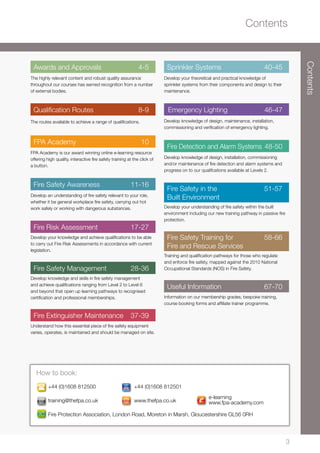
Contents
3
Contents
+44 (0)1608 812500	 +44 (0)1608 812501
training@thefpa.co.uk	www.thefpa.co.uk
Fire Protection Association, London Road, Moreton in Marsh, Gloucestershire GL56 0RH
How to book:
Awards and Approvals	 4-5
The highly relevant content and robust quality assurance
throughout our courses has earned recognition from a number
of external bodies.
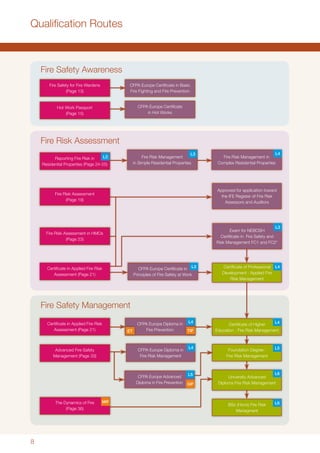
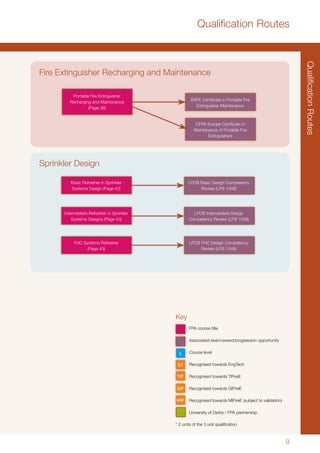
Qualification Routes	 8-9
The routes available to achieve a range of qualifications.
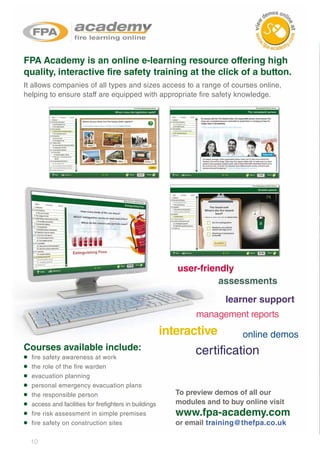
FPA Academy	 10
FPA Academy is our award winning online e-learning resource
offering high quality, interactive fire safety training at the click of
a button.
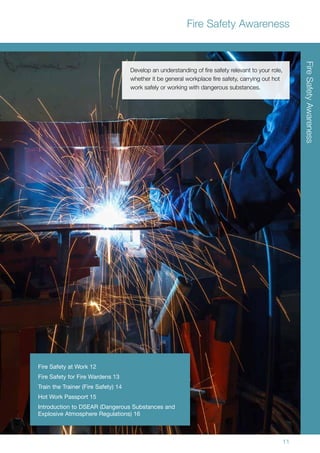
Fire Safety Awareness	 11-16
Develop an understanding of fire safety relevant to your role,
whether it be general workplace fire safety, carrying out hot
work safely or working with dangerous substances.
Fire Risk Assessment	 17-27
Develop your knowledge and achieve qualifications to be able
to carry out Fire Risk Assessments in accordance with current
legislation.
Fire Safety Management	 28-36
Develop knowledge and skills in fire safety management
and achieve qualifications ranging from Level 2 to Level 6
and beyond that open up learning pathways to recognised
certification and professional memberships.
Fire Extinguisher Maintenance	 37-39
Understand how this essential piece of fire safety equipment
varies, operates, is maintained and should be managed on site.
Sprinkler Systems	 40-45
Develop your theoretical and practical knowledge of
sprinkler systems from their components and design to their
maintenance.
Emergency Lighting 46-47
Develop knowledge of design, maintenance, installation,
commissioning and verification of emergency lighting.
Fire Detection and Alarm Systems	48-50
Develop knowledge of design, installation, commissioning
and/or maintenance of fire detection and alarm systems and
progress on to our qualifcations available at Levels 2.
Fire Safety in the	 51-57
Built Environment
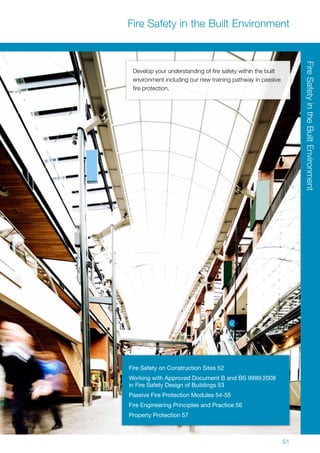
Develop your understanding of fire safety within the built
environment including our new training pathway in passive fire
protection.
Fire Safety Training for 	 58-66
Fire and Rescue Services	
Training and qualification pathways for those who regulate
and enforce fire safety, mapped against the 2010 National
Occupational Standards (NOS) in Fire Safety.
Useful Information	 67-70
Information on our membership grades, bespoke training,
course booking forms and affiliate trainer programme.
@
@@
@
@
@
e-learning
www.fpa-academy.com
The highly relevant content and robust quality assurance
throughout our courses has earned recognition from a number
of external bodies including:
The CFPA Europe Certificates, Diploma
and Advanced Diploma in Fire Prevention
The Confederation of Fire Protection Associations Europe
(CFPA) is the formal body, governed by statute, which links the
17 recognised fire safety organisations that exist in the countries
of the European Union and the European Free Trade Area. The
CFPA Europe Certificates, Diploma and Advanced Diploma
are recognised in the 17 home countries of the CFPA and offer
holders a Europe-wide recognised qualification in a range of
aspects of fire safety management and prevention.
NEBOSH Certificate in Fire Safety and
Risk Management
Founded in 1979, NEBOSH offers
qualifications that are recognised and
respected by employers in all sectors
of the economy and which provide the
benchmark standard against which
others are compared. FPA is a NEBOSH
Accredited centre, delivering the
underpinning knowledge for certificated
units FC1 and FC2 of the nationally recognised Fire Safety
and Risk Management Certificate. If you have achieved the
NEBOSH National General Certificate (unit NGC1) within the last
5 years you can be awarded the full Certificate.
Institution of Fire Engineers Membership
At selected stages the FPA’s CFPA qualifications in Fire
Prevention are recognised as providing appropriate training
in support of applications for Institution of Fire Engineers (IFE)
membership at various grades.
EngTech
The CFPA Europe Diploma in Fire Prevention has been
approved by the IFE as contributing to the academic
requirements for achieving Engineering Technician (EngTech)
status with the Engineering Council.
Competency Criteria for Fire Risk
Assessors
The Fire Risk Assessment Competency Council comprises a
broad group of relevant fire sector stakeholders. Its objective
has been to establish industry-wide criteria against which the
competence of a fire risk assessor can be judged. These criteria
are able to be used by professional bodies and third party
certification bodies who register or certificate fire risk assessors,
by training providers in the design of course content and by
commercial companies providing fire risk assessment services.
FPA courses have been mapped against these competency
criteria to ensure relevant coverage of the knowledge
requirements within our fire risk assessor training. Examples of
some of the national register schemes available are below:
Institution of Fire Engineers
Register of Fire Risk Assessors & Auditors
The FPA offers a number of risk assessment
courses (please refer to our Fire Risk
Assessment section on page 17) which
have all received course approval from the
IFE for the purpose of their Register of Fire
Risk Assessors and Auditors. Successful
completion of the course will support an
individual’s application to the Register and may help in reducing
the burden of proof required through the application process.
In addition to successfully completing the course, applicants
to the Register will need to be able to provide evidence of
suitable and sufficient education, training and experience in
fire safety, fire risk assessment and /or the audit of completed
assessments before making their application. For further
information please visit the IFE website at www.ife.org.uk/frr/
Institute of Fire Prevention Officers
The Institute of Fire Prevention Officers
(IFPO) represents fire safety professionals
from all walks of life including the Fire
& Rescue Services, underground and
overground rail networks, the aviation
sector as well as the more usual fire sectors.
IFPO operates its own fire risk assessor’s register following
the guidelines issued by the competency criteria council.
Entry on to the register is by application and examination of
qualifications. A number of fire risk assessments are then
submitted for scrutinisation, with a final panel interview. IFPO
offers discounted prices to those who have completed FPA
fire risk assessment training. For further information please visit
www.ifpo.org.uk
4
Awards and Approvals
AwardsandApprovals
5
Awards and Approvals
National Occupational Standards
National Occupational Standards (NOS) are important
benchmarks for those striving to achieve or demonstrate
competence in their particular field of work as they set down
what a person needs to do, know and understand in order to
be competent to carry out activities or functions. A typical NOS
will break down all of the required activities into units including
a unit summary or overview. Each unit will describe the required
standards of performance and the required standards of
knowledge and understanding necessary to perform a particular
function competently. In the fire sector the relevant standards
that underpin activities come from the Fire Safety NOS and
the Electronic Systems NOS. Each of these set of standards
sit with an overarching, independent skills body who’s remit
it is to identify and address skills and workforce development
needs. Fire Safety NOS sit with Skills for Justice and Electronic
Systems NOS sit with Skills for Security.
These NOS underpin the course content of all relevant FPA
courses.
SFJ Awards
SFJ Awards is an awarding organisation
approved by the Qualification Regulators to
provide qualifications in England, Wales and
Northern Ireland.
They develop and deliver nationally recognised qualifications
for the Justice and Community Safety Sector, the Legal Sector,
Local Government, Military and the Fire and Rescue Sector.
FPA is an Approved Centre for SFJ Awards qualifications for
fire safety, fire risk management in residential properties & fire
investigation.
By working with SFJ Awards, organisations can develop and
implement learning programmes that adhere to a recognised
quality assurance process. This results in a quality tailored
training programme that remains the intellectual property of
the organisation that has developed it, as well as providing
increased confidence in the learning programme and ensuring
learners have the right skills to do their jobs with proficiency.
IQ
Industry Qualifications (IQ) is a nationally regulated awarding
organisation committed to raising standards in vocational
education. They are sector-focused and work in partnership
with trade bodies and professional associations to develop
qualifications that are relevant and valued. They believe in
premium quality, thinking differently and above all, in fairness
and transparency, in everything we do.
FPA is an Approved Centre for IQ qualifications in fire detection
and alarm systems and emergency lighting.
University of Derby
The University of Derby
has been working with
companies for several
years to focus on
improving employability
and boost careers and
professional development
through higher education. Engaging with employers to help
drive up the higher skill levels of the UK workforce. Working
in close partnership with the University of Derby, the FPA has
developed a BSc (Hons) route which includes its
well-established and highly regarded CFPA Europe Diploma
and Advanced Diploma in Fire Prevention.
Continuing Professional Development
The FPA supports the principles of CPD and credits or points
may be available to members of professional institutions as a
result of attending specified courses. CPD hours have been
awarded for the majority of FPA courses by the Institution of Fire
Engineers (IFE) and they are also recognised by The Institution
of Occupational Safety and Health (IOSH) and The Institute of
Fire Safety Managers (IFSM). The list of institutions recognising
our courses is continually expanding and an enquiry about
the availability of CPD points should be made at the time of
booking.
6
Bespoke Courses
Tailored, cost-effective training solutions
An increasing number of organisations require training
services to be provided on a ‘bespoke basis’, whereby the
location, timing and course programme can be tailored to
suit specific training objectives.
FPA is able to modify, expand and tailor any of the courses
featured in our prospectus or create entirely new courses
as necessary. Course content can be amended to ensure
that delegates are trained in accordance with your specific
company systems and procedures and, if necessary, we can
also provide on-going back-up and verification services.
Our staff are able to travel extensively home and overseas
to present our courses to clients. We have access to
regional training centres across the UK or can run courses
at your premises at a time to meet with your requirements.
Alternatively FPA’s practical training facilities and classrooms
at Head Office can be used. Rates are by negotiation, but
discounts are available for companies that book a group
of customised training courses, and for those that are FPA
members.
Case studies of just a few of the bespoke programmes
which we were able to develop and present on behalf of our
customers are featured on our website, www.thefpa.co.uk
If you feel your company can benefit from our customised
training solutions then please email training@thefpa.co.uk
with your enquiry.
Our fire warden and general fire awareness courses are
delivered at customers’ premises across the UK and Ireland.
The FPA has a growing list of satisfied
customers, with companies from all
sectors booking courses with us.
Clients from 2014 included:
7
BespokeCourses
Working with the FPA
Affiliate Training Provider Scheme
Training providers of similar educational standards and ethos
can now work in partnership with FPA, bringing the knowledge,
skills and experience of their own training team to the delivery
of a range of FPA’s training courses and qualifications. Each
course is supported by comprehensive Affiliate Provider Training
Materials containing learning resources and assessments.
Joint marketing in the form of promotional activity and use of
affiliate provider branding on certification is also available within
the scheme.
The courses that are available through this scheme are:
•	 FPA Certificate in Action in the Event of Fire
•	 CFPA Europe Certificate in Fire Safety for Fire Wardens (Basic
Fire Fighting and Fire Prevention)
•	 FPA Hot Work Passport
Some of our current affiliate trainers are: Tesco Maintenance,
National Safety Training and Normandie Health & Safety.
Satellite Centre
Satellite Centre status operates in a similar manner to the
Affiliate Trainer scheme but involves training which leads to the
awarding of a nationally recognised qualification and is therefore
subject to further administration on behalf of the centre to meet
the requirements. Learners and trainers will have access to
on-line activities and assessments via the FPA Academy
and they will have the support and guidance of the FPA QA
team. We also provide a network of contact and support
between learners and Satellite centres as part of the ongoing
development of the qualification. The centre will require
appropriate training facilities and a minimum of one Trainer/
IQA and one Administrator/Programme Manager. For larger
organisations these roles are likely to be split across several
members of staff.
The courses that are available through this scheme are:
•	 Level 2 Award: Fundamentals of Fire Detection and Alarm
Systems
•	 Level 2 Award: Fundamentals of Emergency Lighting
•	 Level 3 Award: Reporting Fire Risk in Residential Properties
•	 Level 3 Certificate: Fire Risk Management in Simple
Residential Properties
•	 Level 4 Certificate: Fire Risk Management in Complex
Residential Properties
In order to join either scheme you will need to be, or employ
trainers who have been approved by the FPA as having the
required knowledge, skills and experience to offer specific
training. This may include attending our 3 day Train the Trainer
course. You will be required to complete an application form
and provide a detailed CV, describing your relevant experience
and qualifications.
FPA will review your application and issue an Action Plan
which will outline any additional requirements prior to approval.
All Satellite Centres will receive a centre visit from our quality
management team to look at your facilities and to ensure the
support and needs of the learners can be met from both a
training delivery and administrative point of view. We will also
provide you with various guidance on the processes involved
and what learners can expect from programme delivery,
assessment activities and quality assurance.
Some of our current Satellite Centres
8
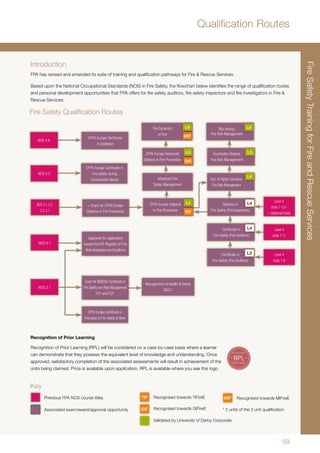
Qualification Routes
Fire Risk Assessment
(Page 19)
Certificate in Applied Fire Risk
Assessment (Page 21)
Certificate in Applied Fire Risk
Assessment (Page 21)
Hot Work Passport
(Page 15)
Reporting Fire Risk in
Residential Properties (Page 24-25)
Fire Safety for Fire Wardens
(Page 13)
Advanced Fire Safety
Management (Page 33)
Fire Safety Awareness
Fire Risk Assessment
Fire Safety Management
CFPA Europe Certificate
in Hot Works
CFPA Europe Certificate in Basic
Fire Fighting and Fire Prevention
CFPA Europe Advanced
Diploma in Fire Prevention
BSc (Hons) Fire Risk
Managment
CFPA Europe Diploma in
Fire Risk Management
The Dynamics of Fire
(Page 36)
MIF
L3 Fire Risk Management
in Simple Residential Properties
L3
L4Certificate of Professional
Development : Applied Fire
Risk Management
L3CFPA Europe Certificate in
Principles of Fire Safety at Work
L4CFPA Europe Diploma in
Fire Prevention
L4
L5
GIF
Certificate of Higher
Education : Fire Risk Management
L4
L6
L3
Exam for NEBOSH
Certificate in Fire Safety and
Risk Management FC1 and FC2*
Approved for application toward
the IFE Register of Fire Risk
Assessors and Auditors
Fire Risk Management in
Complex Residential Properties
L4
Fire Risk Assessment in HMOs
(Page 23)
ET TIF
Foundation Degree :
Fire Risk Management
L5
University Advanced
Diploma Fire Risk Management
L6
QualificationRoutes
9
Qualification Routes
Key
	 FPA course title
	 Associated exam/award/progression opportunity
	 Course level
	 Recognised towards EngTech
	 Recognised towards TIFireE
	 Recognised towards GIFireE
	 Recognised towards MIFireE (subject to validation)
	 University of Derby / FPA partnership
* 2 units of the 3 unit qualification
MIF
GIF
TIF
Basic Refresher in Sprinkler
Systems Design (Page 43)
Intermediate Refresher in Sprinkler
Systems Designs (Page 43)
FHC Systems Refresher
(Page 43)
Sprinkler Design
LPCB Basic Design Competency
Review (LPS 1048)
LPCB Intermediate Design
Competency Review (LPS 1048)
LPCB FHC Design Competency
Review (LPS 1048)
Portable Fire Extinguisher
Recharging and Maintenance
(Page 38)
Fire Extinguisher Recharging and Maintenance
BAFE Certificate in Portable Fire
Extinguisher Maintenance
CFPA-Europe Certificate in
Maintenance of Portable Fire
Extinguishers
ET
L
10
fire safety awareness at work
the role of the fire warden
evacuation planning
personal emergency evacuation plans
the responsible person
access and facilities for firefighters in buildings
fire risk assessment in simple premises
fire safety on construction sites
FPA Academy is an online e-learning resource offering high
quality, interactive fire safety training at the click of a button.
It allows companies of all types and sizes access to a range of courses online,
helping to ensure staff are equipped with appropriate fire safety knowledge.
Courses available include:
•
•
•
•
•
•
•
•
To preview demos of all our
modules and to buy online visit
www.fpa-academy.com
or email training@thefpa.co.uk
user-friendly
assessments
management reports
learner support
online demosinteractive
certification
11
Fire Safety Awareness
Develop an understanding of fire safety relevant to your role,
whether it be general workplace fire safety, carrying out hot
work safely or working with dangerous substances.
FireSafetyAwareness
Fire Safety at Work 12
Fire Safety for Fire Wardens 13
Train the Trainer (Fire Safety) 14
Hot Work Passport 15
Introduction to DSEAR (Dangerous Substances and
Explosive Atmosphere Regulations) 16
12
Fire Safety at Work
Action in the Event of Fire
Overview
This course provides delegates with an understanding of what
to do in the event of a fire and includes practical hands-on use
of a fire extinguisher. Approximately 90 minutes in duration
and delivered at your premises, it provides all staff with an
awareness of fire prevention.
Who will benefit?
This course will benefit all employees in understanding the
appropriate actions to take in the event of fire.
Learning outcomes
Delegates will understand how to:
•	 identify when to evacuate the building
•	 take the correct actions when discovering a fire
•	 select and use the correct extinguisher
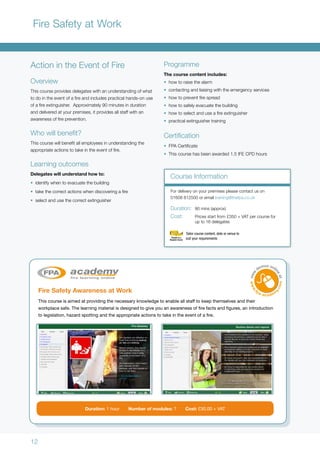
Fire Safety Awareness at Work
This course is aimed at providing the necessary knowledge to enable all staff to keep themselves and their
workplace safe. The learning material is designed to give you an awareness of fire facts and figures, an introduction
to legislation, hazard spotting and the appropriate actions to take in the event of a fire.
Programme
The course content includes:
•	 how to raise the alarm
•	 contacting and liaising with the emergency services
•	 how to prevent fire spread
•	 how to safely evacuate the building
•	 how to select and use a fire extinguisher
•	 practical extinguisher training
Certification
•	 FPA Certificate
•	 This course has been awarded 1.5 IFE CPD hours
Duration: 1 hour Number of modules: 7 Cost: £30.00 + VAT
For delivery on your premises please contact us on
01608 812500 or email training@thefpa.co.uk
Duration:	 90 mins (approx)
Cost:	 Prices start from 	£350 + VAT per course for
	 up to 16 delegates
Course Information
Tailor course content, date or venue to
suit your requirements
13
Overview
Our half-day course for fire wardens has been revamped to
ensure that participants achieve a thorough awareness and
understanding of the threat posed by fire. All delegates receive
practical hands on training in fire extinguishers as well as
interactive training in risk assessment, mitigation and a copy of
our ‘Fire Warden Handbook’ (RRP £20.00).
This course is available as an open course, or as a bespoke
course delivered at clients’ venues at a time suited to them.
Who will benefit?
This course will be of benefit to all staff, particularly those
designated as fire wardens or marshals. It is suitable for
employees working in industry, commerce or the public sector.
Learning outcomes
You will develop knowledge and skills in how to:
•	 identify fire hazards and risks – Unit FS1.1*
•	 report fire hazards and risks – Unit FS1.2*
*Units refer to the National Occupational Standards (NOS) in
Fire Safety 2010.
Programme
The course content includes:
•	 fire legislation, facts and figures
•	 combustion principles and how fire spreads
•	 fire case study
•	 how to spot common hazards
•	 actions in the event of fire and evacuation principles
•	 fire wardens’ responsibilities
•	 routine fire safety checks
•	 fire extinguisher theory and practical
Certification
•	 CFPA Europe Certificate in Basic Fire Fighting and
Fire Prevention
•	 This course has been awarded 3 IFE CPD hours
London London
Jan 20 July 7
Feb 2 Sept 8
Mar 11 Oct 6
Apr 14 Nov 3
May 12 Dec 1
Jun 2
2015 Dates
Duration:	 1
/2 day (12:30-16:45)
Cost:	 FPA members:	 £105 + VAT per delegate
	 Non-members:	 £125 + VAT per delegate
for other venues across the UK visit our website at www.thefpa.co.uk
Course Information 	 Book online at
	www.thefpa.co.uk
FireSafetyAwareness
Fire Safety for Fire Wardens
Early Bird Discount –
pay 7 weeks in advance
and save 10%
Tailor course content,
date or venue to suit
your requirements
“Interesting and easy to follow, good introduction,
friendly and knowledgeable”
Nora Fertig, Australian High Commission
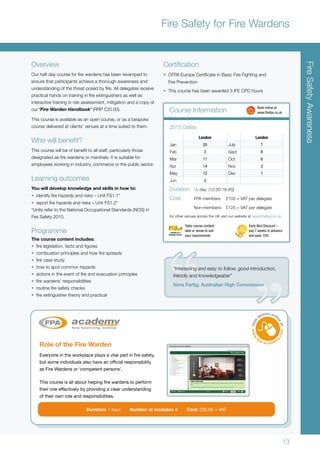
Role of the Fire Warden
Everyone in the workplace plays a vital part in fire safety,
but some individuals also have an official responsibility
as Fire Wardens or ‘competent persons’.
This course is all about helping fire wardens to perform
their role effectively by providing a clear understanding
of their own role and responsibilities.
Duration: 1 hour Number of modules: 8 Cost: £30.00 + VAT
14
Overview
This 3 day course provides delegates with specialist training from
experienced FPA trainers on fire safety knowledge and training
delivery best practice. On successful completion you will have
the necessary skills and confidence to deliver effective fire safety
awareness training in-house.
This course has developed to become one of our most popular,
with delegates benefitting from its relaxed but informative style.
Delegate feedback has indicated that the training has saved
businesses time and money, as well as ensuring that all staff
receive high quality up-to-date training as required by current fire
legislation.
Important: Delegates have the option of taking either the 3 day
course, which includes input on teaching methods on day 1, or,
if you have sufficient qualifications or experience in this area, you
can elect to attend the final 2 days. Anyone applying to become
an Affiliate Trainer of the FPA must undertake the 3 day course.
Who will benefit?
Anyone who wants the ability to be able to deliver knowledgeable
basic fire safety training in-house. Companies no longer need
to send staff off-site or to contract in external companies every
time a new member of staff joins, or when refresher training is
required.
Learning outcomes
Delegates will develop:
•	 confidence in delivering fire safety training and handling any
questions that the delegates raise during the course
•	 a greater awareness of the hazards of fire
•	 an understanding of the nature of fire and how it spreads
•	 an understanding of human behaviour in a fire
•	 knowledge of current fire safety legislation
•	 an understanding of the actions to take in the event of
discovering a fire
•	 the ability to distinguish between the different types of fire
extinguishers and the fires for which they are suited
•	 the ability to tackle small fires with confidence
•	 best practice in training delivery
Programme
The course content includes:
•	 training delivery best practice tools and techniques
•	 fire facts, figures and trends
•	 fire spread
•	 hazard identification
•	 fire legislation
•	 fire evacuation principles
•	 fire extinguisher theory and practical
•	 combustion principles
•	 human behaviour
•	 microteach session
•	 assessment and certification
Certification
•	 FPA Train the Trainer Certificate
•	 CFPA Europe Certificate in Basic Fire Fighting and Fire Prevention
•	 this course has been awarded 18 IFE CPD hours
MiM=Moreton in Marsh Lon=London Glas=Glasgow
MiM Lon** Glas
Jan 20-22
Feb 3-5
Mar 4-6
Apr 14-16
May 6-8
Jun 3-5
July 1-3
Sept 2-4 15-17
Oct 7-9
Nov 4-6
2015 Dates
Duration:	 2 or 3 days
Cost:
2 days	 FPA members:	 £395 + VAT per delegate*
	 Non-members:	 £425 + VAT per delegate*
3 days	 FPA members:	 £550 + VAT per delegate*
	 Non-members:	 £580 + VAT per delegate*
*Price excludes cost of accommodation
**for London venue add £10 per delegate per day
Train the Trainer (Fire Safety)
Course Information
	 Book online at
	www.thefpa.co.uk
Early Bird Discount – pay 7 weeks
in advance and save 10%
Tailor course content, date or venue
to suit your requirements
“I had very limited knowledge and the tutor was
fantastic. Pace was great and used good level of
humour. He made me feel at ease and able to ask loads
of questions, thank you”
David Harvie, Cancer Research UK
Training Information Pack
For a complete training solution in one package – you can
also purchase a Training Information Pack (TIPs) containing
a DVD, trainers’ handbook containing comprehensive
notes, PowerPoint presentation, quiz sheets and certificate
template. Prices start from £185+ VAT – Price is reduced
by £50 if bought together with an FPA Train the Trainer
course. Please visit out online shop for more details.
15
FireSafetyAwareness
Hot Work Passport
Overview
The FPA Hot Work Passport was introduced in response
to requests from industry for a national benchmark that
can be used as an indicator of the levels of knowledge and
understanding of fire safety held by hot work project managers
and operatives. This request was made against reports of a
rising number of serious fires as a result of hot work activities.
Upon attendance at this course, and successful completion of
a short assessment, you will be awarded a personalised Hot
Work Passport, valid for 5 years.
Who will benefit?
This course is designed for those supervisors and operatives
who carry out fire risk assessments in order to complete hot
work permits on construction sites, refurbishment projects and
during maintenance work.
The Passport is an indication to employers and clients that you
have demonstrated a level of knowledge and understanding
of fire safety that will contribute to safe and effective hot work
activities on any structure, building, equipment or area where
construction, alteration or maintenance is taking place.
Learning outcomes
You will develop knowledge and understanding of:
•	 the importance of fire prevention and your own responsibility
when performing dangerous work
•	 systematic working and fire prevention methods underpinned
by the relevant legislation and regulations
Programme
Course content will include:
•	 legislative requirements
•	 principles of fire risk assessment
•	 fire science – understanding fire
•	 structures and materials – understanding fire protection
•	 hot work management processes
•	 hot work equipment fire hazards
•	 preparing to carry out hot work
•	 safety precautions during and after hot work
•	 action in the event of fire
Certification
•	 FPA Hot Work Passport
•	 CFPA Europe Certificate in Hot Works
•	 This course has been awarded 6 IFE CPD hours
2015 Dates
MiM=Moreton in Marsh Lon=London Man=Manchester
Our Hot Work Passport course has been successfully
delivered to over 2,000 employees on company
sites across the UK. Please contact our Training
Department on 01608 812500 for further information.
Also available for delivery as part of our Affiliate
Trainer Scheme - see page 7.
Course Information
MiM Lon** Man
Jan 19
Feb 16
Mar 3
Apr 16
May 13
Jun 10
July 9
Sept 9
Oct 13
Nov 11
Duration:	 1 day
Cost:	 FPA members:	 £185 + VAT per delegate
	 Non-members:	 £210 + VAT per delegate
**for London venue add £10 per delegate
2015 Dates
	 Book online at
	www.thefpa.co.uk
Early Bird Discount – pay 7 weeks
in advance and save 10%
Tailor course content, date or
venue to suit your requirements
“Excellent combination of knowledge and experience”
Mike Charlton, Hawkins
16
Introduction to DSEAR (Dangerous Substances
and Explosive Atmosphere Regulations)
Overview
This one-day course will give a dynamic introduction as to why
correct chemical storage is so important and the respective
regulations to which you must comply.
It will address the basics of COSHH, by answering some of the
most frequently asked questions about the subject; who, how,
when am I qualified? As part of the COSHH section, the course
will explain why chemical segregation is so important and when
considering DSEAR, why the consequences associated with
“non flammable” chemicals in the event of a fire should also be
considered.
Who will benefit?
It is designed for all personnel levels, stating the legal
consequences to both directors and management, whilst
physically demonstrating the reality to those most at risk - the
operators. Any person responsible for health and safety in
the workplace or protection of our environment should attend
as well as those responsible for carrying out both Fire Risk
Assessments and Health and Safety Risk Assessments.
Learning outcomes
By the end of the course, you will have developed:
•	 knowledge of the requirements of DSEAR
•	 awareness of the properties of flammable and explosive
substances
•	 knowledge about the effect of different explosions
•	 an ability to identify, classify and reduce hazards
•	 increased awareness in how to choose equipment, protection
and control systems
•	 an understanding of the importance of correct storage and
maintenance
Programme
The course content includes:
•	 legal foundations
•	 how sources of danger arise
•	 the difference between flashpoint and auto ignition
•	 the fundamentals on the origin of explosions, deflagrations
and fires
•	 risks resulting from improper storage or handling of these
substances
•	 the meaning of the danger triangle
•	 correct storage solutions for chemicals and gas
•	 environmental protection
MiM Lon** Man Glas
Feb 24
Apr 28
May 26
Sept 10
Oct 14
2015 Dates
Duration:	 1 day
Cost:	 FPA members:	 £250 + VAT per delegate
	 Non-members:	 £325 + VAT per delegate
**for London venue add £10 per delegate per day
Course Information 	 Book online at
	www.thefpa.co.uk
Certification
•	 FPA Certificate
•	 this course has been awarded 6 IFE CPD hours
MiM=Moreton in Marsh Lon=London Man=Manchester Glas=Glasgow
“Excellent tutor with great knowledge on subject,
brilliant demos and experiments”
Alex Flannigan, Magnox
17
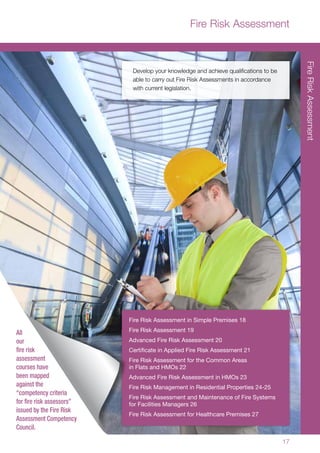
Develop your knowledge and achieve qualifications to be
able to carry out Fire Risk Assessments in accordance
with current legislation.
Fire Risk Assessment in Simple Premises 18
Fire Risk Assessment 19
Advanced Fire Risk Assessment 20
Certificate in Applied Fire Risk Assessment 21
Fire Risk Assessment for the Common Areas
in Flats and HMOs 22
Advanced Fire Risk Assessment in HMOs 23
Fire Risk Management in Residential Properties 24-25
Fire Risk Assessment and Maintenance of Fire Systems
for Facilities Managers 26
Fire Risk Assessment for Healthcare Premises 27
Fire Risk Assessment
FireRiskAssessment
All
our
fire risk
assessment
courses have
been mapped
against the
“competency criteria
for fire risk assessors”
issued by the Fire Risk
Assessment Competency
Council.
18
Overview
This course will develop understanding of responsibilities under
relevant fire legislation and improve knowledge of the fire risk
assessment process. Delegates will learn about a range of
fire safety systems, gain practical experience in carrying out
a simple* fire risk assessment and be provided with fire risk
assessment documentation for use in the workplace.
*small commercial premises of 2-3 storeys not involving a
sleeping risk.
Who will benefit?
Those with responsibility for undertaking fire risk assessments
of simple premises.
Learning outcomes
You will develop:
•	 an understanding of your fire safety responsibilities
•	 an awareness of fire hazards
•	 awareness of the nature of fire and how it spreads
•	 knowledge of the actions to take in the event of a fire
•	 an understanding of the risk assessment process
Programme
The course content includes:
•	 an overview of current fire legislation
•	 fire facts and figures
•	 hazard identification and mitigation
•	 the principles of combustion and fire spread mechanisms
•	 active and passive fire protection systems
•	 human behaviour
•	 the risk assessment process
•	 a fire risk assessment practical exercise
Certification
•	 FPA Certificate
•	 this course has been awarded 5 IFE CPD hours
Progression opportunities
•	 Fire Risk Assessment and Fire Safety Management*
* if you choose to progress onto the above course the cost of
this ‘Introductory’ course will be deducted from the price
Fire Risk Assessment in Simple Premises
MiM=Moreton in Marsh Lon=London Man=Manchester Glas=Glasgow
Course Information
Duration:	 1 day
Cost:	 FPA members:	 £175 + VAT per delegate
	 Non-members:	 £215 + VAT per delegate
** for London venue add £10 per delegate
MiM Lon** Man Glas
Feb 12
Apr 17
Jun 11
Aug 13
Oct 20
Dec 2
2015 Dates
	 Book online at
	www.thefpa.co.uk
Early Bird Discount – pay 7 weeks
in advance and save 10%
Tailor course content, date or venue
to suit your requirements
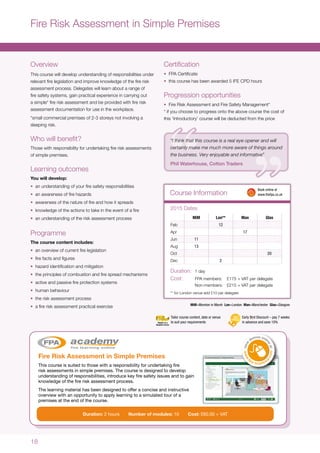
Fire Risk Assessment in Simple Premises
This course is suited to those with a responsibility for undertaking fire
risk assessments in simple premises. The course is designed to develop
understanding of responsibilities, introduce key fire safety issues and to gain
knowledge of the fire risk assessment process.
The learning material has been designed to offer a concise and instructive
overview with an opportunity to apply learning to a simulated tour of a
premises at the end of the course.Duration: 2 hours Number of
modules: 10 Cost: £60.00 + VAT
Duration: 2 hours Number of modules: 10 Cost: £60.00 + VAT
“I think that this course is a real eye opener and will
certainly make me much more aware of things around
the business. Very enjoyable and informative”
Phil Waterhouse, Cotton Traders
19
FireRiskAssessment
Overview
Current fire legislation requires that almost all workplaces
undertake a suitable and sufficient fire risk assessment.
The risk assessment has to identify hazards and take steps to
prevent fire in order to protect the safety of occupants, visitors
and those in the immediate vicinity.
This popular 3 day course is designed to offer practical hands-on
experience in this area and allows delegates to gain experience in
undertaking fire risk assessments.
Who will benefit?
This course is aimed at those who have responsibility for
undertaking fire risk assessments and who wish to receive further
certification in this subject in order to demonstrate competency.
Delegates will be expected to have some background knowledge
of fire safety but may have little or no experience in undertaking
fire risk assessments.
The course has received approval from the Institution of Fire
Engineers (IFE) for the purpose of their Register of Fire Risk
Assessors and Auditors – see page 4 for more information.
Learning outcomes
You will develop:
•	 a broad understanding of workplace fire safety issues that
reviews and adds to your existing knowledge
•	 detailed understanding of the fire risk assessment process
•	 awareness of current fire safety legislation
•	 ability to apply the principles and methodology of fire risk
assessment, exploring the process and applying learning
through a number of practical activities
Programme
The course content includes:
•	 legislative requirements relevant to the location of the course
•	 means of escape and human behaviour
•	 passive and active fire safety overview
•	 principles of risk assessment
•	 the risk assessment process
•	 fire risk assessment – practical exercises
•	 course assessment
Certification
•	 FPA Certificate showing IFE Approval towards their
Register of Fire Risk Assessors and Auditors
•	 This course has been awarded 18.5 IFE CPD hours
Course Information
MiM Dub†
Lon** Glas Man Bel
Jan 12-14 26-28
Feb 23-25
Mar 23-25 2-4 16-18
Apr 20-22 27-29
May 18-20 12-14
Jun 22-24
July 27-29
Aug 3-5
Sept 28-30 21-23
Oct 12-14 19-21
Nov 9-11 30-2 Dec 16-18
2015 Dates
Duration:	 3 days
Cost:	 FPA members:	 £705/s705 + VAT per delegate*
	 Non-members:	£840/s840 + VAT per delegate*
*Price excludes cost of accommodation
†
Euro fee applicable to Dublin venue only
** for London venue add £30 per delegate
MiM=Moreton in Marsh Glas=Glasgow Dub=Dublin Lon=London Man=Manchester Bel=Belfast
Fire Risk Assessment
Early Bird Discount – pay 7 weeks
in advance and save 10%
Tailor course content, date or venue
to suit your requirements
“the facilitator was outstanding, patient, informative
and knowledgeable about the subject. He was able to
transfer his skills to the delegates with a professional
manner.”
Antony Etherington, Etherington Associate
Consultants Ltd (EAC Ltd)
20
Advanced Fire Risk Assessment
Course Information
Overview
This course will strengthen your existing knowledge and
understanding of fire risk assessment and assist with the correct
interpretation of guidance in order to achieve fire safety solutions
that are:
•	 required to ensure minimum life standards are achieved
•	 reasonably practicable to implement
•	 meet statutory requirements
Who will benefit?
This course is aimed at building managers, owners, assessors and
enforcing authorities who are required to determine the fire safety
measures in complex premises.
Delegates should have previously attended appropriate courses
that have provided an underpinning knowledge of fire safety
management.
Learning outcomes
On completion of the course delegates will:
•	 be able to differentiate between matters that are required to
ensure statutory compliance and additional measures that
would reduce the risk to property and business
•	 have an improved ability to apply relevant guidance documents
in order to determine appropriate fire safety solutions
•	 have an understanding of human behaviour in a range of fire
situations
•	 have a greater understanding of active and passive fire safety
measures
•	 have a greater understanding of the effectiveness and limitations
of new and existing fire safety measures and the cost and
benefit of upgrading or replacing existing measures MiM Lon** Glas Man
Feb 4-5
Apr 23-24
May 6-7
Jun 3-4
Sept 2-3
Oct 8-10
Nov 4-5
2015 Dates
Duration:	 2 days
Cost:	 FPA members: £525 + VAT per delegate*
	 Non-members: £650 + VAT per delegate*
*Price excludes cost of accommodation
**for London venue add £20 per delegate
	 Book online at
	www.thefpa.co.uk
Early Bird Discount – pay 7 weeks
in advance and save 10%
Tailor course content,
date or venue to suit
your requirements
MiM=Moreton in Marsh Lon=London Man=Manchester Glas=Glasgow
Programme
Course content includes:
•	 Legal requirements
– CFOA guidance; fire safety management; co-operation and
co-ordination in multi-occupied buildings, human behaviour,
GEEPS, PEEPS
•	 Fire warning systems
– legal requirements, advantages, disadvantages and limitations
of specific systems; cost implications
•	 Passive and active fire safety measures
•	 Guidance documents
– CLG, ADB, LACORS & BS9999 application, interpretation,
limitations, contradictions
•	 General fire precautions in complex premises
Certification
•	 FPA Certificate
•	 This course has been awarded 13 IFE CPD hours
“Very helpful to clarify my own limitations and
providing further relevant technical knowledge. The
tutor’s personal experience enlightened the training.
Particularly enjoyed the Human Behaviour aspect”
Chris Sutton, North Yorkshire County Council
21
Course Information
Overview
Previously titled Fire Risk Assessment and Fire Safety
Management, this well established and popular five-day
course attracts delegates from a wide range of industry
backgrounds, in the public and private sector, including major
UK and overseas organisations. Delegates will benefit from
a concentrated and focused course presented by a range of
fire safety specialists, all of whom are experts in their field. The
course is certificated by the University of Derby at Level 4.
Who will benefit?
This course is ideal for those individuals who require an
intensive yet broad-ranging introduction to the key principles of
fire prevention, fire protection and fire risk assessment.
Learning outcomes
You will develop:
•	 understanding of the fundamental principles of fire prevention
and protection measures, raising awareness of the vast range
of topics involved in fire safety management
•	 knowledge of the principal workplace fire hazards, associated
risks and passive and active means available to mitigate fire
•	 ability to apply the principles and methodology of fire risk
assessment, exploring the process and applying learning
through a number of practical activities
Programme
Course content includes:
•	 fire safety management framework
•	 legislative requirements
•	 fire theory, principle causes and prevention of fire
•	 fire protection in buildings
•	 introduction to the principles of smoke control, fire
engineering and environmental issues
•	 arson and its prevention
•	 human behaviour
•	 the principles and methodologies of fire risk assessment
•	 fire risk assessment in action
•	 practical exercises and practical fire risk assessment
•	 a fire risk assessment in the workplace is required to
complete the course
Certification
All delegates on the course will have the opportunity
to gain:
•	 Certificate of Professional Development in Applied Fire Risk
Assessment (40 HE Credits)
•	 the CFPA Europe Certificate in Principles of Fire Safety at Work
and the first element of the Level 4 CFPA Europe Diploma in Fire
Prevention - pages 30-31
•	 approval towards the Institution of Fire Engineers Register of
Fire Risk Assessors and Auditors
•	 an optional assessment in units FC1 and FC2 of the NEBOSH
Certificate in Fire Safety and Risk Management - page 29
•	 38 IFE CPD hours
For more information on any of these qualifications please refer to
pages 4-5
Progression opportunities
•	 Level 4 CFPA Europe Diploma in Fire Prevention – pages 30-31
•	 Advanced Fire Safety Management – page 33
•	 Advanced Fire Risk Assessment – page 20
MiM Glasgow London**
Jan 19-23
Feb 9-13
Mar 2-6 9-13
Apr 20-24
May 11-15
Jun 15-19 29-3 July
July 13-17 29-3 Aug 3-7
Sept 14-18 7-11
Oct 26-2 19-23
Nov 2-6 23-28
2015 Dates
Duration:	 5 days
Cost:	 FPA members: £1310 + VAT per delegate*
	 Non-members: £1460 + VAT per delegate*
*Price excludes cost of accommodation and NEBOSH registration/
certification
**for London venue add £50 per delegate
	 Book online at
	www.thefpa.co.uk
Early Bird Discount – pay 7 weeks
in advance and save 10%
Tailor course content,
date or venue to suit
your requirements
MiM=Moreton in Marsh
FireRiskAssessment
“(The Trainer) delivered the course exceptionally well.
The course was put in simple terms and I left feeling
comfortable that I had the knowledge and understanding to
complete the exam”
John Harrison, WWH
Certificate in Applied Fire Risk Assessment
22
Overview
Houses in Multiple Occupation (HMO) can pose an increased
risk from fire, particularly if those premises are poorly designed,
managed or maintained.
This course offers essential instruction and information for the
effective safe management of buildings comprising multiple
accommodation units. You will receive instruction and advice on
how to carry out a suitable and sufficient fire risk assessment.
Who will benefit?
Local Authorities, Housing Associations, Landlords and those
that manage, or have some responsibility for any multi-occupied
building(s), will be especially interested in this programme.
Learning outcomes
You will develop:
•	 an awareness and understanding of fire hazards and risks
relating to the common areas of flats, HMOs and similar
premises
•	 an awareness of the guidance documents currently available
to assist the ‘Responsible Person’
•	 awareness of the key principles of fire prevention, control and
fire protection in such premises
•	 practical knowledge of the fire risk assessment process and a
thorough understanding of the legal responsibilities imposed
by current legislation
•	 application of learning through a number of practical activities
Programme
The course content includes:
•	 legislative requirements
•	 current guidance documents
•	 means of escape and life risks specific to the common areas
of multi-occupied residential premises and HMOs
•	 passive fire safety, active systems and developments
in fire detection standards
•	 management issues
•	 principles and practical application of fire risk assessment
Certification
•	 FPA Certificate showing IFE Approval towards their Register of
Fire Risk Assessors and Auditors
•	 this course has been awarded 18.5 IFE CPD hours
Progression opportunities
•	 Advanced Fire Risk Assessment in HMOs
Fire Risk Assessment for the Common Areas
in Flats and HMOs
MiM London** Manchester Glasgow
Feb 16-18
Apr 13-15
May 11-13
Jun 8-10
Sept 14-16
Oct 5-7
Nov 9-11
Duration:	 3 days
Cost:	 FPA members:	 £705 + VAT per delegate*
	 Non-members:	 £840 + VAT per delegate*
*Price excludes cost of accommodation
** for London venue add £30 per delegate
Course Information
2015 Dates
	 Book online at
	www.thefpa.co.uk
Early Bird Discount – pay 7 weeks
in advance and save 10%
Tailor course content, date or venue
to suit your requirements
MiM=Moreton in Marsh
“It was a well paced course very relaxed which put us at
ease. The tutor came across as very informative on the
whole I enjoyed the course”
Eddie Barr, Greensquare
23
FireRiskAssessment
Moreton in Marsh London**
Feb 19-20
Apr 15-16
Jul 8-9
Oct 27-29
Dec 8-10
Duration:	 2 days
Cost:	 FPA members:	 £525 + VAT per delegate*
	 Non-members:	 £650 + VAT per delegate*
*Price excludes cost of accommodation
** for London venue add £20 per delegate
Course Information
2015 Dates
	 Book online at
	www.thefpa.co.uk
“Had a great time but learnt a lot, time well spent,
thank you”
Andrew Williams, A2Dominion
Advanced Fire Risk Assessment in HMOs
Overview
Certain flats and houses in multiple-occupation (HMO) present
a higher risk of fire and a higher risk of injury to the occupants
particularly if the premises are poorly designed, managed or
maintained. There are various requirements and duties placed
on those who occupy, manage and regulate these premises
and guidance has been published to assist in reducing the risk.
Complex situations are common where the extent of control
and the interaction of the various roles and responsibilities
requires careful consideration.
This two–day course offers essential instruction and information
to facilitate the cost effective fire safety management of these
premises within the legislative framework.
Who will benefit?
Local Authorities, Fire & Rescue Service Inspecting Officers,
Housing Associations, Landlords and those that manage, or
have some responsibility for any multi-occupied building(s).
Delegates should have previously attended appropriate courses
that have provided an underpinning knowledge of fire safety
management in HMOs.
Learning outcomes
You will develop:
•	 a greater awareness and understanding of fire hazards and
risks relating to flats and HMOs
•	 a detailed knowledge of the content, reasoning and practical
application of the guidance documents currently available to
assist the ‘Responsible Person’ and enforcing authorities
•	 an increased awareness of the legislative framework and the
powers and duties imposed on those occupying, managing
and regulating fire safety in flats and HMOs
•	 an improved ability to apply relevant guidance documents
using common sense in order to determine appropriate fire
safety solutions
Programme
Course content includes:
•	 Housing Act 2004
•	 Regulatory Reform (Fire Safety) Order 2005
•	 LACORS housing guidance
•	 Local Government group guidance document - “Fire Safety
in Purpose Built Blocks of Flats”
•	 scenario based exercises
Certification
•	 FPA Certificate
•	 This course has been awarded 13 IFE CPD hours
Progression opportunities
•	 Advanced Fire Safety Management - page 33
•	 CFPA Europe Diploma in Fire Prevention - pages 30-31
24
Fire Risk Management in Residential Properties
Overview
Individuals who have responsibility for fire risk management in
simple and complex residential properties now have access
to new nationally recognised and regulated qualifications
to support the development of skills, knowledge and
understanding to a recognised national standard for fire safety
practice in the residential properties sector.
The qualifications titles are as follows:
•	 Level 3 Award for Reporting Fire Risk in Residential Properties
•	 Level 3 Certificate for Fire Risk Management in Simple
Residential Properties
•	 Level 4 Certificate for Fire Risk Management in Complex
Residential Properties
Launched in 2014, FPA is pleased to be offering a series of
open course dates throughout the year and the qualifications
will also be available on a bespoke basis. In addition there is the
opportunity for relevant organisations such as larger housing
associations to become FPA satellite centres in order to deliver
the qualifications in-house. (See page 7 for more information).
These qualifications have been developed in accordance with
the regulatory requirements of the Qualifications and Credit
Framework (QCF) and are underpinned by the Skills for Justice
National Occupational Standards (NOS) in Fire Safety.
What credibility do these qualifications
have?
The qualifications have been developed with the expert
involvement and input of representatives from the following
professional groups:
•	 the National Social Housing Fire Strategy Group (NSHFSG)
•	 Fire Sector Federation (FSF)
•	 the Chief Fire Officers Association (CFOA)
•	 the Fire Protection Association (FPA)
In addition, SFJ Awards have provided support for the
development of these qualifications to meet the requirements
for regulated qualifications.
Who are these qualifications for?
Level 3 Award for Reporting Fire Risk in Residential
Properties
This qualification is suitable for housing staff who are involved
with identifying fire hazards, and contributing to continuous risk
assessment by regular review.
The qualification is also relevant to advisors and enforcers for
residential properties who need to understand the hazards and
risks in residential properties.
It is important to note that this qualification is intended
to contribute to the knowledge of those carrying out risk
assessments, but on its own this qualification would not confirm
the full range of knowledge required for risk assessment.
Level 3 Certificate for Fire Risk Management in Simple
Residential Properties
This qualification is suitable for staff and consultants who carry
out fire risk assessment and determine fire safety provision in
simple residential properties. Simple residential properties are
defined as those properties that are single use, three storeys or
less and built after 1991.
“Well delivered, interactive course”
Steve Osbourne, BPHA Ltd
25
Fire Risk Management in Residential Properties
Level 4 Certificate for Fire Risk Management in Complex
Residential Properties
This qualification is suitable for staff and consultants who carry
out fire risk assessment and determine fire safety provision in
complex residential properties. Complex residential properties
are defined as those properties that are mixed use, four
storeys or more, and could be built at any time. They are
also considered to be any residential block which is HMO or
designed for specific client groups who could present particular
fire risks generated by the client group e.g. Sheltered/Extra
Care/Special Educational needs groups are considered to be
complex.
Each qualification can be accessed independently of the other
and learners are able to access the qualification(s) that are
relevant to their role within fire risk management.
What do the qualifications cover?
Level 3 Award for Reporting Fire Risk in Residential
Properties
•	 reporting hazards and risk associated with fire in residential
properties
•	 monitoring and reporting to ensure that risk reduction
measures, fire precautions and maintenance routines are
sustained
Level 3 and 4 Certificate for Fire Risk Management in
Residential Properties look at the following areas in
relation to simple premises at Level 3 and complex
premises at Level 4
•	 reporting hazards and risk associated with fire in residential
properties
•	 assessing risks associated with fire in residential properties
•	 confirming measures are in place to protect people from fire
in residential properties
•	 evaluating active and passive fire protection systems in
residential properties
What progression opportunities are
available to learners who achieve these
qualifications?
There are a range of progression opportunities available to
learners who achieve the fire risk management qualifications.
These progression opportunities vary from achieving additional
fire risk management qualifications (see page 8 for more
information) to moving into specialist areas of fire safety.
To find out more please visit the FPA’s website.
FireRiskAssessment
Level 3 Award Level 3 Cert Level 4 Cert
MiM Lon* MiM Lon* MiM Lon*
Feb 18
Mar 24-25 17-18
Apr 13 28 22
May 19 21
Jul 6
Sept 7 29-30 15-16
Oct 29 13
Nov 2 25 10
Cost:
Level 3 Award:	 Member £210 + VAT,
	 Non member £250 + VAT
	 plus £35 + VAT certification
Level 3 Certificate:	 Member £750 + VAT
	 Non member £850 + VAT
	 plus £50 + VAT certification
Level 4 Certificate:	 Member £850 + VAT
	 Non member £950 + VAT
	 plus £60 + VAT certification
*Price excludes cost of accommodation
** for London venue add £10 per delegate
Course Information
2015 Dates
	 Book online at
	www.thefpa.co.uk
26
Course Information
Fire Risk Assessment and Maintenance of
Fire Systems for Facilities Managers
Overview
This course is designed to introduce, through both
theoretical and practical sessions, key fire safety issues and
procedures relevant to the facilities manager. It also details
maintenance regimes for fire safety systems in the workplace.
Who will benefit?
This course is aimed at:
•	 those responsible for managing the fire safety equipment and
systems in occupied premises
•	 those responsible for liaising with contract engineers to
ensure fire safety requirements are met
Learning outcomes
You will develop:
•	 an understanding of fire hazards in the workplace and their
associated risks
•	 knowledge of the fire safety related equipment and facilities
which assist in mitigating these risks – from protected means
of escape to fire alarm and detection systems and sprinkler
systems
•	 knowledge of the current standards and codes of practice
which relate to these facilities and the detailed maintenance
regimes which apply
•	 improved understanding of the fire risk assessment process
•	 an understanding of what to look out for when liaising with
contract engineers
Programme
The course content will cover:
•	 identification of the major causes of fire
•	 compartmentation and means of escape
•	 fire doors and glazing
•	 automatic fire alarms and detection systems
•	 emergency lighting
•	 portable firefighting equipment
•	 automatic suppression systems
•	 maintenance and record keeping
•	 staff training
•	 fire risk assessment
•	 dry risers and wet risers
•	 course assessment
Certification
•	 FPA Certificate
•	 This course has been awarded 18 IFE CPD hours
Moreton in Marsh London**
Mar 10-12
Sept 7-9
Nov 25-27
2015 Dates
Duration:	 3 days
Cost:	 FPA members:	 £695 + VAT per delegate*
	 Non-members:	 £830 + VAT per delegate*
*Price excludes cost of accommodation
**for London venue add £30 per delegate
Progression opportunities
•	 Level 4 CFPA Europe Diploma in Fire Prevention – pages 30-31
	 Book online at
	www.thefpa.co.uk
Early Bird Discount – pay 7 weeks
in advance and save 10%
Tailor course content, date or venue
to suit your requirements
“Excellent course, backed up by a wealth of
experience”
Giuseppe Devitto, WH Smith Ltd
2727
FireRiskAssessment
Course Information
*Price excludes cost of accommodation
Duration:	 5 days
Cost:	 FPA/NAHFO members £957 + VAT per delegate*
	 Non-members £1100 + VAT per delegate*
	 Book online at
	www.thefpa.co.uk
Fire Risk Assessment for Healthcare Premises
Overview
This new five day course is delivered by fire safety professionals
with specialist current experience of fire safety management
in complex healthcare environments. Based upon our long
established Certificate in Applied Fire Risk Assessment course
the programme has been developed to focus specifically on
issues associated with healthcare premises with reference to
relevant guidance documents.
Who will benefit?
Fire safety advisors, estates officers or those with a
responsibility for fire risk assessment in healthcare premises,
consultants and auditors.
Learning outcomes
You will develop:
Understanding of the fundamental principles of fire prevention
and protection measures, raising awareness of the vast range
of topics involved in fire safety management in healthcare
premises including:
•	 confidence in identifying fire hazards and assessing risks
associated with fire in healthcare premises
•	 knowledge of fire and smoke behaviour and associated fire
stopping measures
•	 knowledge of active systems in the mitigation of fire
•	 understanding of building user implications in healthcare
premises
•	 understanding of fire safety solutions to minimize risks
•	 ability to develop suitable emergency procedures for
premises
•	 knowledge of associated legislation, standards and
documents
Programme
The course content will cover:
•	 challenges in managing fire safety in healthcare premises
•	 active and passive fire safety overview
•	 means of escape and human behaviour
•	 evacuation strategies
•	 legislation, guides and codes of practice
•	 fire safety management routine
•	 fire risk assessment methodology and practice
•	 structural fire precautions
Moreton in Marsh
May 18-23
Nov 16-20
2015 Dates
28
NEBOSH Certificate in Fire Safety and
Risk Management 29
Level 4 CFPA Europe Diploma in Fire Prevention 30-31
Level 5 CFPA Europe Diploma in Fire Prevention 32
Advanced Fire Safety Management 33
BSc (Hons) Fire Risk Management 34-35
The Dynamics of Fire 36
Develop knowledge and skills in fire safety management
and achieve qualifications ranging from Level 2 to Level 6
and beyond that open up learning pathways to recognised
certification and professional memberships.
Fire Safety Management
29
FireSafetyManagement
NEBOSH Certificate in Fire Safety and
Risk Management
Overview
The NEBOSH National Certificate in Fire Safety and Risk
Management is an established and popular qualification for
those with fire safety responsibilities in the workplace.
The level 3 qualification is divided into three units, each of which
is assessed separately:
•	 Management of Health and Safety (NGC1)* - five-day course
•	 Fire Safety and Risk Management (FC1) - five-day course
•	 Practical Fire Risk Assessment (FC2) - workplace-based
* Students who have already passed NGC1 as part of a
previous NEBOSH qualification do not need to re-take this unit,
provided it was achieved within the last 5 years. If you achieved
NGC1 more than 5 years ago, you may re-sit the examination
without needing to attend a taught course.
Successful completion of both examinations and the practical
assessment is required to achieve this qualification.
Who will benefit?
Managers and supervisory staff who need to ensure that their
organisation meets its responsibilities under fire safety legislation
or people moving into fire safety adviser roles. No previous
health and safety or fire safety knowledge is required although
it should be noted that the assessment includes a requirement
to complete a record of a practical fire risk assessment exercise
using a standard set of forms.
Learning outcomes
You will develop:
•	 knowledge and understanding of the management of fire
safety including legal requirements
•	 understanding of the principles of fire and explosion, causes
and prevention of fire, fire protection in buildings and ensuring
the safety of people in the event of fire
•	 confidence in undertaking fire risk assessments in normal risk
workplaces
Programme
The full NEBOSH Certificate in Fire Safety and Risk
Management comprises of the following:
1.	 Management of Health and Safety NGC1
2.	 Fire Safety and Risk Management FC1 and FC2
	 For further information on this course and dates see page 21
3. 	The FC2 practical risk assessment activity carried out by you
in your workplace
4.	 The FC1 + NGC1 NEBOSH exams
Exam tutorials
We also offer optional exam tutorials which will develop
your exam technique, reinforce earlier learning and help
you to practice answering exam questions with tutor
feedback. We tailor revision to cover knowledge gaps
identified by delegates in advance and this helps to focus
revision on key areas of the syllabus. These are available
on request, subject to demand.
Certification
All delegates on the course will have the opportunity
to gain:
•	 NEBOSH Certificate in Fire Safety and Risk Management
– either unit or full certification
Course Information:
Duration: 1 day
Cost:	 FC1 & 2 	 FPA members: £1450 + VAT*
		 Non-members: £1600 + VAT*
Includes cost of the Certificate in Applied Fire Risk Assessment.
See page 21.
*Price includes NEBOSH registration & certification but excludes cost
of accommodation
†
Exams held in Moreton in Marsh
2015 Dates
	 Book online at
	www.thefpa.co.uk
NGC1 (am)†
FC1 (pm)†
Mar 4 4
Jun 3 3
Sept 2 2
Dec 2 2
30
Level 4 CFPA Europe Diploma in Fire Prevention
Overview
The CFPA Europe Diploma offers holders a qualification in
fire safety management and prevention which is recognised
Europe-wide.
Founded in 1974, The European Confederation of Fire
Protection Associations (CFPA Europe) exists to promote the
highest standards of fire safety management. It is a formal
body, governed by statute, which links nationally recognised fire
protection organisations in 17 European countries.
Since its introduction there have been approximately 20,000
students awarded the qualification working in partnership with
the University of Derby. This Diploma also offers a recognised
HE qualification and progression routes. Prior learning and
existing qualifications may be taken in to account.
The Fire Protection Association is the only UK provider of the
Diploma on behalf of the awarding body CFPA Europe.
Who will benefit?
•	 fire safety managers from national and international
businesses
•	 fire safety professionals and consultants
•	 local authority personnel; building control officers;
environmental health officers; safety officers; fire safety
officers
•	 risk managers
•	 property surveyors
•	 those wishing to gain an in-depth knowledge of fire
prevention issues
*At selected stages the CFPA Diploma’s in Fire Prevention are recognised as fulfilling the academic requirements for membership of the
Institution of Fire Engineers (IFE) at various levels
Five-day
Certificate in Applied
Fire Risk Assessment
Eight Study Units
Directed Coursework
Correspondence
Examination
Dissertation
Project and Interview
Two Study Units
Directed Coursework
Correspondence
Five day Advanced
Fire Safety
Management Course
Apply for EngTech
and TIFireE * (Technician)
Level 5 CFPA Diploma in
Fire Prevention Awarded.
Foundation Degree Fire Risk
Management Awarded
Apply for GIFireE *
(Graduate)
The Dynamics
of Fire
Project Submission
Review by IFE
Apply For MIFireE *
(Member)
Level 6 Advanced Diploma
Fire Risk Management
Awarded
Level 4 CFPA Diploma in
Fire Prevention Awarded.
Cert of HE Fire Risk
Management Awarded
Stages of the Diploma Routes
“Course was invaluable, I’m finding practical
applications for what I have learnt every week”
J Beeching, ISS Facility Services Ltd
31
Level 4 CFPA Europe Diploma in Fire Prevention
Learning outcomes
You will develop:
•	 underpinning knowledge relative to Fire Safety NOS FS1,
FS2, FS3 and FS7
•	 knowledge and understanding of fire prevention issues at a
basic management level
•	 a more comprehensive understanding of fire protection and
prevention principles
•	 a clear understanding of the importance of fire prevention
control and its management
Programme
The Diploma is split into three elements:
1	 5 day Certificate in Applied Fire Risk Assessment
	 Further details of this course can be found on page
21. Exemptions may apply, please contact us for more
information.
2	 Eight individual study units, each requiring
approximately 15 hours study covering:
	 •	 nature and behaviour of fire
	 •	 fire detection
	 •	 fire extinguishment
	 •	 fire and European law
	 •	 means of escape
	 •	 fire protection of buildings
	 •	 fire insurance and security
	 •	 management and protection
3	 Examination: A three-hour written examination
completes the Diploma
Certification
•	 CFPA Europe Diploma in Fire Prevention
•	 Level 4 Certificate of Higher Education Fire Risk Management
awarded by University of Derby
•	 recognition towards EngTech and TIFireE (Technician grade
membership of the Engineering Council and the IFE)
– see page 4 for further details
FireSafetyManagement
Course Information:
Moreton in Marsh
Jan 16
Apr 10
July 10
Sept 11
Nov 20
2015 Exam Dates:
Duration:	 Students are required to complete all elements
	 of the Diploma within a maximum of two years
Venue	 This course is run on a part-classroom and
	 part-distance learning basis. Exams are held
	 at Moreton-in-Marsh
Cost:	 FPA members:	 £2850 + VAT per delegate*
		 + £525 registration and 		
		 certification
	 Non-members:	 £3350 + VAT per delegate*
		 + £525 registration and 		
		 certification
*Price excludes accommodation
Progression opportunities
•	 Level 5 CFPA Europe Diploma in Fire Prevention
•	 University of Derby FdSc: Fire Risk Management
Course Information
•	 see page 21 for enrolment throughout the year
•	 University of Derby FDSC: Fire Risk Management
32
Level 5 CFPA Europe Diploma in Fire Prevention
Overview
Upon successful completion of the Level 4 CFPA Europe
Diploma in Fire Prevention (see pages 30-31) holders will
be eligible to enrol on the Level 5 CFPA Europe Diploma.
Concentrating more extensively on the management aspects of
fire safety and fire risk management, this qualification identifies
successful students as having significant understanding of fire
safety at management level.
Working in partnership with the University of Derby this
qualification incorporates the Foundation Degree (FdSc) Fire
Risk Management and ensures the technical content within this
qualification is of the highest standard and relevant for those
working in the sector.
The FPA is the only UK provider of this course on behalf of the
awarding body – CFPA Europe.
Who will benefit?
Those individuals wishing to:
•	 hold an advanced fire prevention qualification which is
recognised throughout the 17 participating member countries
•	 be listed in the CFPA Diploma holders handbook, CD and the
CFPA Europe website
•	 qualify for the CFPA Advanced Diploma Progression course
•	 work towards Graduate grade Membership of the IFE
Learning outcomes
You will develop:
•	 critical understanding of the wider aspects of risk
management in modern business practice
•	 the ability to identify, analyse and critically evaluate relevant
data in order to propose solutions to identified problems
•	 the application of the key principles of Fire Risk Management
to achieve business protection
•	 improved management skills in emergency and disaster
planning, crisis management and communications
Programme
The Advanced Diploma course is split into four elements:
1	 Advanced Fire Safety Management Course
	 A five-day course which aims to introduce students to
elements of the Advanced Diploma syllabus and extend
their knowledge of management aspects of fire safety and
security. More information on this course can be found on
page 33. Exemptions may apply.
2	 Coursework
	 Students will be required to produce two pieces of directed
coursework broadly covering the following issues:
	 •	 emergency and disaster planning, crisis management, 	
	 business continuity management and communications
	 •	 loss risk management
3	 Project Report
	 Preparation and submission of a project on a suitable
fire-related topic.
4	 Presentation and Interview
	 Interview and assessment is by a panel of recognised
experts.
Certification
•	 CFPA Europe Advanced Diploma in Fire Prevention
•	 recognised towards membership of the IFE at Graduate level
GIFireE)
•	 Foundation Degree: Fire Risk Management (awarded by
University of Derby)
Progression opportunities
•	 The Dynamics of Fire – page 36
•	 BSc (Hons) Fire Risk Management – pages 34-35
Course Information
See page 33 for enrolment dates throughout the year
Duration:	 Students are required to complete all elements
	 of the Diploma within a maximum of 			
	 two years.
Venue	 This course is run on a part-face to face and
	 part-distance learning basis.†
Cost:	 FPA members:	 £1950 + VAT per student*
	 + £725 registration/certification
	 Non-members:	 £2100+ VAT per student*
	 + £725 registration/certification
*Price excludes cost of accommodation
†
Presentation and interview takes place in Moreton in Marsh
33
Advanced Fire Safety Management
Overview
In addition to being a stand-alone event this popular course
forms the first part of the CFPA Europe Level 5 Diploma in Fire
Prevention and is designed to cover the subject of fire safety
management at an advanced management level. Successful
candidates will also be awarded the CFPA Europe Diploma in Fire
Risk Management.
Who will benefit?
•	 anyone with responsibility for the management of statutory fire
safety requirements and compliance in multi-occupied or other
complex buildings
•	 fire safety managers wishing to advance their level of
knowledge and management skills. Candidates should
possess knowledge of BS 9999 and the Regulatory Reform
(Fire Safety) Order 2005 or the relevant legislation in Scotland
and Northern Ireland
Learning outcomes
You will develop:
•	 knowledge of broader management issues flowing from fire
protection strategies
•	 an understanding of the principles of fire engineering design
•	 an improved awareness of the testing and maintenance of fire
protection and suppression equipment
•	 a greater understanding of how to manage risk in complex
premises
•	 strategies to deal with risk management and both short and
long-term loss management
•	 knowledge of business continuity management practice
and procedures
Programme
The course content will include:
•	 advanced management aspects of BS 9999:2008
•	 designing so that a building can be managed
•	 ensuring that systems respond properly in an emergency
•	 fire safety management in large and multi-occupied sites
•	 building works and alterations
•	 planning the response to a fire – risk management, long-term
loss management and business continuity
•	 managing occupied buildings and fire safety legislation
•	 emergency actions – short-term loss management
•	 open book assessment
Certification
•	 FPA Certificate
•	 this course has been awarded 25 IFE CPD hours
•	 CFPA Europe Diploma in Fire Risk Management
Progression opportunities
•	 CFPA Europe Level 5 Diploma in Fire Prevention – page 32
•	 BSc (Hons) Fire Risk Management – page 34-35
FireSafetyManagement
Course Information
Moreton in Marsh
Apr 13-17
Oct 12-16
2015 Dates
Duration:	 5 days
Cost:	 FPA members:		£1450 + VAT
	 Non-members:		£1595 + VAT
*Price excludes cost of accommodation
	 Book online at
	www.thefpa.co.uk
Early Bird Discount – pay 7 weeks
in advance and save 10%
Tailor course content, date or venue
to suit your requirements
“Good course, good debate where most of the
learning was done, look forward to future courses”
Anonymous
34
BSc (Hons) Fire Risk Management
Overview
Working in partnership with the University of Derby FPA is
pleased to announce the launch of the honours Degree
programme (BSc).
The top up programme, whilst following-on from the Foundation
Degree and continuing to equip students with the skills and
knowledge relevant to their employment, will examine the
knowledge and understanding of students with increasing
academic rigour.
The Honours level modules have been chosen to reflect current
trends and enable learners to develop a broad understanding of
Fire Risk Management.
The Work-based [Research] Project gives an opportunity
for students to apply and develop their research and project
management skills in a work-based scenario, greatly enhancing
their future career prospects and employability.
Who will benefit?
Both the FdSc and the BSc are well recognised by employers
as a credible indicator of ability to work competently in a
specific vocational area. This qualification pathway is particularly
relevant for those individuals who:
•	 wish to gain a qualification that offers a recognised
progression pathway through to formal level 6 and
postgraduate study
•	 wish to develop personal skills in working and learning plus
career development planning alongside technical knowledge
•	 wish to benchmark their level of attainment against the UK
Higher Education qualifications framework
All learners beginning this programme will be operating at Level
4 or above.
Pre-requisites of this programme:
•	 Level 5 CFPA Europe Diploma in Fire Prevention (including
the FdSc Fire Risk Management) (see page 32)
Learning outcomes for the BSc
Module outcomes – Human Behaviour
•	 apply knowledge to create a system that integrates human
behaviour factors into life safety planning and practice
•	 have a critical understanding of how psychological and
sociological factors influence behaviour in fire scenarios
•	 have a critical and analytical knowledge of the application of
current human behaviour computer modelling.
•	 locate and critically review current human behaviour related
fire research
Module outcomes – The Dynamics of Fire
•	 demonstrate a critical and analytical understanding of fire
dynamics
•	 critically understand the need for good practice in data
collection and processing
•	 synthesise information and data from a variety of sources.
•	 communicate critical and analytical understanding in both
written and oral form to responsible people and bodies
Module outcomes – Fundamentals of the built
environment
•	 demonstrate a critical understanding of the built environment
and its implications to fires safety management
•	 evaluate the properties of building materials in both modern
methods of construction and traditional buildings
•	 review the implications for fire safety management of both
contemporary and traditional buildings.
•	 undertake quantitative assessment for the sustainability
for built environment systems in the context of fire safety
management
•	 identify eco-friendly solutions in fire engineering
35
FireSafetyManagement
BSc (Hons) Fire Risk Management
BSc Stage 2
•	 The Dynamics of Fire
•	 Fundamentals of the built environment
•	 Sustainability in the built environment
Please note that Level 6 modules of 20 HE credits are
interchangeable.
Learners are required to complete stage 1 and 2 within 2 years.
Module outcomes – Work Based Project
•	 critically evaluate a range of methods to select and justify an
appropriate approach to conducting an ethical enquiry into
an aspect of their professional practice.
•	 articulate the position of their enquiry within academically
relevant and valid research and subject specific literature
•	 collect and critique data within the context of this enquiry
•	 critically analyse and present the outcomes of their
investigation
Module outcomes – Sustainability in the built
environment
On successful completion of the module, students will be
able to:
•	 demonstrate a critical understanding of sustainability
in the built environment and its implications to fire risk
management
•	 demonstrate a critical understanding of Built Environment
Processes and the actors within the field
•	 demonstrate a critical understanding of the Ecological and
Sustainable Modernisation Theory Models
•	 demonstrate the ability to evaluate and apply the Decision
Models in the Built Environment and their implications for fire
safety management of both contemporary and traditional
buildings.
•	 undertake quantitative assessment for the sustainability
for built environment systems in the context of fire safety
management
Assessments
A combination of work based project, presentation and
interview, formal examination and assignments.
Programme
The BSc (Hons) is completed in 2 stages. You may choose to
exit the programme on completion of any stage.
BSc Stage 1
Human behaviour and Fire Risk Management plus a work
based project of 6-10,000 words.
On successful completion of Stage 1 you will have sufficient
credit to be awarded the University Advanced Diploma at
Level 6.
For more information or to discuss possible exemptions, please
contact the training department at training@thefpa.co.uk call
01608 812 500 or visit our website at www.thefpa.co.uk
Course Information
2015 Dates:
For 2015 enrolment dates please contact the training team at
training@thefpa.co.uk
University Advanced Diploma
Cost:	 FPA members: £1580 + VAT per student*
	 + £475 registration/certification
	 Non-members: £1820 + VAT per student*
	 + £475 registration/certification
Bachelor of Science (Hons)
Cost:	 FPA members: £1700 + VAT per student*
	 + £475 registration/certification
	 Non-members: £1895 + VAT per student*
	 + £475 registration/certification
*Price excludes cost of accommodation
36
The Dynamics of Fire
Overview
Fire is the rapid oxidation of a material in the chemical
process of combustion, releasing heat, light and various
reaction products. Fire is a very complex entity that requires
understanding of both physical and chemical principles to
understand its generation, life cycle and management. This
course is designed for professionals who work in industries
that seek to prevent fire and investigate the causes and nature
of fire.
The course is aimed at individuals who have successfully
completed the CFPA Europe Advanced Diploma and wish to
advance their training in order to be recognised toward the
Institution of Fire Engineers (IFE) membership at Member grade,
or work toward the University Advanced Diploma and eventually
the BSc (Hons) Fire Risk Management.
Who will benefit?
•	 those wishing to apply for IFE membership at Member grade
•	 FdSc Fire Risk Management holders working towards
BSc (Hons) Fire Risk Management degree
Learning outcomes
On successful completion of the module, students will be able
to:
•	 demonstrate a critical and analytical understanding of fire
dynamics
•	 critically understand the need for good practice in data
collection and processing
•	 synthesise information and data from a variety of sources
•	 communicate critical and analytical understanding in both
written and oral form to responsible people and bodies
Learning and assessment
The programme will be delivered through a blended learning
approach incorporating face to face teaching, including
lectures, activities, research and case studies.
		
Formative assessment will be through tutor feedback on
elements of the course as it progresses, the intention being to
encourage and motivate the learner in preparation for a final
summative assessment.
Certification
•	 FPA Certificate
•	 This course is recognised towards membership of the IFE at
Member grade (subject to validation)
Progression opportunities
•	 University Advanced Diploma: Fire Risk Management (Level 6)
•	 BSc (Hons) Fire Risk Management (see page 34 & 35)
Course Information
Duration:	 5 days
Cost:	 FPA members:	 £1395 + VAT per delegate*
	 Non-members:	 £1550 + VAT per delegate*
*Price excludes cost of accommodation
2015 Dates
Please contact us directly for dates.
Fire Extinguisher Maintenance
37
FireExtinguisherMaintenance
Understand how this essential piece of fire safety
equipment varies, operates, is maintained and
should be managed on site.
Portable Fire Extinguisher Recharging and Maintenance 38
Portable Fire Extinguisher Technicians Refresher 39
38
Course Information
Portable Fire Extinguisher Recharging and Maintenance
Overview
It is estimated that throughout the UK there are several million
portable fire extinguishers; each needs to be serviced regularly
if it is to remain effective in case of a fire. It is often a fire
extinguisher which is blamed for failing to control a fire whereas
the problem can lie with an incorrect maintenance regime.
This course offers an efficient and cost-effective solution for
organisations that operate on one or more sites to undertake
their own servicing and maintenance.
Who will benefit?
•	 maintenance staff
•	 facilities managers
•	 occupational fire brigade members
•	 those wishing to enter this area of business
Learning outcomes
You will gain:
•	 knowledge of the correct servicing regime to be adopted for
specific types of portable fire extinguisher
•	 the skills necessary to sit the BAFE examination, an integral
element of the BAFE ST104 Registered Technicians Scheme
Programme
The course content includes:
•	 types of fire and smoke spread
•	 methods of fire extinguishment
•	 extinguisher construction
•	 recharging procedures
•	 disposal of medium
•	 preparing a report for the responsible person
•	 provision and siting
•	 gas cartridges
•	 inspection and servicing
•	 extinguishing agents
•	 practical and theory assessment
Certification
•	 The BAFE Certificate in Portable Fire Extinguisher
Maintenance
•	 This course has been awarded 19.5 IFE CPD hours
MiM Dub†
Lon** Glas Man
Jan 26-29
Feb 23-26
Mar 23-26 16-19
Apr 20-23
May 11-14
July 20-23 13-16
Sept 21-24
Oct 12-15
Nov 9-12 16-19
Dec 7-10
Duration:	 4 days
Cost:	 FPA members:	 £620/s620 + VAT per delegate*
	 Non-members:	£690/s690 + VAT per delegate*
*Price includes examination, registration and certification but excludes
accommodation
†
Euro fee applicable to Dublin venue only
**for London venue add £40 per delegate
MiM=Moreton in Marsh Dub=Dublin Lon=London Glas=Glasgow Man=Manchester
2015 Dates
	 Book online at
	www.thefpa.co.uk
Tailor course content, date or venue
to suit your requirements
“It has been very enjoyable and easy explained”
Nacer Rezig, Cofley Workplace
39
Course Information
FireExtinguisherMaintenance
Moreton in Marsh Glasgow London
Feb 10
Apr 24
Sept 1
Nov 20
2015 Dates
Duration:	 1 day
Cost:	 FPA members:	 £195 + VAT per delegate*
	 Non-members:	 £245 + VAT per delegate*
*Price includes written assessment
**for London venue add £40 per delegate
	 Book online at
	www.thefpa.co.uk
Overview
It is estimated that in the UK each year over 500 technicians
become qualified to service fire extinguishers by passing a
recognised technician’s examination course.
Many people are unaware of the need under
BS5306:Part 3:2009 to maintain continuous professional
development. This can be achieved through this 1 day refresher
training course which should be undertaken every 3 years.
This course, conducted by experienced instructors, offers
an update on new products in the market, disposal of
extinguishant and interpretation of the related standards and
regulations.
Who will benefit?
•	 existing extinguisher technicians and those who manage
service technicians that were trained three or more years ago
•	 service technicians in organisations working towards
gaining, and those already recognised by, the BAFE ST104
Registered Technicians Scheme
Learning outcomes
You will revise and develop:
•	 knowledge of current servicing practices
•	 awareness and understanding of related standards and
regulations
•	 the skills to continue to be safe and competent at work
•	 knowledge of current and forthcoming issues affecting the
industry, e.g. environmental impact of extinguishants and the
obligations facing organisations for their responsible disposal
•	 awareness of the range of new extinguishers available, to
ensure that you can offer best practice advice and make
informed, cost-effective choices
•	 knowledge to support you in remaining a ‘competent person’
Programme
The course content includes:
•	 servicing
•	 new British Standards & products
•	 current legislation
•	 updated BS 5306: Part 8:2012 and Part 3:2009
•	 class F extinguishers
Certification
•	 FPA Certificate
•	 this course has been awarded 5 IFE CPD hours
“Informative, accessable, excellent instruction”
Steve Roberts, Assured Fire Services
Portable Fire Extinguisher Technicians Refresher
40
Develop your theoretical and practical knowledge of
sprinkler systems from their components and design to their
maintenance.
Introduction to Sprinkler Systems 41
Basic Sprinkler Systems Design 42
Intermediate Sprinkler Systems Design 42
LPCB Sprinkler Systems Exams 43
Residential and Domestic Sprinkler Systems 44
Maintenance of Sprinkler Systems and Components 44-45
Sprinkler Systems
41
Course Information
Introduction to Sprinkler Systems
Overview
FPA has an unrivalled experience and expertise in the field of
sprinkler systems. In addition to publishing the LPC Rules,
the UK’s most significant sprinkler installation standard, in
December 2013 FPA opened a state-of-the-art sprinkler
workshop facility offering students a unique blend of high quality
theoretical and practical sprinkler training.
This 2 day course provides an introduction to sprinkler systems,
focusing on their operational aspects, the latest LPC Rules,
design principles and their application with other fire protection
systems.
Who will benefit?
The course is designed to meet the needs of fire surveyors,
facilities managers, building control officers, fire service
personnel and all others whose work requires them to have
an appreciation of the installation and operation of sprinkler
systems.
This module is a pre-requisite before attending the Maintenance
of Sprinkler Systems and Components modules.
Learning outcomes
You will develop:
•	 understanding of the components and operation of sprinkler
systems and their role
•	 knowledge of the LPC Rules for Automatic Sprinkler
Installations 2009 incorporating BS EN 12845
•	 understanding of the principles of system design and basic
sprinkler operation
•	 ability to compare and contrast these systems relative to
passive fire protection systems
•	 basic knowledge of the minimum service requirements in
accordance with BSEN 12845 and LPCB TB203
Programme
The course content includes:
•	 overview of standards, the sprinkler rules and third party
certification schemes
•	 spacing and location of sprinklers
•	 application of different sprinkler heads
•	 system components
•	 water supply requirements
•	 the weekly test procedure for wet valves practical
•	 how to reset an air system
Certification
•	 FPA Certificate
Progression opportunities
•	 Basic Sprinkler Systems Design
•	 Maintenance of Sprinkler Equipment Systems and
Components
Moreton in Marsh
Jan 28-29
Mar 3-4
May 13-14
Sep 2-3
Nov 3-4
2015 Dates
Duration:	 2 days
Cost:	 FPA members:	 £490 + VAT per delegate*
	 Non-members:	 £540 + VAT per delegate*
*Price excludes cost of accommodation
The latest version of the LPC Rules is
a comprehensive work of reference for
anybody with a professional involvement
in designing, specifying or installing
sprinkler systems Available to purchase
from FPA publications by emailing
sales@thefpa.co.uk or online at www.thefpa.co.uk
	 Book online at
	www.thefpa.co.uk
SprinklerSystems
42
Sprinkler Systems Design
Basic Sprinkler Systems Design
Overview
Starting with the basics, this course will equip students to
design or approve ordinary hazard sprinkler systems. It serves
to provide a foundation for progression on to the Intermediate
Sprinkler Systems Design course.
Learning outcomes
You will develop:
•	 sound underpinning knowledge of basic sprinkler systems
design
•	 skills in the design or approval of ordinary hazard sprinkler
systems using the pre-calculated method according to LPC
Rules/BS EN 12845
•	 knowledge of the related requirements of LPC Rules/BS EN
12845
Certification
•	 FPA Certificate
•	 this course has been awarded 32.5 IFE CPD hours
Progression opportunities
•	 Intermediate Sprinkler Systems Design
Course Information
Moreton in Marsh
Mar 23-27
Jun 29-3 July
Oct 19-23
2015 Dates
Duration:	5 days
Cost:	 FPA members:	£1350 + VAT per delegate*
	 Non-members:	£1595 + VAT per delegate*
*Price excludes cost of accommodation
	 Book online at
	www.thefpa.co.uk
Intermediate Sprinkler Systems Design
Overview
This course builds upon the Basic Sprinkler Systems Design
course and is primarily designed to develop knowledge and
skills in the design and approval of sprinkler systems for base
build multi-storey and high rise buildings.
Learning outcomes
You will develop:
•	 understanding of the LPC sprinkler rules applicable to base
build sprinkler protection and water supplies
•	 knowledge of the design requirements for sprinkler systems
for base build contracts consisting of zoned installations such
as shopping centres and multi-storey/high rise buildings
•	 knowledge of the sizing procedures of the trunk main
connections to installation control valves and main
distribution pipes up to zone valves
Certification
•	 FPA Certificate
•	 this course has been awarded 13 IFE CPD hours
Progression opportunities
•	 BRE/LPCB Intermediate exam - page 43
Course Information
Moreton in Marsh
Sept 3-4
2015 Dates
Duration:	 2 days
Cost:	 FPA members:	 £500 + VAT per delegate*
	 Non-members:	 £580 + VAT per delegate*
*Price excludes cost of accommodation
	 Book online at
	www.thefpa.co.uk
43
LPCB Sprinkler Systems Exams
Basic Refresher in Sprinkler Systems Design
Overview
This course acts as a refresher for the Basic exam, underpinning the UK
BRE/LPCB Basic competency exam standards. It is aimed at experienced
design engineers wishing to take the BRE/LPCB Basic exam.
Learning outcomes
•	 the principles of basic sprinkler systems design
•	 the design or approval of ordinary hazard sprinkler systems using the
pre-calculated method according to
LPC Rules/BS EN 12845
Certification – BRE/LPCB Basic exam*
Course Information
Moreton in Marsh
Jul 7-10
2015 Dates
Duration:	3 days plus 1 day exam
Cost:	 FPA members: £800 + VAT per delegate*
	 + £370 LPCB registration/certification
	 Non-members: £950 + VAT per delegate*
	 + £370 LPCB registration/certification
*Price excludes cost of accommodation
Intermediate Refresher in Sprinkler Systems Design
Overview
This course acts as a refresher for the Intermediate exam, dealing with
unusual sprinkler contracts such as high rise buildings. It is aimed at
experienced design engineers who need to refresh their existing knowledge.
Learning outcomes
•	 understanding of the LPC sprinkler rules applicable to base build
sprinkler protection and water supplies
•	 the design requirements for sprinkler systems for zoned installations such
as shopping centres and multi-storey/high rise buildings
•	 the sizing procedures of the trunk main connections to installation control
valves and main distribution pipes up to zone valves
Fully Hydraulically Calculated Systems Refresher
Overview
The aim of the course is to teach and/or review with participants how
to use with confidence a proprietary fire protection hydraulics computer
package in line with the requirements of the BRE/LPC FHC exam.
Learning outcomes
•	 knowledge of systems, installations, extensions and alterations involving
FHC principles
•	 knowledge of the related requirements of LPC Rules/BS EN 12845
Certification – BRE/LPCB FHC exam*
The LPS 1048 scheme sets out the basis for approval of sprinkler system installers in both design and installation, including the
levels of competence required for different classes of contract from Basic to Fully Hydraulically Calculated (FHC).
Course Information
Moreton in Marsh
Sept 2-4
2015 Dates
Duration:	2 days plus 1 day exam
Cost:	 FPA members: £550 + VAT per delegate*
	 + £370 LPCB registration/certification
	 Non-members: £695 + VAT per delegate*
	 + £370 LPCB registration/certification
*Price excludes cost of accommodation
Course Information
Moreton in Marsh
Nov 16-19 (exams 25-26)
2015 Dates
Duration:	4 days plus 2 days of exams
Cost:	 FPA members: £1100 + VAT per delegate*
	 + £475 LPCB registration/certification
	 Non-members: £1250 + VAT per delegate*
	 + £475 LPCB registration/certification
*Price excludes cost of accommodation
Certification – BRE/LCPB Intermediate exam*
* Please note that only engineers working for LPS 1048-1 approved installers or companies
that have applied to become LPS 1048-1 approved can take the competence review
exams. They are not open to anyone else.
SprinklerSystems
44
Maintenance of Sprinkler Systems
and Components
Residential and Domestic Sprinkler Systems
On a bespoke basis we can deliver a 3 day programme for residential and domestic sprinkler systems.
Course content includes:
•	 design principles
•	 spacing and location of sprinklers
•	 system components
•	 water supply requirements
Our Sprinkler Workshop Facility offers practical hands-on training on
the maintenance of systems alongside theoretical elements.
For more information please contact training@thefpa.co.uk
or visit www.thefpa.co.uk
BESPO
K
E
45
Course Information
Maintenance of Sprinkler Systems
and Components
Moreton in Marsh
Feb Part 1, 4-5/Part 2, 12-13/Part 3, 25-26
Mar Part 1, 17-18
Apr Part 2, 28-29
May Part 3, 11-12
Jun Part 1, 2-3/Part 2, 16-17
Jul Part 3, 1-2
Sept Part 1, 9-10/Part 2, 16-17
Oct Part 3, 23-24
Nov Part 1, 10-11/Part 2, 17-18/Part 3, 24-25
2015 Dates
Duration:	 2 days per module
Cost per	 FPA members:	 £650 + VAT per delegate*
Part:	 Non-members:	 £725 + VAT per delegate*
*Price excludes cost of accommodation.
Overview
Sprinkler systems are considered by many to be the single most
effective means of protecting industrial, commercial and public
sector premises from the potentially disastrous consequences
of fire. It is essential, however, that systems are correctly
maintained.
Our new suite of modular courses have been designed to
provide knowledge and understanding of sprinkler maintenance
for a range of training requirements, and in particular for those
applying to join the LPS1048 Scheme.
These modules follow on from the introduction to sprinkler
systems course, see page 41.
Maintenance of Sprinkler Equipment
This module is split into three parts, each being 2 days in length
and which must be completed in order.
Part 1 covers water supplies and wet systems.
Part 2 covers dry pipe, alternate and tail end alternate systems.
Part 3 covers deluge and pre-action systems.
Both theory and practical elements are covered in each of the
module courses which enables learners to develop an in-depth
understanding of sprinkler systems.
Who will benefit?
•	 Suitable for service engineers, facilities managers and
technical personnel who need an in depth understanding of
maintenance.
Learning outcomes
You will develop:
•	 an in-depth theoretical and practical understanding of the
different systems
•	 knowledge of how the different systems work
•	 understanding of what the minimum maintenance
requirements are
•	 how to carry out practical maintenance of the equipment
Programme
Course content includes:
Part 1 	 – wet systems and water supplies
Theory session – operation of equipment and
maintenance requirements
	 Practical hands on session
	 Book online at
	www.thefpa.co.uk
SprinklerSystems
Part 2 	 – dry, alternate and tail end systems
	 Theory session – operation of equipment and
maintenance requirements
	 Practical hands on session
Part 3 	 – deluge and pre-action systems
	 Theory session – operation of equipment and
maintenance requirements
	 Practical hands on session
Certification
•	 FPA Certificate
•	 This course has been awarded IFE CPD hours
“Excellent course. Better understanding on how
sprinkler systems work. Tutors very friendly and put me
at ease. Confident on going back to work to start using
my newly learned skills”
David Bush, Costain
46
Emergency Lighting
Develop knowledge of design, maintenance, installation,
commissioning and verification of emergency lighting.
Fundamentals of Emergency Lighting 47
47
EmergencyLighting
Course Information
Moreton in Marsh
Mar 27
Jun 2
Aug 6
Sep 1
Dec 8
2015 Dates
Duration:	 1 day
Cost:	 FPA members:	 £159 + VAT per delegate*
	 Non-members:	 £199 + VAT per delegate*
*ECA members are entitled to the FPA member prices
	 Book online at
	www.thefpa.co.uk
Level 2 Award: Fundamentals of Emergency Lighting
Overview
All workplaces covered by the UK Fire Legislation have a
requirement to safeguard the ‘safety of relevant persons.’ The
legislation also states that ‘emergency routes and exits requiring
illumination must be provided with emergency lighting of
adequate intensity in the case of failure of their normal lighting.’
This one day course will focus on the legal requirements for
emergency lighting systems and also provide a review of the
types of emergency lighting products and components and
their principles of operation.
Who will benefit?
•	 those whose work requires them to have an appreciation of
the installation and operation of emergency lighting systems
Learning outcomes
You will develop:
•	 understanding of the legal framework requiring emergency
lighting including the Fire Safety Order 2005 and Approved
Document B
•	 an awareness of the different types of emergency lighting
equipment including luminaire types, systems and linked
addressable systems
•	 knowledge of British and European standards including
correct locations of emergency lighting systems and of
illuminance levels
•	 an appreciation of how to service and test such systems
•	 an awareness of risk analysis
Programme
The course includes:
•	 lighting principles, light distribution and its effects
•	 classification of escape routes and areas
•	 emergency lighting systems and principles of operations
•	 requirements for fire safety signs
•	 current emergency lighting standards, codes of practice
and their general requirements
•	 ICEL guidance
•	 wiring systems
•	 basics of central emergency power systems
•	 fundamentals of testing and certification
•	 automatic testing systems
•	 maintenance requirements
•	 in course evaluations and post-course assessment
Assessment of learning
Knowledge will be continually assessed throughout each
module using short tests and exercises to confirm levels of
understanding followed by a post-course assessment.
Certification
•	 successful achievement of the post-course assessment will
lead to the IQ Level 2 Organisation Award in Fundamentals of
Emergency Lighting
•	 this course has been awarded 6.5 IFE CPD hours
Progression opportunities
•	 this course is a pre-requisite for any individual wishing to
take further modules in the design, maintenance, installation,
commissioning and verification of emergency lighting systems
and gain further qualifications. These Level 4 modules will
become available in 2015 with details available on FPA’s
website.
“Very useful and informative course. Will be invaluable
to my area of work”
Leigh Cotterill, Milton Keynes Service Partnership
Early Bird Discount – pay 7 weeks
in advance and save 10%
48
Develop knowledge of design, installation, commissioning
and/or maintenance of fire detection and alarm systems
and progress on to our new qualifcations available at
Level 4.
Fire Detection and Alarm Systems 49
Fundamentals of Fire Detection and Alarm Systems 50
Fire Detection and Alarm Systems
49
FireDetectionandAlarmSystems
Introduction
This comprehensive suite of modular training courses in Fire
Detection & Alarm Systems has been developed through a
partnership between the Fire and Security Association (FSA)
and the Fire Protection Association, and is designed to meet the
training requirements of those involved with design, installation,
commissioning and maintenance of associated systems.
Training Pathways
Following the 2 day core module further modules are available
to reflect the needs of companies and/or individuals to develop
and demonstrate competence recognised at level 4 in:
•	 design, installation, commissioning and/or maintenance
Using our new workshop facilities, practical skills can be taught
and skills developed You will be able to clearly demonstrate
to customers and/or employers evidence of training matched
against:
•	 the National Occupational Standards in Systems
•	 relevant British Standards
•	 BAFE SP203 for Fire Detection & Alarm Systems
•	 relevant legislation and guidance
•	 a sector competence matrix agreed by sector employers
•	 awarding body IQ requirements
Fundamentals Module
Fundamentals of Fire Detection and Alarm Systems and Fire
Legislation (see page 50).
Design
For designers of detection and alarm systems including
conventional and analogue addressable systems. For those with
prior knowledge of BS 7671, this course develops knowledge
of BS 5839 Part 1, 8 and 9; BS7273 and BS6266. You will
complete associated design exercises and apply the knowledge
gained in the Fundamentals Module.
Installation
For those who want to develop competence as a senior
installation engineer working on complex premises; must have
completed the C&G 2351/2360/2330 or equivalent. This course
develops knowledge of BS 5839 Part 1 plus Parts 8,9 and BS
6266. Learning is formally and practically assessed.
The course will apply the Fundamentals Module to installation in
simple and complex premises.
Commissioning
This course further develops knowledge of BS 5839 Part 1 for
those who are also senior installation engineers. Learning is
assessed via case study and workshop activities. The course
will apply the Fundamentals Module to commissioning in simple,
conventional premises and complex premises.
Maintenance
This course further develops knowledge of BS 5839 Part 1.
Learning is formally and practically assessed. The course will
apply the Fundamentals Module to servicing in simple and
complex premises.
For further information and dates please see FPA’s website.
Fire Detection and Alarm Systems
50
Level 2 Award: Fundamentals of Fire Detection and
Alarm Systems
Overview
Fire detection and alarm systems are installed into virtually all
commercial and industrial premises in the UK. However, despite
their recognition they are frequently mismanaged, often creating
unwanted alarms. It is therefore essential that those with
responsibility for design, servicing, installation and management
of these systems have an understanding of their operation and
application.
This two day course provides a thorough understanding of the
essentials of fire detection and alarm systems and delegates
who successfully complete this qualification may choose to
undertake further classroom and practical pathway modules
covering the design, servicing and installation of such systems.
Who will benefit?
•	 those whose work requires them to have an appreciation of
the installation and operation of such systems
Learning outcomes
You will develop:
•	 understanding of the legal framework regarding fire detection
and alarm systems including the Fire Safety Order 2005
and similar legislation in Scotland and Ireland, Disability
Discrimination Act and Electricity at Work Regulations
•	 knowledge of the different types of fire detection systems and
latest alarm technology including their principles of operation
•	 understanding of the layout of a fire alarm system including
specific references to power supplies, wiring and cabling
•	 appreciation of the testing and certification requirements
Programme
Course content will cover:
•	 legislation affecting fire detection and alarm systems
•	 general principles and terminology
•	 fundamentals of fire risk assessment
•	 principles of fire science and smoke behaviour
•	 types of fire alarm systems and principles of operation
•	 types of detectors and how they work
•	 audible and visual alarms
•	 wiring and cabling of systems
•	 power supplies and zoning
•	 testing and certification requirements
•	 false alarms
•	 schematics and design drawings
•	 responsibilities of the designer, installer, commissioner,
servicing and maintenance staff
•	 in course evaluation and post-course assessment
Certification
•	 successful achievement of the post-course assessment will
lead to the IQ Level 2 Organisation Award in Fundamentals of
Fire Detection and Alarm Systems
•	 this course has been awarded 13 IFE CPD hours
Progression opportunities
•	 this course is a prerequisite for any individual wishing to take
further modules in the design, installation, commissioning or
maintenance of fire detection and alarm systems and gain
further qualifications
Course Information
Moreton in Marsh
Mar 16-17
May 5-6
Jul 13-14
Sept 14-15
Nov 9-10
2015 Dates
Duration:	 2 days
Cost:	 FPA members:	 £299/s299 + VAT per delegate*
	 Non-members:	£339/s339 + VAT per delegate*
*Price excludes cost of accommodation
*ECA members are entitled to the FPA member price
	 Book online at
	www.thefpa.co.uk
Early Bird Discount – pay 7 weeks
in advance and save 10%
“Good all round course covering a lot of good
knowledge”
Stephen Walker, Sellafield
51
Fire Safety in the Built Environment
Develop your understanding of fire safety within the built
environment including our new training pathway in passive
fire protection.
Fire Safety on Construction Sites 52
Working with Approved Document B and BS 9999:2008
in Fire Safety Design of Buildings 53
Passive Fire Protection Modules 54-55
Fire Engineering Principles and Practice 56
Property Protection 57
FireSafetyintheBuiltEnvironment
52
Fire Safety on Construction Sites
Overview
Available as a bespoke course delivered at your work premises
this course is based on the FPA / Contractors Legal Group Joint
Code of Practice – Fire Prevention on Construction Sites.
Taking a risk assessment approach to the management of fire
safety during the design and on-site phases of a construction
project this course is suitable for all those engaged in the
process and is applicable to all kinds of construction work
including new-build, refurbishment, renovation and demolition.
Who will benefit?
Those who are involved in the design stages of construction
work and those engaged in the management or supervision of
fire safety on building projects.
Learning outcomes
You will develop:
•	 an awareness of relevant legislation, regulations and codes of
practice
•	 an understanding of the risks and hazards associated with
fire safety on construction sites
•	 an awareness of actions that can be taken at the design
stage to minimise on-site risk
•	 an understanding of a range of solutions and control
mechanisms to mitigate risk during construction work
•	 an awareness of appropriate emergency procedures
Fire Safety on Construction Sites
This e-learning course is aimed at all those involved in the
construction process, from the design team through to
contractors and sub-contractors. It describes the legislative
framework for managing fire safety on construction
sites, describes the principal fire hazards and key control
measures required to maintain the safety of the site
throughout construction work.
Duration: 2 hours Number of modules: 6 Cost: £60.00 + VAT
Contents
•	 an introduction to the Joint Code of Practice, its background
and contents
•	 aspects of fire science applicable to the construction
environment
•	 fire safety during construction work
•	 management responsibilities
•	 emergency procedures
•	 fire protection issues
•	 site security
•	 temporary buildings and accommodation
•	 storage of flammable liquids, LPG, gas and electricity supplies
•	 hot work
•	 issues specific to timber frame construction and high rise sites
•	 fire risk assessment and fire risk assessment exercise
Certification
•	 CFPA Europe Certificate in Fire Safety During Construction Works
•	 this course has been awarded 6.5 IFE CPD hours
“The course provided a good introduction of the
subject and gave me a few things to ponder, check
and implement for my project”
Graham Asalay, Skanska
53
Course Information
Overview
This course is designed to develop a wider understanding
of building regulations and guidance documents and their
interpretation within fire safety systems that promote life safety
in the design of buildings.
The course considers passive systems but also reviews active
fire protection systems and highlights the importance of building
design in ensuring business continuity. In addition, the interface
between fire protection and security is discussed plus updates
on the latest available technology are provided.
Who will benefit?
•	 fire safety consultants and fire investigators
•	 fire surveyors, loss adjusters and loss assessors
•	 fire safety managers and fire safety officers
•	 architects, building control officers, regulators and specifiers
•	 fire service officers
•	 CDM coordinators
Learning outcomes
You will develop:
•	 an understanding of key concepts in Approved Document B,
BS 9999 and other guidance documents
•	 knowledge of the theory and practical application of the basic
principles of constructional fire protection
•	 understanding of the need for and benefits of passive and
active fire protection
•	 awareness of the essential components of BS 476: Parts 20-
24 and BS EN equivalents
•	 ability to apply fire design criteria to building design
Programme
The course includes:
•	 introduction to fire safety design and the building regulations
•	 means of escape - horizontal and vertical
•	 how satisfactory means of escape depend upon passive and
active fire protection
•	 how passive and active fire protection contribute to property
protection and business continuity
•	 the fire curve and fire science
•	 service installations
•	 elements of construction including materials
•	 compartmentation, cavity barriers, fire stopping and dampers
•	 fire tests
•	 external fire spread
•	 surface spread of flame
•	 introduction to fire engineering
•	 specialist systems and new technology
•	 European standards and harmonization
•	 FPA Design Guide suite of documents, ADB including
insurers’ requirements for property protection and BS 9999
•	 practical exercises using risk profiling, compartmentation etc.
Certification
•	 FPA Certificate
•	 this course has been awarded 17.5 IFE CPD hours
Moreton in Marsh
Apr 29-1 May
Nov 3-5
2015 Dates
Duration:	 3 days
Cost:	 FPA members:	 £675 + VAT per delegate*
	 Non-members:	 £810 + VAT per delegate*
*Price excludes cost of accommodation
Working with Approved Document B and
BS 9999:2008 in Fire Safety Design of Buildings
	 Book online at
	www.thefpa.co.uk
“Excellent course, well instructed with excellent
examples and knowledge base”
Peter West, Harrods
FireSafetyintheBuiltEnvironment
54
Introduction to Passive Fire Protection
Overview
Passive fire protection is the principal measure utilised within the
fabric of a premises to ensure that the fundamental requirements
of the building regulations for the provision of compartmentation,
structural stability and safe means of escape and safety of fire
fighters are met. In addition passive fire protection materials
correctly specified, installed and maintained will assist in
safeguarding the building structure, protecting assets and
business operations, the maintenance of building serviceability
after fire, minimising rebuild costs, and facilitate timely business
recovery and continuity.
This is achieved by the provision of inherent fire safety and
protection in ensuring the fire resistance of the structure and
protecting against the effects of fire, minimising fire spread
through secondary ignition, limiting the movement of fire, smoke
and other products of combustion and reducing the danger of
collapse or structural distortion.
Following a successful application by the Association of Specialist
Fire Protection (ASFP) to the CITB (Construction Skills Growth
Fund), FPA in partnership with ASFP and a range of other bodies
from across the passive fire protection industry, launched a series
of courses during 2014.
Who will benefit?
Aimed at those involved in the specification, supply and
distribution, installation, maintenance and management of passive
fire protection installations.
•	 specialist contractor workforce
•	 distribution supply chain
•	 allied specialist trades
•	 fire risk assessors, facilities managers and building owners/
managers
•	 site supervisors
•	 fire systems inspectors
•	 building control officers
Learning outcomes
The initial ‘core’ module covers the fundamentals of passive fire
protection and is an essential introduction to the subject.
Followling the course you will be able to:
•	 outline the legal, standard and other code driven
requirements for passive fire protection installations
•	 understand the role of passive protection in ensuring the
safety of buildings and occupants
•	 know the responsibilities of those involved in the process
including the designer, specifier, distributor, installer and end
user
•	 identify some common problems and issues caused by
building alterations and potential solutions
The core module will be supplemented by a series of practically
focused modules which will develop an understanding of the
functional areas of:
•	 intumescent coatings
•	 non-reactive coatings
•	 cavity barriers
•	 dry cladding
•	 fire resisting ductwork and dampers
•	 glass and glazing/ironmongery
•	 fire retardant coatings
•	 fire resisting timber doors
•	 fire stopping
Certification
•	 FPA Certficate
Progression opportunities
•	 Further specialist subject modules see page 55
Course Information
Moreton in Marsh
Feb 2-3
Apr 27-28
Jun 8-9
Aug 10-11
Oct 12-13
Dec 14-15
2015 Dates
Duration:	 2 days
Cost:	 FPA/ASFP members:	£375 + VAT per delegate*
	 Non-members:	 £445 + VAT per delegate*
*Price excludes cost of accommodation
*ASFP Members qualify for the member rate
“A very enjoyable course with a very knowledgeable
instructor”
Andrew Moffat, SIG plc
55
FireSafetyintheBuiltEnvironment
Passive Fire Protection Modules
This comprehensive suite of new modular training courses are designed to develop awareness and understanding of those
involved in the specification, installation, maintenance and management of passive fire protection. On successful completion of the
introductory course you may opt to continue with one of the follow-on modules that best suit your development needs.
These modules are designed to develop an understanding of the subject and focus on the practical application of these processes.
Each subject will be a one day course.
This programme is part funded by CITB - Construction
Skills Growth Fund.
Understanding
Structural Steel
Protection
Understanding
Partitions, Floors
and Ceilings
Understanding
Fire
Stopping
Understanding
Glazing
Understanding
Ducts and
Dampers
Introduction
to Passive
Fire
Protection
Understanding
Fire Doors
Course Information
2015 Dates
Dates available throughout 2015. Please contact us directly.
Duration:	 1 day per module
Cost:	 For prices please contact us directly at
	training@thefpa.co.uk
56
Overview
Fire engineering has two broad functions; it may be used to
secure the safety of people in the event of fire; and to protect
the structure and/or the contents of a building.
There is some crossover between these two functions,
particularly in complex buildings, but to a certain extent they
can be separated. For regulatory approval, the life safety of
people is the primary issue which must be addressed.
The content of this course is based on BS 7974: 2001:
Application of fire safety engineering principles to the design of
buildings. Code of practice. In particular, the input is drawn from
the associated published documents (PD’s) which deal with
issues which are primarily associated with life safety:
•	 PD-1: Initiation and development of fire within the enclosure
of origin
•	 PD-2: Spread of smoke and toxic gases within and beyond
the enclosure of origin
•	 PD-4: Detection of fire and activation of fire protection
systems
•	 PD-6: Evacuation
Fundamental principles are presented as they arise through
the teaching of fire engineering techniques.
Who will benefit?
This course is suitable for all those involved in the fire
engineering design process including fire engineers, building
control officers, approved inspectors, fire officers, architects,
insurers and building managers. Some pre-course reading is
provided as an essential part of this course.
Learning outcomes
You will develop:
•	 knowledge and understanding to assist you in demonstrating
competency in fire engineering which will contribute towards
the higher level of fire safety engineer.
Programme
The course content includes:
•	 PD-1, initiation and development of fire
	 -	stages of fire growth
	 -	time/temperature curves
	 -	decay phase
	 -	smouldering fires
	 -	pre-flashover fires
	 -	calorific values of fuel
	 -	fire load density
	 -	heat release rate
•	 PD-2, spread of smoke
	 -	 smoke movement; smoke plumes, ceiling jets, smoke flow
	 from openings, spill plumes
•	 PD-4, fire protection systems
	 -	 fire engineering with detection and alarm systems
	 -	 activation of fire suppression and smoke control systems
•	 PD-6, evacuation
	 -	 human behaviour in fire
	 -	 evacuation modelling
Certification
•	 CFPA Europe Certificate in Principles of Fire Safety Engineering
•	 this course has been awarded 32.5 IFE CPD hours
Fire Engineering Guides
A 2 day course is available on 2 further important guides;
The BRE Report 368 and The CIBSE Guide E. BRE 368
can be viewed as a supplementary document to BS 7974
in that it looks in greater depth at the subject of smoke
control in large spaces. CIBSE Guide E is a general fire
engineering document that compliments BSE 7974.
This course would be particularly relevant to persons
working in the fire engineering of large shopping centres,
buildings with atria’s or large open spaces. This course
can also be tailored to business needs. Costs and more
information are available on request.
Course Information
Moreton in Marsh
Mar 9-13
Jun 29-3 July
Oct 26-30
2015 Dates
Duration:	 5 days
Cost:	 FPA members:	 £1500 + VAT per delegate*
	 Non-members:	 £1650 + VAT per delegate*
*Price excludes cost of accommodation
“Awareness of calculations for fire engineering
assisted well in my understanding of the course.
Excellent knowledge of the tutor”
Pauline Mullee
Fire Engineering Principles and Practice
57
Overview
This programme was initially developed in response to the
fire safety training requirements of insurance surveyors and
underwriters. It has in recent years broadened to attract others
from the risk management sector, through its strong emphasis
on property protection.
The intensive course allows for break-out sessions for practical
exercise work, including demonstrations covering sprinkler head
activation, fire and smoke behaviour and application of portable
fire fighting equipment.
Who will benefit?
The course is ideal for those in the risk management or
insurance sector who are looking to develop relevant staff
members to have broader knowledge and understanding of fire
safety in property protection.
Learning outcomes
You will develop:
•	 knowledge of the basic principles of fire science and surface
spread of flame
•	 knowledge and understanding of the fundamental principles
of, and systems relevant to, passive and active fire protection
•	 knowledge and understanding of common workplace fire
hazards and associated risk
•	 awareness of the basic principles of fire safety engineering
and smoke movement and control
•	 knowledge of fire risk management and control measures
and business continuity planning techniques
Programme
The course content includes:
•	 fire science
•	 fire hazards
•	 building structures and materials
•	 sprinkler systems
•	 fire safety engineering and property protection
•	 fire suppression
•	 electrical fire safety
•	 business continuity planning
•	 fire risk management
•	 fire detection and alarms
Certification
•	 FPA Certificate
Progression opportunities
•	 CFPA Europe Diploma in Fire Prevention - pages 30-31
Property Protection
Course Information
Further details will be published on our website during 2015.
If you would like us to send you these final details once they
become available please register your interest:
training@thefpa.co.uk
FireSafetyintheBuiltEnvironment
58
Training and qualification pathways for those who regulate
and enforce fire safety, mapped against the 2010 National
Occupational Standards (NOS) in Fire Safety.
Qualification Routes 59
Level 3 Certificate in Fire Safety (Fire Auditors) 60-61
Level 4 Certificate in Fire Safety (Fire Auditors) 62-63
Level 4 Diploma in Fire Safety (Fire Inspectors) 64-65
Level 5 Certificate in Fire Investigation 66
Fire Safety Training for Fire and Rescue Services
•	 © Mediaimagephotography
59
Qualification Routes
Introduction
FPA has revised and amended its suite of training and qualification pathways for Fire & Rescue Services.
Based upon the National Occupational Standards (NOS) in Fire Safety, the flowchart below identifies the range of qualification routes
and personal development opportunities that FPA offers for fire safety auditors, fire safety inspectors and fire investigators in Fire &
Rescue Services.
Fire Safety Qualification Routes
NOS 3.1
Exam for NEBOSH Certificate in
Fire Safety and Risk Management
FC1 and FC2*
NOS 3.1, 3.2,
3.3, 4.1
+ Exam for CFPA Europe
Diploma in Fire Prevention
NOS 4.1
NOS 4.6
CFPA Europe Certificate
in Explosion
NOS 4.5
CFPA Europe Certificate in
Fire Safety during
Construction Works
Foundation Degree:
Fire Risk Management
Certificate in
Fire Safety (Fire Auditors)
BSc (Hons):
Fire Risk Management
Diploma in
Fire Safety (Fire Inspectors)
Cert. of Higher Education:
Fire Risk Management
Certificate in
Fire Safety (Fire Auditors)
L4
L3
L5
L4
L6
L4
Advanced Fire
Safety Management
The Dynamics
of Fire
CFPA Europe Advanced
Diploma in Fire Prevention
CFPA Europe Diploma
in Fire Prevention
L4
L5
L6
TIF
GIF
MIF
Management of Health & Safety
NGC1
CFPA Europe Certificate in
Principles of Fire Safety at Work
	Previous FPA NOS course titles
	 Associated exam/award/approval opportunity GIF
MIF Recognised towards MIFireE
* 2 units of the 3 unit qualificationRecognised towards GIFireE
Validated by University of Derby Corporate
TIF Recognised towards TIFireE
Key
Approved for application
toward the IFE Register of Fire
Risk Assessors and Auditors
Level 4
Units 1-6
Level 4
Units 7-11
Level 4
Units 7-12+
+ Optional Units
FireSafetyTrainingforFireandRescueServices
Recognition of Prior Learning
Recognition of Prior Learning (RPL) will be considered on a case-by-case basis where a learner
can demonstrate that they possess the equivalent level of knowledge and understanding. Once
approved, satisfactory completion of the associated assessments will result in achievement of the
units being claimed. Price is available upon application. RPL is available where you see this logo
60
Overview
Current fire safety regulations emphasise
fire prevention and the management of
risk. These new qualifications support
the development and accreditation of
personnel with fire safety responsibilities
and are intended for Fire and Rescue Service personnel.
Learners will be working in a regulatory role to ensure that
legislative requirements are met through co-operation or
enforcement in the context of simple premises, for example
small buildings with a simple layout such as small shops, offices
or industrial units with easy means of escape. This does not
include premises that include sleeping accommodation or
premises used for high fire risk processes or storage.
This qualification reflects the National Occupational Standards
(NOS) in Fire Safety.
The programme is delivered flexibly through a combination of
face to face delivery, directed study and online learning.
Who will benefit?
This qualification is suitable for fire safety auditors in a regulator
role with responsibility for auditing that the requirements of
fire safety and associated regulations are being met in simple
premises through cooperation or enforcement.
Learning outcomes
See opposite page for details.
Programme
The course content includes (but is not limited to):
•	 fire safety legislation
•	 fire related British Standards and associated documents such
as RR(FS)O; ADB; CLG Guide for Offices and Shops
•	 fire behaviour
•	 fire hazards, fire risks and fire precautions
•	 risk control
•	 fire protection – passive and active
•	 fire risk assessment
•	 gathering evidence
•	 practical risk assessment
•	 producing enforceable documents
Course length
The qualification consists of six modules requiring in total 13
days face-to-face delivery, supported by a programme of online
learning and directed study.
Level 3 Certificate in Fire Safety (Fire Auditors)
Learners will have online access to the FPA Academy which
provides a comprehensive resource bank and access to
assessment and tutor support.
Managers can also choose to monitor the progress of their staff via
an optional online manager tracking and reporting service. Further
information and prices for this service are available on request.
Recognition of prior learning
See page 59 for more information on RPL.
Certification
•	 SFJ Awards Level 3 Certificate in Fire Safety (Fire Auditors)
Bespoke course
The Level 3 Certificate can be purchased on a bespoke basis to
be delivered to groups of learners at a venue convenient to you.
Price available on request.
Each of the units that make up the Level 3 Certificate can be
purchased and delivered individually or in combination to take
account of any existing levels of knowledge/qualifications.
Please contact training@thefpa.co.uk for more details.
Course dates
Dates available on request.
Progression opportunities
•	 Level 4 Certificate in Fire Safety (Fire Auditors) QCF
Cost
FPA members: £1975 + VAT per delegate*
Non-members: £2235 + VAT per delegate*
*price excludes registration/certification of £60 + VAT per delegate
“The tutor ensured general participation and the
course will provide a solid background. Well delivered,
interactive course”
Steve Osbourne, BPHA Ltd
61
FireSafetyTrainingforFireandRescueServices
Level 3 Certificate in Fire Safety (Fire Auditors)
Unit 1
Unit 3
Unit 5
Unit 2
Unit 4
Unit 6
Identify and report hazards and risks associated with fire in simple
premises
Learning Outcomes
1. Understand the requirements for identifying and reporting hazards
and risks associated with fire in simple premises
2. Understand control measures to mitigate the risks from fire in
simple premises
3. Be able to identify fire hazards and risks in simple premises
4. Be able to report fire hazards and risks in simple premises
Delivery:
Class-based learning – 1 day
Online learning, directed study and assessment – 12 hours
Ensure measures are in place to protect people from fire in simple
premises
Learning Outcomes
1. Understand the requirements for the protection of people from fire
in simple premises
2. Be able to ensure resources are available to manage fire risks in
simple premises
Delivery:
Class-based learning – 2 days
Online learning, directed study and assessment – 7 hours
Plan and gather evidence for the purpose of fire safety regulation in
simple premises
Learning Outcomes
1. Understand requirements for planning and gathering evidence for
the purpose of fire safety regulation in simple premises
2. Be able to plan and prepare the collection of evidence for fire
safety regulation in relation to simple premises
3. Be able to gather evidence for the purpose of fire safety regulation
in relation to simple premises
4. Be able to collate evidence for the purpose of fire safety regulation
in relation to simple premises
Delivery:
Class-based learning – 4 days
Assess risks associated with fire in simple premises
Learning Outcomes
1. Understand the requirements for assessing fire risks associated in
simple premises
2. Understand processes and guidance relevant to fire risk
assessment in simple premises
3. Be able to evaluate fire hazards and risks in simple premises
4. Be able to agree solutions to minimise risks from fire in simple
premises
Delivery:
Class-based learning – 3 days
Review matters relating to fire protection systems in simple premises
Learning Outcomes
1. Understand the legislative and organisational requirements
applicable to fire protection systems in simple premises
2. Understand the procedures and processes for reviewing matters
relating to fire protection systems in simple premises
3. Be able to evaluate fire hazards and risks in simple premises
4. Be able to recommend options to support appropriate risk
reduction measures, fire precautions and maintenance routines in
simple premises
Delivery:
Class-based learning – 3 days
Online learning , directed study and assessment – 7 hours
Visit premises for the purposes of fire safety regulation
Learning Outcomes
1. Understand the legislative and organisational requirements
applicable to fire protection systems in simple premises
2. Understand the procedures and processes for reviewing matters
relating to fire protection systems in simple premises
3. Be able to evaluate fire hazards and risks in simple premises
4. Be able to recommend options to support appropriate risk
reduction measures, fire precautions and maintenance routines in
simple premises
Delivery:
Online learning, directed study and assessment – 14 hours
Detailed Learning Outcomes for each unit
62
Overview
Current fire safety regulations emphasise fire
prevention and the management of risk. These
new qualifications support the development
and accreditation of personnel with fire safety
responsibilities and are intended for Fire and
Rescue Service personnel.
Learners will be working in a regulatory role to ensure that
legislative requirements are met through cooperation or
enforcement in the context of complex premises, for example
larger premises, premises occupied by large numbers of people,
where there is a longer distance to an escape route, premises
containing sleeping accommodation or premises used for high
fire risk processes or storage.
This qualification reflects the new National Occupational
Standards (NOS) in Fire Safety developed by Skills for Justice.
The programme is delivered flexibly through a combination of
face to face delivery, directed study and online learning.
Who will benefit?
This qualification is suitable for fire safety auditors in a regulator
role who are responsible for auditing that the requirements of
fire safety and associated regulations are being met in complex
premises through cooperation or enforcement.
Learning outcomes
See page 63 for details.
Programme
The course content includes (but is not limited to):
•	 fire related British Standards and associated documents such
as BS9999; LACORS; DSEAR
•	 sources of ignition, fuel and hazards and inter-relationships in
complex premises
•	 fire and smoke spread via confined spaces
•	 balancing fire protection measures with likely behaviour or
need for assistance
•	 passive and active fire protection in complex premises and
their management and maintenance
•	 fire risk assessment and recommendations in line with the risk
posed
•	 requirements for reviewing safety measures in premises that
are regulated or licensed
Course length
The qualification consists of five modules requiring in total 8 days
face to face delivery, supported by a programme of online learning
and directed study. Learners will have online access to the FPA
Academy which provides a comprehensive resource bank and
access to assessment and tutor support. Managers can also
choose to monitor the progress of their staff via an optional online
manager tracking and reporting service. Further information and
prices for this service are available on request.
Recognition of Prior Learning
See page 59 for more information on RPL.
Certification
•	 SFJ Awards Level 4 Certificate in Fire Safety (Fire Auditors)
Bespoke courses
The Level 4 Certificate can be purchased on a bespoke basis to
be delivered to groups of learners at a venue convenient to you.
Price available on request, please email training@thefpa.co.uk
Each of the units that make up the Level 4 Certificate can be
purchased and delivered individually or in combination to take
account of any existing levels of knowledge/qualifications.
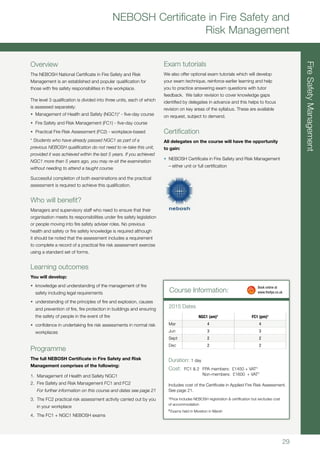
Course dates
Dates available on request.
Progression opportunities
•	 Level 4 Diploma in Fire Safety (Fire Inspectors) QCF
Cost
FPA members: £1750 + VAT per delegate*
Non-members: £1975 + VAT per delegate*
*price excludes registration/certification of £60 + VAT per delegate
Level 4 Certificate in Fire Safety (Fire Auditors)
63
FireSafetyTrainingforFireandRescueServices
Level 4 Certificate in Fire Safety (Fire Auditors)
Unit 7
Unit 9
Unit 11
Unit 8
Unit 10
Assess risks associated with fire in complex premises and
environments
Learning Outcomes
1. Understand the requirements for assessing fire risks with in
complex premises and environments
2. Understand processes and guidance relevant to fire risk
assessment in complex premises and environments
3. Be able to evaluate fire hazards and risks in complex premises
and environments
4. Be able to specify solutions to minimise risks from fire in complex
premises and environments
Delivery:
Class-based learning – 3 days
Review fire protection systems in complex premises and
environments
Learning Outcomes
1. Understand the legislative and organisational requirements
applicable to fire protection systems in complex premises and
environments
2. Understand the procedures and processes for reviewing matters
relating to fire protection systems in complex premises and
environments
3. Be able to evaluate fire risks in complex premises and environments
4. Be able to recommend options to support appropriate risk
reduction measures, fire precautions and maintenance routines in
complex premises and environments
Delivery:
Class-based learning – 3 days
Online learning , directed study and assessment – 7 hours
Visit complex premises and environments for the purposes of fire
safety regulation
Learning Outcomes
1. Understand the legislative and organisational requirements
applicable to fire protection systems in complex premises
2. Understand the procedures and processes for reviewing matters
relating to fire protection systems in complex premises
3. Be able to evaluate fire hazards and risks in complex premises
4. Be able to recommend options to support appropriate risk
reduction measures, fire precautions and maintenance routines in
complex premises
Delivery:
Online learning, directed study and assessment – 15 hours
Ensure measures are in place to protect people from fire in complex
premises and environments
Learning Outcomes
1. Understand the requirements for the protection of people from fire
in complex premises and environments
2. Be able to ensure resources are available to manage fire risks in
complex premises and environments
Delivery:
Class-based learning – 2 days
Online learning, directed study and assessment – 7 hours
Review safety measures at locations that are regulated and/or
licensed
Learning Outcomes
1. Understand requirements for reviewing safety measures in
complex premises and environments that are regulated and/or
licenses
2. Be able to determine risks in complex premises and
environments
3. Be able to recommend controls to manage specific risks in
complex premises and environments
Delivery:
Online learning, directed study and assessment – 28 hours
Detailed Learning Outcomes for each unit
64
Overview
This qualification expands and further develops
knowledge from the Level 4 Certificate in Fire
Safety for Fire Auditors.
Who will benefit?
This qualification is suitable for fire safety inspectors in a
regulator role who are responsible for inspecting fire safety
arrangements in complex premises.
Learning outcomes
The Diploma programme consists of the content of the Level 4
Certificate (see previous pages) PLUS an additional mandatory
core unit, plus enough optional units to gain an extra 7 credits.
This must be a minimum of 2 units but could be more in order
to achieve at least 7 credits.
See opposite page for more details.
Programme
In addition to the content of the Level 4 Certificate
mentioned on previous pages, the content in the
mandatory unit includes (but is not limited to):
•	 construction methods and building materials
•	 risk profiles
•	 fire safety strategies
•	 internal and external fire spread
•	 means of escape
•	 fire safety management strategies
•	 plus the content of the optional modules chosen
Course length
The qualification consists of the Level 4 Certificate modules
requiring in total 8 days face to face delivery, plus the Level 4
Diploma which requires a further 5 days face to face delivery
plus further hours depending on which optional modules
are selected. In addition these modules are supported by a
programme of online learning and directed study.
Learners will have online access to the FPA Academy which
provides a comprehensive resource bank and access to
assessment and tutor support.
Managers can also choose to monitor the progress of their staff
via an optional online manager tracking and reporting service.
Further information and prices for this service are available on
request.
Recognition of Prior Learning
See page 59 for more information on RPL.
Certification
•	 SFJ Awards Level 4 Diploma in Fire Safety (Fire Inspectors)
Bespoke courses
The Level 4 Diploma can be purchased on a bespoke basis to be
delivered to groups of learners at a venue convenient to you.
Price available on request, please email training@thefpa.co.uk
Each of the units that make up the Level 4 Diploma can be
purchased and delivered individually or in combination to take
account of any existing levels of knowledge/qualifications.
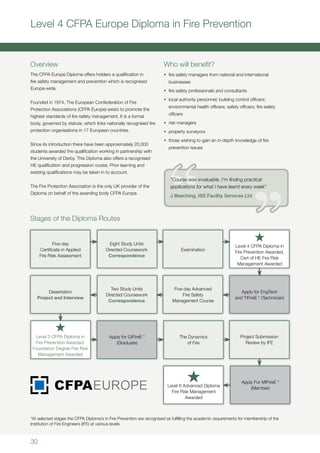
Course dates
Dates available on request.
Progression opportunities
•	 BSc (Hons) Fire Risk Management
Cost
Mandatory Unit 12 plus optional units totalling a further 7 credits
is sufficient to obtain the Diploma. Cost is dependent upon which
units are chosen.
Level 4 Diploma in Fire Safety (Fire Inspectors)
65
FireSafetyTrainingforFireandRescueServices
Level 4 Diploma in Fire Safety (Fire Inspectors)
Unit 12  Mandatory unit
Unit 16  Optional unit: 3 Credits
Unit 18  Optional unit: 3 Credits
Unit 15 Optional unit: 4 Credits
Unit 17  Optional unit: 3 Credits
Review fire safety matters relating to existing or proposed construction
Learning Outcomes
1. Understand the legislative and organisational requirements for reviewing
fire safety matters relating to existing or proposed construction
2. Understand the procedures and processes for reviewing fire safety
matters relating to existing or proposed construction
3. Understand the impact of building materials and construction methods
on fire safety
4. Be able to evaluate plans to determine fire risks associated with
construction design
5. Be able to evaluate planned use of materials and their effectiveness
6. Be able to report on risks with recommendations to support appropriate
risk reduction measures, fire precautions and maintenance routines
Delivery:
Class-based learning – 5 days
Online learning, directed study and assessment – 15 hours
Unit 12
FPA members:	 £850 + VAT per delegate*
Non-members:	 £950 + VAT per delegate*
Prepare and present evidence in court and other formal proceedings in
relation to fire safety matters
Learning Outcomes
1. Understand requirements for preparing and presenting
evidence in court and other formal proceedings in relation to fire safety
matters environments
2. Be able to prepare evidence and reports relating to fire safety for court
and other formal proceedings
3. Be able to present evidence relating to fire safety to court and other
formal proceedings
Delivery:
Class-based learning – 3 days
Unit 16
FPA members:	 £520 + VAT per delegate*
Non-members:	 £590 + VAT per delegate*
Serve statutory enforceable documents for the purposes of fire safety
regulation
Learning Outcomes
1. Understand requirements for serving statutory enforceable
documents for the purposes of fire safety regulation
2. Be able to serve statutory enforceable documents
Delivery:
Online learning, directed study and assessment – 7 hours
Unit 18
FPA members:	 £140 + VAT per delegate*
Non-members:	 £170 + VAT per delegate*
Review fire safety matters relating to premises under construction,
demolition and alteration
Learning Outcomes
1. Understand requirements for reviewing fire safety matters relating to
premises under construction, demolition and alteration
2. Be able to assess fire risks associated with planned construction,
demolition and alteration
3. Be able to advise on controls to manage fire risks in premises
under construction, demolition and alteration
4. Be able to advise on controls to manage fire risks in the vicinity of
premises under construction, demolition and alteration
Delivery:
Online learning, directed study and assessment – 10 hours
Unit 15
FPA members:	 £200 + VAT per delegate*
Non-members:	 £250 + VAT per delegate*
Draft statutory enforceable documents for the purposes of fire safety
regulation
Learning Outcomes
1. Understand requirements for drafting statutory enforceable
documents for the purposes of fire safety regulation
2. Be able to draft statutory enforceable documents
Delivery:
Online learning, directed study and assessment – 7 hours
Unit 17
FPA members:	 £140 + VAT per delegate*
Non-members:	 £170 + VAT per delegate*
Detailed Learning Outcomes for each unit
Note: Details of optional Units 13 and 14 can be provided
upon request.
66
Level 5 Certificate in Fire Investigation
Overview
This nationally accredited qualification has been designed to
develop the knowledge and skills of learners who investigate,
report and present evidence related to incidents involving fire
and/or explosion.
The FPA has teamed up with International Fire Investigators and
Consultants Ltd (IFIC Forensics) to provide a team of subject
specialists offering a valuable mix of practical, theoretical
and case study learning on fire investigation practice and
procedures. Scene excavation of premises and vehicle fires will
be carried out in FPA’s practical burn facilities including use of
a number of different compartments in a two-storey building to
provide learners with realistic scenarios found in domestic or
commercial premises.
Training has been designed to meet the learning outcomes
and assessment criteria from the Level 5 Certificate in Fire
Investigation awarded by SFJ Awards and as such, successful
students will achieve this national qualification.
Who will benefit?
This course is aimed at those working within the field of fire
investigation who are required to investigate, report and present
evidence related to incidents.
Learning outcomes
On successful completion of the programme learners will
understand how to:
•	 present evidence related to fire investigations in court and at
other hearings
•	 prepare to investigate an incident involving fire and/or
explosion
•	 investigate an incident involving fire and/or explosion
•	 report on the investigation of incidents involving fire and/or
explosion
Programme
Course content includes:
•	 the principles of fire and/or explosion
•	 legal and organisational requirements
•	 nature and scope of investigations
•	 types of reports
•	 the range of skills required to provide and present evidence
in court
Certification
•	 SFJ Awards Level 5 Certificate in Fire Investigation
•	 CFPA Europe Certificate in Fire Investigation
Course Information
Moreton in Marsh
Jan 12-23
Apr 13-24
Sep 7-18
Nov 9-20
2015 Dates
Duration:	 This course is 10 days in duration taught over
	 2 weeks (excluding Saturday and Sunday).
	 The cost of the course includes 10 nights 		
	accommodation.
Cost:	 £3650 + VAT per delegate
	 Book online at
	www.thefpa.co.uk
6767
Useful Information
Information on our membership grades, bespoke training,
course booking forms and affiliate trainer programme.
Terms and Conditions 68
Course Booking Form 69
Membership Grades 70
UsefulInformation
68686868
Terms and Conditions
1. 	 Upon receipt of the FPA Training Course booking form
if requested, an invoice will be sent confirming your
reservation.
2. 	 Payment terms are 30 days from date of invoice OR prior
to the start of the course, whichever is soonest.
3. 	 Full joining instructions will be sent so as to arrive no later
than 2 weeks before the course commences.
	 3.1 	 Open Courses
	 Where cancellation is received later than 2 weeks before
the commencement of a course no refund will be made.
	 Transfer of a booking within 2 weeks of a start date to a
later date, will be subject to an additional 10% charge and
the original invoice will stand. Cancellations made before
this time may be subject to an administration fee.
	 3.2 	 Bespoke courses
	 Where cancellation is received up to 5 weeks before the
commencement of a course there will be no cancellation
charge for the course fee. The FPA reserves the right
to charge for any development work or/and course
administration that has been undertaken before that date.
	 Where cancellation is received 3-5 weeks before the start
of the course, there will be a charge of 50% of the course
cost. Where cancellation is received within 3 weeks of the
course, the full course cost will be payable.
4. 	 We will try to accommodate requests for postponement,
changes in names, reductions in numbers, changes to
duration or changes to agreed dates whenever possible
but reserve the right to impose a cancellation charge or the
forfeit of deposits.
5. 	 Payment details: Cheques should be made payable to ‘The
Fire Protection Association’ and crossed ‘A/C payee only’.
Switch, Solo, Visa, Access, Eurocard and Mastercard
facilities are available.
6. 	 Non-payment: In the event of non-payment, interest will
be charged with effect from the first day of the course at a
rate of 2% per month or part thereof, added to the course
fee, with any discount disallowed.
Pricing Policy
• 	 FPA members qualify for a significant reduction on all FPA
training courses/fees. These fees are stated
• 	 the FPA are prepared to revise prices for group bookings
• 	 students wishing to study introductory, intermediate and
advanced pathways of study may qualify for concessions
• 	 all prices are shown exclusive of VAT. VAT is chargeable on
all elements of the invoice.
In all cases please contact the training department for an
informal discussion. We will endeavour to meet your training
needs, whatever your budget.
Learner Agreement
We endeavour to maintain a high quality portfolio of relevant
and up to date training through robust processes and review.
All learners taking part in our training courses and qualifications
are expected to participate actively to the completion of the
programme including any post course assessment that may be
required. It is understood that any assessment undertaken will
be the learners own work and sources referenced appropriately.
We are happy to provide learners with further advice and
guidance regarding assessment should it be required.
General Course Information
1. 	 The FPA shall endeavour to ensure that the published
programme for training is provided. However, the
Company reserves the right to alter published timetables
and speakers.
2. 	 The courses shown are those currently offered by the FPA
and the contents remain their property at all times.
3. 	 Accommodation is not included with any of our courses.
Further advice about accommodation is available from the
training department on +44 (0)1608 812500.
4. 	 Refreshments: All ‘open’ courses include refreshments and
other meals as appropriate.
5. 	 Transport: all prices are exclusive of transportation either to
or from the training venue.
6. 	 Overseas students: Students are reminded that the
language of instruction is English. If you would like any
additional arrangements to be made, please contact the
training department.
7. 	 Special requirements: Students are requested to provide
advance notice of any special requirements they may have.
8.	 The FPA reserves the right to cancel an open training
course if minimum delegate numbers have not been
reached. The FPA will endeavour to give 2 working weeks
notice of cancellations. The Company’s liability shall be
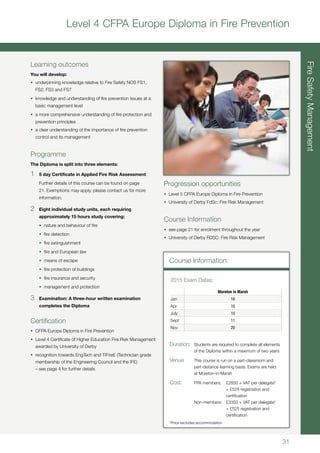
limited to a refund of any booking fees paid.
6969
Security number (last three digits on
reverse of card)
Please photocopy and post, email or fax this form to:
Fire Protection Association, London Road, Moreton in Marsh, Gloucestershire GL56 0RH
Tel: +44(0)1608 812 500 • Fax: +44(0)1608 812 501 • E-mail: training@thefpa.co.uk • Website: www.thefpa.co.uk
Method of Payment (tick box)
Method of payment is by cheque, credit card or BACS. If an invoice is required please supply a copy of your purchase order.
Enclosed is a cheque for the total cost of the order (payable to Fire Protection Association)
Please invoice. Our purchase order no. Please enclose a copy.
Please debit card A/c no.
Name on card	 Issue No.	 Valid from Expiry date
Please indicate card type
Please provide details of available accommodation
/ /
Please sign to confirm you have read our terms  conditions and agree to adhere to them
Signed	Date
Course Details
Course name:
Course date(s) - Preferred: Alternative
Name  position of delegate(s):
Delegate(s) email: mobile no:
Additional Information e.g. dietary or access requirements:
*Please note payment in Euros is only accepted for courses held in Dublin Total fees*: £ / s
VAT £
TOTAL £ / s
Invoice Details
Your name:	 Position:
Company:
Address:
	Postcode:
Telephone:	Fax:
E-mail:	 FPA membership no:
Course Booking Form
BACS Payment - to make a payment via BACS our account details are as follows:
Account Name: The Fire Protection Association
Bank Address: National Westminster Bank PLC, Cambridge King’s Parade Branch, 10 Bennett Street, Cambridge CB2 3PY
Sort Code: 60-04-23 Account No: 24069922 Swift Transfer No: NWBK GB 2L IBAN No: GB81 NWBK 6004 2324 0699 22
UsefulInformation
7070
Head Office
Fire Protection Association
London Road
Moreton in Marsh
Gloucestershire
GL56 0RH
T: +44 (0)1608 812 500
F: +44 (0)1608 812 501
E: training@thefpa.co.uk
www.thefpa.co.uk
TrainingandQualificationsProspectus2015
Welcome
Develop your knowledge and understanding of fire safety with the UK’s national fire safety organisation
FPA is proud to work with the institutions below:
Many of our courses can now be
booked securely online at
www.thefpa.co.uk
If you pay no less than 7 weeks before the course start
date you will receive a 10% discount. Look out for the early
bird for courses that apply.
Training and Qualifications
Prospectus 2015
THE UK’s NATIONAL FIRE SAFETY ORGANISATION
Protecting people, property, business and the environment
Your route to fire safety excellence
Fire safety awareness | Fire risk assessment | Fire safety management | Fire extinguisher maintenance
Emergency lighting | Fire detection and alarm systems | Fire in the built environment | Sprinkler systems
Fire safety audit and enforcement | Bespoke training | e-learning | Qualifications
Welcome to the 2015 FPA Training Prospectus
To start, I would like to thank the many individuals, employers
and organisations that chose to train with us in 2014. The
competency of staff with a fire safety remit remains a key
aspect of fire risk management in the workplace and we are
delighted that increasing numbers of employers continue to
work with us on a long term basis so that, together, we are
continually driving up standards of fire safety. Before we move
on to look at what’s new for 2015, I will touch on just a few of
the highlights from last year.
FPA training highlights for 2014 included:
•	 the new Level 3 Award in Fire Risk Management in
Residential Properties proved popular with housing
associations across the country
•	 the FPA’s state-of-the-art new sprinkler training workshop
opened and received excellent feedback from learners
attending courses on sprinkler systems maintenance
•	 a new Level 5 Diploma in Fire Investigation was launched
using FPA’s new practical burn facilities
•	 the Fire Sector Summit continues to be seen as the
must-attend event of the year with numbers in 2014 at
Sopwell House far exceeding previous years.
Whilst you will find many of our most popular courses and
events appearing again for 2015, we are continually listening to
the sector and once again will be adding to the range of training
and services that we offer.
New for 2015 are:
•	 a revised suite of fire detection and alarm systems
qualification-based courses which allow hands-on training in
purpose built booths
•	 clear routes to achievement of qualifications via Recognition
of Prior Learning
•	 a suite of practical modules to develop understanding of
passive fire protection
•	 the Level 5 Diploma in Fire Investigation which has course
dates available throughout the year
•	 Level 3 and 4 Certificate in Fire Risk Management in
Residential Properties
•	 a new hands-on five-day healthcare course on fire risk
management for practitioners
Our credentials speak for themselves:
•	 we are an Institution of Fire Engineers (IFE) Recognised
Training Provider and an Institution of Fire Safety Managers
(IFSM) Approved Training Centre
•	 we have significant experience of delivering fire safety
training, from major blue chip companies to the public sector
and SMEs
•	 we operate a quality management system in accordance
with BS/EN/ISO 9001, assessed and approved by Lloyds
Register
•	 we are a constituent member of the Confederation of Fire
Protection Associations Europe (CFPA Europe)
•	 we are a NEBOSH Accredited Centre
•	 we are an SFJ Awards Accredited Centre
•	 we run Higher Education programmes validated by
University of Derby Corporate (UDC)
•	 we have achieved the Investors in People Award
•	 the majority of our courses offer CPD points
Whether you are an established client returning to us for more
training or a new customer making enquiries for the first time,
we look forward to working with you in the coming year and
hope that you will find this year’s training offering bigger and
better than ever.
With best wishes for a very successful year.
Sue Tyley
Associate Director, Training
Email: styley@thefpa.co.uk

FPA-Training-Prospectus-2015

  • 1.
    Head Office Fire ProtectionAssociation London Road Moreton in Marsh Gloucestershire GL56 0RH T: +44 (0)1608 812 500 F: +44 (0)1608 812 501 E: training@thefpa.co.uk www.thefpa.co.uk TrainingandQualificationsProspectus2015 Welcome Develop your knowledge and understanding of fire safety with the UK’s national fire safety organisation FPA is proud to work with the institutions below: Many of our courses can now be booked securely online at www.thefpa.co.uk If you pay no less than 7 weeks before the course start date you will receive a 10% discount. Look out for the early bird for courses that apply. Training and Qualifications Prospectus 2015 THE UK’s NATIONAL FIRE SAFETY ORGANISATION Protecting people, property, business and the environment Your route to fire safety excellence Fire safety awareness | Fire risk assessment | Fire safety management | Fire extinguisher maintenance Emergency lighting | Fire detection and alarm systems | Fire in the built environment | Sprinkler systems Fire safety audit and enforcement | Bespoke training | e-learning | Qualifications Welcome to the 2015 FPA Training Prospectus To start, I would like to thank the many individuals, employers and organisations that chose to train with us in 2014. The competency of staff with a fire safety remit remains a key aspect of fire risk management in the workplace and we are delighted that increasing numbers of employers continue to work with us on a long term basis so that, together, we are continually driving up standards of fire safety. Before we move on to look at what’s new for 2015, I will touch on just a few of the highlights from last year. FPA training highlights for 2014 included: • the new Level 3 Award in Fire Risk Management in Residential Properties proved popular with housing associations across the country • the FPA’s state-of-the-art new sprinkler training workshop opened and received excellent feedback from learners attending courses on sprinkler systems maintenance • a new Level 5 Diploma in Fire Investigation was launched using FPA’s new practical burn facilities • the Fire Sector Summit continues to be seen as the must-attend event of the year with numbers in 2014 at Sopwell House far exceeding previous years. Whilst you will find many of our most popular courses and events appearing again for 2015, we are continually listening to the sector and once again will be adding to the range of training and services that we offer. New for 2015 are: • a revised suite of fire detection and alarm systems qualification-based courses which allow hands-on training in purpose built booths • clear routes to achievement of qualifications via Recognition of Prior Learning • a suite of practical modules to develop understanding of passive fire protection • the Level 5 Diploma in Fire Investigation which has course dates available throughout the year • Level 3 and 4 Certificate in Fire Risk Management in Residential Properties • a new hands-on five-day healthcare course on fire risk management for practitioners Our credentials speak for themselves: • we are an Institution of Fire Engineers (IFE) Recognised Training Provider and an Institution of Fire Safety Managers (IFSM) Approved Training Centre • we have significant experience of delivering fire safety training, from major blue chip companies to the public sector and SMEs • we operate a quality management system in accordance with BS/EN/ISO 9001, assessed and approved by Lloyds Register • we are a constituent member of the Confederation of Fire Protection Associations Europe (CFPA Europe) • we are a NEBOSH Accredited Centre • we are an SFJ Awards Accredited Centre • we run Higher Education programmes validated by University of Derby Corporate (UDC) • we have achieved the Investors in People Award • the majority of our courses offer CPD points Whether you are an established client returning to us for more training or a new customer making enquiries for the first time, we look forward to working with you in the coming year and hope that you will find this year’s training offering bigger and better than ever. With best wishes for a very successful year. Sue Tyley Associate Director, Training Email: styley@thefpa.co.uk
  • 2.
    Course Title JanuaryFebruary March April May June July August September October November December Fire Safety Awareness Fire Safety for Fire Wardens 20 Lon 2 Lon 11 Lon 14 Lon 12 Lon 2 Lon 7 Lon 8 Lon 6 Lon 3 Lon 1 Lon Train the Trainer (Fire Safety) 20-22 MiM 3-5 Lon 4-6 MiM 14-16 Glas 6-8 MiM 3-5 Lon 1-3 MiM 2-4 MiM, 15-17 Glas 7-9 Lon 4-6 MiM Hot Work Passport 19 MiM 16 Lon 3 MiM 16 Man 13 Lon 10 MIM 9 Man 9 Lon 13 MIM 11 Man Introduction to DSEAR 24 MiM 28 Lon 26 Man 10 Glas 14 MiM Fire Risk Assessment Fire Risk Assessment for Simple Premises 12 Lon 17 Man 11 MIM 13 MiM 20 Glas 2 Lon Fire Risk Assessment 12-14 MiM, 26-28 Lon 23-25 MiM 2-4 Dub, 16-18 Lon, 23-25 MiM 20-22 Lon, 27-29 Glas 12-14 Man, 18-20 MiM 22-24 MiM 27-29 Lon 3-5 MiM 21-23 Lon, 28-30 MiM 12-14 Glas, 19-21 Man 9-11 MIM, 16-18 Bel, 30- 2 Lon Advanced Fire Risk Assessment 4-5 MiM 23-24 Lon 6-7 Glas 3-4 MiM 2-3 Lon 8-10 MiM 4-5 Man Certificate in Applied Fire Risk Assessment 19-23 MiM 9-13 Lon 2-6 MiM, 9-13 Glas 20-24 MiM 11-15 Lon 15-19 MiM, 29- 3 Lon, 13-17 MiM 7-11 Glas,14-18 MiM 19-23 Lon, 26- 2 MIM, 23-28 Lon Fire Risk Assessment for the Common Areas in Flats and HMOs 16-18 Lon 13-15 MiM 11-13 Lon 8-10 Man 14-16 Lon 5-7 MiM 9-11 Glas Advanced Fire Risk Assessment in HMOs 19-20 Lon 15-16 MIM 8-9 Lon 27-29 MiM 8-10 MIM Risk Management in Residential Properties 18 MiM 17-18/24-25 MiM 13/22/28 MiM 19/21 MiM 6 Lon 7/15-16/29-30 Lon 13/29 Lon 2/4/10/25 Lon Fire Risk Assessment and Maintenance of Fire Systems for Facilities Managers 10-12 MiM 7-9 Lon 25-27 MiM Fire Risk Assessment for Healthcare Premises 18-23 MIM 16-20 MIM Fire Safety Management NEBOSH Certificate in Fire Safety and Risk Management Exams 4 MIM 3 MiM 2 MiM 2 MiM Level 4 CFPA Europe Diploma in Fire Prevention 16 MiM 10 MiM 10 MiM 11 MiM 20 MiM Advanced Fire Safety Management 13-17 MiM 12-16 MiM Fire Extinguisher Maintenance Portable Fire Extinguisher Recharging and Maintenance 26-29 MIM 23-26 Lon 16-19 Man, 23-26 Dub 20-23 MiM 11-14 Lon 13-16 Man, 20-23 Glas 21-24 MiM 12-15 Dub 9-12 Lon, 16-19 Glas 7-10 MiM Portable Fire Extinguisher Technicians Refresher 10 MIM 24 Lon 1 MIM 20 Glas Sprinkler Systems Introduction to Sprinkler Systems 28-29 MIM 3-4 MIM 13-14 MIM 2-3 MIM 3-4 MIM Basic Sprinkler Systems Design 23-27 MiM 29- 3 MiM 19-23 MiM Intermediate Sprinkler Systems Design 11-12 MiM 7-8 MiM Basic Refresher in Sprinkler Systems Design 7-10 MiM Intermediate Refresher in Sprinkler Systems Design 2-4 MiM Fully Hydraulically Calculated Systems Refresher 16-19/25-26 MiM Maintenance of Sprinkler Systems and Components 4-5/12-13/25-26 MiM 17-18 MiM 28-29 MiM 11-12 MiM 2-3/16-17 MiM 1-2 MiM 9-10/16-17 MiM 23-24 MiM 10-11/17-18/24-25 MiM Emergency Lighting Level 2 Award: Fundamentals of Emergency Lighting 27 MiM 2 MiM 6 MiM 1 MiM 8 MiM Fire Detection and Alarm Systems Level 2 Award: Fundamentals of Fire Detection and Alarm Systems 16-17 MiM 5-6 MiM 13-14 MiM 14-15 MiM 9-10 MiM Fire Safety in the Built Environment Working with Approved Document B and BS 9999 29- 1 MiM 3-5 MiM Passive Fire Protection Modules 2-3 MiM 27-28 MiM 8-9 MiM 10-11 MiM 12-13 MiM 14-15 MiM Fire Engineering Principles and Practice 9-13 MiM 29- 3 MiM 26-30 MiM Fire Safety Training for Fire and Rescue Services Level 5 Certificate in Fire Investigation 12-23 MiM 13-24 MiM 7-18 MiM 9-20 MiM Bel=Belfast Dub=Dublin Glas=Glasgow Lon=London Man=Manchester MiM=Moreton in Marsh 2015 Course Calendar
  • 3.
    Course Title JanuaryFebruary March April May June July August September October November December Fire Safety Awareness Fire Safety for Fire Wardens 20 Lon 2 Lon 11 Lon 14 Lon 12 Lon 2 Lon 7 Lon 8 Lon 6 Lon 3 Lon 1 Lon Train the Trainer (Fire Safety) 20-22 MiM 3-5 Lon 4-6 MiM 14-16 Glas 6-8 MiM 3-5 Lon 1-3 MiM 2-4 MiM, 15-17 Glas 7-9 Lon 4-6 MiM Hot Work Passport 19 MiM 16 Lon 3 MiM 16 Man 13 Lon 10 MIM 9 Man 9 Lon 13 MIM 11 Man Introduction to DSEAR 24 MiM 28 Lon 26 Man 10 Glas 14 MiM Fire Risk Assessment Fire Risk Assessment for Simple Premises 12 Lon 17 Man 11 MIM 13 MiM 20 Glas 2 Lon Fire Risk Assessment 12-14 MiM, 26-28 Lon 23-25 MiM 2-4 Dub, 16-18 Lon, 23-25 MiM 20-22 Lon, 27-29 Glas 12-14 Man, 18-20 MiM 22-24 MiM 27-29 Lon 3-5 MiM 21-23 Lon, 28-30 MiM 12-14 Glas, 19-21 Man 9-11 MIM, 16-18 Bel, 30- 2 Lon Advanced Fire Risk Assessment 4-5 MiM 23-24 Lon 6-7 Glas 3-4 MiM 2-3 Lon 8-10 MiM 4-5 Man Certificate in Applied Fire Risk Assessment 19-23 MiM 9-13 Lon 2-6 MiM, 9-13 Glas 20-24 MiM 11-15 Lon 15-19 MiM, 29- 3 Lon, 13-17 MiM 7-11 Glas,14-18 MiM 19-23 Lon, 26- 2 MIM, 23-28 Lon Fire Risk Assessment for the Common Areas in Flats and HMOs 16-18 Lon 13-15 MiM 11-13 Lon 8-10 Man 14-16 Lon 5-7 MiM 9-11 Glas Advanced Fire Risk Assessment in HMOs 19-20 Lon 15-16 MIM 8-9 Lon 27-29 MiM 8-10 MIM Risk Management in Residential Properties 18 MiM 17-18/24-25 MiM 13/22/28 MiM 19/21 MiM 6 Lon 7/15-16/29-30 Lon 13/29 Lon 2/4/10/25 Lon Fire Risk Assessment and Maintenance of Fire Systems for Facilities Managers 10-12 MiM 7-9 Lon 25-27 MiM Fire Risk Assessment for Healthcare Premises 18-23 MIM 16-20 MIM Fire Safety Management NEBOSH Certificate in Fire Safety and Risk Management Exams 4 MIM 3 MiM 2 MiM 2 MiM Level 4 CFPA Europe Diploma in Fire Prevention 16 MiM 10 MiM 10 MiM 11 MiM 20 MiM Advanced Fire Safety Management 13-17 MiM 12-16 MiM Fire Extinguisher Maintenance Portable Fire Extinguisher Recharging and Maintenance 26-29 MIM 23-26 Lon 16-19 Man, 23-26 Dub 20-23 MiM 11-14 Lon 13-16 Man, 20-23 Glas 21-24 MiM 12-15 Dub 9-12 Lon, 16-19 Glas 7-10 MiM Portable Fire Extinguisher Technicians Refresher 10 MIM 24 Lon 1 MIM 20 Glas Sprinkler Systems Introduction to Sprinkler Systems 28-29 MIM 3-4 MIM 13-14 MIM 2-3 MIM 3-4 MIM Basic Sprinkler Systems Design 23-27 MiM 29- 3 MiM 19-23 MiM Intermediate Sprinkler Systems Design 11-12 MiM 7-8 MiM Basic Refresher in Sprinkler Systems Design 7-10 MiM Intermediate Refresher in Sprinkler Systems Design 2-4 MiM Fully Hydraulically Calculated Systems Refresher 16-19/25-26 MiM Maintenance of Sprinkler Systems and Components 4-5/12-13/25-26 MiM 17-18 MiM 28-29 MiM 11-12 MiM 2-3/16-17 MiM 1-2 MiM 9-10/16-17 MiM 23-24 MiM 10-11/17-18/24-25 MiM Emergency Lighting Level 2 Award: Fundamentals of Emergency Lighting 27 MiM 2 MiM 6 MiM 1 MiM 8 MiM Fire Detection and Alarm Systems Level 2 Award: Fundamentals of Fire Detection and Alarm Systems 16-17 MiM 5-6 MiM 13-14 MiM 14-15 MiM 9-10 MiM Fire Safety in the Built Environment Working with Approved Document B and BS 9999 29- 1 MiM 3-5 MiM Passive Fire Protection Modules 2-3 MiM 27-28 MiM 8-9 MiM 10-11 MiM 12-13 MiM 14-15 MiM Fire Engineering Principles and Practice 9-13 MiM 29- 3 MiM 26-30 MiM Fire Safety Training for Fire and Rescue Services Level 5 Certificate in Fire Investigation 12-23 MiM 13-24 MiM 7-18 MiM 9-20 MiM Bel=Belfast Dub=Dublin Glas=Glasgow Lon=London Man=Manchester MiM=Moreton in Marsh 2015 Course Calendar
  • 4.
    Head Office Fire ProtectionAssociation London Road Moreton in Marsh Gloucestershire GL56 0RH T: +44 (0)1608 812 500 F: +44 (0)1608 812 501 E: training@thefpa.co.uk www.thefpa.co.uk TrainingandQualificationsProspectus2015 Welcome Develop your knowledge and understanding of fire safety with the UK’s national fire safety organisation FPA is proud to work with the institutions below: Many of our courses can now be booked securely online at www.thefpa.co.uk If you pay no less than 7 weeks before the course start date you will receive a 10% discount. Look out for the early bird for courses that apply. Training and Qualifications Prospectus 2015 THE UK’s NATIONAL FIRE SAFETY ORGANISATION Protecting people, property, business and the environment Your route to fire safety excellence Fire safety awareness | Fire risk assessment | Fire safety management | Fire extinguisher maintenance Emergency lighting | Fire detection and alarm systems | Fire in the built environment | Sprinkler systems Fire safety audit and enforcement | Bespoke training | e-learning | Qualifications Welcome to the 2015 FPA Training Prospectus To start, I would like to thank the many individuals, employers and organisations that chose to train with us in 2014. The competency of staff with a fire safety remit remains a key aspect of fire risk management in the workplace and we are delighted that increasing numbers of employers continue to work with us on a long term basis so that, together, we are continually driving up standards of fire safety. Before we move on to look at what’s new for 2015, I will touch on just a few of the highlights from last year. FPA training highlights for 2014 included: • the new Level 3 Award in Fire Risk Management in Residential Properties proved popular with housing associations across the country • the FPA’s state-of-the-art new sprinkler training workshop opened and received excellent feedback from learners attending courses on sprinkler systems maintenance • a new Level 5 Diploma in Fire Investigation was launched using FPA’s new practical burn facilities • the Fire Sector Summit continues to be seen as the must-attend event of the year with numbers in 2014 at Sopwell House far exceeding previous years. Whilst you will find many of our most popular courses and events appearing again for 2015, we are continually listening to the sector and once again will be adding to the range of training and services that we offer. New for 2015 are: • a revised suite of fire detection and alarm systems qualification-based courses which allow hands-on training in purpose built booths • clear routes to achievement of qualifications via Recognition of Prior Learning • a suite of practical modules to develop understanding of passive fire protection • the Level 5 Diploma in Fire Investigation which has course dates available throughout the year • Level 3 and 4 Certificate in Fire Risk Management in Residential Properties • a new hands-on five-day healthcare course on fire risk management for practitioners Our credentials speak for themselves: • we are an Institution of Fire Engineers (IFE) Recognised Training Provider and an Institution of Fire Safety Managers (IFSM) Approved Training Centre • we have significant experience of delivering fire safety training, from major blue chip companies to the public sector and SMEs • we operate a quality management system in accordance with BS/EN/ISO 9001, assessed and approved by Lloyds Register • we are a constituent member of the Confederation of Fire Protection Associations Europe (CFPA Europe) • we are a NEBOSH Accredited Centre • we are an SFJ Awards Accredited Centre • we run Higher Education programmes validated by University of Derby Corporate (UDC) • we have achieved the Investors in People Award • the majority of our courses offer CPD points Whether you are an established client returning to us for more training or a new customer making enquiries for the first time, we look forward to working with you in the coming year and hope that you will find this year’s training offering bigger and better than ever. With best wishes for a very successful year. Sue Tyley Associate Director, Training Email: styley@thefpa.co.uk
  • 5.
    Contents 3 Contents +44 (0)1608 812500 +44 (0)1608 812501 training@thefpa.co.uk www.thefpa.co.uk Fire Protection Association, London Road, Moreton in Marsh, Gloucestershire GL56 0RH How to book: Awards and Approvals 4-5 The highly relevant content and robust quality assurance throughout our courses has earned recognition from a number of external bodies. Qualification Routes 8-9 The routes available to achieve a range of qualifications. FPA Academy 10 FPA Academy is our award winning online e-learning resource offering high quality, interactive fire safety training at the click of a button. Fire Safety Awareness 11-16 Develop an understanding of fire safety relevant to your role, whether it be general workplace fire safety, carrying out hot work safely or working with dangerous substances. Fire Risk Assessment 17-27 Develop your knowledge and achieve qualifications to be able to carry out Fire Risk Assessments in accordance with current legislation. Fire Safety Management 28-36 Develop knowledge and skills in fire safety management and achieve qualifications ranging from Level 2 to Level 6 and beyond that open up learning pathways to recognised certification and professional memberships. Fire Extinguisher Maintenance 37-39 Understand how this essential piece of fire safety equipment varies, operates, is maintained and should be managed on site. Sprinkler Systems 40-45 Develop your theoretical and practical knowledge of sprinkler systems from their components and design to their maintenance. Emergency Lighting 46-47 Develop knowledge of design, maintenance, installation, commissioning and verification of emergency lighting. Fire Detection and Alarm Systems 48-50 Develop knowledge of design, installation, commissioning and/or maintenance of fire detection and alarm systems and progress on to our qualifcations available at Levels 2. Fire Safety in the 51-57 Built Environment Develop your understanding of fire safety within the built environment including our new training pathway in passive fire protection. Fire Safety Training for 58-66 Fire and Rescue Services Training and qualification pathways for those who regulate and enforce fire safety, mapped against the 2010 National Occupational Standards (NOS) in Fire Safety. Useful Information 67-70 Information on our membership grades, bespoke training, course booking forms and affiliate trainer programme. @ @@ @ @ @ e-learning www.fpa-academy.com
  • 6.
    The highly relevantcontent and robust quality assurance throughout our courses has earned recognition from a number of external bodies including: The CFPA Europe Certificates, Diploma and Advanced Diploma in Fire Prevention The Confederation of Fire Protection Associations Europe (CFPA) is the formal body, governed by statute, which links the 17 recognised fire safety organisations that exist in the countries of the European Union and the European Free Trade Area. The CFPA Europe Certificates, Diploma and Advanced Diploma are recognised in the 17 home countries of the CFPA and offer holders a Europe-wide recognised qualification in a range of aspects of fire safety management and prevention. NEBOSH Certificate in Fire Safety and Risk Management Founded in 1979, NEBOSH offers qualifications that are recognised and respected by employers in all sectors of the economy and which provide the benchmark standard against which others are compared. FPA is a NEBOSH Accredited centre, delivering the underpinning knowledge for certificated units FC1 and FC2 of the nationally recognised Fire Safety and Risk Management Certificate. If you have achieved the NEBOSH National General Certificate (unit NGC1) within the last 5 years you can be awarded the full Certificate. Institution of Fire Engineers Membership At selected stages the FPA’s CFPA qualifications in Fire Prevention are recognised as providing appropriate training in support of applications for Institution of Fire Engineers (IFE) membership at various grades. EngTech The CFPA Europe Diploma in Fire Prevention has been approved by the IFE as contributing to the academic requirements for achieving Engineering Technician (EngTech) status with the Engineering Council. Competency Criteria for Fire Risk Assessors The Fire Risk Assessment Competency Council comprises a broad group of relevant fire sector stakeholders. Its objective has been to establish industry-wide criteria against which the competence of a fire risk assessor can be judged. These criteria are able to be used by professional bodies and third party certification bodies who register or certificate fire risk assessors, by training providers in the design of course content and by commercial companies providing fire risk assessment services. FPA courses have been mapped against these competency criteria to ensure relevant coverage of the knowledge requirements within our fire risk assessor training. Examples of some of the national register schemes available are below: Institution of Fire Engineers Register of Fire Risk Assessors & Auditors The FPA offers a number of risk assessment courses (please refer to our Fire Risk Assessment section on page 17) which have all received course approval from the IFE for the purpose of their Register of Fire Risk Assessors and Auditors. Successful completion of the course will support an individual’s application to the Register and may help in reducing the burden of proof required through the application process. In addition to successfully completing the course, applicants to the Register will need to be able to provide evidence of suitable and sufficient education, training and experience in fire safety, fire risk assessment and /or the audit of completed assessments before making their application. For further information please visit the IFE website at www.ife.org.uk/frr/ Institute of Fire Prevention Officers The Institute of Fire Prevention Officers (IFPO) represents fire safety professionals from all walks of life including the Fire & Rescue Services, underground and overground rail networks, the aviation sector as well as the more usual fire sectors. IFPO operates its own fire risk assessor’s register following the guidelines issued by the competency criteria council. Entry on to the register is by application and examination of qualifications. A number of fire risk assessments are then submitted for scrutinisation, with a final panel interview. IFPO offers discounted prices to those who have completed FPA fire risk assessment training. For further information please visit www.ifpo.org.uk 4 Awards and Approvals
  • 7.
    AwardsandApprovals 5 Awards and Approvals NationalOccupational Standards National Occupational Standards (NOS) are important benchmarks for those striving to achieve or demonstrate competence in their particular field of work as they set down what a person needs to do, know and understand in order to be competent to carry out activities or functions. A typical NOS will break down all of the required activities into units including a unit summary or overview. Each unit will describe the required standards of performance and the required standards of knowledge and understanding necessary to perform a particular function competently. In the fire sector the relevant standards that underpin activities come from the Fire Safety NOS and the Electronic Systems NOS. Each of these set of standards sit with an overarching, independent skills body who’s remit it is to identify and address skills and workforce development needs. Fire Safety NOS sit with Skills for Justice and Electronic Systems NOS sit with Skills for Security. These NOS underpin the course content of all relevant FPA courses. SFJ Awards SFJ Awards is an awarding organisation approved by the Qualification Regulators to provide qualifications in England, Wales and Northern Ireland. They develop and deliver nationally recognised qualifications for the Justice and Community Safety Sector, the Legal Sector, Local Government, Military and the Fire and Rescue Sector. FPA is an Approved Centre for SFJ Awards qualifications for fire safety, fire risk management in residential properties & fire investigation. By working with SFJ Awards, organisations can develop and implement learning programmes that adhere to a recognised quality assurance process. This results in a quality tailored training programme that remains the intellectual property of the organisation that has developed it, as well as providing increased confidence in the learning programme and ensuring learners have the right skills to do their jobs with proficiency. IQ Industry Qualifications (IQ) is a nationally regulated awarding organisation committed to raising standards in vocational education. They are sector-focused and work in partnership with trade bodies and professional associations to develop qualifications that are relevant and valued. They believe in premium quality, thinking differently and above all, in fairness and transparency, in everything we do. FPA is an Approved Centre for IQ qualifications in fire detection and alarm systems and emergency lighting. University of Derby The University of Derby has been working with companies for several years to focus on improving employability and boost careers and professional development through higher education. Engaging with employers to help drive up the higher skill levels of the UK workforce. Working in close partnership with the University of Derby, the FPA has developed a BSc (Hons) route which includes its well-established and highly regarded CFPA Europe Diploma and Advanced Diploma in Fire Prevention. Continuing Professional Development The FPA supports the principles of CPD and credits or points may be available to members of professional institutions as a result of attending specified courses. CPD hours have been awarded for the majority of FPA courses by the Institution of Fire Engineers (IFE) and they are also recognised by The Institution of Occupational Safety and Health (IOSH) and The Institute of Fire Safety Managers (IFSM). The list of institutions recognising our courses is continually expanding and an enquiry about the availability of CPD points should be made at the time of booking.
  • 8.
    6 Bespoke Courses Tailored, cost-effectivetraining solutions An increasing number of organisations require training services to be provided on a ‘bespoke basis’, whereby the location, timing and course programme can be tailored to suit specific training objectives. FPA is able to modify, expand and tailor any of the courses featured in our prospectus or create entirely new courses as necessary. Course content can be amended to ensure that delegates are trained in accordance with your specific company systems and procedures and, if necessary, we can also provide on-going back-up and verification services. Our staff are able to travel extensively home and overseas to present our courses to clients. We have access to regional training centres across the UK or can run courses at your premises at a time to meet with your requirements. Alternatively FPA’s practical training facilities and classrooms at Head Office can be used. Rates are by negotiation, but discounts are available for companies that book a group of customised training courses, and for those that are FPA members. Case studies of just a few of the bespoke programmes which we were able to develop and present on behalf of our customers are featured on our website, www.thefpa.co.uk If you feel your company can benefit from our customised training solutions then please email training@thefpa.co.uk with your enquiry. Our fire warden and general fire awareness courses are delivered at customers’ premises across the UK and Ireland. The FPA has a growing list of satisfied customers, with companies from all sectors booking courses with us. Clients from 2014 included:
  • 9.
    7 BespokeCourses Working with theFPA Working with the FPA Affiliate Training Provider Scheme Training providers of similar educational standards and ethos can now work in partnership with FPA, bringing the knowledge, skills and experience of their own training team to the delivery of a range of FPA’s training courses and qualifications. Each course is supported by comprehensive Affiliate Provider Training Materials containing learning resources and assessments. Joint marketing in the form of promotional activity and use of affiliate provider branding on certification is also available within the scheme. The courses that are available through this scheme are: • FPA Certificate in Action in the Event of Fire • CFPA Europe Certificate in Fire Safety for Fire Wardens (Basic Fire Fighting and Fire Prevention) • FPA Hot Work Passport Some of our current affiliate trainers are: Tesco Maintenance, National Safety Training and Normandie Health & Safety. Satellite Centre Satellite Centre status operates in a similar manner to the Affiliate Trainer scheme but involves training which leads to the awarding of a nationally recognised qualification and is therefore subject to further administration on behalf of the centre to meet the requirements. Learners and trainers will have access to on-line activities and assessments via the FPA Academy and they will have the support and guidance of the FPA QA team. We also provide a network of contact and support between learners and Satellite centres as part of the ongoing development of the qualification. The centre will require appropriate training facilities and a minimum of one Trainer/ IQA and one Administrator/Programme Manager. For larger organisations these roles are likely to be split across several members of staff. The courses that are available through this scheme are: • Level 2 Award: Fundamentals of Fire Detection and Alarm Systems • Level 2 Award: Fundamentals of Emergency Lighting • Level 3 Award: Reporting Fire Risk in Residential Properties • Level 3 Certificate: Fire Risk Management in Simple Residential Properties • Level 4 Certificate: Fire Risk Management in Complex Residential Properties In order to join either scheme you will need to be, or employ trainers who have been approved by the FPA as having the required knowledge, skills and experience to offer specific training. This may include attending our 3 day Train the Trainer course. You will be required to complete an application form and provide a detailed CV, describing your relevant experience and qualifications. FPA will review your application and issue an Action Plan which will outline any additional requirements prior to approval. All Satellite Centres will receive a centre visit from our quality management team to look at your facilities and to ensure the support and needs of the learners can be met from both a training delivery and administrative point of view. We will also provide you with various guidance on the processes involved and what learners can expect from programme delivery, assessment activities and quality assurance. Some of our current Satellite Centres
  • 10.
    8 Qualification Routes Fire RiskAssessment (Page 19) Certificate in Applied Fire Risk Assessment (Page 21) Certificate in Applied Fire Risk Assessment (Page 21) Hot Work Passport (Page 15) Reporting Fire Risk in Residential Properties (Page 24-25) Fire Safety for Fire Wardens (Page 13) Advanced Fire Safety Management (Page 33) Fire Safety Awareness Fire Risk Assessment Fire Safety Management CFPA Europe Certificate in Hot Works CFPA Europe Certificate in Basic Fire Fighting and Fire Prevention CFPA Europe Advanced Diploma in Fire Prevention BSc (Hons) Fire Risk Managment CFPA Europe Diploma in Fire Risk Management The Dynamics of Fire (Page 36) MIF L3 Fire Risk Management in Simple Residential Properties L3 L4Certificate of Professional Development : Applied Fire Risk Management L3CFPA Europe Certificate in Principles of Fire Safety at Work L4CFPA Europe Diploma in Fire Prevention L4 L5 GIF Certificate of Higher Education : Fire Risk Management L4 L6 L3 Exam for NEBOSH Certificate in Fire Safety and Risk Management FC1 and FC2* Approved for application toward the IFE Register of Fire Risk Assessors and Auditors Fire Risk Management in Complex Residential Properties L4 Fire Risk Assessment in HMOs (Page 23) ET TIF Foundation Degree : Fire Risk Management L5 University Advanced Diploma Fire Risk Management L6
  • 11.
    QualificationRoutes 9 Qualification Routes Key FPAcourse title Associated exam/award/progression opportunity Course level Recognised towards EngTech Recognised towards TIFireE Recognised towards GIFireE Recognised towards MIFireE (subject to validation) University of Derby / FPA partnership * 2 units of the 3 unit qualification MIF GIF TIF Basic Refresher in Sprinkler Systems Design (Page 43) Intermediate Refresher in Sprinkler Systems Designs (Page 43) FHC Systems Refresher (Page 43) Sprinkler Design LPCB Basic Design Competency Review (LPS 1048) LPCB Intermediate Design Competency Review (LPS 1048) LPCB FHC Design Competency Review (LPS 1048) Portable Fire Extinguisher Recharging and Maintenance (Page 38) Fire Extinguisher Recharging and Maintenance BAFE Certificate in Portable Fire Extinguisher Maintenance CFPA-Europe Certificate in Maintenance of Portable Fire Extinguishers ET L
  • 12.
    10 fire safety awarenessat work the role of the fire warden evacuation planning personal emergency evacuation plans the responsible person access and facilities for firefighters in buildings fire risk assessment in simple premises fire safety on construction sites FPA Academy is an online e-learning resource offering high quality, interactive fire safety training at the click of a button. It allows companies of all types and sizes access to a range of courses online, helping to ensure staff are equipped with appropriate fire safety knowledge. Courses available include: • • • • • • • • To preview demos of all our modules and to buy online visit www.fpa-academy.com or email training@thefpa.co.uk user-friendly assessments management reports learner support online demosinteractive certification
  • 13.
    11 Fire Safety Awareness Developan understanding of fire safety relevant to your role, whether it be general workplace fire safety, carrying out hot work safely or working with dangerous substances. FireSafetyAwareness Fire Safety at Work 12 Fire Safety for Fire Wardens 13 Train the Trainer (Fire Safety) 14 Hot Work Passport 15 Introduction to DSEAR (Dangerous Substances and Explosive Atmosphere Regulations) 16
  • 14.
    12 Fire Safety atWork Action in the Event of Fire Overview This course provides delegates with an understanding of what to do in the event of a fire and includes practical hands-on use of a fire extinguisher. Approximately 90 minutes in duration and delivered at your premises, it provides all staff with an awareness of fire prevention. Who will benefit? This course will benefit all employees in understanding the appropriate actions to take in the event of fire. Learning outcomes Delegates will understand how to: • identify when to evacuate the building • take the correct actions when discovering a fire • select and use the correct extinguisher Fire Safety Awareness at Work This course is aimed at providing the necessary knowledge to enable all staff to keep themselves and their workplace safe. The learning material is designed to give you an awareness of fire facts and figures, an introduction to legislation, hazard spotting and the appropriate actions to take in the event of a fire. Programme The course content includes: • how to raise the alarm • contacting and liaising with the emergency services • how to prevent fire spread • how to safely evacuate the building • how to select and use a fire extinguisher • practical extinguisher training Certification • FPA Certificate • This course has been awarded 1.5 IFE CPD hours Duration: 1 hour Number of modules: 7 Cost: £30.00 + VAT For delivery on your premises please contact us on 01608 812500 or email training@thefpa.co.uk Duration: 90 mins (approx) Cost: Prices start from £350 + VAT per course for up to 16 delegates Course Information Tailor course content, date or venue to suit your requirements
  • 15.
    13 Overview Our half-day coursefor fire wardens has been revamped to ensure that participants achieve a thorough awareness and understanding of the threat posed by fire. All delegates receive practical hands on training in fire extinguishers as well as interactive training in risk assessment, mitigation and a copy of our ‘Fire Warden Handbook’ (RRP £20.00). This course is available as an open course, or as a bespoke course delivered at clients’ venues at a time suited to them. Who will benefit? This course will be of benefit to all staff, particularly those designated as fire wardens or marshals. It is suitable for employees working in industry, commerce or the public sector. Learning outcomes You will develop knowledge and skills in how to: • identify fire hazards and risks – Unit FS1.1* • report fire hazards and risks – Unit FS1.2* *Units refer to the National Occupational Standards (NOS) in Fire Safety 2010. Programme The course content includes: • fire legislation, facts and figures • combustion principles and how fire spreads • fire case study • how to spot common hazards • actions in the event of fire and evacuation principles • fire wardens’ responsibilities • routine fire safety checks • fire extinguisher theory and practical Certification • CFPA Europe Certificate in Basic Fire Fighting and Fire Prevention • This course has been awarded 3 IFE CPD hours London London Jan 20 July 7 Feb 2 Sept 8 Mar 11 Oct 6 Apr 14 Nov 3 May 12 Dec 1 Jun 2 2015 Dates Duration: 1 /2 day (12:30-16:45) Cost: FPA members: £105 + VAT per delegate Non-members: £125 + VAT per delegate for other venues across the UK visit our website at www.thefpa.co.uk Course Information Book online at www.thefpa.co.uk FireSafetyAwareness Fire Safety for Fire Wardens Early Bird Discount – pay 7 weeks in advance and save 10% Tailor course content, date or venue to suit your requirements “Interesting and easy to follow, good introduction, friendly and knowledgeable” Nora Fertig, Australian High Commission Role of the Fire Warden Everyone in the workplace plays a vital part in fire safety, but some individuals also have an official responsibility as Fire Wardens or ‘competent persons’. This course is all about helping fire wardens to perform their role effectively by providing a clear understanding of their own role and responsibilities. Duration: 1 hour Number of modules: 8 Cost: £30.00 + VAT
  • 16.
    14 Overview This 3 daycourse provides delegates with specialist training from experienced FPA trainers on fire safety knowledge and training delivery best practice. On successful completion you will have the necessary skills and confidence to deliver effective fire safety awareness training in-house. This course has developed to become one of our most popular, with delegates benefitting from its relaxed but informative style. Delegate feedback has indicated that the training has saved businesses time and money, as well as ensuring that all staff receive high quality up-to-date training as required by current fire legislation. Important: Delegates have the option of taking either the 3 day course, which includes input on teaching methods on day 1, or, if you have sufficient qualifications or experience in this area, you can elect to attend the final 2 days. Anyone applying to become an Affiliate Trainer of the FPA must undertake the 3 day course. Who will benefit? Anyone who wants the ability to be able to deliver knowledgeable basic fire safety training in-house. Companies no longer need to send staff off-site or to contract in external companies every time a new member of staff joins, or when refresher training is required. Learning outcomes Delegates will develop: • confidence in delivering fire safety training and handling any questions that the delegates raise during the course • a greater awareness of the hazards of fire • an understanding of the nature of fire and how it spreads • an understanding of human behaviour in a fire • knowledge of current fire safety legislation • an understanding of the actions to take in the event of discovering a fire • the ability to distinguish between the different types of fire extinguishers and the fires for which they are suited • the ability to tackle small fires with confidence • best practice in training delivery Programme The course content includes: • training delivery best practice tools and techniques • fire facts, figures and trends • fire spread • hazard identification • fire legislation • fire evacuation principles • fire extinguisher theory and practical • combustion principles • human behaviour • microteach session • assessment and certification Certification • FPA Train the Trainer Certificate • CFPA Europe Certificate in Basic Fire Fighting and Fire Prevention • this course has been awarded 18 IFE CPD hours MiM=Moreton in Marsh Lon=London Glas=Glasgow MiM Lon** Glas Jan 20-22 Feb 3-5 Mar 4-6 Apr 14-16 May 6-8 Jun 3-5 July 1-3 Sept 2-4 15-17 Oct 7-9 Nov 4-6 2015 Dates Duration: 2 or 3 days Cost: 2 days FPA members: £395 + VAT per delegate* Non-members: £425 + VAT per delegate* 3 days FPA members: £550 + VAT per delegate* Non-members: £580 + VAT per delegate* *Price excludes cost of accommodation **for London venue add £10 per delegate per day Train the Trainer (Fire Safety) Course Information Book online at www.thefpa.co.uk Early Bird Discount – pay 7 weeks in advance and save 10% Tailor course content, date or venue to suit your requirements “I had very limited knowledge and the tutor was fantastic. Pace was great and used good level of humour. He made me feel at ease and able to ask loads of questions, thank you” David Harvie, Cancer Research UK Training Information Pack For a complete training solution in one package – you can also purchase a Training Information Pack (TIPs) containing a DVD, trainers’ handbook containing comprehensive notes, PowerPoint presentation, quiz sheets and certificate template. Prices start from £185+ VAT – Price is reduced by £50 if bought together with an FPA Train the Trainer course. Please visit out online shop for more details.
  • 17.
    15 FireSafetyAwareness Hot Work Passport Overview TheFPA Hot Work Passport was introduced in response to requests from industry for a national benchmark that can be used as an indicator of the levels of knowledge and understanding of fire safety held by hot work project managers and operatives. This request was made against reports of a rising number of serious fires as a result of hot work activities. Upon attendance at this course, and successful completion of a short assessment, you will be awarded a personalised Hot Work Passport, valid for 5 years. Who will benefit? This course is designed for those supervisors and operatives who carry out fire risk assessments in order to complete hot work permits on construction sites, refurbishment projects and during maintenance work. The Passport is an indication to employers and clients that you have demonstrated a level of knowledge and understanding of fire safety that will contribute to safe and effective hot work activities on any structure, building, equipment or area where construction, alteration or maintenance is taking place. Learning outcomes You will develop knowledge and understanding of: • the importance of fire prevention and your own responsibility when performing dangerous work • systematic working and fire prevention methods underpinned by the relevant legislation and regulations Programme Course content will include: • legislative requirements • principles of fire risk assessment • fire science – understanding fire • structures and materials – understanding fire protection • hot work management processes • hot work equipment fire hazards • preparing to carry out hot work • safety precautions during and after hot work • action in the event of fire Certification • FPA Hot Work Passport • CFPA Europe Certificate in Hot Works • This course has been awarded 6 IFE CPD hours 2015 Dates MiM=Moreton in Marsh Lon=London Man=Manchester Our Hot Work Passport course has been successfully delivered to over 2,000 employees on company sites across the UK. Please contact our Training Department on 01608 812500 for further information. Also available for delivery as part of our Affiliate Trainer Scheme - see page 7. Course Information MiM Lon** Man Jan 19 Feb 16 Mar 3 Apr 16 May 13 Jun 10 July 9 Sept 9 Oct 13 Nov 11 Duration: 1 day Cost: FPA members: £185 + VAT per delegate Non-members: £210 + VAT per delegate **for London venue add £10 per delegate 2015 Dates Book online at www.thefpa.co.uk Early Bird Discount – pay 7 weeks in advance and save 10% Tailor course content, date or venue to suit your requirements “Excellent combination of knowledge and experience” Mike Charlton, Hawkins
  • 18.
    16 Introduction to DSEAR(Dangerous Substances and Explosive Atmosphere Regulations) Overview This one-day course will give a dynamic introduction as to why correct chemical storage is so important and the respective regulations to which you must comply. It will address the basics of COSHH, by answering some of the most frequently asked questions about the subject; who, how, when am I qualified? As part of the COSHH section, the course will explain why chemical segregation is so important and when considering DSEAR, why the consequences associated with “non flammable” chemicals in the event of a fire should also be considered. Who will benefit? It is designed for all personnel levels, stating the legal consequences to both directors and management, whilst physically demonstrating the reality to those most at risk - the operators. Any person responsible for health and safety in the workplace or protection of our environment should attend as well as those responsible for carrying out both Fire Risk Assessments and Health and Safety Risk Assessments. Learning outcomes By the end of the course, you will have developed: • knowledge of the requirements of DSEAR • awareness of the properties of flammable and explosive substances • knowledge about the effect of different explosions • an ability to identify, classify and reduce hazards • increased awareness in how to choose equipment, protection and control systems • an understanding of the importance of correct storage and maintenance Programme The course content includes: • legal foundations • how sources of danger arise • the difference between flashpoint and auto ignition • the fundamentals on the origin of explosions, deflagrations and fires • risks resulting from improper storage or handling of these substances • the meaning of the danger triangle • correct storage solutions for chemicals and gas • environmental protection MiM Lon** Man Glas Feb 24 Apr 28 May 26 Sept 10 Oct 14 2015 Dates Duration: 1 day Cost: FPA members: £250 + VAT per delegate Non-members: £325 + VAT per delegate **for London venue add £10 per delegate per day Course Information Book online at www.thefpa.co.uk Certification • FPA Certificate • this course has been awarded 6 IFE CPD hours MiM=Moreton in Marsh Lon=London Man=Manchester Glas=Glasgow “Excellent tutor with great knowledge on subject, brilliant demos and experiments” Alex Flannigan, Magnox
  • 19.
    17 Develop your knowledgeand achieve qualifications to be able to carry out Fire Risk Assessments in accordance with current legislation. Fire Risk Assessment in Simple Premises 18 Fire Risk Assessment 19 Advanced Fire Risk Assessment 20 Certificate in Applied Fire Risk Assessment 21 Fire Risk Assessment for the Common Areas in Flats and HMOs 22 Advanced Fire Risk Assessment in HMOs 23 Fire Risk Management in Residential Properties 24-25 Fire Risk Assessment and Maintenance of Fire Systems for Facilities Managers 26 Fire Risk Assessment for Healthcare Premises 27 Fire Risk Assessment FireRiskAssessment All our fire risk assessment courses have been mapped against the “competency criteria for fire risk assessors” issued by the Fire Risk Assessment Competency Council.
  • 20.
    18 Overview This course willdevelop understanding of responsibilities under relevant fire legislation and improve knowledge of the fire risk assessment process. Delegates will learn about a range of fire safety systems, gain practical experience in carrying out a simple* fire risk assessment and be provided with fire risk assessment documentation for use in the workplace. *small commercial premises of 2-3 storeys not involving a sleeping risk. Who will benefit? Those with responsibility for undertaking fire risk assessments of simple premises. Learning outcomes You will develop: • an understanding of your fire safety responsibilities • an awareness of fire hazards • awareness of the nature of fire and how it spreads • knowledge of the actions to take in the event of a fire • an understanding of the risk assessment process Programme The course content includes: • an overview of current fire legislation • fire facts and figures • hazard identification and mitigation • the principles of combustion and fire spread mechanisms • active and passive fire protection systems • human behaviour • the risk assessment process • a fire risk assessment practical exercise Certification • FPA Certificate • this course has been awarded 5 IFE CPD hours Progression opportunities • Fire Risk Assessment and Fire Safety Management* * if you choose to progress onto the above course the cost of this ‘Introductory’ course will be deducted from the price Fire Risk Assessment in Simple Premises MiM=Moreton in Marsh Lon=London Man=Manchester Glas=Glasgow Course Information Duration: 1 day Cost: FPA members: £175 + VAT per delegate Non-members: £215 + VAT per delegate ** for London venue add £10 per delegate MiM Lon** Man Glas Feb 12 Apr 17 Jun 11 Aug 13 Oct 20 Dec 2 2015 Dates Book online at www.thefpa.co.uk Early Bird Discount – pay 7 weeks in advance and save 10% Tailor course content, date or venue to suit your requirements Fire Risk Assessment in Simple Premises This course is suited to those with a responsibility for undertaking fire risk assessments in simple premises. The course is designed to develop understanding of responsibilities, introduce key fire safety issues and to gain knowledge of the fire risk assessment process. The learning material has been designed to offer a concise and instructive overview with an opportunity to apply learning to a simulated tour of a premises at the end of the course.Duration: 2 hours Number of modules: 10 Cost: £60.00 + VAT Duration: 2 hours Number of modules: 10 Cost: £60.00 + VAT “I think that this course is a real eye opener and will certainly make me much more aware of things around the business. Very enjoyable and informative” Phil Waterhouse, Cotton Traders
  • 21.
    19 FireRiskAssessment Overview Current fire legislationrequires that almost all workplaces undertake a suitable and sufficient fire risk assessment. The risk assessment has to identify hazards and take steps to prevent fire in order to protect the safety of occupants, visitors and those in the immediate vicinity. This popular 3 day course is designed to offer practical hands-on experience in this area and allows delegates to gain experience in undertaking fire risk assessments. Who will benefit? This course is aimed at those who have responsibility for undertaking fire risk assessments and who wish to receive further certification in this subject in order to demonstrate competency. Delegates will be expected to have some background knowledge of fire safety but may have little or no experience in undertaking fire risk assessments. The course has received approval from the Institution of Fire Engineers (IFE) for the purpose of their Register of Fire Risk Assessors and Auditors – see page 4 for more information. Learning outcomes You will develop: • a broad understanding of workplace fire safety issues that reviews and adds to your existing knowledge • detailed understanding of the fire risk assessment process • awareness of current fire safety legislation • ability to apply the principles and methodology of fire risk assessment, exploring the process and applying learning through a number of practical activities Programme The course content includes: • legislative requirements relevant to the location of the course • means of escape and human behaviour • passive and active fire safety overview • principles of risk assessment • the risk assessment process • fire risk assessment – practical exercises • course assessment Certification • FPA Certificate showing IFE Approval towards their Register of Fire Risk Assessors and Auditors • This course has been awarded 18.5 IFE CPD hours Course Information MiM Dub† Lon** Glas Man Bel Jan 12-14 26-28 Feb 23-25 Mar 23-25 2-4 16-18 Apr 20-22 27-29 May 18-20 12-14 Jun 22-24 July 27-29 Aug 3-5 Sept 28-30 21-23 Oct 12-14 19-21 Nov 9-11 30-2 Dec 16-18 2015 Dates Duration: 3 days Cost: FPA members: £705/s705 + VAT per delegate* Non-members: £840/s840 + VAT per delegate* *Price excludes cost of accommodation † Euro fee applicable to Dublin venue only ** for London venue add £30 per delegate MiM=Moreton in Marsh Glas=Glasgow Dub=Dublin Lon=London Man=Manchester Bel=Belfast Fire Risk Assessment Early Bird Discount – pay 7 weeks in advance and save 10% Tailor course content, date or venue to suit your requirements “the facilitator was outstanding, patient, informative and knowledgeable about the subject. He was able to transfer his skills to the delegates with a professional manner.” Antony Etherington, Etherington Associate Consultants Ltd (EAC Ltd)
  • 22.
    20 Advanced Fire RiskAssessment Course Information Overview This course will strengthen your existing knowledge and understanding of fire risk assessment and assist with the correct interpretation of guidance in order to achieve fire safety solutions that are: • required to ensure minimum life standards are achieved • reasonably practicable to implement • meet statutory requirements Who will benefit? This course is aimed at building managers, owners, assessors and enforcing authorities who are required to determine the fire safety measures in complex premises. Delegates should have previously attended appropriate courses that have provided an underpinning knowledge of fire safety management. Learning outcomes On completion of the course delegates will: • be able to differentiate between matters that are required to ensure statutory compliance and additional measures that would reduce the risk to property and business • have an improved ability to apply relevant guidance documents in order to determine appropriate fire safety solutions • have an understanding of human behaviour in a range of fire situations • have a greater understanding of active and passive fire safety measures • have a greater understanding of the effectiveness and limitations of new and existing fire safety measures and the cost and benefit of upgrading or replacing existing measures MiM Lon** Glas Man Feb 4-5 Apr 23-24 May 6-7 Jun 3-4 Sept 2-3 Oct 8-10 Nov 4-5 2015 Dates Duration: 2 days Cost: FPA members: £525 + VAT per delegate* Non-members: £650 + VAT per delegate* *Price excludes cost of accommodation **for London venue add £20 per delegate Book online at www.thefpa.co.uk Early Bird Discount – pay 7 weeks in advance and save 10% Tailor course content, date or venue to suit your requirements MiM=Moreton in Marsh Lon=London Man=Manchester Glas=Glasgow Programme Course content includes: • Legal requirements – CFOA guidance; fire safety management; co-operation and co-ordination in multi-occupied buildings, human behaviour, GEEPS, PEEPS • Fire warning systems – legal requirements, advantages, disadvantages and limitations of specific systems; cost implications • Passive and active fire safety measures • Guidance documents – CLG, ADB, LACORS & BS9999 application, interpretation, limitations, contradictions • General fire precautions in complex premises Certification • FPA Certificate • This course has been awarded 13 IFE CPD hours “Very helpful to clarify my own limitations and providing further relevant technical knowledge. The tutor’s personal experience enlightened the training. Particularly enjoyed the Human Behaviour aspect” Chris Sutton, North Yorkshire County Council
  • 23.
    21 Course Information Overview Previously titledFire Risk Assessment and Fire Safety Management, this well established and popular five-day course attracts delegates from a wide range of industry backgrounds, in the public and private sector, including major UK and overseas organisations. Delegates will benefit from a concentrated and focused course presented by a range of fire safety specialists, all of whom are experts in their field. The course is certificated by the University of Derby at Level 4. Who will benefit? This course is ideal for those individuals who require an intensive yet broad-ranging introduction to the key principles of fire prevention, fire protection and fire risk assessment. Learning outcomes You will develop: • understanding of the fundamental principles of fire prevention and protection measures, raising awareness of the vast range of topics involved in fire safety management • knowledge of the principal workplace fire hazards, associated risks and passive and active means available to mitigate fire • ability to apply the principles and methodology of fire risk assessment, exploring the process and applying learning through a number of practical activities Programme Course content includes: • fire safety management framework • legislative requirements • fire theory, principle causes and prevention of fire • fire protection in buildings • introduction to the principles of smoke control, fire engineering and environmental issues • arson and its prevention • human behaviour • the principles and methodologies of fire risk assessment • fire risk assessment in action • practical exercises and practical fire risk assessment • a fire risk assessment in the workplace is required to complete the course Certification All delegates on the course will have the opportunity to gain: • Certificate of Professional Development in Applied Fire Risk Assessment (40 HE Credits) • the CFPA Europe Certificate in Principles of Fire Safety at Work and the first element of the Level 4 CFPA Europe Diploma in Fire Prevention - pages 30-31 • approval towards the Institution of Fire Engineers Register of Fire Risk Assessors and Auditors • an optional assessment in units FC1 and FC2 of the NEBOSH Certificate in Fire Safety and Risk Management - page 29 • 38 IFE CPD hours For more information on any of these qualifications please refer to pages 4-5 Progression opportunities • Level 4 CFPA Europe Diploma in Fire Prevention – pages 30-31 • Advanced Fire Safety Management – page 33 • Advanced Fire Risk Assessment – page 20 MiM Glasgow London** Jan 19-23 Feb 9-13 Mar 2-6 9-13 Apr 20-24 May 11-15 Jun 15-19 29-3 July July 13-17 29-3 Aug 3-7 Sept 14-18 7-11 Oct 26-2 19-23 Nov 2-6 23-28 2015 Dates Duration: 5 days Cost: FPA members: £1310 + VAT per delegate* Non-members: £1460 + VAT per delegate* *Price excludes cost of accommodation and NEBOSH registration/ certification **for London venue add £50 per delegate Book online at www.thefpa.co.uk Early Bird Discount – pay 7 weeks in advance and save 10% Tailor course content, date or venue to suit your requirements MiM=Moreton in Marsh FireRiskAssessment “(The Trainer) delivered the course exceptionally well. The course was put in simple terms and I left feeling comfortable that I had the knowledge and understanding to complete the exam” John Harrison, WWH Certificate in Applied Fire Risk Assessment
  • 24.
    22 Overview Houses in MultipleOccupation (HMO) can pose an increased risk from fire, particularly if those premises are poorly designed, managed or maintained. This course offers essential instruction and information for the effective safe management of buildings comprising multiple accommodation units. You will receive instruction and advice on how to carry out a suitable and sufficient fire risk assessment. Who will benefit? Local Authorities, Housing Associations, Landlords and those that manage, or have some responsibility for any multi-occupied building(s), will be especially interested in this programme. Learning outcomes You will develop: • an awareness and understanding of fire hazards and risks relating to the common areas of flats, HMOs and similar premises • an awareness of the guidance documents currently available to assist the ‘Responsible Person’ • awareness of the key principles of fire prevention, control and fire protection in such premises • practical knowledge of the fire risk assessment process and a thorough understanding of the legal responsibilities imposed by current legislation • application of learning through a number of practical activities Programme The course content includes: • legislative requirements • current guidance documents • means of escape and life risks specific to the common areas of multi-occupied residential premises and HMOs • passive fire safety, active systems and developments in fire detection standards • management issues • principles and practical application of fire risk assessment Certification • FPA Certificate showing IFE Approval towards their Register of Fire Risk Assessors and Auditors • this course has been awarded 18.5 IFE CPD hours Progression opportunities • Advanced Fire Risk Assessment in HMOs Fire Risk Assessment for the Common Areas in Flats and HMOs MiM London** Manchester Glasgow Feb 16-18 Apr 13-15 May 11-13 Jun 8-10 Sept 14-16 Oct 5-7 Nov 9-11 Duration: 3 days Cost: FPA members: £705 + VAT per delegate* Non-members: £840 + VAT per delegate* *Price excludes cost of accommodation ** for London venue add £30 per delegate Course Information 2015 Dates Book online at www.thefpa.co.uk Early Bird Discount – pay 7 weeks in advance and save 10% Tailor course content, date or venue to suit your requirements MiM=Moreton in Marsh “It was a well paced course very relaxed which put us at ease. The tutor came across as very informative on the whole I enjoyed the course” Eddie Barr, Greensquare
  • 25.
    23 FireRiskAssessment Moreton in MarshLondon** Feb 19-20 Apr 15-16 Jul 8-9 Oct 27-29 Dec 8-10 Duration: 2 days Cost: FPA members: £525 + VAT per delegate* Non-members: £650 + VAT per delegate* *Price excludes cost of accommodation ** for London venue add £20 per delegate Course Information 2015 Dates Book online at www.thefpa.co.uk “Had a great time but learnt a lot, time well spent, thank you” Andrew Williams, A2Dominion Advanced Fire Risk Assessment in HMOs Overview Certain flats and houses in multiple-occupation (HMO) present a higher risk of fire and a higher risk of injury to the occupants particularly if the premises are poorly designed, managed or maintained. There are various requirements and duties placed on those who occupy, manage and regulate these premises and guidance has been published to assist in reducing the risk. Complex situations are common where the extent of control and the interaction of the various roles and responsibilities requires careful consideration. This two–day course offers essential instruction and information to facilitate the cost effective fire safety management of these premises within the legislative framework. Who will benefit? Local Authorities, Fire & Rescue Service Inspecting Officers, Housing Associations, Landlords and those that manage, or have some responsibility for any multi-occupied building(s). Delegates should have previously attended appropriate courses that have provided an underpinning knowledge of fire safety management in HMOs. Learning outcomes You will develop: • a greater awareness and understanding of fire hazards and risks relating to flats and HMOs • a detailed knowledge of the content, reasoning and practical application of the guidance documents currently available to assist the ‘Responsible Person’ and enforcing authorities • an increased awareness of the legislative framework and the powers and duties imposed on those occupying, managing and regulating fire safety in flats and HMOs • an improved ability to apply relevant guidance documents using common sense in order to determine appropriate fire safety solutions Programme Course content includes: • Housing Act 2004 • Regulatory Reform (Fire Safety) Order 2005 • LACORS housing guidance • Local Government group guidance document - “Fire Safety in Purpose Built Blocks of Flats” • scenario based exercises Certification • FPA Certificate • This course has been awarded 13 IFE CPD hours Progression opportunities • Advanced Fire Safety Management - page 33 • CFPA Europe Diploma in Fire Prevention - pages 30-31
  • 26.
    24 Fire Risk Managementin Residential Properties Overview Individuals who have responsibility for fire risk management in simple and complex residential properties now have access to new nationally recognised and regulated qualifications to support the development of skills, knowledge and understanding to a recognised national standard for fire safety practice in the residential properties sector. The qualifications titles are as follows: • Level 3 Award for Reporting Fire Risk in Residential Properties • Level 3 Certificate for Fire Risk Management in Simple Residential Properties • Level 4 Certificate for Fire Risk Management in Complex Residential Properties Launched in 2014, FPA is pleased to be offering a series of open course dates throughout the year and the qualifications will also be available on a bespoke basis. In addition there is the opportunity for relevant organisations such as larger housing associations to become FPA satellite centres in order to deliver the qualifications in-house. (See page 7 for more information). These qualifications have been developed in accordance with the regulatory requirements of the Qualifications and Credit Framework (QCF) and are underpinned by the Skills for Justice National Occupational Standards (NOS) in Fire Safety. What credibility do these qualifications have? The qualifications have been developed with the expert involvement and input of representatives from the following professional groups: • the National Social Housing Fire Strategy Group (NSHFSG) • Fire Sector Federation (FSF) • the Chief Fire Officers Association (CFOA) • the Fire Protection Association (FPA) In addition, SFJ Awards have provided support for the development of these qualifications to meet the requirements for regulated qualifications. Who are these qualifications for? Level 3 Award for Reporting Fire Risk in Residential Properties This qualification is suitable for housing staff who are involved with identifying fire hazards, and contributing to continuous risk assessment by regular review. The qualification is also relevant to advisors and enforcers for residential properties who need to understand the hazards and risks in residential properties. It is important to note that this qualification is intended to contribute to the knowledge of those carrying out risk assessments, but on its own this qualification would not confirm the full range of knowledge required for risk assessment. Level 3 Certificate for Fire Risk Management in Simple Residential Properties This qualification is suitable for staff and consultants who carry out fire risk assessment and determine fire safety provision in simple residential properties. Simple residential properties are defined as those properties that are single use, three storeys or less and built after 1991. “Well delivered, interactive course” Steve Osbourne, BPHA Ltd
  • 27.
    25 Fire Risk Managementin Residential Properties Level 4 Certificate for Fire Risk Management in Complex Residential Properties This qualification is suitable for staff and consultants who carry out fire risk assessment and determine fire safety provision in complex residential properties. Complex residential properties are defined as those properties that are mixed use, four storeys or more, and could be built at any time. They are also considered to be any residential block which is HMO or designed for specific client groups who could present particular fire risks generated by the client group e.g. Sheltered/Extra Care/Special Educational needs groups are considered to be complex. Each qualification can be accessed independently of the other and learners are able to access the qualification(s) that are relevant to their role within fire risk management. What do the qualifications cover? Level 3 Award for Reporting Fire Risk in Residential Properties • reporting hazards and risk associated with fire in residential properties • monitoring and reporting to ensure that risk reduction measures, fire precautions and maintenance routines are sustained Level 3 and 4 Certificate for Fire Risk Management in Residential Properties look at the following areas in relation to simple premises at Level 3 and complex premises at Level 4 • reporting hazards and risk associated with fire in residential properties • assessing risks associated with fire in residential properties • confirming measures are in place to protect people from fire in residential properties • evaluating active and passive fire protection systems in residential properties What progression opportunities are available to learners who achieve these qualifications? There are a range of progression opportunities available to learners who achieve the fire risk management qualifications. These progression opportunities vary from achieving additional fire risk management qualifications (see page 8 for more information) to moving into specialist areas of fire safety. To find out more please visit the FPA’s website. FireRiskAssessment Level 3 Award Level 3 Cert Level 4 Cert MiM Lon* MiM Lon* MiM Lon* Feb 18 Mar 24-25 17-18 Apr 13 28 22 May 19 21 Jul 6 Sept 7 29-30 15-16 Oct 29 13 Nov 2 25 10 Cost: Level 3 Award: Member £210 + VAT, Non member £250 + VAT plus £35 + VAT certification Level 3 Certificate: Member £750 + VAT Non member £850 + VAT plus £50 + VAT certification Level 4 Certificate: Member £850 + VAT Non member £950 + VAT plus £60 + VAT certification *Price excludes cost of accommodation ** for London venue add £10 per delegate Course Information 2015 Dates Book online at www.thefpa.co.uk
  • 28.
    26 Course Information Fire RiskAssessment and Maintenance of Fire Systems for Facilities Managers Overview This course is designed to introduce, through both theoretical and practical sessions, key fire safety issues and procedures relevant to the facilities manager. It also details maintenance regimes for fire safety systems in the workplace. Who will benefit? This course is aimed at: • those responsible for managing the fire safety equipment and systems in occupied premises • those responsible for liaising with contract engineers to ensure fire safety requirements are met Learning outcomes You will develop: • an understanding of fire hazards in the workplace and their associated risks • knowledge of the fire safety related equipment and facilities which assist in mitigating these risks – from protected means of escape to fire alarm and detection systems and sprinkler systems • knowledge of the current standards and codes of practice which relate to these facilities and the detailed maintenance regimes which apply • improved understanding of the fire risk assessment process • an understanding of what to look out for when liaising with contract engineers Programme The course content will cover: • identification of the major causes of fire • compartmentation and means of escape • fire doors and glazing • automatic fire alarms and detection systems • emergency lighting • portable firefighting equipment • automatic suppression systems • maintenance and record keeping • staff training • fire risk assessment • dry risers and wet risers • course assessment Certification • FPA Certificate • This course has been awarded 18 IFE CPD hours Moreton in Marsh London** Mar 10-12 Sept 7-9 Nov 25-27 2015 Dates Duration: 3 days Cost: FPA members: £695 + VAT per delegate* Non-members: £830 + VAT per delegate* *Price excludes cost of accommodation **for London venue add £30 per delegate Progression opportunities • Level 4 CFPA Europe Diploma in Fire Prevention – pages 30-31 Book online at www.thefpa.co.uk Early Bird Discount – pay 7 weeks in advance and save 10% Tailor course content, date or venue to suit your requirements “Excellent course, backed up by a wealth of experience” Giuseppe Devitto, WH Smith Ltd
  • 29.
    2727 FireRiskAssessment Course Information *Price excludescost of accommodation Duration: 5 days Cost: FPA/NAHFO members £957 + VAT per delegate* Non-members £1100 + VAT per delegate* Book online at www.thefpa.co.uk Fire Risk Assessment for Healthcare Premises Overview This new five day course is delivered by fire safety professionals with specialist current experience of fire safety management in complex healthcare environments. Based upon our long established Certificate in Applied Fire Risk Assessment course the programme has been developed to focus specifically on issues associated with healthcare premises with reference to relevant guidance documents. Who will benefit? Fire safety advisors, estates officers or those with a responsibility for fire risk assessment in healthcare premises, consultants and auditors. Learning outcomes You will develop: Understanding of the fundamental principles of fire prevention and protection measures, raising awareness of the vast range of topics involved in fire safety management in healthcare premises including: • confidence in identifying fire hazards and assessing risks associated with fire in healthcare premises • knowledge of fire and smoke behaviour and associated fire stopping measures • knowledge of active systems in the mitigation of fire • understanding of building user implications in healthcare premises • understanding of fire safety solutions to minimize risks • ability to develop suitable emergency procedures for premises • knowledge of associated legislation, standards and documents Programme The course content will cover: • challenges in managing fire safety in healthcare premises • active and passive fire safety overview • means of escape and human behaviour • evacuation strategies • legislation, guides and codes of practice • fire safety management routine • fire risk assessment methodology and practice • structural fire precautions Moreton in Marsh May 18-23 Nov 16-20 2015 Dates
  • 30.
    28 NEBOSH Certificate inFire Safety and Risk Management 29 Level 4 CFPA Europe Diploma in Fire Prevention 30-31 Level 5 CFPA Europe Diploma in Fire Prevention 32 Advanced Fire Safety Management 33 BSc (Hons) Fire Risk Management 34-35 The Dynamics of Fire 36 Develop knowledge and skills in fire safety management and achieve qualifications ranging from Level 2 to Level 6 and beyond that open up learning pathways to recognised certification and professional memberships. Fire Safety Management
  • 31.
    29 FireSafetyManagement NEBOSH Certificate inFire Safety and Risk Management Overview The NEBOSH National Certificate in Fire Safety and Risk Management is an established and popular qualification for those with fire safety responsibilities in the workplace. The level 3 qualification is divided into three units, each of which is assessed separately: • Management of Health and Safety (NGC1)* - five-day course • Fire Safety and Risk Management (FC1) - five-day course • Practical Fire Risk Assessment (FC2) - workplace-based * Students who have already passed NGC1 as part of a previous NEBOSH qualification do not need to re-take this unit, provided it was achieved within the last 5 years. If you achieved NGC1 more than 5 years ago, you may re-sit the examination without needing to attend a taught course. Successful completion of both examinations and the practical assessment is required to achieve this qualification. Who will benefit? Managers and supervisory staff who need to ensure that their organisation meets its responsibilities under fire safety legislation or people moving into fire safety adviser roles. No previous health and safety or fire safety knowledge is required although it should be noted that the assessment includes a requirement to complete a record of a practical fire risk assessment exercise using a standard set of forms. Learning outcomes You will develop: • knowledge and understanding of the management of fire safety including legal requirements • understanding of the principles of fire and explosion, causes and prevention of fire, fire protection in buildings and ensuring the safety of people in the event of fire • confidence in undertaking fire risk assessments in normal risk workplaces Programme The full NEBOSH Certificate in Fire Safety and Risk Management comprises of the following: 1. Management of Health and Safety NGC1 2. Fire Safety and Risk Management FC1 and FC2 For further information on this course and dates see page 21 3. The FC2 practical risk assessment activity carried out by you in your workplace 4. The FC1 + NGC1 NEBOSH exams Exam tutorials We also offer optional exam tutorials which will develop your exam technique, reinforce earlier learning and help you to practice answering exam questions with tutor feedback. We tailor revision to cover knowledge gaps identified by delegates in advance and this helps to focus revision on key areas of the syllabus. These are available on request, subject to demand. Certification All delegates on the course will have the opportunity to gain: • NEBOSH Certificate in Fire Safety and Risk Management – either unit or full certification Course Information: Duration: 1 day Cost: FC1 & 2 FPA members: £1450 + VAT* Non-members: £1600 + VAT* Includes cost of the Certificate in Applied Fire Risk Assessment. See page 21. *Price includes NEBOSH registration & certification but excludes cost of accommodation † Exams held in Moreton in Marsh 2015 Dates Book online at www.thefpa.co.uk NGC1 (am)† FC1 (pm)† Mar 4 4 Jun 3 3 Sept 2 2 Dec 2 2
  • 32.
    30 Level 4 CFPAEurope Diploma in Fire Prevention Overview The CFPA Europe Diploma offers holders a qualification in fire safety management and prevention which is recognised Europe-wide. Founded in 1974, The European Confederation of Fire Protection Associations (CFPA Europe) exists to promote the highest standards of fire safety management. It is a formal body, governed by statute, which links nationally recognised fire protection organisations in 17 European countries. Since its introduction there have been approximately 20,000 students awarded the qualification working in partnership with the University of Derby. This Diploma also offers a recognised HE qualification and progression routes. Prior learning and existing qualifications may be taken in to account. The Fire Protection Association is the only UK provider of the Diploma on behalf of the awarding body CFPA Europe. Who will benefit? • fire safety managers from national and international businesses • fire safety professionals and consultants • local authority personnel; building control officers; environmental health officers; safety officers; fire safety officers • risk managers • property surveyors • those wishing to gain an in-depth knowledge of fire prevention issues *At selected stages the CFPA Diploma’s in Fire Prevention are recognised as fulfilling the academic requirements for membership of the Institution of Fire Engineers (IFE) at various levels Five-day Certificate in Applied Fire Risk Assessment Eight Study Units Directed Coursework Correspondence Examination Dissertation Project and Interview Two Study Units Directed Coursework Correspondence Five day Advanced Fire Safety Management Course Apply for EngTech and TIFireE * (Technician) Level 5 CFPA Diploma in Fire Prevention Awarded. Foundation Degree Fire Risk Management Awarded Apply for GIFireE * (Graduate) The Dynamics of Fire Project Submission Review by IFE Apply For MIFireE * (Member) Level 6 Advanced Diploma Fire Risk Management Awarded Level 4 CFPA Diploma in Fire Prevention Awarded. Cert of HE Fire Risk Management Awarded Stages of the Diploma Routes “Course was invaluable, I’m finding practical applications for what I have learnt every week” J Beeching, ISS Facility Services Ltd
  • 33.
    31 Level 4 CFPAEurope Diploma in Fire Prevention Learning outcomes You will develop: • underpinning knowledge relative to Fire Safety NOS FS1, FS2, FS3 and FS7 • knowledge and understanding of fire prevention issues at a basic management level • a more comprehensive understanding of fire protection and prevention principles • a clear understanding of the importance of fire prevention control and its management Programme The Diploma is split into three elements: 1 5 day Certificate in Applied Fire Risk Assessment Further details of this course can be found on page 21. Exemptions may apply, please contact us for more information. 2 Eight individual study units, each requiring approximately 15 hours study covering: • nature and behaviour of fire • fire detection • fire extinguishment • fire and European law • means of escape • fire protection of buildings • fire insurance and security • management and protection 3 Examination: A three-hour written examination completes the Diploma Certification • CFPA Europe Diploma in Fire Prevention • Level 4 Certificate of Higher Education Fire Risk Management awarded by University of Derby • recognition towards EngTech and TIFireE (Technician grade membership of the Engineering Council and the IFE) – see page 4 for further details FireSafetyManagement Course Information: Moreton in Marsh Jan 16 Apr 10 July 10 Sept 11 Nov 20 2015 Exam Dates: Duration: Students are required to complete all elements of the Diploma within a maximum of two years Venue This course is run on a part-classroom and part-distance learning basis. Exams are held at Moreton-in-Marsh Cost: FPA members: £2850 + VAT per delegate* + £525 registration and certification Non-members: £3350 + VAT per delegate* + £525 registration and certification *Price excludes accommodation Progression opportunities • Level 5 CFPA Europe Diploma in Fire Prevention • University of Derby FdSc: Fire Risk Management Course Information • see page 21 for enrolment throughout the year • University of Derby FDSC: Fire Risk Management
  • 34.
    32 Level 5 CFPAEurope Diploma in Fire Prevention Overview Upon successful completion of the Level 4 CFPA Europe Diploma in Fire Prevention (see pages 30-31) holders will be eligible to enrol on the Level 5 CFPA Europe Diploma. Concentrating more extensively on the management aspects of fire safety and fire risk management, this qualification identifies successful students as having significant understanding of fire safety at management level. Working in partnership with the University of Derby this qualification incorporates the Foundation Degree (FdSc) Fire Risk Management and ensures the technical content within this qualification is of the highest standard and relevant for those working in the sector. The FPA is the only UK provider of this course on behalf of the awarding body – CFPA Europe. Who will benefit? Those individuals wishing to: • hold an advanced fire prevention qualification which is recognised throughout the 17 participating member countries • be listed in the CFPA Diploma holders handbook, CD and the CFPA Europe website • qualify for the CFPA Advanced Diploma Progression course • work towards Graduate grade Membership of the IFE Learning outcomes You will develop: • critical understanding of the wider aspects of risk management in modern business practice • the ability to identify, analyse and critically evaluate relevant data in order to propose solutions to identified problems • the application of the key principles of Fire Risk Management to achieve business protection • improved management skills in emergency and disaster planning, crisis management and communications Programme The Advanced Diploma course is split into four elements: 1 Advanced Fire Safety Management Course A five-day course which aims to introduce students to elements of the Advanced Diploma syllabus and extend their knowledge of management aspects of fire safety and security. More information on this course can be found on page 33. Exemptions may apply. 2 Coursework Students will be required to produce two pieces of directed coursework broadly covering the following issues: • emergency and disaster planning, crisis management, business continuity management and communications • loss risk management 3 Project Report Preparation and submission of a project on a suitable fire-related topic. 4 Presentation and Interview Interview and assessment is by a panel of recognised experts. Certification • CFPA Europe Advanced Diploma in Fire Prevention • recognised towards membership of the IFE at Graduate level GIFireE) • Foundation Degree: Fire Risk Management (awarded by University of Derby) Progression opportunities • The Dynamics of Fire – page 36 • BSc (Hons) Fire Risk Management – pages 34-35 Course Information See page 33 for enrolment dates throughout the year Duration: Students are required to complete all elements of the Diploma within a maximum of two years. Venue This course is run on a part-face to face and part-distance learning basis.† Cost: FPA members: £1950 + VAT per student* + £725 registration/certification Non-members: £2100+ VAT per student* + £725 registration/certification *Price excludes cost of accommodation † Presentation and interview takes place in Moreton in Marsh
  • 35.
    33 Advanced Fire SafetyManagement Overview In addition to being a stand-alone event this popular course forms the first part of the CFPA Europe Level 5 Diploma in Fire Prevention and is designed to cover the subject of fire safety management at an advanced management level. Successful candidates will also be awarded the CFPA Europe Diploma in Fire Risk Management. Who will benefit? • anyone with responsibility for the management of statutory fire safety requirements and compliance in multi-occupied or other complex buildings • fire safety managers wishing to advance their level of knowledge and management skills. Candidates should possess knowledge of BS 9999 and the Regulatory Reform (Fire Safety) Order 2005 or the relevant legislation in Scotland and Northern Ireland Learning outcomes You will develop: • knowledge of broader management issues flowing from fire protection strategies • an understanding of the principles of fire engineering design • an improved awareness of the testing and maintenance of fire protection and suppression equipment • a greater understanding of how to manage risk in complex premises • strategies to deal with risk management and both short and long-term loss management • knowledge of business continuity management practice and procedures Programme The course content will include: • advanced management aspects of BS 9999:2008 • designing so that a building can be managed • ensuring that systems respond properly in an emergency • fire safety management in large and multi-occupied sites • building works and alterations • planning the response to a fire – risk management, long-term loss management and business continuity • managing occupied buildings and fire safety legislation • emergency actions – short-term loss management • open book assessment Certification • FPA Certificate • this course has been awarded 25 IFE CPD hours • CFPA Europe Diploma in Fire Risk Management Progression opportunities • CFPA Europe Level 5 Diploma in Fire Prevention – page 32 • BSc (Hons) Fire Risk Management – page 34-35 FireSafetyManagement Course Information Moreton in Marsh Apr 13-17 Oct 12-16 2015 Dates Duration: 5 days Cost: FPA members: £1450 + VAT Non-members: £1595 + VAT *Price excludes cost of accommodation Book online at www.thefpa.co.uk Early Bird Discount – pay 7 weeks in advance and save 10% Tailor course content, date or venue to suit your requirements “Good course, good debate where most of the learning was done, look forward to future courses” Anonymous
  • 36.
    34 BSc (Hons) FireRisk Management Overview Working in partnership with the University of Derby FPA is pleased to announce the launch of the honours Degree programme (BSc). The top up programme, whilst following-on from the Foundation Degree and continuing to equip students with the skills and knowledge relevant to their employment, will examine the knowledge and understanding of students with increasing academic rigour. The Honours level modules have been chosen to reflect current trends and enable learners to develop a broad understanding of Fire Risk Management. The Work-based [Research] Project gives an opportunity for students to apply and develop their research and project management skills in a work-based scenario, greatly enhancing their future career prospects and employability. Who will benefit? Both the FdSc and the BSc are well recognised by employers as a credible indicator of ability to work competently in a specific vocational area. This qualification pathway is particularly relevant for those individuals who: • wish to gain a qualification that offers a recognised progression pathway through to formal level 6 and postgraduate study • wish to develop personal skills in working and learning plus career development planning alongside technical knowledge • wish to benchmark their level of attainment against the UK Higher Education qualifications framework All learners beginning this programme will be operating at Level 4 or above. Pre-requisites of this programme: • Level 5 CFPA Europe Diploma in Fire Prevention (including the FdSc Fire Risk Management) (see page 32) Learning outcomes for the BSc Module outcomes – Human Behaviour • apply knowledge to create a system that integrates human behaviour factors into life safety planning and practice • have a critical understanding of how psychological and sociological factors influence behaviour in fire scenarios • have a critical and analytical knowledge of the application of current human behaviour computer modelling. • locate and critically review current human behaviour related fire research Module outcomes – The Dynamics of Fire • demonstrate a critical and analytical understanding of fire dynamics • critically understand the need for good practice in data collection and processing • synthesise information and data from a variety of sources. • communicate critical and analytical understanding in both written and oral form to responsible people and bodies Module outcomes – Fundamentals of the built environment • demonstrate a critical understanding of the built environment and its implications to fires safety management • evaluate the properties of building materials in both modern methods of construction and traditional buildings • review the implications for fire safety management of both contemporary and traditional buildings. • undertake quantitative assessment for the sustainability for built environment systems in the context of fire safety management • identify eco-friendly solutions in fire engineering
  • 37.
    35 FireSafetyManagement BSc (Hons) FireRisk Management BSc Stage 2 • The Dynamics of Fire • Fundamentals of the built environment • Sustainability in the built environment Please note that Level 6 modules of 20 HE credits are interchangeable. Learners are required to complete stage 1 and 2 within 2 years. Module outcomes – Work Based Project • critically evaluate a range of methods to select and justify an appropriate approach to conducting an ethical enquiry into an aspect of their professional practice. • articulate the position of their enquiry within academically relevant and valid research and subject specific literature • collect and critique data within the context of this enquiry • critically analyse and present the outcomes of their investigation Module outcomes – Sustainability in the built environment On successful completion of the module, students will be able to: • demonstrate a critical understanding of sustainability in the built environment and its implications to fire risk management • demonstrate a critical understanding of Built Environment Processes and the actors within the field • demonstrate a critical understanding of the Ecological and Sustainable Modernisation Theory Models • demonstrate the ability to evaluate and apply the Decision Models in the Built Environment and their implications for fire safety management of both contemporary and traditional buildings. • undertake quantitative assessment for the sustainability for built environment systems in the context of fire safety management Assessments A combination of work based project, presentation and interview, formal examination and assignments. Programme The BSc (Hons) is completed in 2 stages. You may choose to exit the programme on completion of any stage. BSc Stage 1 Human behaviour and Fire Risk Management plus a work based project of 6-10,000 words. On successful completion of Stage 1 you will have sufficient credit to be awarded the University Advanced Diploma at Level 6. For more information or to discuss possible exemptions, please contact the training department at training@thefpa.co.uk call 01608 812 500 or visit our website at www.thefpa.co.uk Course Information 2015 Dates: For 2015 enrolment dates please contact the training team at training@thefpa.co.uk University Advanced Diploma Cost: FPA members: £1580 + VAT per student* + £475 registration/certification Non-members: £1820 + VAT per student* + £475 registration/certification Bachelor of Science (Hons) Cost: FPA members: £1700 + VAT per student* + £475 registration/certification Non-members: £1895 + VAT per student* + £475 registration/certification *Price excludes cost of accommodation
  • 38.
    36 The Dynamics ofFire Overview Fire is the rapid oxidation of a material in the chemical process of combustion, releasing heat, light and various reaction products. Fire is a very complex entity that requires understanding of both physical and chemical principles to understand its generation, life cycle and management. This course is designed for professionals who work in industries that seek to prevent fire and investigate the causes and nature of fire. The course is aimed at individuals who have successfully completed the CFPA Europe Advanced Diploma and wish to advance their training in order to be recognised toward the Institution of Fire Engineers (IFE) membership at Member grade, or work toward the University Advanced Diploma and eventually the BSc (Hons) Fire Risk Management. Who will benefit? • those wishing to apply for IFE membership at Member grade • FdSc Fire Risk Management holders working towards BSc (Hons) Fire Risk Management degree Learning outcomes On successful completion of the module, students will be able to: • demonstrate a critical and analytical understanding of fire dynamics • critically understand the need for good practice in data collection and processing • synthesise information and data from a variety of sources • communicate critical and analytical understanding in both written and oral form to responsible people and bodies Learning and assessment The programme will be delivered through a blended learning approach incorporating face to face teaching, including lectures, activities, research and case studies. Formative assessment will be through tutor feedback on elements of the course as it progresses, the intention being to encourage and motivate the learner in preparation for a final summative assessment. Certification • FPA Certificate • This course is recognised towards membership of the IFE at Member grade (subject to validation) Progression opportunities • University Advanced Diploma: Fire Risk Management (Level 6) • BSc (Hons) Fire Risk Management (see page 34 & 35) Course Information Duration: 5 days Cost: FPA members: £1395 + VAT per delegate* Non-members: £1550 + VAT per delegate* *Price excludes cost of accommodation 2015 Dates Please contact us directly for dates.
  • 39.
    Fire Extinguisher Maintenance 37 FireExtinguisherMaintenance Understandhow this essential piece of fire safety equipment varies, operates, is maintained and should be managed on site. Portable Fire Extinguisher Recharging and Maintenance 38 Portable Fire Extinguisher Technicians Refresher 39
  • 40.
    38 Course Information Portable FireExtinguisher Recharging and Maintenance Overview It is estimated that throughout the UK there are several million portable fire extinguishers; each needs to be serviced regularly if it is to remain effective in case of a fire. It is often a fire extinguisher which is blamed for failing to control a fire whereas the problem can lie with an incorrect maintenance regime. This course offers an efficient and cost-effective solution for organisations that operate on one or more sites to undertake their own servicing and maintenance. Who will benefit? • maintenance staff • facilities managers • occupational fire brigade members • those wishing to enter this area of business Learning outcomes You will gain: • knowledge of the correct servicing regime to be adopted for specific types of portable fire extinguisher • the skills necessary to sit the BAFE examination, an integral element of the BAFE ST104 Registered Technicians Scheme Programme The course content includes: • types of fire and smoke spread • methods of fire extinguishment • extinguisher construction • recharging procedures • disposal of medium • preparing a report for the responsible person • provision and siting • gas cartridges • inspection and servicing • extinguishing agents • practical and theory assessment Certification • The BAFE Certificate in Portable Fire Extinguisher Maintenance • This course has been awarded 19.5 IFE CPD hours MiM Dub† Lon** Glas Man Jan 26-29 Feb 23-26 Mar 23-26 16-19 Apr 20-23 May 11-14 July 20-23 13-16 Sept 21-24 Oct 12-15 Nov 9-12 16-19 Dec 7-10 Duration: 4 days Cost: FPA members: £620/s620 + VAT per delegate* Non-members: £690/s690 + VAT per delegate* *Price includes examination, registration and certification but excludes accommodation † Euro fee applicable to Dublin venue only **for London venue add £40 per delegate MiM=Moreton in Marsh Dub=Dublin Lon=London Glas=Glasgow Man=Manchester 2015 Dates Book online at www.thefpa.co.uk Tailor course content, date or venue to suit your requirements “It has been very enjoyable and easy explained” Nacer Rezig, Cofley Workplace
  • 41.
    39 Course Information FireExtinguisherMaintenance Moreton inMarsh Glasgow London Feb 10 Apr 24 Sept 1 Nov 20 2015 Dates Duration: 1 day Cost: FPA members: £195 + VAT per delegate* Non-members: £245 + VAT per delegate* *Price includes written assessment **for London venue add £40 per delegate Book online at www.thefpa.co.uk Overview It is estimated that in the UK each year over 500 technicians become qualified to service fire extinguishers by passing a recognised technician’s examination course. Many people are unaware of the need under BS5306:Part 3:2009 to maintain continuous professional development. This can be achieved through this 1 day refresher training course which should be undertaken every 3 years. This course, conducted by experienced instructors, offers an update on new products in the market, disposal of extinguishant and interpretation of the related standards and regulations. Who will benefit? • existing extinguisher technicians and those who manage service technicians that were trained three or more years ago • service technicians in organisations working towards gaining, and those already recognised by, the BAFE ST104 Registered Technicians Scheme Learning outcomes You will revise and develop: • knowledge of current servicing practices • awareness and understanding of related standards and regulations • the skills to continue to be safe and competent at work • knowledge of current and forthcoming issues affecting the industry, e.g. environmental impact of extinguishants and the obligations facing organisations for their responsible disposal • awareness of the range of new extinguishers available, to ensure that you can offer best practice advice and make informed, cost-effective choices • knowledge to support you in remaining a ‘competent person’ Programme The course content includes: • servicing • new British Standards & products • current legislation • updated BS 5306: Part 8:2012 and Part 3:2009 • class F extinguishers Certification • FPA Certificate • this course has been awarded 5 IFE CPD hours “Informative, accessable, excellent instruction” Steve Roberts, Assured Fire Services Portable Fire Extinguisher Technicians Refresher
  • 42.
    40 Develop your theoreticaland practical knowledge of sprinkler systems from their components and design to their maintenance. Introduction to Sprinkler Systems 41 Basic Sprinkler Systems Design 42 Intermediate Sprinkler Systems Design 42 LPCB Sprinkler Systems Exams 43 Residential and Domestic Sprinkler Systems 44 Maintenance of Sprinkler Systems and Components 44-45 Sprinkler Systems
  • 43.
    41 Course Information Introduction toSprinkler Systems Overview FPA has an unrivalled experience and expertise in the field of sprinkler systems. In addition to publishing the LPC Rules, the UK’s most significant sprinkler installation standard, in December 2013 FPA opened a state-of-the-art sprinkler workshop facility offering students a unique blend of high quality theoretical and practical sprinkler training. This 2 day course provides an introduction to sprinkler systems, focusing on their operational aspects, the latest LPC Rules, design principles and their application with other fire protection systems. Who will benefit? The course is designed to meet the needs of fire surveyors, facilities managers, building control officers, fire service personnel and all others whose work requires them to have an appreciation of the installation and operation of sprinkler systems. This module is a pre-requisite before attending the Maintenance of Sprinkler Systems and Components modules. Learning outcomes You will develop: • understanding of the components and operation of sprinkler systems and their role • knowledge of the LPC Rules for Automatic Sprinkler Installations 2009 incorporating BS EN 12845 • understanding of the principles of system design and basic sprinkler operation • ability to compare and contrast these systems relative to passive fire protection systems • basic knowledge of the minimum service requirements in accordance with BSEN 12845 and LPCB TB203 Programme The course content includes: • overview of standards, the sprinkler rules and third party certification schemes • spacing and location of sprinklers • application of different sprinkler heads • system components • water supply requirements • the weekly test procedure for wet valves practical • how to reset an air system Certification • FPA Certificate Progression opportunities • Basic Sprinkler Systems Design • Maintenance of Sprinkler Equipment Systems and Components Moreton in Marsh Jan 28-29 Mar 3-4 May 13-14 Sep 2-3 Nov 3-4 2015 Dates Duration: 2 days Cost: FPA members: £490 + VAT per delegate* Non-members: £540 + VAT per delegate* *Price excludes cost of accommodation The latest version of the LPC Rules is a comprehensive work of reference for anybody with a professional involvement in designing, specifying or installing sprinkler systems Available to purchase from FPA publications by emailing sales@thefpa.co.uk or online at www.thefpa.co.uk Book online at www.thefpa.co.uk SprinklerSystems
  • 44.
    42 Sprinkler Systems Design BasicSprinkler Systems Design Overview Starting with the basics, this course will equip students to design or approve ordinary hazard sprinkler systems. It serves to provide a foundation for progression on to the Intermediate Sprinkler Systems Design course. Learning outcomes You will develop: • sound underpinning knowledge of basic sprinkler systems design • skills in the design or approval of ordinary hazard sprinkler systems using the pre-calculated method according to LPC Rules/BS EN 12845 • knowledge of the related requirements of LPC Rules/BS EN 12845 Certification • FPA Certificate • this course has been awarded 32.5 IFE CPD hours Progression opportunities • Intermediate Sprinkler Systems Design Course Information Moreton in Marsh Mar 23-27 Jun 29-3 July Oct 19-23 2015 Dates Duration: 5 days Cost: FPA members: £1350 + VAT per delegate* Non-members: £1595 + VAT per delegate* *Price excludes cost of accommodation Book online at www.thefpa.co.uk Intermediate Sprinkler Systems Design Overview This course builds upon the Basic Sprinkler Systems Design course and is primarily designed to develop knowledge and skills in the design and approval of sprinkler systems for base build multi-storey and high rise buildings. Learning outcomes You will develop: • understanding of the LPC sprinkler rules applicable to base build sprinkler protection and water supplies • knowledge of the design requirements for sprinkler systems for base build contracts consisting of zoned installations such as shopping centres and multi-storey/high rise buildings • knowledge of the sizing procedures of the trunk main connections to installation control valves and main distribution pipes up to zone valves Certification • FPA Certificate • this course has been awarded 13 IFE CPD hours Progression opportunities • BRE/LPCB Intermediate exam - page 43 Course Information Moreton in Marsh Sept 3-4 2015 Dates Duration: 2 days Cost: FPA members: £500 + VAT per delegate* Non-members: £580 + VAT per delegate* *Price excludes cost of accommodation Book online at www.thefpa.co.uk
  • 45.
    43 LPCB Sprinkler SystemsExams Basic Refresher in Sprinkler Systems Design Overview This course acts as a refresher for the Basic exam, underpinning the UK BRE/LPCB Basic competency exam standards. It is aimed at experienced design engineers wishing to take the BRE/LPCB Basic exam. Learning outcomes • the principles of basic sprinkler systems design • the design or approval of ordinary hazard sprinkler systems using the pre-calculated method according to LPC Rules/BS EN 12845 Certification – BRE/LPCB Basic exam* Course Information Moreton in Marsh Jul 7-10 2015 Dates Duration: 3 days plus 1 day exam Cost: FPA members: £800 + VAT per delegate* + £370 LPCB registration/certification Non-members: £950 + VAT per delegate* + £370 LPCB registration/certification *Price excludes cost of accommodation Intermediate Refresher in Sprinkler Systems Design Overview This course acts as a refresher for the Intermediate exam, dealing with unusual sprinkler contracts such as high rise buildings. It is aimed at experienced design engineers who need to refresh their existing knowledge. Learning outcomes • understanding of the LPC sprinkler rules applicable to base build sprinkler protection and water supplies • the design requirements for sprinkler systems for zoned installations such as shopping centres and multi-storey/high rise buildings • the sizing procedures of the trunk main connections to installation control valves and main distribution pipes up to zone valves Fully Hydraulically Calculated Systems Refresher Overview The aim of the course is to teach and/or review with participants how to use with confidence a proprietary fire protection hydraulics computer package in line with the requirements of the BRE/LPC FHC exam. Learning outcomes • knowledge of systems, installations, extensions and alterations involving FHC principles • knowledge of the related requirements of LPC Rules/BS EN 12845 Certification – BRE/LPCB FHC exam* The LPS 1048 scheme sets out the basis for approval of sprinkler system installers in both design and installation, including the levels of competence required for different classes of contract from Basic to Fully Hydraulically Calculated (FHC). Course Information Moreton in Marsh Sept 2-4 2015 Dates Duration: 2 days plus 1 day exam Cost: FPA members: £550 + VAT per delegate* + £370 LPCB registration/certification Non-members: £695 + VAT per delegate* + £370 LPCB registration/certification *Price excludes cost of accommodation Course Information Moreton in Marsh Nov 16-19 (exams 25-26) 2015 Dates Duration: 4 days plus 2 days of exams Cost: FPA members: £1100 + VAT per delegate* + £475 LPCB registration/certification Non-members: £1250 + VAT per delegate* + £475 LPCB registration/certification *Price excludes cost of accommodation Certification – BRE/LCPB Intermediate exam* * Please note that only engineers working for LPS 1048-1 approved installers or companies that have applied to become LPS 1048-1 approved can take the competence review exams. They are not open to anyone else. SprinklerSystems
  • 46.
    44 Maintenance of SprinklerSystems and Components Residential and Domestic Sprinkler Systems On a bespoke basis we can deliver a 3 day programme for residential and domestic sprinkler systems. Course content includes: • design principles • spacing and location of sprinklers • system components • water supply requirements Our Sprinkler Workshop Facility offers practical hands-on training on the maintenance of systems alongside theoretical elements. For more information please contact training@thefpa.co.uk or visit www.thefpa.co.uk BESPO K E
  • 47.
    45 Course Information Maintenance ofSprinkler Systems and Components Moreton in Marsh Feb Part 1, 4-5/Part 2, 12-13/Part 3, 25-26 Mar Part 1, 17-18 Apr Part 2, 28-29 May Part 3, 11-12 Jun Part 1, 2-3/Part 2, 16-17 Jul Part 3, 1-2 Sept Part 1, 9-10/Part 2, 16-17 Oct Part 3, 23-24 Nov Part 1, 10-11/Part 2, 17-18/Part 3, 24-25 2015 Dates Duration: 2 days per module Cost per FPA members: £650 + VAT per delegate* Part: Non-members: £725 + VAT per delegate* *Price excludes cost of accommodation. Overview Sprinkler systems are considered by many to be the single most effective means of protecting industrial, commercial and public sector premises from the potentially disastrous consequences of fire. It is essential, however, that systems are correctly maintained. Our new suite of modular courses have been designed to provide knowledge and understanding of sprinkler maintenance for a range of training requirements, and in particular for those applying to join the LPS1048 Scheme. These modules follow on from the introduction to sprinkler systems course, see page 41. Maintenance of Sprinkler Equipment This module is split into three parts, each being 2 days in length and which must be completed in order. Part 1 covers water supplies and wet systems. Part 2 covers dry pipe, alternate and tail end alternate systems. Part 3 covers deluge and pre-action systems. Both theory and practical elements are covered in each of the module courses which enables learners to develop an in-depth understanding of sprinkler systems. Who will benefit? • Suitable for service engineers, facilities managers and technical personnel who need an in depth understanding of maintenance. Learning outcomes You will develop: • an in-depth theoretical and practical understanding of the different systems • knowledge of how the different systems work • understanding of what the minimum maintenance requirements are • how to carry out practical maintenance of the equipment Programme Course content includes: Part 1 – wet systems and water supplies Theory session – operation of equipment and maintenance requirements Practical hands on session Book online at www.thefpa.co.uk SprinklerSystems Part 2 – dry, alternate and tail end systems Theory session – operation of equipment and maintenance requirements Practical hands on session Part 3 – deluge and pre-action systems Theory session – operation of equipment and maintenance requirements Practical hands on session Certification • FPA Certificate • This course has been awarded IFE CPD hours “Excellent course. Better understanding on how sprinkler systems work. Tutors very friendly and put me at ease. Confident on going back to work to start using my newly learned skills” David Bush, Costain
  • 48.
    46 Emergency Lighting Develop knowledgeof design, maintenance, installation, commissioning and verification of emergency lighting. Fundamentals of Emergency Lighting 47
  • 49.
    47 EmergencyLighting Course Information Moreton inMarsh Mar 27 Jun 2 Aug 6 Sep 1 Dec 8 2015 Dates Duration: 1 day Cost: FPA members: £159 + VAT per delegate* Non-members: £199 + VAT per delegate* *ECA members are entitled to the FPA member prices Book online at www.thefpa.co.uk Level 2 Award: Fundamentals of Emergency Lighting Overview All workplaces covered by the UK Fire Legislation have a requirement to safeguard the ‘safety of relevant persons.’ The legislation also states that ‘emergency routes and exits requiring illumination must be provided with emergency lighting of adequate intensity in the case of failure of their normal lighting.’ This one day course will focus on the legal requirements for emergency lighting systems and also provide a review of the types of emergency lighting products and components and their principles of operation. Who will benefit? • those whose work requires them to have an appreciation of the installation and operation of emergency lighting systems Learning outcomes You will develop: • understanding of the legal framework requiring emergency lighting including the Fire Safety Order 2005 and Approved Document B • an awareness of the different types of emergency lighting equipment including luminaire types, systems and linked addressable systems • knowledge of British and European standards including correct locations of emergency lighting systems and of illuminance levels • an appreciation of how to service and test such systems • an awareness of risk analysis Programme The course includes: • lighting principles, light distribution and its effects • classification of escape routes and areas • emergency lighting systems and principles of operations • requirements for fire safety signs • current emergency lighting standards, codes of practice and their general requirements • ICEL guidance • wiring systems • basics of central emergency power systems • fundamentals of testing and certification • automatic testing systems • maintenance requirements • in course evaluations and post-course assessment Assessment of learning Knowledge will be continually assessed throughout each module using short tests and exercises to confirm levels of understanding followed by a post-course assessment. Certification • successful achievement of the post-course assessment will lead to the IQ Level 2 Organisation Award in Fundamentals of Emergency Lighting • this course has been awarded 6.5 IFE CPD hours Progression opportunities • this course is a pre-requisite for any individual wishing to take further modules in the design, maintenance, installation, commissioning and verification of emergency lighting systems and gain further qualifications. These Level 4 modules will become available in 2015 with details available on FPA’s website. “Very useful and informative course. Will be invaluable to my area of work” Leigh Cotterill, Milton Keynes Service Partnership Early Bird Discount – pay 7 weeks in advance and save 10%
  • 50.
    48 Develop knowledge ofdesign, installation, commissioning and/or maintenance of fire detection and alarm systems and progress on to our new qualifcations available at Level 4. Fire Detection and Alarm Systems 49 Fundamentals of Fire Detection and Alarm Systems 50 Fire Detection and Alarm Systems
  • 51.
    49 FireDetectionandAlarmSystems Introduction This comprehensive suiteof modular training courses in Fire Detection & Alarm Systems has been developed through a partnership between the Fire and Security Association (FSA) and the Fire Protection Association, and is designed to meet the training requirements of those involved with design, installation, commissioning and maintenance of associated systems. Training Pathways Following the 2 day core module further modules are available to reflect the needs of companies and/or individuals to develop and demonstrate competence recognised at level 4 in: • design, installation, commissioning and/or maintenance Using our new workshop facilities, practical skills can be taught and skills developed You will be able to clearly demonstrate to customers and/or employers evidence of training matched against: • the National Occupational Standards in Systems • relevant British Standards • BAFE SP203 for Fire Detection & Alarm Systems • relevant legislation and guidance • a sector competence matrix agreed by sector employers • awarding body IQ requirements Fundamentals Module Fundamentals of Fire Detection and Alarm Systems and Fire Legislation (see page 50). Design For designers of detection and alarm systems including conventional and analogue addressable systems. For those with prior knowledge of BS 7671, this course develops knowledge of BS 5839 Part 1, 8 and 9; BS7273 and BS6266. You will complete associated design exercises and apply the knowledge gained in the Fundamentals Module. Installation For those who want to develop competence as a senior installation engineer working on complex premises; must have completed the C&G 2351/2360/2330 or equivalent. This course develops knowledge of BS 5839 Part 1 plus Parts 8,9 and BS 6266. Learning is formally and practically assessed. The course will apply the Fundamentals Module to installation in simple and complex premises. Commissioning This course further develops knowledge of BS 5839 Part 1 for those who are also senior installation engineers. Learning is assessed via case study and workshop activities. The course will apply the Fundamentals Module to commissioning in simple, conventional premises and complex premises. Maintenance This course further develops knowledge of BS 5839 Part 1. Learning is formally and practically assessed. The course will apply the Fundamentals Module to servicing in simple and complex premises. For further information and dates please see FPA’s website. Fire Detection and Alarm Systems
  • 52.
    50 Level 2 Award:Fundamentals of Fire Detection and Alarm Systems Overview Fire detection and alarm systems are installed into virtually all commercial and industrial premises in the UK. However, despite their recognition they are frequently mismanaged, often creating unwanted alarms. It is therefore essential that those with responsibility for design, servicing, installation and management of these systems have an understanding of their operation and application. This two day course provides a thorough understanding of the essentials of fire detection and alarm systems and delegates who successfully complete this qualification may choose to undertake further classroom and practical pathway modules covering the design, servicing and installation of such systems. Who will benefit? • those whose work requires them to have an appreciation of the installation and operation of such systems Learning outcomes You will develop: • understanding of the legal framework regarding fire detection and alarm systems including the Fire Safety Order 2005 and similar legislation in Scotland and Ireland, Disability Discrimination Act and Electricity at Work Regulations • knowledge of the different types of fire detection systems and latest alarm technology including their principles of operation • understanding of the layout of a fire alarm system including specific references to power supplies, wiring and cabling • appreciation of the testing and certification requirements Programme Course content will cover: • legislation affecting fire detection and alarm systems • general principles and terminology • fundamentals of fire risk assessment • principles of fire science and smoke behaviour • types of fire alarm systems and principles of operation • types of detectors and how they work • audible and visual alarms • wiring and cabling of systems • power supplies and zoning • testing and certification requirements • false alarms • schematics and design drawings • responsibilities of the designer, installer, commissioner, servicing and maintenance staff • in course evaluation and post-course assessment Certification • successful achievement of the post-course assessment will lead to the IQ Level 2 Organisation Award in Fundamentals of Fire Detection and Alarm Systems • this course has been awarded 13 IFE CPD hours Progression opportunities • this course is a prerequisite for any individual wishing to take further modules in the design, installation, commissioning or maintenance of fire detection and alarm systems and gain further qualifications Course Information Moreton in Marsh Mar 16-17 May 5-6 Jul 13-14 Sept 14-15 Nov 9-10 2015 Dates Duration: 2 days Cost: FPA members: £299/s299 + VAT per delegate* Non-members: £339/s339 + VAT per delegate* *Price excludes cost of accommodation *ECA members are entitled to the FPA member price Book online at www.thefpa.co.uk Early Bird Discount – pay 7 weeks in advance and save 10% “Good all round course covering a lot of good knowledge” Stephen Walker, Sellafield
  • 53.
    51 Fire Safety inthe Built Environment Develop your understanding of fire safety within the built environment including our new training pathway in passive fire protection. Fire Safety on Construction Sites 52 Working with Approved Document B and BS 9999:2008 in Fire Safety Design of Buildings 53 Passive Fire Protection Modules 54-55 Fire Engineering Principles and Practice 56 Property Protection 57 FireSafetyintheBuiltEnvironment
  • 54.
    52 Fire Safety onConstruction Sites Overview Available as a bespoke course delivered at your work premises this course is based on the FPA / Contractors Legal Group Joint Code of Practice – Fire Prevention on Construction Sites. Taking a risk assessment approach to the management of fire safety during the design and on-site phases of a construction project this course is suitable for all those engaged in the process and is applicable to all kinds of construction work including new-build, refurbishment, renovation and demolition. Who will benefit? Those who are involved in the design stages of construction work and those engaged in the management or supervision of fire safety on building projects. Learning outcomes You will develop: • an awareness of relevant legislation, regulations and codes of practice • an understanding of the risks and hazards associated with fire safety on construction sites • an awareness of actions that can be taken at the design stage to minimise on-site risk • an understanding of a range of solutions and control mechanisms to mitigate risk during construction work • an awareness of appropriate emergency procedures Fire Safety on Construction Sites This e-learning course is aimed at all those involved in the construction process, from the design team through to contractors and sub-contractors. It describes the legislative framework for managing fire safety on construction sites, describes the principal fire hazards and key control measures required to maintain the safety of the site throughout construction work. Duration: 2 hours Number of modules: 6 Cost: £60.00 + VAT Contents • an introduction to the Joint Code of Practice, its background and contents • aspects of fire science applicable to the construction environment • fire safety during construction work • management responsibilities • emergency procedures • fire protection issues • site security • temporary buildings and accommodation • storage of flammable liquids, LPG, gas and electricity supplies • hot work • issues specific to timber frame construction and high rise sites • fire risk assessment and fire risk assessment exercise Certification • CFPA Europe Certificate in Fire Safety During Construction Works • this course has been awarded 6.5 IFE CPD hours “The course provided a good introduction of the subject and gave me a few things to ponder, check and implement for my project” Graham Asalay, Skanska
  • 55.
    53 Course Information Overview This courseis designed to develop a wider understanding of building regulations and guidance documents and their interpretation within fire safety systems that promote life safety in the design of buildings. The course considers passive systems but also reviews active fire protection systems and highlights the importance of building design in ensuring business continuity. In addition, the interface between fire protection and security is discussed plus updates on the latest available technology are provided. Who will benefit? • fire safety consultants and fire investigators • fire surveyors, loss adjusters and loss assessors • fire safety managers and fire safety officers • architects, building control officers, regulators and specifiers • fire service officers • CDM coordinators Learning outcomes You will develop: • an understanding of key concepts in Approved Document B, BS 9999 and other guidance documents • knowledge of the theory and practical application of the basic principles of constructional fire protection • understanding of the need for and benefits of passive and active fire protection • awareness of the essential components of BS 476: Parts 20- 24 and BS EN equivalents • ability to apply fire design criteria to building design Programme The course includes: • introduction to fire safety design and the building regulations • means of escape - horizontal and vertical • how satisfactory means of escape depend upon passive and active fire protection • how passive and active fire protection contribute to property protection and business continuity • the fire curve and fire science • service installations • elements of construction including materials • compartmentation, cavity barriers, fire stopping and dampers • fire tests • external fire spread • surface spread of flame • introduction to fire engineering • specialist systems and new technology • European standards and harmonization • FPA Design Guide suite of documents, ADB including insurers’ requirements for property protection and BS 9999 • practical exercises using risk profiling, compartmentation etc. Certification • FPA Certificate • this course has been awarded 17.5 IFE CPD hours Moreton in Marsh Apr 29-1 May Nov 3-5 2015 Dates Duration: 3 days Cost: FPA members: £675 + VAT per delegate* Non-members: £810 + VAT per delegate* *Price excludes cost of accommodation Working with Approved Document B and BS 9999:2008 in Fire Safety Design of Buildings Book online at www.thefpa.co.uk “Excellent course, well instructed with excellent examples and knowledge base” Peter West, Harrods FireSafetyintheBuiltEnvironment
  • 56.
    54 Introduction to PassiveFire Protection Overview Passive fire protection is the principal measure utilised within the fabric of a premises to ensure that the fundamental requirements of the building regulations for the provision of compartmentation, structural stability and safe means of escape and safety of fire fighters are met. In addition passive fire protection materials correctly specified, installed and maintained will assist in safeguarding the building structure, protecting assets and business operations, the maintenance of building serviceability after fire, minimising rebuild costs, and facilitate timely business recovery and continuity. This is achieved by the provision of inherent fire safety and protection in ensuring the fire resistance of the structure and protecting against the effects of fire, minimising fire spread through secondary ignition, limiting the movement of fire, smoke and other products of combustion and reducing the danger of collapse or structural distortion. Following a successful application by the Association of Specialist Fire Protection (ASFP) to the CITB (Construction Skills Growth Fund), FPA in partnership with ASFP and a range of other bodies from across the passive fire protection industry, launched a series of courses during 2014. Who will benefit? Aimed at those involved in the specification, supply and distribution, installation, maintenance and management of passive fire protection installations. • specialist contractor workforce • distribution supply chain • allied specialist trades • fire risk assessors, facilities managers and building owners/ managers • site supervisors • fire systems inspectors • building control officers Learning outcomes The initial ‘core’ module covers the fundamentals of passive fire protection and is an essential introduction to the subject. Followling the course you will be able to: • outline the legal, standard and other code driven requirements for passive fire protection installations • understand the role of passive protection in ensuring the safety of buildings and occupants • know the responsibilities of those involved in the process including the designer, specifier, distributor, installer and end user • identify some common problems and issues caused by building alterations and potential solutions The core module will be supplemented by a series of practically focused modules which will develop an understanding of the functional areas of: • intumescent coatings • non-reactive coatings • cavity barriers • dry cladding • fire resisting ductwork and dampers • glass and glazing/ironmongery • fire retardant coatings • fire resisting timber doors • fire stopping Certification • FPA Certficate Progression opportunities • Further specialist subject modules see page 55 Course Information Moreton in Marsh Feb 2-3 Apr 27-28 Jun 8-9 Aug 10-11 Oct 12-13 Dec 14-15 2015 Dates Duration: 2 days Cost: FPA/ASFP members: £375 + VAT per delegate* Non-members: £445 + VAT per delegate* *Price excludes cost of accommodation *ASFP Members qualify for the member rate “A very enjoyable course with a very knowledgeable instructor” Andrew Moffat, SIG plc
  • 57.
    55 FireSafetyintheBuiltEnvironment Passive Fire ProtectionModules Passive Fire Protection Modules This comprehensive suite of new modular training courses are designed to develop awareness and understanding of those involved in the specification, installation, maintenance and management of passive fire protection. On successful completion of the introductory course you may opt to continue with one of the follow-on modules that best suit your development needs. These modules are designed to develop an understanding of the subject and focus on the practical application of these processes. Each subject will be a one day course. This programme is part funded by CITB - Construction Skills Growth Fund. Understanding Structural Steel Protection Understanding Partitions, Floors and Ceilings Understanding Fire Stopping Understanding Glazing Understanding Ducts and Dampers Introduction to Passive Fire Protection Understanding Fire Doors Course Information 2015 Dates Dates available throughout 2015. Please contact us directly. Duration: 1 day per module Cost: For prices please contact us directly at training@thefpa.co.uk
  • 58.
    56 Overview Fire engineering hastwo broad functions; it may be used to secure the safety of people in the event of fire; and to protect the structure and/or the contents of a building. There is some crossover between these two functions, particularly in complex buildings, but to a certain extent they can be separated. For regulatory approval, the life safety of people is the primary issue which must be addressed. The content of this course is based on BS 7974: 2001: Application of fire safety engineering principles to the design of buildings. Code of practice. In particular, the input is drawn from the associated published documents (PD’s) which deal with issues which are primarily associated with life safety: • PD-1: Initiation and development of fire within the enclosure of origin • PD-2: Spread of smoke and toxic gases within and beyond the enclosure of origin • PD-4: Detection of fire and activation of fire protection systems • PD-6: Evacuation Fundamental principles are presented as they arise through the teaching of fire engineering techniques. Who will benefit? This course is suitable for all those involved in the fire engineering design process including fire engineers, building control officers, approved inspectors, fire officers, architects, insurers and building managers. Some pre-course reading is provided as an essential part of this course. Learning outcomes You will develop: • knowledge and understanding to assist you in demonstrating competency in fire engineering which will contribute towards the higher level of fire safety engineer. Programme The course content includes: • PD-1, initiation and development of fire - stages of fire growth - time/temperature curves - decay phase - smouldering fires - pre-flashover fires - calorific values of fuel - fire load density - heat release rate • PD-2, spread of smoke - smoke movement; smoke plumes, ceiling jets, smoke flow from openings, spill plumes • PD-4, fire protection systems - fire engineering with detection and alarm systems - activation of fire suppression and smoke control systems • PD-6, evacuation - human behaviour in fire - evacuation modelling Certification • CFPA Europe Certificate in Principles of Fire Safety Engineering • this course has been awarded 32.5 IFE CPD hours Fire Engineering Guides A 2 day course is available on 2 further important guides; The BRE Report 368 and The CIBSE Guide E. BRE 368 can be viewed as a supplementary document to BS 7974 in that it looks in greater depth at the subject of smoke control in large spaces. CIBSE Guide E is a general fire engineering document that compliments BSE 7974. This course would be particularly relevant to persons working in the fire engineering of large shopping centres, buildings with atria’s or large open spaces. This course can also be tailored to business needs. Costs and more information are available on request. Course Information Moreton in Marsh Mar 9-13 Jun 29-3 July Oct 26-30 2015 Dates Duration: 5 days Cost: FPA members: £1500 + VAT per delegate* Non-members: £1650 + VAT per delegate* *Price excludes cost of accommodation “Awareness of calculations for fire engineering assisted well in my understanding of the course. Excellent knowledge of the tutor” Pauline Mullee Fire Engineering Principles and Practice
  • 59.
    57 Overview This programme wasinitially developed in response to the fire safety training requirements of insurance surveyors and underwriters. It has in recent years broadened to attract others from the risk management sector, through its strong emphasis on property protection. The intensive course allows for break-out sessions for practical exercise work, including demonstrations covering sprinkler head activation, fire and smoke behaviour and application of portable fire fighting equipment. Who will benefit? The course is ideal for those in the risk management or insurance sector who are looking to develop relevant staff members to have broader knowledge and understanding of fire safety in property protection. Learning outcomes You will develop: • knowledge of the basic principles of fire science and surface spread of flame • knowledge and understanding of the fundamental principles of, and systems relevant to, passive and active fire protection • knowledge and understanding of common workplace fire hazards and associated risk • awareness of the basic principles of fire safety engineering and smoke movement and control • knowledge of fire risk management and control measures and business continuity planning techniques Programme The course content includes: • fire science • fire hazards • building structures and materials • sprinkler systems • fire safety engineering and property protection • fire suppression • electrical fire safety • business continuity planning • fire risk management • fire detection and alarms Certification • FPA Certificate Progression opportunities • CFPA Europe Diploma in Fire Prevention - pages 30-31 Property Protection Course Information Further details will be published on our website during 2015. If you would like us to send you these final details once they become available please register your interest: training@thefpa.co.uk FireSafetyintheBuiltEnvironment
  • 60.
    58 Training and qualificationpathways for those who regulate and enforce fire safety, mapped against the 2010 National Occupational Standards (NOS) in Fire Safety. Qualification Routes 59 Level 3 Certificate in Fire Safety (Fire Auditors) 60-61 Level 4 Certificate in Fire Safety (Fire Auditors) 62-63 Level 4 Diploma in Fire Safety (Fire Inspectors) 64-65 Level 5 Certificate in Fire Investigation 66 Fire Safety Training for Fire and Rescue Services • © Mediaimagephotography
  • 61.
    59 Qualification Routes Introduction FPA hasrevised and amended its suite of training and qualification pathways for Fire & Rescue Services. Based upon the National Occupational Standards (NOS) in Fire Safety, the flowchart below identifies the range of qualification routes and personal development opportunities that FPA offers for fire safety auditors, fire safety inspectors and fire investigators in Fire & Rescue Services. Fire Safety Qualification Routes NOS 3.1 Exam for NEBOSH Certificate in Fire Safety and Risk Management FC1 and FC2* NOS 3.1, 3.2, 3.3, 4.1 + Exam for CFPA Europe Diploma in Fire Prevention NOS 4.1 NOS 4.6 CFPA Europe Certificate in Explosion NOS 4.5 CFPA Europe Certificate in Fire Safety during Construction Works Foundation Degree: Fire Risk Management Certificate in Fire Safety (Fire Auditors) BSc (Hons): Fire Risk Management Diploma in Fire Safety (Fire Inspectors) Cert. of Higher Education: Fire Risk Management Certificate in Fire Safety (Fire Auditors) L4 L3 L5 L4 L6 L4 Advanced Fire Safety Management The Dynamics of Fire CFPA Europe Advanced Diploma in Fire Prevention CFPA Europe Diploma in Fire Prevention L4 L5 L6 TIF GIF MIF Management of Health & Safety NGC1 CFPA Europe Certificate in Principles of Fire Safety at Work Previous FPA NOS course titles Associated exam/award/approval opportunity GIF MIF Recognised towards MIFireE * 2 units of the 3 unit qualificationRecognised towards GIFireE Validated by University of Derby Corporate TIF Recognised towards TIFireE Key Approved for application toward the IFE Register of Fire Risk Assessors and Auditors Level 4 Units 1-6 Level 4 Units 7-11 Level 4 Units 7-12+ + Optional Units FireSafetyTrainingforFireandRescueServices Recognition of Prior Learning Recognition of Prior Learning (RPL) will be considered on a case-by-case basis where a learner can demonstrate that they possess the equivalent level of knowledge and understanding. Once approved, satisfactory completion of the associated assessments will result in achievement of the units being claimed. Price is available upon application. RPL is available where you see this logo
  • 62.
    60 Overview Current fire safetyregulations emphasise fire prevention and the management of risk. These new qualifications support the development and accreditation of personnel with fire safety responsibilities and are intended for Fire and Rescue Service personnel. Learners will be working in a regulatory role to ensure that legislative requirements are met through co-operation or enforcement in the context of simple premises, for example small buildings with a simple layout such as small shops, offices or industrial units with easy means of escape. This does not include premises that include sleeping accommodation or premises used for high fire risk processes or storage. This qualification reflects the National Occupational Standards (NOS) in Fire Safety. The programme is delivered flexibly through a combination of face to face delivery, directed study and online learning. Who will benefit? This qualification is suitable for fire safety auditors in a regulator role with responsibility for auditing that the requirements of fire safety and associated regulations are being met in simple premises through cooperation or enforcement. Learning outcomes See opposite page for details. Programme The course content includes (but is not limited to): • fire safety legislation • fire related British Standards and associated documents such as RR(FS)O; ADB; CLG Guide for Offices and Shops • fire behaviour • fire hazards, fire risks and fire precautions • risk control • fire protection – passive and active • fire risk assessment • gathering evidence • practical risk assessment • producing enforceable documents Course length The qualification consists of six modules requiring in total 13 days face-to-face delivery, supported by a programme of online learning and directed study. Level 3 Certificate in Fire Safety (Fire Auditors) Learners will have online access to the FPA Academy which provides a comprehensive resource bank and access to assessment and tutor support. Managers can also choose to monitor the progress of their staff via an optional online manager tracking and reporting service. Further information and prices for this service are available on request. Recognition of prior learning See page 59 for more information on RPL. Certification • SFJ Awards Level 3 Certificate in Fire Safety (Fire Auditors) Bespoke course The Level 3 Certificate can be purchased on a bespoke basis to be delivered to groups of learners at a venue convenient to you. Price available on request. Each of the units that make up the Level 3 Certificate can be purchased and delivered individually or in combination to take account of any existing levels of knowledge/qualifications. Please contact training@thefpa.co.uk for more details. Course dates Dates available on request. Progression opportunities • Level 4 Certificate in Fire Safety (Fire Auditors) QCF Cost FPA members: £1975 + VAT per delegate* Non-members: £2235 + VAT per delegate* *price excludes registration/certification of £60 + VAT per delegate “The tutor ensured general participation and the course will provide a solid background. Well delivered, interactive course” Steve Osbourne, BPHA Ltd
  • 63.
    61 FireSafetyTrainingforFireandRescueServices Level 3 Certificatein Fire Safety (Fire Auditors) Unit 1 Unit 3 Unit 5 Unit 2 Unit 4 Unit 6 Identify and report hazards and risks associated with fire in simple premises Learning Outcomes 1. Understand the requirements for identifying and reporting hazards and risks associated with fire in simple premises 2. Understand control measures to mitigate the risks from fire in simple premises 3. Be able to identify fire hazards and risks in simple premises 4. Be able to report fire hazards and risks in simple premises Delivery: Class-based learning – 1 day Online learning, directed study and assessment – 12 hours Ensure measures are in place to protect people from fire in simple premises Learning Outcomes 1. Understand the requirements for the protection of people from fire in simple premises 2. Be able to ensure resources are available to manage fire risks in simple premises Delivery: Class-based learning – 2 days Online learning, directed study and assessment – 7 hours Plan and gather evidence for the purpose of fire safety regulation in simple premises Learning Outcomes 1. Understand requirements for planning and gathering evidence for the purpose of fire safety regulation in simple premises 2. Be able to plan and prepare the collection of evidence for fire safety regulation in relation to simple premises 3. Be able to gather evidence for the purpose of fire safety regulation in relation to simple premises 4. Be able to collate evidence for the purpose of fire safety regulation in relation to simple premises Delivery: Class-based learning – 4 days Assess risks associated with fire in simple premises Learning Outcomes 1. Understand the requirements for assessing fire risks associated in simple premises 2. Understand processes and guidance relevant to fire risk assessment in simple premises 3. Be able to evaluate fire hazards and risks in simple premises 4. Be able to agree solutions to minimise risks from fire in simple premises Delivery: Class-based learning – 3 days Review matters relating to fire protection systems in simple premises Learning Outcomes 1. Understand the legislative and organisational requirements applicable to fire protection systems in simple premises 2. Understand the procedures and processes for reviewing matters relating to fire protection systems in simple premises 3. Be able to evaluate fire hazards and risks in simple premises 4. Be able to recommend options to support appropriate risk reduction measures, fire precautions and maintenance routines in simple premises Delivery: Class-based learning – 3 days Online learning , directed study and assessment – 7 hours Visit premises for the purposes of fire safety regulation Learning Outcomes 1. Understand the legislative and organisational requirements applicable to fire protection systems in simple premises 2. Understand the procedures and processes for reviewing matters relating to fire protection systems in simple premises 3. Be able to evaluate fire hazards and risks in simple premises 4. Be able to recommend options to support appropriate risk reduction measures, fire precautions and maintenance routines in simple premises Delivery: Online learning, directed study and assessment – 14 hours Detailed Learning Outcomes for each unit
  • 64.
    62 Overview Current fire safetyregulations emphasise fire prevention and the management of risk. These new qualifications support the development and accreditation of personnel with fire safety responsibilities and are intended for Fire and Rescue Service personnel. Learners will be working in a regulatory role to ensure that legislative requirements are met through cooperation or enforcement in the context of complex premises, for example larger premises, premises occupied by large numbers of people, where there is a longer distance to an escape route, premises containing sleeping accommodation or premises used for high fire risk processes or storage. This qualification reflects the new National Occupational Standards (NOS) in Fire Safety developed by Skills for Justice. The programme is delivered flexibly through a combination of face to face delivery, directed study and online learning. Who will benefit? This qualification is suitable for fire safety auditors in a regulator role who are responsible for auditing that the requirements of fire safety and associated regulations are being met in complex premises through cooperation or enforcement. Learning outcomes See page 63 for details. Programme The course content includes (but is not limited to): • fire related British Standards and associated documents such as BS9999; LACORS; DSEAR • sources of ignition, fuel and hazards and inter-relationships in complex premises • fire and smoke spread via confined spaces • balancing fire protection measures with likely behaviour or need for assistance • passive and active fire protection in complex premises and their management and maintenance • fire risk assessment and recommendations in line with the risk posed • requirements for reviewing safety measures in premises that are regulated or licensed Course length The qualification consists of five modules requiring in total 8 days face to face delivery, supported by a programme of online learning and directed study. Learners will have online access to the FPA Academy which provides a comprehensive resource bank and access to assessment and tutor support. Managers can also choose to monitor the progress of their staff via an optional online manager tracking and reporting service. Further information and prices for this service are available on request. Recognition of Prior Learning See page 59 for more information on RPL. Certification • SFJ Awards Level 4 Certificate in Fire Safety (Fire Auditors) Bespoke courses The Level 4 Certificate can be purchased on a bespoke basis to be delivered to groups of learners at a venue convenient to you. Price available on request, please email training@thefpa.co.uk Each of the units that make up the Level 4 Certificate can be purchased and delivered individually or in combination to take account of any existing levels of knowledge/qualifications. Course dates Dates available on request. Progression opportunities • Level 4 Diploma in Fire Safety (Fire Inspectors) QCF Cost FPA members: £1750 + VAT per delegate* Non-members: £1975 + VAT per delegate* *price excludes registration/certification of £60 + VAT per delegate Level 4 Certificate in Fire Safety (Fire Auditors)
  • 65.
    63 FireSafetyTrainingforFireandRescueServices Level 4 Certificatein Fire Safety (Fire Auditors) Unit 7 Unit 9 Unit 11 Unit 8 Unit 10 Assess risks associated with fire in complex premises and environments Learning Outcomes 1. Understand the requirements for assessing fire risks with in complex premises and environments 2. Understand processes and guidance relevant to fire risk assessment in complex premises and environments 3. Be able to evaluate fire hazards and risks in complex premises and environments 4. Be able to specify solutions to minimise risks from fire in complex premises and environments Delivery: Class-based learning – 3 days Review fire protection systems in complex premises and environments Learning Outcomes 1. Understand the legislative and organisational requirements applicable to fire protection systems in complex premises and environments 2. Understand the procedures and processes for reviewing matters relating to fire protection systems in complex premises and environments 3. Be able to evaluate fire risks in complex premises and environments 4. Be able to recommend options to support appropriate risk reduction measures, fire precautions and maintenance routines in complex premises and environments Delivery: Class-based learning – 3 days Online learning , directed study and assessment – 7 hours Visit complex premises and environments for the purposes of fire safety regulation Learning Outcomes 1. Understand the legislative and organisational requirements applicable to fire protection systems in complex premises 2. Understand the procedures and processes for reviewing matters relating to fire protection systems in complex premises 3. Be able to evaluate fire hazards and risks in complex premises 4. Be able to recommend options to support appropriate risk reduction measures, fire precautions and maintenance routines in complex premises Delivery: Online learning, directed study and assessment – 15 hours Ensure measures are in place to protect people from fire in complex premises and environments Learning Outcomes 1. Understand the requirements for the protection of people from fire in complex premises and environments 2. Be able to ensure resources are available to manage fire risks in complex premises and environments Delivery: Class-based learning – 2 days Online learning, directed study and assessment – 7 hours Review safety measures at locations that are regulated and/or licensed Learning Outcomes 1. Understand requirements for reviewing safety measures in complex premises and environments that are regulated and/or licenses 2. Be able to determine risks in complex premises and environments 3. Be able to recommend controls to manage specific risks in complex premises and environments Delivery: Online learning, directed study and assessment – 28 hours Detailed Learning Outcomes for each unit
  • 66.
    64 Overview This qualification expandsand further develops knowledge from the Level 4 Certificate in Fire Safety for Fire Auditors. Who will benefit? This qualification is suitable for fire safety inspectors in a regulator role who are responsible for inspecting fire safety arrangements in complex premises. Learning outcomes The Diploma programme consists of the content of the Level 4 Certificate (see previous pages) PLUS an additional mandatory core unit, plus enough optional units to gain an extra 7 credits. This must be a minimum of 2 units but could be more in order to achieve at least 7 credits. See opposite page for more details. Programme In addition to the content of the Level 4 Certificate mentioned on previous pages, the content in the mandatory unit includes (but is not limited to): • construction methods and building materials • risk profiles • fire safety strategies • internal and external fire spread • means of escape • fire safety management strategies • plus the content of the optional modules chosen Course length The qualification consists of the Level 4 Certificate modules requiring in total 8 days face to face delivery, plus the Level 4 Diploma which requires a further 5 days face to face delivery plus further hours depending on which optional modules are selected. In addition these modules are supported by a programme of online learning and directed study. Learners will have online access to the FPA Academy which provides a comprehensive resource bank and access to assessment and tutor support. Managers can also choose to monitor the progress of their staff via an optional online manager tracking and reporting service. Further information and prices for this service are available on request. Recognition of Prior Learning See page 59 for more information on RPL. Certification • SFJ Awards Level 4 Diploma in Fire Safety (Fire Inspectors) Bespoke courses The Level 4 Diploma can be purchased on a bespoke basis to be delivered to groups of learners at a venue convenient to you. Price available on request, please email training@thefpa.co.uk Each of the units that make up the Level 4 Diploma can be purchased and delivered individually or in combination to take account of any existing levels of knowledge/qualifications. Course dates Dates available on request. Progression opportunities • BSc (Hons) Fire Risk Management Cost Mandatory Unit 12 plus optional units totalling a further 7 credits is sufficient to obtain the Diploma. Cost is dependent upon which units are chosen. Level 4 Diploma in Fire Safety (Fire Inspectors)
  • 67.
    65 FireSafetyTrainingforFireandRescueServices Level 4 Diplomain Fire Safety (Fire Inspectors) Unit 12 Mandatory unit Unit 16 Optional unit: 3 Credits Unit 18 Optional unit: 3 Credits Unit 15 Optional unit: 4 Credits Unit 17 Optional unit: 3 Credits Review fire safety matters relating to existing or proposed construction Learning Outcomes 1. Understand the legislative and organisational requirements for reviewing fire safety matters relating to existing or proposed construction 2. Understand the procedures and processes for reviewing fire safety matters relating to existing or proposed construction 3. Understand the impact of building materials and construction methods on fire safety 4. Be able to evaluate plans to determine fire risks associated with construction design 5. Be able to evaluate planned use of materials and their effectiveness 6. Be able to report on risks with recommendations to support appropriate risk reduction measures, fire precautions and maintenance routines Delivery: Class-based learning – 5 days Online learning, directed study and assessment – 15 hours Unit 12 FPA members: £850 + VAT per delegate* Non-members: £950 + VAT per delegate* Prepare and present evidence in court and other formal proceedings in relation to fire safety matters Learning Outcomes 1. Understand requirements for preparing and presenting evidence in court and other formal proceedings in relation to fire safety matters environments 2. Be able to prepare evidence and reports relating to fire safety for court and other formal proceedings 3. Be able to present evidence relating to fire safety to court and other formal proceedings Delivery: Class-based learning – 3 days Unit 16 FPA members: £520 + VAT per delegate* Non-members: £590 + VAT per delegate* Serve statutory enforceable documents for the purposes of fire safety regulation Learning Outcomes 1. Understand requirements for serving statutory enforceable documents for the purposes of fire safety regulation 2. Be able to serve statutory enforceable documents Delivery: Online learning, directed study and assessment – 7 hours Unit 18 FPA members: £140 + VAT per delegate* Non-members: £170 + VAT per delegate* Review fire safety matters relating to premises under construction, demolition and alteration Learning Outcomes 1. Understand requirements for reviewing fire safety matters relating to premises under construction, demolition and alteration 2. Be able to assess fire risks associated with planned construction, demolition and alteration 3. Be able to advise on controls to manage fire risks in premises under construction, demolition and alteration 4. Be able to advise on controls to manage fire risks in the vicinity of premises under construction, demolition and alteration Delivery: Online learning, directed study and assessment – 10 hours Unit 15 FPA members: £200 + VAT per delegate* Non-members: £250 + VAT per delegate* Draft statutory enforceable documents for the purposes of fire safety regulation Learning Outcomes 1. Understand requirements for drafting statutory enforceable documents for the purposes of fire safety regulation 2. Be able to draft statutory enforceable documents Delivery: Online learning, directed study and assessment – 7 hours Unit 17 FPA members: £140 + VAT per delegate* Non-members: £170 + VAT per delegate* Detailed Learning Outcomes for each unit Note: Details of optional Units 13 and 14 can be provided upon request.
  • 68.
    66 Level 5 Certificatein Fire Investigation Overview This nationally accredited qualification has been designed to develop the knowledge and skills of learners who investigate, report and present evidence related to incidents involving fire and/or explosion. The FPA has teamed up with International Fire Investigators and Consultants Ltd (IFIC Forensics) to provide a team of subject specialists offering a valuable mix of practical, theoretical and case study learning on fire investigation practice and procedures. Scene excavation of premises and vehicle fires will be carried out in FPA’s practical burn facilities including use of a number of different compartments in a two-storey building to provide learners with realistic scenarios found in domestic or commercial premises. Training has been designed to meet the learning outcomes and assessment criteria from the Level 5 Certificate in Fire Investigation awarded by SFJ Awards and as such, successful students will achieve this national qualification. Who will benefit? This course is aimed at those working within the field of fire investigation who are required to investigate, report and present evidence related to incidents. Learning outcomes On successful completion of the programme learners will understand how to: • present evidence related to fire investigations in court and at other hearings • prepare to investigate an incident involving fire and/or explosion • investigate an incident involving fire and/or explosion • report on the investigation of incidents involving fire and/or explosion Programme Course content includes: • the principles of fire and/or explosion • legal and organisational requirements • nature and scope of investigations • types of reports • the range of skills required to provide and present evidence in court Certification • SFJ Awards Level 5 Certificate in Fire Investigation • CFPA Europe Certificate in Fire Investigation Course Information Moreton in Marsh Jan 12-23 Apr 13-24 Sep 7-18 Nov 9-20 2015 Dates Duration: This course is 10 days in duration taught over 2 weeks (excluding Saturday and Sunday). The cost of the course includes 10 nights accommodation. Cost: £3650 + VAT per delegate Book online at www.thefpa.co.uk
  • 69.
    6767 Useful Information Information onour membership grades, bespoke training, course booking forms and affiliate trainer programme. Terms and Conditions 68 Course Booking Form 69 Membership Grades 70 UsefulInformation
  • 70.
    68686868 Terms and Conditions Termsand Conditions 1. Upon receipt of the FPA Training Course booking form if requested, an invoice will be sent confirming your reservation. 2. Payment terms are 30 days from date of invoice OR prior to the start of the course, whichever is soonest. 3. Full joining instructions will be sent so as to arrive no later than 2 weeks before the course commences. 3.1 Open Courses Where cancellation is received later than 2 weeks before the commencement of a course no refund will be made. Transfer of a booking within 2 weeks of a start date to a later date, will be subject to an additional 10% charge and the original invoice will stand. Cancellations made before this time may be subject to an administration fee. 3.2 Bespoke courses Where cancellation is received up to 5 weeks before the commencement of a course there will be no cancellation charge for the course fee. The FPA reserves the right to charge for any development work or/and course administration that has been undertaken before that date. Where cancellation is received 3-5 weeks before the start of the course, there will be a charge of 50% of the course cost. Where cancellation is received within 3 weeks of the course, the full course cost will be payable. 4. We will try to accommodate requests for postponement, changes in names, reductions in numbers, changes to duration or changes to agreed dates whenever possible but reserve the right to impose a cancellation charge or the forfeit of deposits. 5. Payment details: Cheques should be made payable to ‘The Fire Protection Association’ and crossed ‘A/C payee only’. Switch, Solo, Visa, Access, Eurocard and Mastercard facilities are available. 6. Non-payment: In the event of non-payment, interest will be charged with effect from the first day of the course at a rate of 2% per month or part thereof, added to the course fee, with any discount disallowed. Pricing Policy • FPA members qualify for a significant reduction on all FPA training courses/fees. These fees are stated • the FPA are prepared to revise prices for group bookings • students wishing to study introductory, intermediate and advanced pathways of study may qualify for concessions • all prices are shown exclusive of VAT. VAT is chargeable on all elements of the invoice. In all cases please contact the training department for an informal discussion. We will endeavour to meet your training needs, whatever your budget. Learner Agreement We endeavour to maintain a high quality portfolio of relevant and up to date training through robust processes and review. All learners taking part in our training courses and qualifications are expected to participate actively to the completion of the programme including any post course assessment that may be required. It is understood that any assessment undertaken will be the learners own work and sources referenced appropriately. We are happy to provide learners with further advice and guidance regarding assessment should it be required. General Course Information 1. The FPA shall endeavour to ensure that the published programme for training is provided. However, the Company reserves the right to alter published timetables and speakers. 2. The courses shown are those currently offered by the FPA and the contents remain their property at all times. 3. Accommodation is not included with any of our courses. Further advice about accommodation is available from the training department on +44 (0)1608 812500. 4. Refreshments: All ‘open’ courses include refreshments and other meals as appropriate. 5. Transport: all prices are exclusive of transportation either to or from the training venue. 6. Overseas students: Students are reminded that the language of instruction is English. If you would like any additional arrangements to be made, please contact the training department. 7. Special requirements: Students are requested to provide advance notice of any special requirements they may have. 8. The FPA reserves the right to cancel an open training course if minimum delegate numbers have not been reached. The FPA will endeavour to give 2 working weeks notice of cancellations. The Company’s liability shall be limited to a refund of any booking fees paid.
  • 71.
    6969 Security number (lastthree digits on reverse of card) Please photocopy and post, email or fax this form to: Fire Protection Association, London Road, Moreton in Marsh, Gloucestershire GL56 0RH Tel: +44(0)1608 812 500 • Fax: +44(0)1608 812 501 • E-mail: training@thefpa.co.uk • Website: www.thefpa.co.uk Method of Payment (tick box) Method of payment is by cheque, credit card or BACS. If an invoice is required please supply a copy of your purchase order. Enclosed is a cheque for the total cost of the order (payable to Fire Protection Association) Please invoice. Our purchase order no. Please enclose a copy. Please debit card A/c no. Name on card Issue No. Valid from Expiry date Please indicate card type Please provide details of available accommodation / / Please sign to confirm you have read our terms conditions and agree to adhere to them Signed Date Course Details Course name: Course date(s) - Preferred: Alternative Name position of delegate(s): Delegate(s) email: mobile no: Additional Information e.g. dietary or access requirements: *Please note payment in Euros is only accepted for courses held in Dublin Total fees*: £ / s VAT £ TOTAL £ / s Invoice Details Your name: Position: Company: Address: Postcode: Telephone: Fax: E-mail: FPA membership no: Course Booking Form BACS Payment - to make a payment via BACS our account details are as follows: Account Name: The Fire Protection Association Bank Address: National Westminster Bank PLC, Cambridge King’s Parade Branch, 10 Bennett Street, Cambridge CB2 3PY Sort Code: 60-04-23 Account No: 24069922 Swift Transfer No: NWBK GB 2L IBAN No: GB81 NWBK 6004 2324 0699 22 UsefulInformation
  • 72.
  • 73.
    Head Office Fire ProtectionAssociation London Road Moreton in Marsh Gloucestershire GL56 0RH T: +44 (0)1608 812 500 F: +44 (0)1608 812 501 E: training@thefpa.co.uk www.thefpa.co.uk TrainingandQualificationsProspectus2015 Welcome Develop your knowledge and understanding of fire safety with the UK’s national fire safety organisation FPA is proud to work with the institutions below: Many of our courses can now be booked securely online at www.thefpa.co.uk If you pay no less than 7 weeks before the course start date you will receive a 10% discount. Look out for the early bird for courses that apply. Training and Qualifications Prospectus 2015 THE UK’s NATIONAL FIRE SAFETY ORGANISATION Protecting people, property, business and the environment Your route to fire safety excellence Fire safety awareness | Fire risk assessment | Fire safety management | Fire extinguisher maintenance Emergency lighting | Fire detection and alarm systems | Fire in the built environment | Sprinkler systems Fire safety audit and enforcement | Bespoke training | e-learning | Qualifications Welcome to the 2015 FPA Training Prospectus To start, I would like to thank the many individuals, employers and organisations that chose to train with us in 2014. The competency of staff with a fire safety remit remains a key aspect of fire risk management in the workplace and we are delighted that increasing numbers of employers continue to work with us on a long term basis so that, together, we are continually driving up standards of fire safety. Before we move on to look at what’s new for 2015, I will touch on just a few of the highlights from last year. FPA training highlights for 2014 included: • the new Level 3 Award in Fire Risk Management in Residential Properties proved popular with housing associations across the country • the FPA’s state-of-the-art new sprinkler training workshop opened and received excellent feedback from learners attending courses on sprinkler systems maintenance • a new Level 5 Diploma in Fire Investigation was launched using FPA’s new practical burn facilities • the Fire Sector Summit continues to be seen as the must-attend event of the year with numbers in 2014 at Sopwell House far exceeding previous years. Whilst you will find many of our most popular courses and events appearing again for 2015, we are continually listening to the sector and once again will be adding to the range of training and services that we offer. New for 2015 are: • a revised suite of fire detection and alarm systems qualification-based courses which allow hands-on training in purpose built booths • clear routes to achievement of qualifications via Recognition of Prior Learning • a suite of practical modules to develop understanding of passive fire protection • the Level 5 Diploma in Fire Investigation which has course dates available throughout the year • Level 3 and 4 Certificate in Fire Risk Management in Residential Properties • a new hands-on five-day healthcare course on fire risk management for practitioners Our credentials speak for themselves: • we are an Institution of Fire Engineers (IFE) Recognised Training Provider and an Institution of Fire Safety Managers (IFSM) Approved Training Centre • we have significant experience of delivering fire safety training, from major blue chip companies to the public sector and SMEs • we operate a quality management system in accordance with BS/EN/ISO 9001, assessed and approved by Lloyds Register • we are a constituent member of the Confederation of Fire Protection Associations Europe (CFPA Europe) • we are a NEBOSH Accredited Centre • we are an SFJ Awards Accredited Centre • we run Higher Education programmes validated by University of Derby Corporate (UDC) • we have achieved the Investors in People Award • the majority of our courses offer CPD points Whether you are an established client returning to us for more training or a new customer making enquiries for the first time, we look forward to working with you in the coming year and hope that you will find this year’s training offering bigger and better than ever. With best wishes for a very successful year. Sue Tyley Associate Director, Training Email: styley@thefpa.co.uk