Four times Microservices:
REST, Kubernetes,
UI Integration, Async
Eberhard Wolff
@ewolff
http://ewolff.com
Fellow
http://continuous-delivery-buch.de/ http://continuous-delivery-book.com/
http://microservices-buch.de/ http://microservices-book.com/
http://microservices-book.com/
primer.html
http://microservices-buch.de/
ueberblick.html
FREE!!!!
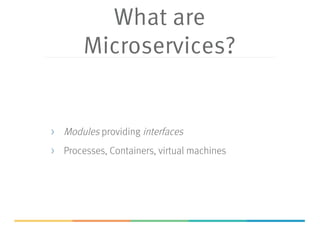
What are
Microservices?
> Modules providing interfaces
> Processes, Containers, virtual machines
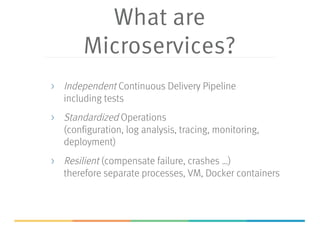
What are
Microservices?
> Independent Continuous Delivery Pipeline
including tests
> Standardized Operations
(configuration, log analysis, tracing, monitoring,
deployment)
> Resilient (compensate failure, crashes …)
therefore separate processes, VM, Docker containers
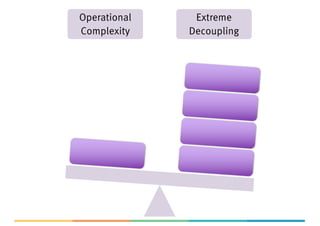
Microservices =
Extreme Decoupling
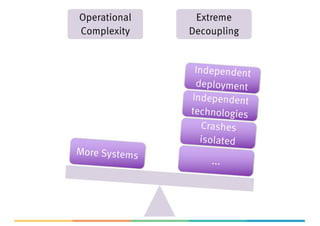
Operational
Complexity
Extreme
Decoupling
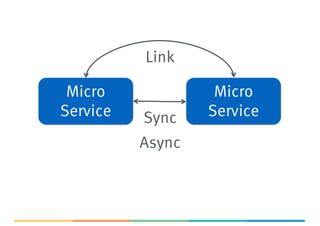
Micro
Service
Micro
Service
Link
Sync
Async
Synchronous REST
Microservices
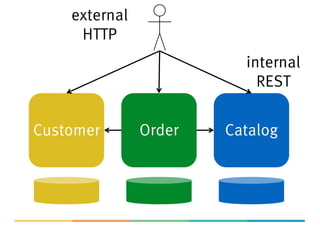
Customer Order Catalog
REST
internal
HTTP
external
Synchronous Microservices
> Service Discovery:
IP / port?
> Load Balancing:
Resilience and independent scaling
> Routing:
Route external request to microservices
> Resilience
Synchronous
Microservices with
Java, Spring Boot /
Cloud & the Netflix
Stack
https://github.com/
ewolff/microservice
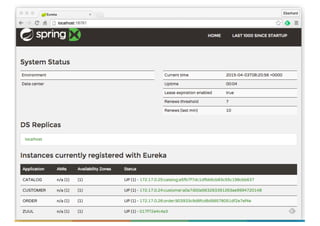
Service Discovery
Eureka
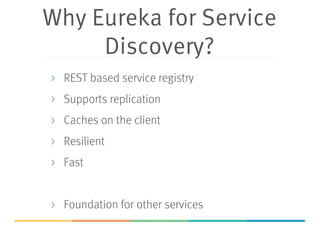
Why Eureka for Service
Discovery?
> REST based service registry
> Supports replication
> Caches on the client
> Resilient
> Fast
> Foundation for other services
Eureka Client
> @EnableDiscoveryClient:
generic
> @EnableEurekaClient:
specific
> Dependency on
spring-cloud-starter-eureka
> Automatically registers application
Eureka Server
@EnableEurekaServer
@EnableAutoConfiguration
public class EurekaApplication {
public static void main(String[] args) {
SpringApplication.run(EurekaApplication.class, args);
}
}
Add dependency to
spring-cloud-starter-eureka-server
Load Balancing
Ribbon
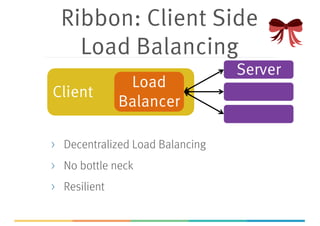
Client
Ribbon: Client Side
Load Balancing
> Decentralized Load Balancing
> No bottle neck
> Resilient
Load
Balancer
Server
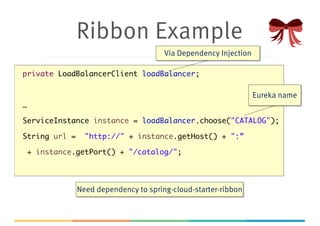
Ribbon Example
private LoadBalancerClient loadBalancer;
…
ServiceInstance instance = loadBalancer.choose("CATALOG");
String url = "http://" + instance.getHost() + ":”
+ instance.getPort() + "/catalog/";
Via Dependency Injection
Eureka name
Need dependency to spring-cloud-starter-ribbon
Resilience
Timeout
> Do call in other thread pool
> Won’t block request handler
> Can implement timeout
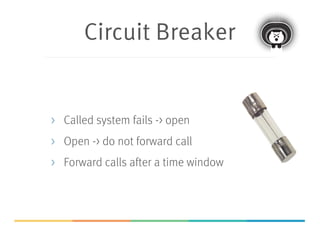
Circuit Breaker
> Called system fails -> open
> Open -> do not forward call
> Forward calls after a time window
Hystrix &
Spring Cloud
> Annotation based approach
> Annotations of javanica libraries
> Simplifies Hystrix
> No commands
@SpringBootApplication
@EnableDiscoveryClient
@EnableCircuitBreaker
public class OrderApp {
public static void main(String[] args) {
SpringApplication.run(OrderApp.class, args);
}
}
Enable Hystrix
Need spring-cloud-starter-hystrix
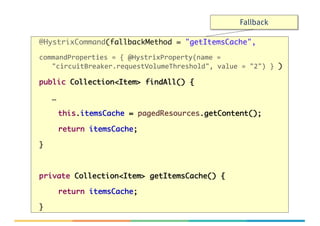
@HystrixCommand(fallbackMethod = "getItemsCache",
commandProperties = { @HystrixProperty(name =
"circuitBreaker.requestVolumeThreshold", value = "2") } )
public Collection<Item> findAll() {
…
this.itemsCache = pagedResources.getContent();
return itemsCache;
}
private Collection<Item> getItemsCache() {
return itemsCache;
}
Fallback
Zuul
Routing
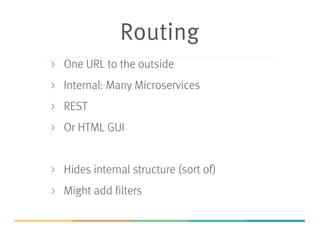
Routing
> One URL to the outside
> Internal: Many Microservices
> REST
> Or HTML GUI
> Hides internal structure (sort of)
> Might add filters
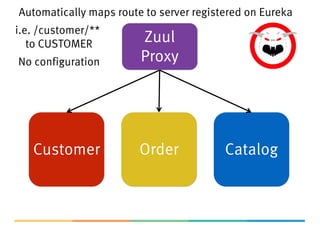
Customer Order Catalog
Zuul
Proxy
Automatically maps route to server registered on Eureka
i.e. /customer/**
to CUSTOMER
No configuration
Netflix Stack
> Service Discovery: Eureka
> Load Balancing: Ribbon
> Routing: Zuul
> Resilience: Hystrix
> Non-Java microservice:
specific clients or sidecar
Consul
> Service Discovery by Hashicorp
> DNS interface
> Platform independent
> Consul Template can fill out config file
templates
> e.g. for load balancer
> …unaware of service discovery
https://github.com/
ewolff/microservice-consul
Kubernetes
https://github.com/
ewolff/microservice-
kubernetes
Kubernetes
> Docker container on a single machine:
Not resilient enough
> Kubernetes: Run Docker container in cluster
> …and much more!
Pods
> Kubernetes runs Pods
> Pods = 1..n Docker containers
> Shared volumes
> …and ports
Replica Sets
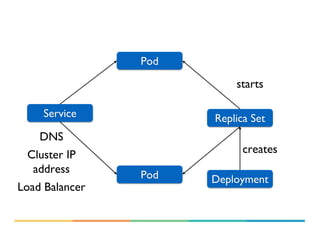
> Deployment creates replica set
> Replica sets ensure that a certain number of
Pods run
> ...for load balancing / fail over
Services
> Services ensure access to the Pods
> DNS entry
> Cluster-wide unique IP address for internal
access
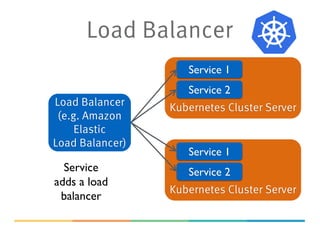
> Node port …
> … or external load balancer for external
access
Replica Set
Pod
Pod
Service
starts
DNS
Cluster IP
address
Load Balancer
Deployment
creates
Load Balancer
Kubernetes Cluster Server
Service 1
Service 2
Kubernetes Cluster Server
Service 1
Service 2Service
adds a load
balancer
Load Balancer
(e.g. Amazon
Elastic
Load Balancer)
Kubernetes
> Service Discovery: DNS
> Load Balancing: IP
> Routing: Load Balancer or Node Port
> Resilience: Hystrix? envoy proxy?
> Can use any language
No code
dependencies on
Kubernetes!
UI Integration
UI Integration
> Very powerful
> Often overlooked
> UI should be part of a microservices
> Self-contained System emphasize UI
> http://scs-architecture.org/
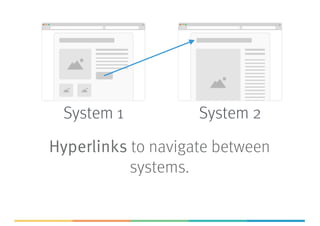
Hyperlinks to navigate between
systems.
System 1 System 2
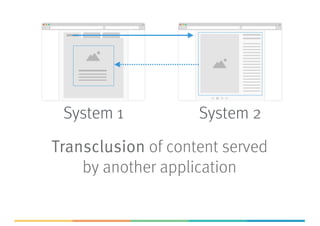
Transclusion of content served
by another application
System 1 System 2
https://www.innoq.com/
en/blog/transclusion/
UI Integration
> Extremely decoupled
> Here is a link: http://ewolff.com
> No need to know anything else about the
system
> What about more complex transclusion?
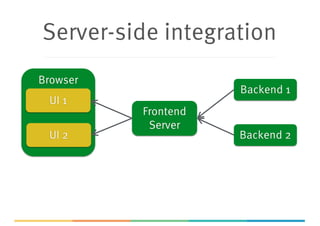
Server-side integration
Browser
UI 1
UI 2
Frontend
Server
Backend 1
Backend 2
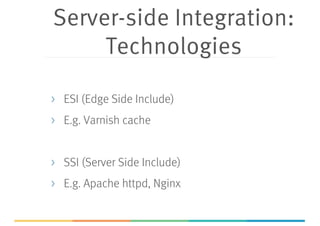
Server-side Integration:
Technologies
> ESI (Edge Side Include)
> E.g. Varnish cache
> SSI (Server Side Include)
> E.g. Apache httpd, Nginx
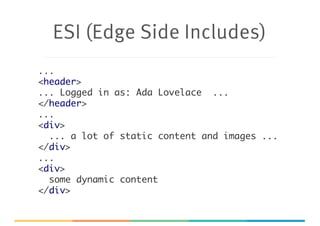
ESI (Edge Side Includes)
...
<header>
... Logged in as: Ada Lovelace ...
</header>
...
<div>
... a lot of static content and images ...
</div>
...
<div>
some dynamic content
</div>
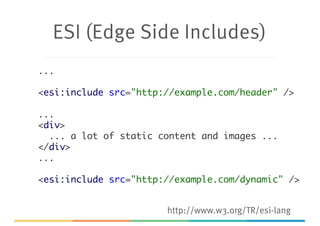
ESI (Edge Side Includes)
...
<esi:include src="http://example.com/header" />
...
<div>
... a lot of static content and images ...
</div>
...
<esi:include src="http://example.com/dynamic" />
http://www.w3.org/TR/esi-lang
https://github.com/
ewolff/SCS-ESI
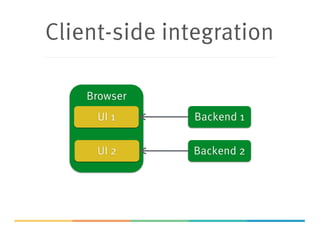
Client-side integration
Browser
UI 1
UI 2
Backend 1
Backend 2
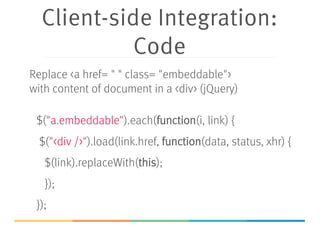
Client-side Integration:
Code
$("a.embeddable").each(function(i, link) {
$("<div />").load(link.href, function(data, status, xhr) {
$(link).replaceWith(this);
});
});
Replace <a href= " " class= "embeddable">
with content of document in a <div> (jQuery)
https://github.com/
ewolff/SCS-jQuery
https://github.com/
ewolff/crimson-
insurance-demo
Asynchronous
Microservices
Asynchronous
> Do not talk to other microservices
> ...and wait for a reply
> …while processing a request.
> Either don‘t wait for a reply
> ...or don‘t communicate while processing a
request.
Asynchronous: Benefits
> Deals with unreliable systems
> Can guarantee delivery
> Good fit for events
> …and Bounded Context / DDD
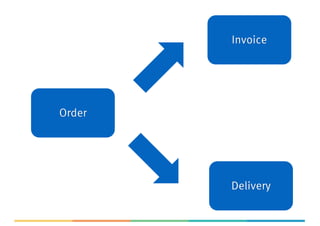
Order
Invoice
Delivery
Kafka
https://github.com/
ewolff/microservice-kafka
Kafka API
> Producer API
> Consumer API
> Streams API (transformation)
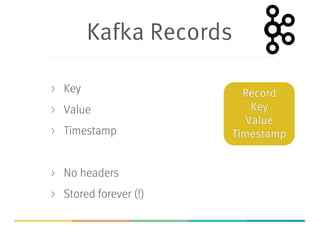
Kafka Records
> Key
> Value
> Timestamp
> No headers
> Stored forever (!)
Record
Key
Value
Timestamp
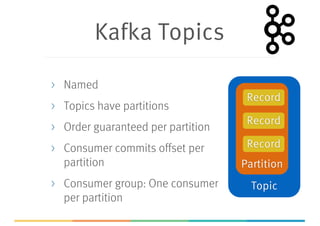
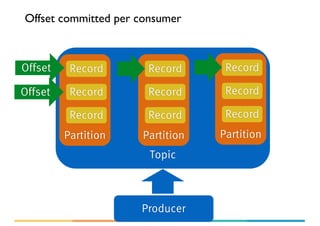
Kafka Topics
> Named
> Topics have partitions
> Order guaranteed per partition
> Consumer commits offset per
partition
> Consumer group: One consumer
per partition
Topic
Partition
Record
Record
Record
Topic
Partition
Record
Record
Record
Producer
Offset
Offset committed per consumer
Offset
Partition
Record
Record
Record
Partition
Record
Record
Record
Log Compaction
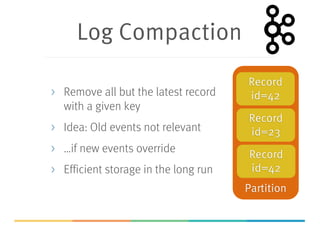
> Remove all but the latest record
with a given key
> Idea: Old events not relevant
> …if new events override
> Efficient storage in the long run
Partition
Record
id=42
Record
id=23
Record
id=42
Kafka Replication
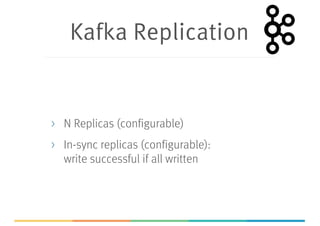
> N Replicas (configurable)
> In-sync replicas (configurable):
write successful if all written
Asynchronous
Microservices
> Service Discovery:
via topic
> Load Balancing:
via partitions / consumer groups
> Routing:
./.
> Resilience
service fails – latency increases
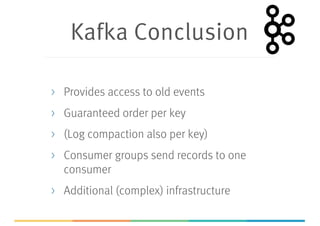
Kafka Conclusion
> Provides access to old events
> Guaranteed order per key
> (Log compaction also per key)
> Consumer groups send records to one
consumer
> Additional (complex) infrastructure
REST & ATOM
https://github.com/
ewolff/microservice-atom
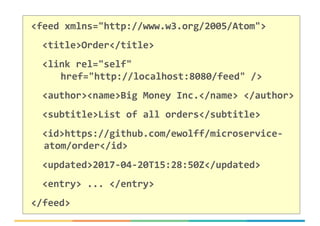
Atom
> Data format
> …for feeds, blogs, podcasts etc
> Access through HTTP
> Idea: Provide a feeds of events / orders
<feed xmlns="http://www.w3.org/2005/Atom">
<title>Order</title>
<link rel="self"
href="http://localhost:8080/feed" />
<author><name>Big Money Inc.</name> </author>
<subtitle>List of all orders</subtitle>
<id>https://github.com/ewolff/microservice-
atom/order</id>
<updated>2017-04-20T15:28:50Z</updated>
<entry> ... </entry>
</feed>
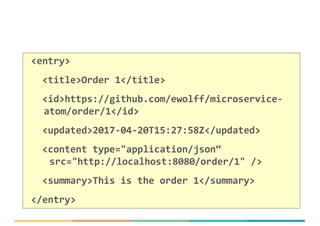
<entry>
<title>Order 1</title>
<id>https://github.com/ewolff/microservice-
atom/order/1</id>
<updated>2017-04-20T15:27:58Z</updated>
<content type="application/json“
src="http://localhost:8080/order/1" />
<summary>This is the order 1</summary>
</entry>
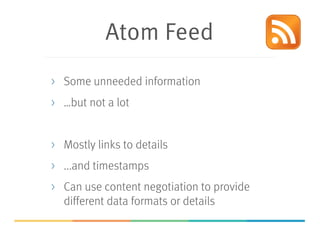
Atom Feed
> Some unneeded information
> …but not a lot
> Mostly links to details
> ...and timestamps
> Can use content negotiation to provide
different data formats or details
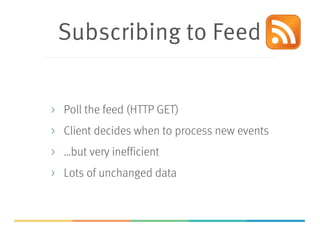
Subscribing to Feed
> Poll the feed (HTTP GET)
> Client decides when to process new events
> …but very inefficient
> Lots of unchanged data
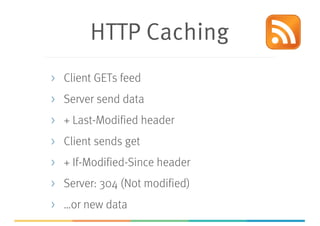
HTTP Caching
> Client GETs feed
> Server send data
> + Last-Modified header
> Client sends get
> + If-Modified-Since header
> Server: 304 (Not modified)
> …or new data
REST can be
asynchronous.
Atom
> Service Discovery:
REST
> Load Balancing:
REST
> Routing:
./.
> Resilience
failures just increase latency
Atom Conclusion
> Can provides access to old events if they
are stored anyway.
> One consumer: idempotency
> No additional infrastructure
Conclusion
Operational
Complexity
Extreme
Decoupling
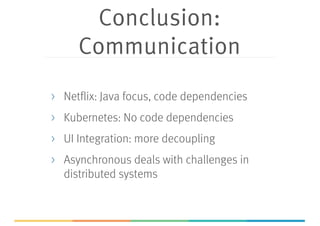
Conclusion:
Communication
> Netflix: Java focus, code dependencies
> Kubernetes: No code dependencies
> UI Integration: more decoupling
> Asynchronous deals with challenges in
distributed systems
Links
> List of microservices demos (sync, async, UI):
http://ewolff.com/microservices-demos.html
> REST vs. Messaging for Microservices
https://www.slideshare.net/ewolff/rest-vs-
messaging-for-microservices
EMail bedcon2017@ewolff.com to get:
Slides
+ Microservices Primer
+ Sample Microservices Book
+ Sample of Continuous Delivery Book
Powered by Amazon Lambda & Microservices

Four Times Microservices - REST, Kubernetes, UI Integration, Async