Quality Assurance /
Software Testing Training
Page 2Classification: Restricted
Agenda
• Introduction to Test Automation Framework
• What a Test Automation Framework is?
• Utility of Test Automation Framework
• Sample Automation Test Framework
• Types of Automation Frameworks
• Data Driven Automation Framework
• Keyword Driven Automation Framework
• Hybrid Automation Framework
• Benefits of Automation Framework Approach
Page 3Classification: Restricted
Introduction to Test Automation Framework
• What an Automation Framework is ?
• How many types of Automation Framework are there ?
• How to select & Deploy an Automation Framework ?
• What are the Constituents of Automation Framework ?
Page 4Classification: Restricted
What a Test Automation Framework is?
It is a structured combination of :
• Various Assumptions for Testing
• Testing Concepts
• Testing Practices
Aim is to provide support to Automated Software Testing
Page 5Classification: Restricted
Utility of Test Automation Framework
• Provides an Outline of overall Test Structure
• Ensures Consistency of Testing
• Minimizes the Amount of Code for Development – thereby
Less Maintenance
• Maximizes Reusability
• Reduces Exposure of Non-Technical Testers to Code
• Enables Test Automation using Data
Page 6Classification: Restricted
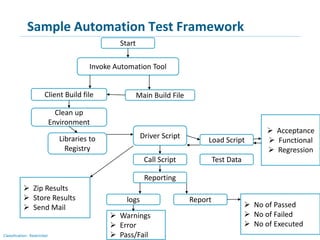
Start
Libraries to
Registry
Driver Script
Client Build file
Clean up
Environment
Main Build File
Invoke Automation Tool
Sample Automation Test Framework
Load Script
 Acceptance
 Functional
 Regression
Call Script Test Data
Reporting
Reportlogs
 Zip Results
 Store Results
 Send Mail
 Warnings
 Error
 Pass/Fail
 No of Passed
 No of Failed
 No of Executed
Page 7Classification: Restricted
Types of Automation Frameworks
• Data Driven Automation Framework
• Keyword Driven Automation Framework
• Hybrid Automation Framework
Page 8Classification: Restricted
Data Driven Automation Framework
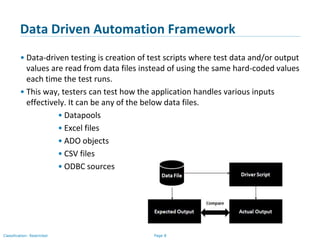
• Data-driven testing is creation of test scripts where test data and/or output
values are read from data files instead of using the same hard-coded values
each time the test runs.
• This way, testers can test how the application handles various inputs
effectively. It can be any of the below data files.
• Datapools
• Excel files
• ADO objects
• CSV files
• ODBC sources
Page 9Classification: Restricted
Data Driven Automation Framework
Advantages:
• Repeated use of Test Scripts with Different Inputs and Response Data
coming out of Predefined Dataset
• Easy to implement in IBM - RFT with the help of Datapools
• Helps in Reducing Coding for Large Test Cases
• Ease of Testing of Time-Consuming & Complex Test Cases
Page 10Classification: Restricted
Keyword Driven Automation Framework
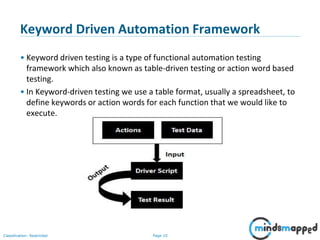
• Keyword driven testing is a type of functional automation testing
framework which also known as table-driven testing or action word based
testing.
• In Keyword-driven testing we use a table format, usually a spreadsheet, to
define keywords or action words for each function that we would like to
execute.
Page 11Classification: Restricted
Keyword Driven Automation Framework
• As the Name suggests, it enables Keyword Driven Testing or Table Driven
Testing
• Data & Keyword Tables being Independent of the Automation Tool
• Enables Documentation of the Functionality of the Application under Test
(AUT) in A Tabular Format
Page 12Classification: Restricted
Example
Consider that you have to automate a flow where you would need to do the
following things in GMail.
• 1) Login to GMail.
• 2) Count the number of unread emails in Inbox.
• 3) Logout from GMail.
If you look at the above test case you will be able to easily identify that you
would need to write 3 different functions for the above test case. These 3
functions will be used to – Login to Gmail, count unread emails and logout.
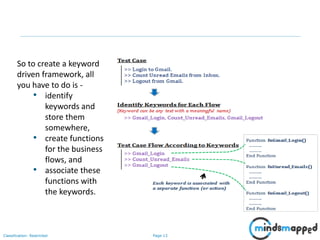
Once you have identified the functions, the next step is to identify some
keywords and then associate the functions with these keywords. Below
figure shows a pictorial representation of this concept.
Page 13Classification: Restricted
So to create a keyword
driven framework, all
you have to do is -
• identify
keywords and
store them
somewhere,
• create functions
for the business
flows, and
• associate these
functions with
the keywords.
Page 14Classification: Restricted
Hybrid Automation Framework
The combination of any two or more frameworks that we have discussed
so far is a hybrid framework.
• It is the Most Popularly Implemented Framework
• It is a Combination of more than one Types of Frameworks described
before
• It has an Ability of Evolving Itself Over a Passage of Time and Over
Many Projects
Page 15Classification: Restricted
Steps 1: Identification of the Scope of Testing:
Company Oriented, Product Oriented, Project Oriented
Step 2 : Identification of the Needs of Testing:
Identify Types of testing e.g. FT, Web Services etc. and application / modules
to be tested
Steps 3: Identification of the Requirements of Testing:
Find out the Nature of Requirements, Identification of type of actions for
each requirement & identification of High Priority Requirements
Step 4 : Evaluation of the Test Automation Tool:
Preparation of Evaluation Checklist, Identification of the Candidate Tools
Available, Sample Run, Rate & Select the Tool, Implementation & Training
Steps to Implement Automation Framework Approach
Page 16Classification: Restricted
Steps 5 : Identification of the Actions to be automated
Actions, Validations & Requirements supported by the Tool
Steps 6 : Design of the Test Automation Framework
Framework Guidelines, Validations, Actions Involved, Systems Involved, Tool
Extensibility Support, Customs Messages & UML Documentation
Steps 7: Design of the Input Data Bank
Identification of Types of Input file, Categorization & Design of File Prototypes
Steps 8: Development of the Automation Framework
Development of Script based upon Framework Design, Driver Scripts, Worker
Scripts, Record / Playback, Screen / Window / Transaction, Action / Keyword &
Data Driven
Steps 9 : Population of Input Data Bank
Different Types of Data Input, Population of Data from Different Data Sources,
Manual Input of Data and Parent – Child Data Hierarchy
Steps 10 : Configuration of the Schedulers
Identify Scheduler Requirements & Configure the Schedulers
Page 17Classification: Restricted
Benefits of Automation Framework Approach
• Significant Reduction in Testing Cycle Time
• Comprehensive Coverage against Requirements
• Use of a "Common Standard" across the Organization / Product Team /
Project Team Generation of Reusable Test Scripts ( Utility Functions)
• Systematic Maintenance of Automation Scripts
• Data Pooling
Page 18Classification: Restricted
Thank You

Automation Test Framework

  • 1.
  • 2.
    Page 2Classification: Restricted Agenda •Introduction to Test Automation Framework • What a Test Automation Framework is? • Utility of Test Automation Framework • Sample Automation Test Framework • Types of Automation Frameworks • Data Driven Automation Framework • Keyword Driven Automation Framework • Hybrid Automation Framework • Benefits of Automation Framework Approach
  • 3.
    Page 3Classification: Restricted Introductionto Test Automation Framework • What an Automation Framework is ? • How many types of Automation Framework are there ? • How to select & Deploy an Automation Framework ? • What are the Constituents of Automation Framework ?
  • 4.
    Page 4Classification: Restricted Whata Test Automation Framework is? It is a structured combination of : • Various Assumptions for Testing • Testing Concepts • Testing Practices Aim is to provide support to Automated Software Testing
  • 5.
    Page 5Classification: Restricted Utilityof Test Automation Framework • Provides an Outline of overall Test Structure • Ensures Consistency of Testing • Minimizes the Amount of Code for Development – thereby Less Maintenance • Maximizes Reusability • Reduces Exposure of Non-Technical Testers to Code • Enables Test Automation using Data
  • 6.
    Page 6Classification: Restricted Start Librariesto Registry Driver Script Client Build file Clean up Environment Main Build File Invoke Automation Tool Sample Automation Test Framework Load Script  Acceptance  Functional  Regression Call Script Test Data Reporting Reportlogs  Zip Results  Store Results  Send Mail  Warnings  Error  Pass/Fail  No of Passed  No of Failed  No of Executed
  • 7.
    Page 7Classification: Restricted Typesof Automation Frameworks • Data Driven Automation Framework • Keyword Driven Automation Framework • Hybrid Automation Framework
  • 8.
    Page 8Classification: Restricted DataDriven Automation Framework • Data-driven testing is creation of test scripts where test data and/or output values are read from data files instead of using the same hard-coded values each time the test runs. • This way, testers can test how the application handles various inputs effectively. It can be any of the below data files. • Datapools • Excel files • ADO objects • CSV files • ODBC sources
  • 9.
    Page 9Classification: Restricted DataDriven Automation Framework Advantages: • Repeated use of Test Scripts with Different Inputs and Response Data coming out of Predefined Dataset • Easy to implement in IBM - RFT with the help of Datapools • Helps in Reducing Coding for Large Test Cases • Ease of Testing of Time-Consuming & Complex Test Cases
  • 10.
    Page 10Classification: Restricted KeywordDriven Automation Framework • Keyword driven testing is a type of functional automation testing framework which also known as table-driven testing or action word based testing. • In Keyword-driven testing we use a table format, usually a spreadsheet, to define keywords or action words for each function that we would like to execute.
  • 11.
    Page 11Classification: Restricted KeywordDriven Automation Framework • As the Name suggests, it enables Keyword Driven Testing or Table Driven Testing • Data & Keyword Tables being Independent of the Automation Tool • Enables Documentation of the Functionality of the Application under Test (AUT) in A Tabular Format
  • 12.
    Page 12Classification: Restricted Example Considerthat you have to automate a flow where you would need to do the following things in GMail. • 1) Login to GMail. • 2) Count the number of unread emails in Inbox. • 3) Logout from GMail. If you look at the above test case you will be able to easily identify that you would need to write 3 different functions for the above test case. These 3 functions will be used to – Login to Gmail, count unread emails and logout. Once you have identified the functions, the next step is to identify some keywords and then associate the functions with these keywords. Below figure shows a pictorial representation of this concept.
  • 13.
    Page 13Classification: Restricted Soto create a keyword driven framework, all you have to do is - • identify keywords and store them somewhere, • create functions for the business flows, and • associate these functions with the keywords.
  • 14.
    Page 14Classification: Restricted HybridAutomation Framework The combination of any two or more frameworks that we have discussed so far is a hybrid framework. • It is the Most Popularly Implemented Framework • It is a Combination of more than one Types of Frameworks described before • It has an Ability of Evolving Itself Over a Passage of Time and Over Many Projects
  • 15.
    Page 15Classification: Restricted Steps1: Identification of the Scope of Testing: Company Oriented, Product Oriented, Project Oriented Step 2 : Identification of the Needs of Testing: Identify Types of testing e.g. FT, Web Services etc. and application / modules to be tested Steps 3: Identification of the Requirements of Testing: Find out the Nature of Requirements, Identification of type of actions for each requirement & identification of High Priority Requirements Step 4 : Evaluation of the Test Automation Tool: Preparation of Evaluation Checklist, Identification of the Candidate Tools Available, Sample Run, Rate & Select the Tool, Implementation & Training Steps to Implement Automation Framework Approach
  • 16.
    Page 16Classification: Restricted Steps5 : Identification of the Actions to be automated Actions, Validations & Requirements supported by the Tool Steps 6 : Design of the Test Automation Framework Framework Guidelines, Validations, Actions Involved, Systems Involved, Tool Extensibility Support, Customs Messages & UML Documentation Steps 7: Design of the Input Data Bank Identification of Types of Input file, Categorization & Design of File Prototypes Steps 8: Development of the Automation Framework Development of Script based upon Framework Design, Driver Scripts, Worker Scripts, Record / Playback, Screen / Window / Transaction, Action / Keyword & Data Driven Steps 9 : Population of Input Data Bank Different Types of Data Input, Population of Data from Different Data Sources, Manual Input of Data and Parent – Child Data Hierarchy Steps 10 : Configuration of the Schedulers Identify Scheduler Requirements & Configure the Schedulers
  • 17.
    Page 17Classification: Restricted Benefitsof Automation Framework Approach • Significant Reduction in Testing Cycle Time • Comprehensive Coverage against Requirements • Use of a "Common Standard" across the Organization / Product Team / Project Team Generation of Reusable Test Scripts ( Utility Functions) • Systematic Maintenance of Automation Scripts • Data Pooling
  • 18.