Travel Risk
& Health
and Safety
Workshop belonging to
the “Influence” section
•7/10/2013

•1
Agenda
1.

Trends in Travel Risks: traditional vs. new risks. Trends in political
violence. Travel Risk Mapping
Isabelle Bousquet – Carlson Wagonlit
Emmanuel Legeron - Europe Assistance
Dr Arnaud Derossi - International SOS

2.

The view of a TMC: Resposibilities of the employers. What to do.
The role of the TMC
Isabelle Bousquet – Carlson Wagonlit

3.

The answer of the Assistance Companies: How the assistance
companies are reacting to the new trends in travel risk? What
added value can they provide to the multinational companies in
managing the risks of the travel risk and the compliance issues?
Dr Arnaud Derossi - International SOS
Emmanuel Legeron - Europe Assistance

7/10/2013

2
1

Trends in Travel Risks:

Traditional vs. New risks
Trends in political violence
Travel Risk Mapping

Isabelle Bousquet
Emmanuel Legeron
Dr Arnaud Derossi

10/7/2013

3
1

Trends in Travel Risks

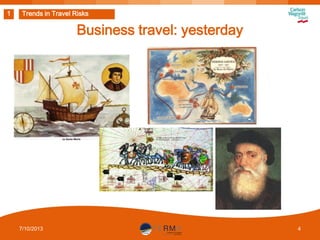
Business travel: yesterday

7/10/2013

4
1

Trends in Travel Risks

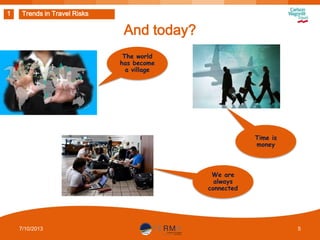
And today?
The world
has become
a village

Time is
money

We are
always
connected

7/10/2013

5
1

Trends in Travel Risks

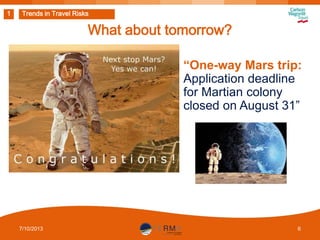
What about tomorrow?
“One-way Mars trip:
Application deadline
for Martian colony
closed on August 31”

7/10/2013

6
1

Trends in Travel Risks

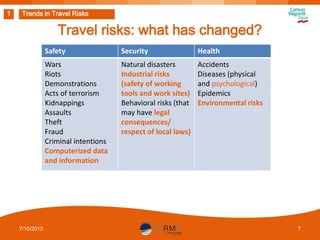
Travel risks: what has changed?
Safety

Health

Wars
Riots
Demonstrations
Acts of terrorism
Kidnappings
Assaults
Theft
Fraud
Criminal intentions
Computerized data
and information

7/10/2013

Security
Natural disasters
Industrial risks
(safety of working
tools and work sites)
Behavioral risks (that
may have legal
consequences/
respect of local laws)

Accidents
Diseases (physical
and psychological)
Epidemics
Environmental risks

7
1

Trends in Travel Risks

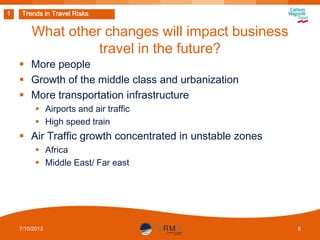
What other changes will impact business
travel in the future?
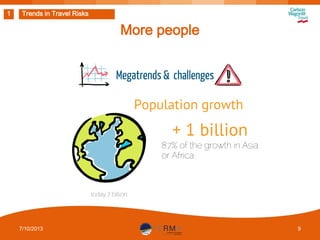
 More people
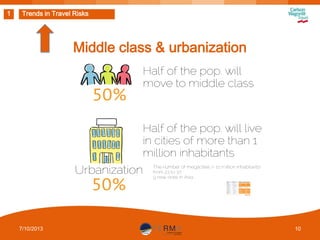
 Growth of the middle class and urbanization
 More transportation infrastructure
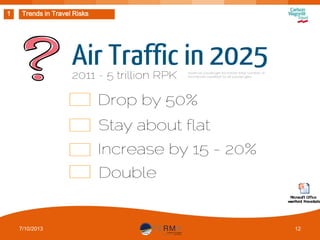
 Airports and air traffic
 High speed train

 Air Traffic growth concentrated in unstable zones
 Africa
 Middle East/ Far east

7/10/2013

8
1

Trends in Travel Risks

More people

7/10/2013

9
1

Trends in Travel Risks

Middle class & urbanization

7/10/2013

10
1

Trends in Travel Risks

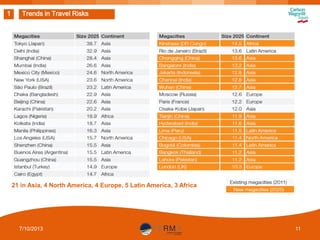
21 in Asia, 4 North America, 4 Europe, 5 Latin America, 3 Africa

7/10/2013

11
1

Trends in Travel Risks

7/10/2013

12
1

Trends in Travel Risks

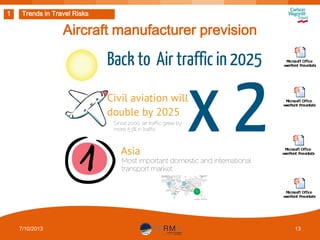
Aircraft manufacturer prevision

7/10/2013

13
1

Trends in Travel Risks

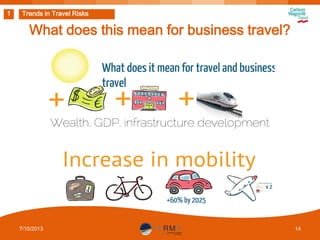
What does this mean for business travel?

7/10/2013

14
1

Trends in Travel Risks

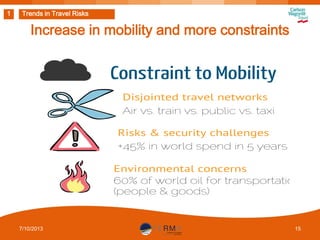
Increase in mobility and more constraints

7/10/2013

15
1

Trends in Travel Risks

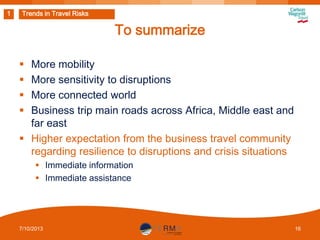
To summarize
More mobility
More sensitivity to disruptions
More connected world
Business trip main roads across Africa, Middle east and
far east
 Higher expectation from the business travel community
regarding resilience to disruptions and crisis situations





 Immediate information
 Immediate assistance

7/10/2013

16
1

Trends in Travel Risks

Traditional vs. New risks

Trends in political violence
Travel Risk Mapping

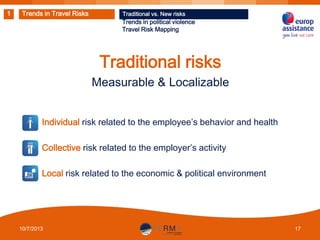
Traditional risks
Measurable & Localizable
Individual risk related to the employee’s behavior and health
Collective risk related to the employer’s activity
Local risk related to the economic & political environment

10/7/2013

17
1

Trends in Travel Risks

Traditional vs. New risks

Trends in political violence
Travel Risk Mapping

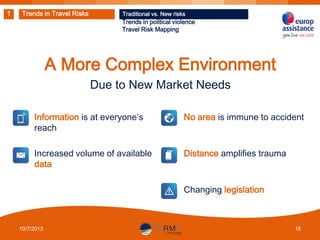
A More Complex Environment
Due to New Market Needs
Information is at everyone’s
reach

No area is immune to accident

Increased volume of available
data

Distance amplifies trauma

Changing legislation

10/7/2013

18
1

Trends in Travel Risks

Traditional vs. New risks

Trends in political violence
Travel Risk Mapping

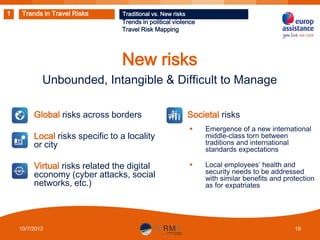
New risks
Unbounded, Intangible & Difficult to Manage
Global risks across borders
Local risks specific to a locality
or city
Virtual risks related the digital
economy (cyber attacks, social
networks, etc.)

10/7/2013

Societal risks


Emergence of a new international
middle-class torn between
traditions and international
standards expectations



Local employees’ health and
security needs to be addressed
with similar benefits and protection
as for expatriates

19
1

Trends in Travel Risks

Traditional vs. New risks
Trends in political violence

Travel Risk Mapping

10/7/2013

20
1

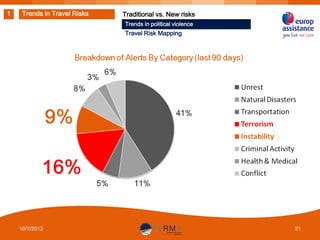
Trends in Travel Risks

Traditional vs. New risks
Trends in political violence

Travel Risk Mapping

10/7/2013

21
1

Trends in Travel Risks

Traditional vs. New risks
Trends in political violence
Travel Risk Mapping

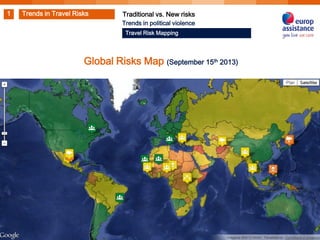
Global Risks Map (September 15th 2013)

10/7/2013

22
1

Trends in Travel Risks

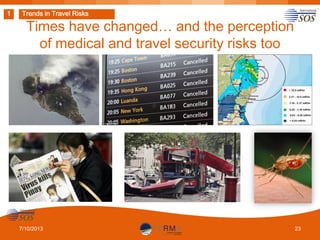
Times have changed… and the perception
of medical and travel security risks too

7/10/2013

23
1

Trends in Travel Risks

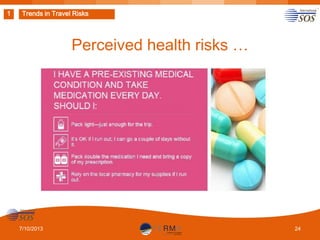
Perceived health risks …

7/10/2013

24
1

Trends in Travel Risks

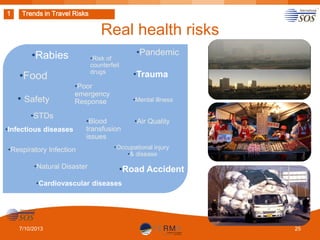
Real health risks
•Rabies

•Risk of
counterfeit
drugs

•Food
• Safety

•Poor
emergency
Response

•STDs
•Infectious diseases

•Natural Disaster

•Trauma
•Mental illness

•Blood
transfusion
issues

•Respiratory Infection

•Pandemic

•Air Quality

•Occupational injury
•& disease

•Road Accident

•Cardiovascular diseases

7/10/2013

25
1

Trends in Travel Risks

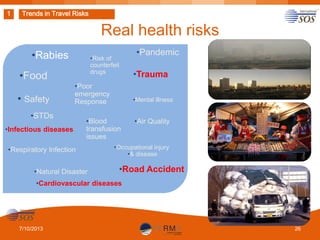
Real health risks
•Rabies

•Risk of
counterfeit
drugs

•Food
• Safety

•Poor
emergency
Response

•STDs
•Infectious diseases

•Natural Disaster

•Trauma
•Mental illness

•Blood
transfusion
issues

•Respiratory Infection

•Pandemic

•Air Quality

•Occupational injury
•& disease

•Road Accident

•Cardiovascular diseases

7/10/2013

26
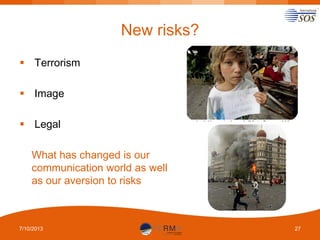
New risks?
 Terrorism
 Image
 Legal
What has changed is our
communication world as well
as our aversion to risks

7/10/2013

27
2

The view of a TMC

Responsibilities of the Employer
The role of the TMC
What to do

Isabelle Bousquet

10/7/2013

28
2

The view of a TMC

Responsibilities of the employers

What to do
The role of the TMC

What are the responsibilities
of the employers regarding travel risks
 Legal obligation
 Type of population concerned

7/10/2013

29
2

The view of a TMC

Responsibilities of the employers

Legal obligations
 Duty of care
 Duty of disclose
 Standard of care

 Company need to be aware of legislation applicable in all
countries of its network

7/10/2013

30
2

The view of a TMC

Responsibilities of the employers

Types of populations concerned
Business travelers
Short term mission
Expatriates and seconded workers
Family and friends
Third country Nationals (expatriates from a third country
in a third country)
 Local staff
 Subcontractors
 Client and providers when on company premises






7/10/2013

31
2

The view of a TMC

Responsibilities of the employers
What to do

The role of the TMC

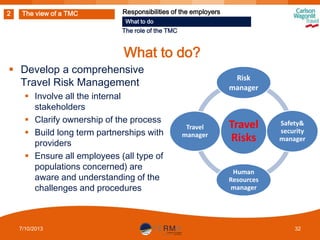
What to do?
 Develop a comprehensive
Travel Risk Management
 Involve all the internal
stakeholders
 Clarify ownership of the process
 Build long term partnerships with
providers
 Ensure all employees (all type of
populations concerned) are
aware and understanding of the
challenges and procedures

7/10/2013

Risk
manager

Travel
manager

Travel
Risks

Safety&
security
manager

Human
Resources
manager

32
2

The view of a TMC

What to do

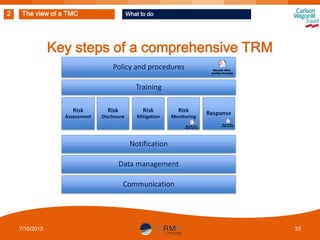
Key steps of a comprehensive TRM
Policy and procedures
Training
Risk

Risk

Risk

Risk

Assessment

Disclosure

Mitigation

Monitoring

Response

Notification
Data management
Communication

7/10/2013

33
2

The view of a TMC

What to do

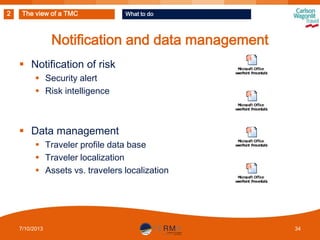
Notification and data management
 Notification of risk
 Security alert
 Risk intelligence

 Data management
 Traveler profile data base
 Traveler localization
 Assets vs. travelers localization

7/10/2013

34
2

The view of a TMC

What to do

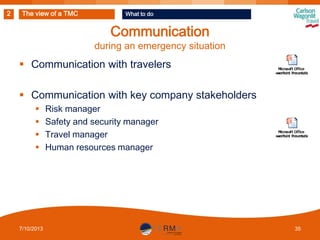
Communication

during an emergency situation

 Communication with travelers
 Communication with key company stakeholders





7/10/2013

Risk manager
Safety and security manager
Travel manager
Human resources manager

35
2

The view of a TMC

What to do

Crisis management
 All types of disruptions or threats may impact travelers:
 Operational disruption (strikes, airport , Air traffic control, airlines
disruption)
 Industrial catastrophy (nuclear plant, chemical accident)
 Climate major events (fog, snow, ice, storm, hurricane, heavy rains,…)
 Natural catastrophy (earthquake, tsunami, flooding,..)
 Geopolitical crisis (riots, civil war, terrorist attack,…)
 Health threats

 The response level shall adapt to the severity of the incident
and the scope of impact on travelers
 Level 1:Individual or small group of travelers impacted with no threat to
human life
 Level 2: Major collective impact on travelers with threat to human life
requiring immediate evacuation and/or repatriation

36
2

The view of a TMC

What to do

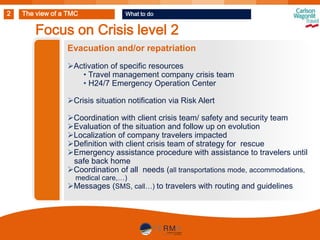
Focus on Crisis level 2
Evacuation and/or repatriation
Activation of specific resources
• Travel management company crisis team
• H24/7 Emergency Operation Center
Crisis situation notification via Risk Alert
Coordination with client crisis team/ safety and security team
Evaluation of the situation and follow up on evolution
Localization of company travelers impacted
Definition with client crisis team of strategy for rescue
Emergency assistance procedure with assistance to travelers until
safe back home
Coordination of all needs (all transportations mode, accommodations,
medical care,…)
Messages (SMS, call…) to travelers with routing and guidelines
2

The view of a TMC

Responsibilities of the employers
What to do
The role of the TMC

The role of the Travel Management Company
 A partner at each step of the travel risk management
process of the company
 to ensure safety and security of the travelers
 to ensure best in class management of travel expenses
 to manage travels and travelers data

 A partner for all stakeholders involved
 to provide end to end solutions with needed expertise

 A support for the travelers
 Before their trip
 During their trip when facing disruption
 During their trip when facing crisis/emergency situation

7/10/2013

38
2

The view of a TMC

The role of the TMC

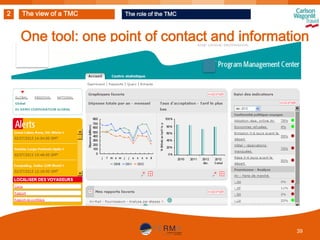
One tool: one point of contact and information

39
3

The answer of the Assistance Companies:

How the assistance companies are reacting to the new trends in travel risk?
What added value can they provide to the multinational companies in
managing the risks of the travel risk and the compliance issues?

Dr Arnaud Derossi
Emmanuel Legeron

10/7/2013

40
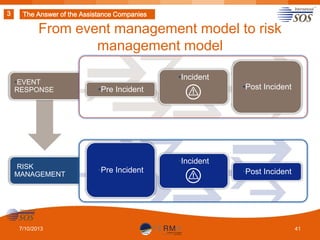
3

The Answer of the Assistance Companies

From event management model to risk
management model
•EVENT
RESPONSE

•RISK
MANAGEMENT

7/10/2013

•Incident

•Post Incident

•Pre Incident

•Pre Incident

•Incident
•Post Incident

41
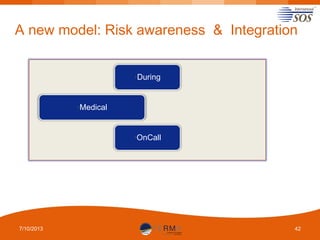
A new model: Risk awareness & Integration
•During

•Medical

•OnCall

7/10/2013

42
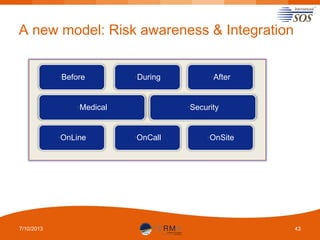
A new model: Risk awareness & Integration
•Before

•During

•Medical

•OnLine

7/10/2013

•After

•Security

•OnCall

•OnSite

43
3

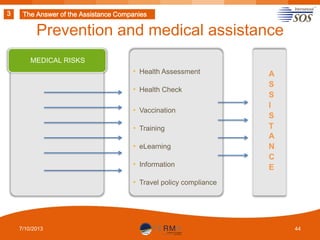
The Answer of the Assistance Companies

Prevention and medical assistance
MEDICAL RISKS

• Health Assessment
• Health Check
• Vaccination
• Training
• eLearning

• Information

A
S
S
I
S
T
A
N
C
E

• Travel policy compliance

7/10/2013

44
3

The Answer of the Assistance Companies

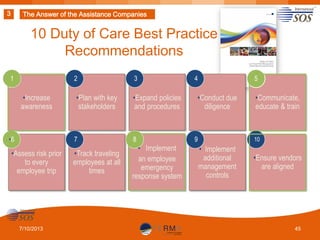
10 Duty of Care Best Practice
Recommendations
•1
1

•2

•Increase
awareness

•6

•Plan with key
stakeholders

•3

•Expand policies
and procedures

•7

•Assess risk prior
to every
employee trip

7/10/2013

•8
8

•Track traveling
employees at all
times

• Implement
an employee
emergency
response system

•4

•5
5

•Conduct due
diligence

•9

•Communicate,
educate & train

•1
0

•10

• Implement
additional
management
controls

•Ensure vendors
are aligned

45
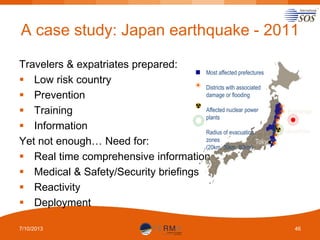
A case study: Japan earthquake - 2011
Travelers & expatriates prepared:
Most affected prefectures
 Low risk country
Districts with associated
damage or flooding
 Prevention
Affected nuclear power
 Training
plants
 Information
Radius of evacuation
zones
Tokyo
Yet not enough… Need for:
(20km, 30km, 80km)
 Real time comprehensive information
 Medical & Safety/Security briefings
 Reactivity
 Deployment
7/10/2013

Epicenter
Fukushima

46
Key facts







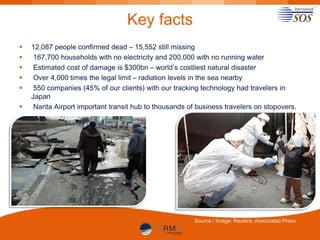
12,087 people confirmed dead – 15,552 still missing
167,700 households with no electricity and 200,000 with no running water
Estimated cost of damage is $300bn – world’s costliest natural disaster
Over 4,000 times the legal limit – radiation levels in the sea nearby
550 companies (45% of our clients) with our tracking technology had travelers in
Japan
Narita Airport important transit hub to thousands of business travelers on stopovers.

Source / Image: Reuters, Associated Press
Organizations’ greatest challenge
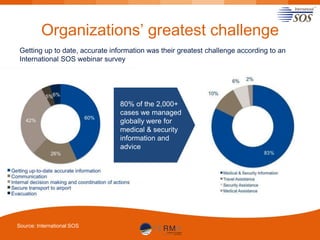
Getting up to date, accurate information was their greatest challenge according to an
International SOS webinar survey

80% of the 2,000+
cases we managed
globally were for
medical & security
information and
advice

Source: International SOS
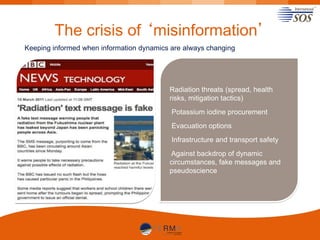
The crisis of ‘misinformation’
Keeping informed when information dynamics are always changing

Radiation threats (spread, health
risks, mitigation tactics)
Potassium iodine procurement

Evacuation options
Infrastructure and transport safety
Against backdrop of dynamic
circumstances, fake messages and
pseudoscience
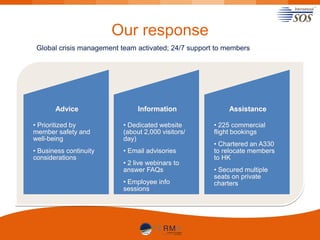
Our response
Global crisis management team activated; 24/7 support to members

Advice

Information

• Prioritized by
member safety and
well-being

• Dedicated website
(about 2,000 visitors/
day)

• Business continuity
considerations

• Email advisories
• 2 live webinars to
answer FAQs

• Employee info
sessions

Assistance
• 225 commercial
flight bookings
• Chartered an A330
to relocate members
to HK
• Secured multiple
seats on private
charters
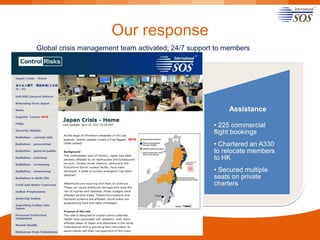
Our response
Global crisis management team activated; 24/7 support to members

Advice

Information

• Prioritized by
member safety and
well-being

• Dedicated website
(about 2,000 visitors/
day)

• Business continuity
considerations

• Email advisories
• 2 live webinars to
answer FAQs

• Employee info
sessions

Assistance
• 225 commercial
flight bookings
• Chartered an A330
to relocate members
to HK
• Secured multiple
seats on private
charters
Lessons learned
Prepare, prepare and prepare some more



Importance of business continuity and crisis
management plans even in low to

moderate risk environments


Plans need to be realistic in relation to the
prevailing threat



Access to trusted sources of information to
make informed decisions



The ability to locate employees quickly and
communicate with them is crucial



The ability to react quickly AND to activate
logistics and deployment teams is critical
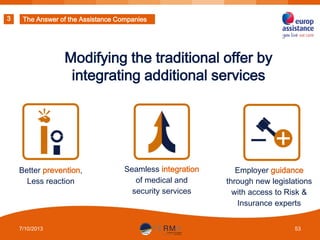
3

The Answer of the Assistance Companies

Modifying the traditional offer by
integrating additional services

Better prevention,
Less reaction

7/10/2013

Seamless integration
of medical and
security services

Employer guidance
through new legislations
with access to Risk &
Insurance experts
53
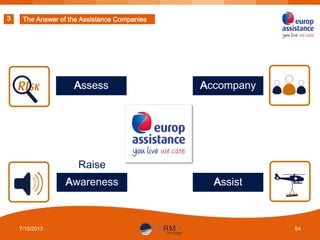
3

The Answer of the Assistance Companies

Assess

Accompany

Raise

Awareness

7/10/2013

Assist

54
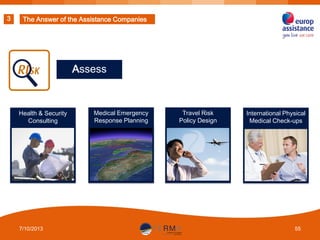
3

The Answer of the Assistance Companies

Assess

Health & Security
Consulting

7/10/2013

Medical Emergency
Response Planning

Travel Risk
Policy Design

International Physical
Medical Check-ups

55
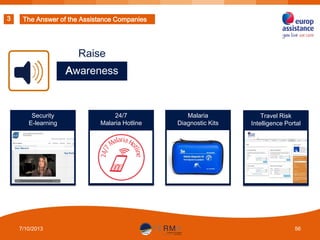
3

The Answer of the Assistance Companies

Raise
Awareness

Security
E-learning

7/10/2013

24/7
Malaria Hotline

Malaria
Diagnostic Kits

Travel Risk
Intelligence Portal

56
3

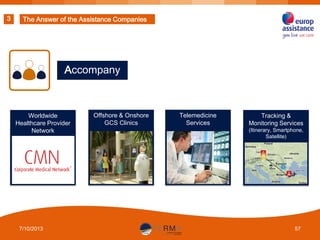
The Answer of the Assistance Companies

Accompany

Worldwide
Healthcare Provider
Network

7/10/2013

Offshore & Onshore
GCS Clinics

Telemedicine
Services

Tracking &
Monitoring Services

(Itinerary, Smartphone,
Satellite)

57
3

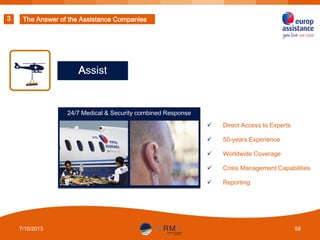
The Answer of the Assistance Companies

Assist

24/7 Medical & Security combined Response



50-years Experience



Worldwide Coverage



Crisis Management Capabilities



7/10/2013

Direct Access to Experts

Reporting

58
Thank You!

7/10/2013

59

FORUM 2013 Travel risks, health and safety

  • 1.
    Travel Risk & Health andSafety Workshop belonging to the “Influence” section •7/10/2013 •1
  • 2.
    Agenda 1. Trends in TravelRisks: traditional vs. new risks. Trends in political violence. Travel Risk Mapping Isabelle Bousquet – Carlson Wagonlit Emmanuel Legeron - Europe Assistance Dr Arnaud Derossi - International SOS 2. The view of a TMC: Resposibilities of the employers. What to do. The role of the TMC Isabelle Bousquet – Carlson Wagonlit 3. The answer of the Assistance Companies: How the assistance companies are reacting to the new trends in travel risk? What added value can they provide to the multinational companies in managing the risks of the travel risk and the compliance issues? Dr Arnaud Derossi - International SOS Emmanuel Legeron - Europe Assistance 7/10/2013 2
  • 3.
    1 Trends in TravelRisks: Traditional vs. New risks Trends in political violence Travel Risk Mapping Isabelle Bousquet Emmanuel Legeron Dr Arnaud Derossi 10/7/2013 3
  • 4.
    1 Trends in TravelRisks Business travel: yesterday 7/10/2013 4
  • 5.
    1 Trends in TravelRisks And today? The world has become a village Time is money We are always connected 7/10/2013 5
  • 6.
    1 Trends in TravelRisks What about tomorrow? “One-way Mars trip: Application deadline for Martian colony closed on August 31” 7/10/2013 6
  • 7.
    1 Trends in TravelRisks Travel risks: what has changed? Safety Health Wars Riots Demonstrations Acts of terrorism Kidnappings Assaults Theft Fraud Criminal intentions Computerized data and information 7/10/2013 Security Natural disasters Industrial risks (safety of working tools and work sites) Behavioral risks (that may have legal consequences/ respect of local laws) Accidents Diseases (physical and psychological) Epidemics Environmental risks 7
  • 8.
    1 Trends in TravelRisks What other changes will impact business travel in the future?  More people  Growth of the middle class and urbanization  More transportation infrastructure  Airports and air traffic  High speed train  Air Traffic growth concentrated in unstable zones  Africa  Middle East/ Far east 7/10/2013 8
  • 9.
    1 Trends in TravelRisks More people 7/10/2013 9
  • 10.
    1 Trends in TravelRisks Middle class & urbanization 7/10/2013 10
  • 11.
    1 Trends in TravelRisks 21 in Asia, 4 North America, 4 Europe, 5 Latin America, 3 Africa 7/10/2013 11
  • 12.
    1 Trends in TravelRisks 7/10/2013 12
  • 13.
    1 Trends in TravelRisks Aircraft manufacturer prevision 7/10/2013 13
  • 14.
    1 Trends in TravelRisks What does this mean for business travel? 7/10/2013 14
  • 15.
    1 Trends in TravelRisks Increase in mobility and more constraints 7/10/2013 15
  • 16.
    1 Trends in TravelRisks To summarize More mobility More sensitivity to disruptions More connected world Business trip main roads across Africa, Middle east and far east  Higher expectation from the business travel community regarding resilience to disruptions and crisis situations      Immediate information  Immediate assistance 7/10/2013 16
  • 17.
    1 Trends in TravelRisks Traditional vs. New risks Trends in political violence Travel Risk Mapping Traditional risks Measurable & Localizable Individual risk related to the employee’s behavior and health Collective risk related to the employer’s activity Local risk related to the economic & political environment 10/7/2013 17
  • 18.
    1 Trends in TravelRisks Traditional vs. New risks Trends in political violence Travel Risk Mapping A More Complex Environment Due to New Market Needs Information is at everyone’s reach No area is immune to accident Increased volume of available data Distance amplifies trauma Changing legislation 10/7/2013 18
  • 19.
    1 Trends in TravelRisks Traditional vs. New risks Trends in political violence Travel Risk Mapping New risks Unbounded, Intangible & Difficult to Manage Global risks across borders Local risks specific to a locality or city Virtual risks related the digital economy (cyber attacks, social networks, etc.) 10/7/2013 Societal risks  Emergence of a new international middle-class torn between traditions and international standards expectations  Local employees’ health and security needs to be addressed with similar benefits and protection as for expatriates 19
  • 20.
    1 Trends in TravelRisks Traditional vs. New risks Trends in political violence Travel Risk Mapping 10/7/2013 20
  • 21.
    1 Trends in TravelRisks Traditional vs. New risks Trends in political violence Travel Risk Mapping 10/7/2013 21
  • 22.
    1 Trends in TravelRisks Traditional vs. New risks Trends in political violence Travel Risk Mapping Global Risks Map (September 15th 2013) 10/7/2013 22
  • 23.
    1 Trends in TravelRisks Times have changed… and the perception of medical and travel security risks too 7/10/2013 23
  • 24.
    1 Trends in TravelRisks Perceived health risks … 7/10/2013 24
  • 25.
    1 Trends in TravelRisks Real health risks •Rabies •Risk of counterfeit drugs •Food • Safety •Poor emergency Response •STDs •Infectious diseases •Natural Disaster •Trauma •Mental illness •Blood transfusion issues •Respiratory Infection •Pandemic •Air Quality •Occupational injury •& disease •Road Accident •Cardiovascular diseases 7/10/2013 25
  • 26.
    1 Trends in TravelRisks Real health risks •Rabies •Risk of counterfeit drugs •Food • Safety •Poor emergency Response •STDs •Infectious diseases •Natural Disaster •Trauma •Mental illness •Blood transfusion issues •Respiratory Infection •Pandemic •Air Quality •Occupational injury •& disease •Road Accident •Cardiovascular diseases 7/10/2013 26
  • 27.
    New risks?  Terrorism Image  Legal What has changed is our communication world as well as our aversion to risks 7/10/2013 27
  • 28.
    2 The view ofa TMC Responsibilities of the Employer The role of the TMC What to do Isabelle Bousquet 10/7/2013 28
  • 29.
    2 The view ofa TMC Responsibilities of the employers What to do The role of the TMC What are the responsibilities of the employers regarding travel risks  Legal obligation  Type of population concerned 7/10/2013 29
  • 30.
    2 The view ofa TMC Responsibilities of the employers Legal obligations  Duty of care  Duty of disclose  Standard of care  Company need to be aware of legislation applicable in all countries of its network 7/10/2013 30
  • 31.
    2 The view ofa TMC Responsibilities of the employers Types of populations concerned Business travelers Short term mission Expatriates and seconded workers Family and friends Third country Nationals (expatriates from a third country in a third country)  Local staff  Subcontractors  Client and providers when on company premises      7/10/2013 31
  • 32.
    2 The view ofa TMC Responsibilities of the employers What to do The role of the TMC What to do?  Develop a comprehensive Travel Risk Management  Involve all the internal stakeholders  Clarify ownership of the process  Build long term partnerships with providers  Ensure all employees (all type of populations concerned) are aware and understanding of the challenges and procedures 7/10/2013 Risk manager Travel manager Travel Risks Safety& security manager Human Resources manager 32
  • 33.
    2 The view ofa TMC What to do Key steps of a comprehensive TRM Policy and procedures Training Risk Risk Risk Risk Assessment Disclosure Mitigation Monitoring Response Notification Data management Communication 7/10/2013 33
  • 34.
    2 The view ofa TMC What to do Notification and data management  Notification of risk  Security alert  Risk intelligence  Data management  Traveler profile data base  Traveler localization  Assets vs. travelers localization 7/10/2013 34
  • 35.
    2 The view ofa TMC What to do Communication during an emergency situation  Communication with travelers  Communication with key company stakeholders     7/10/2013 Risk manager Safety and security manager Travel manager Human resources manager 35
  • 36.
    2 The view ofa TMC What to do Crisis management  All types of disruptions or threats may impact travelers:  Operational disruption (strikes, airport , Air traffic control, airlines disruption)  Industrial catastrophy (nuclear plant, chemical accident)  Climate major events (fog, snow, ice, storm, hurricane, heavy rains,…)  Natural catastrophy (earthquake, tsunami, flooding,..)  Geopolitical crisis (riots, civil war, terrorist attack,…)  Health threats  The response level shall adapt to the severity of the incident and the scope of impact on travelers  Level 1:Individual or small group of travelers impacted with no threat to human life  Level 2: Major collective impact on travelers with threat to human life requiring immediate evacuation and/or repatriation 36
  • 37.
    2 The view ofa TMC What to do Focus on Crisis level 2 Evacuation and/or repatriation Activation of specific resources • Travel management company crisis team • H24/7 Emergency Operation Center Crisis situation notification via Risk Alert Coordination with client crisis team/ safety and security team Evaluation of the situation and follow up on evolution Localization of company travelers impacted Definition with client crisis team of strategy for rescue Emergency assistance procedure with assistance to travelers until safe back home Coordination of all needs (all transportations mode, accommodations, medical care,…) Messages (SMS, call…) to travelers with routing and guidelines
  • 38.
    2 The view ofa TMC Responsibilities of the employers What to do The role of the TMC The role of the Travel Management Company  A partner at each step of the travel risk management process of the company  to ensure safety and security of the travelers  to ensure best in class management of travel expenses  to manage travels and travelers data  A partner for all stakeholders involved  to provide end to end solutions with needed expertise  A support for the travelers  Before their trip  During their trip when facing disruption  During their trip when facing crisis/emergency situation 7/10/2013 38
  • 39.
    2 The view ofa TMC The role of the TMC One tool: one point of contact and information 39
  • 40.
    3 The answer ofthe Assistance Companies: How the assistance companies are reacting to the new trends in travel risk? What added value can they provide to the multinational companies in managing the risks of the travel risk and the compliance issues? Dr Arnaud Derossi Emmanuel Legeron 10/7/2013 40
  • 41.
    3 The Answer ofthe Assistance Companies From event management model to risk management model •EVENT RESPONSE •RISK MANAGEMENT 7/10/2013 •Incident •Post Incident •Pre Incident •Pre Incident •Incident •Post Incident 41
  • 42.
    A new model:Risk awareness & Integration •During •Medical •OnCall 7/10/2013 42
  • 43.
    A new model:Risk awareness & Integration •Before •During •Medical •OnLine 7/10/2013 •After •Security •OnCall •OnSite 43
  • 44.
    3 The Answer ofthe Assistance Companies Prevention and medical assistance MEDICAL RISKS • Health Assessment • Health Check • Vaccination • Training • eLearning • Information A S S I S T A N C E • Travel policy compliance 7/10/2013 44
  • 45.
    3 The Answer ofthe Assistance Companies 10 Duty of Care Best Practice Recommendations •1 1 •2 •Increase awareness •6 •Plan with key stakeholders •3 •Expand policies and procedures •7 •Assess risk prior to every employee trip 7/10/2013 •8 8 •Track traveling employees at all times • Implement an employee emergency response system •4 •5 5 •Conduct due diligence •9 •Communicate, educate & train •1 0 •10 • Implement additional management controls •Ensure vendors are aligned 45
  • 46.
    A case study:Japan earthquake - 2011 Travelers & expatriates prepared: Most affected prefectures  Low risk country Districts with associated damage or flooding  Prevention Affected nuclear power  Training plants  Information Radius of evacuation zones Tokyo Yet not enough… Need for: (20km, 30km, 80km)  Real time comprehensive information  Medical & Safety/Security briefings  Reactivity  Deployment 7/10/2013 Epicenter Fukushima 46
  • 47.
    Key facts       12,087 peopleconfirmed dead – 15,552 still missing 167,700 households with no electricity and 200,000 with no running water Estimated cost of damage is $300bn – world’s costliest natural disaster Over 4,000 times the legal limit – radiation levels in the sea nearby 550 companies (45% of our clients) with our tracking technology had travelers in Japan Narita Airport important transit hub to thousands of business travelers on stopovers. Source / Image: Reuters, Associated Press
  • 48.
    Organizations’ greatest challenge Gettingup to date, accurate information was their greatest challenge according to an International SOS webinar survey 80% of the 2,000+ cases we managed globally were for medical & security information and advice Source: International SOS
  • 49.
    The crisis of‘misinformation’ Keeping informed when information dynamics are always changing Radiation threats (spread, health risks, mitigation tactics) Potassium iodine procurement Evacuation options Infrastructure and transport safety Against backdrop of dynamic circumstances, fake messages and pseudoscience
  • 50.
    Our response Global crisismanagement team activated; 24/7 support to members Advice Information • Prioritized by member safety and well-being • Dedicated website (about 2,000 visitors/ day) • Business continuity considerations • Email advisories • 2 live webinars to answer FAQs • Employee info sessions Assistance • 225 commercial flight bookings • Chartered an A330 to relocate members to HK • Secured multiple seats on private charters
  • 51.
    Our response Global crisismanagement team activated; 24/7 support to members Advice Information • Prioritized by member safety and well-being • Dedicated website (about 2,000 visitors/ day) • Business continuity considerations • Email advisories • 2 live webinars to answer FAQs • Employee info sessions Assistance • 225 commercial flight bookings • Chartered an A330 to relocate members to HK • Secured multiple seats on private charters
  • 52.
    Lessons learned Prepare, prepareand prepare some more  Importance of business continuity and crisis management plans even in low to moderate risk environments  Plans need to be realistic in relation to the prevailing threat  Access to trusted sources of information to make informed decisions  The ability to locate employees quickly and communicate with them is crucial  The ability to react quickly AND to activate logistics and deployment teams is critical
  • 53.
    3 The Answer ofthe Assistance Companies Modifying the traditional offer by integrating additional services Better prevention, Less reaction 7/10/2013 Seamless integration of medical and security services Employer guidance through new legislations with access to Risk & Insurance experts 53
  • 54.
    3 The Answer ofthe Assistance Companies Assess Accompany Raise Awareness 7/10/2013 Assist 54
  • 55.
    3 The Answer ofthe Assistance Companies Assess Health & Security Consulting 7/10/2013 Medical Emergency Response Planning Travel Risk Policy Design International Physical Medical Check-ups 55
  • 56.
    3 The Answer ofthe Assistance Companies Raise Awareness Security E-learning 7/10/2013 24/7 Malaria Hotline Malaria Diagnostic Kits Travel Risk Intelligence Portal 56
  • 57.
    3 The Answer ofthe Assistance Companies Accompany Worldwide Healthcare Provider Network 7/10/2013 Offshore & Onshore GCS Clinics Telemedicine Services Tracking & Monitoring Services (Itinerary, Smartphone, Satellite) 57
  • 58.
    3 The Answer ofthe Assistance Companies Assist 24/7 Medical & Security combined Response   50-years Experience  Worldwide Coverage  Crisis Management Capabilities  7/10/2013 Direct Access to Experts Reporting 58
  • 59.