www.ferma.eu
LIVE WEBINAR – FOLLOW US
@FERMARISK
#FERMAWEBINAR
FERMA Risk Leadership at the heart of Europe
Suscribe to our newsletter: www.ferma.eu
Contact us: enquiries@ferma.eu
www.ferma.eu
WHY RISK MANAGERS SHOULD
LOOK AT ARTIFICIAL INTELLIGENCE
NOW ?
LIVE WEBINAR #7
@FERMARISK
#FERMAWEBINAR
www.ferma.eu
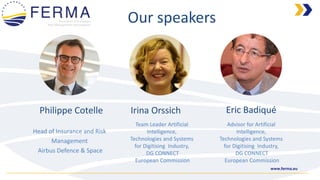
Philippe Cotelle
Head of Insurance and Risk
Management
Airbus Defence & Space
Team Leader Artificial
Intelligence,
Technologies and Systems
for Digitising Industry,
DG CONNECT
European Commission
Irina Orssich
Our speakers
Eric Badiqué
Advisor for Artificial
Intelligence,
Technologies and Systems
for Digitising Industry,
DG CONNECT
European Commission
www.ferma.eu
Structure of the
document
1. LET’S TALK ABOUT
▪ What is AI?
▪ Why is now the time to focus on AI?
▪ Data is Key
2. AI IN RISK MANAGEMENT – IMPACTS OF AI IN THE ERM
FRAMEWORK
▪ Integrating risks generated by AI in the ERM
framework
▪ Scope of AI-related risks
3. BENEFITS AND OPPORTUNITIES FOR RISK MANAGERS
APPLYING AI
▪ General benefits for risk management
▪ AI Action Guide for Risk Managers
▪ Developing an AI Roadmap
www.ferma.eu
Why and how to
implement AI in RM?
An overview about AI, industrial use
cases, the limits and advantages of AI
implementations and the role of data
in AI applications
www.ferma.eu
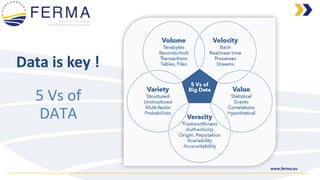
Data is key !
5 Vs of
DATA
www.ferma.eu
www.ferma.eu
Polling question #1
Do you assess AI related risks in your
organisation?
YES / NO /Planning to
www.ferma.eu
Lorem Ipsum is simply dummy text of the printing and
typesetting industry. Lorem Ipsum has been the
industry's standard
Lorem Ipsum is simply dummy text of the printing and
typesetting industry. Lorem Ipsum has been the
industry's standard
TITLE TITLE
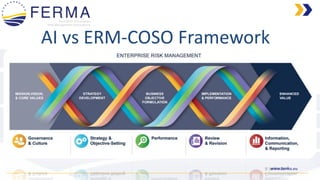
AI vs ERM-COSO Framework
www.ferma.eu
White paper on AI
a European approach to excellence and trust
Irina Orssich
European Commission -
Artificial Intelligence
Technologies and Systems for
Digitising Industry
April 2020
European Commission
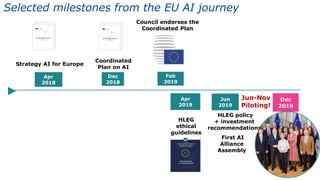
Coordinated
Plan on AI
Dec
2018
Council endorses the
Coordinated Plan
Feb
2019
Apr
2019
HLEG
ethical
guidelines
Selected milestones from the EU AI journey
Jun
2019
HLEG policy
+ investment
recommendations
First AI
Alliance
Assembly
Dec
2019
Jun-Nov
Piloting!
Apr
2018
Strategy AI for Europe
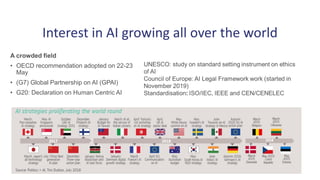
Interest in AI growing all over the world
A crowded field
• OECD recommendation adopted on 22-23
May
• (G7) Global Partnership on AI (GPAI)
• G20: Declaration on Human Centric AI
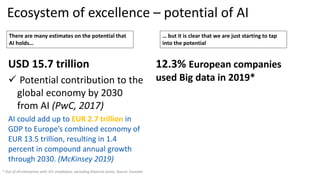
USD 15.7 trillion
✓ Potential contribution to the
global economy by 2030
from AI (PwC, 2017)
AI could add up to EUR 2.7 trillion in
GDP to Europe’s combined economy of
EUR 13.5 trillion, resulting in 1.4
percent in compound annual growth
through 2030. (McKinsey 2019)
12.3% European companies
used Big data in 2019*
Ecosystem of excellence – potential of AI
There are many estimates on the potential that
AI holds…
… but it is clear that we are just starting to tap
into the potential
* Out of all enterprises with 10+ employees, excluding financial sector. Source: Eurostat
Building on EU
strengths
World-leading position in robotics
Strong industrial and services sectors: automotive,healthcare, agrifood
Strong business-to-business domain
Excellent research centres
Industrial data
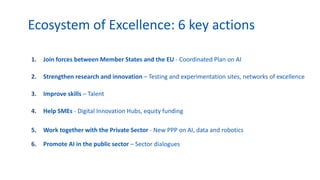
1. Join forces between Member States and the EU - Coordinated Plan on AI
2. Strengthen research and innovation – Testing and experimentation sites, networks of excellence
3. Improve skills – Talent
4. Help SMEs - Digital Innovation Hubs, equity funding
5. Work together with the Private Sector - New PPP on AI, data and robotics
6. Promote AI in the public sector – Sector dialogues
Ecosystem of Excellence: 6 key actions
“The specific characteristics of many AI
technologies, including opacity (‘black box-
effect’), complexity, unpredictability and
partially autonomous behaviour, may make it
hard to verify compliance with, and may
hamper the effective enforcement of, rules of
existing EU law meant to protect fundamental
rights.” (White Paper on AI)
Ecosystem of trust
Lack of trust is a main factor holding back a broader AI uptake.
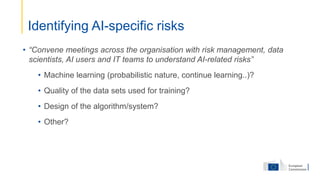
• “Convene meetings across the organisation with risk management, data
scientists, AI users and IT teams to understand AI-related risks”
• Machine learning (probabilistic nature, continue learning..)?
• Quality of the data sets used for training?
• Design of the algorithm/system?
• Other?
Identifying AI-specific risks
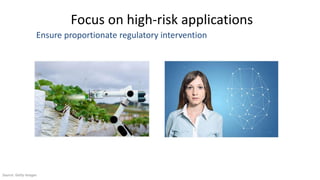
Focus on high-risk applications
Ensure proportionate regulatory intervention
Source: Getty images
• Do we need more than 2 levels of risk?
• How to specify high risk areas?
• How flexible do we need to be?
• What are the most relevant areas for best practice?
• We need your views on how to achieve legal certainty
Calibrating the risk-based approach
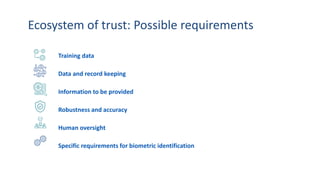
Training data
Data and record keeping
Information to be provided
Robustness and accuracy
Human oversight
Specific requirements for biometric identification
Ecosystem of trust: Possible requirements
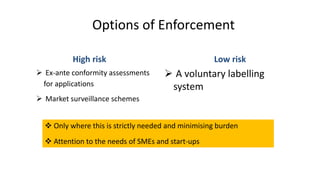
High risk
➢ Ex-ante conformity assessments
for applications
➢ Market surveillance schemes
Low risk
➢ A voluntary labelling
system
Options of Enforcement
❖ Only where this is strictly needed and minimising burden
❖ Attention to the needs of SMEs and start-ups
www.ferma.eu
Polling question #2
Do you believe that the proposed EU plan will
encourage AI development in Europe ?
YES/ NO / DON’T KNOW
www.ferma.eu
Benefits &
Opportunities for Risk
Managers Applying AI
www.ferma.eu
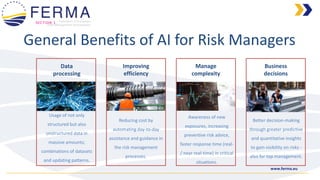
Business
decisions
Manage
complexity
Improving
efficiency
Data
processing
General Benefits of AI for Risk Managers
SECTION 1
Usage of not only
structured but also
unstructured data in
massive amounts;
combinations of datasets
and updating patterns.
Reducing cost by
automating day-to-day
assistance and guidance in
the risk management
processes.
Awareness of new
exposures, increasing
preventive risk advice,
faster response time (real-
/ near real-time) in critical
situations.
Better decision-making
through greater predictive
and quantitative insights
to gain visibility on risks -
also for top management.
www.ferma.eu
Polling question #3
Do you plan to use AI tools to perform your risk
and insurance activities?
YES/ NO
www.ferma.eu
AI & Robotics to respond to COVID Crisis
FERMA webinar
19.5.2020
www.ferma.eu
➢ Key role of tech and strategic autonomy: does crisis strongly reinforce the case
for tech excellence and strengthening strategic autonomy?
➢ Digitization/AI-ization: will the crisis through lockdown and major economic
disruption accelerate the digitization, introduction of AI tools and
transformation of many sectors of activity?
➢ Is this a major opportunity for EU industry to provide new digital solutions and
for all types of organisation to reorganise, greenify their process and become
more efficient? What can we do to accompany/amplify this?
Covid lessons? 1/ Digitization
www.ferma.eu
➢ Privacy aspects: does the need to deploy tracing tools change the way the public
perceives AI in terms of privacy protection? Will that impact the approach to AI
regulation?
➢ Bias and quality of training data set: what have we learned?
➢ Data aspects: what will be the impact of the crisis on the data strategy (G2B,
B2B, B2G, data quality, data governance)?
➢ International cooperation: does the current crisis reinforce the need for
international cooperation around AI and data governance?
➢ Can we expect that the crisis will lead to a higher awareness of privacy-related
issues globally? Or will it go the other way?
Covid lessons? 2/Trust and data
www.ferma.eu
https://ec.europa.eu/digital-single-market/en/news/join-ai-robotics-vs-covid-19-initiative-european-ai-alliance
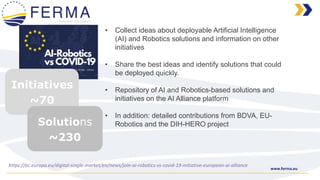
• Collect ideas about deployable Artificial Intelligence
(AI) and Robotics solutions and information on other
initiatives
• Share the best ideas and identify solutions that could
be deployed quickly.
• Repository of AI and Robotics-based solutions and
initiatives on the AI Alliance platform
• In addition: detailed contributions from BDVA, EU-
Robotics and the DIH-HERO project
Initiatives
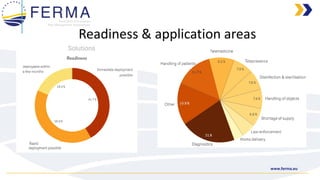
~70
Solutions
~230
www.ferma.eu
Readiness & application areas
www.ferma.eu
• EC as broker between providers and those in need of solutions.
• Procurement actions – Emergency fund
• Special R&I calls and top up calls for solutions that need further development and testing
• Connect solution providers with private investors (pitching events..).
• Leverage Digital Innovation Hubs for supporting deployment of some of these solutions.
• Make use of structural funds earmarked for response to the COVID crisis with Member States.
Options for next steps
www.ferma.eu
Q&A
www.ferma.eu
SUBJECT: KEY FINDINGS OF OUR EUROPEAN RISK MANAGER REPORT 2020
WHEN: JUNE
HOW: email invitation and/or register on www.ferma.eu
THANK YOU & JOIN OUR NEXT WEBINAR
RECORD YOUR 2 CPD POINTS
CONTACT US: enquiries@ferma.eu

Webinar: Why risk managers should look at Artificial Intelligence now?

  • 1.
    www.ferma.eu LIVE WEBINAR –FOLLOW US @FERMARISK #FERMAWEBINAR FERMA Risk Leadership at the heart of Europe Suscribe to our newsletter: www.ferma.eu Contact us: enquiries@ferma.eu
  • 2.
    www.ferma.eu WHY RISK MANAGERSSHOULD LOOK AT ARTIFICIAL INTELLIGENCE NOW ? LIVE WEBINAR #7 @FERMARISK #FERMAWEBINAR
  • 3.
    www.ferma.eu Philippe Cotelle Head ofInsurance and Risk Management Airbus Defence & Space Team Leader Artificial Intelligence, Technologies and Systems for Digitising Industry, DG CONNECT European Commission Irina Orssich Our speakers Eric Badiqué Advisor for Artificial Intelligence, Technologies and Systems for Digitising Industry, DG CONNECT European Commission
  • 4.
    www.ferma.eu Structure of the document 1.LET’S TALK ABOUT ▪ What is AI? ▪ Why is now the time to focus on AI? ▪ Data is Key 2. AI IN RISK MANAGEMENT – IMPACTS OF AI IN THE ERM FRAMEWORK ▪ Integrating risks generated by AI in the ERM framework ▪ Scope of AI-related risks 3. BENEFITS AND OPPORTUNITIES FOR RISK MANAGERS APPLYING AI ▪ General benefits for risk management ▪ AI Action Guide for Risk Managers ▪ Developing an AI Roadmap
  • 5.
    www.ferma.eu Why and howto implement AI in RM? An overview about AI, industrial use cases, the limits and advantages of AI implementations and the role of data in AI applications
  • 6.
  • 7.
  • 8.
    www.ferma.eu Polling question #1 Doyou assess AI related risks in your organisation? YES / NO /Planning to
  • 9.
    www.ferma.eu Lorem Ipsum issimply dummy text of the printing and typesetting industry. Lorem Ipsum has been the industry's standard Lorem Ipsum is simply dummy text of the printing and typesetting industry. Lorem Ipsum has been the industry's standard TITLE TITLE AI vs ERM-COSO Framework
  • 10.
    www.ferma.eu White paper onAI a European approach to excellence and trust Irina Orssich European Commission - Artificial Intelligence Technologies and Systems for Digitising Industry April 2020 European Commission
  • 11.
    Coordinated Plan on AI Dec 2018 Councilendorses the Coordinated Plan Feb 2019 Apr 2019 HLEG ethical guidelines Selected milestones from the EU AI journey Jun 2019 HLEG policy + investment recommendations First AI Alliance Assembly Dec 2019 Jun-Nov Piloting! Apr 2018 Strategy AI for Europe
  • 12.
    Interest in AIgrowing all over the world A crowded field • OECD recommendation adopted on 22-23 May • (G7) Global Partnership on AI (GPAI) • G20: Declaration on Human Centric AI
  • 13.
    USD 15.7 trillion ✓Potential contribution to the global economy by 2030 from AI (PwC, 2017) AI could add up to EUR 2.7 trillion in GDP to Europe’s combined economy of EUR 13.5 trillion, resulting in 1.4 percent in compound annual growth through 2030. (McKinsey 2019) 12.3% European companies used Big data in 2019* Ecosystem of excellence – potential of AI There are many estimates on the potential that AI holds… … but it is clear that we are just starting to tap into the potential * Out of all enterprises with 10+ employees, excluding financial sector. Source: Eurostat
  • 14.
    Building on EU strengths World-leadingposition in robotics Strong industrial and services sectors: automotive,healthcare, agrifood Strong business-to-business domain Excellent research centres Industrial data
  • 15.
    1. Join forcesbetween Member States and the EU - Coordinated Plan on AI 2. Strengthen research and innovation – Testing and experimentation sites, networks of excellence 3. Improve skills – Talent 4. Help SMEs - Digital Innovation Hubs, equity funding 5. Work together with the Private Sector - New PPP on AI, data and robotics 6. Promote AI in the public sector – Sector dialogues Ecosystem of Excellence: 6 key actions
  • 16.
    “The specific characteristicsof many AI technologies, including opacity (‘black box- effect’), complexity, unpredictability and partially autonomous behaviour, may make it hard to verify compliance with, and may hamper the effective enforcement of, rules of existing EU law meant to protect fundamental rights.” (White Paper on AI) Ecosystem of trust Lack of trust is a main factor holding back a broader AI uptake.
  • 17.
    • “Convene meetingsacross the organisation with risk management, data scientists, AI users and IT teams to understand AI-related risks” • Machine learning (probabilistic nature, continue learning..)? • Quality of the data sets used for training? • Design of the algorithm/system? • Other? Identifying AI-specific risks
  • 18.
    Focus on high-riskapplications Ensure proportionate regulatory intervention Source: Getty images
  • 19.
    • Do weneed more than 2 levels of risk? • How to specify high risk areas? • How flexible do we need to be? • What are the most relevant areas for best practice? • We need your views on how to achieve legal certainty Calibrating the risk-based approach
  • 20.
    Training data Data andrecord keeping Information to be provided Robustness and accuracy Human oversight Specific requirements for biometric identification Ecosystem of trust: Possible requirements
  • 21.
    High risk ➢ Ex-anteconformity assessments for applications ➢ Market surveillance schemes Low risk ➢ A voluntary labelling system Options of Enforcement ❖ Only where this is strictly needed and minimising burden ❖ Attention to the needs of SMEs and start-ups
  • 22.
    www.ferma.eu Polling question #2 Doyou believe that the proposed EU plan will encourage AI development in Europe ? YES/ NO / DON’T KNOW
  • 23.
  • 24.
    www.ferma.eu Business decisions Manage complexity Improving efficiency Data processing General Benefits ofAI for Risk Managers SECTION 1 Usage of not only structured but also unstructured data in massive amounts; combinations of datasets and updating patterns. Reducing cost by automating day-to-day assistance and guidance in the risk management processes. Awareness of new exposures, increasing preventive risk advice, faster response time (real- / near real-time) in critical situations. Better decision-making through greater predictive and quantitative insights to gain visibility on risks - also for top management.
  • 25.
    www.ferma.eu Polling question #3 Doyou plan to use AI tools to perform your risk and insurance activities? YES/ NO
  • 26.
    www.ferma.eu AI & Roboticsto respond to COVID Crisis FERMA webinar 19.5.2020
  • 27.
    www.ferma.eu ➢ Key roleof tech and strategic autonomy: does crisis strongly reinforce the case for tech excellence and strengthening strategic autonomy? ➢ Digitization/AI-ization: will the crisis through lockdown and major economic disruption accelerate the digitization, introduction of AI tools and transformation of many sectors of activity? ➢ Is this a major opportunity for EU industry to provide new digital solutions and for all types of organisation to reorganise, greenify their process and become more efficient? What can we do to accompany/amplify this? Covid lessons? 1/ Digitization
  • 28.
    www.ferma.eu ➢ Privacy aspects:does the need to deploy tracing tools change the way the public perceives AI in terms of privacy protection? Will that impact the approach to AI regulation? ➢ Bias and quality of training data set: what have we learned? ➢ Data aspects: what will be the impact of the crisis on the data strategy (G2B, B2B, B2G, data quality, data governance)? ➢ International cooperation: does the current crisis reinforce the need for international cooperation around AI and data governance? ➢ Can we expect that the crisis will lead to a higher awareness of privacy-related issues globally? Or will it go the other way? Covid lessons? 2/Trust and data
  • 29.
    www.ferma.eu https://ec.europa.eu/digital-single-market/en/news/join-ai-robotics-vs-covid-19-initiative-european-ai-alliance • Collect ideasabout deployable Artificial Intelligence (AI) and Robotics solutions and information on other initiatives • Share the best ideas and identify solutions that could be deployed quickly. • Repository of AI and Robotics-based solutions and initiatives on the AI Alliance platform • In addition: detailed contributions from BDVA, EU- Robotics and the DIH-HERO project Initiatives ~70 Solutions ~230
  • 30.
  • 31.
    www.ferma.eu • EC asbroker between providers and those in need of solutions. • Procurement actions – Emergency fund • Special R&I calls and top up calls for solutions that need further development and testing • Connect solution providers with private investors (pitching events..). • Leverage Digital Innovation Hubs for supporting deployment of some of these solutions. • Make use of structural funds earmarked for response to the COVID crisis with Member States. Options for next steps
  • 32.
  • 33.
    www.ferma.eu SUBJECT: KEY FINDINGSOF OUR EUROPEAN RISK MANAGER REPORT 2020 WHEN: JUNE HOW: email invitation and/or register on www.ferma.eu THANK YOU & JOIN OUR NEXT WEBINAR RECORD YOUR 2 CPD POINTS CONTACT US: enquiries@ferma.eu