FORMULATION AND EVALUATION
OF TRANSDERMAL DRUG DELIVERY
SYSTEMS
FORMULATION OF TDDS
Basic Components of TDDS:
Drug reservoir or polymer matrix:-
Polymers control the release of the drug from the device.
Polymers used in TDDS should have good stability and
compatibility with the drug and other components of the
system.
Examples are:-
Natural polymers:- cellulose derivatives, zein, gelatine,
shellac, waxes, gums, natural rubber etc.
Synthetic polymers:- polyethylene, PVC, poly vinyl
acetate,polyacrylate etc.
2) Drug substance:-
The selection of drug for TDDS is based on physicochemical
properties of drug. Transdermal drug delivery system is
much suitable for drug having-
• Extensive first pass metabolism.
• Narrow therapeutic window.
• Dose should be less (mg/day).
• Low molecular weight (less than 500 Daltons).
• Short half-life which causes non-compliance due to
frequent dosing.
• The drug should be non-irritating and non-allergic to
human skin.
3)Penetration enhancers:-
These are the substance, which facilitate the transport of drug
molecules across the skin by temporarily altering its
permeability.
Chemical enhancers:-
They insert themselves directly between thehydrophobic
lipid tails and change lipid packing with cause lipid
fluidity and increase the drug permeation.
Solvents:- e.g- water, alcohol, methyl sulfoxide, propylene glycol
etc.
Surfactant:-
 Anionic surfactants- sodium lauryl sulphate,
dicotylsulphosuccinate etc.
 Non-ionic surfactants- pluronic F127, pluronic F68 etc.
Physical enhancement techniques:-
• Lonotophorosis
• Sonophorosis
• Electroporation
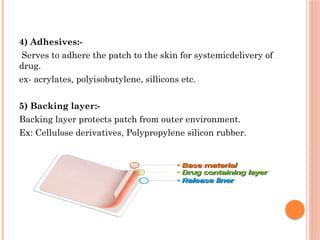
4) Adhesives:-
Serves to adhere the patch to the skin for systemicdelivery of
drug.
ex- acrylates, polyisobutylene, sillicons etc.
5) Backing layer:-
Backing layer protects patch from outer environment.
Ex: Cellulose derivatives, Polypropylene silicon rubber.
METHODS OF PREPARATION OF
TDDS:-
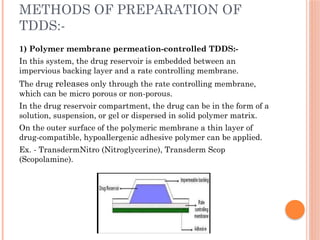
1) Polymer membrane permeation-controlled TDDS:-
In this system, the drug reservoir is embedded between an
impervious backing layer and a rate controlling membrane.
The drug releases only through the rate controlling membrane,
which can be micro porous or non-porous.
In the drug reservoir compartment, the drug can be in the form of a
solution, suspension, or gel or dispersed in solid polymer matrix.
On the outer surface of the polymeric membrane a thin layer of
drug-compatible, hypoallergenic adhesive polymer can be applied.
Ex. - TransdermNitro (Nitroglycerine), Transderm Scop
(Scopolamine).
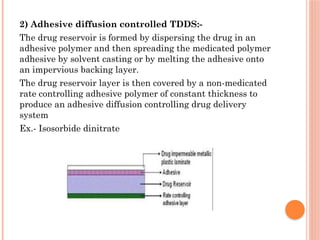
2) Adhesive diffusion controlled TDDS:-
The drug reservoir is formed by dispersing the drug in an
adhesive polymer and then spreading the medicated polymer
adhesive by solvent casting or by melting the adhesive onto
an impervious backing layer.
The drug reservoir layer is then covered by a non-medicated
rate controlling adhesive polymer of constant thickness to
produce an adhesive diffusion controlling drug delivery
system
Ex.- Isosorbide dinitrate
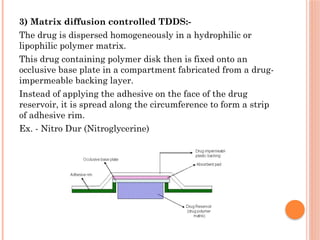
3) Matrix diffusion controlled TDDS:-
The drug is dispersed homogeneously in a hydrophilic or
lipophilic polymer matrix.
This drug containing polymer disk then is fixed onto an
occlusive base plate in a compartment fabricated from a drug-
impermeable backing layer.
Instead of applying the adhesive on the face of the drug
reservoir, it is spread along the circumference to form a strip
of adhesive rim.
Ex. - Nitro Dur (Nitroglycerine)
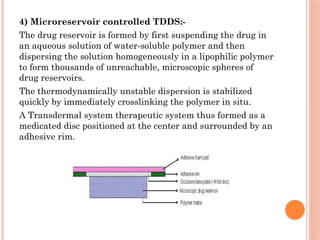
4) Microreservoir controlled TDDS:-
The drug reservoir is formed by first suspending the drug in
an aqueous solution of water-soluble polymer and then
dispersing the solution homogeneously in a lipophilic polymer
to form thousands of unreachable, microscopic spheres of
drug reservoirs.
The thermodynamically unstable dispersion is stabilized
quickly by immediately crosslinking the polymer in situ.
A Transdermal system therapeutic system thus formed as a
medicated disc positioned at the center and surrounded by an
adhesive rim.
EVALUATION OF TDDS
The evaluation methods for transdermal dosage
form can be classified into following types:
1. Physicochemical evaluation
2. In vitro evaluation
3. In vivo evaluation
1. PHYSICOCHEMICAL EVALUATION
• Interaction studies
• Thickness of patch
• Weight uniformity
• Percentage moisture content
• Water vapour permeability (WVP) evaluation
• Drug content
• Content uniformity test
• Probe tack test
• Stability study
2. IN VITRO EVALUATION
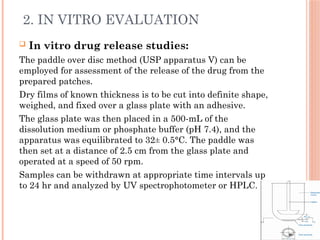
 In vitro drug release studies:
The paddle over disc method (USP apparatus V) can be
employed for assessment of the release of the drug from the
prepared patches.
Dry films of known thickness is to be cut into definite shape,
weighed, and fixed over a glass plate with an adhesive.
The glass plate was then placed in a 500-mL of the
dissolution medium or phosphate buffer (pH 7.4), and the
apparatus was equilibrated to 32± 0.5°C. The paddle was
then set at a distance of 2.5 cm from the glass plate and
operated at a speed of 50 rpm.
Samples can be withdrawn at appropriate time intervals up
to 24 hr and analyzed by UV spectrophotometer or HPLC.
 In vitro skin permeation studies :
An in vitro permeation study can be carried out by using
diffusion cell.
Full thickness abdominal skin of male Wistar rats weighing
200 to 250 gm is taken. Hair from the abdominal region is to
be removed carefully by using an electric clipper; equilibrated
for an hour in dissolution medium or phosphate buffer pH 7.4
before starting the experiment.
The temperature of the cell was maintained at 32 ± 0.5°C
using a thermostatically controlled heater.
The isolated rat skin piece is to be mounted between the
compartments of the diffusion cell, with the epidermis facing
upward into the donor compartment.
Sample volume of definite volume is to be removed from the
receptor compartment at regular intervals, and an equal
volume of fresh medium is to be replaced.
Samples are to be filtered through filtering medium and can
be analyzed spectrophotometrically or HPLC.
3. IN VIVO EVALUATION
 Animal models:
Considerable time and resources are required to carry out
human studies, so animal studies are preferred at small
scale.
The most common animal species used for evaluating
transdermal drug delivery system are mouse, hairless rat,
hairless dog, hairless rhesus monkey, rabbit, guinea pig etc.
Various experiments conducted lead us to a conclusion that
hairless animals are preferred over hairy animals in both in
vitro and in vivo experiments.
Rhesus monkey is one of the most reliable models for in vivo
evaluation of transdermal drug delivery in man.
 Human models:
The final stage of the development of a transdermal device
involves collection of pharmacokinetic and pharmacodynamic
data following application of the patch to human volunteers.
Clinical trials have been conducted to assess the efficacy, risk
involved, side effects, patient compliance etc. ( Phase 1 –
Phase 4 ).
 Skin Irritation study:
Skin irritation and sensitization testing can be performed on
healthy rabbits (average weight 1.2 to 1.5 kg). The dorsal
surface (50 cm2 ) of the rabbit is to be cleaned and remove the
hair from the clean dorsal surface by shaving and clean the
surface by using rectified spirit and the representative
formulations can be applied over the skin. The patch is to be
removed after 24 hr and the skin is to be observed and
classified into 5 grades on the basis of the severity of skin
injury.

FORMULATION AND EVALUATION TDDS RL007-1.pptx

  • 1.
    FORMULATION AND EVALUATION OFTRANSDERMAL DRUG DELIVERY SYSTEMS
  • 2.
    FORMULATION OF TDDS BasicComponents of TDDS: Drug reservoir or polymer matrix:- Polymers control the release of the drug from the device. Polymers used in TDDS should have good stability and compatibility with the drug and other components of the system. Examples are:- Natural polymers:- cellulose derivatives, zein, gelatine, shellac, waxes, gums, natural rubber etc. Synthetic polymers:- polyethylene, PVC, poly vinyl acetate,polyacrylate etc.
  • 3.
    2) Drug substance:- Theselection of drug for TDDS is based on physicochemical properties of drug. Transdermal drug delivery system is much suitable for drug having- • Extensive first pass metabolism. • Narrow therapeutic window. • Dose should be less (mg/day). • Low molecular weight (less than 500 Daltons). • Short half-life which causes non-compliance due to frequent dosing. • The drug should be non-irritating and non-allergic to human skin.
  • 4.
    3)Penetration enhancers:- These arethe substance, which facilitate the transport of drug molecules across the skin by temporarily altering its permeability. Chemical enhancers:- They insert themselves directly between thehydrophobic lipid tails and change lipid packing with cause lipid fluidity and increase the drug permeation. Solvents:- e.g- water, alcohol, methyl sulfoxide, propylene glycol etc. Surfactant:-  Anionic surfactants- sodium lauryl sulphate, dicotylsulphosuccinate etc.  Non-ionic surfactants- pluronic F127, pluronic F68 etc. Physical enhancement techniques:- • Lonotophorosis • Sonophorosis • Electroporation
  • 5.
    4) Adhesives:- Serves toadhere the patch to the skin for systemicdelivery of drug. ex- acrylates, polyisobutylene, sillicons etc. 5) Backing layer:- Backing layer protects patch from outer environment. Ex: Cellulose derivatives, Polypropylene silicon rubber.
  • 6.
    METHODS OF PREPARATIONOF TDDS:- 1) Polymer membrane permeation-controlled TDDS:- In this system, the drug reservoir is embedded between an impervious backing layer and a rate controlling membrane. The drug releases only through the rate controlling membrane, which can be micro porous or non-porous. In the drug reservoir compartment, the drug can be in the form of a solution, suspension, or gel or dispersed in solid polymer matrix. On the outer surface of the polymeric membrane a thin layer of drug-compatible, hypoallergenic adhesive polymer can be applied. Ex. - TransdermNitro (Nitroglycerine), Transderm Scop (Scopolamine).
  • 7.
    2) Adhesive diffusioncontrolled TDDS:- The drug reservoir is formed by dispersing the drug in an adhesive polymer and then spreading the medicated polymer adhesive by solvent casting or by melting the adhesive onto an impervious backing layer. The drug reservoir layer is then covered by a non-medicated rate controlling adhesive polymer of constant thickness to produce an adhesive diffusion controlling drug delivery system Ex.- Isosorbide dinitrate
  • 8.
    3) Matrix diffusioncontrolled TDDS:- The drug is dispersed homogeneously in a hydrophilic or lipophilic polymer matrix. This drug containing polymer disk then is fixed onto an occlusive base plate in a compartment fabricated from a drug- impermeable backing layer. Instead of applying the adhesive on the face of the drug reservoir, it is spread along the circumference to form a strip of adhesive rim. Ex. - Nitro Dur (Nitroglycerine)
  • 9.
    4) Microreservoir controlledTDDS:- The drug reservoir is formed by first suspending the drug in an aqueous solution of water-soluble polymer and then dispersing the solution homogeneously in a lipophilic polymer to form thousands of unreachable, microscopic spheres of drug reservoirs. The thermodynamically unstable dispersion is stabilized quickly by immediately crosslinking the polymer in situ. A Transdermal system therapeutic system thus formed as a medicated disc positioned at the center and surrounded by an adhesive rim.
  • 10.
    EVALUATION OF TDDS Theevaluation methods for transdermal dosage form can be classified into following types: 1. Physicochemical evaluation 2. In vitro evaluation 3. In vivo evaluation
  • 11.
    1. PHYSICOCHEMICAL EVALUATION •Interaction studies • Thickness of patch • Weight uniformity • Percentage moisture content • Water vapour permeability (WVP) evaluation • Drug content • Content uniformity test • Probe tack test • Stability study
  • 12.
    2. IN VITROEVALUATION  In vitro drug release studies: The paddle over disc method (USP apparatus V) can be employed for assessment of the release of the drug from the prepared patches. Dry films of known thickness is to be cut into definite shape, weighed, and fixed over a glass plate with an adhesive. The glass plate was then placed in a 500-mL of the dissolution medium or phosphate buffer (pH 7.4), and the apparatus was equilibrated to 32± 0.5°C. The paddle was then set at a distance of 2.5 cm from the glass plate and operated at a speed of 50 rpm. Samples can be withdrawn at appropriate time intervals up to 24 hr and analyzed by UV spectrophotometer or HPLC.
  • 13.
     In vitroskin permeation studies : An in vitro permeation study can be carried out by using diffusion cell. Full thickness abdominal skin of male Wistar rats weighing 200 to 250 gm is taken. Hair from the abdominal region is to be removed carefully by using an electric clipper; equilibrated for an hour in dissolution medium or phosphate buffer pH 7.4 before starting the experiment. The temperature of the cell was maintained at 32 ± 0.5°C using a thermostatically controlled heater. The isolated rat skin piece is to be mounted between the compartments of the diffusion cell, with the epidermis facing upward into the donor compartment. Sample volume of definite volume is to be removed from the receptor compartment at regular intervals, and an equal volume of fresh medium is to be replaced. Samples are to be filtered through filtering medium and can be analyzed spectrophotometrically or HPLC.
  • 14.
    3. IN VIVOEVALUATION  Animal models: Considerable time and resources are required to carry out human studies, so animal studies are preferred at small scale. The most common animal species used for evaluating transdermal drug delivery system are mouse, hairless rat, hairless dog, hairless rhesus monkey, rabbit, guinea pig etc. Various experiments conducted lead us to a conclusion that hairless animals are preferred over hairy animals in both in vitro and in vivo experiments. Rhesus monkey is one of the most reliable models for in vivo evaluation of transdermal drug delivery in man.
  • 15.
     Human models: Thefinal stage of the development of a transdermal device involves collection of pharmacokinetic and pharmacodynamic data following application of the patch to human volunteers. Clinical trials have been conducted to assess the efficacy, risk involved, side effects, patient compliance etc. ( Phase 1 – Phase 4 ).  Skin Irritation study: Skin irritation and sensitization testing can be performed on healthy rabbits (average weight 1.2 to 1.5 kg). The dorsal surface (50 cm2 ) of the rabbit is to be cleaned and remove the hair from the clean dorsal surface by shaving and clean the surface by using rectified spirit and the representative formulations can be applied over the skin. The patch is to be removed after 24 hr and the skin is to be observed and classified into 5 grades on the basis of the severity of skin injury.