Key areas
• Spellout research question
• State research hypothesis
• Formulate objectives
3.
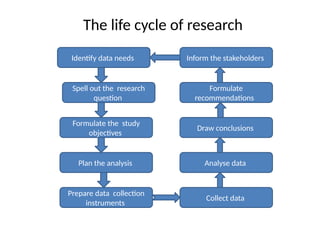
Identify data needs
Spellout the research
question
Formulate the study
objectives
Plan the analysis
Prepare data collection
instruments
Collect data
Analyse data
Draw conclusions
Formulate
recommendations
Inform the stakeholders
The life cycle of research
4.
What is researchquestion?
•‘Uncertainty’ about something in the population
that the investigator wants to resolve by making
measurements in the study population
• Uncertainty = ‘data needs’
• Clear question facilitates to
• Choose the most optimal design
• Identify who should be included, what the
outcomes should be, and when the outcomes
need to be measured.
5.
Refining ‘ideas’ intoresearch questions
• Begins with general uncertainty about a health
issue
• Narrows down to a concrete, researchable
issue
6.
Translating uncertainty toresearch question
• Frames problem in specific terms (clinical/public
health/…)
• Focuses on one issue
• Is written in everyday language
• Can use more than one operational verb, if needed
• Should link the question to the potential action that
would be taken once the question is answered
• Is stated as a question!
7.
Research question setsout
• ✓ What the investigator wants to know
• ☒NOT
• ☒What the investigator might do or
• ☒What the results of the study might
ultimately contribute to that particular field of
science
8.
Sources of researchquestions
1. Mastering the published literature
• Continue review of work of others in the area of interest
2. Being alert to new ideas and technique
• Attending research meetings / conferences
• Having a skeptical attitude about prevailing beliefs
• Applying new technologies to old issues
3. Keeping the imagination roaming
• Careful observation; teaching, tenacity
4. Choosing a guide/mentor