The world as we know is changing rapidly...
Not an era of change but a change of era
“times in history when
something…happened
in mathematics
that…changed the way
ordinary people think
about their lives.”
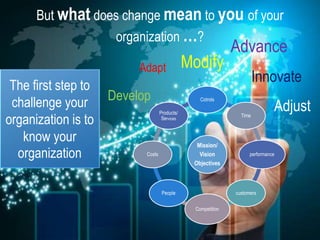
The first step to
challenge your
organization is to
know your
organization
Mission/
Vision
Objectives
Cotrols
Time
performance
customers
Competition
People
Costs
Products/
Services
But what does change mean to you of your
organization …?
Adapt
Adjust
Modify
Innovate
Develop
Advance
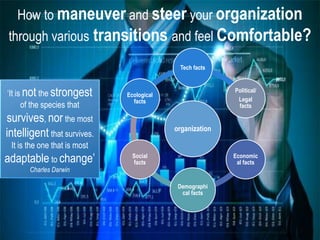
‘It is not the strongest
of the species that
survives, nor the most
intelligent that survives.
It is the one that is most
adaptable to change’
Charles Darwin
How to maneuver and steer your organization
through various transitions and feel Comfortable?
organization
Tech facts
Political/
Legal
facts
Economic
al facts
Demographi
cal facts
Social
facts
Ecological
facts
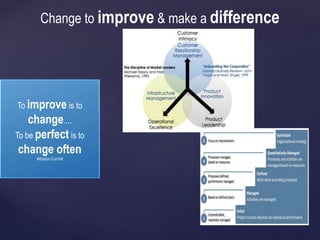
Change to improve & make a difference
To improve is to
change....
To be perfect is to
change often
Winston Curchill
To improve is to
change....
To be perfect is to
change often
Winston Curchill
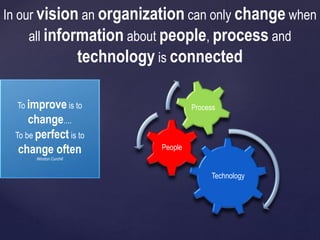
In our vision an organization can only change when
all information about people, process and
technology is connected
Technology
People
Process
607-04-2016
An organization is a
commitment of a group of
people working together, to
reach common goals and
objectives
Understanding the definition of an organization
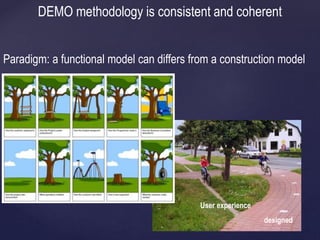
DEMO methodology is consistent and coherent
Paradigm: a functional model can differs from a construction model
designed
User experience
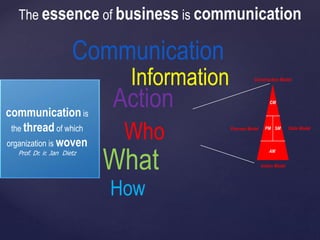
The essence of business is communication
What
Construction Model
Process Model
Action Model
State ModelSMPM
AM
CM
Who
How
Information
Action
Communication
communication is
the thread of which
organization is woven
Prof. Dr. ir. Jan Dietz
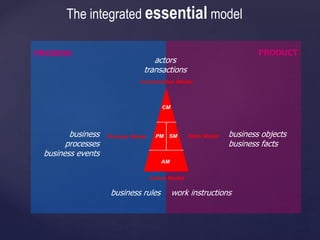
actors
transactions
business
processes
business events
business objects
business facts
Construction Model
Process Model
Action Model
State ModelSMPM
AM
CM
PRODUCT
work instructionsbusiness rules
PROSESS
The integrated essential model
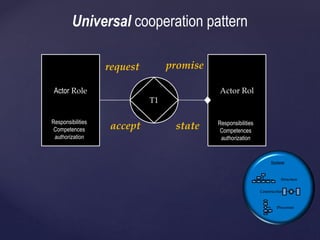
Actor Role
Responsibilities
Competences
authorization
Actor Rol
T1
System
Structure
Construction
Processes
request promise
stateaccept Responsibilities
Competences
authorization
Universal cooperation pattern
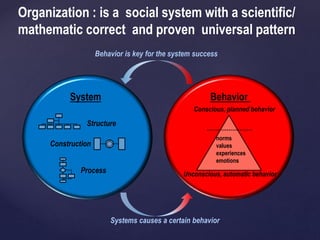
Organization : is a social system with a scientific/
mathematic correct and proven universal pattern
System Behavior
Structure
Construction
Process
Systems causes a certain behavior
Behavior is key for the system success
Conscious, planned behavior
norms
values
experiences
emotions
Unconscious, automatic behavior
DEMO methodology
DEMO is a methodology for designing, organizing and linking organizations.
Central concept is the "communicative action": communication is considered
essential for the functioning of organizations. Agreements between employees,
customers and suppliers are indeed created to communicate. The same is true for the
acceptance of the results supplied.
The DEMO methodology is based on the following principles:
• The essence of an organization is that it consists of people with authority and responsibility
to act and negotiate.
• The modeling of business processes and information systems is a rational activity, which
leads to uniformity.
• Information Protection models should be for all concerned. Understandable
• Information should psychonomic to 'fit' with their users.
The DEMO methodology provides a coherent understanding of communication,
information, action and organization. The scope is here shifted from
"Information Systems Engineering" to "Business Systems Engineering",
with a clear understanding of both the information and the central organizations.
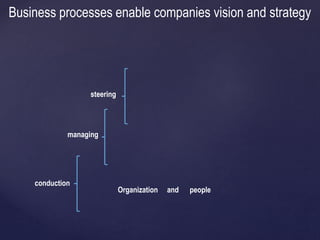
Organization and people
steering
managing
conduction
Business processes enable companies vision and strategy
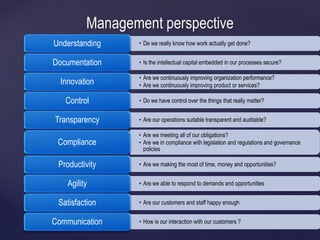
Management perspective
• De we really know how work actually get done?Understanding
• Is the intellectual capital embedded in our processes secure?Documentation
• Are we continuously improving organization performance?
• Are we continuously improving product or services?Innovation
• Do we have control over the things that really matter?Control
• Are our operations suitable transparent and auditable?Transparency
• Are we meeting all of our obligations?
• Are we in compliance with legislation and regulations and governance
policies
Compliance
• Are we making the most of time, money and opportunities?Productivity
• Are we able to respond to demands and opportunitiesAgility
• Are our customers and staff happy enoughSatisfaction
• How is our interaction with our customers ?Communication
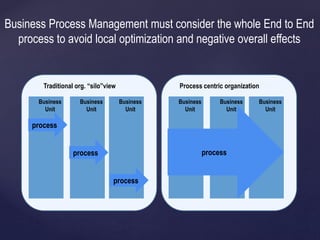
Business
Unit
process
Business
Unit
Business
Unit
Business
Unit
Business
Unit
Business
Unit
Business Process Management must consider the whole End to End
process to avoid local optimization and negative overall effects
Traditional org. “silo”view Process centric organization
process
process
process
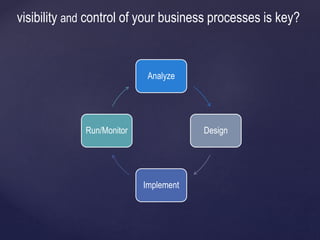
visibility and control of your business processes is key?
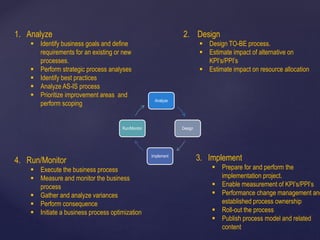
Analyze
Design
Implement
Run/Monitor
Analyze
Design
Implement
Run/Monitor
1. Analyze
 Identify business goals and define
requirements for an existing or new
processes.
 Perform strategic process analyses
 Identify best practices
 Analyze AS-IS process
 Prioritize improvement areas and
perform scoping
2. Design
 Design TO-BE process.
 Estimate impact of alternative on
KPI’s/PPI’s
 Estimate impact on resource allocation
4. Run/Monitor
 Execute the business process
 Measure and monitor the business
process
 Gather and analyze variances
 Perform consequence
 Initiate a business process optimization
3. Implement
 Prepare for and perform the
implementation project.
 Enable measurement of KPI’s/PPI’s
 Performance change management and
established process ownership
 Roll-out the process
 Publish process model and related
content
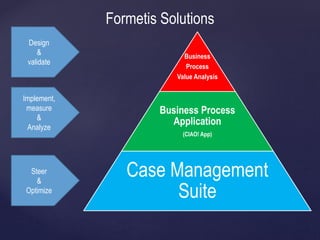
Formetis Solutions
Business
Process
Value Analysis
Business Process
Application
(CIAO! App)
Case Management
Suite
Implement,
measure
&
Analyze
Steer
&
Optimize
Design
&
validate
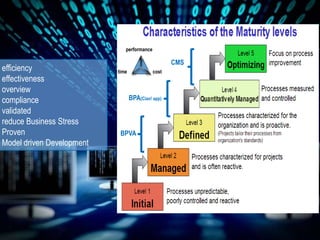
CMS
BPA(Ciao! app)
BPVA
efficiency
effectiveness
overview
compliance
validated
reduce Business Stress
Proven
Model driven Development
costtime
performanceperformance
time
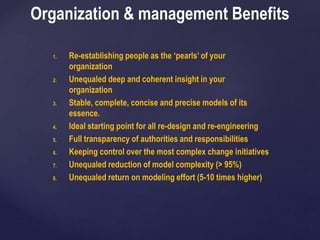
Organization & management Benefits
1. Re-establishing people as the ‘pearls’ of your
organization
2. Unequaled deep and coherent insight in your
organization
3. Stable, complete, concise and precise models of its
essence.
4. Ideal starting point for all re-design and re-engineering
5. Full transparency of authorities and responsibilities
6. Keeping control over the most complex change initiatives
7. Unequaled reduction of model complexity (> 95%)
8. Unequaled return on modeling effort (5-10 times higher)
Organization & management Benefits
1. Improve process performance
2. Improve compliance & regulatory
control and traceability
3. Manage operational risks
4. Improve scalability and planning
5. Easier auditing
6. Keep content fresh
7. Dynamic resourcing
• Configuration discovery
• Issue tracking
• Waist reduction
• Change management
• Capacity management
• ..
22
ForMetis are enterprise engineers: apply the discipline of enterprise engineering
ForMetis designs enterprises and builds tailor made information systems for demanding
professional customers for the production of (financial) services
ForMetis participates actively in research and development of enterprise engineering with
academic and professional partners, bridge academic & professional world
ForMetis develops the DEMO Engine and the Enterprise Operating System
support for Blockchain technology
ForMetis Activities and Partnerships

ForMetis160707

  • 1.
    The world aswe know is changing rapidly... Not an era of change but a change of era “times in history when something…happened in mathematics that…changed the way ordinary people think about their lives.”
  • 2.
    The first stepto challenge your organization is to know your organization Mission/ Vision Objectives Cotrols Time performance customers Competition People Costs Products/ Services But what does change mean to you of your organization …? Adapt Adjust Modify Innovate Develop Advance
  • 3.
    ‘It is notthe strongest of the species that survives, nor the most intelligent that survives. It is the one that is most adaptable to change’ Charles Darwin How to maneuver and steer your organization through various transitions and feel Comfortable? organization Tech facts Political/ Legal facts Economic al facts Demographi cal facts Social facts Ecological facts
  • 4.
    Change to improve& make a difference To improve is to change.... To be perfect is to change often Winston Curchill
  • 5.
    To improve isto change.... To be perfect is to change often Winston Curchill In our vision an organization can only change when all information about people, process and technology is connected Technology People Process
  • 6.
    607-04-2016 An organization isa commitment of a group of people working together, to reach common goals and objectives Understanding the definition of an organization
  • 7.
    DEMO methodology isconsistent and coherent Paradigm: a functional model can differs from a construction model designed User experience
  • 8.
    The essence ofbusiness is communication What Construction Model Process Model Action Model State ModelSMPM AM CM Who How Information Action Communication communication is the thread of which organization is woven Prof. Dr. ir. Jan Dietz
  • 9.
    actors transactions business processes business events business objects businessfacts Construction Model Process Model Action Model State ModelSMPM AM CM PRODUCT work instructionsbusiness rules PROSESS The integrated essential model
  • 10.
    Actor Role Responsibilities Competences authorization Actor Rol T1 System Structure Construction Processes requestpromise stateaccept Responsibilities Competences authorization Universal cooperation pattern
  • 11.
    Organization : isa social system with a scientific/ mathematic correct and proven universal pattern System Behavior Structure Construction Process Systems causes a certain behavior Behavior is key for the system success Conscious, planned behavior norms values experiences emotions Unconscious, automatic behavior
  • 12.
    DEMO methodology DEMO isa methodology for designing, organizing and linking organizations. Central concept is the "communicative action": communication is considered essential for the functioning of organizations. Agreements between employees, customers and suppliers are indeed created to communicate. The same is true for the acceptance of the results supplied. The DEMO methodology is based on the following principles: • The essence of an organization is that it consists of people with authority and responsibility to act and negotiate. • The modeling of business processes and information systems is a rational activity, which leads to uniformity. • Information Protection models should be for all concerned. Understandable • Information should psychonomic to 'fit' with their users. The DEMO methodology provides a coherent understanding of communication, information, action and organization. The scope is here shifted from "Information Systems Engineering" to "Business Systems Engineering", with a clear understanding of both the information and the central organizations.
  • 13.
    Organization and people steering managing conduction Businessprocesses enable companies vision and strategy
  • 14.
    Management perspective • Dewe really know how work actually get done?Understanding • Is the intellectual capital embedded in our processes secure?Documentation • Are we continuously improving organization performance? • Are we continuously improving product or services?Innovation • Do we have control over the things that really matter?Control • Are our operations suitable transparent and auditable?Transparency • Are we meeting all of our obligations? • Are we in compliance with legislation and regulations and governance policies Compliance • Are we making the most of time, money and opportunities?Productivity • Are we able to respond to demands and opportunitiesAgility • Are our customers and staff happy enoughSatisfaction • How is our interaction with our customers ?Communication
  • 15.
    Business Unit process Business Unit Business Unit Business Unit Business Unit Business Unit Business Process Managementmust consider the whole End to End process to avoid local optimization and negative overall effects Traditional org. “silo”view Process centric organization process process process
  • 16.
    visibility and controlof your business processes is key? Analyze Design Implement Run/Monitor
  • 17.
    Analyze Design Implement Run/Monitor 1. Analyze  Identifybusiness goals and define requirements for an existing or new processes.  Perform strategic process analyses  Identify best practices  Analyze AS-IS process  Prioritize improvement areas and perform scoping 2. Design  Design TO-BE process.  Estimate impact of alternative on KPI’s/PPI’s  Estimate impact on resource allocation 4. Run/Monitor  Execute the business process  Measure and monitor the business process  Gather and analyze variances  Perform consequence  Initiate a business process optimization 3. Implement  Prepare for and perform the implementation project.  Enable measurement of KPI’s/PPI’s  Performance change management and established process ownership  Roll-out the process  Publish process model and related content
  • 18.
    Formetis Solutions Business Process Value Analysis BusinessProcess Application (CIAO! App) Case Management Suite Implement, measure & Analyze Steer & Optimize Design & validate
  • 19.
    CMS BPA(Ciao! app) BPVA efficiency effectiveness overview compliance validated reduce BusinessStress Proven Model driven Development costtime performanceperformance time
  • 20.
    Organization & managementBenefits 1. Re-establishing people as the ‘pearls’ of your organization 2. Unequaled deep and coherent insight in your organization 3. Stable, complete, concise and precise models of its essence. 4. Ideal starting point for all re-design and re-engineering 5. Full transparency of authorities and responsibilities 6. Keeping control over the most complex change initiatives 7. Unequaled reduction of model complexity (> 95%) 8. Unequaled return on modeling effort (5-10 times higher)
  • 21.
    Organization & managementBenefits 1. Improve process performance 2. Improve compliance & regulatory control and traceability 3. Manage operational risks 4. Improve scalability and planning 5. Easier auditing 6. Keep content fresh 7. Dynamic resourcing • Configuration discovery • Issue tracking • Waist reduction • Change management • Capacity management • ..
  • 22.
    22 ForMetis are enterpriseengineers: apply the discipline of enterprise engineering ForMetis designs enterprises and builds tailor made information systems for demanding professional customers for the production of (financial) services ForMetis participates actively in research and development of enterprise engineering with academic and professional partners, bridge academic & professional world ForMetis develops the DEMO Engine and the Enterprise Operating System support for Blockchain technology ForMetis Activities and Partnerships

Editor's Notes

  • #4 LvK: Transitie is stelselverandering, dus in wetten, regels en andere externe factoren. Transformatie is het intern omgaan met die transitie.
  • #7 Definitie. Social engineering gaat hiervan uit, vele bedrijven en universiteiten gaan hier nu van uit. Namen: Ben Tiggelaar, Cialdini, Dijksterhuis, Jos Burgers, etc. Een organisatie is iets anders dan een bedrijf. Een bedrijf heeft ook een visie, missie, strategie, automatisering, bureaustoelen, etc. Een organisatie is dát deel waar mensen met elkaar aan ‘t samenwerken zijn. En omdat mensen sociale wezens zijn, is een organisatie dus een sociaal systeem.
  • #11 Er is een universeel patroon van samenwerking aan de systeemkant van de organisatie. Dit patroon bestaat uit actorrollen en transacties. En het manifesteert zich op ‘atoomniveau’. Dit heet de constructie van een organisatie. Modelleringstechniek heet DEMO. Het vakgebied heet Enterprise Engineering. Hiermee kun je organisaties, en dus samenwerking, ontwerpen. Maar je kunt het ook gebruiken om analyses van bestaande situaties te maken. CONSTRUCTIE + ESSENTIE? Organisatorische weeffouten, focus op het ontologische constructiemodel. Nieuw feit en niet afleidbaar: vuistregel voor coördinatiefeit of productiefeit.
  • #13 LvK: Veel moeilijke woorden. Essentie van DEMO is MENSEN die COMMUNICEREN over wat ze PRODUCEREN.
  • #14 LvK: Hoe verhoudt deze piramide zich tot andere piramides? DEMO piriamide, Bob’s producten piramide?
  • #17 LvK: Dit is onze voorgestelde ForMetis aanpak?
  • #20 LvK; Slide 5 gaat ook over CMMi. Waarom 2 keer?