Formative Assessment and
ELs: A Collaborative Tool
Daniela DiGregorio, PhD & Sydney Snyder, PhD
WIDA 2016 National Conference
October 14, 2016
1
URL: http://bit.ly/2dZ5GYZ
Session Objectives
Participants will :
• Define and explain the benefits of using formative
assessments for ELs
• Discuss how to scaffold formative assessments for
ELs
• Discuss strategies for using formative assessments to
engage colleagues in collaborative conversations
2
FORMATIVE
ASSESSMENT AND
WHY IT BENEFITS
ELS
3
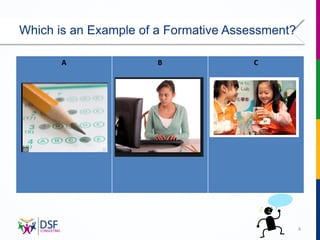
Which is an Example of a Formative Assessment?
A B C
4
Formative Assessment Defined
“The process of monitoring student knowledge and
understanding during instruction in order to give
useful feedback and make timely changes in
instruction to ensure maximal student growth.”
Noyce & Hickey, 2011
5
Benefits of Formative Assessment
• Honors teachers as decision-makers
• Invites student voice
• Is an expression of instruction
• Is embedded in teaching routines
• Revolves around providing descriptive feedback
6Gottlieb, 2016
Types of Formative Assessments
• Create a list of the various types of formative
assessments that you already use in your
classroom.
7
Effective Strategies for Formative Assessment of
ELs
• Physical Demonstration
– Hands-on tasks
– Act out concepts
– Gestures
• Pictorial Products
– Drawings
– Models
– Graphs, charts
8
Effective Strategies for Formative Assessment of
ELs (cont.)
• Graphic Organizers
– K-W-L charts
– Venn diagrams
– Webs
– Partial completion of
organizers
• Written Products
– Content area logs
– Reading response logs
• Oral Assessments
– Oral interviews
– Reports
– Retelling
– Role plays
– Audio/video taping
9
SCAFFOLDING FORMATIVE
ASSESSMENTS FOR ELS
10
Discussion
• How do you scaffold formative assessments to
meet the needs of ELs of varying proficiency
levels?
11
Ms. Horwitz’s Assessment
As you watch the video consider the following questions:
• What scaffolds or supports do you see represented in
the video? What other scaffolds could have been
used?
• How does Ms. Horwitz use data from the checklist
during the activity? How else might she use the
information?
• How could you adapt this checklist for use in your
classroom?
12
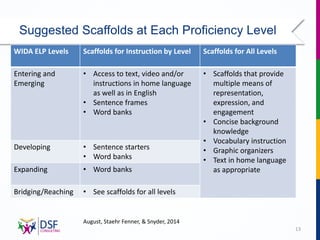
Suggested Scaffolds at Each Proficiency Level
WIDA ELP Levels Scaffolds for Instruction by Level Scaffolds for All Levels
Entering and
Emerging
• Access to text, video and/or
instructions in home language
as well as in English
• Sentence frames
• Word banks
• Scaffolds that provide
multiple means of
representation,
expression, and
engagement
• Concise background
knowledge
• Vocabulary instruction
• Graphic organizers
• Text in home language
as appropriate
Developing • Sentence starters
• Word banks
Expanding • Word banks
Bridging/Reaching • See scaffolds for all levels
13
August, Staehr Fenner, & Snyder, 2014
Scaffolded Assessment Example
After a close reading of an informational text, 8th grade
students might be asked to do the following:
14
WIDA ELP Level Assessment Task
Entering Identify objects and actions in images that connect to the key
concepts in the text.
Emerging Describe the images that connect to the key concepts in the
text.
Developing Retell the main ideas and key details from the text either
orally or in writing using a graphic organizer and/or word
bank.
Expanding Discuss the text in small groups and provide a written
response to questions about the text using a graphic
organizer and/or word bank.
Bridging/Reaching Discuss the text in small groups and provide a written
analysis of the text (may include use of graphic organizer).
Formative Assessment Carousel Activity
In pairs, walk around the room looking at the formative
assessment examples. Use your sticky notes to answer the
following questions:
• What questions or comments do you have about the
formative assessment?
• How could these assessments be scaffolded for ELs of
varying proficiency levels?
15
Formative Assessment Carousel Debrief
Turn to a partner and share:
1. One formative assessment you would like to
take back to your school to share with
colleagues.
2. One way to scaffold that formative
assessment
3. Your primary takeaway from this activity
16
FORMATIVE
ASSESSMENTS AS
A COLLABORATIVE
TOOL
17
Discussion
• In what ways do you use formative assessments
as a collaborative tool?
18
Formative Assessment for ELs
Step 1: Articulate the construct being taught and
assessed: teacher and/or student articulate learning
goals and success criteria
Step 2: Elicit evidence about ELs’ learning:
teacher(s) gather evidence to determine where
the student is in relation to learning goal
Step 3: Interpret evidence to inform ongoing
instruction: teacher(s) and/or student look at
evidence to provide feedback on the status of
student learning
19Alvarez, Ananda, Walqui, Sato, & Rabinowitz, 2014
Tools to Foster Collaboration
• Rubrics
• Checklists
• Video or audio recordings
• Student work samples
• Progress charts and learning logs
• Goal/criteria setting charts
• Student portfolios
• Anecdotal records
20
Collaborating with Students
Learning Logs Checklist
21Farrel, 2013
What we learned
today
Questions I have
Equipped for the
Future, n.d.
Collaborating with Other Educators
Staehr Fenner, D. 2014. pp. 71-72
Classroom-Based Assessment in Action
As you watch the video clip, think about the questions
below.
• What formative assessments were used in the video?
• How did the teachers collaborate to reinforce concepts?
• In what ways are you already using this process or could
you adapt this process in your setting?
23
WRAP-UP
24
Final Questions or Comments?
• What is one take-away you have from today’s session?
25
Thank you!
Daniela.digregorio@wilkes.edu
Sydney@DSFConsulting.net
26

Formative_assessment_and_ELs

  • 1.
    Formative Assessment and ELs:A Collaborative Tool Daniela DiGregorio, PhD & Sydney Snyder, PhD WIDA 2016 National Conference October 14, 2016 1 URL: http://bit.ly/2dZ5GYZ
  • 2.
    Session Objectives Participants will: • Define and explain the benefits of using formative assessments for ELs • Discuss how to scaffold formative assessments for ELs • Discuss strategies for using formative assessments to engage colleagues in collaborative conversations 2
  • 3.
  • 4.
    Which is anExample of a Formative Assessment? A B C 4
  • 5.
    Formative Assessment Defined “Theprocess of monitoring student knowledge and understanding during instruction in order to give useful feedback and make timely changes in instruction to ensure maximal student growth.” Noyce & Hickey, 2011 5
  • 6.
    Benefits of FormativeAssessment • Honors teachers as decision-makers • Invites student voice • Is an expression of instruction • Is embedded in teaching routines • Revolves around providing descriptive feedback 6Gottlieb, 2016
  • 7.
    Types of FormativeAssessments • Create a list of the various types of formative assessments that you already use in your classroom. 7
  • 8.
    Effective Strategies forFormative Assessment of ELs • Physical Demonstration – Hands-on tasks – Act out concepts – Gestures • Pictorial Products – Drawings – Models – Graphs, charts 8
  • 9.
    Effective Strategies forFormative Assessment of ELs (cont.) • Graphic Organizers – K-W-L charts – Venn diagrams – Webs – Partial completion of organizers • Written Products – Content area logs – Reading response logs • Oral Assessments – Oral interviews – Reports – Retelling – Role plays – Audio/video taping 9
  • 10.
  • 11.
    Discussion • How doyou scaffold formative assessments to meet the needs of ELs of varying proficiency levels? 11
  • 12.
    Ms. Horwitz’s Assessment Asyou watch the video consider the following questions: • What scaffolds or supports do you see represented in the video? What other scaffolds could have been used? • How does Ms. Horwitz use data from the checklist during the activity? How else might she use the information? • How could you adapt this checklist for use in your classroom? 12
  • 13.
    Suggested Scaffolds atEach Proficiency Level WIDA ELP Levels Scaffolds for Instruction by Level Scaffolds for All Levels Entering and Emerging • Access to text, video and/or instructions in home language as well as in English • Sentence frames • Word banks • Scaffolds that provide multiple means of representation, expression, and engagement • Concise background knowledge • Vocabulary instruction • Graphic organizers • Text in home language as appropriate Developing • Sentence starters • Word banks Expanding • Word banks Bridging/Reaching • See scaffolds for all levels 13 August, Staehr Fenner, & Snyder, 2014
  • 14.
    Scaffolded Assessment Example Aftera close reading of an informational text, 8th grade students might be asked to do the following: 14 WIDA ELP Level Assessment Task Entering Identify objects and actions in images that connect to the key concepts in the text. Emerging Describe the images that connect to the key concepts in the text. Developing Retell the main ideas and key details from the text either orally or in writing using a graphic organizer and/or word bank. Expanding Discuss the text in small groups and provide a written response to questions about the text using a graphic organizer and/or word bank. Bridging/Reaching Discuss the text in small groups and provide a written analysis of the text (may include use of graphic organizer).
  • 15.
    Formative Assessment CarouselActivity In pairs, walk around the room looking at the formative assessment examples. Use your sticky notes to answer the following questions: • What questions or comments do you have about the formative assessment? • How could these assessments be scaffolded for ELs of varying proficiency levels? 15
  • 16.
    Formative Assessment CarouselDebrief Turn to a partner and share: 1. One formative assessment you would like to take back to your school to share with colleagues. 2. One way to scaffold that formative assessment 3. Your primary takeaway from this activity 16
  • 17.
  • 18.
    Discussion • In whatways do you use formative assessments as a collaborative tool? 18
  • 19.
    Formative Assessment forELs Step 1: Articulate the construct being taught and assessed: teacher and/or student articulate learning goals and success criteria Step 2: Elicit evidence about ELs’ learning: teacher(s) gather evidence to determine where the student is in relation to learning goal Step 3: Interpret evidence to inform ongoing instruction: teacher(s) and/or student look at evidence to provide feedback on the status of student learning 19Alvarez, Ananda, Walqui, Sato, & Rabinowitz, 2014
  • 20.
    Tools to FosterCollaboration • Rubrics • Checklists • Video or audio recordings • Student work samples • Progress charts and learning logs • Goal/criteria setting charts • Student portfolios • Anecdotal records 20
  • 21.
    Collaborating with Students LearningLogs Checklist 21Farrel, 2013 What we learned today Questions I have Equipped for the Future, n.d.
  • 22.
    Collaborating with OtherEducators Staehr Fenner, D. 2014. pp. 71-72
  • 23.
    Classroom-Based Assessment inAction As you watch the video clip, think about the questions below. • What formative assessments were used in the video? • How did the teachers collaborate to reinforce concepts? • In what ways are you already using this process or could you adapt this process in your setting? 23
  • 24.
  • 25.
    Final Questions orComments? • What is one take-away you have from today’s session? 25
  • 26.