Form Research
  {   Shona Traynor & Xavier Vale

      Katz, Steven D., Film Directing: Shot by Shot, Michael
      Wise Productions, 1991
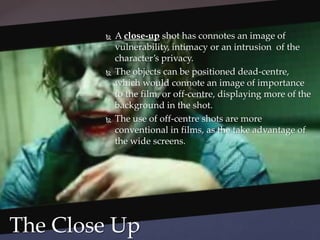
   A close-up shot has connotes an image of
            vulnerability, intimacy or an intrusion of the
            character’s privacy.
           The objects can be positioned dead-centre,
            which would connote an image of importance
            to the film, or off-centre, displaying more of the
            background in the shot.
           The use of off-centre shots are more
            conventional in films, as the take advantage of
            the wide screens.


The Close Up
   The medium shot works well if there are
    between one to five characters in a frame. Any
    more than this, however, requires a full shot.
   The camera shot is used mainly in dialogue
    scenes, capturing both the actor’s facial
    expressions and clear gestures.


      The Medium Shot
   The long shot has not been used as much in
        recent years, ‘relegated to the function of an
        establishing shot’.
       These are used to establish both a character and
        a specific location in the same frame, but needs
        dialogue to work effectively.
       A positive of having a long shot is that the
        audience can see the full body language of the
        actor.


The Long Shot
   These shots are useful for dialogue
               scenes between two people. These are
               places ‘just inside…the line of sight of
               the subjects.’
              They also enable a different perspective
               to be given, allowing the mis-en-scene
               to be shown in a slightly different
               angle.

Over the Shoulder Shots
   The position of lighting can greatly influence
        the connotations a certain shot has.
       For example, the villain in an action movie
        would have shadows constantly on him,
        highlighting his dark and evil personality.


Lighting
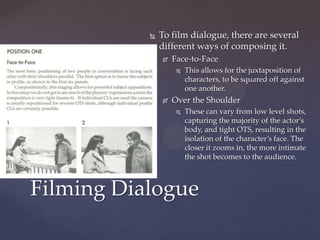
   To film dialogue, there are several
               different ways of composing it.
                  Face-to-Face
                      This allows for the juxtaposition of
                       characters, to be squared off against
                       one another.
                  Over the Shoulder
                      These can vary from low level shots,
                       capturing the majority of the actor’s
                       body, and tight OTS, resulting in the
                       isolation of the character’s face. The
                       closer it zooms in, the more intimate
                       the shot becomes to the audience.


Filming Dialogue
   Shoulder-to-Shoulder
              This enables the actors to ‘be seen in full face or
               in profile’ within a single shot., allowing the
               audience to see the relationship between the two
               or more characters in the shot.


Filming Dialogue
   For interior scenes, there are only three
             positions the camera can be in, and
             conventionally, only the middle ground
             and background shots are used.
                MIDDLE GROUND: The camera is placed
                 out of the action, but is positioned in such
                 a way that all the actors have a different
                 depth. This reduces the amount of cutting
                 needed.
                BACKGROUND: More cutting would be
                 applicable for this camera shot, as the
                 majority of actors in the frame have
                 approximately the same depth of field.


Depth of a Frame
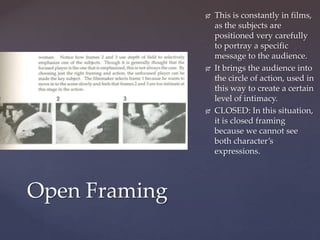
   This is constantly in films,
                   as the subjects are
                   positioned very carefully
                   to portray a specific
                   message to the audience.
                  It brings the audience into
                   the circle of action, used in
                   this way to create a certain
                   level of intimacy.
                  CLOSED: In this situation,
                   it is closed framing
                   because we cannot see
                   both character’s
                   expressions.


Open Framing
   This gives an even higher
                 level of intimacy to the
                 audience.
                 CLOSED: In this situation,
                 where you can see both of
                 the character’s expressions
                 clearly.


Closed Framing
   First-person POV
                       These have been awkward in
                        narrative-based films because we are
                        deprived of the actor’s facial features
                        and expression.
                   Omniscient POV
                       This only works if we have some
                        insight into the character, eg.
Point of View           Voiceover
   The Pan shot is used to:
                 Include a wider range of space
                  not available through a fixed
                  frame
                 Follow the action/subject as it
                  moves.
                 Connect two or more points of
                  interest to the audience.
             It is also used to signify the
              emphasize the depth of a specific
              shot.


The Pan
FOLLOWING IS A
SUMMARY OF THINGS
WE WILL TAKE
FORWARD IN OUR
PRODUCTION
   Depth of a Frame
        The positioning of the cameras will be important,
         especially in the bedroom scene.
    Open and Closed Framing
        We could use this in a bedroom scene – the female
         character lying in bed - the other side is empty. This
         could connote her loneliness.
    The Pan
        It could take in the surroundings as she goes to post the
         letter in the post-box.
    Over-the-Shoulder
        This could be used in our preliminary tasks as there
         might not be a lot of conversation in our final
         production.
Summary

Form research FINAL 2

  • 1.
    Form Research { Shona Traynor & Xavier Vale Katz, Steven D., Film Directing: Shot by Shot, Michael Wise Productions, 1991
  • 2.
    A close-up shot has connotes an image of vulnerability, intimacy or an intrusion of the character’s privacy.  The objects can be positioned dead-centre, which would connote an image of importance to the film, or off-centre, displaying more of the background in the shot.  The use of off-centre shots are more conventional in films, as the take advantage of the wide screens. The Close Up
  • 3.
    The medium shot works well if there are between one to five characters in a frame. Any more than this, however, requires a full shot.  The camera shot is used mainly in dialogue scenes, capturing both the actor’s facial expressions and clear gestures. The Medium Shot
  • 4.
    The long shot has not been used as much in recent years, ‘relegated to the function of an establishing shot’.  These are used to establish both a character and a specific location in the same frame, but needs dialogue to work effectively.  A positive of having a long shot is that the audience can see the full body language of the actor. The Long Shot
  • 6.
    These shots are useful for dialogue scenes between two people. These are places ‘just inside…the line of sight of the subjects.’  They also enable a different perspective to be given, allowing the mis-en-scene to be shown in a slightly different angle. Over the Shoulder Shots
  • 7.
    The position of lighting can greatly influence the connotations a certain shot has.  For example, the villain in an action movie would have shadows constantly on him, highlighting his dark and evil personality. Lighting
  • 8.
    To film dialogue, there are several different ways of composing it.  Face-to-Face  This allows for the juxtaposition of characters, to be squared off against one another.  Over the Shoulder  These can vary from low level shots, capturing the majority of the actor’s body, and tight OTS, resulting in the isolation of the character’s face. The closer it zooms in, the more intimate the shot becomes to the audience. Filming Dialogue
  • 9.
    Shoulder-to-Shoulder  This enables the actors to ‘be seen in full face or in profile’ within a single shot., allowing the audience to see the relationship between the two or more characters in the shot. Filming Dialogue
  • 10.
    For interior scenes, there are only three positions the camera can be in, and conventionally, only the middle ground and background shots are used.  MIDDLE GROUND: The camera is placed out of the action, but is positioned in such a way that all the actors have a different depth. This reduces the amount of cutting needed.  BACKGROUND: More cutting would be applicable for this camera shot, as the majority of actors in the frame have approximately the same depth of field. Depth of a Frame
  • 11.
    This is constantly in films, as the subjects are positioned very carefully to portray a specific message to the audience.  It brings the audience into the circle of action, used in this way to create a certain level of intimacy.  CLOSED: In this situation, it is closed framing because we cannot see both character’s expressions. Open Framing
  • 12.
    This gives an even higher level of intimacy to the audience. CLOSED: In this situation, where you can see both of the character’s expressions clearly. Closed Framing
  • 13.
    First-person POV  These have been awkward in narrative-based films because we are deprived of the actor’s facial features and expression.  Omniscient POV  This only works if we have some insight into the character, eg. Point of View Voiceover
  • 14.
    The Pan shot is used to:  Include a wider range of space not available through a fixed frame  Follow the action/subject as it moves.  Connect two or more points of interest to the audience.  It is also used to signify the emphasize the depth of a specific shot. The Pan
  • 15.
    FOLLOWING IS A SUMMARYOF THINGS WE WILL TAKE FORWARD IN OUR PRODUCTION
  • 16.
    Depth of a Frame  The positioning of the cameras will be important, especially in the bedroom scene.  Open and Closed Framing  We could use this in a bedroom scene – the female character lying in bed - the other side is empty. This could connote her loneliness.  The Pan  It could take in the surroundings as she goes to post the letter in the post-box.  Over-the-Shoulder  This could be used in our preliminary tasks as there might not be a lot of conversation in our final production. Summary