Libby Weiler
PORTFOLIO
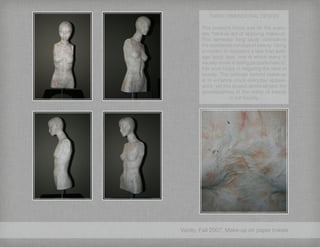
Vanity, Fall 2007, Make-up on paper towels
THREE DIMENSIONAL DESIGN
This project’s focus was on the every-
day habitual act of applying make-up.
This semester long study contradicts
the worldwide concept of beauty. Using
a manikin to represent a less than aver-
age body type, one in which many in
society strive in being proportionate to,
this work helps in negating the idea of
beauty. The concept behind make-up
is to enhance one’s everyday appear-
ance, yet this project demonstrates the
grotesqueness of the reality of beauty
in our society.
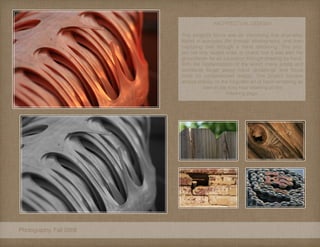
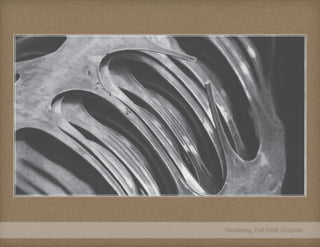
Photography, Fall 2008
ARCHITECTUAL DESIGN I
This project’s focus was on identifying five anomalies
found in everyday life through photography, and then
capturing one through a hand rendering. This proj-
ect not only taught order in chaos, but it was also the
groundwork for an education through drawing by hand.
With the modernization of the world, many artists and
architects forget about hand renderings and focus
more on computerized design. This project focuses
almost entirely on the forgotten art of hand rendering as
seen in the sixty hour drawing on the
following page.
Rendering, Fall 2008, Graphite
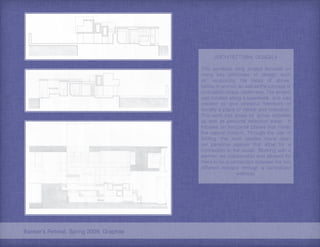
Banker’s Retreat, Spring 2009, Graphite
ARCHITECTURAL DESIGN II
This semester long project focused on
many key principles of design such
as: reciprocity, the ideas of above,
below, in and on, as well as the concept of
civilization versus wilderness. The project
was located along a boardwalk, and was
created to give stressful members of
society a place of retreat and relaxation.
This work has areas for group activities
as well as personal reflection areas. It
focuses on horizontal planes that mimic
the natural horizon. Through the use of
folding, this work creates many open
yet personal spaces that allow for a
connection to the ocean. Working with a
partner, we collaborated and allowed for
there to be a connection between the two
different designs through a centralized
walkway.
Banker’s Retreat, Spring 2009, Graphite
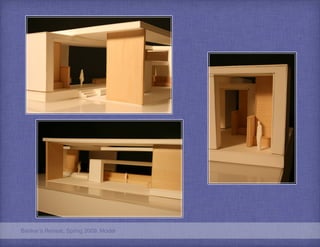
Banker’s Retreat, Spring 2009, Model
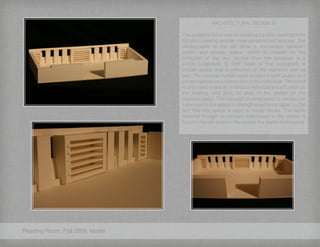
Reading Room, Fall 2009, Model
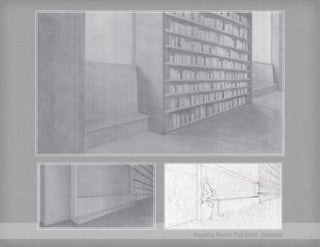
ARCHITECTURAL DESIGN III
This project’s focus was on creating a public reading room
but also creating smaller more personalized spaces. The
photographs to the left show a connection between
public and private space, which is created by the
reflection of the two. Across from the entrance is a
public bookshelf, to both sides of that bookshelf, is
private space that is reflected on the opposite wall as
well. The concept is that wood is used in both public and
private spaces as a connection to the individual. The wood
is only used where an individual will experience it, such as
the seating, and floor, as seen in the sketch on the
opposite page. This concept of using wood to connect an
individual to the space is strengthened once again by the
fact that this space is used to house books. The same
material thought to connect individuals to the space is
found in the attraction to the space, the books themselves.
Reading Room, Fall 2009, Graphite
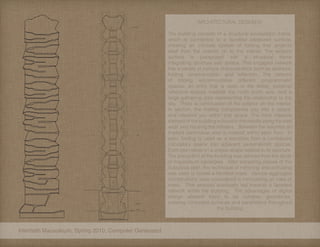
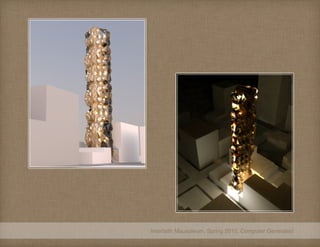
Interfaith Mausoleum, Spring 2010, Computer Generated
ARCHITECTURAL DESIGN IV
The building consists of a structural exoskeleton frame,
which is connected to a facetted panelized surface,
creating an intricate system of folding that projects
itself from the exterior on to the interior. The exterior
surface is juxtaposed with a structural frame
integrating structure with suface. This engaged network
has a variety of surface characteristics such as aperture,
folding, ornamentation, and reflection. The network
of folding accommodates different programmatic
spaces: an entry that is open to the street, personal
reflective spaces towards the north south axis, and a
large gathering area representing the relationship to the
sky. There is continuation of the exterior on the interior.
In section, the folding compresses you into a space,
and releases you within that space. The most massive
element of the building is found in the middle along the east
west axis housing the remains. Between the volumes an
implied continuous void is created within each floor. In
plan, folding is used as a transition from a centralized
circulatory space into adjacent personalized spaces.
Each plan takes on a unique shape relative to its aperture.
The precedent of the building was derived from the study
of mausoleum typologies. After extracting pieces of the
Sulaybiya plan, the technique of mirroring and extruding
was used to create a facetted mass. Various aggregate
combinations were considered in formulating an idea of
mass. That process eventually led towards a facetted
network within the building. The advantages of digital
design allowed there to be complex geometries,
creating controlled surfaces and parameters throughout
the building.
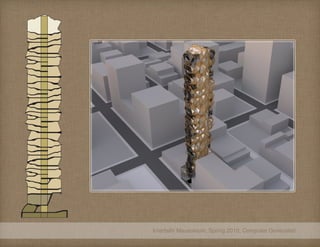
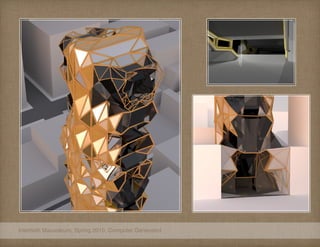
Interfaith Mausoleum, Spring 2010, Computer Generated
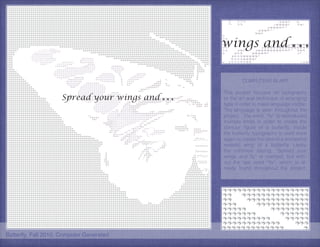
Butterfly, Fall 2010, Computer Generated
COMPUTERS IN ART
This project focuses on typography
or the art and technique of arranging
type in order to make language visible.
The language is seen throughout the
project. The word, “fly” is reproduced
multiple times in order to create the
contour figure of a butterfly. Inside
the butterfly, typography is used once
again to create the idea of a somewhat
realistic wing of a butterfly. Lastly,
the common saying, “Spread your
wings and fly” is overlaid, but with-
out the last word “fly”, which is al-
ready found throughout the project.
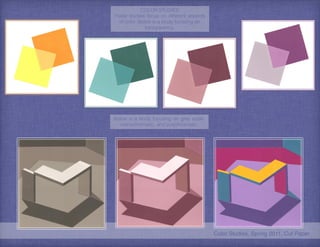
Color Studies, Spring 2011, Cut Paper
COLOR STUDIES
These studies focus on different aspects
of color. Below is a study focusing on
transparency.
Below is a study focusing on grey scale,
monochromatic, and polychromatic.
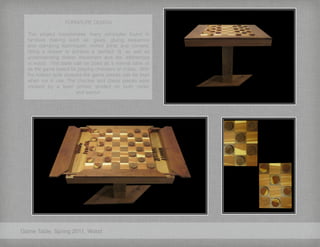
Game Table, Spring 2011, Wood
FURNITURE DESIGN
This project incorporates many principles found in
furniture making such as: glues, gluing sequence
and clamping techniques, mitred joints and corners,
fitting a drawer to achieve a ‘perfect’ fit, as well as
understanding timber movement and the differences
in wood. This table can be used as a normal table or
as the game board for playing checkers or chess. With
the hidden side drawers the game pieces can be kept
when not in use. The checker and chess pieces were
created by a laser printer, printed on both cedar
and walnut.
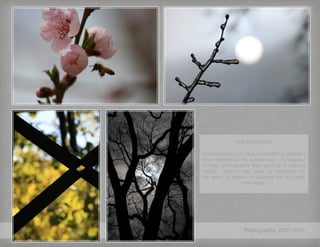
Photography, 2007-2011
PHOTOGRAPHY
A photograph can capture something beautiful
often missed by the human eye. Throughout
college, photography was used as a relaxing
hobby. Often it was used as inspiration for
my work, or helped in allowing me to create
new ideas.
B.S. Architectural Studies
FAY JONES SCHOOL OF ARCHITECTURE

WeilerPortfolio copy

  • 1.
  • 3.
    Vanity, Fall 2007,Make-up on paper towels THREE DIMENSIONAL DESIGN This project’s focus was on the every- day habitual act of applying make-up. This semester long study contradicts the worldwide concept of beauty. Using a manikin to represent a less than aver- age body type, one in which many in society strive in being proportionate to, this work helps in negating the idea of beauty. The concept behind make-up is to enhance one’s everyday appear- ance, yet this project demonstrates the grotesqueness of the reality of beauty in our society.
  • 4.
    Photography, Fall 2008 ARCHITECTUALDESIGN I This project’s focus was on identifying five anomalies found in everyday life through photography, and then capturing one through a hand rendering. This proj- ect not only taught order in chaos, but it was also the groundwork for an education through drawing by hand. With the modernization of the world, many artists and architects forget about hand renderings and focus more on computerized design. This project focuses almost entirely on the forgotten art of hand rendering as seen in the sixty hour drawing on the following page.
  • 5.
  • 6.
    Banker’s Retreat, Spring2009, Graphite ARCHITECTURAL DESIGN II This semester long project focused on many key principles of design such as: reciprocity, the ideas of above, below, in and on, as well as the concept of civilization versus wilderness. The project was located along a boardwalk, and was created to give stressful members of society a place of retreat and relaxation. This work has areas for group activities as well as personal reflection areas. It focuses on horizontal planes that mimic the natural horizon. Through the use of folding, this work creates many open yet personal spaces that allow for a connection to the ocean. Working with a partner, we collaborated and allowed for there to be a connection between the two different designs through a centralized walkway.
  • 7.
  • 8.
  • 9.
  • 10.
    Reading Room, Fall2009, Model ARCHITECTURAL DESIGN III This project’s focus was on creating a public reading room but also creating smaller more personalized spaces. The photographs to the left show a connection between public and private space, which is created by the reflection of the two. Across from the entrance is a public bookshelf, to both sides of that bookshelf, is private space that is reflected on the opposite wall as well. The concept is that wood is used in both public and private spaces as a connection to the individual. The wood is only used where an individual will experience it, such as the seating, and floor, as seen in the sketch on the opposite page. This concept of using wood to connect an individual to the space is strengthened once again by the fact that this space is used to house books. The same material thought to connect individuals to the space is found in the attraction to the space, the books themselves.
  • 11.
    Reading Room, Fall2009, Graphite
  • 12.
    Interfaith Mausoleum, Spring2010, Computer Generated ARCHITECTURAL DESIGN IV The building consists of a structural exoskeleton frame, which is connected to a facetted panelized surface, creating an intricate system of folding that projects itself from the exterior on to the interior. The exterior surface is juxtaposed with a structural frame integrating structure with suface. This engaged network has a variety of surface characteristics such as aperture, folding, ornamentation, and reflection. The network of folding accommodates different programmatic spaces: an entry that is open to the street, personal reflective spaces towards the north south axis, and a large gathering area representing the relationship to the sky. There is continuation of the exterior on the interior. In section, the folding compresses you into a space, and releases you within that space. The most massive element of the building is found in the middle along the east west axis housing the remains. Between the volumes an implied continuous void is created within each floor. In plan, folding is used as a transition from a centralized circulatory space into adjacent personalized spaces. Each plan takes on a unique shape relative to its aperture. The precedent of the building was derived from the study of mausoleum typologies. After extracting pieces of the Sulaybiya plan, the technique of mirroring and extruding was used to create a facetted mass. Various aggregate combinations were considered in formulating an idea of mass. That process eventually led towards a facetted network within the building. The advantages of digital design allowed there to be complex geometries, creating controlled surfaces and parameters throughout the building.
  • 13.
    Interfaith Mausoleum, Spring2010, Computer Generated
  • 14.
    Interfaith Mausoleum, Spring2010, Computer Generated
  • 15.
    Interfaith Mausoleum, Spring2010, Computer Generated
  • 16.
    Butterfly, Fall 2010,Computer Generated COMPUTERS IN ART This project focuses on typography or the art and technique of arranging type in order to make language visible. The language is seen throughout the project. The word, “fly” is reproduced multiple times in order to create the contour figure of a butterfly. Inside the butterfly, typography is used once again to create the idea of a somewhat realistic wing of a butterfly. Lastly, the common saying, “Spread your wings and fly” is overlaid, but with- out the last word “fly”, which is al- ready found throughout the project.
  • 17.
    Color Studies, Spring2011, Cut Paper COLOR STUDIES These studies focus on different aspects of color. Below is a study focusing on transparency. Below is a study focusing on grey scale, monochromatic, and polychromatic.
  • 18.
    Game Table, Spring2011, Wood FURNITURE DESIGN This project incorporates many principles found in furniture making such as: glues, gluing sequence and clamping techniques, mitred joints and corners, fitting a drawer to achieve a ‘perfect’ fit, as well as understanding timber movement and the differences in wood. This table can be used as a normal table or as the game board for playing checkers or chess. With the hidden side drawers the game pieces can be kept when not in use. The checker and chess pieces were created by a laser printer, printed on both cedar and walnut.
  • 19.
    Photography, 2007-2011 PHOTOGRAPHY A photographcan capture something beautiful often missed by the human eye. Throughout college, photography was used as a relaxing hobby. Often it was used as inspiration for my work, or helped in allowing me to create new ideas.
  • 20.
    B.S. Architectural Studies FAYJONES SCHOOL OF ARCHITECTURE