Why the Tribal Forest Rights Bill?
Recent roots: Spate of brutal evictions MoEF’s May 3, 2002 order  Evict all ‘encroachers’ by September 30 Cited Supreme Court’s concerns  Bet May 02 & Aug 04, evictions from 1.52 lakh ha. – still continuing At 1 ha/hshld, 1.52 lakh families or 7.5 lakh impoverished people brutally evicted. No evidence of powerful land grabbers being targeted
Nature of brutality and illegality Use of elephants to raze huts during drought Beatings, including some killings, children burnt alive in huts  In many cases, people had evidence of longstanding occupation Total non-accountability of state landlord in remote areas (ref Endangered Symbiosis)
Outrage & birth of Campaign Protests and demonstrations in several states. Lobbying with MPs, MLAs, state governments. Letters to PMO by Commissioner, STs. Issue reached Parliament Birth of CSD
MoEF and GoI response Clarification order of 30.10.02 saying all forest dwellers are not ‘encroachers’ February 2004 orders Affidavit in S Ct about ‘historical injustice’ 2 letters to states to stop evictions Stopping evictions in UPA’s CMP CSD’s lobbying with NAC PM’s decision to get bill drafted.
Roots of the Problem: Construction of ‘National’ ‘Forests’ Need to de-construct supposedly threatened ‘national’  forests. ‘ Recorded forest area’ (RFA) and ‘forest cover’ (FC) used interchangeably although  different from each other  RFA = RF+PF+lands ‘recorded’ as forests FC = Over 10% tree canopy density RFA & FC do not necessarily overlap
RFA & FC – SFR 2003 All India RFA: 774,740 km2  (23.57%)  RF = 51.6%; PF = 30.8%;17.6% = ‘Unclassed’ forest (not legally notified) All India FC:  678338 km2 (20.64%)  Actual forest cover unclear as orchards, tea/coffee/coconut/rubber/agroforestry plantations, sugarcane & cotton fields included in ‘forest cover’ 20% of even RFs have no cover
Dismal condition of land records FD and RD records don’t tally Accdng to MoEF, RFA = 77 million ha Accdng to MoA, RFA = 67.87 mha 9.13 mha ‘disputed’ between them with millions of farmers caught in the middle 12.37 lakh ha disputed in MP alone 3 lakh ha disputed in just 4 districts of Maharashtra
Post-independence statization Between 1951- 88, ‘national’ forest estate was enlarged by 26 million ha (from 41 to 67 mha) through sweeping notifications Poorly surveyed tribal areas bore the brunt of this ‘statization’ spree.  Sixty per cent of forest cover today  concentrated in 187 tribal districts confined to only one-third of the country (a lot in the NE outside ‘state’ forests).
Post-independence statization Large numbers of STs disenfranchised of their customary resource rights through blanket notifications without even their knowledge and labelled ‘encroachers’ on their ancestral lands.  FCA further trapped several million forest dwellers as illegal occupants of their own lands through freezing land use based on unsound paper records.
The Situation in Orissa -1 Huge areas under princely states declared ‘deemed’ forests without any ecological surveys or settlement of rights;  40% of RFs never surveyed, predominantly shifting cultivation lands 55% of RFA under RD as it is in villages, Orissa revenue settlement rules require 10% of village area to be reserved as gramya jungle 100s of villages and lands cultivated since generations still unsurveyed but recorded as govt lands
The Situation in Orissa -2 ST population = 22.2% Schedule V (tribal maj.) area = 44.7% BPL population (all Orissa) = 47% BPL – STs  = 73% BPL STs in south Orissa  = 87% 6 to 8000 villages protecting forests but no FD recognition
The Situation in Orissa -3 Scheduled Areas – 74% land declared govt. land (48% forest, 26% revenue). Lands with over 10 degree slope not surveyed because ‘too expensive’ 23% STs landless 40.5% STs own under 2.5 acres In PTG and shifting cultivation areas, almost all land declared govt. property due to non-recognition of communal tenures Corrupt settlement officers recorded even irrigated paddy fields as RFs
The Situation in Orissa - 4 Officially only 5113 ha pre-80 ‘encroachment’ Only 29 ha ‘regularised’ in 25 years Lakhs displaced without rehabilitation Official records bear little relation with ground reality; double displacement for ‘compensatory afforestation’ In just last 5 years, 1224 ha of illegal forest diversion by mining cos regularised.
The case of Andhra Pradesh - 1 RFA 63,821 sq km  (23.2%); FC  44,637 sq km  (16.15%) 62% of RFA in Tribal areas  60% Sch V Tribal area been declared RF 25.11.1978 GO extended AP Forest Act, “All lands in the SAs containing trees, shrubs and coppice growth shall be forest”. 21,210 kms of forest boundary disputed
The case of Andhra Pradesh - 2 Only 9.8% to max 33% area in Scheduled districts under cultivation  Fallow shifting cultivation lands declared ‘forests’ and few pattas given for cultivated lands. 77,661 acres of pre-80 cultivated land not regularised but brought under JFM 3.25 lakh ha labeled ‘encroachment’
Overall situation Poor procedures and unsound premises for defining and identifying forests:  The national forest estate assembled through unsound processes, resulting in serious tenurial and land use conflicts, unclear boundaries, jurisdictional disputes between  departments & communities & inappropriate management objectives for non-forest lands declared state ‘forests’ through sweeping notifications.
Is FD or Community Conservation more effective? Nagaland: RFA 52.0%; FC 82%; notified forest –only 6% of FC Mizoram: RFA 79.3%; FC 87.4%; notified forest – 61% of FC but not ‘settled’ Arunanchal Pradesh: RFA 61.5%; FC 81.2%; 60% of RFA is highly disputed ‘unclassed state forest’  In Uttaranchal, VP forests as good as RFs despite no support
Widespread Community conservation across country Village communities are not only protecting forests but  a whole range of ecosystems and habitats across the country. However, they have no legal rights or authority to do so. In most cases, community initiatives have come up after acute degradation and realisation of it’s impact on lives and livelihoods
What is the legal situation? Sep 1990 circulars of MoEF (still unimplemented) FP (1) Review of encroachments on forest land.  FP (2) Review of disputed claims over forest land, arising out of (faulty) forest settlement. FP (3) Disputes regarding pattas/leases/grants involving forest land. FP (5) Conversion of forest villages into revenue villages and settlement of other old habitations.
Impact of the Godavarman case  Aggravated crisis in forest and protected areas All regularisation  and conversion of forest villages stayed (despite the 1990 orders) Feb 2000 order staying removal of any forest produce from PAs- livelihood crisis for 3.5 to 4 million people Evictions order of May 2002
Regularization and Diversion So far 3.66 lakh hectare   pre-1980 eligible ‘encroachment’ regularized (out of this regularisation of about 2 lakh ha stayed) All occupants with disputed claims etc equated with ‘encroachers’ despite their being there since generations During same period, 9.55 lakh ha (increasing rapidly) of forest land diverted for mining, industry and hydro projects. Over 85,000 ha diverted in 2005 alone.
Dissonance between tribal and conservation laws   widespread negation of communal tenures & role of forests in tribal livelihoods and culture through rigid application of conservation laws superimposed over tribal areas.  Major violation of constitutional provisions for safeguarding tribal cultures, livelihoods and resource, including ecological rights
Dissonance between tribal and conservation laws By 1990 about 8.5 million tribals (about 12.6% of all tribals) had been displaced by mega projects and Protected Areas.  Tribals only 8% of the population but at least 55% of those displaced.  6.4 million displaced adivasis left to fend for themselves without any rehabilitation.  What is state accountability to those displaced after 1980 due to non-recognition of their rights?
CSD initiatives Been making affected communities aware of the 1990 guidelines and their rights Thousands of claims for recognition of rights filed in several states – empowers them to challenge FD eviction threats Provisions of the bill based on their priorities although recognition of several shortcomings 150,000 adivasis participated in rallies demanding early tabling of bill on 15.8.05 1000s participated in dharnas in Delhi and states
Tribal Forest Rights Bill to rectify the historical injustice done to tribal people in the consolidation of state forests “ to recognise and vest the (listed) forest rights and occupation in forest land in forest-dwelling STs who have been residing in such forests for generations but whose rights could not be recorded”
Tribal Forest Rights Bill rights to include “responsibilities and authority for sustainable use, conservation of biodiversity and maintenance of ecological balance  To strengthen the conservation regime while ensuring livelihood and food security make STs primary stakeholders in combining conservation with sustainable use.
Tribal Forest Rights Bill 12 listed ‘forest rights’  include: rights to land under individual or communal occupation since pre-80 to customary community lands for usufructs and grazing including the right to protect, regenerate and /or conserve or manage ‘community forest resources’ settlement of disputed claims, pattas/leases and conversion of forest villages to revenue villages (as per the 1990 circulars) rights over MFP, & habitat and habitation rights of PTGs & pre-agricultural communities.
Tribal Forest Rights Bill Max of 2.5 hectares of cultivated land per nuclear family even if they are in occupation of more land (contentious) rights shall be heritable but not alienable  not a square inch of land not already under occupation, in the case of land under cultivation or habitation, is proposed to be vested
Tribal Forest Rights Bill Rights to be vested ‘only in those forest-dwelling STs  living in the areas in which they are scheduled and in occupation of land since before October 25, 1980’  This more restrictive than 1990 circulars and shall exclude all non-STs, STs who have moved outside their scheduled areas and the millions forcibly displaced after 1980
Tribal Forest Rights Bill Bill totally in line with existing forest and other policies In MoEF’s own words, “it should be understood clearly that the lands occupied by the tribals in forest areas do not have any forest vegetation”.  That it’s Feb 04 circulars “do not relate to encroachers, but to remedy a serious historical injustice. It will also significantly lead to better forest conservation”
Tribal Forest Rights Bill In contrast to (typically non-tribal) settlement officers,  the bill vests authority in the gram sabha to initiate action for determining and recording the forest rights that may be vested MoTA shall be the nodal agency for implementation As per MoEF, 13.43 lakh ha are under ‘encroachment’ (1.7% of RFA). Only a part of this will be eligible under the bill.
RFA & FC in Hills HP: RFA = 66.5%; FC = 25.8%; ie 40.7%  GA ‘recorded’ as ‘forest’  has NO FOREST Uttaranchal: RFA =  64.8%; FC = 45.74%; ie 20% GA ‘recorded’ as ‘forest’  has NO FOREST Sikkim; RFA = 82.3%; FC = 45.97%; ie 36.2% GA ‘recorded’ as ‘forest’ has  NO FOREST
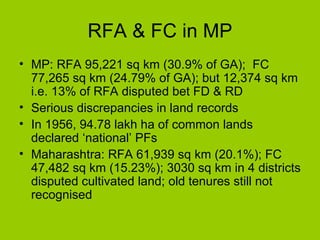
RFA & FC in MP MP: RFA 95,221 sq km  (30.9% of GA);  FC  77,265 sq km  (24.79% of GA); but  12,374 sq km i.e. 13% of  RFA disputed bet FD & RD  Serious discrepancies in land records In 1956, 94.78 lakh ha of common lands declared ‘national’ PFs Maharashtra: RFA 61,939 sq km  (20.1%); FC 47,482  sq km  (15.23%); 3030 sq km in 4 districts disputed cultivated land; old tenures still not recognised

Forest Rights Act_Background: By Madhu Sarin

  • 1.
    Why the TribalForest Rights Bill?
  • 2.
    Recent roots: Spateof brutal evictions MoEF’s May 3, 2002 order Evict all ‘encroachers’ by September 30 Cited Supreme Court’s concerns Bet May 02 & Aug 04, evictions from 1.52 lakh ha. – still continuing At 1 ha/hshld, 1.52 lakh families or 7.5 lakh impoverished people brutally evicted. No evidence of powerful land grabbers being targeted
  • 3.
    Nature of brutalityand illegality Use of elephants to raze huts during drought Beatings, including some killings, children burnt alive in huts In many cases, people had evidence of longstanding occupation Total non-accountability of state landlord in remote areas (ref Endangered Symbiosis)
  • 4.
    Outrage & birthof Campaign Protests and demonstrations in several states. Lobbying with MPs, MLAs, state governments. Letters to PMO by Commissioner, STs. Issue reached Parliament Birth of CSD
  • 5.
    MoEF and GoIresponse Clarification order of 30.10.02 saying all forest dwellers are not ‘encroachers’ February 2004 orders Affidavit in S Ct about ‘historical injustice’ 2 letters to states to stop evictions Stopping evictions in UPA’s CMP CSD’s lobbying with NAC PM’s decision to get bill drafted.
  • 6.
    Roots of theProblem: Construction of ‘National’ ‘Forests’ Need to de-construct supposedly threatened ‘national’ forests. ‘ Recorded forest area’ (RFA) and ‘forest cover’ (FC) used interchangeably although different from each other RFA = RF+PF+lands ‘recorded’ as forests FC = Over 10% tree canopy density RFA & FC do not necessarily overlap
  • 7.
    RFA & FC– SFR 2003 All India RFA: 774,740 km2 (23.57%) RF = 51.6%; PF = 30.8%;17.6% = ‘Unclassed’ forest (not legally notified) All India FC: 678338 km2 (20.64%) Actual forest cover unclear as orchards, tea/coffee/coconut/rubber/agroforestry plantations, sugarcane & cotton fields included in ‘forest cover’ 20% of even RFs have no cover
  • 8.
    Dismal condition ofland records FD and RD records don’t tally Accdng to MoEF, RFA = 77 million ha Accdng to MoA, RFA = 67.87 mha 9.13 mha ‘disputed’ between them with millions of farmers caught in the middle 12.37 lakh ha disputed in MP alone 3 lakh ha disputed in just 4 districts of Maharashtra
  • 9.
    Post-independence statization Between1951- 88, ‘national’ forest estate was enlarged by 26 million ha (from 41 to 67 mha) through sweeping notifications Poorly surveyed tribal areas bore the brunt of this ‘statization’ spree. Sixty per cent of forest cover today concentrated in 187 tribal districts confined to only one-third of the country (a lot in the NE outside ‘state’ forests).
  • 10.
    Post-independence statization Largenumbers of STs disenfranchised of their customary resource rights through blanket notifications without even their knowledge and labelled ‘encroachers’ on their ancestral lands. FCA further trapped several million forest dwellers as illegal occupants of their own lands through freezing land use based on unsound paper records.
  • 11.
    The Situation inOrissa -1 Huge areas under princely states declared ‘deemed’ forests without any ecological surveys or settlement of rights; 40% of RFs never surveyed, predominantly shifting cultivation lands 55% of RFA under RD as it is in villages, Orissa revenue settlement rules require 10% of village area to be reserved as gramya jungle 100s of villages and lands cultivated since generations still unsurveyed but recorded as govt lands
  • 12.
    The Situation inOrissa -2 ST population = 22.2% Schedule V (tribal maj.) area = 44.7% BPL population (all Orissa) = 47% BPL – STs = 73% BPL STs in south Orissa = 87% 6 to 8000 villages protecting forests but no FD recognition
  • 13.
    The Situation inOrissa -3 Scheduled Areas – 74% land declared govt. land (48% forest, 26% revenue). Lands with over 10 degree slope not surveyed because ‘too expensive’ 23% STs landless 40.5% STs own under 2.5 acres In PTG and shifting cultivation areas, almost all land declared govt. property due to non-recognition of communal tenures Corrupt settlement officers recorded even irrigated paddy fields as RFs
  • 14.
    The Situation inOrissa - 4 Officially only 5113 ha pre-80 ‘encroachment’ Only 29 ha ‘regularised’ in 25 years Lakhs displaced without rehabilitation Official records bear little relation with ground reality; double displacement for ‘compensatory afforestation’ In just last 5 years, 1224 ha of illegal forest diversion by mining cos regularised.
  • 15.
    The case ofAndhra Pradesh - 1 RFA 63,821 sq km (23.2%); FC 44,637 sq km (16.15%) 62% of RFA in Tribal areas 60% Sch V Tribal area been declared RF 25.11.1978 GO extended AP Forest Act, “All lands in the SAs containing trees, shrubs and coppice growth shall be forest”. 21,210 kms of forest boundary disputed
  • 16.
    The case ofAndhra Pradesh - 2 Only 9.8% to max 33% area in Scheduled districts under cultivation Fallow shifting cultivation lands declared ‘forests’ and few pattas given for cultivated lands. 77,661 acres of pre-80 cultivated land not regularised but brought under JFM 3.25 lakh ha labeled ‘encroachment’
  • 17.
    Overall situation Poorprocedures and unsound premises for defining and identifying forests: The national forest estate assembled through unsound processes, resulting in serious tenurial and land use conflicts, unclear boundaries, jurisdictional disputes between departments & communities & inappropriate management objectives for non-forest lands declared state ‘forests’ through sweeping notifications.
  • 18.
    Is FD orCommunity Conservation more effective? Nagaland: RFA 52.0%; FC 82%; notified forest –only 6% of FC Mizoram: RFA 79.3%; FC 87.4%; notified forest – 61% of FC but not ‘settled’ Arunanchal Pradesh: RFA 61.5%; FC 81.2%; 60% of RFA is highly disputed ‘unclassed state forest’ In Uttaranchal, VP forests as good as RFs despite no support
  • 19.
    Widespread Community conservationacross country Village communities are not only protecting forests but a whole range of ecosystems and habitats across the country. However, they have no legal rights or authority to do so. In most cases, community initiatives have come up after acute degradation and realisation of it’s impact on lives and livelihoods
  • 20.
    What is thelegal situation? Sep 1990 circulars of MoEF (still unimplemented) FP (1) Review of encroachments on forest land. FP (2) Review of disputed claims over forest land, arising out of (faulty) forest settlement. FP (3) Disputes regarding pattas/leases/grants involving forest land. FP (5) Conversion of forest villages into revenue villages and settlement of other old habitations.
  • 21.
    Impact of theGodavarman case Aggravated crisis in forest and protected areas All regularisation and conversion of forest villages stayed (despite the 1990 orders) Feb 2000 order staying removal of any forest produce from PAs- livelihood crisis for 3.5 to 4 million people Evictions order of May 2002
  • 22.
    Regularization and DiversionSo far 3.66 lakh hectare pre-1980 eligible ‘encroachment’ regularized (out of this regularisation of about 2 lakh ha stayed) All occupants with disputed claims etc equated with ‘encroachers’ despite their being there since generations During same period, 9.55 lakh ha (increasing rapidly) of forest land diverted for mining, industry and hydro projects. Over 85,000 ha diverted in 2005 alone.
  • 23.
    Dissonance between tribaland conservation laws widespread negation of communal tenures & role of forests in tribal livelihoods and culture through rigid application of conservation laws superimposed over tribal areas. Major violation of constitutional provisions for safeguarding tribal cultures, livelihoods and resource, including ecological rights
  • 24.
    Dissonance between tribaland conservation laws By 1990 about 8.5 million tribals (about 12.6% of all tribals) had been displaced by mega projects and Protected Areas. Tribals only 8% of the population but at least 55% of those displaced. 6.4 million displaced adivasis left to fend for themselves without any rehabilitation. What is state accountability to those displaced after 1980 due to non-recognition of their rights?
  • 25.
    CSD initiatives Beenmaking affected communities aware of the 1990 guidelines and their rights Thousands of claims for recognition of rights filed in several states – empowers them to challenge FD eviction threats Provisions of the bill based on their priorities although recognition of several shortcomings 150,000 adivasis participated in rallies demanding early tabling of bill on 15.8.05 1000s participated in dharnas in Delhi and states
  • 26.
    Tribal Forest RightsBill to rectify the historical injustice done to tribal people in the consolidation of state forests “ to recognise and vest the (listed) forest rights and occupation in forest land in forest-dwelling STs who have been residing in such forests for generations but whose rights could not be recorded”
  • 27.
    Tribal Forest RightsBill rights to include “responsibilities and authority for sustainable use, conservation of biodiversity and maintenance of ecological balance To strengthen the conservation regime while ensuring livelihood and food security make STs primary stakeholders in combining conservation with sustainable use.
  • 28.
    Tribal Forest RightsBill 12 listed ‘forest rights’ include: rights to land under individual or communal occupation since pre-80 to customary community lands for usufructs and grazing including the right to protect, regenerate and /or conserve or manage ‘community forest resources’ settlement of disputed claims, pattas/leases and conversion of forest villages to revenue villages (as per the 1990 circulars) rights over MFP, & habitat and habitation rights of PTGs & pre-agricultural communities.
  • 29.
    Tribal Forest RightsBill Max of 2.5 hectares of cultivated land per nuclear family even if they are in occupation of more land (contentious) rights shall be heritable but not alienable not a square inch of land not already under occupation, in the case of land under cultivation or habitation, is proposed to be vested
  • 30.
    Tribal Forest RightsBill Rights to be vested ‘only in those forest-dwelling STs living in the areas in which they are scheduled and in occupation of land since before October 25, 1980’ This more restrictive than 1990 circulars and shall exclude all non-STs, STs who have moved outside their scheduled areas and the millions forcibly displaced after 1980
  • 31.
    Tribal Forest RightsBill Bill totally in line with existing forest and other policies In MoEF’s own words, “it should be understood clearly that the lands occupied by the tribals in forest areas do not have any forest vegetation”. That it’s Feb 04 circulars “do not relate to encroachers, but to remedy a serious historical injustice. It will also significantly lead to better forest conservation”
  • 32.
    Tribal Forest RightsBill In contrast to (typically non-tribal) settlement officers,  the bill vests authority in the gram sabha to initiate action for determining and recording the forest rights that may be vested MoTA shall be the nodal agency for implementation As per MoEF, 13.43 lakh ha are under ‘encroachment’ (1.7% of RFA). Only a part of this will be eligible under the bill.
  • 33.
    RFA & FCin Hills HP: RFA = 66.5%; FC = 25.8%; ie 40.7% GA ‘recorded’ as ‘forest’ has NO FOREST Uttaranchal: RFA = 64.8%; FC = 45.74%; ie 20% GA ‘recorded’ as ‘forest’ has NO FOREST Sikkim; RFA = 82.3%; FC = 45.97%; ie 36.2% GA ‘recorded’ as ‘forest’ has NO FOREST
  • 34.
    RFA & FCin MP MP: RFA 95,221 sq km (30.9% of GA); FC 77,265 sq km (24.79% of GA); but 12,374 sq km i.e. 13% of RFA disputed bet FD & RD Serious discrepancies in land records In 1956, 94.78 lakh ha of common lands declared ‘national’ PFs Maharashtra: RFA 61,939 sq km (20.1%); FC 47,482 sq km (15.23%); 3030 sq km in 4 districts disputed cultivated land; old tenures still not recognised