Introduction to Drug
Analysis
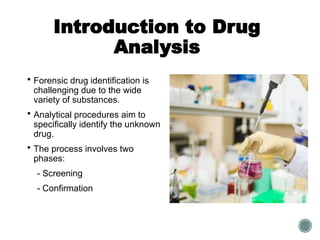
Forensic drug identification is
challenging due to the wide
variety of substances.
Analytical procedures aim to
specifically identify the unknown
drug.
The process involves two
phases:
- Screening
- Confirmation
Screening Phase
• Screeningtest -a test that is nonspecific and preliminary in nature
• Reduces the possibilities from many to a manageable few.
• Often involves color tests.
• Helps eliminate unlikely candidates/evidences.
• Screening tests are non-specific but rapid and practical.
5.
Confirmation Phase
• Pinpointsthe drug’s identity using specific techniques.
• Involves tests like infrared spectrophotometry or mass spectrometry.
• A single test that identifies a substance is known as a confirmation.
• Aims to identify the substance to the exclusion of all others.
• Confirmation tests provide high scientific certainty.
6.
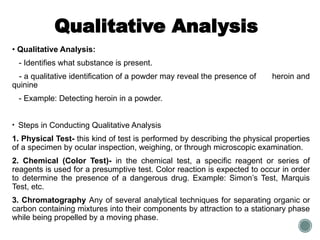
Qualitative Analysis
• QualitativeAnalysis:
- Identifies what substance is present.
- a qualitative identification of a powder may reveal the presence of heroin and
quinine
- Example: Detecting heroin in a powder.
• Steps in Conducting Qualitative Analysis
1. Physical Test- this kind of test is performed by describing the physical properties
of a specimen by ocular inspection, weighing, or through microscopic examination.
2. Chemical (Color Test)- in the chemical test, a specific reagent or series of
reagents is used for a presumptive test. Color reaction is expected to occur in order
to determine the presence of a dangerous drug. Example: Simon’s Test, Marquis
Test, etc.
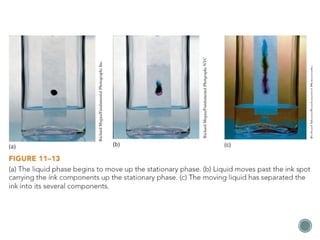
3. Chromatography Any of several analytical techniques for separating organic or
carbon containing mixtures into their components by attraction to a stationary phase
while being propelled by a moving phase.
7.
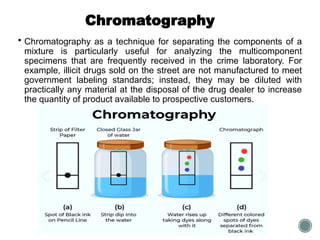
Chromatography
Chromatography asa technique for separating the components of a
mixture is particularly useful for analyzing the multicomponent
specimens that are frequently received in the crime laboratory. For
example, illicit drugs sold on the street are not manufactured to meet
government labeling standards; instead, they may be diluted with
practically any material at the disposal of the drug dealer to increase
the quantity of product available to prospective customers.
8.
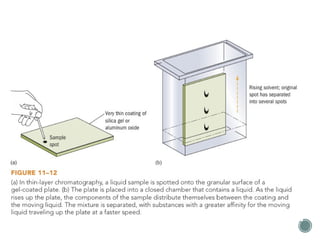
Chromatography (TLC)
•Separates components of a mixture.
• TLC uses:
- Solid stationary phase (e.g., silica gel)
- Liquid moving phase
• Substances visualized under UV or chemical spray.
• Compared with standard for identification.
11.
Quantitative Analysis
- Aquantitative analysis may conclude the presence of 10 percent heroin
and 90 percent quinine.
- Measures how much of the substance is present.
- Spectroscopic techniques like- GC-MS, UV, IR
- Ultraviolet Spectroscopy (UV) • Ultraviolet Spectroscopy (UV) offers
conclusive proof for the positive identification of drugs because other
materials could produce an indistinguishable spectrum.
- Infrared Spectroscopy (IR) • Can specifically identify the substance.
The IR pattern is unique to each compound and can be considered as
being analogous to the fingerprint of compound being examined.
- Gas Chromatography – Mass Spectrometry(GC-MS) • is an
analytical method that combines the features of gas-chromatography
and mass spectrometry to identify substances within a test sample.
12.
Color Tests
Many drugsyield characteristic colors when brought into contact with
specific chemical reagents. Not only do these tests provide a useful
indicator of a drug’s presence, but they are also used by
investigators in the field to examine materials suspected of
containing a drug. However, color tests are useful for screening
purposes only and are never taken as conclusive identification of
unknown drugs. Five primary color test reagents are as follows:
1. Marquis Reagent
2. Dillie-Koppanyi Reagent
3. Duquenois-Levine Reagent
4. Van Urk Reagent
5. Scott Test
13.
Color Tests
1. Marquis(2 percent formaldehyde in sulfuric acid). The reagent
turns purple in the presence of heroin and morphine and most opium
derivatives. Marquis also becomes orange-brown when mixed with
amphetamines and methamphetamines.
2. Dillie-Koppanyi (1 percent cobalt acetate in methanol is first
added to the suspect material, followed by 5 percent isopropylamine
in methanol). This is a valuable screening test for barbiturates, in
whose presence the reagent turns violet-blue in color.
3. Duquenois-Levine (solution A is a mixture of 2 percent vanillin
and 1 percent acetaldehyde in ethyl alcohol; solution B is
concentrated hydrochloric acid; solution C is chloroform). This is a
valuable color test for marijuana, performed by adding solutions A,
B, and C, respectively, to the suspect vegetation. A positive result is
shown by a purple color in the chloroform layer.
4. Van Urk (1 percent solution of p-dimethylaminobenzaldehyde in
10 percent concentrated hydrochloric acid and ethyl alcohol). The
reagent turns blue-purple in the presence of LSD. However, owing to
the extremely small quantities of LSD in illicit preparations, this test
is difficult to conduct under field conditions.
5. Scott Test (solution A is 2 percent cobalt thiocyanate dissolved in
water and glycerine [1:1]; solution B is concentrated hydrochloric
acid; solution C is chloroform). This is a color test for cocaine. A
powder containing cocaine turns solution A blue. Upon addition of B,
the blue color is transformed to a clear pink color. Upon addition of
C, if cocaine is present, the blue color reappears in the chloroform
layer.
A field color test kit for marijuana.
14.
Microcrystalline Tests
• Morespecific than color tests.
• Crystal formation examined under a microscope.
• Example:
- Cocaine with platinum chloride: distinct crystal shapes.
• Quick and do not require separation of substances.

![Color Tests
1. Marquis (2 percent formaldehyde in sulfuric acid). The reagent
turns purple in the presence of heroin and morphine and most opium
derivatives. Marquis also becomes orange-brown when mixed with
amphetamines and methamphetamines.
2. Dillie-Koppanyi (1 percent cobalt acetate in methanol is first
added to the suspect material, followed by 5 percent isopropylamine
in methanol). This is a valuable screening test for barbiturates, in
whose presence the reagent turns violet-blue in color.
3. Duquenois-Levine (solution A is a mixture of 2 percent vanillin
and 1 percent acetaldehyde in ethyl alcohol; solution B is
concentrated hydrochloric acid; solution C is chloroform). This is a
valuable color test for marijuana, performed by adding solutions A,
B, and C, respectively, to the suspect vegetation. A positive result is
shown by a purple color in the chloroform layer.
4. Van Urk (1 percent solution of p-dimethylaminobenzaldehyde in
10 percent concentrated hydrochloric acid and ethyl alcohol). The
reagent turns blue-purple in the presence of LSD. However, owing to
the extremely small quantities of LSD in illicit preparations, this test
is difficult to conduct under field conditions.
5. Scott Test (solution A is 2 percent cobalt thiocyanate dissolved in
water and glycerine [1:1]; solution B is concentrated hydrochloric
acid; solution C is chloroform). This is a color test for cocaine. A
powder containing cocaine turns solution A blue. Upon addition of B,
the blue color is transformed to a clear pink color. Upon addition of
C, if cocaine is present, the blue color reappears in the chloroform
layer.
A field color test kit for marijuana.](https://image.slidesharecdn.com/forensicdruganalysispresentation-260118201249-217ded4f/85/Forensic_Drug_Analysis_Presentation-pptx-13-320.jpg)


![谷歌留痕技术 [ 𝙩𝙤𝙥 𝟮𝟯𝟯. 𝙘 𝙤𝙢 ]](https://cdn.slidesharecdn.com/ss_thumbnails/top233-260130174328-3833018c-thumbnail.jpg?width=640&height=640&fit=bounds)