David S. Bieri, Head of Business Development
BIS-AMF Seminar on
Foreign Exchange Reserve Management
6 June 2004, Abu Dhabi
Reserve Level Optimisation and its
Implications for Reserve Management
 What are foreign exchange reserves?
 Why are such reserves needed?
 Who manages those reserves? How are they managed?
 How much reserves is sufficient? Is there an optimal level?
 What impact do foreign exchange reserves have on the
global financial system?
 What is behind the renewed interest in reserve
management?
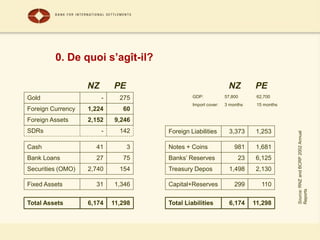
0. De quoi s’agît-il?
ASSETS LIABILITIES
Gold
Foreign Currency
SDRs
Net Foreign Assets
Cash
Bank Loans
Securities (OMO)
Fixed Assets
InternationalDomestic
Notes + Coins
Banks’ Reserves
Treasury Deposits
Capital + Reserves
Domestic
Foreign Liabilities
0. De quoi s’agît-il?
Gold
Foreign Currency
SDRs
Foreign Assets
Cash
Bank Loans
Securities (OMO)
Fixed Assets
Notes + Coins
Banks’ Reserves
Treasury Depos
Capital+Reserves
Foreign Liabilities
1,224
-
2,152
41
27
2,740
31
275
60
142
9,246
3
75
154
1,346
981
23
1,498
299
1,681
6,125
2,130
110
3,373 1,253
NZ PE NZ PE
Source:RNZandBCRP2002Annual
Reports
-
Total Assets Total Liabilities6,174 11,298 6,174 11,298
GDP: 57,800 62,700
Import cover: 3 months 15 months
Overview
1. Recent trends in reserve management
2. Motives for holding reserves
3. The optimal level and composition of reserves
4. Conclusions and outlook
1. Recent Trends
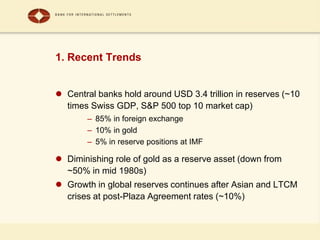
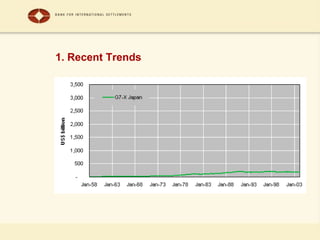
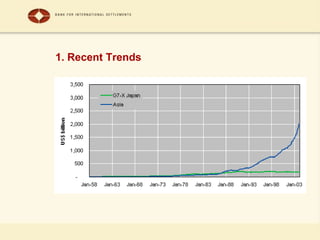
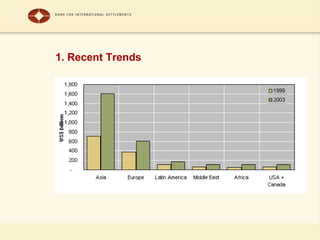
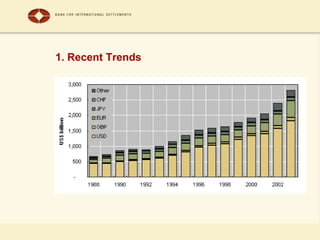
 Central banks hold around USD 3.4 trillion in reserves (~10
times Swiss GDP, S&P 500 top 10 market cap)
– 85% in foreign exchange
– 10% in gold
– 5% in reserve positions at IMF
 Diminishing role of gold as a reserve asset (down from
~50% in mid 1980s)
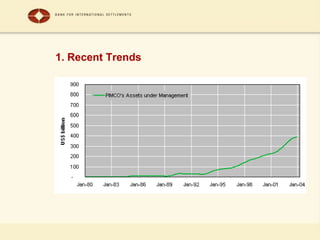
 Growth in global reserves continues after Asian and LTCM
crises at post-Plaza Agreement rates (~10%)
1. Recent Trends
1. Recent Trends
1. Recent Trends
1. Recent Trends
1. Recent Trends
1. Recent Trends
 Post-Bretton Woods growth as result of managed float
 Increase in cross-border capital flows, with trade volumes
lagging despite ‘globalisation’
 Floating exchange rates no longer a panacea to absorb
exogenous shocks (eg. Asian crisis, declining US$)
 changing nature of purpose of reserves
 Emergence of ‘confidence reserves’ rather than 3
traditional functions (transactions need, intervention and
wealth diversification)
1. Recent Trends
1. Recent Trends
1. Recent Trends
1. Recent Trends
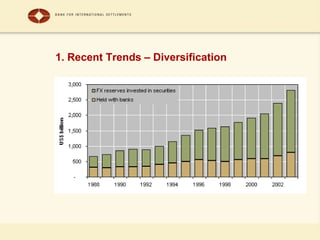
 Currency composition with persisting US$ bias (~65%)
 USD dominance cannot be explained by international trade
flows or risk-adjusted returns
– SDR weights reflect trade flows of goods and services
– USD 46%, EUR 25%, JPY 17% and GBP 12%
 Securities market liquidity as main explanatory variable for
USD bias
 Growth potential for EUR (ECB policy, increasing liquidity,
diversification benefits)
1. Recent Trends – Diversification
2. Motives for Holding Reserves - Demand
 Transactions Needs
– Flexibility for government to manage currency composition of
liabilities
– Improve country’s status in international financial environment
(easing access to capital markets)
 Interventions (precautionary) Needs
– Short-term (sterilized) FX rate management vs. medium-term
stabilization policy
– Strategic reserve of liquidity and crisis prevention
 Wealth Diversification
– Increasing scrutiny
2. Motives for Holding Reserves
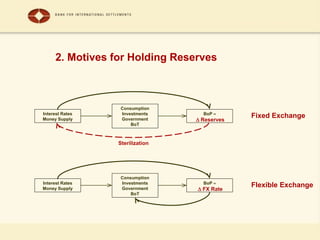
 Nature of exchange rate regime and intervention policy
 Relative openness/flexibility of economy
– Constraints on trade and capital flows
– Vulnerability to external shocks (geographic and economic
diversification)
 Principles of monetary policy
 Level of development of domestic capital market
 External exposure of economy
– Size of international financial transactions
– Volatility of export receipts
 Opportunity cost of holding reserves
2. Motives for Holding Reserves
Interest Rates
Money Supply
Consumption
Investments
Government
BoT
BoP =
D Reserves
Sterilization
Interest Rates
Money Supply
Consumption
Investments
Government
BoT
BoP =
D FX Rate
Fixed Exchange
Flexible Exchange
2. Factors Determining Size of Reserves
 Monetary policy anchor
 Exchange rate regime
 Volatility of export receipts
 Size of international financial transactions
 Relative openness of economy (vulnerability to external
shocks)
3. Optimal Level of Reserves
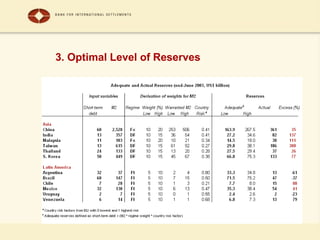
 Traditional approach focuses on macroeconomic
adjustment costs vs. opportunity cost
– Trade related measures of adequacy
– Buffer stock models (e.g. Frenkel and Jovanovic, 1982)
– Shift of focus from current to capital account
 Recent financial crises (LatAm, Asia) exacerbated by
inadequate reserves …? (e.g. Feldstein, 1999):
– Capitals flows vs. trade financing
– Lack of liquidity of foreign assets vs. liabilities
– Runs on domestic banks
– Contagion
3. Optimal Level of Reserves
 Emergence of new ‘post Asia crisis’ adequacy measures
– ‘Guidotti rule’ (1999)
– Average maturity of ext. debt + ‘Liquidity-at-risk’ (Greenspan)
 Minimum benchmark of reserve adequacy for Emerging
Market Countries (e.g. De Beaufort et al., 2001) contains 3
familiar elements
– Import cover
– Short-term external debt
– Broad money supply (proxy for internal demand of reserves)
3. Optimal Level of Reserves
3. Optimal Composition of Reserves
 Lack of unified framework leads to portfolio ‘tranching’
approach
– Liquidity and buffer portfolios
– Investment portfolio (wealth maximization)
 Limitations of mean-variance approach
– Institutional arrangement may preclude optimization of NET
foreign assets
– Definition of reference basket
– Susceptibility of Markowitzian optimization to inputs and numerical
techniques (time dependency + measurement errors  corner
solutions  portfolio resampling + constrained weights)
– Non-diversifiable risks of fixed-income portfolios (highly correlated
risk factors)
4. Conclusions and Outlook
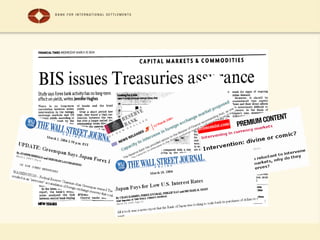
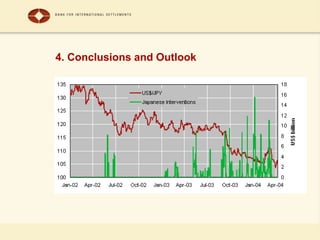
 FX intervention back ‘en-vogue’ in low-inflation, low-interest
rate environment
 Large scale intervention by Japanese MoF
– Cumulative amount US$ 375bn since mid-2002
– Approx. US$ 145bn during Q1 2004
 RBNZ announces intervention as official policy tool for
“insurance purposes”
– “[…] an additional instrument to achieve Policy Target
Agreement obligations”
– “[…] restore order to dysfunction in the foreign exchange
market”
 Anecdotal evidence of ECB and SNB intervention activity
4. Conclusions and Outlook
 Are central banks holding adequate reserves?
 Are reasons for holding reserves additive?
 Do flexible exchange rates undermine any of these
reasons?
 Can there be too much of a good thing? Are there side
effects from holding excessive reserves?
– Le mieux est l’ennemi du bien
– Moral hazard (firm’s liquidity management, sustainability of
government policies)
– Appropriateness of central bank as nation’s “wealth
manager”
4. Conclusions and Outlook
“The kind of situation which economists are prone to
consider as requiring corrective governmental action
is, in fact, often the result of governmental action.”
R. Coase (1960)
References
• Aizenman, Joshua and Nancy Marion. “Foreign Exchange Reserves in East Asia: Why the High Demand?”, FRBSF Economic Letter, No.
2003-11, Federal Reserve Bank of San Francisco, April 2003.
• Bank of Israel. “Investment of the Foreign Exchange Reserves and Developments in the Foreign Currency Market”, Foreign Currency
Department, Annual Report 2002.
• Caballero, Ricardo and Arvind Krishnamurthy. “International Liquidity Illusion: On the Risks of Sterilization”, Working Paper, No. 8141, National
Bureau of Economic Research, February 2001.
• De Beaufort Wijnholds, J. Onno and Arend Kapteyn. “Reserve Adequacy in Emerging Market Economies”, Working Paper, No. 01/143,
International Monetary Fund, September 2001.
• Feldstein, Martin. “Self-Protection for Emerging Market Economies”, Working Paper, No. 6907, National Bureau of Economic Research,
January 1999.
• Frenkel, Jacob and Boyan Jovanovic. “Optimal International Reserves: A Stochastic Framework”, The Economic Journal, 91:507-514, June
1981.
• Greenspan, Alan. “Currency Reserves and Debt”, Speech before World Bank Conference on Recent Trends in Reserve Management, April
1999.
• Hoffman, David. “Adequacy of Foreign Exchange Reserves: Evidence from Panel Time Series Modeling”, Working Paper, Bank of Israel,
January 2003.
• Horii, Akinari. “The Evolution of Reserve Currency Diversification”, BIS Economic Paper, December 1986.
• Humpage, Owen F. “On the Rotation of the Earth, Drunken Sailor, and Exchange Rate Policy”, Federal Reserve Bank of Cleveland Economic
Commentary, February 2004.
• IMF. “Issues in Reserve Adequacy and Management”, Monetary and Exchange Affairs Department and Policy Development and Review
Department, October 2001.
• IMF. “Guidelines for Foreign Exchange Reserves Management: Accompanying Document”, Monetary and Exchange Affairs Department,
March 2003.
• Jensen, Michael and William Meckling. “Theory of the Firm: Managerial Behaviour, Agency Costs, and Ownership Structure”, Journal of
Financial Economics, 3(5):305-360, 1976.
• Kletzer, Kenneth and Mark M. Spiegel. “Sterilization Cost and Exchange Rate Targeting”, Working Paper, Federal Reserve Bank of San
Francisco, April 2000.
• Miller, Merton and Daniel Orr. “A Model of the Demand for Money by Firms”, Quarterly Journal of Economics, 80(3):413-435, August 1966.
• Scott, Roger. “The Management of Foreign Exchange Reserves”, BIS Economic Paper, No. 38, July 1993.

Foreign Exchange Reserve Level Optimisation

  • 1.
    David S. Bieri,Head of Business Development BIS-AMF Seminar on Foreign Exchange Reserve Management 6 June 2004, Abu Dhabi Reserve Level Optimisation and its Implications for Reserve Management
  • 3.
     What areforeign exchange reserves?  Why are such reserves needed?  Who manages those reserves? How are they managed?  How much reserves is sufficient? Is there an optimal level?  What impact do foreign exchange reserves have on the global financial system?  What is behind the renewed interest in reserve management?
  • 4.
    0. De quois’agît-il? ASSETS LIABILITIES Gold Foreign Currency SDRs Net Foreign Assets Cash Bank Loans Securities (OMO) Fixed Assets InternationalDomestic Notes + Coins Banks’ Reserves Treasury Deposits Capital + Reserves Domestic Foreign Liabilities
  • 5.
    0. De quois’agît-il? Gold Foreign Currency SDRs Foreign Assets Cash Bank Loans Securities (OMO) Fixed Assets Notes + Coins Banks’ Reserves Treasury Depos Capital+Reserves Foreign Liabilities 1,224 - 2,152 41 27 2,740 31 275 60 142 9,246 3 75 154 1,346 981 23 1,498 299 1,681 6,125 2,130 110 3,373 1,253 NZ PE NZ PE Source:RNZandBCRP2002Annual Reports - Total Assets Total Liabilities6,174 11,298 6,174 11,298 GDP: 57,800 62,700 Import cover: 3 months 15 months
  • 6.
    Overview 1. Recent trendsin reserve management 2. Motives for holding reserves 3. The optimal level and composition of reserves 4. Conclusions and outlook
  • 7.
    1. Recent Trends Central banks hold around USD 3.4 trillion in reserves (~10 times Swiss GDP, S&P 500 top 10 market cap) – 85% in foreign exchange – 10% in gold – 5% in reserve positions at IMF  Diminishing role of gold as a reserve asset (down from ~50% in mid 1980s)  Growth in global reserves continues after Asian and LTCM crises at post-Plaza Agreement rates (~10%)
  • 8.
  • 9.
  • 10.
  • 11.
  • 12.
  • 13.
    1. Recent Trends Post-Bretton Woods growth as result of managed float  Increase in cross-border capital flows, with trade volumes lagging despite ‘globalisation’  Floating exchange rates no longer a panacea to absorb exogenous shocks (eg. Asian crisis, declining US$)  changing nature of purpose of reserves  Emergence of ‘confidence reserves’ rather than 3 traditional functions (transactions need, intervention and wealth diversification)
  • 14.
  • 15.
  • 16.
  • 17.
    1. Recent Trends Currency composition with persisting US$ bias (~65%)  USD dominance cannot be explained by international trade flows or risk-adjusted returns – SDR weights reflect trade flows of goods and services – USD 46%, EUR 25%, JPY 17% and GBP 12%  Securities market liquidity as main explanatory variable for USD bias  Growth potential for EUR (ECB policy, increasing liquidity, diversification benefits)
  • 18.
    1. Recent Trends– Diversification
  • 19.
    2. Motives forHolding Reserves - Demand  Transactions Needs – Flexibility for government to manage currency composition of liabilities – Improve country’s status in international financial environment (easing access to capital markets)  Interventions (precautionary) Needs – Short-term (sterilized) FX rate management vs. medium-term stabilization policy – Strategic reserve of liquidity and crisis prevention  Wealth Diversification – Increasing scrutiny
  • 20.
    2. Motives forHolding Reserves
  • 21.
    2. Motives forHolding Reserves  Nature of exchange rate regime and intervention policy  Relative openness/flexibility of economy – Constraints on trade and capital flows – Vulnerability to external shocks (geographic and economic diversification)  Principles of monetary policy  Level of development of domestic capital market  External exposure of economy – Size of international financial transactions – Volatility of export receipts  Opportunity cost of holding reserves
  • 22.
    2. Motives forHolding Reserves Interest Rates Money Supply Consumption Investments Government BoT BoP = D Reserves Sterilization Interest Rates Money Supply Consumption Investments Government BoT BoP = D FX Rate Fixed Exchange Flexible Exchange
  • 23.
    2. Factors DeterminingSize of Reserves  Monetary policy anchor  Exchange rate regime  Volatility of export receipts  Size of international financial transactions  Relative openness of economy (vulnerability to external shocks)
  • 24.
    3. Optimal Levelof Reserves  Traditional approach focuses on macroeconomic adjustment costs vs. opportunity cost – Trade related measures of adequacy – Buffer stock models (e.g. Frenkel and Jovanovic, 1982) – Shift of focus from current to capital account  Recent financial crises (LatAm, Asia) exacerbated by inadequate reserves …? (e.g. Feldstein, 1999): – Capitals flows vs. trade financing – Lack of liquidity of foreign assets vs. liabilities – Runs on domestic banks – Contagion
  • 25.
    3. Optimal Levelof Reserves  Emergence of new ‘post Asia crisis’ adequacy measures – ‘Guidotti rule’ (1999) – Average maturity of ext. debt + ‘Liquidity-at-risk’ (Greenspan)  Minimum benchmark of reserve adequacy for Emerging Market Countries (e.g. De Beaufort et al., 2001) contains 3 familiar elements – Import cover – Short-term external debt – Broad money supply (proxy for internal demand of reserves)
  • 26.
    3. Optimal Levelof Reserves
  • 27.
    3. Optimal Levelof Reserves
  • 28.
    3. Optimal Levelof Reserves
  • 29.
    3. Optimal Levelof Reserves
  • 30.
    3. Optimal Levelof Reserves
  • 31.
    3. Optimal Compositionof Reserves  Lack of unified framework leads to portfolio ‘tranching’ approach – Liquidity and buffer portfolios – Investment portfolio (wealth maximization)  Limitations of mean-variance approach – Institutional arrangement may preclude optimization of NET foreign assets – Definition of reference basket – Susceptibility of Markowitzian optimization to inputs and numerical techniques (time dependency + measurement errors  corner solutions  portfolio resampling + constrained weights) – Non-diversifiable risks of fixed-income portfolios (highly correlated risk factors)
  • 32.
    4. Conclusions andOutlook  FX intervention back ‘en-vogue’ in low-inflation, low-interest rate environment  Large scale intervention by Japanese MoF – Cumulative amount US$ 375bn since mid-2002 – Approx. US$ 145bn during Q1 2004  RBNZ announces intervention as official policy tool for “insurance purposes” – “[…] an additional instrument to achieve Policy Target Agreement obligations” – “[…] restore order to dysfunction in the foreign exchange market”  Anecdotal evidence of ECB and SNB intervention activity
  • 33.
  • 34.
  • 35.
    4. Conclusions andOutlook  Are central banks holding adequate reserves?  Are reasons for holding reserves additive?  Do flexible exchange rates undermine any of these reasons?  Can there be too much of a good thing? Are there side effects from holding excessive reserves? – Le mieux est l’ennemi du bien – Moral hazard (firm’s liquidity management, sustainability of government policies) – Appropriateness of central bank as nation’s “wealth manager”
  • 36.
    4. Conclusions andOutlook “The kind of situation which economists are prone to consider as requiring corrective governmental action is, in fact, often the result of governmental action.” R. Coase (1960)
  • 37.
    References • Aizenman, Joshuaand Nancy Marion. “Foreign Exchange Reserves in East Asia: Why the High Demand?”, FRBSF Economic Letter, No. 2003-11, Federal Reserve Bank of San Francisco, April 2003. • Bank of Israel. “Investment of the Foreign Exchange Reserves and Developments in the Foreign Currency Market”, Foreign Currency Department, Annual Report 2002. • Caballero, Ricardo and Arvind Krishnamurthy. “International Liquidity Illusion: On the Risks of Sterilization”, Working Paper, No. 8141, National Bureau of Economic Research, February 2001. • De Beaufort Wijnholds, J. Onno and Arend Kapteyn. “Reserve Adequacy in Emerging Market Economies”, Working Paper, No. 01/143, International Monetary Fund, September 2001. • Feldstein, Martin. “Self-Protection for Emerging Market Economies”, Working Paper, No. 6907, National Bureau of Economic Research, January 1999. • Frenkel, Jacob and Boyan Jovanovic. “Optimal International Reserves: A Stochastic Framework”, The Economic Journal, 91:507-514, June 1981. • Greenspan, Alan. “Currency Reserves and Debt”, Speech before World Bank Conference on Recent Trends in Reserve Management, April 1999. • Hoffman, David. “Adequacy of Foreign Exchange Reserves: Evidence from Panel Time Series Modeling”, Working Paper, Bank of Israel, January 2003. • Horii, Akinari. “The Evolution of Reserve Currency Diversification”, BIS Economic Paper, December 1986. • Humpage, Owen F. “On the Rotation of the Earth, Drunken Sailor, and Exchange Rate Policy”, Federal Reserve Bank of Cleveland Economic Commentary, February 2004. • IMF. “Issues in Reserve Adequacy and Management”, Monetary and Exchange Affairs Department and Policy Development and Review Department, October 2001. • IMF. “Guidelines for Foreign Exchange Reserves Management: Accompanying Document”, Monetary and Exchange Affairs Department, March 2003. • Jensen, Michael and William Meckling. “Theory of the Firm: Managerial Behaviour, Agency Costs, and Ownership Structure”, Journal of Financial Economics, 3(5):305-360, 1976. • Kletzer, Kenneth and Mark M. Spiegel. “Sterilization Cost and Exchange Rate Targeting”, Working Paper, Federal Reserve Bank of San Francisco, April 2000. • Miller, Merton and Daniel Orr. “A Model of the Demand for Money by Firms”, Quarterly Journal of Economics, 80(3):413-435, August 1966. • Scott, Roger. “The Management of Foreign Exchange Reserves”, BIS Economic Paper, No. 38, July 1993.