FORECASTING & DEMAND
PLANNING
Learning Objectives
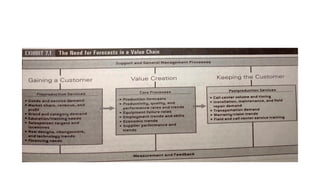
• Describe the importance of forecasting to the value chain
• Explain basic concepts of forecasting and time series
• Explain how to apply simple moving average and exponential
smoothing models
• Describe how to apply regression as a forecasting approach
• Explain the role of judgment in forecasting
• Describe how statistical and judgmental forecasting
techniques are applied in practice
What is forecasting
Forecasting is the process of projecting the
values of one or more variables into the
future
Purpose of Forecasting
•It drive analyses and decisions related to operations
•Key component in many types of integrated
operating systems such as supply chain
management, customer relationship management
(CRM) and revenue management systems
•Result in positive inventory and staffing decisions,
adequate customer service and lack of complaints
BASIC CONCEPTS IN FORECASTING
•Forecast planning horizon
The planning horizon is the length of time on which a
forecast is based.
Long-range forecasts cover a planning horizon of 1 to
10 years and are necessary to plan for the expansion of
facilities and to determine future needs for land, labor
and equipment
BASIC CONCEPTS IN FORECASTING
Intermediate-range forecasts over a 3 to 12 month period are needed
to plan workforce levels, allocate budgets among divisions, schedule
jobs and resources and establish purchasing plans.
Short range forecasts focus on the planning horizon of p to three
months and are used by operations managers to plan production
schedules and assign workers to jobs, determine short-term capacity
requirements ad aid shipping departments in planning transportation
needs and establishing delivery schedules
BASIC CONCEPTS IN FORECASTING
•The time bucket is the unit of measure for the time
period used in a forecast. A time bucket might be a
year, quarter, month, week, hour or even a minute.
BASIC CONCEPTS IN FORECASTING
•Data Patterns in Time Series
Time series is a set of observations measured at
successive points in time or over successive periods of
time. It provides the data for understanding how the
variable that we wish to forecast has changed
historically.
BASIC CONCEPTS IN FORECASTING
Five Characteristics of Time Series
1. Trend . It is the underlying pattern of growth or decline in a time
series.
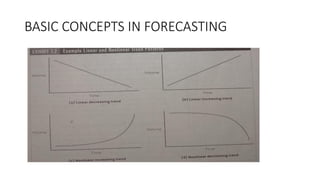
Trend Patterns
• Linear increasing and decreasing trends
• Nonlinear
BASIC CONCEPTS IN FORECASTING
Five Characteristics of Time Series
2. Seasonal patterns are characterized by repeatable
period of ups and downs over short periods at time.
3. Cyclical patterns are regular patterns in a data series
that take place over long periods of time.
4. Random Variation is the unexplained deviation of a
time series from a predictable pattern such as a trend
seasonal or cyclical pattern.
BASIC CONCEPTS IN FORECASTING
Five Characteristics of Time Series
5. Irregular Variation is a one-time variation that is
explainable
•Forecast Errors and Accuracy
All forecast s are subject to error and understanding
the nature and size of errors is important in making
good decisions.
BASIC CONCEPTS IN FORECASTING
•Forecast error is the difference between the observed
value of the time series and the forecast or AT – FT.
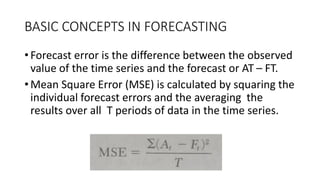
•Mean Square Error (MSE) is calculated by squaring the
individual forecast errors and the averaging the
results over all T periods of data in the time series.
BASIC CONCEPTS IN FORECASTING
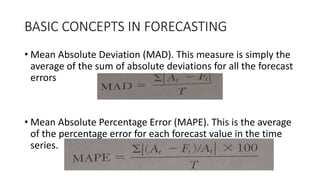
• Mean Absolute Deviation (MAD). This measure is simply the
average of the sum of absolute deviations for all the forecast
errors
• Mean Absolute Percentage Error (MAPE). This is the average
of the percentage error for each forecast value in the time
series.
Statistical Forecasting Models
•Statistical forecasting is based on the assumption that
the future will be an extrapolation of the past.
•SIMPLE MOVING AVERAGE.
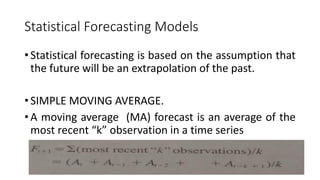
•A moving average (MA) forecast is an average of the
most recent “k” observation in a time series
FORECASTING AND MARKET DEMAND-PLANNING.pdf

FORECASTING AND MARKET DEMAND-PLANNING.pdf

  • 1.
  • 2.
    Learning Objectives • Describethe importance of forecasting to the value chain • Explain basic concepts of forecasting and time series • Explain how to apply simple moving average and exponential smoothing models • Describe how to apply regression as a forecasting approach • Explain the role of judgment in forecasting • Describe how statistical and judgmental forecasting techniques are applied in practice
  • 3.
    What is forecasting Forecastingis the process of projecting the values of one or more variables into the future
  • 4.
    Purpose of Forecasting •Itdrive analyses and decisions related to operations •Key component in many types of integrated operating systems such as supply chain management, customer relationship management (CRM) and revenue management systems •Result in positive inventory and staffing decisions, adequate customer service and lack of complaints
  • 6.
    BASIC CONCEPTS INFORECASTING •Forecast planning horizon The planning horizon is the length of time on which a forecast is based. Long-range forecasts cover a planning horizon of 1 to 10 years and are necessary to plan for the expansion of facilities and to determine future needs for land, labor and equipment
  • 7.
    BASIC CONCEPTS INFORECASTING Intermediate-range forecasts over a 3 to 12 month period are needed to plan workforce levels, allocate budgets among divisions, schedule jobs and resources and establish purchasing plans. Short range forecasts focus on the planning horizon of p to three months and are used by operations managers to plan production schedules and assign workers to jobs, determine short-term capacity requirements ad aid shipping departments in planning transportation needs and establishing delivery schedules
  • 8.
    BASIC CONCEPTS INFORECASTING •The time bucket is the unit of measure for the time period used in a forecast. A time bucket might be a year, quarter, month, week, hour or even a minute.
  • 9.
    BASIC CONCEPTS INFORECASTING •Data Patterns in Time Series Time series is a set of observations measured at successive points in time or over successive periods of time. It provides the data for understanding how the variable that we wish to forecast has changed historically.
  • 10.
    BASIC CONCEPTS INFORECASTING Five Characteristics of Time Series 1. Trend . It is the underlying pattern of growth or decline in a time series. Trend Patterns • Linear increasing and decreasing trends • Nonlinear
  • 11.
    BASIC CONCEPTS INFORECASTING
  • 12.
    BASIC CONCEPTS INFORECASTING Five Characteristics of Time Series 2. Seasonal patterns are characterized by repeatable period of ups and downs over short periods at time. 3. Cyclical patterns are regular patterns in a data series that take place over long periods of time. 4. Random Variation is the unexplained deviation of a time series from a predictable pattern such as a trend seasonal or cyclical pattern.
  • 13.
    BASIC CONCEPTS INFORECASTING Five Characteristics of Time Series 5. Irregular Variation is a one-time variation that is explainable •Forecast Errors and Accuracy All forecast s are subject to error and understanding the nature and size of errors is important in making good decisions.
  • 14.
    BASIC CONCEPTS INFORECASTING •Forecast error is the difference between the observed value of the time series and the forecast or AT – FT. •Mean Square Error (MSE) is calculated by squaring the individual forecast errors and the averaging the results over all T periods of data in the time series.
  • 15.
    BASIC CONCEPTS INFORECASTING • Mean Absolute Deviation (MAD). This measure is simply the average of the sum of absolute deviations for all the forecast errors • Mean Absolute Percentage Error (MAPE). This is the average of the percentage error for each forecast value in the time series.
  • 16.
    Statistical Forecasting Models •Statisticalforecasting is based on the assumption that the future will be an extrapolation of the past. •SIMPLE MOVING AVERAGE. •A moving average (MA) forecast is an average of the most recent “k” observation in a time series